11 November 2013

Jardin des Félibres, Sceaux


'ICI
REPOSE LE CORPS
DE FLORIAN
HOMME DE LETTRES'

Jean-Pierre Claris de Florian (1755–94) was a playwright, novelist, poet and fabulist born in Gard, Occitan, and who died here in Sceaux, about seven miles south of Paris. Voltaire was his great-uncle by marriage.

He is buried close to Saint Jean- Baptiste church, which is at the side of the Jardin des Félibres (Provençal poets) in Sceaux, where every year, at the end of spring, the Fêtes félibréennes take place.

The Félibrige is an association founded by Frédéric Mistral and six other Félibres – Joseph Roumanille, Paul Giéra, Théodore Aubanel, Alphonse Tavan, Anselme Mathieu and Jean-Gabriel Brunet. Its aim is to safeguard and promote the language and culture of the langue d'oc. The seat of the Félibrige is the Museon Arlaten (Provençal for 'Musée d'Arles'), dedicated to the ethnography of the area, and it was established in 1896 by Frédéric Mistral and later installed in the hôtel de Laval-Castellane after he won the Nobel Prize for Literature in 1904.

'LE VINGT CINQ JUIN MIL NEUF CENT CINQUANTE
À L'OCCASION DU CINQUANTENAIRE
DE LA FÉDÉRATION RÉGIONALISTE FRANÇAISE
FONDÉE PAR J. CHARLES BRUN
LA VILLE DE SCEAUX
A ÉTÉ SOLENNELLEMENT RECONNUE ET PROCLAMÉE
CITÉ FÉLIBRÉENNE'

In the garden itself, there are busts of ten Félibres.


'MAURICE FAURE
1850 – 1919
FONDATEUR DE LA CIGALE
ET DE LA SOCIÉTÉ DES FÉLIBRES
À PARIS
FONDATEUR À SCEAUX
DES FÊTES DE FLORIAN
MINISTRE DE L'INSTRUCTION PUBLIQUE'


FRÉDÉRIC
MISTRAL
––––––––
LA SOCIÉTÉ
DES FÉLIBRES
DE
PARIS'


'THÉODOR AUBANEL
1828 – 1886
–––––––––––––––
AU GRAND POÈTE
PROVENÇAL
L'UN DES FONDATEURS
DES FÊTES FÉLIBRÉENNES
DE
SCEAUX'


PAUL MARIÉTON
CHANCELIER DV FÉLIBRIGE
CE BVSTE A ÉTÉ ÉLEVÉ
PAR LES SOINS
DE SES AMIS
ET DV
PROVENÇAL DE PARIS'


'CLOVIS HUGUES
1851 – 1907
––––––––––
CE MONUMENT A ÉTÉ ÉLEVÉ
PAR SOUSCRIPTION PUBLIQUE
SUR L'INITIATIVE
DU PROVENÇAL DE PARIS
ET AVEC LE CONCOURS
DES FÉLIBRES CIGALIERS
ET MEMBRES DES
ASSOCIATIONS MÉRIDIONALES

28 MAI 1911'


'DELUNS
MONTAUD
1845 – 1907'


'Joseph
LOUBET

Montpellier
1874
Sceaux
1951

Majoral
du Félibrige

Refondateur
du Félibrige
à Paris'


'FÉLIBRE
SEXTIVS MICHEL
MAIRE DE PARIS
1825 – 1906
SES ADMIRATEURS
ET
SES AMIS'


'JEAN
CHARLES-BRUN
1870–1946'


'AU
FÉLIBRE
ET
CIGALIER
PAUL ARÈNE
1846* – 1896'

*Most other sources suggest 1843.

And across the road from this lovely garden is a café called Les Félibres.

The website of Sceaux municipal library has a little more information on each of the poets mentioned:
–––––––––––––––––––––––––––––––––––
Les Félibres

René Louis Lafforgue: Cimetière de Cachan #3

René Louis Lafforgue (1925–67)* was of Basque origin and exiled in France. He took part in the French Resistance with his brother Sylvain (1928–44), who died fighting for freedom. He became a very popular singer-songwriter but died in a car crash on the road from Albi to Castres.

Lafforgue appears as one of Georges Perec's memories in Je me souviens (1978), a book inspired by Joe Brainard's I Remember (1970). Of Perec's 480 memories, Lafforgue is number 467.

*I took these dates from those on the grave, although his given birthdate doesn't tally with other sources.


Below are links to three of Lafforgue's songs, the first one being a performance with Georges Brassens on guitar, the second two being recordings of two of his most popular songs:

–––––––––––––––––––––––––––––––––––
René Louis Lafforgue: 'Le Poseur de rails'
René Louis Lafforgue: 'Julie la Rousse'

René Louis Lafforgue: 'L'Écluse'

André Desguine: Cimetière de Cachan #2

André Desguine (1902–81) left his private library of 55,000 books to the département of Hauts-de-Seine. He had collected them over the years from bouqinistes on the banks of the Seine, bookshops, auctions, and from other countries, particularly Italy. His wish was to avoid dispersal of them, and for the general public to share this treasure.

Desguine's special interest was in the 16th century, and he edited Ronsard's Les Bacchanales ou le Folastrissime voyage d'Hercueil près Paris, contributed to the journal Gallia and the Bulletin de l'Association Guillaume Budé. The Bibliothèque André-Desguine was founded in Nanterre in 1983 and has been open to the public since 1988.

10 November 2013

Henry Poulaille: Cimetière de Cachan #1

The rather idyllic setting of the cemetery at Cachan with the grave of the prominent working-class writer Henry Poulaille in the foreground and the towering aqueduct in the background.

Poulaille was the son of an anarchist carpenter, and an anarchist himself: France has known many working-class anarchist novelists, although the only two British ones I know of (apart from more recent ones such as James Kelman and Niall Griffiths) are Lewis Grassic Gibbon and the considerably more obscure Lionel Britton.

Not many people seem to have visited Poulaille's grave, and it is in a rather forlorn state.

I had to hold back the ivy to read the inscription:
 
'HENRY POULAILLE
1896 – 1980
ÉCRIVAIN'
 
Poulaille's most well known novel is Pain de soldat: 1914–1917 (1937), a partly autobiographical account of his experiences of war.

Jean Teulé: Le Magasin des suicides (2007)

The subject of Le Magasin des suicides is just that: a suicide shop, a place where all manner of items – nooses with ropes of different lengths, sharpened sabres and ceremonial kimonos for sappuka (hara-kiri being considered a vulgar expression), heavy weights for drowning or defenestration, poisoned sweets or liquid concoctions, etc. The shop's motto is 'Vous avez raté votre vie? Avec nous, vous réussirez votre mort!' ('You've failed in life? With us, you'll succeed in death!').

The book is set in France in the city of Religions Oubliées ('Forgotten Religions') at some vague future time when the currency is the euro-yen and ecological disasters are commonplace occurrences. Depression is rife and suicide a normal fact of life, given government approval with few provisos. Nearby commercial outlets are named after famous suicide figures: the florist's is called Tristan et Iseult after France's star-crossed lovers, the restaurant François Vatel after the famous cook, and the disco Kurt Cobain after Nirvana.

The Tuvache ('Kill Cow'? 'You, cow'? No, I give up) family has held Le Magasins des suicides for ten generations, and is proud of its emotional investment in the depressive, the sombre, the pessimist, in anything morbid and joyless. The family are all named after famous suicide figures: the father is Mishima (after the writer Yukio); the mother is Lucrèce (after the legendary Roman figure Lucretia); the elder son Vincent after Van Gogh, and he's anorexic and has his head in bandages because of his pain; and daughter Marilyn's name of course needs no explanation, although Marilyn Tuvache is rather fat.

So the family thrives, or rather gets by very well, on profound miserabilism. But then along comes the latest addition to the family – Alan, who becomes the family's Polyanna, full of optimism and seeing positive in everything negative.* He is obviously the bane of the family.

However, Alan's optimism begins to spread contagion in the family, he sabotages the Tuvache's suicide goods, turns the family concern into a thriving joke shop, and transforms his relatives: Marilyn becomes desirable and gets engaged to Ernest (named after Hemingway, of course), Vincent starts eating and can't get enough pancakes, the whole family would rather die than lose Alan, Vincent even takes off his bandages to save his life, although the final four words – perhaps necessarily – change the climax.

I didn't particularly find the end disappointing – more the whole thing, in a way: this is inventive, full of imagination, even gripping, very funny; but it's also predictable, awfully contrived and artificial, totally unbelievable but then that's part of its attraction. I'm very glad I read it, and shall read more of Jean Teulé. But there's just something irredeemably silly about it. I suspect that's the point. 

*It takes more than a third of the way through this short novel to discover that he's named after Alan Turing, who died from an apple he'd poisoned because society wasn't then ready to accept homosexuality. The Tuvache family sell kits with a poisoned apple and painting equipment only on the condition that the buyer wills the apple painting to the shop – they have a large number of apple paintings on display, including one in the Cubist style and a blue one executed by a colour blind suicide case.

My Jean Teulé posts:
––––––––––––––––––––––––––––––––––––
Jean Teulé: L'Œil de Pâques
Jean Teulé: Le Montespan | Monsieur Montespan
Jean Teulé: Le Magasin des suicides | Suicide Shop

8 November 2013

André Fraigneau: Père Lachaise Columbarium #22

The Hussards was a literary movement the 'members' of which never recognised the term itself, and not did they see themselves as part of a movement. The expression was originally used in 1952 by the writer and journalist Bernard Frank in Les Temps Modernes to describe a group of strongly right-wing writers who were anti-Sartrean and anti-Gaullist. Under this umbrella come Roger Nimier (who published Le Hussard bleu in 1950 and of course inadvertently gave the name to the group of writers), Jacques Laurent, Antoine Blondin, Michel Déon, Jacques Chardonne, Paul Morand, and so on.

But Déon said that neither he nor Blondin would have been writers without the existence of André Fraigneau (1905–91), whose L’Amour vagabond (1949) is seen as something of a sacred text for the Hussards – Blondin, for instance, wrote L’humeur vagabonde in homage to it.

Some people (readers and writers) are attracted to the Hussard style (short, incisive, poetic phrasing) in spite of their politics, and Jérôme Garcin even coined the term 'néo-Hussards' to describe more recent writers such as Patrick Besson, a person who is wholly without the political affiliations of the original Hussards because he still considers himself a kind of communist. (Besson also published the novel Le Hussard rouge in 2011.)

My first post on Père Lachaise is linked below:

–––––––––––––––––––––––––––––––––––
Le Cimetière du Père-Lachaise / Père Lachaise Cemetery

Théodore Koenig: Père Lachaise Columbarium #21

'Grand poète', Théodore Koenig (1922–97)? A great joke, surely? I can't find out much about him. He was a Belgian, although the Bibliothèque Royale de Belgique doesn't have any of his work. But the Bibliothèque nationale de France certainly calls him a poet, and an essayist, and although they seem not to have (m)any of his writings they have a number of his abstract collages, which the surrealist Koening perhaps intended as poems. Certainly the titles sound, er, interesting: Concerto for Épinard ('Concerto for Spinach', 1990); Le Melon mémorisateur ('The Melon Memoriser', 1990); Nuit sur le tigre ('Night on the Tiger', 1991), etc. Lucio Mad (see the post immediately below) seems perfectly sane.

Lucio Mad: Père Lachaise Columbarium #20

One French blog describes Lucio Mad, aka Eric Madelin (1962–2005), as – among other things – a writer, a lover of Africa and African women, a lover of cannabis and rap, and the founder of L'Asile culturel ('Cultural Asylum') a 'Z series' theatre troupe that toured right bank theatres with its particular brand of insanity.
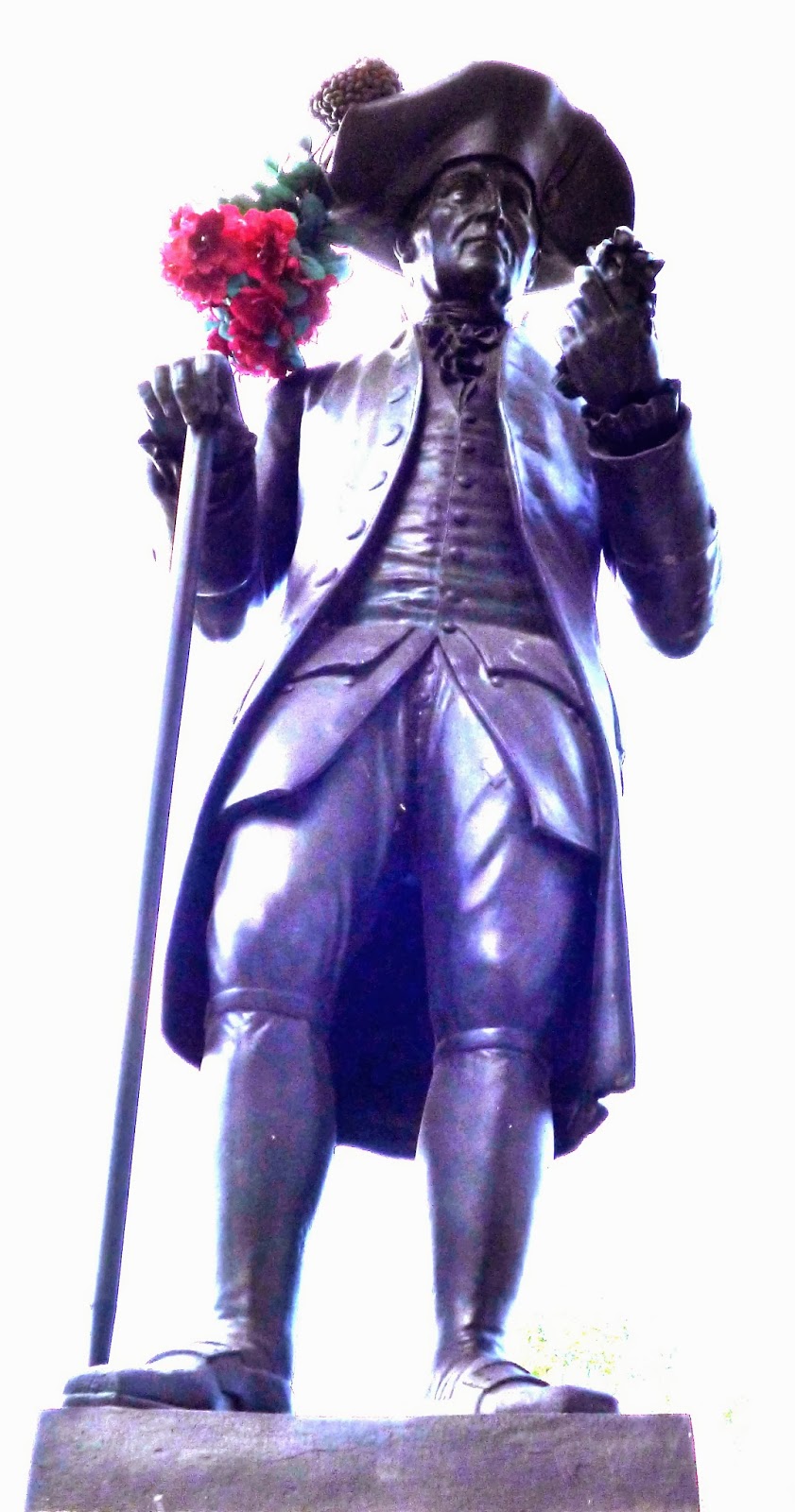
His novels include Les trafiqueurs (1995), Dakar en barre (1997), and Paradis B (1998).

Juan Bautista Piñeiro: Père Lachaise Columbarium #19

Juan Bautista Piñeiro (1945–1994) was born in Spain, brought up in Buenos Aires, and spent many years in France. He certainly wasn't only a poet as suggested here: he wrote the novels Le Voyage nu (1977) and Les Amours du Nil (1981), and the play Boulevard du mélodrame (1985) for the Aubervilliers theatre.

He died of AIDS in Paris.

Lucian Raïcu: Père Lachaise Columbarium #18

Lucian Raïcu (1934–2006) was born Bernard Leibovici, and was a Romanian writer who was, Eugène Ionesco noted on the back cover of the French translation of Raïcu's Avec Gogol (1992), an authority on both Gogol and Tolstoï. Furthermore, he called him the greatest literary critic of his generation. He saw the above book, as all of Raïcu's works, as a victory against censorship.

Raïcu's partner Sonia Larian (born Ariane Lewenstein) is also a writer.

Émil Synek: Père Lachaise Columbarium #17

Dr Émil Synek (1903–93) originally lived in Prague, the city where he was born and where he earned his doctorate in Law. At the age of 24 his first play was performed in Prague, and he went on to write more than twenty others, as well as novels and biographies. He spent the second half of his life in Paris.

7 November 2013

Sarane Alexandrian: Père Lachaise Columbarium #16

Sarane Alexandrian was born in Baghdad but at sixteen participated in  the Resistance in the Limousin. He was closely linked with André Breton at the age of twenty, and never lost his admiration for him, although their interests diverged.

He wrote a number of novels and essays on art and literature, but is perhaps noted for two literary essays in particular: Le Surréalisme et le rêve (1974) and Le Socialisme romantique (1979).

Jean Gaudry: Père Lachaise Columbarium #15

Jean Gaudry (1933-1991) was from Orléans and a painter and poet. His books include the humorous Gerces (1960), Lettre à Tristan Maya (which included his illustrations), and La Pompe à sang (1992), poetry which also included two texts.

Joseph Amber Barry: Père Lachaise Columbarium #14

'Joseph Amber
Barry
13.6.1917
SCRANTON, USA
15.3.1994

PARIS
WRITER ÉCRIVAIN'
 
Joseph Amber Barry is easier to track down than Émile Pignot. Barry came to France in 1944 with the American army, became familiar with the Gertrude Stein set and never left – it beat Scranton, PA, I don't doubt. It seems his most famous book is a biography of George Sand, although he also wrote a book about Versailles, one about the couple, and another on Byron and Augusta. For all the time he spent in France, it seems that the only books of his in French are translations.

Émile Pignot: Père Lachaise Columbarium #13

'LE POÈTE
ÉMILE-PIGNOT
REPOSE ICI
1887 – 1926
 
LES TOMBES DES POÈTES
ONT DES CLARTÉS...E-P
DEVANT L'ÉTERNITÉ LE POÈTE RESTE
                                                           JOSELIA'

Maybe I'm looking in the wrong places, but at the moment I can find out virtually nothing about Émile Pignot, other than that he was also a novelist and a playwright. Joselia (mentioned above) illustrated at least one of the books he wrote (Humanité), and he must at the beginning of the century have been relatively popular judging by the number of his books for sale, but he's now pretty much forgotten. He gave talks as well, and at least one of those was published. The pacifist Victor Margueritte prefaced one of his (poetry?) books (Les Chants d'airain), and Paul Brulat prefaced another (Sommes-nous une race maudite? ('Are We a Damned Race?')). I love this title: Le Lendemain du grand soir: effroyable et prophétique descente aux enfers (The Day After the Big Day: Horrifying and Prophetic Descent into Hell). I'll have to poke around some more: this looks weird stuff.

Rirette Maîtrejean, née Anna Estorges: Père Lachaise Columbarium #12

Rirette Maîtrejean (1887–1968) is yet another anarchist, and one who went through at least her earlier life with a series of partners (including Victor Serge) and a great number of (perhaps not always completely legal) activities. Spartacus Educational provides a decent enough introduction to her life, and the link to the article (in English) is below.
 
Maîtrejean wrote for a number of periodicals, but her lasting written monument is quite an early autobiography, written in 1913 but apparently published several times: Souvenirs d'anarchie : la vie quotidienne au temps de la bande à Bonnot à la veille de 1914.
 
–––––––––––––––––––––––––––––––––––
Rirette Maîtrejean

Félix Fénéon: Père Lachaise Columbarium #11

File:Félix Fénéon by Vallotton.jpg
 Drawing by Félix Valloton (1898)
 
'À la mémoire de
Félix FÉNÉON
1861–1944
Homme de Lettres
Bienfaiteur
de L'Université'
 
Fénéon is remembered for his journalism in general papers and magazines, something in which he took great delight. He was also an anarchist who wrote for various anarchist publications, although his anarchic instincts probably come out best in his Nouvelles en trois lignes, or 'Short Stories in Three Lines' in Le Matin.  The nouvelles had existed before Fénéon briefly came to the paper, but he invested them with an originality that was often very amusing, almost a new form of art in itself. Below is a link to a .pdf with examples:
 
–––––––––––––––––––––––––––––––––––
Félix Fénéon: Nouvelles en trois lignes

Edmond Jabès: Père Lachaise Columbarium #10

Edmond Jabès (1912–91) was born in Cairo into a French-speaking Jewish family. He became friends with two other writers, Albert Cossery (1913–2008) and Andrée Chedid (1920–2011), both of whom were also born in Cairo, moved to Paris, and wrote in French.

Jabès became a friend of Paul Celan, another writer in the apophatic, or negative theological, tradition. He was interested in the difference between souvenir (which he thought self-made) and mémoire (which he saw as external), and was also concerned with how a child constructs language.

6 November 2013

Karen Bramson: Père Lachaise Columbarium #9

'KAREN BRAMSON
OFFICIER DE LA LÉGION D'HONNEUR
NÉE À COPENHAGUE
ÉCRIVIT EN FRANÇAIS (THÉATRE ET ROMANS)
LA PLUS GRANDE PARTIE DE SON ŒUVRE
ET PENDANT LA GUERRE MIT SON TALENT
AU SERVICE DE LA FRANCE
––––––––––––––––––––––––––––––––––––––
26 JANVIER 1936'
 
 There is a fascinating, and very moving, article about Bramson, centring on her relationship with Alexis Leger and written by Holger Christian Holst, below:

–––––––––––––––––––––––––––––––––––
Une correspondance perdue : Karen Bramson / Alexis Leger

Clarence John Laughlin: Père Lachaise Columbarium #8

'In memory of
Clarence John
LAUGHLIN
1905–1985
Surrealist
Writer
And
Photographer'

Laughlin was born in the south of the U.S.A. – Lake Charles, Louisiana – although his family moved to New Orleans after the failure of a rice-growing venture, his father being forced to work in a factory. He was much distressed in 1918 by the death of his father, who had fostered in him a great love of literature which never left him.
 
Laughlin took up photography at twenty-five and is considered one of the first surreal photographers in the States. He was influenced by Eugène Atget (1857–1927) and others working on urban landscapes and published Ghosts Along the Mississippi in 1948. Many of his poems and short stories are still unpublished.

Henri Chassin: Père Lachaise Columbarium #7

Henri Chassin (1887–1964) was a poet, a singer, an anti-militarist and an anarchist who as a teenager met such people as Xavier Privas. He refused to fight in World War I, deserted, was apprehended, sent to a disciplinary unit in Africa, escaped three times, and was eventually put in a psychiatric hospital.

After the war ended Chassin was released and became a railway worker, but taking part in a huge strike led to his dismissal. He continued his studies, gained a degree in law, and for nearly thirty years worked at Dunlop as a legal representative.

While he was doing this legal work though, Chasson had a parallel career as a singer in Montmartre night spots. In 1927 he published Machin de Belleville, a collection of his poetry.

Gaston Montéhus: Père Lachaise Columbarium #6

'AU POÈTE-CHANSONNIER du PEUPLE
GASTON MONTEHUS . 1872-1952
"La Jeune Garde"             "Gloire au 17"
"On est un République"        "Ne riez pas des autres"
HOMMAGE de ses CAMARADES
les "VETERANS du PARTI SOCIALISTE S.F.I.O."'

Guy Hocquenghem: Père Lachaise Columbarium #5

Guy Hocquenghem (1946—1988) was a writer and a soixante-huitard. He 'officially' came out in a letter in the Nouvel Observateur in 1972. His books — fiction and non-fiction (the latter mainly queer theory) — are concerned with homosexual matters, and his novel L'Amour en relief (probably his most well-known book) looks really interesting.

Hocquenghem died of AIDS at the age of 41.

Georges Perec: Père Lachaise Columbarium #4

'Esther
BIENENFELD
1896–1974
––––––––––
Georges
PEREC
1936–1982'

The name above Perec's is his aunt's: his father died in the war in 1940, his mother was killed in Auschwitz, and his aunt and uncle adopted him. Much has been written about his being an orphan, and many speculations made about the importance of 'disappearance' in his work, of how the constraints he lived under in some way mirror the constraints Oulipo use. It's an interesting construction I suppose. But obviously the biggest constraint was his death at 45.

Léon Werth: Père Lachaise Columbarium #3

Léon Werth (1878–1955) was a close friend of Octave Mirbeau, which probably says quite a lot. He was anti-bourgeois, anti-military, anti-clerical, libertarian, etc. In 1913 his novel La Maison Blanche (with a Preface by Mirbeau) got through to the third Goncourt selection but failed to win. Fifteen months in the trenches had convinced him of the folly of war, and the anger it caused in him was translated into Clavel Soldat (1919), which caused a scandal.

Saint-Exupéry was a great friend of Werth's after they met in 1931, and the aviator-writer dedicates Le Petit Prince to him, calling him the best friend he has in the world.

Isadora Duncan: Père Lachaise Columbarium #2

The urn of Isadora Duncan (1877–1927) is one of the most famous here, no doubt not just because of her revolutionary dancing style but also in part because of the fascination with her unconventional and tragic life. Writers and artists were inspired by her, such John Cowper Powys's Élise Angel in After My Fashion (1980), or Antoine Bourdelle's sculptures.

Duncan married the deeply troubled Russian poet Sergueï Essénine – a man eighteen years her junior – although the marriage was very short-lived and a few years after his return to Russia he killed himself. Famously, Duncan was killed by strangulation from her scarf caught in a car wheel at Nice. She joined her two children killed in Paris in 1913 when the car they were in ran into the Seine.

Maurice Joyeux and Suzy Chevet: Père Lachaise Columbarium #1

The Columbarium in Père Lachaise cemetery can reveal some fascinating things if you know where to look, although this place – especially the underground areas – can be as confusing as the divisions where the graves are. Anyway, this is the first of a number of Columbarium posts:
 
Maurice Joyeux (1910–91) is a prominent figure in the history of French anarchism. In 1957 he published a book called Le Consulat polonais, which fictionalises his attack on the Polish consulate, for which he was imprisoned for a year. Other minor spells in prison followed, and then in 1940 he received five years for refusing to go to war. He started a rebellion in the prison, escaped, was caught, and was freed in 1944: this is the subject of his second book, Mutinerie à Montluc (1971). Joyeux's writings from about 1969 seem to be almost entirely related to anarchist theory.

Radio libertaire, an organ of Fédération anarchiste, was founded in 1981 and made Joyeux its first guest.

Suzanne Chevet was an anarcho-syndicalist who was the editorial director of the anarchist paper La Rue, published by the libertarian group Louise Michel. Sent to Saint-Malo by the Vichy régime, she organised a series of escapes to Jersey until she was caught by the Gestapo, although she escaped, took on a false identity, and worked in offices of the Service du travail obligatoire until Liberation. In 1945 she met Joyaux, her partner. For many years she worked for the unionist organisation Force ouvrière. She died in Port Grimaud when a car hit her.

Robert Brasillach and Maurice Bardèche: Cimetière de Charonne #3

 
Robert Brasillach (1909–1945) is a writer who is much better known for his political views, for which he lost his life. He began writing for the extreme right-wing Action française and went on during the Occupation to be editor-in-chief of the anti-Semitic Je suis partout. After the war many writers – among them Camus, Colette, Valéry, Mauriac and Cocteau – petitioned the government for leniency, but he received the death sentence and was executed in Arceuil, Val-de-Marne.
 
Geneviève Maugis was his half-sister.


Maurice Bardèche (1907–1998) was Brasillach's brother-in-law and another extreme right-winger. Patrick Besson wrote about the strangeness of his becoming a 'collaborator' after liberation: certainly during the war he limited his writing to 19th century literature (apart from a few articles on art in Je suis partout), but in 1948 he published Nuremberg ou la Terre promise – a book of Holocaust denial for which he was imprisoned for a year and fined 50,000 francs. In 1957 he published Suzanne et le taudis (lit. 'Suzanne and the Slum') about the poverty-stricken conditions his family lived in, but he remained unrepentantly on the extreme right. Unsurprisingly, Jean-Marie Le Pen (then leader of the Front National*) was present at Bardèche's funeral and voiced his strong admiration.

*Marine Le Pen – Jean-Marie Le Pen's daughter – now leads the Front National, which is still (despite any attempts she makes to suggest the contrary), emphatically a political party of the extreme right. Amusingly, the left-leaning paper Libération published a front page photo of her last month (12–13 October 2013) with the headline screaming the warning '100% EXTRÊME DROITE APPELLATION CONTRÔLÉE', although it was far from amusing to learn that the Front National won Brignoles (Var) that weekend.

Henri and Gérard Baüer: Cimetière de Charonne #2

Henri Baüer (1851–1915) was a writer, critic and journalist and the son of Alexandre Dumas fils. He was a communard officer who took part in the semaine sanglant at the end of May 1871 and as a result was exiled to New Caledonia for seven years.
 
On his return to Paris he wrote for the conservative Écho de Paris, becoming an influential drama critic. He strongly supported the naturalist theatre, was a Dreyfusard, and was the only critic to support Alfred Jarry in the Ubu Roi scandal. He left l'Écho de Paris in 1898.

Gérard Bauer (1888–1967) was Henri's son and Dumas fils's grandson. He too worked for l'Écho de Paris (for a much longer period than his father), and published five volumes of chronicles, a novel and a short comedy.

François Bègue: Cimetière de Charonne #1

François Bègue's statue on his grave in the small cemetery in the 20th arrondissement is the place's most prominent feature. But who was he?
 
'Ycy repose
Bègue dit Magloire
Peintre en bâtiments.
Patriote, Poète,
Philosophe et secretataire
de Monsieur
De Robespierre
1793'
 
Well, François Bègue (1750–1837) was a house painter perhaps, but Robespierre's secretary? And if he was a poet the BNF doesn't seem to have any of his works. Café philosopher he may well have been, as he seems to have liked his drink and is said to have been buried with a bottle of wine. The self-mythologizing eccentric may well have been aided by alcoholic lubrication and attendant gross exaggeration – indeed plain invention. But he is said to have earned a great deal of money as a bonesetter, gave generously, and had the statue made from recycled materials.
 
Many people were present at his funeral, celebrating his life by song and drink. Certainly the man was a brilliant advertiser of himself, and even today he stands there with flowers someone has taken the trouble to put by his hand: Bègue is also said to have been a horticulturist and to have created the rose Magloire.