Showing posts with label Hawera. Show all posts

8 May 2013

Julia Millen: Ronald Hugh Morrieson: A Biography (1996)

In her biography of the New Zealand writer Ronald Hugh Morrieson (1922–72), Julia Millen mentions that his crime was 'being different', and this comes across strongly in the book. Born in the small, conservative Taranaki town of Hawera to a musical family in a house where he lived all his relatively short life, Morrieson rarely ventured further afield, and even his intended life as a student in Auckland only lasted a day or so before he felt forced to return homesick.

The house he lived in was built by his maternal grandfather Charles Bartley Johnson, who, when Ron was born, lived there with his wife Lucy, Ron's parents Hugh Morrieson and Eunice (née Johnson), and Charles and Lucy's other offspring, his unmarried uncle Roy and aunt Doris Johnson. Ron's father died when Ron was only eight, and in time there were just three in the house: Ron, and his mother and aunt, both of whom spoiled him to an enormous degree, and seemed largely in denial of his many demeanours.

At the age of ten Ron made parsnip wine and got a schoolfriend drunk in the lunch hour, and this was really just a foretaste of a lifelong love affair with drink. At eighteen he drove to a dance with some friends in Stratford, a nearby town, did some drinking, and on the way back knocked a girl over: he failed to stop, she was hospitalised, and he later gave himself up to the police, claiming that he hadn't noticed her: he was put on probation for two years, lost his licence, and was forbidden to be out at night after 8pm.

Morrieson played in bands locally until he was 37 and loved the camaraderie, the drinking lifestyle that was inevitably attached to it, and enjoyed the company of a number of female sexual partners. Horseplay is a drama by Ken Duncum that was first shown in 1994 and imagines James K. Baxter visiting Morrieson in Hawera near the end of their lives. In it, Wilma is Morrieson's girlfriend and complains about having to constantly get in and out of the window: before reading the biography I thought this must be some kind of symbol but it's real: Morrieson actually had a ladder leading up to his bedroom window so that his mother and aunt wouldn't have to see his girlfriends going upstairs with him. It's the kind of bizarre – almost unbelievable – detail that could have come from one of his books.

Maurice Shadbolt said that some of Morrieson's characters might well have come from his drinking friends in Hawera, and Millen greatly extends this observation by pointing out a large number of similarities between people or things in Morrieson's books, and those in his life: for instance, the tower in Predicament (a book that Morrieson once wanted to call 'The Tower') that leans (giving Cedric one of his nicknames – Pisa) recalls the leaning (and useless) water tower in Hawera; Cedric's father's eccentric behaviour is not unlike that of Morrieson's grandfather Charles Johnson's; there is obsessive and reckless gambling in illegal, out-of-town crown and anchor games in Comes a Hot Friday, such as Morrieson used to regularly attend in south Taranaki; Salter the Sensational (aka 'The Scarecrow') initially excited the drunks in the lock-in pub, as the magician Carter the Great excited Hawera schoolchildren; Pallet on the Floor involves events in and around a freezing plant: Morrieson worked in one in nearby Patea; and so on and so on.

At 37, Morrieson decided to devote himself to the world of letters, but kept himself afloat (mainly alcoholically) by giving private music lessons at home. The lessons weren't a great success, but they'd have been far less so (in fact, probably non-existent) if Morrieson's short story 'Cross My Heart and Cut My Throat' – with its hungover music teacher lusting after a thirteen-year-old pupil and (unbidden) sneaking a kiss on her lips and briefly touching her inner thigh – had been published while he was alive.

But then, after two novels Morrieson couldn't get anything published, he continued to drink to wild excess, his mother's death came in 1968 and left him a wreck, and four years later continued drinking led to the death he seemed resigned to. Like Morrieson's novels, this is a humorous book as well as a (quietly) violent one, but of course the protagonist brought the violence on himself. Unlike the novels, though, it is also intensely sad.

My other blog posts on Morrieson's work:

–––––––––––––––––––––––––––––––––––

Ronald Hugh Morrieson: Came a Hot Friday (1964)
Ronald Hugh Morrieson: The Scarecrow (1963)
Ronald Hugh Morrieson: Predicament (1974)
Ronald Hugh Morrieson in Hawera, Taranaki, New Zealand

29 April 2013

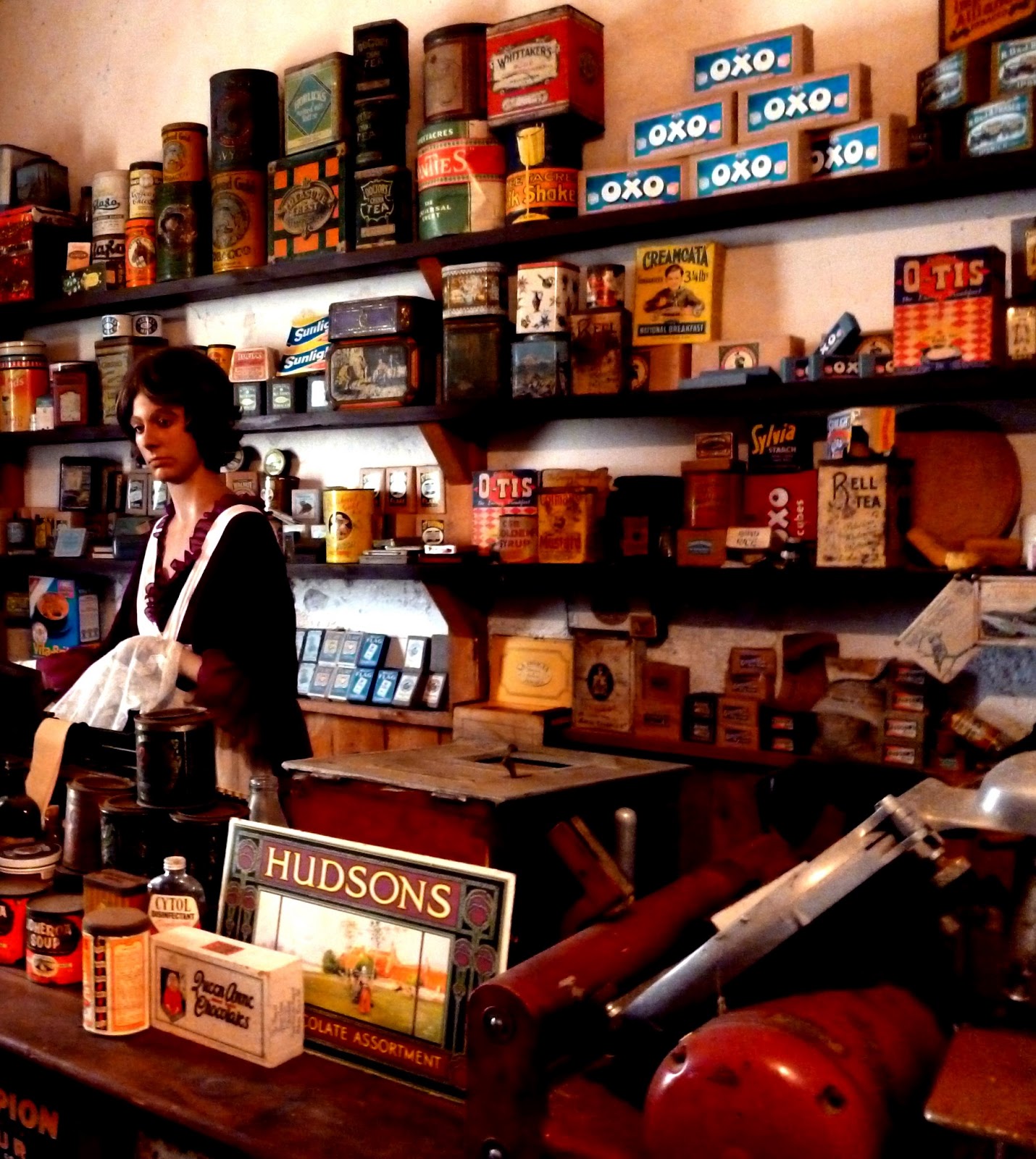
Nigel Ogle's Tawhiti Museum, Hawera, New Zealand

Nigel and Teresa Ogle bought a seventy-year-old cheese factory here in 1975, and built a museum out of it. Using moulds of actual people – friends, relatives and locals – life-size models of characters are created.
 
The flour mill at Tawhiti was built in 1881 but closed down in 1886. 
 
It was bought and re-opened by the miller George Ogle, who had emigrated with his wife Mary Ann, their first children, and brother William from Nottinghamshire, England in 1884 and bought the mill in 1887 after a short time at a mill in Auckland.
 
The Ogle Brothers' store in Hawera.
 
Other exhibits:


21 April 2013

Ronald Hugh Morrieson: The Scarecrow (1963)

Famously – insofar as you can use the word 'famously' about Ronald Hugh Morrieson – The Scarecrow begins with the sentence 'The same week our fowls were stolen, Daphne Moran had her throat slit,'* and the blurb on the back cover of the New Zealand Penguin edition calls it '[t]he greatest first sentence in New Zealand literature'. This is praise indeed, although the narrator modestly explains that the model for this beginning is in Robert Louis Stevenson's Treasure Island: 'The same broadside I lost my leg, old Pew lost his deadlights', which is in fact the second sentence of the eleventh chapter.

The blurb speaks of Morrieson's novel as a 'hilarious Gothic melodrama', and more than once I've come across the expression 'Taranaki Gothic' in relation to it. Certainly there's a strange juxtaposition of the relatively inconsequential (fowls being stolen) to the horrific (a bloody murder), and placing such a sentence right at the beginning of the story almost guarantees that the reader will continue reading this very strange novel.

But the first sentence is so arresting that the reader will probably look at it again: it's in two halves, and the first half seems to be in a conversational, matter-of-fact tone, but then we're pulled up sharp when the weird stuff starts. And the way Morrieson performs this trick is fascinating, all the more so by the way that he improves on Stevenson's sentence: not only does the musically educated Morrieson give the two halves an identical set of syllables (eight), but he changes the active voice into the passive voice – twice – and in so doing creates an immediate distancing effect.

Distance is important in The Scarecrow, whose background protagonist Hubert Salter is an alcoholic serial killer whose main interest in life is having sex with dead women's bodies. You can't get much more distanced from society than that, and yet it's interesting to think about that forename: 'Hubert' sounds so cosy and yet it belongs to a horrific monster. Morrieson's character, like Morrieson's language in general, is distinctly contradicting itself.


Salter's bowtie is surely a major image that emphasises the bizarre effect Morrieson is creating: we have a man who looks like a scarecrow, a hideous filthy tramp, and yet he wears a highly conspicuous symbol of respectability – a tie, and not just any tie, but a bowtie: of all the items of clothing that simultaneously (and self-consciously) convey elegance and coldness of distance, the tie is surely at the top of the table, and the bowtie is surely at the top of the tie table for elegance and ridiculousness. Morrieson is playing games with the reader, glibly (but astutely) introducing images of lightness and heaviness, horror and amusement, mixing an intangible, contradictory literary brew. He's a kind of gaudy, verbal cartoonist.

This is an amazing novel.

*The cinema is a more immediate medium of course, and the movie poster of The Scarecrow changes 'week' to 'day'.

My other blog posts on Morrieson's work:

–––––––––––––––––––––––––––––––––––
Ronald Hugh Morrieson in Hawera, Taranaki, New Zealand
Ronald Hugh Morrieson: Came a Hot Friday (1964)
Ronald Hugh Morrieson: Predicament (1974)
Julia Millen: Ronald Hugh Morrieson: A Biography (1996)

19 April 2013

James Cowan and Kimble Bent in Hawera, Taranaki, New Zealand

Kimble Bent in 1903, aged 66
 
James Cowan (1870–1943) was a writer of non-fiction who was born in Pakuranga, Auckland, and who became a great admirer of Māori culture. He spoke fluent Māori and wrote a great number of books, perhaps the most well known of which is The New Zealand Wars: A History of the Maori Campaigns and the Pioneering Period (1922–23).
 
First published as a series of articles in the New Zealand Times called The White Slave in 1906, Cowan's book The Adventures of Kimble Bent: A Story of Wild Life in the New Zealand Bush (1911) is a study of one of New Zealand's frontier figures whom he had interviewed extensively and photographed.

Bent (1837–1916) was an American serving with the British army and had been posted to New Zealand in 1861. He was regularly disobedient and drunk, and had been imprisoned in Wellington and flogged in front of his company. In 1865, while with the army in Taranaki a little south of Hawera, he deserted. He was found by Tito te Hanataua, chief of the Ngāti Ruanui, and lived with Māori for thirteen years, avoiding contact with Pākehā (or people of European descent).
 
Maurice Shadbolt partly fictionalized Bent's story in Monday's Warriors (1990).
 
In Tawhiti Museum there are several representations of Bent's story. Here, he is surrendering to Tito te Hanataua.

Tito te Hanataua leads Bent into Orangai Pa, where he is made to do heavy manual work. He slowly earns the trust of the Māori.
 
In Orangai Pa Bent (now Ringiringi) came to follow the Pai Mārire faith established by the prophet Te Ua Haumene. Above, a march around the niu, or sacred pole that the prophet had the people erect.

During an attack by the soldiers, Ringringi guides the old and the women and children to safety.


An online edition of the book is linked below:

–––––––––––––––––––––––––––––––––––
James Cowan: The Adventures of Kimble Bent

16 April 2013

Ronald Hugh Morrieson: Came a Hot Friday (1964)

Ronald Hugh Morrieson's novel Came a Hot Friday (like his début The Scarecrow, which I shall review a little later after re-reading) is a strange mixture of thriller and comedy punctuated by speech very often in the New Zealand vernacular. It seems more intricately structured, though, with chapters seen from the points of view of different characters who will interweave with others.
 
The blurb on the back of this retro New Zealand Penguin edition seems doubtful about how to sum the book up, and I can understand the problem: it's about Morrie Shalapeski, who sets fire to premises he doesn't realize a man is sleeping in; and Wes Pennington and his chum Cyril Kiddman (incorrectly spelt in the blurb), who start a lucrative betting scam; and Don Jackson (perhaps an older version of The Scarecrow's Neddy Poindexter), who is out to lose his virginity; and Sel Bishop, the violent bookie who has no concern for anyone but himself and how much money he can make; and the absurd but highly sympathetic Te Whakinga Kid, who is a mock-Zorro who pretends so much that things become real.
 
They are all brought together in some way: the man Morrie (eventually) accidentally kills is Pop Simon, whom he knows and likes, and who is known by his boss's wife's friend; Don becomes the third partner in Wes and Cyril's betting scam; Morrie was paid for the arson by the evil Sel Bishop, who towards the end tries to burn Morrie, Wes, and his own girlfriend Claire (who is also Morrie's sister).
 
Oddly, perhaps, almost all of the characters (with the notable exceptions of the bookies Bishop and Cray) are seen in a sympahetic light, often as wounded victims of a life without mercy in which they have to feed their addictions – usually by getting as hopelessly drunk as possible as often as possible, or (to a lesser extent) by extreme gambling. The narrator is aware of the extent of the self-destruction (and seems particularly knowledgeable about the effects of alcohol) but appears to see this behaviour as natural, or at least unavoidable.
 
A special mention should go to the Te Wakinga Kid, the Māori who dresses as a cowboy and uses a cap gun. He is a fusion of a pretend bandit and a pretend sheriff, who – as deus ex machina – transforms himself (for the reader and for the characters he rescues from otherwise certain death) instantly into a real hero. Right at the end of the book though – leaving with the swag – he sees himself as a real bandit only and throws away his sheriff badge: he has grown up and overcome superstition.
 
But, as the last page seems to say, he's just a scared kid after all: he has been as self-deceived about his new role as he was about his former ones.
 
My other blog posts on Morrieson:

–––––––––––––––––––––––––––––––––––
Ronald Hugh Morrieson: Predicament (1974)
Julia Millen: Ronald Hugh Morrieson: A Biography (1996)

15 April 2013

Ronald Hugh Morrieson in Hawera, Taranaki, New Zealand

Outside New Zealand and Australia, I doubt that many people have heard of the writer Ronald Hugh Morrieson (1922–72), and doubt even that he's very well known in New Zealand, the country of his birth. My title is obvious: the small town of Hawera is where Morrieson was born, where he lived and where he died. He hardly ever left the town: when he started university in Auckland he couldn't stand it and returned permanently to Hawera in a week.

It's customary to quote Morrieson's friend, the author Maurice Shadbolt, on what Morrieson said to him: 'I hope I’m not another one of these poor buggers who get discovered when they’re dead'. On Morrieson's death only two novels – The Scarecrow (1962) and Came a Hot Friday (1964) – were published, although these were followed after his death by Predicament (1975) and Pallet on the Floor (1976), which I believe is more of a draft than a finished novel. Subsequently all of the books were turned into films. But only the novel The Scarecrow seems to be widely available: I only found his second novel in one outlet, and his others are out of print. Even in death, he's still somewhat obscure.

Morrieson had a reputation in Hawera as a drunk and a waster, although he was better known locally as a musician than as a writer – earlier, he played in dance bands, and gave music lessons later.

He lived with his mother Eunice and his aunt Doris at 1 Regent Street, where he was born, and was devastated by the death of his mother (who had also been a music teacher) in 1968. The house was built by his maternal grandfather Charles Bartley Johnson, a cabinet maker. In 1993 there were plans to knock down the house and replace it with a Kentucky Fried Chicken outlet, but despite the setting up of a Scarecrow Committee to attempt to prevent this the house was demolished in April 1973.


However, the house was far from completely destroyed: Morrieson's room or attic, where his family say he wrote all his work, was bought by local builder Robert Surgenor to be used as a 'sleep-out' by his daughter. The attic was moved in December 2011 to Tawhiti Museum a few miles outside central Hawera, where it was renovated and now forms the upper floor of a display dedicated to Morrieson.

A poster of the movie The Scarecrow (1982).

Came a Hot Friday (1984).

Predicament (2010).

Morrieson's attic is not all that was preserved from the house: in Morrieson's Café Bar, wood from the house is used in the bar front, table tops, doors, fireplaces and staircase. Express an interest in Morrieson, and you will be shown a large laminated sheet giving a potted biography of the writer.


I'd parked next door to the café, in Countdown supermarket car park, and was intrigued to see Morriesons's van there: 'Let us solve your "Predicament" with a free ride to Morrieson's Café & Bar'.

I asked the very helpful girl at the i-site if she could could tell me where Morrieson's grave is in Hawera Cemetery. She jumped behind the computer and asked:

'What's the first name?'

'Ronald'.

'Oh, that Morrieson!'

I found a copy of The Scarecrow the following day in Whitcoull's in Wanganui ($5 off, making it just $9) and the assistant asked me if I'd read any of his books, and when I replied 'Not yet' she told me they are very odd.* So, I suppose the 'poor bugger' has been discovered by some people.

'In
Loving Memory Of
RONALD HUGH
BELOVED SON OF THE LATE
HUGH F. AND EUNICE H.
MORRIESON.
DIED 26TH DECEMBER 1972
AGED 50 YEARS.'

His aunt survived him:

'ALSO DORIS H. E. JOHNSON
DIED 28TH FEBRUARY 1974
AGED 81 YEARS.'


*She's right too. I've only read The Scarecrow so far, but for a book about a necrophilic serial killer this is a highly amusing work: the key, I think, is that all the sex and violence is understated, often in the form of suggestion.

My other blog posts on Morrieson's work:

–––––––––––––––––––––––––––––––––––

Ronald Hugh Morrieson: Came a Hot Friday (1964)
Ronald Hugh Morrieson: The Scarecrow (1963)
Ronald Hugh Morrieson: Predicament (1974)
Julia Millen: Ronald Hugh Morrieson: A Biography (1996)