Showing posts with label Bordeaux (33). Show all posts

18 January 2016

Jean-Paul Kauffmann: 31, allées Damour: Raymond Guérin 1905-1955 (2004)

'This anarchist, this permanent rebel, is in everyday life a man of order and habit.' Jean-Paul Kauffmann's sentence comes towards the end of his scholarly, 350-page biography of Raymond Guérin, one of the most famous of the forgotten – in fact never really ever known – French writers. And yet it could serve as an introduction to this chameleon-like author. On the one hand Kauffman doesn't have an easy job with a man so little known, although on the other almost everything he discovers is new and his task was much facilitated by the archive at the Bibliothèque Jacques Doucet near the Panthéon.

I was a little reminded of my research on the artist and would-be writer Karl Salsbury Wood, who (this was wartime England) scribbled his findings on wallpaper-backed diaries, fastidiously (manically?) recording details of every (half)penny spent on his windmill tours. But Guérin seems to have been even more obsessive, with his bills, restaurant napkins, etc, included in the archival boxes.

Kauffmann doesn't only include the details of the Raymond Guérin archive but also much of himself, his conversations with his research neighbour who's looking into Paul Éluard, the interest of Juliette Bordessoule more in Kauffmann's own captivity than Guérin's, the girl in the lift to 31 allées Damour (Bordeaux) who thinks the 'great writer' associated with the building is not Guérin (well, who he?) but Montesquieu, on so on.

This is a wonderfully meticulous, obsessive book about a meticulous, obsessive person, a book to return to and discover amazing things about an amazing person. But only for some of us, of course, as the majority of committed readers will not, for instance, be interested in Monsieur Hermès (probably named after a brand of exercise book) and his masturbatory activities in L'Apprenti, or Hermès again in the 800-page 'follow-up' Parmi tant d'autres feux..., let alone the 500-page Les Poulpes in which Guérin changes Hermès's name to le Grand Dab, and which ends the trilogy Ébauche d'une Mythologie de la Réalité (lit. 'Sketch of a Mythology of Reality'). Pretentious? I should hope so: aren't James Joyce, T. S. Eliot, Virginia Woolf et al gloriously pretentious? Of course, so what's wrong with that? Readable? Probably not for most, but then I specialise in reading unreadable books, and Guérin sounds deliciously unreadable.

I've only read Zobain so far (my review is linked below), but I shall certainly be back for more. Fascinatingly, Kauffmann discovers that all correspondence with Denise Montauriol (Guérin's first wife) has been removed from the archive, and asks if Juliette Bordessoule is responsible for this: tantalizingly, there's later a photo of the elderly woman on one of the plates between pages 56 and 57, although the reader has to plough though about two thirds of this biography before he or she can be certain that Bordessoule is the heir to Guérin's estate. Kauffmann, then, wouldn't have known (as Finitude's Zobain Afterword makes clear) that Denise (or Denyse) complained bitterly to Guérin in more than one letter that her problem was that he hadn't made her 'a woman', and furthermore hadn't told his mother the 'real' reason for the divorce.

Guérin may well have appeared very pleasant to many other people, although he could be very difficult too. After a letter savagely criticising Gaston Gallimard for the 'pittance' he received from him, Gallimard replied: 'You are too egocentric, too self-oriented to conceive of an outside world. Your arrogance blinds you, and if you were a normal man you wouldn't have this totally unjustifiable persecution complex, which in my eyes excuses you. However, this egotism, this ingratitude, which has perhaps been the driving force of your publications, is probably what will limit you in the future'. But amazingly, Gallimard went on to meet many of Guérin's demands.

How can I criticise this astonishing book? There's not enough sex?

18 June 2010

Jean Fernand-Lafargue and Bordeaux, Gironde (33)

Novelist, poet and playwright Jean Fernand-Lafarque (1856-1903), born in Bordeaux, is perhaps best known as a writer of novels of manners. Some of his works include Une idylle à Tahiti (1882), Dette d’honneur (1883), La Fausse Piste (1885), La Gourme (1886) (which was considered rather shocking), Fin d'amour (1890), and Une seconde femme (1995).

The monument, which is in the Jardin Public in Bordeaux, was conceived by the sculptor Jules Rispal, and incorporates two characters from his novels: a gamekeeper from Les Landes and a grape-picker from the Médoc.

Léon Valade and Bordeaux, Gironde (33)

The poet and author Léon Valade (1844-84) was born in rue Thiac in Bordeaux and was a friend of Paul Verlaine, who dedicated his poem 'Pierrot' to him. Valade, one of the so-called Parnassian school of poets, was one of the first people to recognize the genius of Rimbaud.

This bronze monument in the Jardin Public is the work of Charles-Louis Malric (1872-1942) in 1904. It was melted down during the German occupation, but this new model was made from a plaster mould held in the Musée des Beaux-Arts in Bordeaux.


Verlaine's sonnet:

Pierrot

A Léon Valade.

Ce n'est plus le rêveur lunaire du vieil air
Qui riait aux aïeux dans les dessus de portes;
Sa gaîté, comme sa chandelle, hélas! est morte,
Et son spectre aujourd'hui nous hante, mince et clair.

Et voici que parmi l'effroi d'un long éclair
Sa pâle blouse à l'air, au vent froid qui l'emporte,
D'un linceul, et sa bouche est béante, de sorte
Qu'il semble hurler sous les morsures du ver.

Avec le bruit d'un vol d'oiseaux de nuit qui passe,
Ses manches blanches font vaguement par l'espace
Des signes fous auxquels personne ne répond.

Ses yeux sont deux grands trous où rampe du phosphore,
Et la farine rend plus effroyable encore
Sa face exsangue au nez pointu de moribond.

Montaigne and Montesquieu, Bordeaux, Gironde (33), France

Along with Mauriac, Montaigne (1533-92), and Montesquieu (1689-1755) are the other two giants of literature around here beginning with the same letter, and the size of the statues here on the Esplanade des Quinconces, Bordeaux, seems to give them a symbolic significance.

Around the side of Montaigne's statue are a few sentences from Chapter II of Book II of his Essais.

Montesquieu holds a copy of L'Esprit des lois.

These statues were made by Dominique Félix Maggesi (1801-92), who, from 1829, was the official sculptor in Bordeaux, where he ran his own school of sculpture until 1886.

This bust of Maggesi is in the Jardin Public.

There is another memorial to Montaigne in Bordeaux: 'In the 16th century on this site numbers 23 and 25 rue de la Rousselle and 3 rue Faure (formerly rue Montaigne) stood the family residence of Michel Montaigne author of Essais Mayor of Bordeaux 1581-1585.'

14 June 2010

François Mauriac and Bordeaux, Gironde (33), France

As this plaque clearly states, François Mauriac (1885-1970) was born in this house, 86 rue du pas St Georges, in the center of Bordeaux.

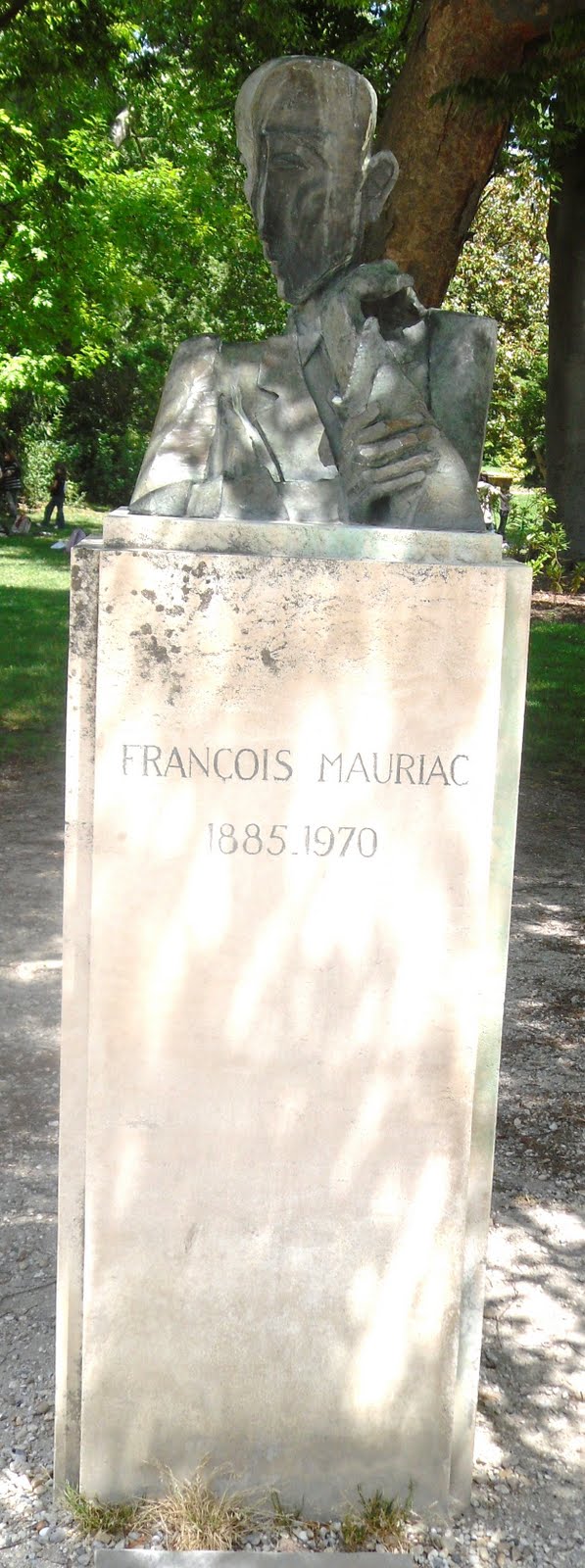
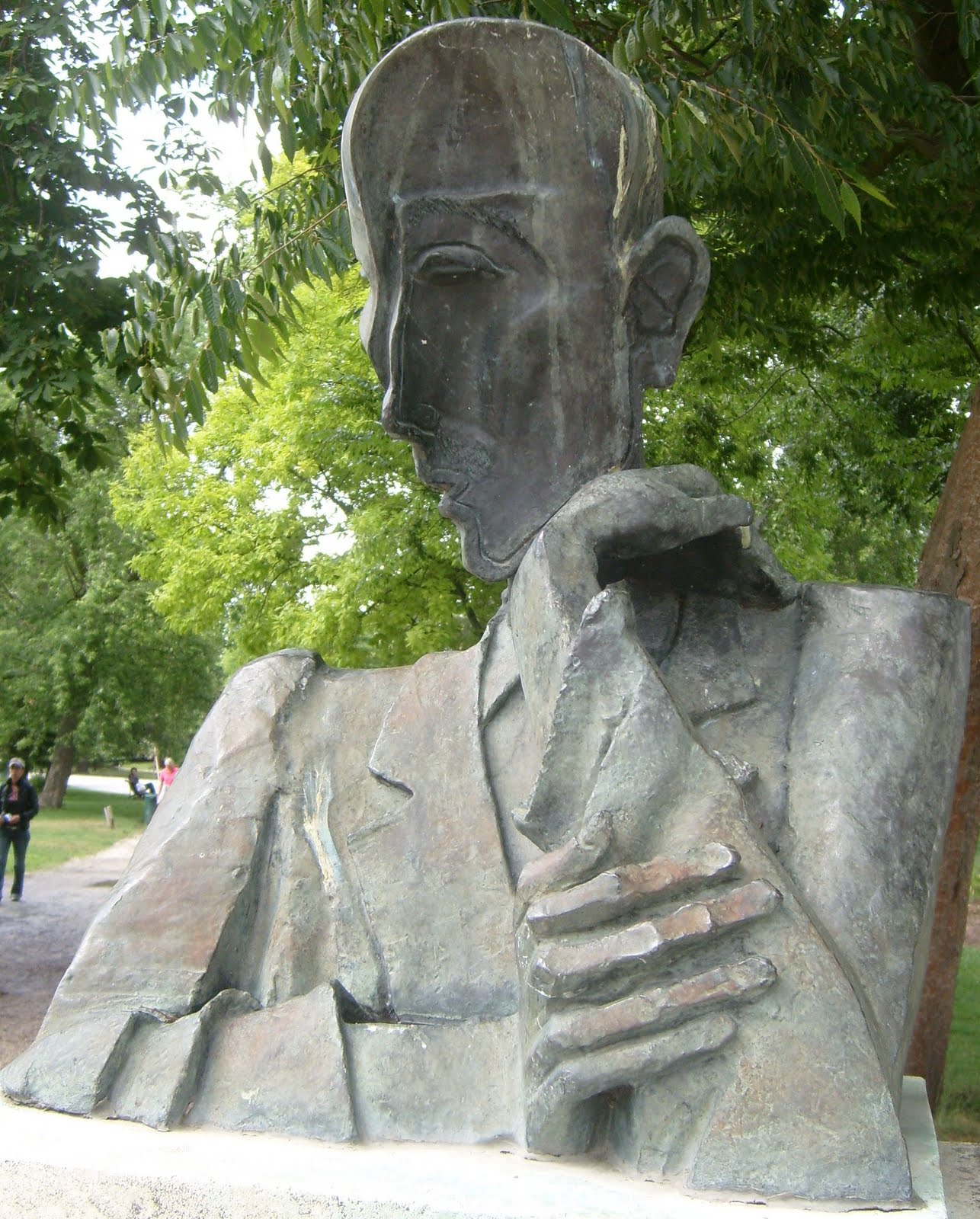
In Préséances (1921), Mauriac was quite clear about what he saw as the ugliness of Bordeaux women: 'les bordelaises sont laides comme des gouvernantes anglaises'. His mother pointed out that that statement ensured that he would never have a public monument in Bordeaux, although of course she was wrong. This sculpture was erected in the Jardin Public in Bordeaux on the 100th aniversary of Mauriac's birth. But it has not remained there without problems, and in March 1993 the modernist bust (actually a copy of the original) was stolen. It was assumed that the bust would never again see the light of day, although the police received a tip-off in January 1995, and as a result found it in a parcel in a disused warehouse in Bordeaux.

At the back of the bust is the signature of the sculptor Ossip Zadkine, a Russian exiled in the USA when he made the work in 1943. He said that a cure for his homesickness was involving himself in his passions.