Showing posts with label Brooklyn (NYC). Show all posts

25 August 2015

NYC #59: Thomas Wolfe, Brooklyn Heights, Brooklyn

'THOMAS WOLFE
AMERICAN AUTHOR
LIVED ON BROOKLYN HEIGHTS FROM 1931 TO 1935,
AND IN THIS HOUSE, 1933 TO 1935, WHILE WRITING
OF TIME AND THE RIVER.
–––––––––––––––––––––
"GREAT GOD, THE ONLY BRIDGE, THE BRIDGE OF
POWER, LIFE AND JOY, THE BRIDGE THAT WAS A
SPAN, A CRY, AN ECSTASY – THAT WAS AMERICA."
DEDICATED ON MAY 20, 1983, BY
THE THOMAS WOLFE SOCIETY'

NYC #58: W. H. Auden, Brooklyn Heights, Brooklyn

'W. H. AUDEN
POET ('1907–1973)
–––––––––––––––––
LIVED IN BROOKLYN HEIGHTS FROM 1939 TO 1941,
FROM 1939 TO 1940 ON THE TOP FLOOR OF THIS HOUSE,
WHERE HE WROTE "NEW YEAR LETTER."
–––––––––––––––––
"AND LOVE ILLUMINATES AGAIN
THE CITY AND THE LION'S DEN,
THE WORLD'S GREAT RAGE, THE TRAVEL OF YOUNG MEN."
 
THE W. H. AUDEN SOCIETY, JUNE 25, 1996'

NYC #57: Henry Miller, Brooklyn Heights, Brooklyn

'HENRY MILLER
 
1891–1980
 
Raised in Brooklyn, the best-selling author
is noted for his imaginative, controversial novels
Tropic of Cancer (1934), which chronicles
his colorful life as an expatriate in Paris, and
Tropic of Capricorn (1939), which depicts his adult
life in New York city. Both books were banned
in the U.S. until 1961. Miller lived here
from 1924 to 1925.'
 
91 Remsen Street. What the plaque doesn't say is that Miller and his second wife June were evicted from here: in a fictionalized account of searching for this place and moving in, Miller's novel Plexus states that the place was way beyond the means of the narrator.

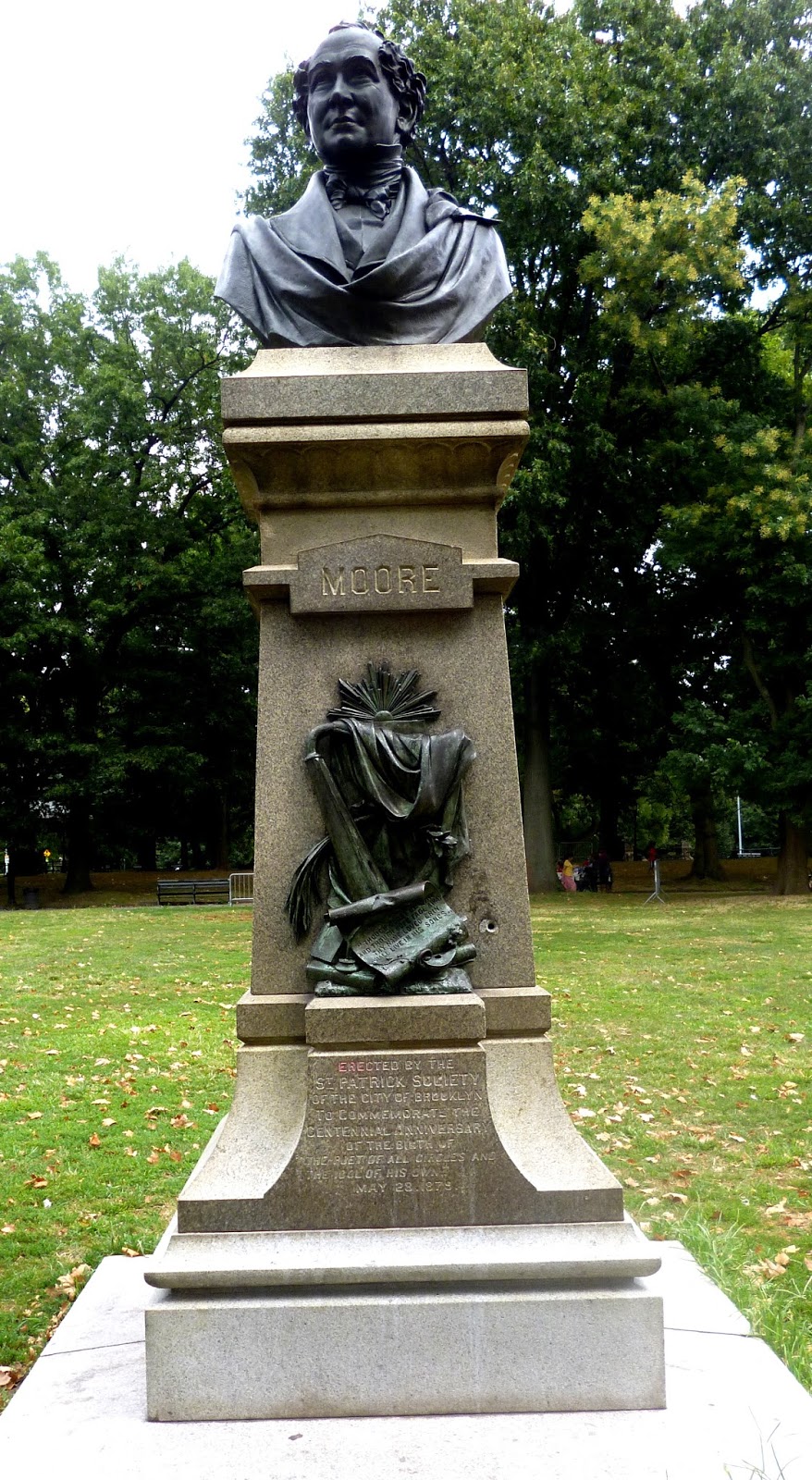
NYC #56: Thomas Moore, Prospect Park, Brooklyn

Among the representations of composers in Concert Grove, Prospect Park, is a bust on a pedestal of the Irish poet Thomas Moore (1779–1852), who was also a musician:
 
'ERECTED BY THE
ST PATRICK SOCIETY
OF THE CITY OF BROOKLYN
TO COMMEMORATE THE
CENTENNIAL ANNIVERARY
OF THE BIRTH OF
"THE POET OF ALL CIRCLES AND
THE IDOL OF HIS OWN
."
       MAY 28, 1879'

The quotation comes from Moore's friend Lord Byron's description of him, and is reproduced on Moore's family grave in Bromham, Wiltshire.

The lines on the scroll in his hand are from Moore's poem 'Oh! Blame Not the Bard.'

23 August 2015

NYC #41: Horace Greeley, Green-Wood Cemetery (11), Brooklyn


'HORACE GREELEY
BORN
FEBRUARY 3, 1811.
DIED
NOVEMBER 29, 1872.
–––––––––––
FOUNDER OF THE
NEW YORK TRIBUNE'


20 August 2015

NYC #40: Ann Stephens, Green-Wood Cemetery (10), Brooklyn

Ann Stephens (1813–86) founded the Portland Magazine in Maine, edited The Ladies Companion, and was a writer of poems and dime novels. She also had a magazine called Mrs. Stephens' Illustrated New Monthly.

NYC #39: George C. Tilyou, Green-Wood Cemetery (9), Brooklyn


'GEORGE C. TILYOU
DIED NOV. 30, 1914, AGED 52 YEARS.
"MANY HOPES LIE BURIED HERE."
 
Tilyou created Steeplechase Park at Coney Island. The smiling face is still synonymous with the amusement park.

NYC #38: Lola Montez, Green-Wood Cemetery (8), Brooklyn

'BORN AT
GRANGE, COUNTY SLIGO
FEBRUARY 17, 1821.
KNOWN AS
LOLA MONTEZ,
COUNTESS OF LANDSFELD.'
 
And on the other side of the tombstone:
 
'MRS.
ELIZA GILBERT
DIED
Jan. 17, 1861
Æ. 42.'
 
Born Eliza Gilbert, she became the much more erotic Lola Montez, famous as a dancer, an actor, and a courtesan. Her lover King Ludwig I of Bavaria made her Countess of Landsfeld. She is variously said to have died of pneumonia, cholera, or syphilis.

NYC #37: Jean-Michel Basquiat, Green-Wood Cemetery (7), Brooklyn

'JEAN-MICHEL
BASQUIAT
ARTIST
DEC. 1960   AUG. 1988'
 
Jean-Michel Basquiat's grave is one of the most popular and famous in Green-Wood Cemetery. Basquiat was born in Brooklyn and died in his Manhattan studio of a heroin overdose.

NYC #36: James Weldon Johnson, Green-Wood Cemetery (6), Brooklyn

James Weldon Johnson by Carl Van Vechten.
 
'JOHNSON
JAMES WELDON
1871–1938
GRACE NAIL
1885–1976'
 
So there we have it, the grave of James Weldon Johnson, with his wife Grace in the Nail plot. By far the most significant writer in Green-Wood Cemetery but not mentioned on the cemetery's map. And the Jeffrey I. Richman map of the same just lists the pulp novelist Laura Jean Libbey and, as it says, James Kirke Paulding of 'Peter Piper Picked a Peck' fame. Omissions of deafening silence.

NYC #35: James Kirke Paulding, Green-Wood Cemetery (5), Brooklyn

James Kirke Paulding (1778–1860) was a friend of Washington Irving and had links with the Knickerbocker group. A disturbing sentence in Paulding's Wikipedia entry (accessed 08/19/15) reads 'Paulding's View of Slavery in the United States (1836) was a comprehensive defense of both Black slavery and America's claim to be a bastian [sic] of liberty against the attacks of abolitionists and European critics'. Um. Apart from Laura Jean Libbey, this is the only person included in the 'Writers' section of Jeffrey I. Richman's map of Green-Wood Cemetery. But I wouldn't recommend that anyone look for the grave, unless they're as fanatical as us: this is a very small plaque with only Paulding's name indicated as above, and at the time of visiting it was hidden under a bush.

NYC #34: Laura Jean Libbey, Green-Wood Cemetery (4), Brooklyn


'LAURA JEAN LIBBEY
DIED
OCTOBER 25, 1924'
 
The grave of Laura Jean Libbey (1842–1924) is very impressive, but then this author was by the standards of the time a very successful and wealthy woman: altogether she wrote eighty-two sensational, romantic dime novels aimed at female readers, and had a lucrative editorial position.
 
As an indication of the kind of material she churned out, Kidnapped at the Altar; Or, The Romance of that Saucy Jessie Bain and Pretty Madcap Dorothy; Or, How She Won a Lover give a strong clue. The first paragraph of the latter book reads:

'"It's so hard for working-girls to get acquainted. They never meet a rich young man, and they don't want a poor one. It seems to me that a girl who has to commence early to work for her living might just as well give up forever all hopes of a lover and of marrying," declared Nadine Holt, one of the prettiest girls in the immense book-bindery, to the group of companions who were gathered about her. "It's get up at daylight, swallow your breakfast, and hurry to work; and it's dark before you are out on the street again. How can we ever expect to meet a marriageable fellow?"'
 
'Spew out wonderful literature like this?' I'm tempted to answer.
 
Green-Wood Cemetery hands out a cemetery map to visitors with the locations of twenty-two remains circled. Although Laura Jean Libbey's isn't one of them, a mere three dollars will buy you another map devised by a certain Jeffrey I. Richman, which locates well over two hundred graves. This map divides the graves into several categories, although the main interest is in people connected with the Civil War, 'Pioneers', 'Entertainers', 'Great Stories', etc. The 'Writers' section contains as many examples as the 'Dogs' and the 'Spirits' sections, and even (and I'm yawning endlessly here) the 'Baseball' section has three characters. Needless to say, this Jeffrey I. Richman guy considers Laura Jean Libbey worthy of note, which she certainly is, but...

19 August 2015

NYC #33: Henry Bergh, Green-Wood Cemetery (3), Brooklyn


'Humility of Man Before a Group of Agelesss Animals
By Wilhelm Hunt Diederich (1884–1953)
and John Terken (1912–1993)
 
This bas-relief, a tribute to the bond between man and animals, was given by its renowned artists to the ASPCA circa 1953 and hung on its Manhattan headquarters until 1992. Generations of New Yorkers viewed this iconic sculpture while passing the ASPCA (American Society for the Prevention of Cruelty to Animals) headquarters along the FDR Drive at 92nd Street. In 2006, this sculpture was installed at Green-Wood Cemetery, below the grave of Henry Bergh, the founder and first presidnet of the ASPCA, in his honor and in celebration of the 140th anniverary of the founding of the ASPCA, the first humane organization in the Americas. It will remain here on permanent loan, inspiring kindness and compassion to all living things.'

NYC #32: Henry Beecher Stowe, Green-Wood Cemetery (2), Brooklyn

Henry Beecher Stowe was an abolitionist, lecturer and general social reformer famously accused of adultery, and (equally famously) exonerated: some people thought scandalously so. He was also the brother of Harriet Beecher Stowe.

His published works include:

Seven Lectures to Young Men (1844)
Star Papers (1855)
Summer in the Soul (1858)
Prayers from the Plymouth Pulpit (1867)
Norwood, or Village Life in New England (1868) (a novel).

NYC #31: Alice and Phoebe Cary, Green-Wood Cemetery (1), Brooklyn

The tomb of the poet sisters Alice Cary (1820–71) and Phoebe Cary (1824–1871), most of whose poems were published together and posthumously:

Poems of Alice and Phoebe Cary (1849)
A Memorial of Alice and Phoebe Cary With Some of Their Later Poems (1873)
The Last Poems of Alice and Phoebe Cary (1873)
Ballads for Little Folk by Alice and Phoebe Cary (1873)

11 August 2015

NYC #7: Coney Island, Brooklyn

Coney Island, Brooklyn is a fascinating piece of faded glory. There's a museum here which contains many exhibits reminding the curious of that glory, including a room with Thomas and Dundy's magnificent model of Luna Park. Unfortunately they don't allow you to take photos, which of course would advertise the museum far more and I'm sure greatly increase interest in the museum, but there you have it, and I'm reduced to showing what photos I can.

The smiling face you see from the baseball cap above – and as a kind of ghostly shadow in the image at the top – is all over Coney Island, a little like a logo of the place. This is Tillie, who seems to be named after George C. Tilyou who owned Steeplechase Park on Coney Island, which came to an end in 1964. The park of course – although a shadow of its former self – still exists and is still very popular.

As an indication of Coney Island as a continuing part of the psyche of New York, I reproduce this shot I took in 2008 with the Cyclone in the background: this was a Saturday afternoon and the occasion was the annual Mermaid Parade. Yes, of course Coney Island is horribly gaudy, noisy and irredeemably tacky. But sometimes tackiness has a certain beauty. And now, a few (sometimes bewildering) images that caught my eye this year:

'SEE
DANCING
SPACE MONSTER
The SPINNER
WITCH WITCHERY
& ALIGATOR' [sic]

'SEE
HANGMAN'S
DELIGHT
SCREECHY NELL
SHAGGY GHOST'


'HELP
1703'


'GEO C. TILYOU'S
CONEY ISLAND
STEEPLEPLACE
The
Funny
Place'

10 July 2008

Literary New York City (Mainly)

I may have taken all of these images of New York City, although I'd have been unaware of the existence of most of them without Kevin Walsh's Forgotten New York, a real mine of information on many of the more obscure aspects of New York City's history. One of the most interesting things about this book is that it doesn't just cover what many people – North Americans included – often refer to as New York City: Manhattan tout court: Manhattan, of course, is only one New York's five boroughs: all too often, we forget that Staten Island, Brooklyn, Queens and the Bronx are also a part of New York City.

Many thanks, too, to my partner Penny Atkinson, who assisted me in finding many of these places.


'We were very tired, we were very merry—
We had gone back and forth all night on the ferry'

Edna St Vincent Millay's famous words, from her poem 'Recuerdo', evoke the hedonism of the 1920s. She is speaking, of course, of the Staten Island ferry, still one of the greatest free rides in the world.</> This is a view of Manhattan financial district from the ferry.

It is worth exploring Staten Island itself, and a frequent train service will take you to the bottom of the island in about forty-five minutes.

In the early part of the previous century, the land on which these structures now stand in Flushing Meadows–Corona Park, near the town of Flushing in Queens, was an ash disposal heap. In The Great Gatsby, F. Scott Fitzgerald describes it as 'a fantastic form where ashes grow like wheat into ridges and hills and grotesque gardens'. That quotation is my excuse for showing these three weird images. New York's two World Fair's were in 1939 and 1964, and the remains of these occasions still, gloriously, litter the park.

The above structure was part of New York State Pavilion. This was the Tent of Tomorrow, showing the sixteen 100-foot columns which supported the roof. Sky Streak capsule lifts took people to the top.

Rocket Thrower, showing a giant hurling a rocket through a constellation.


Above is Theodore Roszak's Forms in Transit, one of the most difficult exhibits to find.

The bust above is of Harriet Beecher Stowe, and is one of a number of writers, politicians, etc, in the Hall of Fame at the Bronx Community College.

This statue is in a prominent position, in the Literary Walk in Central Park, Manhattan. Here, Shakespeare, Robert Burns and Walter Scott stand: all very famous men. Above, though, is a forgotten man of American poetry: Fitz–Greene Halleck (1790–1867). Rather than paraphrase someone else's description of Halleck's work and life, the reader is best directed to The Fitz–Greene Halleck Society web pages.

A rather odd thing for a person from Nottingham, England, to find a plaque dedicated to fellow Nottinghamian William Booth, the founder of the Salvation Army, in Battery Park, Lower Manhattan.


This blog supports Barack Obama in his battle to become President of the United States: at least he didn't vote for the war on Iraq, and he represents hope to so many in a deeply divided country. But he has a fine juggling act to perform, and he also supports the neo-liberal ethos which causes poverty: even if he wins two terms, how much will he have achieved in that time?

The photo above and the one below were taken in Alphabet City, Manhattan.


Poe Cottage in the Bronx is the farmhouse where Edgar Allan Poe lived between 1846 and 1849. Now a museum, the building was closed for general renovations when visited in June 2008.

Almost impossible to read because situated so high up the wall, this plaque in the Upper West Side at Broadway and 84th Street marks the site where Poe spent the summer of 1844 on a farm. The building is a café.


Patchin Place, Greenwich Village, Manhattan, once home to several literary figures, among them E. E. Cummings and Djuna Barnes.

Coney Island, Brooklyn, is now a shadow of its former self (and still under threat), but many New Yorkers continue to flock to the beaches. The occasion here was the Mermaid Parade, 21 June 2008. Literary references? How about Styron's Sophie's Choice?

Inevitably, Brooklyn Bridge evokes thoughts of Whitman's ferry crossing and Hart Crane's poem, but also, of course, the wonderful Marianne Moore.

The entrance to New York Public Library, home of, among many others, manuscripts by such diverse writers as Shelley and Kerouac.