Showing posts with label Emerson (Ralph Waldo). Show all posts

22 December 2011

Maylis de Kerangal: Naissance d'un pont (2010)

Naissance d'un pont (lit. 'Birth of a Bridge') is on the surface about just that: the building of a bridge between the fictional Californian towns Coca and Edgefront. The dream of the Dubai-obsessed local mayor, the building of the bridge will in less than a year directly involve attempted sabotage (linked with a death), strong violence, strike action, accidental death, delay due to bird behavior, etc; indirectly, the effects are far more.

Maylis de Kerangal is interested in 'porosité', or porousness, the way things seep through to other things, which she shows not only in her characters (the resemblance between the apparent opposites Jacob and Diderot, for example) but in the words she uses: the technical language of the world of engineering merges seamlessly into the colloquial, and the spoken word — even in conversation — is not marked by punctuation but allowed to join in the narrative flow. And this flow sometimes goes on and on, with the use of very long sentences. So it's not surprising to learn that she was impressed by Mathias Énard's Zone, a novel consisting of only one sentence.

What is perhaps surprising, though, is that there is much humor. This can come in the form of the narrator's mocking repetition, as in 'John Johnson, known as the Boa'; it can come in the deadpan but chilling description of the way Soren previously walked out on his girlfriend: 'hardly has the bear entered the appartment than he turns the key in the lock with a feverish hand, shuts the door on the bear and the girl', which is retributively and laconically recalled in the way Soren (now known to be dead but the reason originally unclear) meets his end in the forest in Edgefront: 'There is a bear missing from the town zoo'; or it can come in an almost slapstick manner, as when Shakira joins the cranedriver Sanche — who is armed with a liter of Jack Daniel's, dry cakes and a CD player — in his cabin fifty feet up in the air for cramped sex.

Some of the names are playful too, as in the architect Ralph Waldo, or the materialistic building site boss Georges Diderot, or in the naturalness of Katherine Thoreau.

The bridge is where outsiders of many kinds meet, where history joins the present and the future, where a modern itinerant Lone Ranger becomes a kind of spaghetti western actor in the multicultural internet generation. One of the most interesting books I've read this year.

17 December 2011

Thornton W. Burgess in Sandwich, Cape Cod, Massachusetts: Literary New England #21

Although he spent most of his life in or near Springfield, Massachusetts (latterly in Hampden, where his former home is now the Laughing Brook Wildlife Sanctuary), the children's writer and conservationist Thornton W. Burgess (1874—1965) saw his birthplace in Sandwich, Cape Cod as his spiritual home: it is where his deep concern for wildlife was born.

The house was built in 1746, and Burgess was a direct descendant of Thomas Burgess, one of the first settlers in the town in 1637.

The museum is inside the Deacon Eldred House, and also serves as the Sandwich Chamber of Commerce Visitor Information Center. We couldn't see inside because it had just come to the end of the season.

A welcome sign at the side of the door gives an indication of a few of Burgess's many animal characters, such as Peter Rabbit, Reddy Fox, and Sammy Jay depicted here.

And unsurprisngly, representations of animals are present outside, such as this rabbit in the sage.

Or this metal squirrel.

Or this plaque of rabbits on the roof. The quotation 'The finest gift is a portion of thyself' is from Ralph Waldo Emerson.

'A TUSSIE-MUSSIE GARDEN

OUR HERB GARDEN IS A 50' CIRCULAR GARDEN
DESIGNED TO REPRESENT A TUSSIE-MUSSIE,
A SMALL NOSEGAY OF FLOWERS AND HERBS
TIED WITH A RIBBON.

THE GARDEN IS DIVIDED INTO AREAS OF
FRAGRANT, CULINARY, MEDICINAL AND DYEING HERBS.

THE OPPOSITE END OF OUR GARDEN OFFERS A
"DIFFERENT VIEW" AND TWO SPECIAL GARDENS.

CREATED FOR THE THORNTON BURGESS MUSEUM
BY WILLIAM & BARBARA SOLLER'

I couldn't work it out, but then I didn't expect to.

Ditto the sundial.

Views of the back and side elevations.

There is also a 'small touch and smell' herb garden.

At the back of the house is Shawme pond, and a few yards further down is Dexter's Grist Mill, which was first operated in about 1654. It was restored in 1961.

5 December 2011

Susan Cheever: American Bloomsbury (2006)

Susan Cheever's American Bloomsbury: Louisa May Alcott, Ralph Waldo Emerson, Margaret Fuller, Nathaniel Hawthorne, and Henry David Thoreau: Their Lives, Their Loves, Their Work (New York: Simon & Schuster (2006)) gives the impression of a designed-for-Googling title, cramming in the important members of the writing set in Concord, Massachusetts. This book is not a critical analysis of the authors' works — that would be a whistlestop tour in just 200 pages — but it does manage to bring the main characters of a literary phenomenon to life very well.

The Concord phenomenon would not have been possible without the financial support of Emerson, who — thanks to the money he inherited from his first wife Ellen Tucker — provided assistance to the writers, as one of the many blunt chapter titles, 'Emerson Pays for Everything', makes quite clear.

This book is essentially a popular representation of a highly talented literary community concentrated in a very small area. It isn't a work of original research and relies, apart from some speculation, entirely on secondary sources. As the chapter title already mentioned suggests, this is also slightly sensationalized. And he words 'American Bloomsbury' of course suggest not just a concentration of great talent in a small area, but also bed-hopping, sex triangles, homosexuality, free thinking, etc.

How does that square with the reality of Concord? Was it a 19th century Bloomsbury, or is the title just a publisher's exaggeration? Apart from the concentration of talent, are there any other similarities to Bloomsbury? Yes and no. In both communities, we have the freshness of new ideas, the spirit of adventure, the break with the past, etc. But to suggest that Concord was a hotbed of wild sex — and not only the word 'Bloomsbury' does that, but also Cheever's titillating chapter titles 'Sex' and 'Margaret Fuller, the Sexy Muse' — is going way too far. The first sentence of 'Sex' points out that the 'more liberal ways' of the previous century were giving way to the 'uptight views' of the mid-nineteenth century, and the chapter itself — scarcely more than two pages in length — only speaks of one of the five writers in relation to sex outside marriage, and that's to speak of Hawthorne's fictional Hester Prynne!

Desire is abundant though: Lousia May Alcott falls first for natural man Thoreau, then philosopher Emerson; Thoreau falls for, well, several women; and Cheever's 'Sexy Muse' Fuller (incidentally the only one of the five not to be buried in Sleepy Hollow Cemetery, but Mount Auburn) gets both Hawthorne and Emerson's lusting after her. But through all this, there's not a scrap of proof any of the five heros spent any of their 'Transcendental Wild Oats', as Louisa humorously puts it, on any of their objects of desire.

If Margaret Fuller was a tantalizer, so is Susan Cheever. This is still well worth a read though — just don't be conned by the title.

30 May 2011

Authors' Houses: Nathaniel Hawthorne, Ralph Waldo Emerson, and the Alcotts in Concord, Massachusetts

The Old Manse on Monument Street, Concord, was built by Ralph Waldo Emerson's grandfather, Rev. William Emerson, in 1770. William's widow married Rev. Ezra Ripley, and Emerson stayed with his ageing step-grandfather at the Old Manse in 1834, where he wrote a draft of Nature, (1836), which set the foundations for transcendentalism.

In 1842 Nathaniel Hawthorne married Sophia Peabody and moved to the Old Manse, which was not in fact named 'The Old Manse' until Hawthorne  came along, and was where Thoreau had prepared the garden for the pair to move in.

Hawthorne's Mosses from an Old Manse (1846).

Originally named 'Coolidge Castle' after the family that owned it from its construction in 1828, Ralph Waldo Emerson bought this house, at the junction of the Cambridge Turnpike and Lexington Road, in 1835: the tragic death of his wife Ellen at the age of twenty had left him wealthy, and after a period of turmoil (in which he left both the church and academia), he visited Europe and returned to New England with many new ideas, and to Concord in particular with a new wife - Lydia (he preferred 'Lidian'), née Jackson.

A number of notable people visited Emerson in this house, and a few stayed here for a short time - significantly Henry Thoreau, and Margaret Fuller.

The utopian Amos Bronson Alcott (1799-1888), the founder of the unfortunate Temple School in Boston and the father of Louisa May Alcott, moved to Concord. Aided by the ever-generous Emerson, the Alcotts purchased 'Hillside' in 1845, although Bronson's wife Abigail (usually called Abby) was unhappy with the move, and the family rented the home out and moved on in 1848.

In 1852, the Hawthornes moved back to Concord and purchased the house, renaming it 'The Wayside'. 

Harriett Mulford Stone Lothrop - mentioned in my Sleepy Hollow Cemetery post as the writer of the Five Little Peppers children's stories as 'Margaret Sidney' - and her daughter Margaret preserved The Wayside.

The Alcotts returned to Concord and bought Orchard House, next door to 'Wayside' (or 'Hillside' as Bronson still insisted in calling it) in 1857.  Louisa wrote Little Women here.

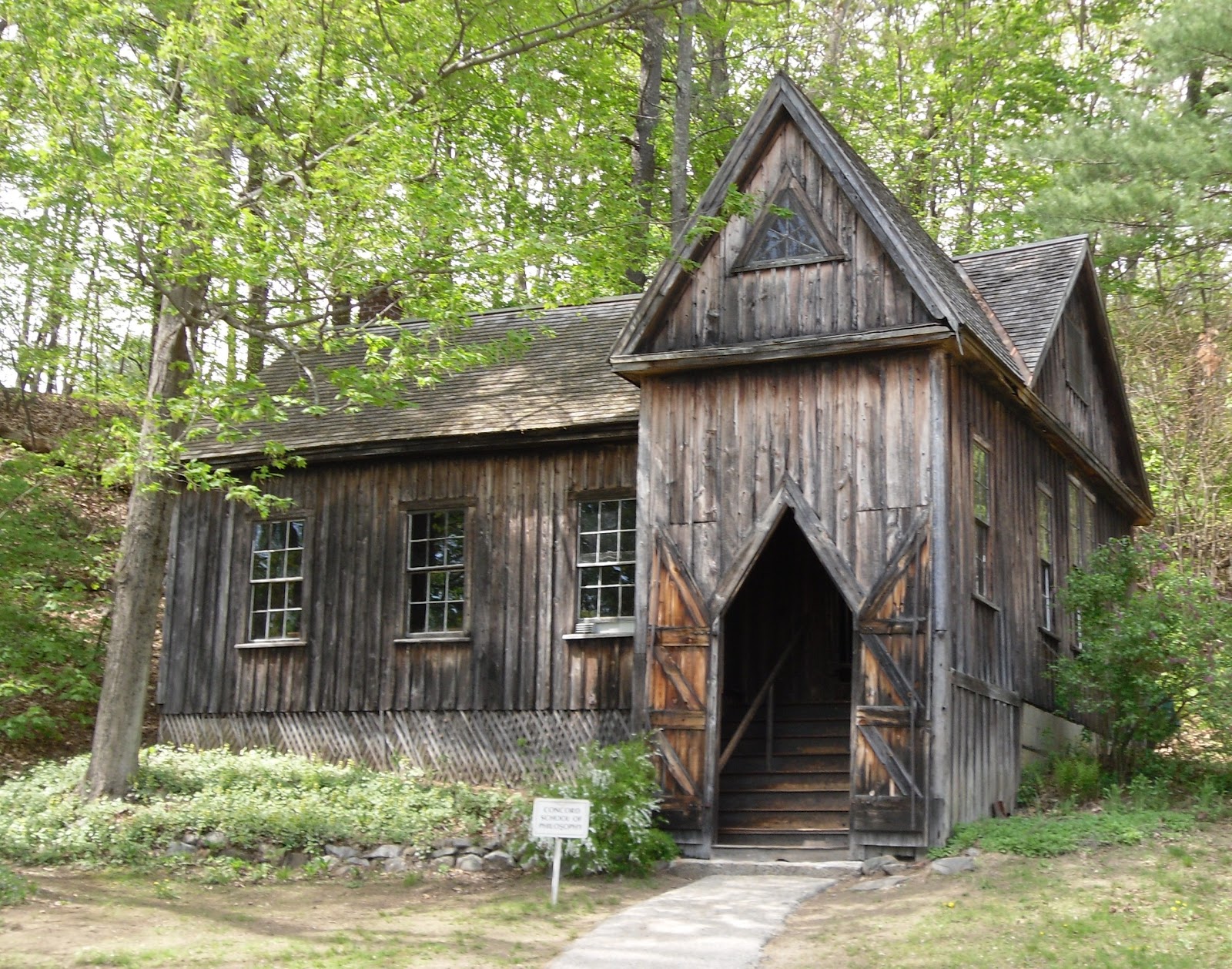
The Concord School of Philosophy is at the side of the house and was run by Bronson from 1880 until a short while before his death.

29 May 2011

Sleepy Hollow Cemetery, Concord, Massachusetts

Most of the noted Concord writers are buried on Authors' Ridge, Sleepy Hollow Cemetery, Concord, MA, which is about a half mile north out of downtown Concord on the west side of Bedford Road, and no doubt the highest area of the cemetery. Very unusual it must be to find such of cluster of famous people all in one spot. 

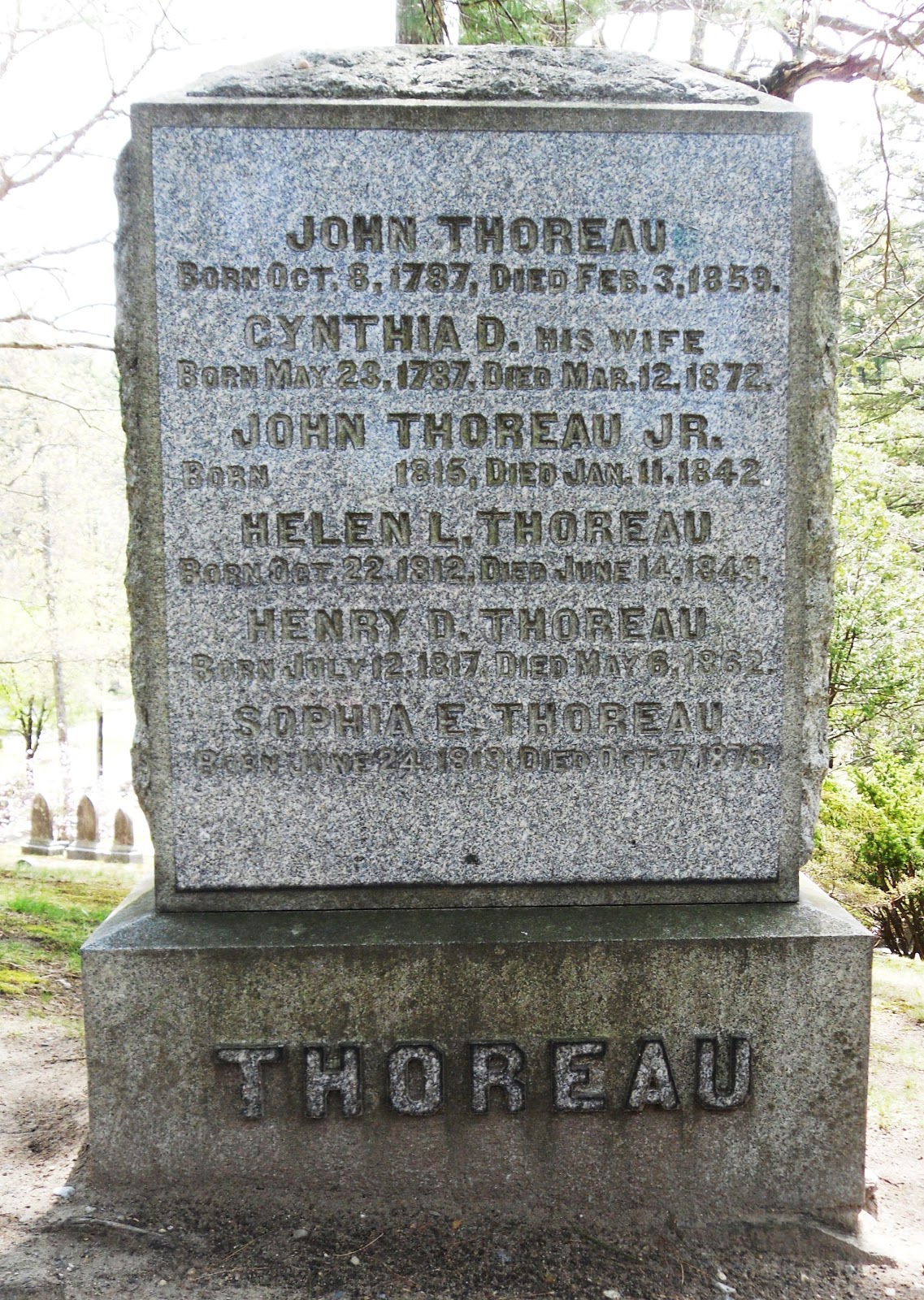
The Thoreau plot contains - along with Henry David Thoreau - the remains of Henry David Thoreau's pencil maker father John Thoreau (1787-1858), his wife Cynthia Dunbar Thoreau (1787-1872), his brother John Thoreau Jr (1816-42), and his younger sister Sophia E. Thoreau (1819-76).

It's not difficult to spot the grave of the most noted Thoreau.

And right opposite is the grave of Nathaniel Hawthorne in the Hawthorne plot.

'SOPHIA
WIFE OF
NATHANIEL HAWTHORNE
BORN IN SALEM MASSACHUSETTS
DIED IN LONDON
JANUARY TWENTY-FIRST 1871
BURIED IN KENSAL GREEN
REINTERRED HERE JUNE 2006'

Emerson's huge slab of granite.

'RALPH WALDO
EMERSON
BORN IN BOSTON MAY 1803
DIED IN CONCORD APRIL 27 1882
THE PASSIVE MASTER LENT HIS HAND
TO THE VAST SOUL THAT O'ER HIM PLANNED'

The above two-line quotation is from Emerson's poem 'The Problem'.

'LIDIAN
Wife of Ralph Waldo Emerson,
Wife of Charles & Lucy (Cotton) Jackson.
Born on 20th September 1802, close by
Plymouth Rock, as she loved to remember.
Died November 30th 1892 in Concord.'

Emerson's second wife (see post above).

'HARRIETT MILFORD STONE LOTHROP
MARGARET SIDNEY
THE CREATOR OF THE FIVE LITTLE PEPPERS
ALWAYS A LOVER OF AND WORKER FOR CHILDREN'

Lothrop (1844-1924) - as 'Margaret Sidney' (see the post above) - wrote children's stories.

As this marker states, Lothrop was the founder of the Children of the American Revolution. Had the marker not been there, it would have been difficult to find the grave.

The Alcott family plot.

Louisa May Alcott.

Edmund Hosmer (1798-1881) was a Concord farmer who was a friend of Emerson and Thoreau who was associated with the Transcendentalists and had helped Thoreau in the construction of his cabin.

'EPHRIAM WALES BULL
THE ORIGINATOR OF THE CONCORD GRAPE
BORN IN BOSTON MAR 4 1806
DIED IN CONCORD SEPT 26 1806
HE SOWED OTHERS REAPED'

Presumably the final line refers to the fact that Bull, a neighbor of Bronson Alcott's - thanks to Thomas Jefferson -  was unable to patent his invention, so lost out big time. The story of this is in an essay in Paul Collins's Banvard's Folly: Thirteen Tales of Renowned Obscurity, Famous Anonymity, and Rotten Luck (London: Picador, 2001).

'ELIZABETH PALMER PEABODY
1804-1894
A TEACHER OF THREE GENERATIONS OF CHILDREN,
AND THE FOUNDER OF KINDERGARTEN IN AMERICA.
EVERY HUMAN CAUSE HAD HER SYMPATHY.
AND MANY HER ACTIVE AID.'

Sophia Hawthorne's sister is buried far from Authors' Ridge.