
Showing posts with label Britton (Lionel). Show all posts
Showing posts with label Britton (Lionel). Show all posts
16 January 2020
Tony Shaw, PhD thesis: 'The Work of Lionel Britton' (2007)
Libellés :
Britton (Lionel),
Shaw (Tony)


2 May 2016
Thomas Thomas at the White Hart, by Robert Hughes
ROBERT HUGHES WRITES:
Thomas Thomas was the innkeeper of the White Hart Inn, Lower Maudlin Street, Bristol. He could also have been my great-great-great-great-grandfather.
In a city where there were not only many Thomas Thomases, but where at least two who were publicans, it is difficult to identify one individual and attribute a life story to him. Here we do at least make the attempt, but we have to start below: this is an engraving of the British Needle Mills, said to have been the biggest needle factory in the world.

Although Samuel Thomas (1807-1878) built this mighty factory complex while still in his twenties or very early thirties, there is as yet no record of how he obtained the money to do it. Supposing he had a big fortune behind him in the first place, there would be nothing remarkable as to how he afforded his endeavour, although it was an outstanding enterprise by any standard.

However, Samuel was thought to have started life a ‘simple workman’. Consider this press cutting below, concerning his will after he died.
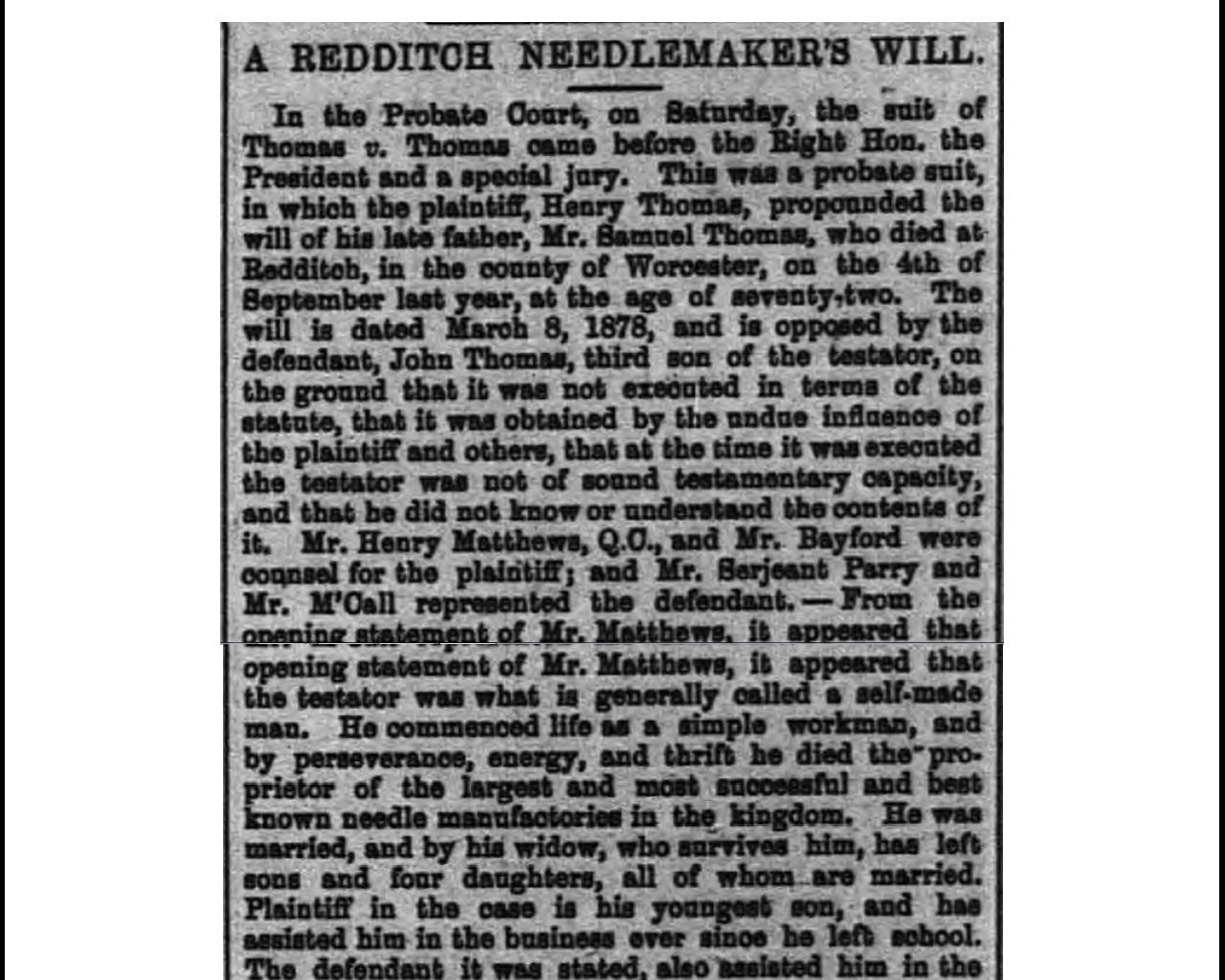
On the face of it, this is the kind of story which inspired Victorian England. Even if he did not literally start life as a simple workman, his achievement was immense. Lionel Britton was not a great fan of ‘Trade’, and the British Needle Mills were nothing less than ‘Trade’. We have been able to conclude that Hunger and Love is a long (and yes it is long!) primal scream against his own background.
Samuel Thomas may not have been the easiest of men to love, and in other articles we can see he quite openly had a mistress set up in a separate establishment over more than a decade, giving rise to the notorious Redditch Horsewhipping case of 1865. On the other hand, there are articles in the press archives which describe him giving out coal to the poor, receiving an award for generosity to his workpeople, and being ready to lend a hand when it was needed.
So he was an eminent man in his town, and yet did anyone have a clue where he had come from or how he financed the British Needle Mills? It certainly looks as though Samuel felt free to manufacture his own myths alongside his world-renowned needles.
Lionel Britton said that his great-grandfather ‘came from Wales with sixpence to his name’. This was quite likely to have been the prevalent myth within the family, and yet it is nonsense.

Samuel was born in Bitton, Gloucestershire. Three censuses attest to that, including the astonishing record of 1861 where he is at the home of his mistress in Spring St, Edgbaston. On the same day he is recorded in Redditch, where whoever filled in the form put NK as his place of birth. Nowhere else in my researches have I found another individual recorded in two places at once on any of the censuses!
Bitton was a large straggly parish between Bath and Bristol. Somewhere in the village is a stone proclaiming Bath is 6 miles and Bristol is 6 miles.
At the western end of the parish was the chapelry-of-ease at Hanham, where it was convenient for the locals to have their children baptised. Interestingly, we have an example of where a child seems to have had a baptism ceremony in Hanham and also in the parish church of Bitton: Ann Thomas was baptised 29 Jul 1805 at Hanham, and then 25 Aug 1805 at Bitton. The parents were James Thomas and Jane. We can return to this in a subsequent article, as another child of this couple later turns up in Redditch.
Bitton was a large straggly parish between Bath and Bristol. Somewhere in the village is a stone proclaiming Bath is 6 miles and Bristol is 6 miles.
At the western end of the parish was the chapelry-of-ease at Hanham, where it was convenient for the locals to have their children baptised. Interestingly, we have an example of where a child seems to have had a baptism ceremony in Hanham and also in the parish church of Bitton: Ann Thomas was baptised 29 Jul 1805 at Hanham, and then 25 Aug 1805 at Bitton. The parents were James Thomas and Jane. We can return to this in a subsequent article, as another child of this couple later turns up in Redditch.

Samuel Thomas was baptised 9 Feb 1807 at Hanham. From his tombstone in Redditch, photographed by my cousin David Guillaume before everything was torn up to make whatever Redditch is supposed to be now, he was born 16 Jan 1807. The likely baptism record gives us Samuel Stephens Thomas, and his parents were Thomas Thomas and Jane.
Samuel Thomas of Redditch who built the British Needle Mills was not known to use any middle initial, except that there is one intriguing record. His much-loved daughter Maria died in Paris in 1860, and this clip from the Worcestershire Chronicle quotes that middle initial:
Samuel Thomas of Redditch who built the British Needle Mills was not known to use any middle initial, except that there is one intriguing record. His much-loved daughter Maria died in Paris in 1860, and this clip from the Worcestershire Chronicle quotes that middle initial:

So who were Thomas Thomas and Jane? The only marriage in the Bristol Diocese which would fit was one between Thomas Thomas and Jane Pennington, 13 Apr 1801.

Does this make them the the parents of Samuel Thomas? An argument in favour would be that although Sam is the only child recorded in Bitton rather than in St James, he receives a middle name, like three of the other children of this couple but unlike around 90% of the rest of the population.
An argument against would be that Samuel had 11 children and never called any of them either Thomas or Jane. In the old days, it was something of a norm that names of parents were passed on to children. The only way we can reconcile this with the idea of Sam’s parents being Thomas and Jane is if we postulate that he was a bit of a radical, and wanted to branch out…perhaps even that he had had a breach with them and decided consciously to avoid any name that would honour them. That circumstance would be very sad indeed, but the evidence that those were indeed his parents’ names is rather strong.
He could have been the child of another and unknown Thomas and Jane, who were just passing by in Bitton (or the chapelry of Hanham). Persuading us against that however is that there is a tribe of Thomases in Hanham, and indeed James Thomas (born in Bitton) turns up as a needlemaker in Redditch in several censuses, and raises a big family.
Thomas Thomas and Jane Pennington seem to have had four children besides Samuel Stephens Thomas if he is indeed one of theirs. There is a Jane Thomas baptised in the parish of St James, Bristol 5 Sep 1802, then much later, also in St James, on 24 Mar 1816 three children are baptised at once. In the order in which they appear on the record:
Mary Anne Thomas
Thomas Pennington Thomas
John Pennington Thomas.
No place or abode is mentioned, but the father’s profession is “Brewer”.
The Bristol trade directories for 1819 and 1822 list a Thomas Thomas at the White Hart, Lower Maudlin St.
This website contains the following: The inn was offered for sale by auction in 1824, described it as old-established and well accustomed with brewhouse and good cellarage attached, for many years in the occupation of Thomas Thomas, tenant at will. It was 'situated ajacent to the steps leading to the church yard of the parish church of St James', link here.
An argument against would be that Samuel had 11 children and never called any of them either Thomas or Jane. In the old days, it was something of a norm that names of parents were passed on to children. The only way we can reconcile this with the idea of Sam’s parents being Thomas and Jane is if we postulate that he was a bit of a radical, and wanted to branch out…perhaps even that he had had a breach with them and decided consciously to avoid any name that would honour them. That circumstance would be very sad indeed, but the evidence that those were indeed his parents’ names is rather strong.
He could have been the child of another and unknown Thomas and Jane, who were just passing by in Bitton (or the chapelry of Hanham). Persuading us against that however is that there is a tribe of Thomases in Hanham, and indeed James Thomas (born in Bitton) turns up as a needlemaker in Redditch in several censuses, and raises a big family.
Thomas Thomas and Jane Pennington seem to have had four children besides Samuel Stephens Thomas if he is indeed one of theirs. There is a Jane Thomas baptised in the parish of St James, Bristol 5 Sep 1802, then much later, also in St James, on 24 Mar 1816 three children are baptised at once. In the order in which they appear on the record:
Mary Anne Thomas
Thomas Pennington Thomas
John Pennington Thomas.
No place or abode is mentioned, but the father’s profession is “Brewer”.
The Bristol trade directories for 1819 and 1822 list a Thomas Thomas at the White Hart, Lower Maudlin St.
This website contains the following: The inn was offered for sale by auction in 1824, described it as old-established and well accustomed with brewhouse and good cellarage attached, for many years in the occupation of Thomas Thomas, tenant at will. It was 'situated ajacent to the steps leading to the church yard of the parish church of St James', link here.


She died just a couple of weeks after the 1851 census, so we are lucky to have that.
John was with his brother Thomas in 1861, but his eventual fate is not yet clear. Given that in 1861 he was a labourer, and a probable record of 1871 gives him as ‘epileptic’, he was unlikely to have been an idiot and could have been simply…epileptic!
Thomas Pennington Thomas is easier to trace thanks to the happy fact that his middle name was included in his death record. He died 19 Nov 1874, said to be aged 62, and was a shoemaker or shoemaker clicker on every census except 1861 when he was a labourer. Possibly he had fallen on hard times in that year, or he chose not to elevate his station above that of his brother.
He married Ann Collings at Bedminster, then Somerset, on 27 Apr 1832. They had three known children:
Clara Ann Thomas, born 18 Apr 1844.
Angelina Pennington Thomas born 25 Jan 1849.
Thomas Alfred Thomas born 29 Mar 1851. These records are from GRO certificates in my possession. Clara Ann Thomas is in this Public Member Tree on Ancestry.co.uk.
Assuming the hypothesis is correct and Samuel Thomas was the child of Thomas Thomas and Jane Pennington, then I have identifiable fifth cousins with whom to make a DNA comparison which would prove it beyond all reasonable doubt.

The ‘Bristol’s lost pubs’ website gives us this image from the 1950s, which is out of copyright and can be freely used. The information includes the fact that Thomas Thomas was the landlord from 1816-1823. This is rather interesting as you will see the church of St James behind the pub and it is tempting to construct a narrative that whatever he had been doing before, he was now settling into running a pub that literally abutted the churchyard of St James, and that he then thought it was high time to have his hitherto unbaptised children christened in the church. This would put him right with the locals.
An item of family legend talks of an itinerant trader, (scrawled family tree by Charles Frederick Guillaume). Thomas may have been exactly that, and made enough to install himself in the White Hart and to increase his fortune by brewing as well as retailing beer.
Neither Thomas Thomas nor his widow Jane made a will unless an exhaustive search of the records has missed something, so is it not possible that Samuel Stephens Thomas, as the eldest son at the death of his father in 1829 acquired a decent pot of cash which he used to expand his needle business?
This is all in the realm of speculation at the moment. We would like to see some confirmation and will welcome any contributions from readers of this blog!
A final note: Ida Thomas (1902-2004) wrote a number of letters to my cousin David Guillaume who was trying to piece together the family tree. The following extract from one dated 30 Jan 2008, when she was already 95 years old, relates that “Original Samuel and a brother came together from Wales S. brother went to Leeds in the shoe manufacturing line…”
 Could this be a bit of family legend which contained at least a nugget of truth? Allowing for a mix-up between Leeds and Bristol (large cities NOT London or Birmingham!) and for the fact that we know Samuel himself did not come from Wales, this could be a description of Samuel Stephens Thomas and Thomas Pennington Thomas. One founded the British Needle Mills in Redditch, the other became a shoemaker.
An item of family legend talks of an itinerant trader, (scrawled family tree by Charles Frederick Guillaume). Thomas may have been exactly that, and made enough to install himself in the White Hart and to increase his fortune by brewing as well as retailing beer.
Neither Thomas Thomas nor his widow Jane made a will unless an exhaustive search of the records has missed something, so is it not possible that Samuel Stephens Thomas, as the eldest son at the death of his father in 1829 acquired a decent pot of cash which he used to expand his needle business?
This is all in the realm of speculation at the moment. We would like to see some confirmation and will welcome any contributions from readers of this blog!
A final note: Ida Thomas (1902-2004) wrote a number of letters to my cousin David Guillaume who was trying to piece together the family tree. The following extract from one dated 30 Jan 2008, when she was already 95 years old, relates that “Original Samuel and a brother came together from Wales S. brother went to Leeds in the shoe manufacturing line…”

5 July 2014
Elizabeth Fry (1774–1832), by Robert Hughes


Letter from Mollie Tanner, 27 March 2003
Lionel Britton (1887–1971) has been referred to many times here as Dr Tony Shaw is the world authority on this eccentric writer who was also my great-uncle. In the course of researching my family tree I have had enormous assistance from Tony, as well as from a number of cousins including David Guillaume, who has very kindly shown me Mollie Tanner's letter from which two of these images are taken.
Other articles have dealt with Samuel Thomas (1807–78), Lionel Britton's great-grandfather. Samuel married Mary Retallack in the parish of Stoke Damerel (broadly Devonport, Devon) on 2 September 1829, but until recently it was not clear who her parents were as there were several possible contenders within the parish, none of them convincing.
Now it emerges that Mary was born 8 November 1807, but her baptism was delayed until 18 March 1810, when she was baptised at the same time as her younger sister Elizabeth. The parents were John Retallack and Elizabeth.
We have a dramatic and poignant record of the death of Elizabeth Retallack, buried 'at the same time' as her younger daughter. The Exeter and Plymouth Gazette of the time described a raging cholera epidemic, but while the few named deaths did not include the Elizabeth Retallacks, mother or daughter, the paper had the temerity to declare that those not surviving were 'confined to the lowest orders'! Whoever wrote that ought to be horsewhipped, and your man for that would be the Samuel Thomas mentioned above, who was the protagonist in the notorious Redditch Horsewhipping Case of 1865, an affair which made the newspapers all over the kingdom!
The burial record for Elizabeth Retallack gives her as 55. Of all marriage records which come up on Findmypast between a John Retallack and an Elizabeth, the only persuasive one is 14 Mar 1805, in the parish of Antony, in Cornwall, between John Retallack and Elizabeth Fry. The only convincing Elizabeth Fry would be baptised in the nearby parish of Maker on 8 Jun 1774. At her death she would have been 58, not 55. The records generally are very unreliable about the ages of ladies in middle age and this discrepancy is in itself no show-stopper.
What is needed then is some other evidence that this couple were indeed the parents of Mary Retallack who was born in Devonport. Firstly, the parishes of Antony and Maker are just across Plymouth Sound from Devonport. All other records which might compete come from quite a long way further afield in Cornwall. An Elizabeth who marries a John Retallack in Roche and would have been exactly the right age turns out to have had a huge brood of children in Roche and never went near Devonport, while nothing else in the records comes even close.
So while it is gratifying to know about my Cornish ancestry (the Retallack heartland is centred around St Columb) and that I cannot be called an 'emmet' any more on my sojourns in that lovely county, there is also the need to feel confident that Elizabeth Fry was indeed my great-great-great-great-grandmother. Here a little snippet of family legend about a Fry connection would help...and bingo! We have one.
David Guillaume was researching the family tree in 2003 and received a letter from Mollie Tanner in which she asked for a little help on a topic never prompted by him. The images are reasonably clear, even though written by a lady coming up to 97 years old, and she says that she had a 'beautiful ivory fan with the initials E.F.' which she believed to be Elizabeth Fry. Now, she thought this might have been the Elizabeth Fry who was a famous prison reformer, but the only clear evidence handed down to her was that 'one of the Thomas family was a Miss Fry'.
A possibility then would be that the Jane who was Samuel Thomas' mother in the Bitton baptism of 1807 was Jane Fry, but no records support this. One of the children of Samuel Thomas and Mary Retallack might have married a Fry, but again there is no such record.
The ivory fan will have belonged to Elizabeth Fry, but not the noted reformer, just Elizabeth Fry from Maker who died of cholera at the same time as her youngest daughter.
Family history is not always about the sensational find of a connection to fame and celebrity, but more satisfying when, however poignantly, it reveals reality.
26 July 2013
Lionel Britton Recognised as a Working-Class Writer
Libellés :
Britton (Lionel),
Grant (J. C.),
Sommerfield (John)
After all the (almost studied) exclusion of Lionel Britton from books dealing with or mentioning working-class literature, it's very refreshing to find him included somewhere for once. Rather belatedly, I've just discovered The Encyclopedia of Twentieth-Century Fiction (2011) by editors Brian W. Shaffer and Patrick O'Donnell et al, and the first volume of it – Twentieth-Century British and Irish Fiction – includes a section titled 'Working-Class Fiction', which is by Aaron Kelly and includes a sizeable paragraph on Lionel Britton (p. 407). This is most welcome, although there are a few minor errors: Britton didn't go to Russia in the 1920s, and he didn't go there to seek Soviet citizenship: he made his application some time before 1920 (but was rejected), but he didn't in fact visit Russia until 1935 (at the expense of the International Union of Revolutionary Writers). Also, it is not certain that the protagonist Arthur Phelps dies in Britton's novel Hunger and Love (1931) because the narrator leaves it open.
Kelly also mentions John Sommerfield as a working-class writer, although recently Nick Hubble (via a biographical essay by Andy Croft) pointed out the error of including him in this category: Sommerfield's father was a self-educated journalist, and John Sommerfield went to University College School, Hampstead with such students as Stephen Spender and Maurice Cornforth.* This reminded me of the assumption that the obscure J. C. Grant – author of the slightly bizarre mining novel The Back-to-Backs (1930) – was of working-class origin, whereas I discovered that his father was a (probably relatively comfortable) journalist.
*Nick Hubble, 'John Sommerfield and Mass-Observation', The Space Between: Literature and Culture, 1914–1945, Vol. 8:1 2012: 31–52 (p. 31).
Kelly also mentions John Sommerfield as a working-class writer, although recently Nick Hubble (via a biographical essay by Andy Croft) pointed out the error of including him in this category: Sommerfield's father was a self-educated journalist, and John Sommerfield went to University College School, Hampstead with such students as Stephen Spender and Maurice Cornforth.* This reminded me of the assumption that the obscure J. C. Grant – author of the slightly bizarre mining novel The Back-to-Backs (1930) – was of working-class origin, whereas I discovered that his father was a (probably relatively comfortable) journalist.
*Nick Hubble, 'John Sommerfield and Mass-Observation', The Space Between: Literature and Culture, 1914–1945, Vol. 8:1 2012: 31–52 (p. 31).
13 October 2012
Antony Clayton: Netherwood: Last Resort of Aleister Crowley (2012)
Libellés :
Britton (Lionel),
Crowley (Aleister),
East Sussex,
Hastings

Netherwood is the fascinating biography of a house about two and a half miles from the centre of Hastings in East Sussex, but in particular it concerns the final years in the life of its most famous (or rather, infamous) inhabitant: the writer, occultist, magician and mountaineer Aleister Crowley.
Netherwood (not its original name) existed for approximately one hundred years, from about 1860 to 1870 until its demolition in 1968, and was a school in its early life, before Dr James Auriol Armitage (formerly a GP interested in healing by electricity) retired there with his wife in 1912. Dr Armitage's caretaker Charles Edward Bradman lived there after the death of the Armitages, and probably near the end of 1935 the actor and playwright Edmund Charles Vernon Symonds ('Vernon') and his wife Ellen Kathleen ('Johnnie') bought the then run-down property to turn into a socialist guest house with lectures by prominent intellectuals. The working-class author Lionel Britton, suffering from very poor reception of his latest play Animal Ideas, escaped there to do manual work in return for board and lodging.
The bulk of the book is taken up with a generally very sympathetic account of Crowley, or the Great Beast, once dubbed ‘the wickedest man in the world’ by sensationalist newspapers. Vernon and Johnnie weren't phased by this tag, especially when – direct from the Bell Inn in Aston Clinton, Buckinghamshire, without being allowed to pick up a fresh heroin supply on the way – a frail old man descended on them from an ambulance also carrying all his books.
It was 1 February 1945, and Crowley would live for nearly three years in Room 13, at Netherwood, until he died in bed on 1 December 1947. There he would indulge in his heroin habit (for his asthma, of course), his expensive taste in drink and tobacco, and go out to play chess at the local club. He had a number of visitors, notably including a young Richard Ellmann researching W. B. Yeats, and Professor Eliza Marian Butler. The brief obituary in the Hastings & St Leonards Observer of 6 December said 'his interest in magic [a word Crowley terminated with a "k"] seemed to have waned and he seldom even mentioned the subject.'
There are a number of illustrations in the book, such as a pre-Symonds photo of Netherwood; stills from the movie The Fall of the House of Usher, in which Vernon played a part and which was partly filmed at Netherwood; Lionel Britton pretending to lift a huge tree trunk; several shots of an elderly Great Beast; son Aleister Ataturk Crowley looking fearsome; and several paintings of Crowley's, including one now owned by Jimmy Page of Led Zeppelin fame.
This is a well researched and well annotated book: very informative.
(There are also contributions by Gary Lachman, Andy Sharp and David Tibet.)
Below is a link to my previous post on Netherwood.
––––––––––––––––––––––––––––––––––
Netherwood, Hastings: Lionel Britton Rants
9 October 2012
Lionel Britton's Will (Revised)
Libellés :
Britton (Lionel)
 One of the most amusing parts of my PhD thesis, I thought, was when I wrote about working-class writer Lionel Britton's will at the end of the second part of my Introduction. Coming from an atheist who cared little or nothing about animals, and his literary estate never likely to bring in any revenue, I thought this was his final joke to the world:
'[T]he copyright of all of Britton’s work, revealed in Britton’s will, went to the Royal Society for the Prevention of Cruelty to Animals, the British Union for the Abolition of Vivisection, the World Wildlife Fund, and — inexplicably, as he had no apparent connections there — the vicars and churchwardens of Polstead in Suffolk.'
However, Britton's great-nephew Robert Hughes, a tireless seeker of the truth relating to his family tree, has just discovered this information:
'I finally phoned the Ipswich Probate Office today, and it is now apparent that Lionel Britton did indeed make the bequests to the animal charities and to the vicar of Polstead and his churchwarden, genuinely and sincerely.
The only qualification is that this was not our Lionel Britton. Uncle Lionel died on 9 Jan 1971, and this guy, Lionel Henry Britton, on 9 Jun 1971. The latter Lionel was 72, and his will was indeed probated on 3 Aug 1971 at Ipswich. His last place of residence was an address in Billericay, but the registration district was Bury St Edmunds, which I would not have thought would include the home town of Tricky Dickie and his Cortina.* Probably he died at or near Polstead despite his home being officially Billericay.'
So he never made a will, and the University of Texas in Austin, whose database of writers' wills I retrieved the information from, has got it wrong. Ah well. The truth can be mighty boring at times.
* I can see the reference to Ian Dury's 'Billericay Dickie' here, but wasn't 'Tricky Dicky' a nickname for a certain disgraced US president: Country Joe McDonald's 'genuine plastic man' from Yorba Linda, CA?
–––––––––––––––––––––––––––––––––––
Country Joe McDonald – Tricky Dicky
Ian Dury & The Blockheads – Billericay Dickie
21 March 2012
Irza Thomas born in Rue St Denis, Paris by Robert Hughes
Libellés :
Britton (Lionel),
Goffin (Antoinette),
Thomas (Samuel Jr)
 The detailed birth records from Paris seem very recently to have appeared on the internet.
Irza Thomas, the mother of Lionel Britton, was born at 168 Rue St Denis, in what was then the 1st Arrondissement of Paris, on 21 May 1866.
The above picture is a close-up of part of the entry. It shows that the registrar was perhaps slightly pickled at the time, as he makes her 'fils' of her parents while conceding that she is of 'sexe feminin'. The recorded middle name Marie is not otherwise known, and the records available elsewhere state consistently that she was Irza Vivian Geraldine. Perhaps he mixed up her middle name with that of her mother, Antoinette, who is more familiar to us as Marie Antoinette.
9 February 2012
'Will of Samuel Thomas (1807-1878)' by Robert Hughes
 Samuel Thomas (Senior) died in 1878, at 71 years of age. He was buried at his parish church in Redditch, but the New Town development in the later 20th Century required his grave to be moved. A photograph taken at this time by my cousin David Guillaume shows a fairly elaborate tomb, with the date of birth reasonably discernible, but that of his wife Mary not clear because of corrosion of the stone.
An intriguing (if possibly apocryphal) story has it that the old guy was by persuasion an atheist, and only agreed to contribute to the church funds if he could be buried in such a place as would require all worshippers to confront the atheist every Sunday: i.e. just outside the church door!
Samuel is generally regarded as having his family origins in Wales, and indeed a scrawled tree by his great-grandson Charles F Guillaume states that he was from a Jewish family 'settled in Wales', and a 'travelling packman' who 'founded the needle industry in Redditch'.
My grandfather Bob Britton spoke little of his family, but I vividly remember hearing from him on at least one occasion that the Thomas family 'founded the needle industry in Redditch'. Independent evidence suggests that numerous producers were in the town well before Samuel Thomas' time, but Samuel Thomas and Co were extremely prominent (the facade of The British Needle Mills their factory is to be seen in the town today as a protected feature), and it is clear that Samuel was responsible for some important innovations, such as a process where needles were machine-sharpened thus replacing the costly and unhealthy sharpening by hand. A letter from Ida Thomas, who died at 102 and was a great-grand-daughter of Samuel, mentions how there was hostility to the introduction of the process, even though the hand-sharpeners had suffered ill-health from their work!
Another cousin tells how Samuel Thomas needed 16 bodyguards to protect him as he walked through the streets of Redditch, so many had he put out of work through the mechanisation of what had been a cottage industry.
The tension between industrial progress and traditonal craft is of course a well-worn theme and the term 'Luddism' today marks the machine-breakers of the period beginning about 1811.
With this background we might expect that Lionel Britton, also a great-grandson of Samuel Thomas (Senior), made him a villain in his seminal work 'Hunger and Love'.
Dr Shaw is the world expert on the volume and indeed on its author, but it would be surprising if he would disagree that the generic Victorian factory owner such as Lionel's great-grandfather Samuel Thomas figures as a major-league bad guy!
In some recent posts I have speculated whether Sam Junior (1835-1912) might have been held in a completely different light by Lionel, who certainly never knew Old Sam, but apparently had Sam Junior as his guardian at least for awhile. There is good evidence that their world views were remarkably similar.
The turning point in Sam Junior's life may well have come when he was cut out of his father's will. Before 1878, he had the expectation (as the eldest son) of inheriting a huge fortune by the standards of the time, but for whatever reason (and this is a long discussion which must be taken up later) he was disinherited in favour of the third surviving son, Henry. The bitterness over this is reflected in letters from Ida Thomas, who recounts how Sam Junior spent all his remaining funds fighting the will.
Above is the record of the probate, the relevant passage reading: "Proved at Worcester the fifteenth day of May 1879 by the oath of Henry Thomas the Son the sole Executor to whom administration was granted_ The Right Honorable Sir James Hannen Knight_ the President of the Probate Divorce and Admiralty Division of the High Court of Justice having on the twenty sixth day of April 1879 by his final Decree in a certain cause or suit then depending in the said Court entitled "Thomas against Thomas" pronounced for the force and validity of the said Will."
6 February 2012
'Samuel Thomas (1835-1912), and Ruskin' by Robert Hughes


This quotation from Ruskin is said to be in Samuel Thomas' own hand, and I am grateful to my cousin Maurice for bringing it to our attention as it could tell us a great deal about Samuel's character and beliefs.
The text reads: "The constant duty of every man to his fellows is to ascertain his own powers and special gifts; and to strengthen them for the help of others", and is from The Ethics of the Dust.
Ruskin is of course John Ruskin (1819-1910), one of the best known of Victorian poets, social commentators, and architectural critics. He became latterly a prominent exponent of radical social reform.
Maurice also has a dictionary of Classics, dated 1807, which Samuel had given to Ernest Augustus Thomas, Maurice's grandfather. (Is it a co-incidence that 1807 was also the year Samuel Thomas Senior was born?)
Lionel Britton, (of whom there is so much more on Dr Shaw's blog), had hard things to say of trade and the men who perpetrated it. Samuel, his grandfather, was undoubtedly a man of trade, but not necessarily seen by Lionel in that light.
Samuel, having been cut out of his needle manufacturer father Samuel Thomas' will, spent the rest of his life eking out a living as best he could. Although this undoubtedly included many years as a commercial traveller, and at least one attempt at manufacturing needles in his own right, was it so far different from Lionel's own travails as a ragged-trousered bookseller's assistant?
1 September 2011
Lionel Britton with His Nephews and Niece

Lionel Britton has been referred to extensively in this blog, and much is known about his literary endeavours.
This little picture however, despite its indifferent quality, makes an important point. Here is the quirky, argumentative Uncle Lionel in a very normal and touching family photo.
Lionel was not easy company as he would declaim and denounce rather than discourse, but in this scene he has taken a moment to relax with his brother Reginald Percy Leopold Britton (1889–1970, known perennially as Bob), at back right; his nephew Robin Carton Leopold Britton (1921–1927), bottom right; his nephew Duncan Campbell Britton, (1915–1976); and his niece Flora Jean Britton, (1919–2008).
We have no date for the photo, but you may conclude from the ages of the children that this was taken in about 1925.
16 August 2011
George Orwell, Lionel Britton, and 'The Proletarian Writer'
Libellés :
Britton (Lionel),
Orwell (George)

For a number of years now the transcript of 'The Proletarian Writer' – Desmond Hawkins's Home Service radio interview with George Orwell on 6 December 1940 – has been available in Peter Davison's A Patriot After All: 1940–1941, but I've only just noticed it online. As I've mentioned this in several posts before, I won't dwell on it again, except to repeat that it's very interesting how affected Orwell was by Lionel Britton's Hunger and Love: almost ten years after publication he's still talking about it, even calling it an 'exceptional book'. It seems hardly surprising, then, to find echoes of Britton in – for example – Keep the Aspidistra Flying and Coming Up for Air.
The transcript is here.
The transcript is here.
19 July 2011
George Albert Thomas, by Robert Hughes
Robert Hughes, the great-nephew of the writer Lionel Britton, continues to throw light on his family history, this time concerning the Spanish Civil War.
 George Albert Thomas was born in Coventry, Warwickshire, England, 25 Feb 1915, and was previously mentioned in this blog in an entry dated 17 November 2008, which described how his parents brought him to Saskatchewan, Canada.
His father was George Thomas, b. 1873 in Billancourt, Paris, to Samuel Thomas and his Belgian wife Marie-Antoinette (née Goffin).
His mother was Ethel May Thomas (née Morris), b. 1884 in Holt, Wiltshire, England, to Albert William Morris, a gardener on a big estate, and his wife Mary Ann (née Fisher).
Initially George and Ethel May went to Wolseley, where George’s brother Frank had already established himself as a nurseryman. Forestry was very big in the province at that time and Frank seems to have found employment planting trees, but George, the father of George Albert, seems to have been more of a mechanic, and eventually gravitated to the larger city of Saskatoon.
George Albert clearly joined the Mackenzie-Papineau Battalion and fought in the Civil War in Spain, where he died - details here.
Under the heading of ‘The Volunteers’ we can see there is only one George Thomas and that he is listed as Missing in Action, which in the context of that war meant he is almost bound to have been killed. (See any number of sources about the Spanish Civil War, which amply confirm that foreign ‘irregulars’ were not given Prisoner of War status, and therefore summararily executed.)
It is worth speculating about a radical streak in the Thomas family: in this guy it manifested itself in an urge to fight and die for a quixotic cause, and in the case of Lionel Britton a determination not to be sent out to die for any cause. (He was a conscientious objector in World War I.)
George Albert has a significant physical resemblance to his grandmother Marie-Antoinette, see photo below. Put him in drag and grey his hair and you would never know.

This lad will have gone to give his life for something he believed in, but to me as a cousin of his it seems a tragedy.

His father was George Thomas, b. 1873 in Billancourt, Paris, to Samuel Thomas and his Belgian wife Marie-Antoinette (née Goffin).
His mother was Ethel May Thomas (née Morris), b. 1884 in Holt, Wiltshire, England, to Albert William Morris, a gardener on a big estate, and his wife Mary Ann (née Fisher).
Initially George and Ethel May went to Wolseley, where George’s brother Frank had already established himself as a nurseryman. Forestry was very big in the province at that time and Frank seems to have found employment planting trees, but George, the father of George Albert, seems to have been more of a mechanic, and eventually gravitated to the larger city of Saskatoon.
George Albert clearly joined the Mackenzie-Papineau Battalion and fought in the Civil War in Spain, where he died - details here.
Under the heading of ‘The Volunteers’ we can see there is only one George Thomas and that he is listed as Missing in Action, which in the context of that war meant he is almost bound to have been killed. (See any number of sources about the Spanish Civil War, which amply confirm that foreign ‘irregulars’ were not given Prisoner of War status, and therefore summararily executed.)
It is worth speculating about a radical streak in the Thomas family: in this guy it manifested itself in an urge to fight and die for a quixotic cause, and in the case of Lionel Britton a determination not to be sent out to die for any cause. (He was a conscientious objector in World War I.)
George Albert has a significant physical resemblance to his grandmother Marie-Antoinette, see photo below. Put him in drag and grey his hair and you would never know.
This lad will have gone to give his life for something he believed in, but to me as a cousin of his it seems a tragedy.
4 May 2010
Lionel Britton and the Foundling Hospital, Coram's Fields, Guilford Street, Bloomsbury: Literary London #22
Libellés :
Bloomsbury,
Britton (Lionel),
London
Ed Glinert, in A Literary Guide to London (2000), mentions that Dickens publicized the work of the Foundling Hospital that once stood on Guilford Street in Household Words, and goes on to say that Harriet Beadle in Little Dorrit (1857) is known as 'Tattycoram' partly after an old nickname she had, partly after the place in which she was brought up.
When Lionel Britton - or rather, his protagonist Arthur Phelps - passed this way, it was still a hospital:
'Half-way down Guilford Street is the Foundling Hospital. That is for the love children. Thrown away because they were too expensive to keep, or because they were not proper, or because they came through lack of knowledge and were inconvenient. The bourgeoisie, whose social organisation has made it possible for the child and the mother to be together, built the stone walls and took it in. Do for cannon-fodder...'
Hunger and Love (1931), p. 412.


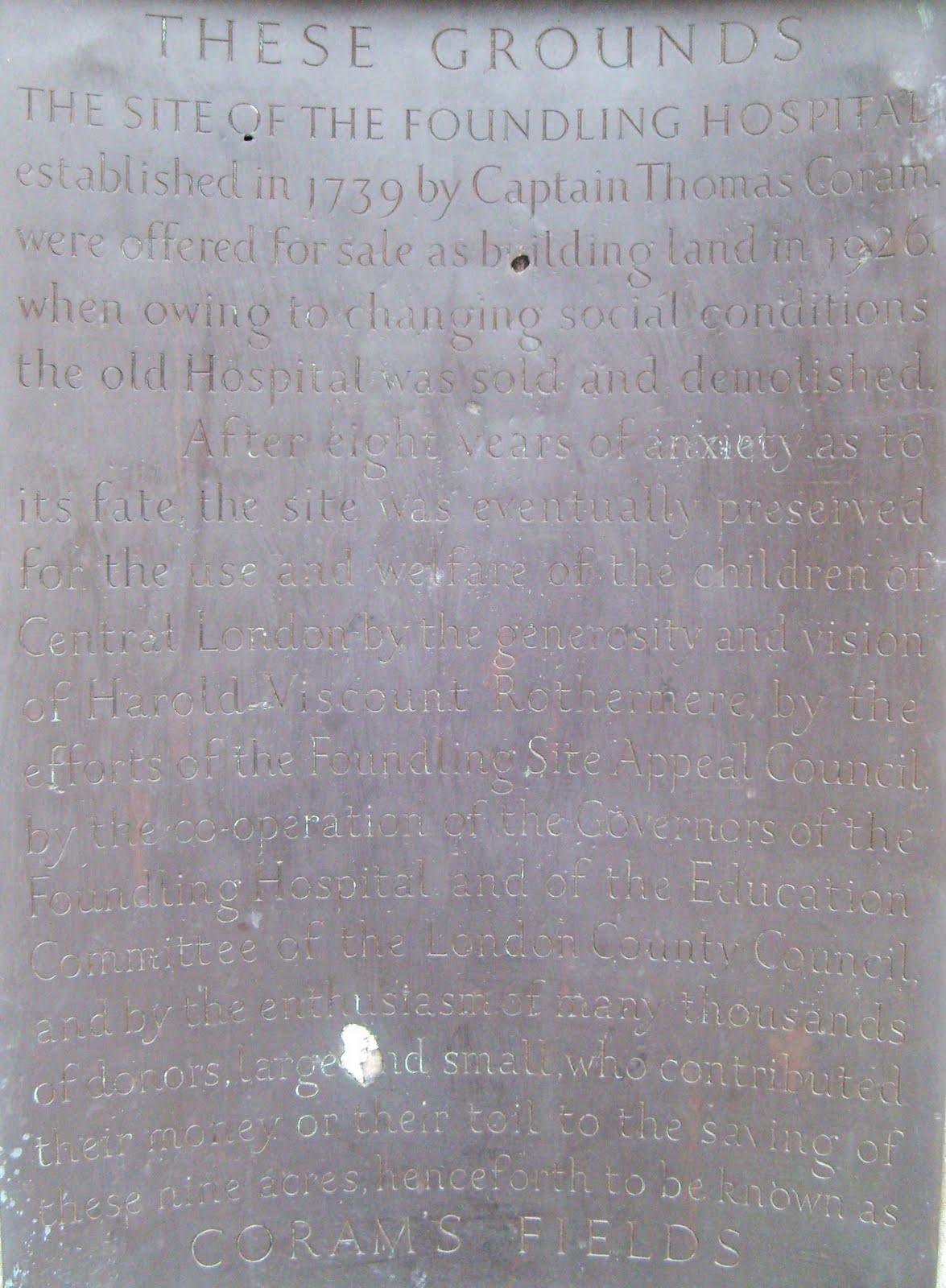
'THESE GROUNDS
THE SITE OF THE FOUNDLING HOSPITAL
established in 1739 by Captain Thomas Corem were offered for sale as building land in 1926, when owing to changing social conditions, the old Hospital was sold and demolished.
After eight years of anxiety as to its fate, the site was eventually preserved for the use and welfare of the children of Central London by the generosity and vision of Harold, Viscount Rothermere, by the efforts of the Foundling Site Appeal Council, by the co-operation of the Governors of the Foundling Hospital and of the Education Committee of the London County Council, and by the enthusiasm of many thousands of donors, large and small, who contributed their money or their toil to the saving of these nine acres, henceforth to be known as CORAM'S FIELDS'.
So the land has now been turned into a park. Coram's Fields looked interesting to me, but I wasn't allowed to enter as I wasn't accompanied by a child. The mad side of political correctness?
When Lionel Britton - or rather, his protagonist Arthur Phelps - passed this way, it was still a hospital:
'Half-way down Guilford Street is the Foundling Hospital. That is for the love children. Thrown away because they were too expensive to keep, or because they were not proper, or because they came through lack of knowledge and were inconvenient. The bourgeoisie, whose social organisation has made it possible for the child and the mother to be together, built the stone walls and took it in. Do for cannon-fodder...'
Hunger and Love (1931), p. 412.

THE SITE OF THE FOUNDLING HOSPITAL
established in 1739 by Captain Thomas Corem were offered for sale as building land in 1926, when owing to changing social conditions, the old Hospital was sold and demolished.
After eight years of anxiety as to its fate, the site was eventually preserved for the use and welfare of the children of Central London by the generosity and vision of Harold, Viscount Rothermere, by the efforts of the Foundling Site Appeal Council, by the co-operation of the Governors of the Foundling Hospital and of the Education Committee of the London County Council, and by the enthusiasm of many thousands of donors, large and small, who contributed their money or their toil to the saving of these nine acres, henceforth to be known as CORAM'S FIELDS'.
So the land has now been turned into a park. Coram's Fields looked interesting to me, but I wasn't allowed to enter as I wasn't accompanied by a child. The mad side of political correctness?
2 September 2009
E. Phillips Oppenheim and, er, Lionel Britton
Libellés :
Britton (Lionel),
Oppenheim (E. Phillips)


The combination of E. Phillips Oppenheim and Lionel Britton seems a very odd one indeed – the former a highly successful writer of thrillers and romantic novels who lived in this luxurious house, which now a pub – The Cedars in Evington, Leicestershire – and Lionel Britton, who lived in and wrote about squalor. But Britton's protagonist Arthur Phelps reads him – not for the story, of course, but to pick up tips on how to attract girls. It's also, inevitably, a great excuse for the narrator to have a rant:
‘Love had something to do with it. It was also considerably furthered by Mr. Phillips Oppenheim. Love, however, came first.
‘Novels are not much use to you. The convention is that they’re amusing, and you can’t afford to refuse to try anything at all that promises to make life a little lighter, so you’d had various goes at them. I suppose they satisfy prime ministers; I suppose they satisfy archbishops, ministers of education, - that sort of person; newspaper critics; anything seemed to do for them; lord mayors. It’s all very depressing. But sometimes you may find you like a novel for reasons which have nothing whatever to do with what the critics tell you you ought to like it for. Mr. Oppenheim’s thrilling and stirring stories and all that - I doubt very much whether you ever really troubled yourself much about them: you know, saving the heroine, and all that. But there was something, I remember it very well, which interested you, and that was Mr. Oppenheim’s interest in clothes; I think it must have interested him too. There comes a time, I suppose, when young men do begin to get interested in clothes, like cock birds in their plumage; and old Oppenheim notices the scurf on the shoulder, and the suit that was cut in the East End by a Socialist friend; all that sort of thing; and you begin to imagine yourself learning points and getting on in the world. Appearances count for so much; if you could find out how to do it. And there was, of course, the love of women. Cockadoodledoo!
‘Well, one has the form of the species; primary and secondary sex characters, endocrine glands, and all that; one lives in a civilisation made by publicans, lawyers, greengrocers and so on, and one keeps one’s sex characters what they call decently covered up, and one what they call decently interferes with the proper working of the endocrine glands, - exocrine, too, for that matter. And in the resulting bodily discomfort and soul atmosphere of veiled suggestion and nasty suppression they offer us religion, morality and romance as a substitute for the joy of life; black fog and dustbins, instead of the sun and the hills. Would you like a little light reading, now, to pass the time? Soon be dead.
‘God, according to the archbishop, gave you your body; and the archbishop, having a superior sense do decency, has ordered the job to be covered up. Prime ministers being in charge of our civilisations, if you want to succeed you must have a good clothes appearance - what’s inside them doesn’t matter much, because prime ministers don’t know what the human is. A syphilitic penis or vagina doesn’t matter to them so long as it’s covered up. Love being one of the most glorious of the emotions of mankind you must provide yourself with a dirty mind when you think of your sex organs - the pastor will see to that - and make your appeal for feminine favour by covering up what looks human about you with a bit of rag. That is how, Arthur my boy, you and I are going to get on in the world: to find a high place to help in its work: to feel the glory and delight of the sweet sex interchange of love. The butcher and the publican have seen to that. Pastors and masters. House of Lords.
‘Well, as I say, your gonadic maturity and Mr. Phillips Oppenheim between them, aided by the underground influence of all the other blighters, turned your attention to clothes; Love, - you know; and getting on in the world. Not that I suppose it would have made much difference but for that couple of bob. Two bob a week is a big material difference in the substratum of reality, and all these other things are merely an appearance or reflection on the top: love, and romance, and success in life. The two bob vanished so fast you might have supposed, as soon as you got used to it, that there was no more there than there was before. It was like the square of the odd bit of calculus: you could pretend it wasn’t there, and it didn’t make any difference. Or so you might think. But it was there, all the same. And it did make all the differnece.
‘Romance and love - many a soul has starved upon them; while a pail of horse-dung would have kept them alive. You can stand behind a shop’s counter and grab profit for the shopkeeper who owns you, while love and beauty and romance pass you by, but at least you will keep your cells together, and dream: if you feel so inclined. The earth is yours…to dream about …so long as you keep your cells together. If They don’t find you out.
‘Two bob, then, was the material basis; and over above it was the dream. Having the material basis you began to take a practical interest in Mr. Phillips Oppenheim, 3d. apiece, Foyle’s, 2d. on return; how so-and-so pinched a look at the inside collar of the shabby but distinguished-looking overcoat of a certain valet, arguing that it was too distinguished to have been made for the valet. And having got the name of the big pot’s tailor (it being easy to get done in the eye if you went by the outside appearance of a tailor’s shop) and of the tailor’s customer (since you would get no attention without a recommendation), you just strolled in and ordered a few hundred poundworth of clothes - lounge suits and hunting suits and dinner suits and fishing suits or whatever it is they wear, and don’t look at these things I’ve got on; Sir So-and-So, you know, the big pot, and all that. Ah, ba gum lad, and he was a big pot too. And the shopkeeper, or whatever they call themselves in these big establishments, impressed partly by the magnitude of the order - one never asks the price, you know - and awed by the name of the big pot, saw about it, and very nearly said Sir, and let on to being a tailor although there was no trade on the brass plate.
‘So that - that was how it was done. You’re underdog. All these people had the advantage of you right away. They put on their distinguished appearance in the morning and took it off again at night to prevent it from being creased. You can see at a glance they’re superior: lord! look at our trousers….If now, you had somebody to press your trousers and keep them dry-cleaned for you, and could afford good cloth and a swanky tailor with no trade on the brass plate, and professors at the university pumping understanding into you whether you liked it or not - where’d be the difference? They didn’t even have the trouble of wanting to be human. The valets and professors did it all for them. Name on headstone when they’re dead. Here was a man? They’re your masters.
‘But as for you - tuck you shirt in, for God’s sake! - you do want to be human. You don’t know what it means, any more than they do; but the desire is in you blood. For all you know these people may be human. Whether it’s because they look better in a nice suit of clothes or whether their appearance has helped them to more human environment and given them a chance, and whether it’s the shabbiness of your clothes that keeps you down or just the natural manginess of your soul, you don’t know. But they may be human, for all you know: though sometimes you have doubts. Surely,- they can’t have any hand in keeping you down? Look at the slums, my boy: the human race…
‘So you read your Phillips Oppenheim. And you scouted round the various tailor’s shops, evading the touts as well as you could, comparing models and prices. Some of them were as much as three guineas [£3.15]. But they were your rulers. There was that chap who was the only man in the street who had ever earned £12 a week as foreman cutter. Blimey, some of ’em were as much as £5 apiece. But that was quite out of it’ - Hunger and Love, pp. 128-31.
24 August 2009
Rone Waugh Paints Lionel Britton
Libellés :
Britton (Lionel),
Modernism,
Radek (Karl),
Rudd (Kevin),
Socialist realism,
Waugh (Rone)
The Australian artist Rone Waugh is an admirer and a relative of the working-class writer Lionel Britton, and, inspired by Fredda Brilliant's bust of the wild man, has painted this tribute, which is 'a diptych, acrylic and beeswax on canvas 1.5m x 2m over the 2 panels':
 Rone asked me to comment on this work, and my reply (after deleting a few spelling errors on my part), was:
'Hi Rone
'Many thanks for sending me this brilliant diptych. I was too tired, after a long drive yesterday, to make a coherent reply to your question, but have probably woken up and recovered sufficiently to make an acceptable response. I love the brown study of Britton's face, which is tremendously evocative of the suffering he went through, and his preoccupations etched out subtly in the background are very effective. The hunger and love dichotomy/marriage is of course more pronounced because hunger and love – the experiences and the book itself – were his central preoccupations. (It's significant that, some years after the publication of Hunger and Love, Britton told a journalist that he regularly returned to the novel and learned more things from it.) The Picassoeque blue girl aptly occupies the 'love' side.
'And then we come to the 'socialist realism' banner, running amost parallel to the preoccupations, which intrigues me. This was of course the prevailing Soviet aesthetic, and although not all Stalinist critics wholly identified with it in private, the majority of them toed the line in public, such as when Radek repeatedly denounced modernism, and Joyce in particular, as 'bourgeois'. So 'socialist realism' is at odds with the Cubist-inspired blue girl, and (in spite of the heavily realistic elements in Britton's work) at odds with Britton's politics (especially after his visit to Russia), and at odds with his aesthetic – he was very much in favour of avant-garde cinema, for instance, and tried to introduce strongly impressionistic elements into his writing. So I assume that 'socialist realism' is a piece of graffiti written on the painting by the upholders of the Stalinist aesthetic.
'But, of course, there seems to be a major contradiction: the graffiti is blue rather than red. Is this because red would have clashed too strongly with the other colours, and/or made the painting too simplistic? Is the blue the Stalinist graffitist's own contradictions – his or her rebellious thoughts – coming to the fore? Or is the Stalinist graffitist saying that Britton's work (associating the blue, perhaps, with Picasso) is a modernist bastardization of socialist realism? Or am I way off the mark? Not that it matters, of course, because any kind of artistic work should provoke ideas, and you've certainly done that.
'I'd welcome your comments on my comments, though.
'Cheers and well done!
'Tony'
Rone's response:
'Hi Tony.
'Many thanks for your positive response to my painting and your comments are right on the money.
'The rationale behind the graffiti is that it represents the misunderstanding by the Russians of Lionel's politics and also his book.
'Having said that I should explain I am very much an intuitive painter and don't try to over-analyse what I do either before or after. In fact paintings that rely on explanation have failed IMHO.
'In hindsight the reason for the use of blue graffiti is that red would have given undue emphasis and, as you suggest, been less thought provoking. The fact that I only have one can of spray paint probably has nothing to do with it :)
'The attached pic is a painting (also a diptych about the same size as the Britton work) I made recently of the prime minister of Australia Kevin Rudd. His uninformed comment on photographer Bill Henson's work is depicted with the same spray can.
'Cheers and thanks again for your comments.
'Rone
'PS: The photos are not the best and don't show the texture which is an important element of my work. I hope to make a better effort soon.'

 Rone asked me to comment on this work, and my reply (after deleting a few spelling errors on my part), was:
'Hi Rone
'Many thanks for sending me this brilliant diptych. I was too tired, after a long drive yesterday, to make a coherent reply to your question, but have probably woken up and recovered sufficiently to make an acceptable response. I love the brown study of Britton's face, which is tremendously evocative of the suffering he went through, and his preoccupations etched out subtly in the background are very effective. The hunger and love dichotomy/marriage is of course more pronounced because hunger and love – the experiences and the book itself – were his central preoccupations. (It's significant that, some years after the publication of Hunger and Love, Britton told a journalist that he regularly returned to the novel and learned more things from it.) The Picassoeque blue girl aptly occupies the 'love' side.
'And then we come to the 'socialist realism' banner, running amost parallel to the preoccupations, which intrigues me. This was of course the prevailing Soviet aesthetic, and although not all Stalinist critics wholly identified with it in private, the majority of them toed the line in public, such as when Radek repeatedly denounced modernism, and Joyce in particular, as 'bourgeois'. So 'socialist realism' is at odds with the Cubist-inspired blue girl, and (in spite of the heavily realistic elements in Britton's work) at odds with Britton's politics (especially after his visit to Russia), and at odds with his aesthetic – he was very much in favour of avant-garde cinema, for instance, and tried to introduce strongly impressionistic elements into his writing. So I assume that 'socialist realism' is a piece of graffiti written on the painting by the upholders of the Stalinist aesthetic.
'But, of course, there seems to be a major contradiction: the graffiti is blue rather than red. Is this because red would have clashed too strongly with the other colours, and/or made the painting too simplistic? Is the blue the Stalinist graffitist's own contradictions – his or her rebellious thoughts – coming to the fore? Or is the Stalinist graffitist saying that Britton's work (associating the blue, perhaps, with Picasso) is a modernist bastardization of socialist realism? Or am I way off the mark? Not that it matters, of course, because any kind of artistic work should provoke ideas, and you've certainly done that.
'I'd welcome your comments on my comments, though.
'Cheers and well done!
'Tony'
Rone's response:
'Hi Tony.
'Many thanks for your positive response to my painting and your comments are right on the money.
'The rationale behind the graffiti is that it represents the misunderstanding by the Russians of Lionel's politics and also his book.
'Having said that I should explain I am very much an intuitive painter and don't try to over-analyse what I do either before or after. In fact paintings that rely on explanation have failed IMHO.
'In hindsight the reason for the use of blue graffiti is that red would have given undue emphasis and, as you suggest, been less thought provoking. The fact that I only have one can of spray paint probably has nothing to do with it :)
'The attached pic is a painting (also a diptych about the same size as the Britton work) I made recently of the prime minister of Australia Kevin Rudd. His uninformed comment on photographer Bill Henson's work is depicted with the same spray can.
'Cheers and thanks again for your comments.
'Rone
'PS: The photos are not the best and don't show the texture which is an important element of my work. I hope to make a better effort soon.'

Lionel Britton Poses
Libellés :
Bramwell (Betty),
Britton (Lionel)
This painting is by Betty Bramwell, about whom I know nothing, although, judging from a few times this image cropped up in the Lionel Britton Collection at Southern Illinois University, Carbondale, IL, I suspect it dates from the 1930s and perhaps from about the time of the publication of Hunger and Love (1931). Many thanks to Robert Hughes for making the publication of this possible.


30 July 2009
Stanley Middleton (1919–2009)
 Toward the Sea (1995)
 Live and Learn (1996)
For a number of years the novelist Stanley Middleton (who won the Booker for Holiday (1974)), or Stan Middo as he was invariably and very affectionately known to us all, taught me English at High Pavement Grammar School, Gainsford Crescent, Bestwood Estate, Nottingham. I have many fond memories of him and his idiosyncrasies. During one lesson he told me that he imagined me reading Norman Mailer's An American Dream in the bath, although I still don't know why he came out with that, and I hadn't read the book at the time! The tests he set us were also idiosyncratic: I well remember him giving us ten questions every Friday morning on a few chapters of Great Expectations, and that one of them was 'How many mice ran across Miss Havisham's floor'? Today I don't remember what the answer was, and of course it is – and always was – completely unimportant, but I suppose it's an example of the importance of 'close reading' to Stan.
Although I didn't realize it at the time, Stan – like his friend and colleague Keith Dobson ('Dobbo' to us) – was an avid admirer of F. R. Leavis, and a piece of literature had to be studied in a vacuum, without historical, biographical, etc, trappings. In 2003 I was persuaded by a friend of Stan's to write to him: he'd once confided to me that although I thought he'd forget me, he wouldn't. Over all those years, he had of course forgotten me, but I received an interesting handwritten letter in reply. I post the contents, in full, below:


'42 Caledon Road
Sherwood
Nottingham
NG5 2NG
Tel: 0115 9623085
7. ix. 2003.
'Thank you for your letter. It arrived at the same time as one from John Kirton which I read first. He introduced you without giving your name so your letter was no surprise. I was delighted to hear from you, but now I'm really bad with names. As to my boast that I don't forget students, I don't think I'd make it any more.
'You're quite right about the influence of close reading and the Leavisite canon when you were at school. I remember Phil Davis told me that when he was a student at Cambridge (He'll be over 50 now or thereabouts and professor or head of the English department at Liverpool. Do you remember him at school?) he asked the then professor at Cambridge, Christopher Ricks, how he stood. 'Oh, we're all Leavisites now', said Ricks. I'd like to have heard C. R. [who has written some very favourable and detailed literary criticisms of Bob Dylan] trying to convince Leavis of the value of Bob Dylan. Nowadays Leavis and Leavisites seem to have disappeared as the morning dew. Students seem not to have heard of him.
'I was interested to read of your career. You seem to have drunk the cup of life to the full. I hope our Ph.D studies go well. The topic (no, I had not heard of Lionel Britton, though I had of James Prior) seems interesting, and raised matters that I had not ever considered.1 You're right in thinking I'm not very drawn to modern literary theory. I've no objection to it as a (very useful) tool, but the baby went out with the bath water [I had said in my letter that Leavis used to teach literature as if it has no umbilical cord!] Students and their misguided tutors were so immersed in 'theory' that they seemed to me to neglect the tools they were theorising about. Leavis's question 'Ask 'em what they love' [?] and it's [sic] triumphant cry 'Then you've got 'em', is where I stand. My friend at High Pavement, Ken [sic] Dobson, (dead now some years) was fond of this advice. He was a pupil of Leavis himself in the Thirties at Downing Coll. Do you remember him?
'It pleased me that John (K) said you praised me as a teacher. I used to think when I was teaching that I ought to be writing full-time. Now I'm glad, when occasionally I think about it, that I continued to teach. I guess I seem old-fashioned to modern critics, but fashion plays its part, and perhaps my time and method will come round again. I've just signed the contract for my next book with Hutchinson, (now part of Random House) but they haven't given me the date for publication.2 Money they sent, but that doesn't matter much at my age.
'I'm afraid I can't tell you where the D. H. L. quotation is from. If I see John Lucas I'll ask him, but I think that after Pauline's mother's funeral they're off to Greece.
'Yours,
'Stanley Middleton'
I used to live a very short distance away from Stan, on Gunthorpe Drive, which was part of architect Thomas Cecil Howitt's council house estate in Sherwood. Stan almost always walked to High Pavement: along Caledon Road into Hucknall Road and along it, then along Arnold Road and into the school. I too frequently walked to school – our route was almost the same – and I would often overtake him with an exchange of greeting. In the long lunchtime, we would very often run into him and Dobbo as they walked around the playing fields. They knew my political views were (and indeed still are) well to the left, and on one occasion – when they saw me with a copy of New Society, they told me: 'Watch what you're eating!', as the paper was owned by a Conservative. A lovely man.
1Lionel Britton (1887–1971) was a major – albeit unsung – working-class writer of initial middle-class origin forced by unfortunate circumstances into a menial working-class existence, and who wrote about the working class. In contrast, Stanley Middleton had his origins in the working class but chose to write about the middle class. Man Made of Smoke is perhaps Middleton's only book with a working-class main character.
21 July 2009
Lionel Britton, Cecil Thomas, and Adam Stanley Keith Make a Publishing Deal
Libellés :
Britton (Lionel),
Canada,
Hughes (Robert),
Shaw (Bernard),
Thomas (Cecil),
Thomas (Justin)

The photo below shows Lionel Britton between his cousin Cecil Thomas and Adam Stanley Keith, both of Tweedsmuir Ave, Toronto, Canada. It was taken in London on 26 May 1964, on the occasion of the signing of a contract between the three men. The aim was to establish a publishing company - later known as the Park Group Ltd after Park House, 66 Tufnell Park Road, where Britton lived - to re-publish all of Britton's out of print works, and many of his unpublished ones. They all had great hopes that Britton's name would be written large on Broadway. Unfortunately, Britton insisted that his amplification of Bernard Shaw's play, Why She Would Not, be published first, but the other men obviously feared legal recriminations, as The Society of Authors refused to allow publication. And Britton had had a very long and bitter, almost insane, feud with the Society over this.
Cecil later adopted Adam as his son, and he became known as Justin Thomas. Justin had been abused by his parents, and although illiterate until well into his twenties, went on to gain a PhD in Psychology. He wrote an autobiography with the glorious title How I Overcame My Fear of Whores, Royalty, Gays, Teachers, Hippies, Psychiatrists, Athletes, Transvestites, Clergymen, Police, Children, Bullies, Politicians, Mothers, Fathers, Publishers, and Myself, which gives several pages of informaton on Britton's ancestors. Justin established Label Liberation and still lives in Canada. When I had a long telephone conversation with him last year, he told me of how Britton rode to the above occasion on a bicycle, and that he met Herbert Marshall and his wife in London shortly after Britton's death in 1971, when they were arranging to have all of Britton's literary effects shipped to Southen Illinois University, Carbondale, where Marshall was a professor.
Many thanks to Justin Thomas for ferreting about in wherever he had to ferret about to make this photo available, and to Robert Hughes for passing it on.
14 June 2009
A Dolphin in a Sentry-Box; or, on the Trail of Lionel Britton
(I can't regret something I didn't know, but at the time of writing this article and having it published in a magazine devoted to an extreme right-wing crank is a heavy burden to take. Nevertheless, I can only repeat that at the time I had no knowledge of this.)
The extraordinary writer Lionel Britton (1887-1971) published one novel and three plays in the 1930s and then disappeared from the literary map. There were very few obituaries, although it was in one of them – an anonymous article entitled ‘Forgotten Genius Ends his Days at Margate’, in The Isle of Thanet Gazette – that I discovered that a number of his unpublished works remained intact. His friend Professor Herbert Marshall, a great admirer of Britton, had arranged for all his literary effects to be shipped to Southern Illinois University (SIU) in Carbondale.
Carbondale has a population of about 22,000, although in term time it almost doubles in size. I very much doubt that the name Lionel Britton is known in any other university in the world with the exception of the Open University, where I gained my PhD in Literature on Britton’s work. Yet at the Special Collections Research Center in Carbondale, which houses ninety archival boxes of Britton manuscripts, his name is familiar: one member of staff – obviously to some extent acquainted with his biography – even told me that all Britton needed was a therapist! (The reason for that remark will probably become clear later in this article.) I have been to Carbondale on two occasions, and recently spent five weeks poring over the contents of a number of those boxes. Below I give a synopsis of my findings.
Britton and the Written Word
It is sometimes difficult to ascertain what Britton’s literary influences were, although superficially it would appear from reading Hunger and Love that James Joyce is one of them. C.E.M. Joad comes to this conclusion in Under the Fifth Rib: A Belligerent Autobiography (1932), where he speaks about the ‘Cult of Unreason’, and claims that Britton writes in the same genre as Joyce, Huxley, Woolf and Lawrence. In his brief essay ‘Unreason in Modern Literature’, however, Britton reacts angrily to this, saying:
‘Who are these people? What’s that to do with me? I don’t know anything about these blokes. I’ve heard about them. I hear people talking about them, and every now and again I think to myself I ought to know something about this, and I pick up one of their books. And that’s as far as it gets. I jolly soon lay it down again. What’s this stuff to me? I’m not a critic who’s paid for reading. I’m a writer, and I don’t intend to take poison. If I read this stuff I find I can’t think afterwards. It muddles up the speech centre in the brain. I can no longer think or speak naturally. If I force myself a few sentences too far into one of their books, then until I take a mental purgative or emetic I’m done. I might as well be dead. I won’t do it.’
The reason for this outburst is perhaps initially unclear, although Britton was frequently given to such tantrums, and there are numerous examples of them in Hunger and Love. Evidently, Britton has adopted one of the common preconceptions about the modernists: they are elitists, and therefore out of touch with the working class. Britton sees himself as a ‘proletarian’ writer, and thinks it wholly inappropriate to share a modernist aesthetic with such authors.
But Joad quotes a passage from Hunger and Love which he finds incomprehensible, and then a passage from the ‘Ithaca’ section of Ulysses, which he finds is similarly written – ‘in jerks’:
‘Solitary hotel in mountain pass. Autumn. Twilight. Fire lit. In dark corner young man seated. Young woman enters. Restless. Solitary. She sits. She goes to window. She stands. She sits. Twilight. She stands. On solitary hotel paper she writes. She thinks. She writes. She sighs. Wheels and hoofs. She hurries out. He comes from the dark corner. He seizes solitary paper, He holds it towards fire. Twilight. He reads. Solitary.’
Britton appreciates that Joyce is trying to express restlessness here, and says that if Joad doesn’t understand that then he doesn’t know how to write. Britton, however, would not express it in quite the same way:
‘I could never say “On solitary hotel paper she writes”. I should say: “She writes. Hotel paper. Solitary hotel.” I should not say “In dark corner young man seated.” I should say: “Young man sitting in dark corner.” I’d run a mile rather than use a word like “seated”. Be seated, madam! Not me!’
Throughout Hunger and Love Britton sees his enemies the bourgeoisie as unnatural, and in this article he associates the writing of modernists with an artificial style of writing. If he read them, he could ‘no longer think or speak naturally.’
Fame
The earliest play that Britton wrote was ‘Fame; or, the Reluctant Employee’, which probably dates from the early 1920s if not slightly before. The first words are spoken by Harry Humphries, a starving writer who lives in a garret surrounded by books piled on egg box shelves and sugar box tables and chairs. He is holding a herring in one hand and a frying pan in the other:
‘Life wouldn’t be so bad, only it’s the nuisance of it. First you’ve got to anabolize, and then you’ve got to catabolize; and then it’s time for bed. Now I have here an anabolic herring, denominated red, for no particular reason so far as I can see except that it’s not red in many; the egg that – (feels it in sudden misgiving) – yes, it is hard; many’s the egg that creature laid all unmindful of its destiny down at the bottom of the deep blue sea, because (argumentatively) if they don’t lay them at the bottom where the dickens do they lay them? And to think that to-morrow that fish will be talking philosophy! in me! It’s enough to make a chap look upon himself as an alchemist. It’s a humble sort of instrument when you look at him to make the universe conscious of itself. (Suddenly thinking.) Was Buddha, wasn’t it? – Now what’s the blessed order? (Goes to dictionary, putting herring on table.) Now you lie there, while I look up your references. (Sniffs.) You’ve been out of work a long time. I always classify my food before I eat it. It makes it much more interesting to have a pedigree herring, complete with its genus and differentia, tracing its final journey down your digestive tract.’ (Turning up dictionary.)’
The themes of this passage and the writing style will be familiar to anyone who has ever read any of Hunger and Love, with its emphasis on science (‘anabolize’, ‘catabolize’), its clipped, digressive language (‘Was Buddha, wasn’t it?’), the vital importance of the learning process, and the humour. ‘Fame’ was evidently a precursor of Hunger and Love, and there is even a repetition in the play of the scene in the novel where a bookseller pronounces Pierre de Coulevain’s L’Isle inconnue as ‘Leelin Connu’. The Miss Whyman and the Doreen of Hunger and Love are conflated in ‘Fame’ to Dora, who first sees socialism from a negative perspective. In a heartfelt remark to her, Henry says: ‘I’m looking forward to seeing the employer’s head stuck on a pole.’ The use of the definite article instead of the possessive adjective is interesting here: Britton has shifted the dispossessed working class into a transcendent position and hoisted the bosses into history. (This is probably an allusion to Zola’s Germinal, where towards the end of the book a similar event takes place with the former boss’s genitals.)
The analogies between Hunger and Love and ‘Fame’ pile up, but it’s clear that – although many of the prototypical ideas in this play were forwarded to the novel, there was nevertheless a small amount of self-censorship in the published book; for instance, Britton saw H. G. Wells as a potential supporter of the novel, so he had to delete the following comment about Wells’s support for World War I: ‘I’m wonderfully fond of Wells. He’s a very great man; but he turned out a rotter during the war.’
Towards the end of the play, Henry looks forward to a successful life writing books instead of dusting them: clearly, ‘Fame’ looks to the future with hope as opposed to the bleak vision of Hunger and Love.
A Whisper to the Voice of Man
One of the aims of my second visit to SIU was to bring back a copy of ‘Murder’s Last Word’, Britton’s second and final novel and the follow-up to his huge Hunger and Love (1931). Hunger and Love boasted a five-page Introduction by Bertrand Russell and received very mixed reviews, although many of them – by Upton Sinclair and Richard Aldington, for example – were full of praise. It was well known at the time that Britton had had problems with publishers because he refused to allow them to make cuts to his repetitive and digressive novel; but in the end, Britton found a very sympathetic publisher in Putnam, and this first novel is highly unusual in that the publisher didn’t ask the author to make any emendations. In 1940, Britton was ready to show the world his second novel. Again, Putnam were enthusiastic, and their reader Constant Huntington told Britton that he had waited for years for the occasion. Why, then, was it never published?
The first obvious thing to note about Britton’s manuscript is that, at approximately 67,000 words, it is just over one fifth the size of Hunger and Love. But the second thing is far more important: Britton had made it clear that he intended to write a more popular novel, and this is what ‘Murder’s Last Word’ appears to be. Anyone familiar with Hunger and Love, though, especially with its treatment of some characters as an excuse for the narrator to launch into a long philosophical or scientific digression, would be very sceptical about Britton’s temperamental ability to write a ‘popular’ novel. And indeed, this scepticism would appear to be vindicated by two of the chapter titles: ‘Science and Morality’ and ‘Hegel Keeps His Secret’. And the beginning of the Preface strongly suggests that this ‘murder mystery’, as he calls it, will not be too far removed from what Britton’s readers expected: ‘[A]s any scientist will tell you in these days of Relativity, and as Copernicus found out before Einstein, the cart may push the horse as well as the horse pull the cart, and it all depends on whether you are going up hill or down, or, as in the solar system, on the point of view’, and ‘To a soldier, killing is everything; but as Hegel would have told you before you were born (though without a place in ‘Who’s Who’, and even then perhaps only if you could understand the Otherness in Being), killing implies being killed, and is impossible without it’. Everything seems to be in the place we would expect: Britton continues the long, circuitous sentences, and we appear to be set for the kind of digressions we are used to.
But this Preface is also a kind of excuse, and Britton is evidently apologising to his readers for having been forced to write within a more popular genre. Is there a great difference between this novel and Hunger and Love? Certainly the sub-title sounds a little like the Britton of the beginning of the previous decade: ‘A Sensational Thriller; or, “Blood” for Scientists, Philosophers, Statesmen, and Common Men of Today and Tomorrow – if There is a Tomorrow…’. Nevertheless, ‘Murder’s Last Word’ bears many similarities to conventional thriller fiction of the time. The language is (almost too) simple, the plot (and there is one this time) concerns a series of brutal murders which are embarrassing the police, and as the story unravels it transpires that this is the work of a ruthless (and German run) group of people who want to dominate the world by destroying everyone apart from the inhabitants of their own country; the novel also contains a few gory details, mystery, suspense, and a great deal of action. In a sense, it is everything that Hunger and Love is not, and there is a virtual absence of digression. Even the two nominally suspicious chapters mentioned above are conventional, and there is no scientific debate or philosophical discussion in them.
Britton sent out copies to a number of people to gauge the wisdom of his strategies, and there was some favourable response: V. Selson, ‘a business woman’ and the director of the Selson Machine Tools Co., said ‘Now that you have begun to write for people like me, you should be very successful.’ Fredda Brilliant, Herbert Marshall’s sculptor wife, said ‘I couldn’t at first believe that one and the same author could write such highly contrasting novels with equal brilliancy, but it seems that it is so! Such a book makes blitz reading for blitz hours!’ Bertrand Russell also congratulated him on his ability to adapt, although he thought that Britton should have made it clearer for duller readers who the main characters were meant to represent. Britton had said that this was a thriller with a difference, and it was intended as an allegory, an attack on Nazism. As he said (by way of another apology in an author’s note), ‘I have done the best I can with second best to add a whisper to the voice of man.’ Vernon Porter did not miss the point, but added: ‘I hope those who find the thrills absorbing will not miss the big idea and the clever criticism of dictatorship.’ P. Dienes of Birkbeck College added: ‘The idea behind the story is so good and so important that it seems to me to be wasted on a mere murder story, however cleverly done. And yours is damned well done.’
Dienes, though, along with a number of other readers, felt obliged to comment (very politely) on one small issue: ‘The scientific detail at the end is rather lengthy. I wonder if anybody wants to learn physics while waiting for the wholesale destruction of life on our planet?’ Britton had inserted six pages on the nature of the carbon atom into the novel: it was as if he could not be entirely forget the content of Hunger and Love. But it was sufficient to annoy a number of people. Amy Priestley, the head teacher of Monega Road Infant School in East Ham, loved it, but was forced to complain: ‘[D]o you really expect us lesser mortals to read a scientific lecture on the nature of carbon, when we are bursting for the denouement?’ And Marion Seeley, M.A., a senior English teacher at the Bromley High School for Girls, obviously agreed with her: ‘This I think won't be forgiven you by your average reader of thrillers. It holds up the action intolerably just when the excitement is at its highest pitch.’
Putnam, which had previously turned down later plays that Britton wrote, and had advised him to write another novel, were disappointed with the result, and had to make it clear that they did not publish thrillers. Many years later, Putnam bought the Dennis Dobson imprint and wanted to publish ‘Murder’s Last Word’ in the Blue Lamp Mysteries series. Britton refused because ‘it is obviously something more than just a thriller’.
Mr Pickwick
Britton may not have appreciated the work of the modernists but he enjoyed Charles Dickens a great deal. The half-title of the present article is a quotation from Dickens’s The Pickwick Papers (1836-37): Chapter VI of the novel takes place in the Wardle home at Dingley Dell, where Mr Pickwick plays whist, and where one of his opponents is ‘the unlucky Miller [who] felt as much out of his element as a dolphin in a sentry-box’. The phrase conjures up a surrealistic image that juxtaposes the artificial and regimented to the natural and the free, the violent to the peaceful, the grotesque to the graceful; it is an image of the outsider, and eerily sums up the world of Arthur Phelps of Hunger and Love. Equally, it sums up the world of Lionel Britton.
‘Mr Pickwick’ is the only play Britton wrote that was performed but not published. Its full title is ‘Mr Pickwick: In Search of Human Nature and the Strange Adventures that Befell Him Therein: An Original Play from the Pen of Charles Dickens through the Eyes of Lionel Britton’. It was performed at Rugby in 1945, although due to what appears to have been a cost-cutting exercise it was not, as originally scheduled, also performed at Huddersfield and Bristol.
In one of the archive boxes at SIU, a textually identical play is bound in a Kellogg’s Corn Flakes box, although there is a different subtitle: ‘[A]ttempts to capture Dickens’s original idea, which he lost as he went along’. It’s obvious that a dramatisation of The Pickwick Papers would vary in many ways from even the film version, but Britton’s treatment of the characters is nonetheless faithful to the characters, and to many events, in the novel. But the whole play takes place in the lounge of the Bull Inn.
The Pickwick Papers was in part a satire on the pretentious activities of historical societies, although this is lost in Britton’s version. What is important, from the beginning, is the working-class element, and Britton emphasises the role of Sam Weller in particular:
‘I feel that we have much to learn here, and perhaps more than we shall find in a further journey, and therefore I deemed it possible that the remarkable personality of the man in question and his services at this spot, would release my energies and afford me at the same time the stimulus of his curious reflections, in the pursuit of my investigations into the peculiarities of our fellow creatures.’
As may be expected, Britton – who used the expression ‘errand boy’ as a metaphor for a member of the working class – dwells on the seedier aspects of Weller’s history; Pickwick, who calls Weller a philosopher, is astonished by his accounts of his vagabond life, by his taking various precarious jobs and having to sleep in the filthy boarding houses of the ‘tuppenny rope’, or under Waterloo Bridge. Britton no doubt identified with Weller’s aphorism: ‘It’s bein’ poor where you sees life.’
To a lesser degree, Weller’s father is also a representative of working-class views:
‘[V]ot’s eddication for but to make the most o’ life, and not to be done no’ow by no sorts o’ blackguards, no matter how smart they thinks theirselves . Vy, ven you got that, you got eddication, and no puttin’ nothin’ arter your name nor no puttin’ nothin’ afore it, von’t take the place o’ that, sir.’
Pickwick replies: ‘I do really believe you are right.’
The blackguards Britton is thinking of, of course, are the bourgeoisie, and ‘Mr Pickwick’ makes considerable criticism of them. As in The Pickwick Papers, there are a number of occasions when the characters are allowed to voice their contempt for the legal profession: Sam is not allowed to kick anyone in the novel, although in the play he kicks the solicitor Dodson, who ‘scuttles out through the door like a scared cat’; in a general remark about lawyers, Old Weller remarks that ‘It’s a pint of honour vit ’em never to leave you nothing’. But it is perhaps Jingle who provides the best opportunity for Britton to extend his attacks to other institutions and also to indulge in the ‘headline abbreviation’ patterns of Hunger and Love; Jingle declares of Dr Slammer: ‘Poor fellow—disgraceful exhibition—mad doctors—regiments—shoot—mad—all mad!’
Several years after writing the play, Britton sent Robert Morley a copy of the script, and Morley claimed to have enjoyed the play immensely, but then realised that he couldn’t play Pickwick because he was a little fat man, whereas he was a big fat man. John Burrell of the Old Vic also rejected the play, claiming that Britton had taken ‘too many liberties’ with the novel.
O. H. M. S.
‘O. H. M. S.: or, How to Make God’ is an original play and marks a return to Britton’s experimental work. It was probably written in the 1940s or the 1950s and begins with a note which serves as a warning to any reader seeking the comfort of a traditional play: ‘If you are looking for the story it is very difficult, because it aint there’. The time is ‘Then, Now and Forever’, and the place ‘Here, There and Everywhere’. Britton continues:
‘The whole play is intended not so much to be immediately and clearly understood the first time it is seen, but as a kind of speaking music which will adjust man’s feelings towards himself and the universe, and which can be more and more understood the more deeply it is studied.’
The first scene is conventional enough, with a family scene set in the evening, and concerns a conflict between a conservative working-class father and his radical son who is studying at the local polytechnic. The son is a great believer in co-operation and believes that one day everyone will be working together for a just society, which he compares unfavourably to the past and the present, as represented by his father, whom he compares to an ape. At the end of the scene the mother partly reconciles the father to the fact that some social progress is being made in that their son, unlike his father, will never have to touch his cap to his bosses at work.
But this is the last we see of the family, and the characters in other sections also only make one appearance: the parts are only thematically related to one another. In the second section a British worker, and then a policeman, try to find some sense in a caveman; soon, they are replaced by a ‘Lit’ry Gent’ and a businessman with a fat cigar, the former arguing the merits of education for the masses, the latter saying that educating them too much will mean that they can ‘See through advertisements’.
In another section a sergeant is training his men when a child enters. The sergeant asks him what he wants, the child replies that he wants to grow up, and the sergeant explodes, ‘Well, you can’t grow up ’e r e ! Besides, you’ll ’ave your blasted career cut short, my bonny boy, with a bullet in the neck, if you come round ’ere tryin’ to bolshevise the soldiers, Now, just you tell me – oo the ’ell sent you?’ The brief speech is of course an attack on the armed forces cutting young men’s lives short, but it also shows the fear in the Establishment that left-wing views are infiltrating those forces.
Britton’s targets are virtually all institutions, and in the fifth section he finds a generic name for anyone he believes is standing in the way of progress – meaning in the way of the march towards anarchism and its twin goal of global co-operation as opposed to competition: they are Way-Closers, or W Cs for short. Britton couldn’t have predicted that wall-to-wall sport would replace the wall-to-wall religion of the 19th and early 20th centuries, although one W C’s remark suggests that Britton was aware of this opium of the people: ‘Sport is good. It uses up energy and nothing is achieved.’
Why She Would Not
Bernard Shaw’s last play, Why She Would Not, was written in the year that he died and was probably unfinished. Britton added a detailed ending to it, and for the rest of his life was obsessed with the refusal of the Society of Authors to allow the simultaneous publication of both Shaw’s piece and his own ending. He kept scrapbooks of newspaper cuttings about the Society, its financial details, and biographical details of the committee members.
Britton wrote to many literary figures protesting against the Society’s rejection of his work, and his grievances met with some sympathy, including that of Bertrand Russell, who remarked: ‘If the principle became established that nothing should be published unless it aroused admiration in a number of elderly big-wigs, the result would be a disastrous censorship’; Graham Greene told Britton that he had recently left the Society, but said that he could use his name as much as he liked in support of his campaign against it. Others, though, were less understanding. Britton was claiming that his aim was to restore Shaw’s good name because he had suffered negative criticism since his death: he believed that the ending would show the public what was in Shaw’s mind; unsurprisingly, T. S. Eliot failed to understand how another writer could show what was in Shaw’s mind.
In 1964, Britton sent a two-hundred-and-eighty-five-paragraph dossier to the Director of Public Prosecutions alleging fraudulent activities on the part of the Society of Authors. Nothing was ever proved. Also in 1964, Britton formed a company – The Park Group Limited – with two Canadians using a bank in the Bahamas with the intention of publishing and producing his plays for stage and screen, of which the first was to be ‘the Shaw play’. However, nothing appears to have come to fruition from the Park Group, probably because Britton was insisting that ‘the Shaw play’ be published first, whereas the other directors (who were responsible for all of the company’s not inconsiderable expenses pending a refund from the ‘profits’) were worried about a possible court injunction. Three years later Britton established his own company – Promethean Publishers Ltd – which appears never to have published anything either.
The play concerns a young man who begins working for a company and swiftly works his way up to the top to become the chair, although he is going to spread the profits evenly between all employees: essentially, his vision is to create a co-operative utopia. But did Britton write a masterpiece as he perhaps thought, or was he was his labour simply a point of principle?
The bound typescript begins with a fifty-page ‘Testament’ in which Britton records his struggle with the Society of Authors; it continues with a forty-eight-page Preface in which he gets a little carried away:
‘There are forms of life which live in the boiling springs of New Zealand, while others, like the anaerobic bacteria, can do without air and indeed choke in it, and the lichen makes a living on bare rock; and the variety and beauty of colour and form is only equalled by the multiplicity and hideousness of shapes so horrible that if only they were big enough to see without aids to vision they would fill the world with gibbering idiots within a week.’
Britton’s play then follows, then Shaw’s few pages, concluding with a ninety-page epilogue entitled ‘Inside Shaw’s Head’.
The play itself only takes up about a quarter of the total manuscript. It transpires that what Britton thought Shaw was thinking was in fact what Britton was thinking, and ‘Why She Would Not’ is a kind of fusion of Hunger and Love and Brain. It is a perfectly respectable play, but no masterpiece: the preliminary pages are of much more interest than the play itself. But then perhaps the same can be said of Shaw’s Prefaces.
We Are the Animals: A Song and Thought Musical
This play is written in the very rough spidery scrawl which characterised Britton’s writing in the few years leading up to his death, so it is highly probable that this was written towards the end of the 1960s, if not slightly later.
Act I is set sometime in the future at Hyde Park Corner, where various animals are preparing for a rally. The new lower classes are invertebrates, who are frowned on by the enfranchised vertebrates: lions don’t want the education of performing fleas, and declare that democracy ‘allows everybody the right to rob everybody else, and share in the robbery, by giving them the vote to elect those who control the robbery’.
Act II is set in the House of Uncommons, where the Home Secretary (the President of the Vertebrates’ Association) states that he will not support the demands of the invertebrates. There is much singing before Worm enters and has an altercation with Lion.
Act IV is the last, when the Russian Bear, the American Eagle and the British Lion enter and express national clichés. On the entrance of Lion, Worm and Lobster, Eagle says that atom bombs are getting smaller and cheaper, that they will be smuggled into big nations in diplomatic bags, timed to go off at the same time, and that this will lead to small nations being allowed to do as they please. This prompts Worm, a representative of the lowest group of workers, to sing in triumph:
‘When the nations have their fun
And they’re done in one by one
We’ll be there.
When the whole wide world is empty,
And the whole wide world is bare
We’ll be there.
When you’ve blown yourselves to bits
We’ll be there.
We’ll be there,
We’ll be there.
When you’ve blown yourselves to bits,
We’ll be there.’
Carbondale has a population of about 22,000, although in term time it almost doubles in size. I very much doubt that the name Lionel Britton is known in any other university in the world with the exception of the Open University, where I gained my PhD in Literature on Britton’s work. Yet at the Special Collections Research Center in Carbondale, which houses ninety archival boxes of Britton manuscripts, his name is familiar: one member of staff – obviously to some extent acquainted with his biography – even told me that all Britton needed was a therapist! (The reason for that remark will probably become clear later in this article.) I have been to Carbondale on two occasions, and recently spent five weeks poring over the contents of a number of those boxes. Below I give a synopsis of my findings.
Britton and the Written Word
It is sometimes difficult to ascertain what Britton’s literary influences were, although superficially it would appear from reading Hunger and Love that James Joyce is one of them. C.E.M. Joad comes to this conclusion in Under the Fifth Rib: A Belligerent Autobiography (1932), where he speaks about the ‘Cult of Unreason’, and claims that Britton writes in the same genre as Joyce, Huxley, Woolf and Lawrence. In his brief essay ‘Unreason in Modern Literature’, however, Britton reacts angrily to this, saying:
‘Who are these people? What’s that to do with me? I don’t know anything about these blokes. I’ve heard about them. I hear people talking about them, and every now and again I think to myself I ought to know something about this, and I pick up one of their books. And that’s as far as it gets. I jolly soon lay it down again. What’s this stuff to me? I’m not a critic who’s paid for reading. I’m a writer, and I don’t intend to take poison. If I read this stuff I find I can’t think afterwards. It muddles up the speech centre in the brain. I can no longer think or speak naturally. If I force myself a few sentences too far into one of their books, then until I take a mental purgative or emetic I’m done. I might as well be dead. I won’t do it.’
The reason for this outburst is perhaps initially unclear, although Britton was frequently given to such tantrums, and there are numerous examples of them in Hunger and Love. Evidently, Britton has adopted one of the common preconceptions about the modernists: they are elitists, and therefore out of touch with the working class. Britton sees himself as a ‘proletarian’ writer, and thinks it wholly inappropriate to share a modernist aesthetic with such authors.
But Joad quotes a passage from Hunger and Love which he finds incomprehensible, and then a passage from the ‘Ithaca’ section of Ulysses, which he finds is similarly written – ‘in jerks’:
‘Solitary hotel in mountain pass. Autumn. Twilight. Fire lit. In dark corner young man seated. Young woman enters. Restless. Solitary. She sits. She goes to window. She stands. She sits. Twilight. She stands. On solitary hotel paper she writes. She thinks. She writes. She sighs. Wheels and hoofs. She hurries out. He comes from the dark corner. He seizes solitary paper, He holds it towards fire. Twilight. He reads. Solitary.’
Britton appreciates that Joyce is trying to express restlessness here, and says that if Joad doesn’t understand that then he doesn’t know how to write. Britton, however, would not express it in quite the same way:
‘I could never say “On solitary hotel paper she writes”. I should say: “She writes. Hotel paper. Solitary hotel.” I should not say “In dark corner young man seated.” I should say: “Young man sitting in dark corner.” I’d run a mile rather than use a word like “seated”. Be seated, madam! Not me!’
Throughout Hunger and Love Britton sees his enemies the bourgeoisie as unnatural, and in this article he associates the writing of modernists with an artificial style of writing. If he read them, he could ‘no longer think or speak naturally.’
Fame
The earliest play that Britton wrote was ‘Fame; or, the Reluctant Employee’, which probably dates from the early 1920s if not slightly before. The first words are spoken by Harry Humphries, a starving writer who lives in a garret surrounded by books piled on egg box shelves and sugar box tables and chairs. He is holding a herring in one hand and a frying pan in the other:
‘Life wouldn’t be so bad, only it’s the nuisance of it. First you’ve got to anabolize, and then you’ve got to catabolize; and then it’s time for bed. Now I have here an anabolic herring, denominated red, for no particular reason so far as I can see except that it’s not red in many; the egg that – (feels it in sudden misgiving) – yes, it is hard; many’s the egg that creature laid all unmindful of its destiny down at the bottom of the deep blue sea, because (argumentatively) if they don’t lay them at the bottom where the dickens do they lay them? And to think that to-morrow that fish will be talking philosophy! in me! It’s enough to make a chap look upon himself as an alchemist. It’s a humble sort of instrument when you look at him to make the universe conscious of itself. (Suddenly thinking.) Was Buddha, wasn’t it? – Now what’s the blessed order? (Goes to dictionary, putting herring on table.) Now you lie there, while I look up your references. (Sniffs.) You’ve been out of work a long time. I always classify my food before I eat it. It makes it much more interesting to have a pedigree herring, complete with its genus and differentia, tracing its final journey down your digestive tract.’ (Turning up dictionary.)’
The themes of this passage and the writing style will be familiar to anyone who has ever read any of Hunger and Love, with its emphasis on science (‘anabolize’, ‘catabolize’), its clipped, digressive language (‘Was Buddha, wasn’t it?’), the vital importance of the learning process, and the humour. ‘Fame’ was evidently a precursor of Hunger and Love, and there is even a repetition in the play of the scene in the novel where a bookseller pronounces Pierre de Coulevain’s L’Isle inconnue as ‘Leelin Connu’. The Miss Whyman and the Doreen of Hunger and Love are conflated in ‘Fame’ to Dora, who first sees socialism from a negative perspective. In a heartfelt remark to her, Henry says: ‘I’m looking forward to seeing the employer’s head stuck on a pole.’ The use of the definite article instead of the possessive adjective is interesting here: Britton has shifted the dispossessed working class into a transcendent position and hoisted the bosses into history. (This is probably an allusion to Zola’s Germinal, where towards the end of the book a similar event takes place with the former boss’s genitals.)
The analogies between Hunger and Love and ‘Fame’ pile up, but it’s clear that – although many of the prototypical ideas in this play were forwarded to the novel, there was nevertheless a small amount of self-censorship in the published book; for instance, Britton saw H. G. Wells as a potential supporter of the novel, so he had to delete the following comment about Wells’s support for World War I: ‘I’m wonderfully fond of Wells. He’s a very great man; but he turned out a rotter during the war.’
Towards the end of the play, Henry looks forward to a successful life writing books instead of dusting them: clearly, ‘Fame’ looks to the future with hope as opposed to the bleak vision of Hunger and Love.
A Whisper to the Voice of Man
One of the aims of my second visit to SIU was to bring back a copy of ‘Murder’s Last Word’, Britton’s second and final novel and the follow-up to his huge Hunger and Love (1931). Hunger and Love boasted a five-page Introduction by Bertrand Russell and received very mixed reviews, although many of them – by Upton Sinclair and Richard Aldington, for example – were full of praise. It was well known at the time that Britton had had problems with publishers because he refused to allow them to make cuts to his repetitive and digressive novel; but in the end, Britton found a very sympathetic publisher in Putnam, and this first novel is highly unusual in that the publisher didn’t ask the author to make any emendations. In 1940, Britton was ready to show the world his second novel. Again, Putnam were enthusiastic, and their reader Constant Huntington told Britton that he had waited for years for the occasion. Why, then, was it never published?
The first obvious thing to note about Britton’s manuscript is that, at approximately 67,000 words, it is just over one fifth the size of Hunger and Love. But the second thing is far more important: Britton had made it clear that he intended to write a more popular novel, and this is what ‘Murder’s Last Word’ appears to be. Anyone familiar with Hunger and Love, though, especially with its treatment of some characters as an excuse for the narrator to launch into a long philosophical or scientific digression, would be very sceptical about Britton’s temperamental ability to write a ‘popular’ novel. And indeed, this scepticism would appear to be vindicated by two of the chapter titles: ‘Science and Morality’ and ‘Hegel Keeps His Secret’. And the beginning of the Preface strongly suggests that this ‘murder mystery’, as he calls it, will not be too far removed from what Britton’s readers expected: ‘[A]s any scientist will tell you in these days of Relativity, and as Copernicus found out before Einstein, the cart may push the horse as well as the horse pull the cart, and it all depends on whether you are going up hill or down, or, as in the solar system, on the point of view’, and ‘To a soldier, killing is everything; but as Hegel would have told you before you were born (though without a place in ‘Who’s Who’, and even then perhaps only if you could understand the Otherness in Being), killing implies being killed, and is impossible without it’. Everything seems to be in the place we would expect: Britton continues the long, circuitous sentences, and we appear to be set for the kind of digressions we are used to.
But this Preface is also a kind of excuse, and Britton is evidently apologising to his readers for having been forced to write within a more popular genre. Is there a great difference between this novel and Hunger and Love? Certainly the sub-title sounds a little like the Britton of the beginning of the previous decade: ‘A Sensational Thriller; or, “Blood” for Scientists, Philosophers, Statesmen, and Common Men of Today and Tomorrow – if There is a Tomorrow…’. Nevertheless, ‘Murder’s Last Word’ bears many similarities to conventional thriller fiction of the time. The language is (almost too) simple, the plot (and there is one this time) concerns a series of brutal murders which are embarrassing the police, and as the story unravels it transpires that this is the work of a ruthless (and German run) group of people who want to dominate the world by destroying everyone apart from the inhabitants of their own country; the novel also contains a few gory details, mystery, suspense, and a great deal of action. In a sense, it is everything that Hunger and Love is not, and there is a virtual absence of digression. Even the two nominally suspicious chapters mentioned above are conventional, and there is no scientific debate or philosophical discussion in them.
Britton sent out copies to a number of people to gauge the wisdom of his strategies, and there was some favourable response: V. Selson, ‘a business woman’ and the director of the Selson Machine Tools Co., said ‘Now that you have begun to write for people like me, you should be very successful.’ Fredda Brilliant, Herbert Marshall’s sculptor wife, said ‘I couldn’t at first believe that one and the same author could write such highly contrasting novels with equal brilliancy, but it seems that it is so! Such a book makes blitz reading for blitz hours!’ Bertrand Russell also congratulated him on his ability to adapt, although he thought that Britton should have made it clearer for duller readers who the main characters were meant to represent. Britton had said that this was a thriller with a difference, and it was intended as an allegory, an attack on Nazism. As he said (by way of another apology in an author’s note), ‘I have done the best I can with second best to add a whisper to the voice of man.’ Vernon Porter did not miss the point, but added: ‘I hope those who find the thrills absorbing will not miss the big idea and the clever criticism of dictatorship.’ P. Dienes of Birkbeck College added: ‘The idea behind the story is so good and so important that it seems to me to be wasted on a mere murder story, however cleverly done. And yours is damned well done.’
Dienes, though, along with a number of other readers, felt obliged to comment (very politely) on one small issue: ‘The scientific detail at the end is rather lengthy. I wonder if anybody wants to learn physics while waiting for the wholesale destruction of life on our planet?’ Britton had inserted six pages on the nature of the carbon atom into the novel: it was as if he could not be entirely forget the content of Hunger and Love. But it was sufficient to annoy a number of people. Amy Priestley, the head teacher of Monega Road Infant School in East Ham, loved it, but was forced to complain: ‘[D]o you really expect us lesser mortals to read a scientific lecture on the nature of carbon, when we are bursting for the denouement?’ And Marion Seeley, M.A., a senior English teacher at the Bromley High School for Girls, obviously agreed with her: ‘This I think won't be forgiven you by your average reader of thrillers. It holds up the action intolerably just when the excitement is at its highest pitch.’
Putnam, which had previously turned down later plays that Britton wrote, and had advised him to write another novel, were disappointed with the result, and had to make it clear that they did not publish thrillers. Many years later, Putnam bought the Dennis Dobson imprint and wanted to publish ‘Murder’s Last Word’ in the Blue Lamp Mysteries series. Britton refused because ‘it is obviously something more than just a thriller’.
Mr Pickwick
Britton may not have appreciated the work of the modernists but he enjoyed Charles Dickens a great deal. The half-title of the present article is a quotation from Dickens’s The Pickwick Papers (1836-37): Chapter VI of the novel takes place in the Wardle home at Dingley Dell, where Mr Pickwick plays whist, and where one of his opponents is ‘the unlucky Miller [who] felt as much out of his element as a dolphin in a sentry-box’. The phrase conjures up a surrealistic image that juxtaposes the artificial and regimented to the natural and the free, the violent to the peaceful, the grotesque to the graceful; it is an image of the outsider, and eerily sums up the world of Arthur Phelps of Hunger and Love. Equally, it sums up the world of Lionel Britton.
‘Mr Pickwick’ is the only play Britton wrote that was performed but not published. Its full title is ‘Mr Pickwick: In Search of Human Nature and the Strange Adventures that Befell Him Therein: An Original Play from the Pen of Charles Dickens through the Eyes of Lionel Britton’. It was performed at Rugby in 1945, although due to what appears to have been a cost-cutting exercise it was not, as originally scheduled, also performed at Huddersfield and Bristol.
In one of the archive boxes at SIU, a textually identical play is bound in a Kellogg’s Corn Flakes box, although there is a different subtitle: ‘[A]ttempts to capture Dickens’s original idea, which he lost as he went along’. It’s obvious that a dramatisation of The Pickwick Papers would vary in many ways from even the film version, but Britton’s treatment of the characters is nonetheless faithful to the characters, and to many events, in the novel. But the whole play takes place in the lounge of the Bull Inn.
The Pickwick Papers was in part a satire on the pretentious activities of historical societies, although this is lost in Britton’s version. What is important, from the beginning, is the working-class element, and Britton emphasises the role of Sam Weller in particular:
‘I feel that we have much to learn here, and perhaps more than we shall find in a further journey, and therefore I deemed it possible that the remarkable personality of the man in question and his services at this spot, would release my energies and afford me at the same time the stimulus of his curious reflections, in the pursuit of my investigations into the peculiarities of our fellow creatures.’
As may be expected, Britton – who used the expression ‘errand boy’ as a metaphor for a member of the working class – dwells on the seedier aspects of Weller’s history; Pickwick, who calls Weller a philosopher, is astonished by his accounts of his vagabond life, by his taking various precarious jobs and having to sleep in the filthy boarding houses of the ‘tuppenny rope’, or under Waterloo Bridge. Britton no doubt identified with Weller’s aphorism: ‘It’s bein’ poor where you sees life.’
To a lesser degree, Weller’s father is also a representative of working-class views:
‘[V]ot’s eddication for but to make the most o’ life, and not to be done no’ow by no sorts o’ blackguards, no matter how smart they thinks theirselves . Vy, ven you got that, you got eddication, and no puttin’ nothin’ arter your name nor no puttin’ nothin’ afore it, von’t take the place o’ that, sir.’
Pickwick replies: ‘I do really believe you are right.’
The blackguards Britton is thinking of, of course, are the bourgeoisie, and ‘Mr Pickwick’ makes considerable criticism of them. As in The Pickwick Papers, there are a number of occasions when the characters are allowed to voice their contempt for the legal profession: Sam is not allowed to kick anyone in the novel, although in the play he kicks the solicitor Dodson, who ‘scuttles out through the door like a scared cat’; in a general remark about lawyers, Old Weller remarks that ‘It’s a pint of honour vit ’em never to leave you nothing’. But it is perhaps Jingle who provides the best opportunity for Britton to extend his attacks to other institutions and also to indulge in the ‘headline abbreviation’ patterns of Hunger and Love; Jingle declares of Dr Slammer: ‘Poor fellow—disgraceful exhibition—mad doctors—regiments—shoot—mad—all mad!’
Several years after writing the play, Britton sent Robert Morley a copy of the script, and Morley claimed to have enjoyed the play immensely, but then realised that he couldn’t play Pickwick because he was a little fat man, whereas he was a big fat man. John Burrell of the Old Vic also rejected the play, claiming that Britton had taken ‘too many liberties’ with the novel.
O. H. M. S.
‘O. H. M. S.: or, How to Make God’ is an original play and marks a return to Britton’s experimental work. It was probably written in the 1940s or the 1950s and begins with a note which serves as a warning to any reader seeking the comfort of a traditional play: ‘If you are looking for the story it is very difficult, because it aint there’. The time is ‘Then, Now and Forever’, and the place ‘Here, There and Everywhere’. Britton continues:
‘The whole play is intended not so much to be immediately and clearly understood the first time it is seen, but as a kind of speaking music which will adjust man’s feelings towards himself and the universe, and which can be more and more understood the more deeply it is studied.’
The first scene is conventional enough, with a family scene set in the evening, and concerns a conflict between a conservative working-class father and his radical son who is studying at the local polytechnic. The son is a great believer in co-operation and believes that one day everyone will be working together for a just society, which he compares unfavourably to the past and the present, as represented by his father, whom he compares to an ape. At the end of the scene the mother partly reconciles the father to the fact that some social progress is being made in that their son, unlike his father, will never have to touch his cap to his bosses at work.
But this is the last we see of the family, and the characters in other sections also only make one appearance: the parts are only thematically related to one another. In the second section a British worker, and then a policeman, try to find some sense in a caveman; soon, they are replaced by a ‘Lit’ry Gent’ and a businessman with a fat cigar, the former arguing the merits of education for the masses, the latter saying that educating them too much will mean that they can ‘See through advertisements’.
In another section a sergeant is training his men when a child enters. The sergeant asks him what he wants, the child replies that he wants to grow up, and the sergeant explodes, ‘Well, you can’t grow up ’e r e ! Besides, you’ll ’ave your blasted career cut short, my bonny boy, with a bullet in the neck, if you come round ’ere tryin’ to bolshevise the soldiers, Now, just you tell me – oo the ’ell sent you?’ The brief speech is of course an attack on the armed forces cutting young men’s lives short, but it also shows the fear in the Establishment that left-wing views are infiltrating those forces.
Britton’s targets are virtually all institutions, and in the fifth section he finds a generic name for anyone he believes is standing in the way of progress – meaning in the way of the march towards anarchism and its twin goal of global co-operation as opposed to competition: they are Way-Closers, or W Cs for short. Britton couldn’t have predicted that wall-to-wall sport would replace the wall-to-wall religion of the 19th and early 20th centuries, although one W C’s remark suggests that Britton was aware of this opium of the people: ‘Sport is good. It uses up energy and nothing is achieved.’
Why She Would Not
Bernard Shaw’s last play, Why She Would Not, was written in the year that he died and was probably unfinished. Britton added a detailed ending to it, and for the rest of his life was obsessed with the refusal of the Society of Authors to allow the simultaneous publication of both Shaw’s piece and his own ending. He kept scrapbooks of newspaper cuttings about the Society, its financial details, and biographical details of the committee members.
Britton wrote to many literary figures protesting against the Society’s rejection of his work, and his grievances met with some sympathy, including that of Bertrand Russell, who remarked: ‘If the principle became established that nothing should be published unless it aroused admiration in a number of elderly big-wigs, the result would be a disastrous censorship’; Graham Greene told Britton that he had recently left the Society, but said that he could use his name as much as he liked in support of his campaign against it. Others, though, were less understanding. Britton was claiming that his aim was to restore Shaw’s good name because he had suffered negative criticism since his death: he believed that the ending would show the public what was in Shaw’s mind; unsurprisingly, T. S. Eliot failed to understand how another writer could show what was in Shaw’s mind.
In 1964, Britton sent a two-hundred-and-eighty-five-paragraph dossier to the Director of Public Prosecutions alleging fraudulent activities on the part of the Society of Authors. Nothing was ever proved. Also in 1964, Britton formed a company – The Park Group Limited – with two Canadians using a bank in the Bahamas with the intention of publishing and producing his plays for stage and screen, of which the first was to be ‘the Shaw play’. However, nothing appears to have come to fruition from the Park Group, probably because Britton was insisting that ‘the Shaw play’ be published first, whereas the other directors (who were responsible for all of the company’s not inconsiderable expenses pending a refund from the ‘profits’) were worried about a possible court injunction. Three years later Britton established his own company – Promethean Publishers Ltd – which appears never to have published anything either.
The play concerns a young man who begins working for a company and swiftly works his way up to the top to become the chair, although he is going to spread the profits evenly between all employees: essentially, his vision is to create a co-operative utopia. But did Britton write a masterpiece as he perhaps thought, or was he was his labour simply a point of principle?
The bound typescript begins with a fifty-page ‘Testament’ in which Britton records his struggle with the Society of Authors; it continues with a forty-eight-page Preface in which he gets a little carried away:
‘There are forms of life which live in the boiling springs of New Zealand, while others, like the anaerobic bacteria, can do without air and indeed choke in it, and the lichen makes a living on bare rock; and the variety and beauty of colour and form is only equalled by the multiplicity and hideousness of shapes so horrible that if only they were big enough to see without aids to vision they would fill the world with gibbering idiots within a week.’
Britton’s play then follows, then Shaw’s few pages, concluding with a ninety-page epilogue entitled ‘Inside Shaw’s Head’.
The play itself only takes up about a quarter of the total manuscript. It transpires that what Britton thought Shaw was thinking was in fact what Britton was thinking, and ‘Why She Would Not’ is a kind of fusion of Hunger and Love and Brain. It is a perfectly respectable play, but no masterpiece: the preliminary pages are of much more interest than the play itself. But then perhaps the same can be said of Shaw’s Prefaces.
We Are the Animals: A Song and Thought Musical
This play is written in the very rough spidery scrawl which characterised Britton’s writing in the few years leading up to his death, so it is highly probable that this was written towards the end of the 1960s, if not slightly later.
Act I is set sometime in the future at Hyde Park Corner, where various animals are preparing for a rally. The new lower classes are invertebrates, who are frowned on by the enfranchised vertebrates: lions don’t want the education of performing fleas, and declare that democracy ‘allows everybody the right to rob everybody else, and share in the robbery, by giving them the vote to elect those who control the robbery’.
Act II is set in the House of Uncommons, where the Home Secretary (the President of the Vertebrates’ Association) states that he will not support the demands of the invertebrates. There is much singing before Worm enters and has an altercation with Lion.
Act IV is the last, when the Russian Bear, the American Eagle and the British Lion enter and express national clichés. On the entrance of Lion, Worm and Lobster, Eagle says that atom bombs are getting smaller and cheaper, that they will be smuggled into big nations in diplomatic bags, timed to go off at the same time, and that this will lead to small nations being allowed to do as they please. This prompts Worm, a representative of the lowest group of workers, to sing in triumph:
‘When the nations have their fun
And they’re done in one by one
We’ll be there.
When the whole wide world is empty,
And the whole wide world is bare
We’ll be there.
When you’ve blown yourselves to bits
We’ll be there.
We’ll be there,
We’ll be there.
When you’ve blown yourselves to bits,
We’ll be there.’
Subscribe to:
Posts (Atom)


 Posts
All Comments
Posts
All Comments