Showing posts with label Aubeterre-sur-Dronne (16). Show all posts

2 March 2018

Église Souterraine Saint Jean, Aubeterre-sur-Dronne (16), Charente (16)

The Église souterraine (also known as 'Église monolithe') in Aubeterre-sur-Dronne, Charente, was hollowed out of the calcareous rock beneath the castle, and is one of the largest underground churches in Europe. Discovered was a Roman reliquary six metres high and three metres wide, and a pit containing religious relics. A necropolis contains eighty sarcophagi. It is quite possible that pilgrims on their way to Compostela used to visit this place, believing that the relics would protect them on their way. Unfortunately, it was closed at the time of our visit.

28 February 2018

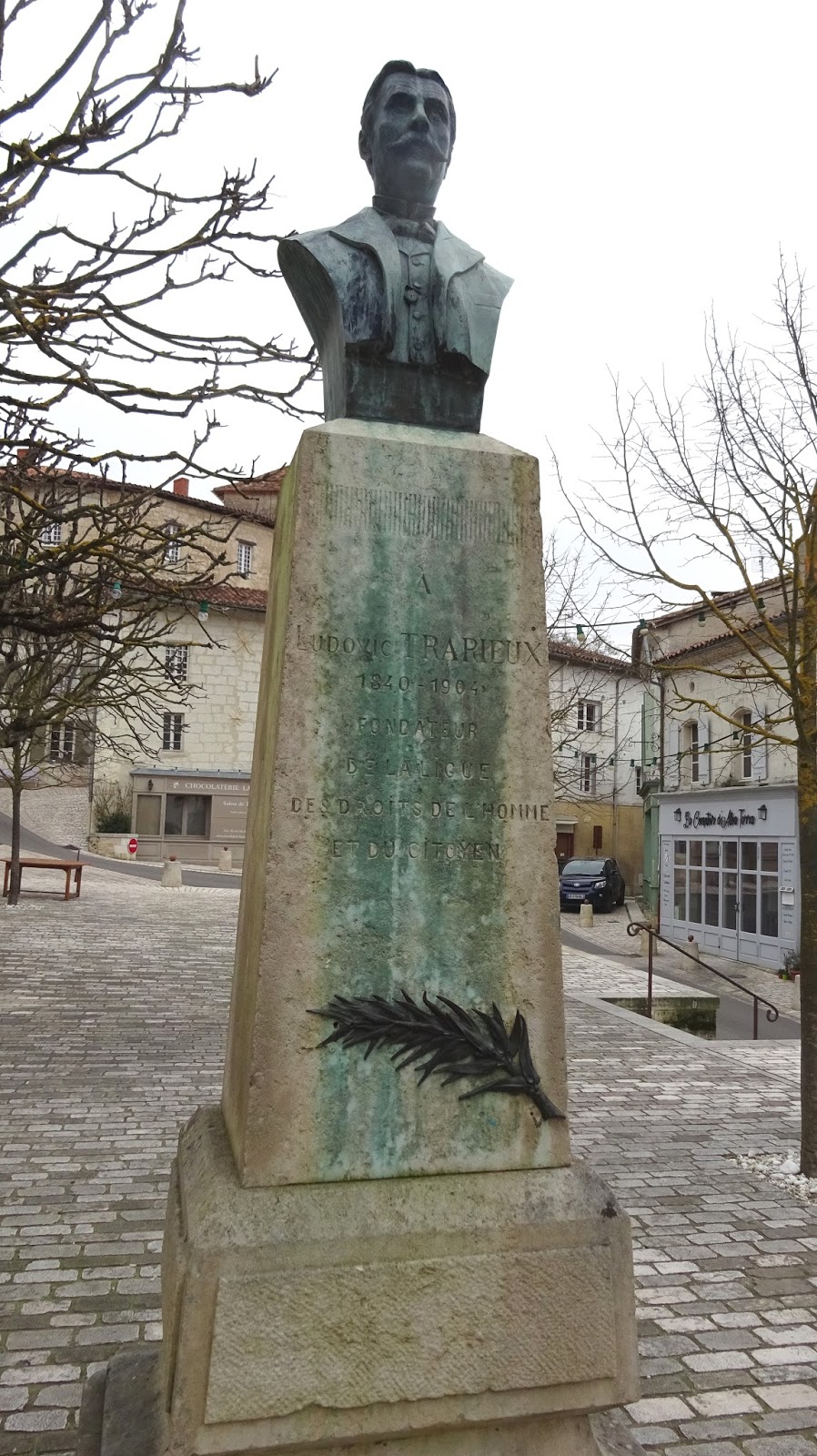
Ludovic Trarieux in Aubeterre-sur-Dronne (16), Charente (16)

Ludovic Trarieux (1840–1904) was born in Aubeterre-sur-Dronne, Charente, and was a lawyer and a politician of the 'soft' right. He was the founder and the first president of La Ligue des droits de l'homme (1898) (The League of the Rights of Man), and the instigator of the revision of the trial of Captain Alfred Dreyfus. As such, he was also a strong supporter of Émile Zola, who was suffering from huge legal problems following his publication of 'J'accuse' in the newspaper L'Aurore in 1898 in support of Dreyfus, an issue which was dividing France in two. Trarieux himself published a number of papers, mainly on legal questions, including the Dreyfus case. The bust of him is in the centre of Aubeterre-sur-Dronne, just a few meters away from his birthplace, with a plaque recognising his contributions to humanity.


Pierre Véry in Aubeterre-sur-Dronne and Bellon (16), Charente (16)

Pierre Véry (1900–60) was a crime writer born in Bellon (Charente), where he is buried. His first novel, Pont-Égaré (1927), featured in the selections that year for both the Renaudot and the Femina, although after hesitating between literary fiction and crime, he chose crime in 1934. Among his most famous books are L'Assassinat du père Noël (1934), Les Disparus de Saint-Agil (1935), and Goupi-Mains rouges (1937), all of which were adapted to the cinema screen. Some of his works are set in the area of his birth. His former home in Aubeterre-sur-Dronne is now a restaurant named after him:


'PIERRE VÉRY
HOMMES DE LETTRES
NÉ LE 17 NOVEMBRE 1900
DÉCÉDÉ LE 12 OCTOBRE 1960'