As my final Florida post, I have to include this structure in Key West that I omitted the first time round, quite possibly because I couldn't find anything to say about it. I haven't much to say now, although this largely appears to consist of pieces of clay moulded into spidery shapes on top of the original wall and encrusted with various kinds of circular mirrors. It's on the corner of Margaret and Angela streets, just opposite the main entrance to Key West Cemetery, and I suppose I'll never know the story behind it. Or maybe there is no 'story', perhaps it was just built on a whim. Interesting to note that the covering of the car in the background goes with the color scheme though.
Showing posts with label Key West (FL). Show all posts
5 April 2015
Roadside Art in Key West, Florida
Libellés :
Florida,
Key West (FL)
As my final Florida post, I have to include this structure in Key West that I omitted the first time round, quite possibly because I couldn't find anything to say about it. I haven't much to say now, although this largely appears to consist of pieces of clay moulded into spidery shapes on top of the original wall and encrusted with various kinds of circular mirrors. It's on the corner of Margaret and Angela streets, just opposite the main entrance to Key West Cemetery, and I suppose I'll never know the story behind it. Or maybe there is no 'story', perhaps it was just built on a whim. Interesting to note that the covering of the car in the background goes with the color scheme though.
26 March 2015
B. P. Roberts, Key West Cemetery, Florida
Libellés :
Florida,
Key West (FL),
Roberts (B. P.)
This is one of the most interesting graves in Key West Cemetery.
'I TOLD YOU I WAS SICK
B. P. ROBERTS
MAY 17. 1929
JUNE 18. 1979'
The Key West Cemetery 'Self-Guided Tour' leaflet describes Roberts as a 'local hypochondriac', although to go at fifty is pretty early. This huge structure was very easy to find, and yet in spite of the indications in the leaflet, after much searching we had to give up on finding the poet Juana Borrero and 'Sloppy' Joe Russell too.
Key West and Tourism
Libellés :
Florida,
Key West (FL)
Sometimes you can't avoid tourism, I think in Florida in particular. It's obviously interesting that this huge object represents the southernmost point in the States, being only ninety miles from Cuba. We aren't used to tourism and do our best to avoid it, and we were amazed by the long line of people from different nations queuing to have their photos taken next to this marker. We didn't bother because we aren't that kind of people, and anyway in between the posing everyone had an opportunity to take a shot of it without anyone leaning on it and smiling inanely.
The Southernmost Point is at the end of Whitehead Street, while at the other end on nearby Duval Street is Sloppy Joe's Bar. Although 'Sloppy' Joe Russell was Hemingway's fishing guide and friend, I didn't include this image with my post on Papa's house because it seemed a bit tacky to do so. We walked straight in and straight out of this place: at about four in the afternoon it was crammed with drinkers and unbelievably noisy. I think it's somewhere tourists go to say they've been there, and they may well also buy a tee-shirt or a cap or something else associated with Hemingway in the attached gift shop. A few of these tourists may even have read one of the man's books. Or maybe not.
Writers Associated with Key West, Florida: #5 John Hersey
Libellés :
Florida,
Hersey (John),
Key West (FL)
719 Windsor Lane, Key West.
THE WRITERS COMPOUND
FOUNDING RESIDENTS
John Ciardi 1976 – 1986
Ralph Ellison 1976 – 1993
John Hersey 1976 – 1993
Richard Wilbur 1976 – 2007
'FRIEND OF LIBRARIES U.S.A.
LITERARY LANDMARKS REGISTER
JOHN HERSEY
1914 – 1993
Reporting death, he did not
proclaim it.
To life – for all its heresy –
he was open and loving.'
Writers Associated with Key West, Florida: #4 José Martí
Libellés :
Cuba,
Florida,
Key West (FL),
Martí (José)
'FRIENDS OF LIBRARIES U.S.A.
LITERARY LANDMARKS REGISTER
designates the
SAN CARLOS
INSTITUTE
"La Casa Cuba"
founded in 1871
a Literary Landmark
in honor of its tradition of academic excellence
as a shrine to Cuban heritage and where
JOSE MARTI
1853-1895
Cuban patriot. poet and scholar
united the exile community in his campaign
for Cuba's independence.'
A bust of José Martí in the San Carlos Institute, underneath which is a bi-lingual quotation:
'Libertad es el derecho
EL APOSTOL DDE LA LIBERTAD CUBANA
QUISO OFRECIR
AL PUEBLO DE KEY WEST
LO QUE QUEDABA DE SU CORAZON.
ESTE MONUMENTO
PERPETUA SU DESEO.'
'COMO DEJARE SIN DECIR
LA VIVEZA CON QUE ANHELO
UNA OCASION RESPETUOSA
DE PONER LO QUE ME QUEDA
DE CORAZON JUNTO AL CAYO ?'
que todo hombre tiene a
ser honrado, y a pensar
a hablar sin hipocresía'
'Liberty is the right of
every man to be honest, to
think and to speak without
hypocrisy'
José Martí
'José Martí visited Key West for the first time from
December 25, 1891 to January 5. 1892. His
accomplishments in these two weeks figure very high in
the history of Cuba. He was able to unite the exiled
community, the "Bases" of the Partido Revolucionario
Cubano were written and the tobacco workers agreed to
help finance the war. The two big dates at the San
Carlos during these two weeks, were the 3rd and 5th of
January when the "Bases" were announced and a huge
farewell party was held in Martí's honor.'
In Bayview Park, Key West, there is a superb monument to José Martí.
EL APOSTOL DDE LA LIBERTAD CUBANA
QUISO OFRECIR
AL PUEBLO DE KEY WEST
LO QUE QUEDABA DE SU CORAZON.
ESTE MONUMENTO
'COMO DEJARE SIN DECIR
LA VIVEZA CON QUE ANHELO
UNA OCASION RESPETUOSA
DE PONER LO QUE ME QUEDA
DE CORAZON JUNTO AL CAYO ?'
'CAYO HUESO, ISLA LABRADA Y HERMOSEADA POR EL ESFUERZO CUBANO.
Y NO CARGAREMOS CON ELLA COMO NUESTRA ALMA INVENCIBLE
QUE HA SIDO Y NOS LA CLAVAREMOS AL COSTADO.
PARA MONUMENTO DE SUS FUNDADORES Y OBJETO DE NUESTRA JUSTA ADMIRACION ?'
19 March 2015
Writers Associated with Key West, Florida: #3 Ernest Hemingway
Libellés :
Florida,
Hemingway (Ernest),
Key West (FL)
'THE ERNEST HEMINGWAY
HOUSE & MUSEUM
Where Hemingway lived and wrote from 1931–1939
This site is dedicated as a Literary Landmark by the Association
of Library Trustees, Advocates, Friends and Foundations on the
occasion of the first One Island One Book event, when the
citizens of KeyWest celebrated the novel To Have and Not Have.'
Asa Forsythe Tift (1812–89), one of the richest men in the USA, built this house between 1849 and 1851. His wife and three children died in an epidemic of yellow fever in the mid-1850s, he didn't re-marry and died in the house.
The house fell into disrepair until – according to some sources – Gus, the uncle of Hemingway's second wife Pauline (née Pffeiffer) – bought it for them for $8000 in 1931. The Hemingway House website tells a different story: Hemingway bought it with back taxes.
The living room. Furniture in the house is the original.
The living room was initially divided by a wall which Pauline had removed.
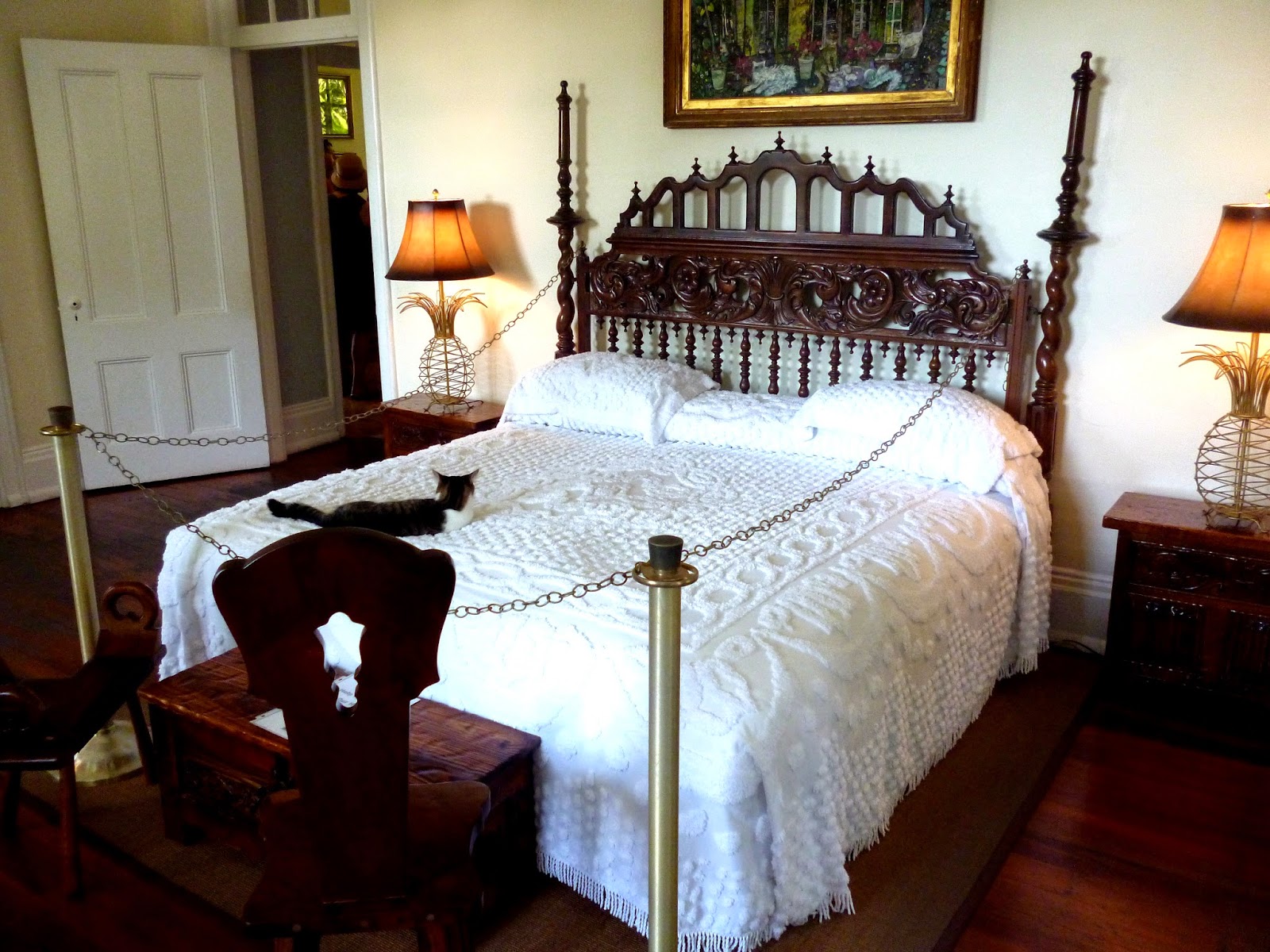
The master bedroom, complete with cat.
One of Hemingway's wooden trophies from Africa.
The original kitchen.
And the original bathroom.
Part of the veranda between the two floors.
The swimming pool cost Pauline $20,000, which was of course much more than the cost of the house itself. It was not only the first in Key West, but the first within a hundred miles. Although funded by his wife, legend has it that Hemingway said she'd taken everything but his last cent, and threw a penny in the pool.
And this is said to be the original penny.
The extension where Hemingway did his writing.
Hemingway's writing table, with typewriter and once-living trophy from an African safari.
Hemingway obviously took great pride in killing animals.
Another side of his writing room, with pictures of him at different ages.
One of the many cats that have the run of the house, which are all descendants of the famous six-toed cats. The bar next door to the Hemingway house is even called The Six-Toed Cat. This one is called Eleanor Roosevelt.
And some cats presumably enjoyed paddling in the cement.
There's even a cat cemetery, with dates of the animals often named after writers, actors, and so on, such as Marilyn Monroe, Edgar Allan Poe, Simone de Beauvoir, Jimmy Stewart, etc. Visitors can spend as long as they like on their visit here, and we took part in one of the guided tours, which was interesting but unsurprisingly probably almost as much time was spent talking about the cats as Hemingway himself. It's as though Hemingway has taken a back seat here: most people, after all, see the cats as the huge attraction here. I didn't expect a university lecture of course, but just a few words about the man's importance to literature wouldn't have gone amiss, such as his Spartan style, his paring away of excess fat, his admiration for such writers as Zane Grey, etc.
Opposite is Key West lighthouse. Legend also says that this is how Hemingway found his way home after a night's excess of alcohol. You come to expect such remarks about Hemingway, who went out of his way to create a larger-than-life myth of himself. But as a person who has spent most of his life respecting animals to the extent that I would never dream of eating any of them, I shall probably always find it very difficult indeed to like Ernest Hemingway the man.
18 March 2015
Writers Associated with Key West, Florida: #2 Wallace Stevens
Libellés :
Florida,
Frost (Robert),
Hemingway (Ernest),
Key West (FL),
Stevens (Wallace)
Wallace Stevens (1879–1955) was an insurance executive in Hartford, Connecticut as well as a poet. He first visited Key West in 1922 and liked it so much that he returned to it virtually every winter until 1940, but he never took his wife Elsie or his daughter Holly (born 1924). He stayed at the Casa Marina, and was noted in Key West for his drunken behavior: he once quarrelled with Robert Frost, and broke his hand hitting Hemingway on the jaw, although Hemingway thumped him back into the gutter. Two of his poems were 'The Idea of Order at Key West' and 'Farewell to Florida'.
17 March 2015
Writers Associated with Key West, Florida: #1 Tennessee Williams
Libellés :
Florida,
Key West (FL),
Williams (Tennessee)
1431 Duncan Street, Key West, where Tennessee Williams – born in 1911 in Columbus, Mississippi – lived from 1949 until his death in 1983.
Just a few houses down from Williams' house on Duncan Street, at 1421, is a house still called 'The Rose Tatoo' after Tennessee Williams's 1951 play of the same name, the cinema version of which was filmed here in 1954 and released the following year. Williams took a very enthusiastic interest in the events.
24 February 2015
Naomi Wood: Mrs Hemingway (2014)
Libellés :
Florida,
Hemingway (Ernest),
Ketchum (ID),
Key West (FL),
Wood (Naomi)
'Mrs. Hemingway'. With a full stop. Naomi Wood is English with an MA from the UEA Creative Writing school, with a PhD to boot, and this fictional work is based on true events and archival research. The full stop is there, I think, not just because Americans still use it but also because it fits in with the use of the time, like the 1920s swimming costumes worn by Hemingway, Hadley and Pauline on the cover above.
Obviously Ernest Hemingway's work is not the central interest, in fact it's of little interest at all, merely serving as a backcloth to the five characters: Hemingway himself and the generic 'Mrs. Hemingway', who is actually four people – Hadley, née Richardson (1921–27); Pauline (here 'Fife'), née Pfeiffer (1927–40); Martha, née Gellhorn (1940–45); and Mary, née Welsh (1945–61), 1961 being the year of Hemingway's suicide.
An omniscient narrator relates the stories of the four Mrs. Hemingways, each wife being presented in order of her existence in Hemingway's life, although there is frequently a great deal of playing with different periods of time: the end may be related at the beginning of a section before backtracking, for example.
A little of Hadley's tale is told in Paris, although almost all of it takes place in Antibes, France, and it is very much a story of a threesome: not sexually (at least together, that is) but of Hadley and Fife sharing Hemingway until the very tolerant Hadley declares a one hundred day moratorium on the Fife/Hemingway relationship but concedes defeat long before and 'gives' her husband away to his lover.
Hemingway and Hadley went through some tough financial times, although life is made much easier now that one of Fife's relatives gifts them the house in Key West, Florida, where much of this section is set. But then Fife discovers that her husband's frequent trips away are due to his wanting to be with his new girlfriend Martha, a reporter who delights in writing about war.
But marriage to Martha is destined to be relatively short: sick of living in the peace of Havana, Cuba during the war, Martha makes a potentially hazardous journey to report on the war in Europe. And not too long after that Mary comes along.
Mary and Hemingway settled in Ketchum, Idaho, and Hemingway was already beginning to see himself as an old man. Certainly he had health problems, as the ever-loving Fife discovered on her visit to the couple: not just the pills in the cabinet, but the knowledge that he had had EST (ECT) therapy at a sanatorium. Hemingway had quite a family heritage to try and cope with – mainly the suicides of his father and a brother and sister. His alcoholism obviously made matters worse, and in the end he blew his skull away.
I'm left with the impression that it can't have been easy at all being any 'Mrs. Hemingway', and even though the man may have been to some extent fighting a genetic legacy of mental illness, he comes across as egotistical, frequently callous (both to women and animals), and a braggart.
A fascinating character he may have been all the same, and an important writer too, but I find it very difficult to like him as a man. Naomi Wood has done a pretty good job here.
Obviously Ernest Hemingway's work is not the central interest, in fact it's of little interest at all, merely serving as a backcloth to the five characters: Hemingway himself and the generic 'Mrs. Hemingway', who is actually four people – Hadley, née Richardson (1921–27); Pauline (here 'Fife'), née Pfeiffer (1927–40); Martha, née Gellhorn (1940–45); and Mary, née Welsh (1945–61), 1961 being the year of Hemingway's suicide.
An omniscient narrator relates the stories of the four Mrs. Hemingways, each wife being presented in order of her existence in Hemingway's life, although there is frequently a great deal of playing with different periods of time: the end may be related at the beginning of a section before backtracking, for example.
A little of Hadley's tale is told in Paris, although almost all of it takes place in Antibes, France, and it is very much a story of a threesome: not sexually (at least together, that is) but of Hadley and Fife sharing Hemingway until the very tolerant Hadley declares a one hundred day moratorium on the Fife/Hemingway relationship but concedes defeat long before and 'gives' her husband away to his lover.
Hemingway and Hadley went through some tough financial times, although life is made much easier now that one of Fife's relatives gifts them the house in Key West, Florida, where much of this section is set. But then Fife discovers that her husband's frequent trips away are due to his wanting to be with his new girlfriend Martha, a reporter who delights in writing about war.
But marriage to Martha is destined to be relatively short: sick of living in the peace of Havana, Cuba during the war, Martha makes a potentially hazardous journey to report on the war in Europe. And not too long after that Mary comes along.
Mary and Hemingway settled in Ketchum, Idaho, and Hemingway was already beginning to see himself as an old man. Certainly he had health problems, as the ever-loving Fife discovered on her visit to the couple: not just the pills in the cabinet, but the knowledge that he had had EST (ECT) therapy at a sanatorium. Hemingway had quite a family heritage to try and cope with – mainly the suicides of his father and a brother and sister. His alcoholism obviously made matters worse, and in the end he blew his skull away.
I'm left with the impression that it can't have been easy at all being any 'Mrs. Hemingway', and even though the man may have been to some extent fighting a genetic legacy of mental illness, he comes across as egotistical, frequently callous (both to women and animals), and a braggart.
A fascinating character he may have been all the same, and an important writer too, but I find it very difficult to like him as a man. Naomi Wood has done a pretty good job here.
Subscribe to:
Posts (Atom)