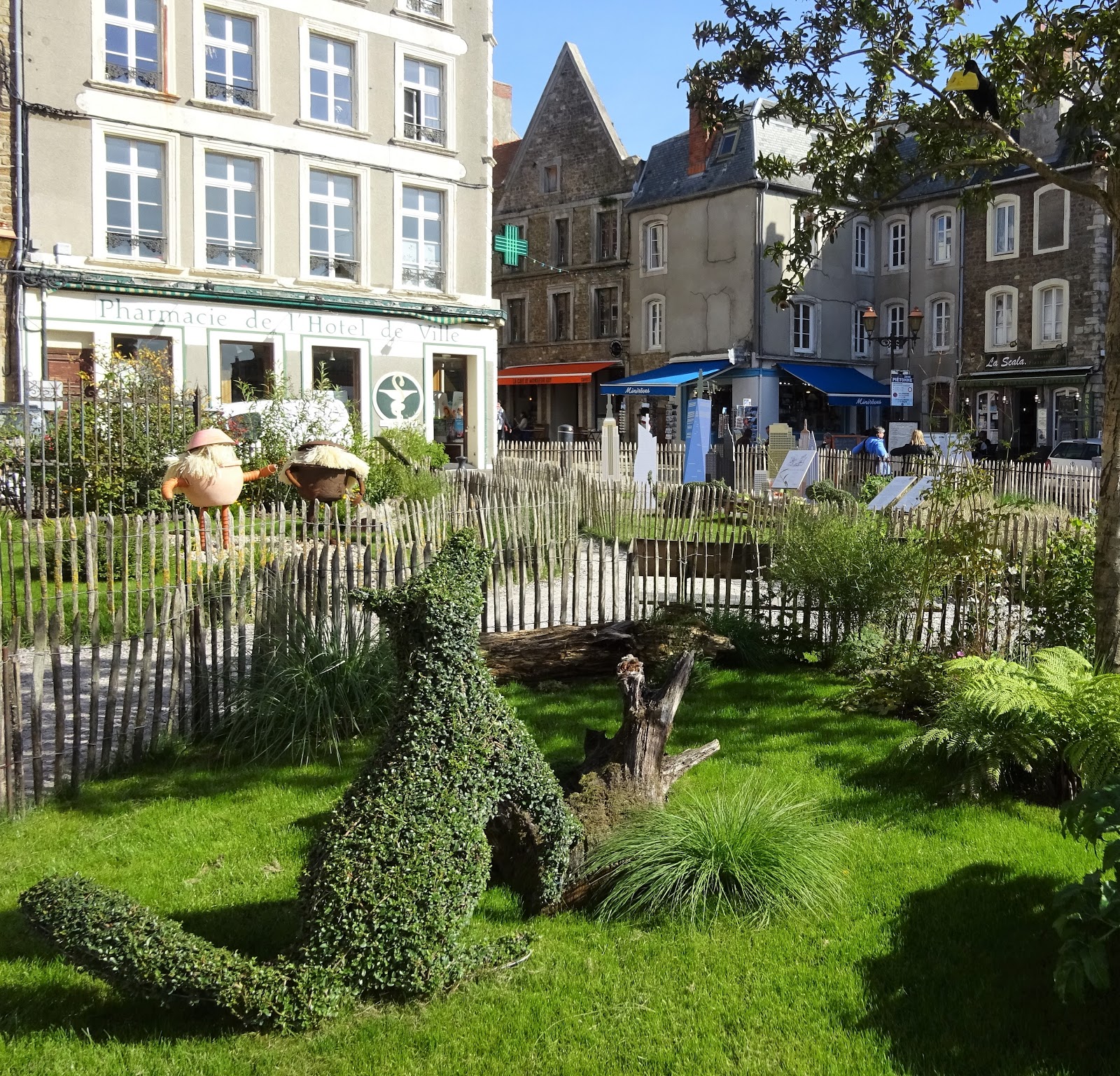
And this year in Boulogne-sur-Mer, the theme of the 13th Jardin éphémère is superstition, although by no means all of the examples are obvious. Fortunately, almost all are given explanations, with the single exception of a woman's left leg treading on a turd: too obvious to explain? I think not: the Mairie was probably worried about parents objecting to the word 'Merde !' being used – yes, even the French can be sensitive about the use of strong language. Remember how Alfred Jarry used 'Merdre !' as a euphemism in Ubu Roi? But that was in 1896, and things haven't moved on since then? Apparently not. The overwhelming impression I came away with was of education: Boulogne's Jardins éphémères are something really special.
 The Mairie, proudly displaying the number of superstition.
 In the Far East bamboo is used for many things: food, tools, housing, scaffolding, etc. Strongly resistant, it is a symbol of longevity, strength and happiness.
 Thirteen at a table. Judas was the thirteenth man at the Last Supper. In paintings, a thirteenth plate is often in yellow, with a bag of money representing the price Judas received for his treason.
 The four-leaf clover, said to ward off ghosts and evil, and to bring wealth.
 The birch tree, with its silvery-white trunk, represents purity. In Russia a small broom made with birch branches and plunged into a bath was said to purify the skin.
 The eagle (or imperial) fern, called so because it has the shape of an eagle and is used in heraldic symbols. Fixed to house doors, it is said to be an effective amulet against outside evils. In the Gironde, the fern is placed on house thresholds to keep witches away.
 A black cat was said to be the companion of witches and the devil. Black cats were the victims of terrible tortures and persecutions in the 18th century. Even today it is said to be unlucky to cross the path of a black cat (especially from the left).
 'Touch wood' ('Toucher du bois') is of course a common expression, even used by the non-superstitious, relating to good fortune. But for many centuries, the positive qualities of wood have been thought to protect people from evil.
 Spilling salt on the table is from the same biblical event as before, coming from the Last Supper, in which Judas knocked down a salt pot. It now signifies the announcement of a quarrel, misfortune or a warning of misfortune to come. The antidote is to throw the spilt grains over your left shoulder. (There are also crossed knives here!
 Walking under a ladder is said to bring bad luck. For Christians the ladder is symbolic, as one was used for the cruxifiction. In the Middle ages it was associated with death by hanging: a ladder was used to attach the rope to the gallows. Also, because of the shape of a ladder against a wall, it was considered a profanation of the Trinity.

 A female foot treads on a turd. The French often don't say 'Bonne chance !' ('Good luck!) as it might bring bad luck: instead, they say 'Merde !' (Shit!). Note that the foot is the left one, as treading on a turd with your left foot is said to bring luck.
 Hazel ('le noisetier') is the tree of harmony for the Greeks, fertility for the Germans and knowledge for the Irish.
 The rowan ('le sorbier') is noted for its preservative qualities against dangers. In Connecticut a rowan tree was planted near a tomb to prevent the dead from returning to haunt a family, and in Scotland shepherds used a rowan broom to keep their flocks away from evil.
 Putting bread upside down is a superstition dating from the Middle Ages and still extant. It originates from the time when the baker placed the condemned man's bread upside down for him to recognise easily: it was thus associated with misfortune.
 Sailors of the Marine Nationale in the mid-19th century used to wear bâchis, or hats with a red pompon. Touching the pompom was believed to bring good luck.
 Ivy ('le lierre') is linked to lasting emtional ties such as friendship and love. Young women in Pas-de-Calais included an ivy leaf in their love letters in the belief that it would make them marry soon. Ivy on houses in Nordic countries were good luck charms. Heavily pregnant women avoided contact with ivy, fearing a miscarriage: ivy and parsley were used in abortions.
 Cradles were not passed from one baby to another because it was believed that a younger baby would catch all the older baby's illnesses. Empty cradles were never swung as it was thought that evil spirits would take refuge there.
 At one time, in homage to a dead person, men would place their hat on the bed, and from this practice came the belief that it was an ill omen to put a hat on a bed.
 The Romans believed there were evil spirits in mirrors. Breaking one freed the demons and brought seven years bad luck.
 A horseshoe, of course, is a lucky charm, and also a symbol of strength and fertility. It wards off evil spirits.
 To early Christians the shiny leaves of the box tree ('le buis') appeared to have been watered by Christ's tears. It was also seen as sacred to the Greeks and the Gauls. The presence of a single branch in a house sheltered the inhabitants from evil spells and storms.
 Owls symbolised night and death to the Egyptians, and it was also a messenger of death to the Romans. Up to the end of the 19th century an owl, when captured, was immediately crucified on barn doors.
 Garlic is a magic vegetable with many beneficial (particularly medicinal) qualities. The workers on the Great Pyramid ate it regularly to improve their immune system, and in India they put several cloves of garlic in front of the door of their house to frighten evil spirits. In Rumania garlic is the enemy of vampires.
 The superstition surrounding the bad luck that carnations ('les oeillets') bring was particularly widespread in the theatrical world, where directors hoping to re-employ a female actor would send roses: sending carnations meant she would not be re-employed for other roles: the flower signalled bad luck in their career. By extension, sending carnations to a woman indicates bad luck.
 Lily of the Valley ('le muguet') is a lucky charm, and to give this flower on 1 May is the norm: but never before, as that indicates bad luck.









 Posts
Posts

