Showing posts with label Twickenham. Show all posts

22 October 2013

Alexander Pope in St Marys Church, Twickenham

The nave of St Marys Church, Twickenham, looking towards the chancel. Just visible is Pope's plaque on the floor slightly to the right of the furthest row of pews on the left.

'HERE ARE BURIED
THE MORTAL REMAINS
OF
ALEXANDER POPE
1688–1744
Qui nil molitur inepte
R. I. P.
 
This tablet was placed
by three members of the Faculty of English
of Yale University
1962'
 
And on one of the church walls:

'TO THE MEMORY OF
MARY BEACH
WHO DIED NOV. 5. 1725 AGED 78
ALEX. POPE, WHOM SHE NVRSED IN
HIS INFANCY AND CONSTANTLY AT-
TENDED FOR THIRTY EIGHT YEARS,
IN
GRATITVDE TO A FAITHFVL OLD SERVANT,
ERECTED THIS STONE.'
 
My other Pope posts:
 
–––––––––––––––––––––––––––––––––––
Alexander Pope's Grotto in Twickenham
Alexander Pope in Stanton Harcourt, Oxfordshire
Anthony Beckles Willson: Mr Pope & others at Cross Deep
Alexander Pope in Chiswick

Catherine Clive in Twickenham

Catherine (or Kitty) Clive (1711–1785) enjoyed a very successful acting career. In 1769 she retired to Strawberry Hill, Twickenham, where Horace Walpole provided a house for her.
 
'Sacred to the Memory of
MRS CATHERINE CLIVE,
Who died December the 7th 1785
æt 75 years.
 
Clive’s blameless life this tablet shall proclaim,
Her moral virtues and her well-earn’d fame.
In comic scenes the stage she early trod,
“Nor sought the critic’s praise nor fear’d his rod”
In real life was equal praise her due,
Open to pity and to friendship true;
In wit still pleasing, as in converse free,
From aught that could afflict humanity;
Her generous heart to all her friends was known;
And e‘en the stranger’s sorrows were her own.
Content with fame e’er affluence she wav’d,
To share with others what by toil she sav’d;
And nobly bounteous, from her slender store
She bade two dear relations not be poor.
Such deed's [sic] on life’s short scenes true glory shed
And heav’nly plaudits hail the virtuous dead.'

She was buried in St Marys Church, Twickenham. The plaque on the church wall was paid for, and the poem written by, her long-term friend Jane Pope (whose adult début was with Kitty Clive in Sir John Vanbrugh's The Confederacy).

I give a link below to a biography of Clive by Percy Fitzgerald, who is bitchy about both the (perceived) low cost of the memorial and of the quality of Jane Pope's verse.

–––––––––––––––––––––––––––––––––––
Percy Fitzgerald: The Life of Mrs Catherine Clive (1888)

4 September 2013

The Oceanides, aka The Naked Ladies, Twickenham

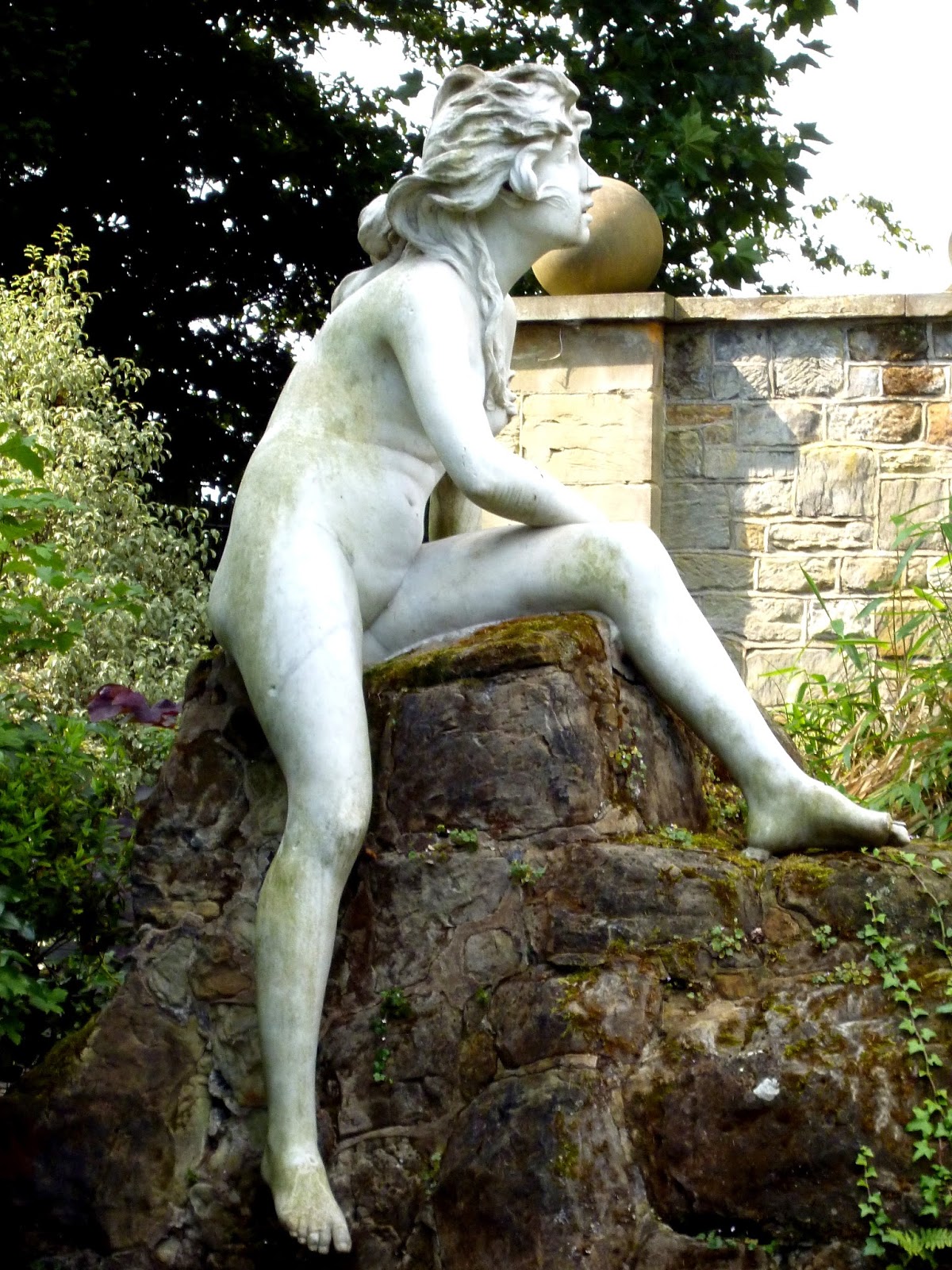
An amazing sight greets any unsuspecting member of the public walking through the riverside area of York House Gardens, Twickenham. These are the Oceanides, commonly known as the Naked Ladies, in Italian Carrara marble. The interesting thing here is that these are not static nudes, but very active ones obviously created out of a love of the female body: they are in fact very sensual.
 
An interpretation plaque at the side states that these have come from the Roman school of Orazio Andreoni, dating from the turn of the 19th century. It claims that the name of the sculptor is unknown, although the Victorian Web seems to have found another (more recent, presumably) source of information, and confidently states that they were made by Oscar Spalmach (1864–1917) in Andreoni's studio.
 
Whitaker Wright brought them to England for his Surrey property, although they didn't stay there very long: Wright was found guilty of fraud and killed himself in 1904, and the last private owner of York House – Sir Ratan Tata – bought the statues in 1909. After he died nine years later his wife sold the house to Twickenham Urban District Council. The statues weren't included in the sale but remained in place, although neglect and vandalism led to them falling into a sorry state by the late 1980s. But Elizabeth Bell-Wright encouraged local societies to fight to save the statues, which received further restoration in 2007. And here, in all their glory, are more detailed shots of the Naked Ladies:


21 June 2013

Anthony Beckles Willson: Mr Pope & Others at Cross Deep, Twickenham in the 18th Century (1996)

I've already mentioned Anthony Beckles Willson in the Pope's Grotto post linked below, and indeed some of my information on the grotto and house came from this book. But the scope of this publication is much broader, detailing the people who lived in Cross Deep (formerly also the name of this area just outside Twickenham) before, during, and after Pope lived here between 1719 and his death in 1744.
 
This is a very well illustrated work, and it has to be so because of the often very confusing changing nature of the properties over time. Pope's Grotto is on the site of the present school Radnor House. One of Pope's neighbours was John Robartes (1686–1757), 4th Earl of Radnor, whose property (now long gone) was also called Radnor House. Robertes also owned a Cold Bath, or Bath House, near the River Thames, part of which has been moved to Radnor Gardens adjoining the present day Radnor House. Robertes was one of the witnesses to Pope's will in December 1943.
 
Pope erected a large memorial in the form of an obelisk at the bottom of his garden to commemorate his mother, with whom he had lived and who died in 1733. It survived Baroness Howe's ravages and now stands in the grounds of Penn House, Amersham, Bucks, after sailing by coal barge to Gopsall Park in Leicestershire, where it had spent several decades and is a kind of Howe family heirloom.
 
This large, impressive, informative and engrossing work is self-published and occasionally betrays minor flaws that more assiduous proofreading would have unearthed: for instance, both Robert Shirley and Selina Finch are given two separate ages when they married, and there are a number of rather eccentric uses of the comma: mere quibbles – this is still a fascinating book.
 
–––––––––––––––––––––––––––––––––––
Alexander Pope's Grotto in Twickenham
Alexander Pope in Stanton Harcourt, Oxfordshire
Alexander Pope in Chiswick

11 June 2013

Alexander Pope's Grotto in Twickenham

Alexander Pope (1688–1844), whose father died in October 1717, moved from Chiswick to Twickenham with his mother Edith (née Turner), his childhood nurse Mary Beach and a dog called Bounce in spring 1919. After translating Homer's Iliad, Pope had a considerable amount of money. He leased property from Thomas Vernon by the Thames in Cross Deep in Twickenham, and soon began building a house there. The villa was built close to the road, and the land across from it – which belonged to several people – Pope leased for a garden, his head man being John Serle. Pope constructed a tunnel under the road to provide access directly from the house to the garden, and began work on a grotto in the cellars, which he continued working on until shortly before his death. The tunnel was originally 22ft long, but was later extended on two occasions due to road widening.
 
Anthony Beckles Willson has done a large amount of research on the local history of Twickenham, and refers to Pope's second stage, which which began towards the end of 1739, as 'mining and geology'. Pope was a friend of Ralph Allen of Bath, who was building a mansion in Prior Park near his mines and quarries, and some of Pope's inspiration came from him, although the driving force came when he visited Hotwell Spa in the Avon Gorge, Bristol, in 1739 and was greatly impressed by the rock formations. He had ores, spars, crystals, marble, mundic, alabaster and freestone – among other materials – sent to him, and the grotto very much reflects this new interest. Many people contributed to Pope's hobby, such as Sir Hans Sloane supplying stones from the Giant's Causeway, Ireland. Not only stone, but wood, glass, coral, birds' nests, etc, went into furnishing the brickwork of the grotto, which has to some extent been altered over time (and particularly been the victim of pilfering), although much of it has remained intact.
 
The sign at the front of Radnor House School, the owners of the grotto.
 
The entrance to the grotto showing the tunnel that led to the garden.
 
Figures of heads above the entrance, although they were probably added after Pope's death.
 
A lion's head at the entrance.
 
Through the entrance is a lateral chamber, the left side of which has part of a dead tree said to be of a willow that Pope planted.
 
 
On each side of the tunnel is a chamber bearing an ammonite cast at the centre of the entrance arch. After Pope's death Serle published a tourist guide to the garden and the grotto, although these casts aren't mentioned in it.
 
The right chamber, flamboyantly covered in stones and shells.
 
 
At the rear of the chamber is a statue of St James of Compostella, the patron saint of Spain, with scallop emblem at the front of his hat.
 
 
The statue at the rear of the left chamber is perhaps of the Virgin Mary, which dates from after that of St James. A plan of the grotto drawn in 1785 by Samuel Lewis features both of the statues, although they were perhaps installed by Sir William Stanhope, who bought the property after Pope's death.
 
Apart from the statue, another central feature of the left chamber is the table with its various stone exhibits, of which this shows a section.
 
The white card contains a quotation by Pope: 'When you have a mind to light it up, it affords you a very different Scene: it is finished with Shells interspersed with Pieces of Looking-glass in angular Forms ... at which when a Lamp is hung in the Middle ..., a thousand pointed Rays glitter and are reflected over the place.'
 
A closer shot of the tunnel.
 
Pope didn't own the property: it still belonged to the Vernon family. Stanhope bought it the year after Pope's death in 1745, had wings fitted to the villa and later bought the garden, then bought more garden land at the top of Pope's garden and constructed his own tunnel, which was known as 'Stanhope's Cave'. This is the entrance to it.
 
The tablet at the centre of the arch reads:
 
'The Humble Roof, the Garden’s Scanty Line,
Ill suits the Genius of the Bard Divine,
But fancy now Displays a Fairer Scope,
And STANHOPE’S Plans Unfold the Soul of POPE.'

With not a little arrogance, then, Stanhope thought he had improved on Pope's manual work, although Horace Walpole didn't. In 1807 – when Walpole had been dead for ten years – Sophie Charlotte, Baroness Howe of Langar, Nottinghamshire demolished it.


Taking Pope's Dunciad as an influence behind her satire, Lady Mary Wortley Montagu had some rather unkind (but admittedly clever and very funny) words to say of Pope and his grotto, of which this is more than a fragment of the fragment:
 
'The Court of Dulness: A Fragment:
 
Her palace plac'd beneath a muddy road,
And such the influence of the dull abode,
The carrier's horse above can scarcely drag his load.
Here chose the goddess her belov'd retreat,
Which Phoebus tries in vain to penetrate;
Adorn'd within with shells of small expense,
(Emblems of tinsel rhyme and trifling sense),
Perpetual fogs enclose the sacred cave,
The neighbouring sinks their fragrant odours gave;
In contemplation here she pass'd her hours,
Closely attended by subservient powers:
Bold Profanation with a brazen brow,–
Much to this great ally does Dulness owe:
But still more near the goddess you attend,
Naked Obscenity! her darling friend.
To thee for shelter all the dull still fly,
Pert double meanings e'en at school we try.
What numerous writers owe their praise to thee,
No sex – no age – is from thy influence free;
By thee how bright appears the senseless song,
By thee the book is sold, the lines are strong.
The heaviest poet, by thy pow'rful aid,
Warms the brisk youth and charms the sprightly maid;
Where breathes the mortal who's not prov'd thy force
In well-bred pun, or waiting-room discourse?'
 
However, Pope's friend Robert Dodsley came up with this tribute:

'The Cave of Pope
 
When dark Oblivion in her sable cloak 
Shall wrap the names of heroes and of kings; 
And their high deeds, submitting to the stroke 
Of time, shall fall amongst forgotten things:
 
Then (for the Muse that distant day can see)
On Thames’s bank the stranger shall arrive,
With curious wish thy sacred grott to see,
Thy sacred grott shall with thy name survive.

Grateful posterity, from age to age, 
With pious hand the ruin shall repair:
Some good old man, to each inquiring sage 
Pointing the place, shall cry, “The bard lived there 
 
“Whose song was music to the listening ear, 
Yet taught audacious vice and folly shame:
Easy his manners, but his life severe;
His word alone gave infamy or fame. 

“Sequestered from the fool and coxcomb-wit, 
Beneath this silent roof the Muse he found; 
’Twas here he slept inspired, or sat and writ
Here with his friends the social glass went round.”

With awful veneration shall they trace 
The steps which thou so long before hast trod; 
With reverent wonder view the solemn place 
From whence thy genius soared to nature’s God. 
 
Then, some small gem, or moss, or shining ore,
Departing, each shall pilfer, in fond hope
To please their friends on every distant shore,
Boasting a relic from the cave of Pope.'
 
Further photos of the grotto:


Outside, but still on Cross Deep, is the Alexander Pope pub and hotel.
 
ADDENDUM: When I returned to Twickenham in August 2013, I noticed for the first time this inscription on the school wall:
 
'ON THIS SPOT STOOD UNTIL 1809
THE HOUSE OF
ALEXANDER POPE
THE GROTTO THAT FORMED HIS BASEMENT
STILL REMAINS 1848'
 
 My other Pope posts:

–––––––––––––––––––––––––––––––––––
Alexander Pope in St Marys Church, Twickenham
Alexander Pope in Stanton Harcourt, Oxfordshire
Anthony Beckles Willson: Mr Pope & others at Cross Deep
Alexander Pope in Chiswick

10 June 2013

Eel Pie Island, Twickenham

I remember many years ago bumping into my former English school teacher Stan Middo, a man more formally known to others as the writer Stanley Middleton (1919–2009), and him asking me how things were on Eel Pie Island. I'd never been to Eel Pie Island and had never mentioned the place to Stan before, but he obviously quite rightly assumed that I'd understand that he was using the expression generically: Eel Pie Island had been associated with the hippie ethos, and I had for some time been espousing hippie ideals.
 
Until last weekend, though, I'd never set foot on Eel Pie Island, although a casual opportunity to do so (which I hadn't taken advantage of when I went to Horace Walpole's Strawberry Hill House last year) emerged when I re-visited Twickenham to see the opening of Alexander Pope's Grotto as one of the Twickenham Festival attractions. And although the hippie trappings may have long gone, there nevertheless remains a certain zaniness, even hints of anti-authoritarianism on the island.
 
'ANY PERSON OMITTING TO SHUT
AND FASTEN THIS GATE AFTER
USING IT, IS LIABLE TO A PENALTY
OF FORTY SHILLINGS'
 
'THE CORNISH RIVIERA
ENGLAND'S NATIONAL HEALTH & PLEASURE RESORT'
 
'NO
UNDER-
STANDING
ANY
TIME'
 
'WRONG
DAY
GO BACK'
 
'LOVESHACK'
 
'NOTICE
 
THANK YOU
FOR NOTICING THIS
NEW NOTICE
 
YOUR NOTICING IT
HAS BEEN NOTED
 
AND WILL BE REPORTED TO THE AUTHORITIES'
 
There isn't much of it as you soon come to a kind of wall beyond which you can't go, but I found Eel Pie Island – to which positively no motor vehicle is allowed and access is only by boat or footbridge – quite refreshing.

28 April 2012

Horace Walpole's Strawberry Hill House, near Twickenham

Strawberry Hill House is close to Twickenham and more than twelve miles from the crazy turmoil of the tourist-clogged parts of central London. This was the summer villa of the writer, politician and collector Horace Walpole (1717–97), who in 1747 discovered the site and began transforming a very modest property into a neo-gothic building, in so doing being a forerunner of a highly influential revival. The restoration is considerably impressive.

It took him from the late 1740s until 1776 to complete his project.

This is the entrance to the house that became a tourist attraction even in Walpole's lifetime, and later the style would be termed 'Strawberry Hill gothic'. Walpole had his own ('Strawberry Hill') press here, and in 1784 published a description of the property and its history, along with a detailed description of his collection of pictures, sculptures, furniture, etc.

'HORACE
WALPOLE
1717–1797
MAN OF LETTERS
LIVED HERE'

The staircase in the hall. Richard Bentley designed the balustrade.

An antelope holding a shield crouches at each corner.

The lantern is a copy of the original.

The chimney in the Great Parlour, or the dining-room, designed by Bentley.

And an example of the stained glass windows tops in the Great Parlour.

In another window a cobbler whistles to a caged bird.

The Library, whose books were sold in 1842, and which are now in the Lewis Walpole Library at Yale University.

The gothic arches at the top which swing on hinges.

A detail of the ceiling that Walpole conceived, Bentley sketched, and Clermont painted.

The Holbein Chamber, where Walpole displayed his collection of Holbein drawings.
Again, the chimney is by Bentley, largely inspired by Archbishop Warham's tomb in Canterbury.

Leaving the Holbein Chamber, the first glimpse of the Gallery is the fan vaulting, inspired by Henry VII's chapel in Westminster Abbey.

The Gallery was Walpole's principal entertaining room, and is 56 feet long, 17 feet high, and 13 feet wide excluding the recesses.

The chimney piece is by John Chute and Thomas Pitt.

The Round Room seen from the Gallery.

The windows of the Round Room.

The chimney piece was inspired by Edward the Confessor's tomb in Westminster Abbey.

The Tribune held Walpole's most precious treasures, and its ceiling takes its inspiration from the chapter house at York.

Walpole thought that the yellow glass gave the room 'a golden gloom'.

The Great North Bedchamber was merely for show.

Walpole's Beauty Room is now called the Discovery Room, where different ages of the house can be seen.

Here, for instance, we can see the original black and yellow of the chimney piece.
Lady Waldegrave was a 19th century owner of Strawberry Hill House, and this is just a brief glimpse of her bell system.

Finally, it's obviously, er, a folly to look at a garden when the grass is sodden, so I contented myself with a photo of Walpole's (recreated) shell bench and made my way on.

The link below is to more detailed information from Richmond Libraries' Local Studies Collection.
––––––––––––––––––––––––––––––––––––
Horace Walpole (1717–97) and Strawberry Hill