Showing posts with label Dulac (Germaine). Show all posts

20 December 2021

Germaine Dulac's La Cigarette (1919)

Egyptologist and museum curator Pierre Guérande (Gabriel Signoret) has, at the age of forty-eight, married the young Denise (Andrée Brabant), but he begins to fear for the relationship when his wife's friend Irène de Tramont (Genevieve Williams) comes on the scene. Irène's friend Maurice Herbert introduces Denise to him, and it seems to Pierre that he's lost his love to a guy who is 'modern': not only does he dance the tango but he's a golf ace and teaches Denise how to play the game. Pierre begins to believe that he's yesterday's papers, only fit for the sexual scrapheap, and decides – much like the elderly Egyptian prince he knows so much about – that he has to perform a sophisticated suicide. But at an unexpected moment: he poisons one of his cigarettes, mixes them up, and he'll die at an unknown time.

The problem is that he has to be very wary of anyone else – such as his wife – touching any of his cigarettes. But when he's down to his last one – and he knows that that must be the lethal one – Denise starts to smoke it. He snatches it from her, but then learns the truth: Maurice has never been anything more than a friend, Pierre is a man of culture, and that doesn't necessarily have anything to do with youth as Denise loves him: in fact Pierre has been winding himself up a tree he can't climb down unless it's explained to him. For a silent movie, there are a large number of words.

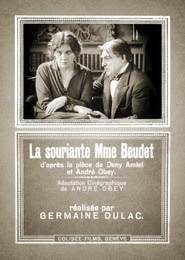
Germaine Dulac's La Souriante Madame Beudet | The Smiling Madame Beudet (1923)

Germaine Dulac's silent avant-garde movie La Souriante Madame Beudet is seen by many critics as the first explicit feminist film, and the title is distinctly ironic.

Madeleine Beudet (Germaine Dermoz) lives in a provincial town with her husband (played by Alexandre Arquillière), who is a grotesque merchant draper in the Beudet et Labas firm. Beudet lives for money, his wife for culture. In spite of her physically comfortable bourgeois existence she is bitterly miserable and a number of images, such as a tennis player whisking her husband away or the vision of a handsome man: a fantasy or a memory – appear as images or superimpostions in the film to reveal her state of mind.

Three particular lines from Baudelaire's 'La Mort des amants' strike her. They are from Les Fleurs du mal, and from the first stanza of the poem, which was incidentally one of Les Cinq poèmes de Charles Baudelaire which Debussy used as song and piano melodies:

'Nous aurons des lits pleins d'odeurs légères,

Des divans profonds comme des tombeaux,

Et d'étranges fleurs sur des étagères 

[...].'

The Beudets have been invited to the theatre to see Faust, although Madeleine (imagining her husband as Mephistopheles) refuses and while she is alone she loads Baudet's gun which he frequently plays with, pretending to kill himself. But she is stricken with remorse and sees images of the court. But before she can retrieve the gun and unload it Baudet has hold of it, and, thinking of course that it is empty, points it at Madeleine and fires. Fortunately he hits the wall, but his stupidity (and his egotism) lead him to believe that it was his wife who sought to kill herself. Return to normality.