Showing posts with label North Island. Show all posts

3 May 2013

Frederick Edward Maning in Auckland, New Zealand

In Symonds Street Cemetery:
 
 
'IN MEMORY OF
FREDERICK EDWARD MANING
KNOWN TO COLONIAL FAME
AS THE AUTHOR OF
OLD NEW ZEALAND.
HE CAME TO THIS LAND IN HIS YOUTH
HE LIVED IN IT TO THE VERGE OF OLD AGE
IN NEW ZEALAND'S FIRST NATIVE WAR.
HE SERVED HIS COUNTRY WELL IN THE FIELD.
IN LATER LIFE A JUDGE OF HER LAND COURT
HE DID THE STATE GOOD SERVICE ON THE BENCH'
 
'WHEN FULL OF YEARS YET FULL OF STRENGTH
STRICKEN WITH A PAINFUL MALADY
HE SOUGHT RELIEF IN THE MOTHER COUNTRY
WHERE HE DIED ON THE 25TH JULY 1883
AGED 72 YEARS.'
–––––––
HIS LAST WORDS WERE
LET ME BE BURIED IN THE FAR OFF LAND
I LOVE SO WELL

–––––––

'HERE THEREFORE LOVING FRIENDS INTERRED HIM
IN HIS LAST RESTING PLACE
IN THE LAND OF HIS ADOPTION
AND HAVE RAISED THIS MEMORIAL
TO ONE OF NEW ZEALAND'S EARLIEST COLONISTS
AND MOST FAITHFUL SONS.'

30 April 2013

Rangitoto Island, New Zealand

I don't have a literary example to give here, but then I don't need one as the photo is eloquent enough. All the same, the volcanic island of Rangitoto, in the Hauraki Gulf, forms the backdrop of many New Zealand literary canvases. I took this from Takapuna beach, which looks deserted, although in reality it was lunchtime and there were a number of people sunbathing and eating and drinking around us, but I just found a moment when no one was walking along the sand.

Frank Sargeson in Takapuna, Auckland, New Zealand

'FRANK SARGESON (1903–1982)
lived at this address from
1931 until his death. Here
he wrote all his best
known short stories and
novels, grew vegetables
and entertained friends
and fellow-writers. Here
a truly New Zealand
literature had its
beginnings'
 
The original bach here, at 14 Esmonde Road (now 14A), was bought by Sargeson's (Davy) family in 1923 as a holiday home where they spent their Christmas summers. It was no more than a primitive one-room, creosoted shed. Sargeson came to live permanently here from May 1931, after leaving his uncle Oakley Sargeson's farm.
 
The new fibrolite dwelling above was built in 1948 by George Hadyn – Vernon Brown drew up the original plans, but the construction would have cost too much and Sargeson objected to the idea of a 'boogeois' (as he called it) terrazzo sinkbench. 
 
The home Hadyn built had a living room-cum-kitchen at the front and a bedroom and bathroom with toilet at the back. This photo shows the original entrance, which was at the back and opened onto the bedroom. The wall on the right of the photo is part of the later extension – see below for more details. Bottom right is approximately the site of the destroyed ex-army hut.
 
The later entrance, with deck at the side of the original bedroom and additional bedroom to the back, was built in the late 1960s: Sargeson had inherited some money from his aunt Diana Runciman, who died in November 1966, and Sargeson's partner Harry Doyle – formerly frequently moving around – was living permanently with him now that he was becoming too ill for any more wandering.
 
Nigel Cook, who at one time had worked on Oakley's farm, was a practising architect living in Auckland, and he designed the extension. The top shelf of the bookcase holds numerous issues of the literary magazine Landfall. Sargeson used to have perishable food stored in the Tremains' fridge next door, but his aunt's death meant he could claim her old fridge for his dairy produce and cat food, etc.
 
The living room, with fitted bookcases, desk...
 
 ...and couch bed. Sargeson didn't like all the windows as it meant that he had to supply curtains for them.
 
On the other side of the living room is the kitchen, where Sargeson prepared his home-grown vegetables (although his garden shrank somewhat with the new property.)
 
Bob Gilbert (who as G. R. Gilbert had a brief writing life and was now working as a lighthouse keeper) built Sargeson a radio. He was delighted to listen to classical music on it, although it brought complaints from his neighbours.
 
The famous Lemora, an 18 per cent fortified grapefruit and lemon wine that Sargeson loved, and which he frequently shared with his friends. This was invented by the Russian immigrant Alexis Migounoff on his farm in Matakana and production went on for sixty years. In 2003, however, the government introduced a tax hike which would have meant an untenable increase on a flagon from $12 to $25. The New Zealand Herald (13 June 2003) reported that one angry Lemora drinker imagined Frank Sargeson rolling in his grave: this is doubly impossible, as he was cremated.
 
 
In 1950 Cristina Droescher (daughter of Greville Texidor) and her partner Keith Patterson (also known as Spud) were leaving for England and left Sargeson with Spud's paintings to brighten up his home.
 
Several other images hang on the walls: Sargeson and Harry Doyle.
 
On the porch bench Sargeson's hand rests on the black cat that walked into his life very shortly after Doyle left it, in 1971. With some hyperbole, he compared Robin Morrison's photo to an early Manet.
 
This delightful shot shows Janet Frame (1924–2004) tap-dancing in Sargeson's living room in 2000. It was taken by Michael King (1945–2004), both Sargeson's and Frame's biographer.
 
In 'The House That Jack Built', George Haydn's contribution to An Affair of the Heart: A Celebration of Frank Sargeson's Centenary (Devonport, NZ: Cape Catley, 2003), Hadyn speaks about the brief row he had with Sargeson over the shower room: Sargeson accused him of profiteering by skimping on materials, whereas Hadyn was in fact making a loss. (OK, I should have used flash.)
 
Hadyn also notes that Sargeson had an obsession with toilet pans: he held that high pans are 'completely unsuitable for natural crapping'.
 
 The first bedroom, with the back door that was the entrance.
 
Sargeson's ashes, according to his wishes, were scattered under a loquat tree. Kevin Ireland marked the occasion by reading 'Ash Tuesday'.
 
'FRANK SARGESON
SCULPTURED BY
ANTHONY STONES
PRESENTED BY THE PEOPLE
TO THE
TAKAPUNA LIBRARY'
 
And in Auckland Central City Library is another likeness of Sargeson, this time by Alison Duff, 1965.
 
Many thanks to Vanessa Seymour of Takapuna Library for a very enlightening and fascinating tour of the Frank Sargeson house – and for mentioning this sculpture to us.
 
Link to another Sargeson post:

–––––––––––––––––––––––––––––––––––
Michael King: Frank Sargeson: A Life (1995)

29 April 2013

Richard O'Brien in Hamilton, New Zealand


'RIFF RAFF

IT'S ASTOUNDING!

WHERE WE STAND IS THE BIRTHPLACE OF THE ROCKY HORROR PICTURE SHOW.

ON THIS SITE STOOD THE EMBASSY THEATRE, THE HOME OF HAMILTON'S
LATE NIGHT DOUBLE FEATURE SHOW, AND THE BARBER SHOP WHERE
RICHARD O'BRIEN CUT HAIR AND DAYDREAMED FROM 1959 TO 1964

THE PERRY FOUNDATION HAMILTON CITY COUNCIL

WETA WORKSHOP THE RIFF RAFF PUBLIC ARTS TRUST' 'EMBASSY THEATRE

––––––––––––––

THE ROCKY HORROR PICTURE SHOW IS AN INTERNATIONAL,
INTERACTIVE PHENOMENON THAT IS TRULY A 'CULT CLASSIC'. SINCE
1975, RICHARD O'BRIEN'S COCKTAIL OF COMEDY, CABARET AND CROSS-
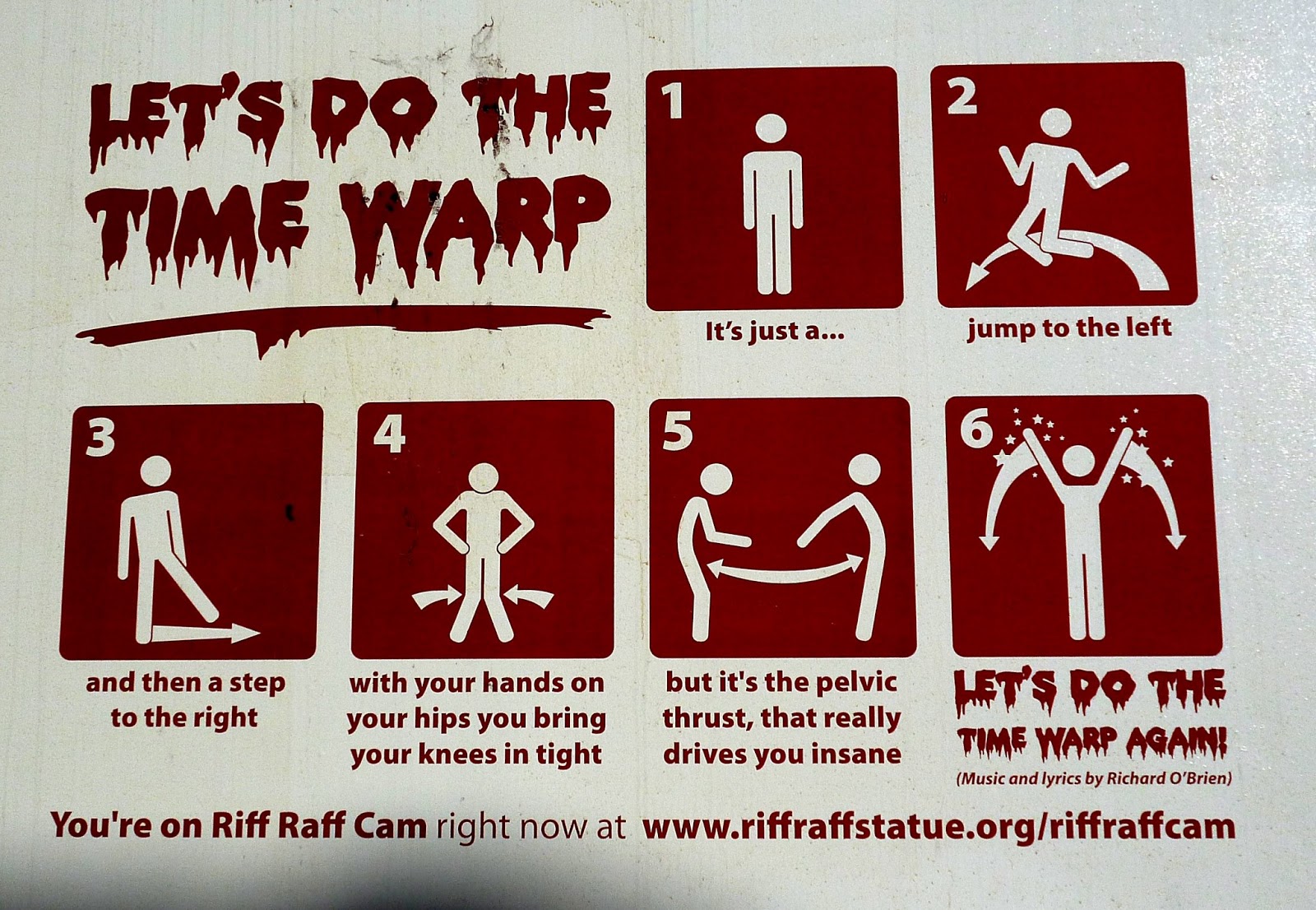
DRESSING HAS SEEN AUDIENCES IN FISHNET TIGHTS DO THE TIME
WARP AGAIN AND AGAIN.

O'BRIEN MOVED TO HAMILTON IN 1957 AND WORKED IN A BARBER-SHOP
IN THE EMBASSY THEATRE WHICH STOOD ON THIS SITE. HE CREDITS
THE MANY B-GRADE, LATE NIGHT DOUBLE FEATURE MOVIES HE
WATCHED HERE AS MUCH OF THE INSPIRATION FOR ROCKY HORROR.

THE EMBASSY THEATRE WAS OPENED IN 1915 AS THE THEATRE ROYAL,
AND WAS USED AS A MAJOR VENUE FOR STAGE SHOWS, CONCERTS AND
POLITICAL RALLIES UNTIL THE 1960'S. THE STAGE THEN CLOSED, BUT
THE EMBASSY REMAINED AS A PICTURE THEATRE,
AFFECTIONATELY KNOWN AS THE "FLEA-PIT" UNTIL
ITS CLOSURE IN 1989. DESPITE PROTEST, THE
THEATRE WAS DEMOLISHED IN 1991.

THIS STATUE CELEBRATES THE INTER-
NATIONAL SUCCESS OF HAMILTONIAN
RICHARD O'BRIEN, AND A PIECE OF
HAMILTON'S CINEMATIC HISTORY.'


Nigel Ogle's Tawhiti Museum, Hawera, New Zealand

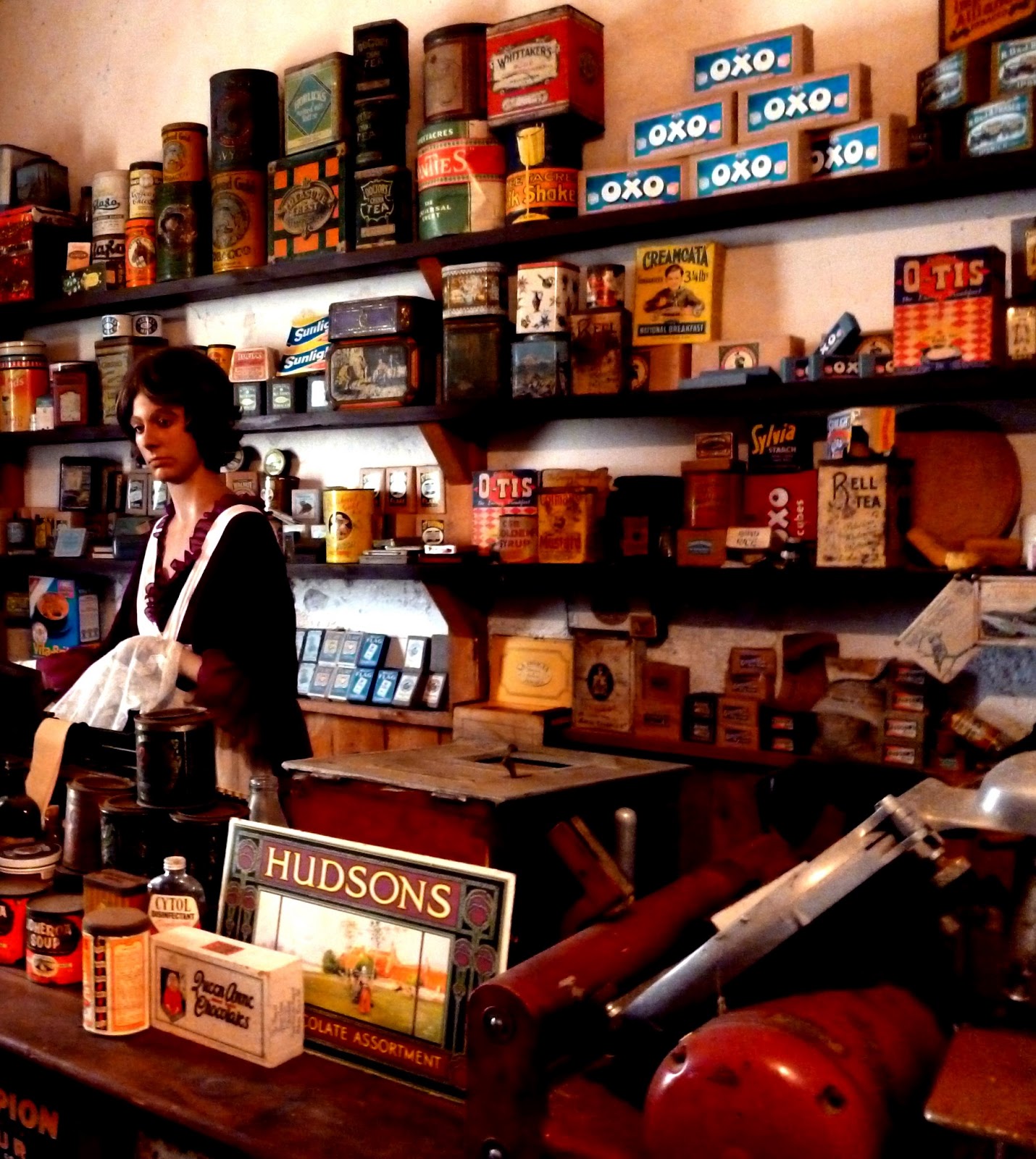
Nigel and Teresa Ogle bought a seventy-year-old cheese factory here in 1975, and built a museum out of it. Using moulds of actual people – friends, relatives and locals – life-size models of characters are created.
 
The flour mill at Tawhiti was built in 1881 but closed down in 1886. 
 
It was bought and re-opened by the miller George Ogle, who had emigrated with his wife Mary Ann, their first children, and brother William from Nottinghamshire, England in 1884 and bought the mill in 1887 after a short time at a mill in Auckland.
 
The Ogle Brothers' store in Hawera.
 
Other exhibits:


Ronald Hugh Morrieson: Predicament (1974)

Predicament was the third Ronald Hugh Morrieson novel to be published, although it was a posthumous publication: in a minor way, his comment to Maurice Shadbolt, that he feared he would be 'one of these poor buggers who get discovered when they're dead', had come true.

Morrieson has been mentioned by some reviewers as a writer of Taranaki Gothic. Shadbolt writes a six-page Introduction to this edition, in which he speaks of his first-hand knowledge of Morrieson and speaks about the occasion that he asked Shadbolt what Southern Gothic is, as a 'professor bloke' representing Australian Broadcasting had asked him if he was influenced by it, and Morrieson merely pretended that he knew what it is. Shadbolt mentioned William Faulkner, Truman Capote, Carson McCullers and Calder Willingham in his reply, although I'd have thought that Erskine Caldwell definitely deserves a mention as a comparison, but it seems that Morrieson hadn't read any of these authors.

Significantly, Morrieson asks if these writers make the reader smile, as he can't bear the idea of reading books that don't do so. Here we probably have a strong indication of Morrieson's aesthetic as a writer, as Predicament has a similar quality to The Scarecrow and Came a Hot Friday in that it is a blend of the serious and the amusing, giving it a kind of cartoon quality.

Predicament has a teenage protagonist like The Scarecrow, although he is not the narrator. Fifteen-year-old Cedric Williamson meets Mervyn Toebeck, who almost certainly has just killed his abusive meths addict father, and, as he meets Mervyn's friend the Spook, the respectable, bookish schoolboy will be led into a number of predicaments.

Cedric, like Mervyn, is an outsider, which is one of the reasons why he relates to Mervyn, but his home life is very different: he lives with his loving grandmother and his father Martin, whose mental balance has been upset as a result of a fall, and who for years has been building a strange tall wooden tower in front of his house, much to the annoyance of neighbours.

Rather reluctantly, Cedric gets drawn into blackmail with Mervyn and the Spook, although their victim Blair Bramwell (who is carrying out a secret affair with his young step-mother Margot) decapitates the intruding Spook. And Cedric is in a predicament.

All this sounds rather gruesome and sordid, but it is Morrieson's usual light ways of handling the subject matter that take the seriousness out of it. Perhaps a comparison with the Coen Brothers's treatment of the balance between the violent and the comical isn't irrelevant here, especially as Morrieson's influences seem as much (if not more) indebted to celluloid as opposed to print.

On the back cover of this Penguin New Zealand edition is a one-sentence quotation from the book: 'On the Sunday afternoon, Mervyn Toebeck gate-crashed his life', which is an image that is repeated later in the book, and for me this is a key to understanding it. Throughout the book, other people intrude on each other and 'gate-crash' either physically or mentally (or very often both) into other people's lives, although it is perhaps particularly the mental gate-crashing that we witness. And that gate-crashing can be active or passive, because Morrieson depicts an environment in which people are very strongly affected by the very presence of others.

A very interesting article about Morrieson's novels, with particular (and detailed) reference to Predicament (especially to that novel seen as social satire) is here: Ian Richards's Predicament in Context.

My other blog posts on Morrieson's work:

–––––––––––––––––––––––––––––––––––
Ronald Hugh Morrieson in Hawera, Taranaki, New Zealand
Ronald Hugh Morrieson: Came a Hot Friday (1964)
Ronald hugh Morrieson: The Scarecrow (1963)
Julia Millen: Ronald Hugh Morrieson: A Biography (1996)

26 April 2013

Michael King: Frank Sargeson: A Life (1995)

The first quarter of Michael King's Frank Sargeson: A Life is called 'Norris Davey', and the rest 'Frank Sargeson' because the writer, born Norris Frank Davey, changed his name at the beginning of the 1930s – when he was in his late twenties – soon after receiving a suspended sentence in Wellington for indecent assault: this had been a single consenting act of mutual homosexual masturbation, although his older casual pick-up Leonard Hollobin – considered a 'corrupter of youth' by the police – received a long prison sentence with hard labour.

Michael King is convinced that this incident is a vital turning point in Sargeson's biography: not only did it lead to Sargeson changing his name, but it lost him his job (and therefore destroyed his professional career as a solicitor), and led him into a kind of denial, a retreat from his past. He had learned one lesson: that the homosexual subculture he'd discovered in London couldn't with impunity be as freely indulged in back home in New Zealand.

Nevertheless, and although there is no mention of the court case in Sargeson's three-part autobiography, homosexuality is used in his stories as a encrypted emblem of difference, the reader is often introduced to a world in which the male body is celebrated, and where marriage is often a source of considerable discord. The codes Sargeson uses remind me – no matter how different it may be – of the work of his British contemporary Rhys Davies, the homosexual writer who left his native Wales for London, where he was free from the asphyxiation of the chapel mentality.

Frank Sargeson, born in Hamilton, was certainly asphyxiated by the religious constraints of his puritanical, strict Methodist parents, and his life – decades of poverty during which he forsook the trap of comfort and security in exchange for devotion to reading and writing – was very much a rebellion against his parents' conformist ethos, and by extension conformity to social norms themselves: against the easy, automatic responses of the people he was surrounded by.

If Michael King's biography frequently depicts an almost monk-like ascetic figure, this is in no way a hagiography, and Sargeson's self-denial – almost self-effacement – sometimes gives way to jealousy, prickliness and senseless bitchiness, mockery, neo-Luddism, a grumpy old man mentality (even before he grew old). He nevertheless comes shining through the negatives: generally, he is without hypocrisy (as an anti-monarchist, he admirably refuses the OBE), he gives a voice to the outsider, he is religiously devoted to his craft, and abundantly generous both materially and psychologically.

Sargeson's famous bach at 14 Esmonde Road, Takapuna, Auckland (now a museum preserving his memory), is perhaps best known for its old army hut at the back (now gone), where Janet Frame (also an innocent victim, but of victim of psychiatry) stayed and wrote her first novel Owls Do Cry (1957), although it also temporarily housed, for instance, 'Peter' (Edith Pudsey Dawson), Kevin Ireland, and Renate Prince, an architectural student.

The bach, in its three incarnations (the last one a one-room extension of the first), was also – on and off – a home for over forty years to the itinerant horse-obsessed Harry Doyle, Sargeson's (typically) older and working-class friend and lover.

More importantly – at least for literary history – 14 Esmonde Road is where Sargeson tended his words with the same love and attention as he gave to his vegetables or Harry Doyle, where – initially influenced by, for example, Hemingway and Saroyan – he hewed his literary creations into a spare style, the spartan, vernacular reportage of the narrators blending seamlessly with the reported speech (which was unreported by inverted commas). It is where Frank Sargeson self-consciously (but with a whisper) heralded the birth of the new voice of New Zealand literature: a new world that refused to look back to the motherland, that at last refused to mimic the style of writers who lived on the other side of the world. And, entranced by the innovation, many other New Zealand writers followed him, many of whom had previously been personally encouraged by him.

Tucked inside my secondhand book (which was not easy to find, not even in New Zealand, and has remainder marks on the bottom edge) is an cut-out review of Frank Sargeson: A Life by Tim Upperton in the New Zealand Herald (24 February 1996, s.7, p.9) Upperton is quite right to praise this scholarly work that is Michael King's 478-page biography of Sargeson, and quite right to argue against anyone suggesting that the writer is now a little old-fashioned. Yes, Sargeson was right too in not toeing any political party line, right in having his narrator in 'Conversation with My Uncle' ask how many bananas the bowler-hatted walking dead man would take from the social picnic.

The question is even more urgent now, when politicians incessantly turn the screws on the poor rather than the rich, and the electorate is merely expected to shrug its shoulders and accept rather than rebel, to agree with what it is told and not to question the status quo. Frank Sargeson wasn't frightened to question the status quo. As opposed to what (Australia's) Patrick White said when he called Sargeson's writing 'Not for export', it is for export and for the whole world, although it is most unfortunate that his name is scarcely known outside New Zealand: we desperately need more voices against conformity. We need Frank Sargeson.


Link to another Sargeson post:

–––––––––––––––––––––––––––––––––––
Frank Sargeson in Takapuna, Auckland, New Zealand

16 April 2013

Ronald Hugh Morrieson: Came a Hot Friday (1964)

Ronald Hugh Morrieson's novel Came a Hot Friday (like his début The Scarecrow, which I shall review a little later after re-reading) is a strange mixture of thriller and comedy punctuated by speech very often in the New Zealand vernacular. It seems more intricately structured, though, with chapters seen from the points of view of different characters who will interweave with others.
 
The blurb on the back of this retro New Zealand Penguin edition seems doubtful about how to sum the book up, and I can understand the problem: it's about Morrie Shalapeski, who sets fire to premises he doesn't realize a man is sleeping in; and Wes Pennington and his chum Cyril Kiddman (incorrectly spelt in the blurb), who start a lucrative betting scam; and Don Jackson (perhaps an older version of The Scarecrow's Neddy Poindexter), who is out to lose his virginity; and Sel Bishop, the violent bookie who has no concern for anyone but himself and how much money he can make; and the absurd but highly sympathetic Te Whakinga Kid, who is a mock-Zorro who pretends so much that things become real.
 
They are all brought together in some way: the man Morrie (eventually) accidentally kills is Pop Simon, whom he knows and likes, and who is known by his boss's wife's friend; Don becomes the third partner in Wes and Cyril's betting scam; Morrie was paid for the arson by the evil Sel Bishop, who towards the end tries to burn Morrie, Wes, and his own girlfriend Claire (who is also Morrie's sister).
 
Oddly, perhaps, almost all of the characters (with the notable exceptions of the bookies Bishop and Cray) are seen in a sympahetic light, often as wounded victims of a life without mercy in which they have to feed their addictions – usually by getting as hopelessly drunk as possible as often as possible, or (to a lesser extent) by extreme gambling. The narrator is aware of the extent of the self-destruction (and seems particularly knowledgeable about the effects of alcohol) but appears to see this behaviour as natural, or at least unavoidable.
 
A special mention should go to the Te Wakinga Kid, the Māori who dresses as a cowboy and uses a cap gun. He is a fusion of a pretend bandit and a pretend sheriff, who – as deus ex machina – transforms himself (for the reader and for the characters he rescues from otherwise certain death) instantly into a real hero. Right at the end of the book though – leaving with the swag – he sees himself as a real bandit only and throws away his sheriff badge: he has grown up and overcome superstition.
 
But, as the last page seems to say, he's just a scared kid after all: he has been as self-deceived about his new role as he was about his former ones.
 
My other blog posts on Morrieson:

–––––––––––––––––––––––––––––––––––
Ronald Hugh Morrieson: Predicament (1974)
Julia Millen: Ronald Hugh Morrieson: A Biography (1996)

15 April 2013

Ronald Hugh Morrieson in Hawera, Taranaki, New Zealand

Outside New Zealand and Australia, I doubt that many people have heard of the writer Ronald Hugh Morrieson (1922–72), and doubt even that he's very well known in New Zealand, the country of his birth. My title is obvious: the small town of Hawera is where Morrieson was born, where he lived and where he died. He hardly ever left the town: when he started university in Auckland he couldn't stand it and returned permanently to Hawera in a week.

It's customary to quote Morrieson's friend, the author Maurice Shadbolt, on what Morrieson said to him: 'I hope I’m not another one of these poor buggers who get discovered when they’re dead'. On Morrieson's death only two novels – The Scarecrow (1962) and Came a Hot Friday (1964) – were published, although these were followed after his death by Predicament (1975) and Pallet on the Floor (1976), which I believe is more of a draft than a finished novel. Subsequently all of the books were turned into films. But only the novel The Scarecrow seems to be widely available: I only found his second novel in one outlet, and his others are out of print. Even in death, he's still somewhat obscure.

Morrieson had a reputation in Hawera as a drunk and a waster, although he was better known locally as a musician than as a writer – earlier, he played in dance bands, and gave music lessons later.

He lived with his mother Eunice and his aunt Doris at 1 Regent Street, where he was born, and was devastated by the death of his mother (who had also been a music teacher) in 1968. The house was built by his maternal grandfather Charles Bartley Johnson, a cabinet maker. In 1993 there were plans to knock down the house and replace it with a Kentucky Fried Chicken outlet, but despite the setting up of a Scarecrow Committee to attempt to prevent this the house was demolished in April 1973.


However, the house was far from completely destroyed: Morrieson's room or attic, where his family say he wrote all his work, was bought by local builder Robert Surgenor to be used as a 'sleep-out' by his daughter. The attic was moved in December 2011 to Tawhiti Museum a few miles outside central Hawera, where it was renovated and now forms the upper floor of a display dedicated to Morrieson.

A poster of the movie The Scarecrow (1982).

Came a Hot Friday (1984).

Predicament (2010).

Morrieson's attic is not all that was preserved from the house: in Morrieson's Café Bar, wood from the house is used in the bar front, table tops, doors, fireplaces and staircase. Express an interest in Morrieson, and you will be shown a large laminated sheet giving a potted biography of the writer.


I'd parked next door to the café, in Countdown supermarket car park, and was intrigued to see Morriesons's van there: 'Let us solve your "Predicament" with a free ride to Morrieson's Café & Bar'.

I asked the very helpful girl at the i-site if she could could tell me where Morrieson's grave is in Hawera Cemetery. She jumped behind the computer and asked:

'What's the first name?'

'Ronald'.

'Oh, that Morrieson!'

I found a copy of The Scarecrow the following day in Whitcoull's in Wanganui ($5 off, making it just $9) and the assistant asked me if I'd read any of his books, and when I replied 'Not yet' she told me they are very odd.* So, I suppose the 'poor bugger' has been discovered by some people.

'In
Loving Memory Of
RONALD HUGH
BELOVED SON OF THE LATE
HUGH F. AND EUNICE H.
MORRIESON.
DIED 26TH DECEMBER 1972
AGED 50 YEARS.'

His aunt survived him:

'ALSO DORIS H. E. JOHNSON
DIED 28TH FEBRUARY 1974
AGED 81 YEARS.'


*She's right too. I've only read The Scarecrow so far, but for a book about a necrophilic serial killer this is a highly amusing work: the key, I think, is that all the sex and violence is understated, often in the form of suggestion.

My other blog posts on Morrieson's work:

–––––––––––––––––––––––––––––––––––

Ronald Hugh Morrieson: Came a Hot Friday (1964)
Ronald Hugh Morrieson: The Scarecrow (1963)
Ronald Hugh Morrieson: Predicament (1974)
Julia Millen: Ronald Hugh Morrieson: A Biography (1996)