Showing posts with label Eure-et-Loir (28). Show all posts

10 August 2019

Éolienne Bollée in Berchères-les-Pierres, Eure-et-Loir (28)

This we stumbled upon quite by chance: a lavoir with an éolienne Bollée. The latter is a water pump driven by wind and invented by Ernest-Sylvain Bollée (1814-1891), a kind which was operative in France from 1872 to 1933. About 350 once existed, mainly in France, and of which about 80 can still be seen. In 1993 this pump in Berchères-les-Pierres was declared a Monument Historique. Bollée died on horseback in an accident with a tram.

Charles Péguy in Chartres, Eure-et-Loir (28)

Born in La Beauce region, writer and poet Charles Péguy (1873-1914) saw Chartres cathedral as his own. He went on a pilgrimage on two occasions, in 1912 and 1913, to Chartres from his home in Palaiseau, Essonne, a distance of some 140 kilometres return. The organisation L'Amitié Charles Péguy commermorated the century of his pilgrimage by creating Le Chemin Charles Péguy. Blue and white markers plot out the route.


Jean Moulin in Chartres, Eure-et-Loir (28)

Great hero of the French Resistance, Jean Moulin (1899-1943) has a very impressive mural here. He was briefly préfet of the département Eure-et-Loir before being forced into hiding from the Nazis. Several places locally honour Moulin, including one where a quotation from is paper, Premier Combat, is given.

Hanneke Beaumont in Chartres, Eure-et-Loir (28)

The sitting statues sculpture in the Place Châtelet in Chartres is by the famous German artist Hanneke Beaumont and was installed in 2009 for Chartres's 'Art en Ville' event. Chartres Tourisme describes this as two men reaching out for contact, but who will never make contact, seem to be waiting for the viewer to make contact, for us to join them.

9 August 2019

Boîte à lire, Illiers-Combray, Eure-et-Loir (28)

A one-sided Boîte à lire spotted in Illiers-Combray, Eure-et-Loir (28).

Boîtes à lire:
––––––––––––––––––––––––––––––––––––
Boîte à Lire, Dicy, Nièvre
Boîte à lire, Maisons-Laffitte, Yvelines
Boîte à lire, Sorigny, Indre-et-Loire
Boîte à Lire, Jonzac, Charente-Maritime
Boîte à lire, La Roque-d'Anthéron, Bouches-du-Rhône
Boîte à Lire, Épineuil-le-Fleuriel, Cher
Boîte à lire, Marseille, Bouches-du-Rhône
Boîte à lire, East Markham, UK
Boîte à lire, La Folie Couvrechef, Caen, Calvados
Boîte à lire, Bergues, Nord
Boîte à lire, Le Havre, Seine-Maritime
Boîte à lire, Villerville, Calvados
Boîte à lire, Saint-Servan, Saint-Malo, Ille-et-Vilaine
Boîte à lire in Caen, Calvados
Boîte à Lire, Noyant d'Allier, Allier
Boîte à lire, Dampierre-en-Burly, Loiret
Boîte à lire, Illiers-Combray, Eure-et-Loir
Boîte à lire, Chartres, Eure-et-Loir
Boîte à lire, Saint-Romain-au-Mont-d'Or, Rhône

Philippe Desportes and Mathurin Régnier in Chartres, Eure-et-Loir (28)

A monument in the centre of Chartres celebrating two medieval poets born in Chartres: Philippe Desportes (1546-1606) and Mathurin Régnier (1573-1613).

Franz Stock in Rechèvres, Chartres, Eure-et-Loir (28)

L'abbé Franz Stock (1904-48) was a German Catholic priest. He was chaplain in prisons during World War II, ministering to condemned men. He was the spiritual director of the 'séminaire des barbelés' in  Chartres. On his death he was buried in the cemetery in Thais, although his remains were moved in 1963 to the very impressive L'Église de Saint-Jean-Baptiste in Rechèvres, Chartres, constructed in 1961, where his tomb lies. Unfortunately, a heavily sunned notice on the church door informed us that the church was, er, temporarily closed apart from at the time of Mass.


Boîte à lire, Chartres, Eure-et-Loir (28)

Right in the centre of Chartres, a double-sided Boîte à lire with a great number of books. No comment!


Boîtes à lire:
––––––––––––––––––––––––––––––––––––
Boîte à Lire, Dicy, Nièvre
Boîte à lire, Maisons-Laffitte, Yvelines
Boîte à lire, Sorigny, Indre-et-Loire
Boîte à Lire, Jonzac, Charente-Maritime
Boîte à lire, La Roque-d'Anthéron, Bouches-du-Rhône
Boîte à Lire, Épineuil-le-Fleuriel, Cher
Boîte à lire, Marseille, Bouches-du-Rhône
Boîte à lire, East Markham, UK
Boîte à lire, La Folie Couvrechef, Caen, Calvados
Boîte à lire, Bergues, Nord
Boîte à lire, Le Havre, Seine-Maritime
Boîte à lire, Villerville, Calvados
Boîte à lire, Saint-Servan, Saint-Malo, Ille-et-Vilaine
Boîte à lire in Caen, Calvados
Boîte à Lire, Noyant d'Allier, Allier
Boîte à lire, Dampierre-en-Burly, Loiret
Boîte à lire, Illiers-Combray, Eure-et-Loir
Boîte à lire, Chartres, Eure-et-Loir
Boîte à lire, Saint-Romain-au-Mont-d'Or, Rhône

La Médiathèque l'Apostrophe, Chartres, Eure-et-Loir (28)

In 1919 the decision was made to construct L'Hôtel des Postes in the centre of Chartres. The architect was Raoul Brandon (1878-1941), who incorporated a number of mosaics relating to the postal service, which Patrick Macquaire, in his book Un essai de transformation sociale : Le Quartier Picassiette à Chartres (2018), suggests may have been an inspiration to Raymond Isidore, or 'Picassiette'. The building became Médiathèque l'Apostrophe in 2007.


6 August 2019

Marcel Proust in Illiers-Combray, Eure-et-Loir (28)


Illiers-Combray – originally just Illiers but the name was extended in 1971 as a homage to Marcel Proust (1871-1922) – is understandably a small town (pop. 3325 in 2016) with a deep interest in the great writer. After all, Proust spent his holidays here between the ages of six to nine at the home of his paternal aunt, Elizabeth Proust, who is called 'Tante Léonie' in his work À la recherche du temps perdu, notably in the first volume Du côté de chez Swann. Germaine Amiot, the grand-daughter of Tante Léonie, gave the house to La Société des amis de Marcel Proust and Les Amis de Combray in 1976.
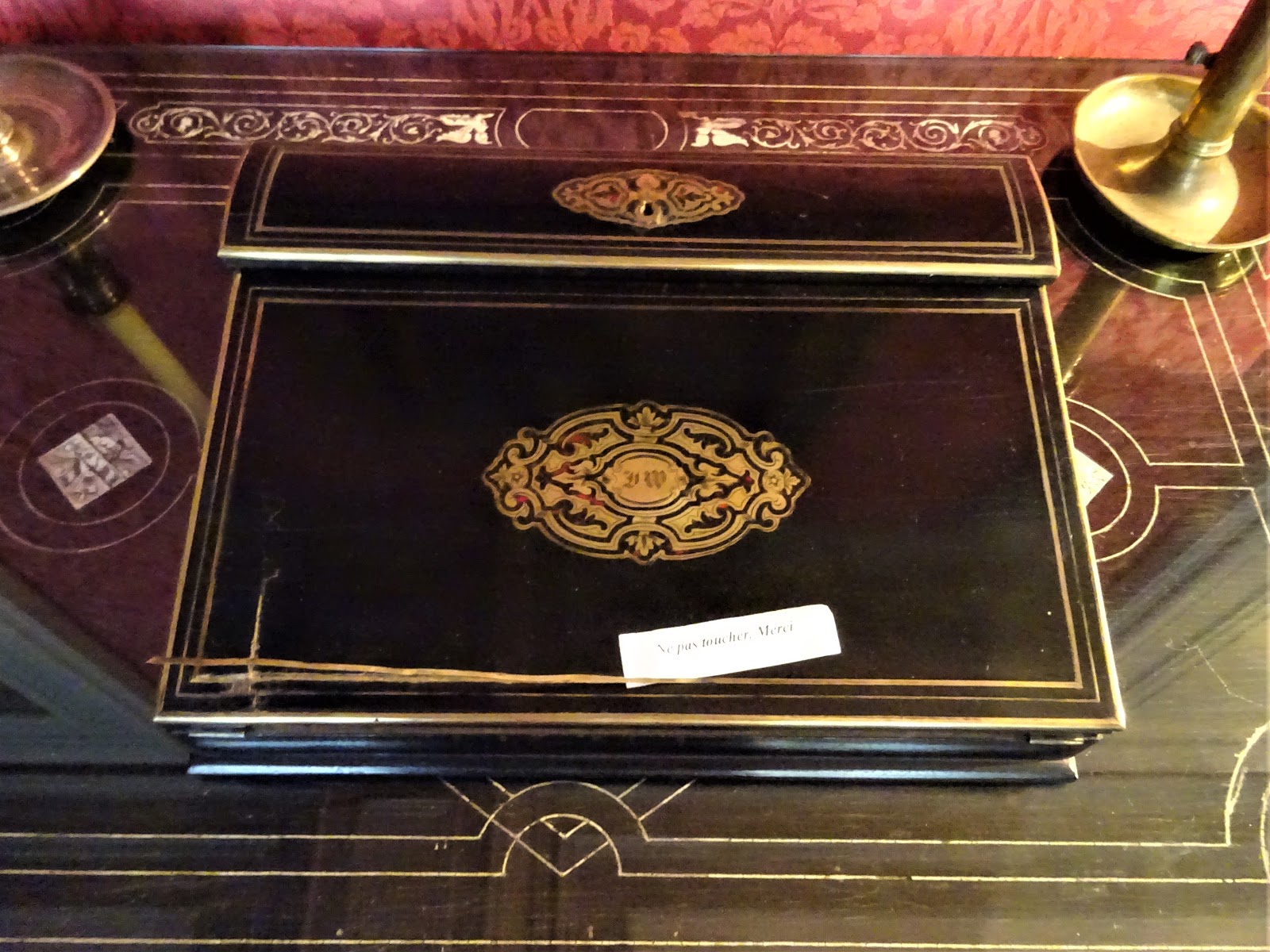
Here I show a number of photos in and around his house in Illiers, a town which in Du côté de chez Swann is very thinly disguised as 'Combray'. I begin with a shot of the garden and the orangerie, then the kitchen (including the back pantry and a replica of the coffee pot used then), before moving to the drawing room with its 19th century woodwork.

The staircase leads to a bedroom that fascinated the narrator of the novel, with its magic lantern, its dried flowers, the clock under its glass dome and the book François le Champi.

But obviously it's the room opposite that is crucial: where 'Tante Léonie' gave Proust the petite madeleine with its scallop (coquille Saint Jacques) shape that she dunked in tea. Many years later of course, that memory would come surging back, perhaps without which Proust would not be known.

The salon rouge on the ground floor shows a painting of Proust's father Dr Adrien Proust by Jules Lecomte du Noüy, with a writing desk of his mother Jeanne before her marriage (when she was Weil).

The salon oriental looks onto the garden, and in it is a copy of  the painting Femme à la fenêtre by Lazerques. Here, the family would play cards.

My photos conclude with a shot of the house where Proust's father Dr Adrien Proust was born, plus the plaque on it, which includes a sculpted likeness of the man.


5 August 2019

The Mosaic stones, Hauts-de-Chartres, Chartres, Eure-et-Loir (28)

The renovation of the Hauts-de-Chartres area of Chartres, essentially led by Patrick Macquaire, importantly included the work of Raymond Isidore (Picassiette) in the process, and mosaics were all-important. Many people joined in the work, some of which included mosaics on boulders. Here are some examples:


The Grave of Raymond Isidore, aka Picassiette, Hauts-de-Chartres, Chartres, Eure-et-Loir (28)

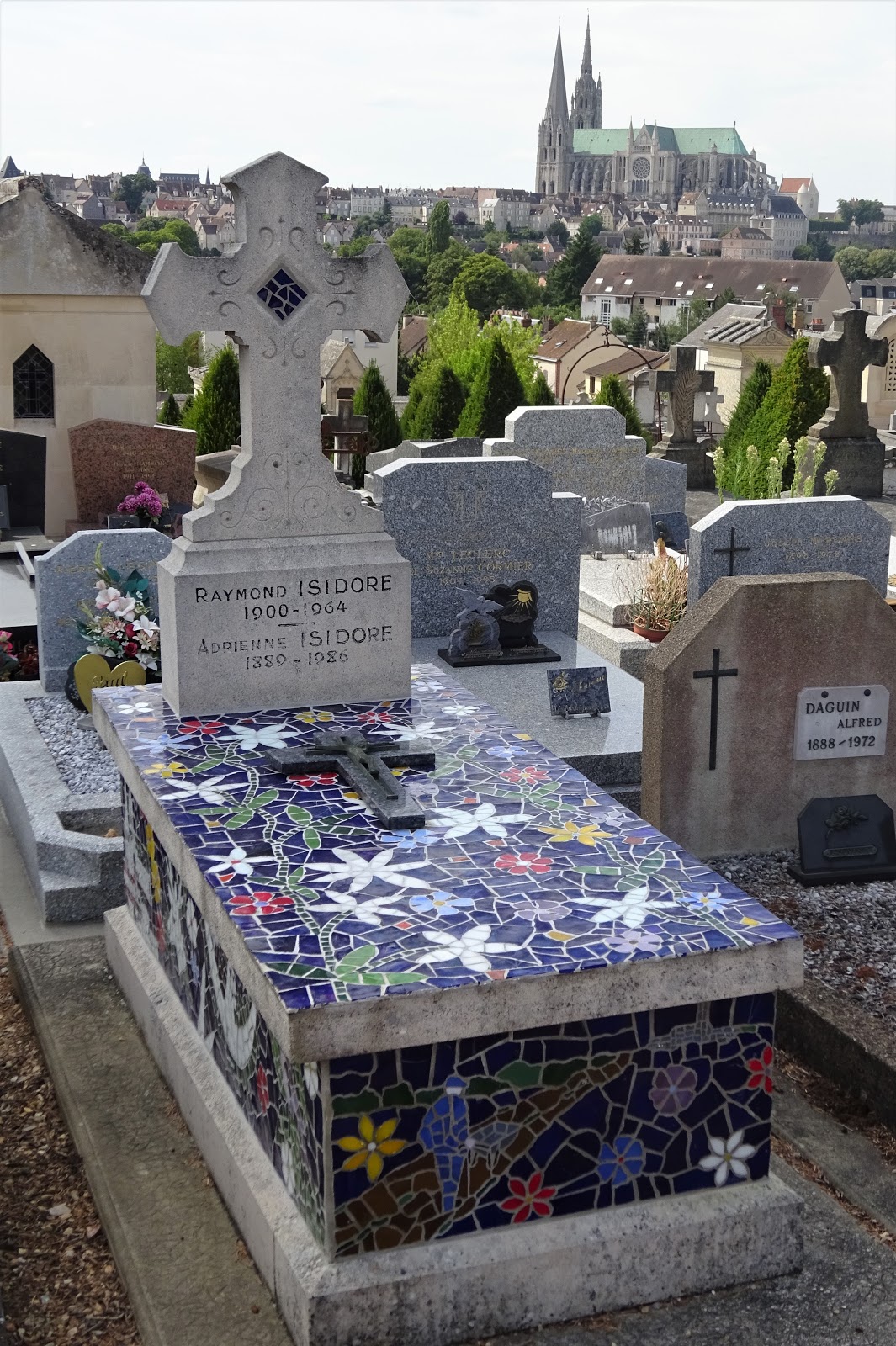
As an article in the local paper L'Echo Républicain says, many people know where Raymond Isidore's (or Picassiette's) house is, but not where he's buried, which is in the Cimetière Saint-Chéron (where he worked as a sweeper), just a few hundred metres from the Maison Picassiette, and the grave (which of course is also that of his wife Adrienne) has relatively recently been renovated. An interesting fact is that his grave is within sight of the cathedral in Chartres, the place he represented so many times in his art.