Showing posts with label Redditch. Show all posts

2 May 2016

Thomas Thomas at the White Hart, by Robert Hughes

ROBERT HUGHES WRITES:


Thomas Thomas was the innkeeper of the White Hart Inn, Lower Maudlin Street, Bristol. He could also have been my great-great-great-great-grandfather.

In a city where there were not only many Thomas Thomases, but where at least two who were publicans, it is difficult to identify one individual and attribute a life story to him. Here we do at least make the attempt, but we have to start below: this is an engraving of the British Needle Mills, said to have been the biggest needle factory in the world.


Samuel Thomas was my great-great-great-grandfather, and much has been said about him on this blog. The eccentric writer Lionel Britton, author of Hunger and Love, is among his many descendants.

Although Samuel Thomas (1807-1878) built this mighty factory complex while still in his twenties or very early thirties, there is as yet no record of how he obtained the money to do it. Supposing he had a big fortune behind him in the first place, there would be nothing remarkable as to how he afforded his endeavour, although it was an outstanding enterprise by any standard.

However, Samuel was thought to have started life a ‘simple workman’. Consider this press cutting below, concerning his will after he died.
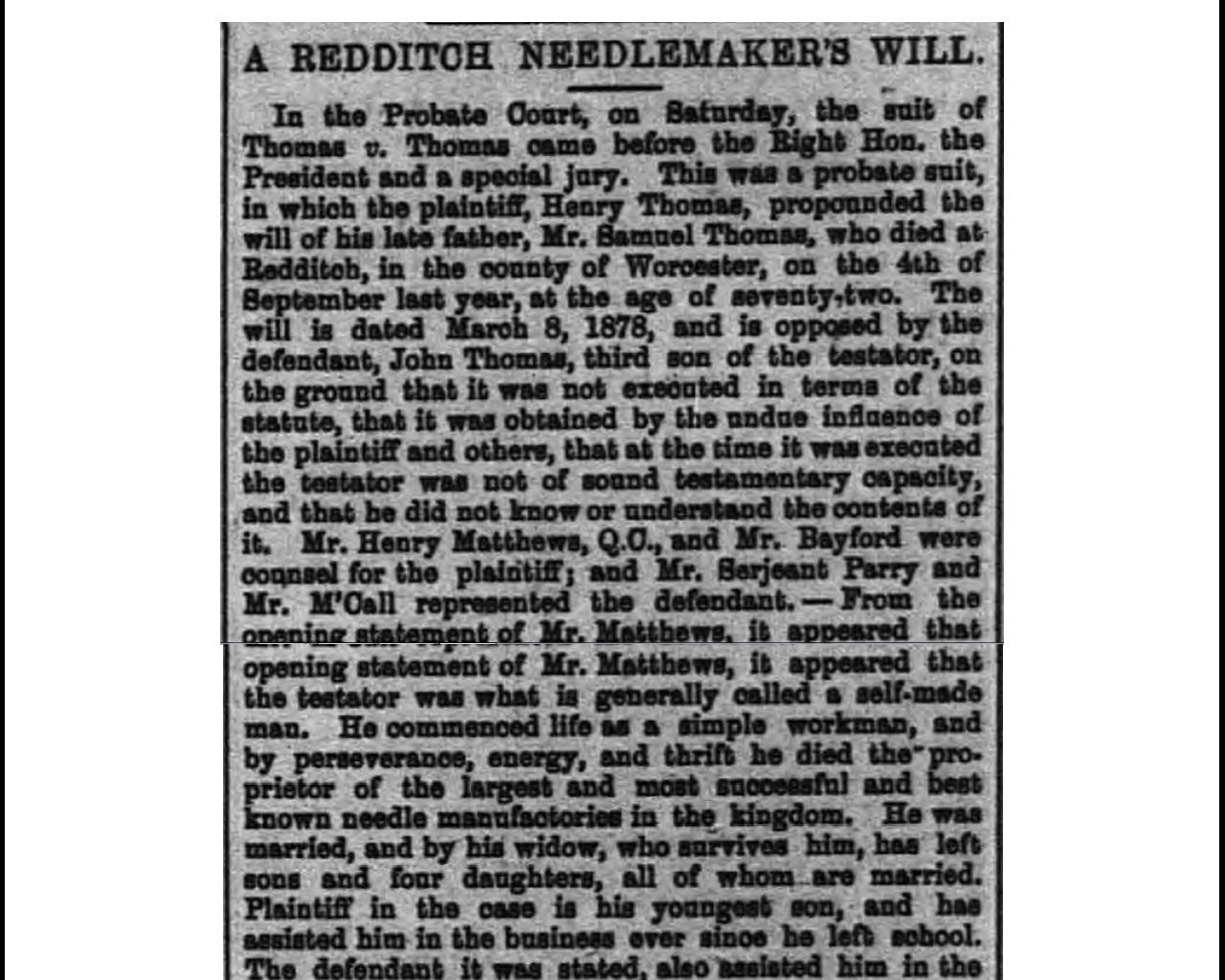
The contest over Samuel’s will is a whole different story, but what concerns us here is the narrative about his career. Was he really the ‘self-made man’ of this account? (He died 6th Sept, not 4th, and he was 71 not 72. Just to get that straight.)

On the face of it, this is the kind of story which inspired Victorian England. Even if he did not literally start life as a simple workman, his achievement was immense. Lionel Britton was not a great fan of ‘Trade’, and the British Needle Mills were nothing less than ‘Trade’. We have been able to conclude that Hunger and Love is a long (and yes it is long!) primal scream against his own background.

Samuel Thomas may not have been the easiest of men to love, and in other articles we can see he quite openly had a mistress set up in a separate establishment over more than a decade, giving rise to the notorious Redditch Horsewhipping case of 1865. On the other hand, there are articles in the press archives which describe him giving out coal to the poor, receiving an award for generosity to his workpeople, and being ready to lend a hand when it was needed.

So he was an eminent man in his town, and yet did anyone have a clue where he had come from or how he financed the British Needle Mills? It certainly looks as though Samuel felt free to manufacture his own myths alongside his world-renowned needles.

Lionel Britton said that his great-grandfather ‘came from Wales with sixpence to his name’. This was quite likely to have been the prevalent myth within the family, and yet it is nonsense.

Samuel was born in Bitton, Gloucestershire. Three censuses attest to that, including the astonishing record of 1861 where he is at the home of his mistress in Spring St, Edgbaston. On the same day he is recorded in Redditch, where whoever filled in the form put NK as his place of birth. Nowhere else in my researches have I found another individual recorded in two places at once on any of the censuses!

Bitton was a large straggly parish between Bath and Bristol. Somewhere in the village is a stone proclaiming Bath is 6 miles and Bristol is 6 miles.

At the western end of the parish was the chapelry-of-ease at Hanham, where it was convenient for the locals to have their children baptised. Interestingly, we have an example of where a child seems to have had a baptism ceremony in Hanham and also in the parish church of Bitton: Ann Thomas was baptised 29 Jul 1805 at Hanham, and then 25 Aug 1805 at Bitton. The parents were James Thomas and Jane. We can return to this in a subsequent article, as another child of this couple later turns up in Redditch.

Samuel Thomas was baptised 9 Feb 1807 at Hanham. From his tombstone in Redditch, photographed by my cousin David Guillaume before everything was torn up to make whatever Redditch is supposed to be now, he was born 16 Jan 1807. The likely baptism record gives us Samuel Stephens Thomas, and his parents were Thomas Thomas and Jane.

Samuel Thomas of Redditch who built the British Needle Mills was not known to use any middle initial, except that there is one intriguing record. His much-loved daughter Maria died in Paris in 1860, and this clip from the Worcestershire Chronicle quotes that middle initial:

So who were Thomas Thomas and Jane? The only marriage in the Bristol Diocese which would fit was one between Thomas Thomas and Jane Pennington, 13 Apr 1801.

Does this make them the the parents of Samuel Thomas? An argument in favour would be that although Sam is the only child recorded in Bitton rather than in St James, he receives a middle name, like three of the other children of this couple but unlike around 90% of the rest of the population.

An argument against would be that Samuel had 11 children and never called any of them either Thomas or Jane. In the old days, it was something of a norm that names of parents were passed on to children. The only way we can reconcile this with the idea of Sam’s parents being Thomas and Jane is if we postulate that he was a bit of a radical, and wanted to branch out…perhaps even that he had had a breach with them and decided consciously to avoid any name that would honour them. That circumstance would be very sad indeed, but the evidence that those were indeed his parents’ names is rather strong.

He could have been the child of another and unknown Thomas and Jane, who were just passing by in Bitton (or the chapelry of Hanham). Persuading us against that however is that there is a tribe of Thomases in Hanham, and indeed James Thomas (born in Bitton) turns up as a needlemaker in Redditch in several censuses, and raises a big family.

Thomas Thomas and Jane Pennington seem to have had four children besides Samuel Stephens Thomas if he is indeed one of theirs. There is a Jane Thomas baptised in the parish of St James, Bristol 5 Sep 1802, then much later, also in St James, on 24 Mar 1816 three children are baptised at once. In the order in which they appear on the record:

Mary Anne Thomas

Thomas Pennington Thomas

John Pennington Thomas.

No place or abode is mentioned, but the father’s profession is “Brewer”.

The Bristol trade directories for 1819 and 1822 list a Thomas Thomas at the White Hart, Lower Maudlin St.

This website contains the following: The inn was offered for sale by auction in 1824, described it as old-established and well accustomed with brewhouse and good cellarage attached, for many years in the occupation of Thomas Thomas, tenant at will. It was 'situated ajacent to the steps leading to the church yard of the parish church of St James', link here.

A Thomas Thomas of Maudlin Lane was buried 19 Mar 1829. Maudlin Lane is now known as Lower Maudlin St, and it could be that at the time both descriptions were used interchangeably.

By the time of the 1841 census, we have Jane Thomas in a household in a neighbouring street (Great James St) with her son John. She is ‘ind’ which signifies independent means. In 1851, she is back in Lower Maudlin St at No 1, again with her son John who is described rather insensitively as an ‘idiot’ living on Parish Relief. Jane is an ‘annuitant’ which is the same in effect as ‘ind’. This record includes the very important information that she was born in the parish of St George’s, Pill, but she spoils it a little by saying this is ‘Glos’ when in fact Pill is in the parish of Easton in Gordano, Somerset. Jane was probably never going to have been a significant intellectual: note that she signs with a cross on her marriage certificate.

She died just a couple of weeks after the 1851 census, so we are lucky to have that.

John was with his brother Thomas in 1861, but his eventual fate is not yet clear. Given that in 1861 he was a labourer, and a probable record of 1871 gives him as ‘epileptic’, he was unlikely to have been an idiot and could have been simply…epileptic!

Thomas Pennington Thomas is easier to trace thanks to the happy fact that his middle name was included in his death record. He died 19 Nov 1874, said to be aged 62, and was a shoemaker or shoemaker clicker on every census except 1861 when he was a labourer. Possibly he had fallen on hard times in that year, or he chose not to elevate his station above that of his brother.

He married Ann Collings at Bedminster, then Somerset, on 27 Apr 1832. They had three known children:

Clara Ann Thomas, born 18 Apr 1844.

Angelina Pennington Thomas born 25 Jan 1849.

Thomas Alfred Thomas born 29 Mar 1851. These records are from GRO certificates in my possession. Clara Ann Thomas is in this Public Member Tree on Ancestry.co.uk.

Assuming the hypothesis is correct and Samuel Thomas was the child of Thomas Thomas and Jane Pennington, then I have identifiable fifth cousins with whom to make a DNA comparison which would prove it beyond all reasonable doubt.


The ‘Bristol’s lost pubs’ website gives us this image from the 1950s, which is out of copyright and can be freely used. The information includes the fact that Thomas Thomas was the landlord from 1816-1823. This is rather interesting as you will see the church of St James behind the pub and it is tempting to construct a narrative that whatever he had been doing before, he was now settling into running a pub that literally abutted the churchyard of St James, and that he then thought it was high time to have his hitherto unbaptised children christened in the church. This would put him right with the locals.

An item of family legend talks of an itinerant trader, (scrawled family tree by Charles Frederick Guillaume). Thomas may have been exactly that, and made enough to install himself in the White Hart and to increase his fortune by brewing as well as retailing beer.

Neither Thomas Thomas nor his widow Jane made a will unless an exhaustive search of the records has missed something, so is it not possible that Samuel Stephens Thomas, as the eldest son at the death of his father in 1829 acquired a decent pot of cash which he used to expand his needle business?

This is all in the realm of speculation at the moment. We would like to see some confirmation and will welcome any contributions from readers of this blog!

A final note: Ida Thomas (1902-2004) wrote a number of letters to my cousin David Guillaume who was trying to piece together the family tree. The following extract from one dated 30 Jan 2008, when she was already 95 years old, relates that “Original Samuel and a brother came together from Wales S. brother went to Leeds in the shoe manufacturing line…”


Could this be a bit of family legend which contained at least a nugget of truth? Allowing for a mix-up between Leeds and Bristol (large cities NOT London or Birmingham!) and for the fact that we know Samuel himself did not come from Wales, this could be a description of Samuel Stephens Thomas and Thomas Pennington Thomas. One founded the British Needle Mills in Redditch, the other became a shoemaker.

16 February 2009

The Work of Lionel Britton: Introduction

The Open University has now put my entire thesis online, which makes it much easier to read - without the lost attributes - here.
Please note, though, that the final paragraph of the second Introduction has now been found to be completely incorrect: Lionel Britton, the writer of Hunger and Love, never wrote a will: The University of Texas got the wrong Lionel Britton!

A. The Plan of the Thesis

Over the previous thirty years there have been a number of attempts to recover from oblivion the literature written by the working classes, an area that has been largely submerged under the literature of the dominant classes; in general, this interest has concentrated on the inter-war years, a period when working-class literature was in considerable evidence. The recovery has placed some emphasis on works by authors other than the few well-known ones in the working-class ‘canon’ because a much larger body of working-class literature exists which had hitherto remained largely unknown.

However, a significant omission from this ambitious recovery project is the novelist and playwright Lionel Britton, who if mentioned at all has been so mainly as a footnote to a general critical work or even to reject his inclusion at all in this literature. One of the aims of this thesis is to draw attention to this omission, and to demonstrate that Britton deserves recognition for his contribution to working-class literature. My thesis also deals with the little-recognised phenomenon of modernist techniques in working-class literature, and more generally with Britton’s relation to the literature of alienation of the inter-war years from the viewpoint of certain groups of outsiders, and with his vision of an escape from this state of alienation. Throughout, my emphasis is on Britton’s seven-hundred-page Hunger and Love (1931), his only published novel: although he also published the plays Brain (1930), Spacetime Inn (1932) and Animal Ideas (1935), his central argument is contained in the novel, and his first two plays are illustrations evolving from this argument, or — in the case of Animal Ideas, about which I have very little to say in the thesis — a simpler re-statement of it.1Also, I refer throughout the thesis to many manuscripts and obscure published articles, a number of which were written by Britton himself, which are held at the Lionel Britton Collection at Southern Illinois University in Carbondale, an invaluable source which I exploit throughout this thesis. 2)

I divide my Introduction into two sections because together with this plan, some biographical details about Lionel Britton are necessary as almost nothing has been published about his life, or at least the little that has been published is mainly hidden in newspapers or often obscure magazines from the 1930s. In the second part of my Introduction, as well as using information gathered from the LBC, I make use of material collected from such sources as the International Genealogical Index, census returns, trade directories, and birth, marriage and death certificates. I place some emphasis on the details of Britton’s family in the nineteenth century because in a number of ways these help to shed light on his later development, at the same time as they provide a backcloth to Hunger and Love: the novel has strong autobiographical elements. Other details of Britton’s later life also help to explain the reasons why he disappeared so quickly from public view.

In the first part of Chapter 1, ‘Lionel Britton and the Critics’, I give a short synopsis of the novel in order to make this and ensuing chapters more comprehensible, and in the second I examine the negative, mixed and positive critical reactions to Britton’s work, which largely consist of reviews of Hunger and Love in the early 1930s: as there has been virtually no critical work on Britton in recent years, most of the quoted material in this chapter is from newspapers and magazines from the first half of the 1930s; most of that material again comes from the LBC.

I make particular use of my findings at the LBC in Chapter 2, ‘What Lionel Britton Is Up To’: the title refers to one of the chapters in Hunger and Love concerning evolution, and my own chapter concerns the evolution of Britton’s book. Britton worked on his novel for several years, and an early typescript reveals the differences between this draft and the final copy, of which I give a number of examples. Of interest are the pencilled emendations Britton made to the typescript, because they reveal far more than the expected corrections of typographical errors or other inconsistencies: much more importantly, they facilitate an understanding of his artistic, aesthetic and political intentions. Also of interest to the development of Britton’s work is his attitude to censorship, and the problems it brought not only with publishers, but also the difficulties he experienced when wishing to stage his work; self-censorship is also relevant here.

In Chapter 3, ‘Lionel Britton’s Relation to Working-Class Fiction’, I begin by giving a brief overview of working-class fiction from the Chartist period to the end of the inter-war years, and then continue by assessing how much recent critical work has been written specifically on inter-war working-class literature, which is almost non-existent in the case of Britton. My main aim is to establish the relationship that Britton’s work has with working-class writers of the inter-war years; I analyse several working-class novels written by members of the working classes from the point of view of certain common preoccupations of this literature, continually drawing comparisons and contrasts between these novels and Hunger and Love. My chosen writers are all working-class authors with strong interests in the working classes as distinct from non-working class authors merely sympathetic to the working classes, and my chosen novels are mainly ones that have not previously received a great deal of critical attention.

I entitle Chapter 4 ‘Outsider Modernism’ because it is an expression which I find especially appropriate to what a number of working-class authors were attempting to say beyond the realist model: although realism is generally assumed to be the natural medium through which working-class authors express themselves, the true picture is a little more complicated than this. I begin by defining modernism and looking at its causes and manifestations, and then continue by examining the charges that it was elitist or bourgeois. I interpret ‘outsider modernism’ as a style of writing belonging to marginalized groups of writers, specifically the working classes in this chapter, and I explain the differences between this and mainstream modernism, analysing several passages of examples of outsider modernism in different writers, highlighting where appropriate their similarities to Britton’s novel. Finally, I briefly detail some of the realist techniques used in Hunger and Love, the recording of the minutiae of Arthur’s world, which I then contrast by giving several much more detailed examples of outsider modernist techniques in Hunger and Love, which probe the workings of Arthur’s mind. My main intention in this chapter is to establish that there is a continuation of modernist techniques in the working-class writing of the late 1920s and early 1930s, and which uses a different aesthetic from that of mainstream modernism. It links logically with the following chapter because outsider modernism is often an expression of alienation.

In my ‘Alienation and Escape’ chapter I again examine a number of texts and again draw analogies with a number of episodes in Hunger and Love. The difference is that in this chapter I am extending the analogy to incorporate authors not only from the working classes, but also from writers representing other dispossessed or disadvantaged groups of people. Alienation of some form affects all of these groups, and in order to shed more light on this, beginning with a definition of atheistic existentialism, I apply key atheistic existentialist concepts to several examples of the British literature of alienation during the inter-war period: existentialism, as I explain below, appears to have readier links to the general literature of alienation than any other philosophy. After analysing the books written by various authors, I then give several examples of alienation in Hunger and Love, all the time relating it to Sartrean existentialism. I conclude by stating that the novel is pointing towards an ideal society.

‘Past and Future Perfect’ is my final chapter. After defining the key terms ‘science fiction’ and ‘utopia’ and ‘dystopia’, in the early part of this chapter I address the specifically utopian and dystopian elements in Britton’s science fiction plays Brain and Spacetime Inn. I then briefly discuss the science fiction (a very unusual genre in working-class literature) in two of Grassic Gibbon’s novels and also Gibbon’s and Britton’s anarchism, followed by both authors’ preoccupation with the theme of nudity as an expression of freedom and truth, before broadening the chapter out to examine some utopias in writers from other minority groups, particularly (although not exclusively) in the genre of science fiction.

An Appendix illustrates the difference between the chapter titles in the different states of the novel.

B. Lionel Britton — A Brief Biography

As mentioned above, scarcely any biographical information about Lionel Britton is readily available, and since the mid-1930s his name has been almost forgotten. Information about Britton’s family background, though, is helpful to gain an impression of the formation of his ideas, particularly the importance of literature and foreign languages to him, and the reasons for his hatred of capitalism, religion, the law and institutions in general. The details of Britton’s life after the publication of his last imaginative work in 1935 are also an indication of why he disappeared from the public eye.

Lionel Erskine Nimmo Britton had far from humble beginnings. At his birth on 4 November 1887 his paternal grandfather, John James Britton, was a solicitor practising in the small Warwickshire market town of Alcester and his father, Richard Waddams Nimmo Britton, had very recently passed his intermediate examinations to be a solicitor and was now practising in the family business — Britton & Son — in the nearby village of Astwood Bank, where he lived with his family.3 Lionel’s maternal grandfather, Samuel Thomas, was for some time the representative in France of Samuel Thomas & Sons, manufacturers of needles and fish-hooks in Redditch; this business was founded by Samuel’s father — also named Samuel — who lived in a large house in front of his extensive British Needle Mills until his death in 1878.4 It was one of the largest businesses in the town, with one hundred and twenty-two employees at the time of the 1871 census. By the 1881 census, Henry Thomas, a younger son of Samuel Thomas senior, appears to have taken over the greater part, if not all, of the family business. By this time Samuel Thomas junior had returned to England on a permanent basis, and he too was a needle manufacturer, employing just twelve people.

Lionel’s mother, Irza Vivian Geraldine, was born in 1866 and had met Richard at Kings Coughton, in a former farmhouse near Alcester where Richard lived with his father and the rest of the family; Irza was a fifteen-year-old poetry enthusiast who had initially gone to the house to visit John James Britton, a ‘real live poet’ who had earned a minor reputation locally, and who later published a novel.5 Irza and Richard married in 1885 and moved to Astwood Bank, where Ivy was born the following year and Lionel the year after.6 There is only one listing of Britton & Son at Astwood Bank in Kelly’s Directories for that period: early in 1888, the company went into bankruptcy.7

Never fully qualified as a solicitor, Richard — who had previously worked as a teaching assistant and was given to writing philosophical musings by no means entirely different from those of his mature son Lionel — probably did not enjoy the legal profession. On his bankruptcy, he initially tried to find work again as a teaching assistant in England, although the family very soon moved to Paris, where Richard had found work as a managing clerk in a legal firm, and where Lionel’s brother Percy was born.8 France and the French language run throughout the Britton and the Thomas families: Samuel Thomas junior had spent a number of years in France, where at least six of his children, including Lionel’s mother, were born; both of Samuel’s wives were French, and both of Lionel’s parents spoke the language fluently. This strong French connection must to some extent explain Lionel’s fluency in the language, and is no doubt also indicative of the facility with which he later learned so many others: his friend Herbert Marshall claimed that Britton was fluent in over twenty different languages.9

However, Richard’s employment in France lasted only a short time, and the Brittons then moved to the Bournemouth area, where Richard again worked unsuccessfully as a solicitor, and where the family income was supplemented by Irza working as a boarding house keeper. A fourth child, Cyril, was born in 1891, and by the end of the following year the couple had significant debts. In 1894, when Lionel was seven, Richard died of tuberculosis.10 Irza, who already had at least one suitor, remained in the area and married a gunner in the Royal Navy in 1897, although no other details of this marriage appear to have survived, and she was later to change her name back to Britton.11

Lionel, Ivy, Percy and Cyril all moved to Redditch to live with their maternal grandparents, where their grandfather was then a traveller in a fishing tackle business. According to Lionel’s own account, he excelled at school and soon learned all that they could teach him. It seems evident that he showed some of the rebelliousness that would later be a notable feature of his character: he already hated religious instruction, and was excused music lessons because he thought them ‘silly’.12 By 1901 Ivy was still at school at the age of nearly fifteen, but her younger brother Lionel was almost certainly in London by this time. His grandparents had presumably not wanted, or perhaps had not had the means for, him to continue his education. For a brief period he lodged elsewhere in Redditch, later informing the Daily News and Westminster Gazette that his first job was ‘sandpapering fishing rods’.13 After running away and spending a few days as an office boy in Birmingham, Britton moved to London, and from this point his work life and intellectual life become very similar to that of Arthur Phelps in Hunger and Love.

In London, Britton found work as an errand boy at a grocer’s in Theobald’s Road, although he was dismissed from there for reasons unknown. He next found more errand work with an educational bookseller, the University Book Co. on Southampton Row, which according to Britton was the main catalyst to his intellectual curiosity, where he secretly read all he could in the firm’s time, which was also when he discovered ‘the penny-dump on the book-barrows on Farringdon Road’, ‘a mine of mind for empty pockets’.14 Britton worked at the shop for about six years, when he voluntarily left to work as a shop assistant for bookseller A. H. Mayhew (on whom Sarner in Hunger and Love is probably based) in Charing Cross Road for nearly two years; Mayhew found him ‘honest and industrious’ and ‘parted with him with regret’.15

Britton appears not to have mentioned World War I in newspaper or magazine articles or surviving letters, although the vicious propaganda machine in the novel, where the narrator tells of Phelps being urged by almost everyone around him into joining the war, seems to be comment enough on Britton’s experience of it: in an obituary, Raymond Douglas reveals that Britton was attacked by a patriotic mob for not enlisting, and was imprisoned as a conscientious objector for about eighteen months.16

As early as 1917, Britton started to learn Russian and applied for Russian citizenship, although his application was disallowed by the Soviet ambassador. Then in the early 1920s he found a more remunerative post with the Incorporated Society of British Advertisers, where he worked for about six years, latterly as Assistant General Secretary. In his letter of reference in 1929, the General Secretary describes Britton as ‘an independent thinker, cautious and meditative, yet courageous in the expression of his opinions’, and who was also ‘a gifted linguist [whose] translation of the lesser European languages has frequently been of value to us’.17

For several years before this Britton had been working on his huge novel Hunger and Love, although he had disagreed with publishers because he refused to allow any cuts to be made to the content. It is a measure of his self-confidence and his powers of persuasion that he secured Bertrand Russell’s five-page Introduction to the novel, and that Constant Huntington of Putnam not only did not insist that he make cuts, but also allowed him to write the final amendments to it more or less as he wished.

The influence of the cinema on Britton’s writing is briefly mentioned in a chapter below, as film was of great interest to him: he was chairman of the experimental London Film Guild in the late 1920s, which had its studio in the same building as Foyle’s bookshop on Charing Cross Road. This voluntary organization was largely unsuccessful, only producing a small number of mainly critically unsuccessful shorts; Britton never directed a film, although he was responsible for some montage work.18 The secretary of the Guild was Herbert Marshall, who later moved to Russia for a number of years as a student of Eisenstein’s.

By the time Britton left his advertising job in favour of writing, his mother Irza was living with him in a flat in Marylebone, in Saville Street, which was later incorporated into Hanson Street. And by the late 1920s Britton had also met Sinead Acheson, a woman in the legal profession who was to be his devoted friend for the rest of his life, and with whom he appears to have lived intermittently during the 1930s and 1940s.

Britton also had a strong interest in the theatre over many years and frequently attended performances; when he was a teenager, he had been a supernumerary at Her Majesty’s Theatre under Sir Herbert Tree, and wrote his first play — ‘Fang; or, the Reluctant Employee’ — during this period.19 Before Hunger and Love was finally published, Britton had also written at least a first draft of his three published plays, and it is an indication of his strong powers of persuasion that the play would possibly not have been published without the assistance of Bernard Shaw, into whose hands he contrived to thrust a copy; Shaw passed it on to Sir Barry Jackson, which the press reported with great enthusiasm. Brain was published in May 1930, very shortly after its first and only performance, which was by the Masses Stage and Film Guild at the Savoy Theatre. Brain ensured that Britton was already relatively well known when Hunger and Love was published the following February, and after this his short-lived fame began in earnest and he was in great demand for a few brief years. He was asked to give a number of talks, to open theatres, he became the drama critic for the New Clarion, and established Left Theatre with André van Gyseghem and several others. There were many articles about him in newspapers and magazines, and a great deal of attention was also given to his second play, Spacetime Inn, for example: the blurb on the dust jacket speaks of ‘the play which was read at the House of Commons — the only occasion in the history of any Parliament that such a thing has ever happened’.20 Britton’s M. P. friend John Smith Clarke had made the occasion possible, but both the blurb and the headlines are slightly misleading: although Britton himself certainly read his play before a group of M. P.s, the session was only held in a House of Commons committee room.21 Critically, the play was better received than Brain, although it was performed for four nights only at the Arts Theatre in London, and once by the Hostel Players in Hoddeson the following year. (For this second performance, the play also attracted a great deal of publicity — much of it pictorial — because Bernard Shaw gave one of his old Norfolk jackets to his namesake in the play.)

There were many caricatures of Britton in the newspapers and magazines of the day because he was quite an unusual figure for the time. Shaw had called him a ‘wild young man’ and Arnold Bennett had thought that he looked as though he had just come from the French Riviera: he had a shock of wiry hair which stood up almost perpendicular to his head and which he rather amateurishly cut himself, and he always wore an open-neck shirt, usually with light trousers or shorts and plimsolls; he was teetotal and did not smoke.

Britton had been anticipating a visit to Russia for some years, and as the initial excitement of his success eased off considerably, he went there in July 1935 at the expense of the International Union of Revolutionary Writers. Five years previously, the working-class writer Harold Heslop had stayed there for the same amount of time as Britton: three months.22 The two writers’ impressions of the country have many similarities — Heslop was shocked by the poverty he saw, by his guide’s ignorance of Russian culture, and bewildered by the consternation which his desire to see Zamyatin caused; after attending a show trial, he called himself ‘a stranger in a world beyond my own belief’.23 Britton’s frequent letters to Acheson express his disgust with the country. He was also alarmed by the poverty, exasperated by the queues and what he saw as the ignorance of the Russian people, as well as the fact that they would not answer his probing questions or allow him to explore his surroundings unescorted; above all, perhaps, he thought that his belief in co-operation as opposed to competition was not being practised in Russia: he believed that food and other shortages were caused by the government channelling money into the defence budget. What he saw forced him to see the United Kingdom as more socialist than Russia; he still thought that Russian communism would eventually succeed in its goals, but thought that the gradualism of the British Labour Party was better suited to the country’s progress than the Communist Party of Great Britain.24 He returned by boat in October; Irza had become used to having more space, and most of Britton’s belongings had been moved to Acheson’s house.

Britton had awoken from his utopian dream to find a nightmare both in Russia and, more personally, at home. Putnam, having made only a modest profit from Hunger and Love (less than £100 after 10,000 sales and an expensive promotion campaign) and losses with Brain and Spacetime Inn, had already refused to give more than a perfunctory promotion to Animal Ideas. Britton had delayed his visit to Russia because the play was due to be published in the United Kingdom, but it proved to be a disaster: it was never performed (except by Britton himself at various readings), sales were very low, and it was largely ignored critically. In a revealing fourteen-page letter to Herbert Marshall, he called his experience ‘the snuff-out’: he was facing ruin as a writer and had little money left.1

Britton escaped from London to take part in a socialist project at ‘Netherwood’ in Hastings, which was perhaps chosen because of its connection with the working-class writer Robert Tressell. In the second half of the 1930s, Netherwood was a large run-down property which had been bought by the actor and playwright E. C. Vernon Symonds to convert into a left-wing guest house that was intended as a haven for socialist meetings and trade union conferences among other things. Britton received free board and lodging there in return for manual work — mainly gardening and reconstructing the swimming pool — and was eking out the remainder of his advance for the Russian edition of Hunger and Love, although he hated almost everything about Netherwood.

During his stay in Hastings Britton was writing the play ‘Du Barry’, although it was never published and never performed. He later wrote several more plays and a novel, philosophical works, and dramatized several novels, such as The Pickwick Papers, Barchester Towers, Gwyn Jones’s Times Like These and three works by J. Jefferson Farjeon. But apart from a performance of ‘Mr Pickwick’ at Rugby and two translations of rather obscure Russian writers in the 1940s, Britton’s career in the theatre and in print was at an end.26

Consequently, although he remained a committed writer, Britton was by economic necessity forced to find other means of survival, which led to an itinerant lifestyle. He taught from time to time, gave play readings throughout the country, and synchronized English dialogue to Russian films. And there was also another source of income: Acheson had bought a second-hand boat — known as ‘Spacetime Inn’, or simply ‘Spacetime’ — which she kept on the Thames and followed Irza’s suggestion to rent it out, with Britton collecting the proceeds from customers. He lived on the boat, in boathouses, or simply by the riverside, from about 1937 to 1944, although not continuously. And towards the end of the 1940s he was living with his mother again, now at Park House, a leasehold property at 66 Tufnell Park Road. In a draft application for a grant from the Civil List fund in 1951, he gave his income as ‘Between £70 and £80 per annum’.27

In 1954 Britton suffered multiple injuries in a car accident from which he was very fortunate to survive; however, he received an undisclosed sum in compensation, with which he hoped to publish his work and ‘be independent of publishers’ readers’.28 Britton was developing an obsession: he had amplified Bernard Shaw’s (possibly unfinished) play Why She Would Not, and for the rest of his life was concerned with the Society of Authors’s refusal to allow the simultaneous publication of both Shaw’s fragment and Britton’s ending. He kept scrapbooks of newspaper cuttings about the society along with its financial details, and biographical details of the committee members. And he was directly or indirectly supported by several prominent writers in opposition to the society’s exclusivity, including Bertrand Russell, who remarked of the society’s attitude to Britton’s writing: ‘If the principle became established that nothing should be published unless it aroused admiration in a number of elderly big-wigs, the result would be a disastrous censorship’.29 These were encouraging words, although they can only have fed the obsession: in 1964, Britton sent a two-hundred-and-eighty-five-paragraph dossier to the Director of Public Prosecutions alleging fraudulent activities on the part of the Society of Authors. Nothing was ever proved.30

Also in 1964, Britton formed a company — The Park Group Limited — with two Canadians using a bank in the Bahamas with the intention of publishing and producing his plays for stage and screen, of which the first was to be ‘the Shaw play’.31 However, nothing appears to have come to fruition from the Park Group, probably because Britton was insisting that ‘the Shaw play’ be published first, whereas the other directors (who were responsible for all of the company’s not inconsiderable expenses pending a refund from the ‘profits’) were worried about a possible court injunction.32 Three years later Britton established his own company — Promethean Publishers Ltd — which appears never to have published anything either.

Britton spent his last years as a virtual recluse in Margate. In 1969 he wrote a letter to Bertrand Russell from his new home, in which he states that he has had a nervous breakdown, and has lost his house in Tufnell Park along with all of his money; the reasons for this are not mentioned.33 But Britton was still trying to sue the Society of Authors as late as June 1970, six months before his death at the local hospital following a heart attack.#34 There were few obituaries, and even those commented on his obscurity.

Herbert Marshall, who was by that time Professor and Director of Soviet and East European Studies (Performing Arts) at Southern Illinois University, had all of Britton’s literary effects transported to the university, where they remain today.35 

1Lionel Britton, Hunger and Love (London: Putnam, 1931); Lionel Britton, Brain: A Play of the Whole Earth (London: Putnam, 1930); Lionel Britton, Spacetime Inn: A Play (London: Putnam, 1932); Lionel Britton, Animal Ideas: A Dramatic Symphony of the Human in the Universe (London: Putnam, 1935).

2Hereafter all references to this collection are abbreviated to ‘LBC’.

3Birth certificate, Lionel Britton, Feckenham, registration district of Bromsgrove, Worcestershire and Warwickshire, 4 November 1887; ‘The Law Society’, Times, 24 November 1883, p. 12.

4Death certificate, Samuel Thomas, registration district of Tardebigg, Worcestershire, 6 September 1878.

5Irza Britton, letter to Richard Britton, [n. d.], LBC, Box 2, Folder 29; John James Britton, Carrélla: Lyrics, Lays, and Sympathies (London: Bennett, 1867); John James Britton, The Lay of the Lady Ida: And Other Poems (London: Remington, 1883); John James Britton, Flight (London: Trischler, 1890).

6Marriage certificate, Richard Waddams Nimmo Britton and Irza Vivian Geraldine Thomas, Birmingham Register Office, registration district Birmingham, Warwickshire, 17 August 1885.

7G. Edward Saville, King’s Coughton: A Warwickshire Hamlet (King’s Coughton: The author, 1973).

8Thomas Perkins, letter of reference, 13 February 1888, LBC, Box 6, Folder 1; John Mourilyan, letter of reference, 15 March 1890, LBC, Box 6, Folder 1.

9Anonymous, ‘Forgotten Genius Ends his Days at Margate’, Isle of Thanet Gazette, 29 January 1971, [n. pg.].

10Death certificate, Richard Waddams Nimmo Britton, registration district of Christchurch, Southamptonshire, 1 December 1894.

11Marriage certificate, Francis le Breton and Irza Vivien Geraldine Britton, Portsmouth Register Office, registration district of Portsmouth, Portsmouthshire, 13 October 1897.

12Lionel Britton, ‘Lionel Britton’, typescript, [n. d.], p. [1], LBC, Box 6, Folder 1.

13Anonymous, ‘Young Playwright’s Romance: Work in Factory at Age of 13; Fame at 30: Mr. Shaw’s “Find”’, Daily News and Westminster Gazette, 18 March 1930, [no page], LBC, Box 12, Folder 11. (Hereafter, all references to unknown page numbers are referred to as ‘n. pg’.)

14Lionel Britton, ‘Lionel Britton’, unpublished handwritten notes, [c. 1960s], p. 3, LBC, Box 1, Folder 1.

15A. H. Mayhew, letter of reference to Irza Britton about Lionel Britton, 18 November 1918, LBC, Box 2, Folder 2.

16Raymond Douglas, ‘Lionel Britton’, Humanist, May 1971, pp. 151–52.

17Alfred H. Angus, letter of reference about Lionel Britton, 4 September 1929, LBC, Box 2, Folder 2.

18The Film Guild of London, newsletter, [n. d.], LBC, Box 6, ‘other programs, newsletters’.

19Animal Ideas, rear flap; Rebecca Gorski, ‘Biographical Sketch’, LBC.

20Spacetime Inn, front flap.

21Hannen Swaffer, ‘Play to Be Read in Commons: Whole Action in Flash: Only Clever M. P.s Will Know What It’s about!’, [Daily Express], [c. 1932], [n. pg.], LBC, Box 12, Folder 10.

22Harold Heslop, Out of the Old Earth (Newcastle upon Tyne: Bloodaxe, 1994).

23Out of the Old Earth, p. 242.

24In spite of this conclusion, Britton had little interest in party politics, and it is evident from Hunger and Love that a form of anarchism is being advocated; it is no coincidence that anarchist sympathiser Bertrand Russell wrote a five-page Introduction to the novel, or that anarchist periodicals such as Freedom (quoted in Chapter 1) welcomed Britton’s work. I comment on Britton’s and Grassic Gibbon’s anarchism in Chapter 6.

25Lionel Britton, letter to Herbert Marshall, 20 May 1936, p. [7], LBC, Box 2, Folder 13.

26V[assili Grigor’evich] Yan[chevetsky], Jenghiz–Khan: A Tale of 13th Century Asia, trans. by Lionel Erskine Britton (London: Hutchinson International Authors, [1945]); N. Teleshov, A Writer Remembers: Reminiscences, trans. by Lionel Erskine Britton (London: Hutchinson, [1946]).

27Lionel Britton, draft application for Civil List grant, 4 January 1951, LBC, Box 13, Folder 13.

28Lionel Britton, letter to Bertrand Russell, 28 November 1955, in the possession of Harry Berberian (hereafter ‘HB’).

29Bertrand Russell, letter to Lionel Britton, 20 March 1956, HB.

30Attorney General [name illegible], letter to John Parker, House of Commons, 1 June 1970, LBC, Box 2, Folder 23.

31Cecil Thomas, letter to Lionel Britton, 4 December 1964, LBC, Box 2, Folder 21.

32Cecil Thomas, letter to Lionel Britton, 3 September 1964, LBC, Box 2, Folder 21.

33Lionel Britton, letter to Bertrand Russell, 10 June 1969, HB.

34Death certificate, Lionel Britton, Ramsgate, registration district of Thanet, Kent, 9 January 1971.

35‘Forgotten Genius Ends his Days at Margate’.

4 June 2008

British Mills, Redditch

British Mills in Redditch was a large needle and fishing tackle factory on Prospect Hill founded by Samuel Thomas senior – the great-grandfather of Lionel Britton – who used to live with his family in a self-contained house (part of which is visible to the left of this photo) attached to the facade. Of note is the painted 'S. THOMAS & SONS LTD' towards the top of the building. Today, virtually all that remains of the factory is this facade.

Many thanks once more to Jane Matthews and Robert Hughes for making possible the publication of this image.

St Stephens School, Redditch, and 6 Hewell Road, Redditch

St Stephens School in Redditch was where working-class writer Lionel Britton was educated. He stayed there until he was about twelve, later saying that the headteacher told him that he had learned all they could teach him. He later found a job sandpapering fishing rods, although didn't do this for long: he went to Birmingham for several days before finding various poorly paid jobs in London, where he would briefly make his name as a writer.
6 Hewell Road was the home of Samuel Thomas junior and his wife Marie Antoinette. It was where Lionel, Ivy, Percy (or Bob) and Cyril Britton lived for several years after the death of their father, Richard Britton.

Many thanks to Jane Matthews and Robert Hughes for making possible the publication of this image.

8 April 2008

Hewell Road, Redditch – Home of the Family of Samuel Thomas Junior


These two images are from old postcards of Hewell Road, Redditch, although today most if not all of the houses no longer exist. They're a little indistinct, but that isn't too important; the date is unknown, and that isn't particularly important either. What is important (or at least, what is of interest) is if 6 Hewell Road is shown here: this is where Samuel Thomas junior – son of Samuel Thomas the needle and fishing tackle manufacturer – lived with his family. At the time of the 1901 census, there were eleven people in the house: Samuel Thomas himself (aged 66); his wife Marie Antoinette Thomas (56); their son Newton Thomas (18); their daughter Florry Thomas (21); Samuel's friend Henri Charles Guillaume (35); Henri's wife (also Samuel and Marie's daughter) Rose Guillaume (23); Rose and Henri's daughter Daisy Guillaume (3) and their son Lionel Guillaume (1); and Samuel and Marie's grandchildren: Ivy Britton (14), Percy Britton – later to be known as Bob (11), and Cyril Britton (9); the eldest son, the later writer Lionel Britton (13) had by this time escaped to London to live in poverty.

A middle-class family of this size must have lived in a large house; the only house of any size in the two postcards appears to be the detached one with the portico to the right of the upper postcard and behind the lamp-post, and on the left in the lower postcard. It may well be that this is 6 Hewell Road.

25 September 2007

British Needle Mills — Redditch, Worcestershire


'Correct representation of the British Needle & Fish Hook Mills'. The diagram is dated 1840, and shows the factory owned by Samuel Thomas, Lionel Britton's maternal great-grandfather, which stood on Prospect Hill in Redditch, Worcestershire. Thomas was one of the town's biggest employers, with a workforce of over one hundred. Virtually all that remains of the building is the facade, part of which Thomas lived in
from the late 1830s until his death in 1878, and is shown here.