Showing posts with label Canada. Show all posts

23 May 2016

Jacques Godbout: Salut Galarneau ! | Hail Galarneau! (1967)

Québécois writer Jacques Godbout's third novel is Salut Galarneau ! (1967), which anchors the writing more firmly to Québec province than his two previous ones: L'Acquarium (1962) is set in a nameless country and Le Couteau sur la table (1965) in both French- and English-speaking Canada. Salut Galarneau ! is all the more closer to home and largely set in the Montreal area. Here, the narrator François Galarneau has a mobile stall (called Au roi du hot dog) from which he sells hot dogs and chips, although much of the time he spends contemplating, in particular contemplating the book he's writing, which is really the book we're reading here, and which his brother Jacques and his girlfriend Marise have urged him to write.

The chapters are not given titles in numbers or words but capital letters, which added together slightly cryptically spell out (twice) the name of François's 'restaurant': 'AUROIDUHOTDOGAUROIDUHOTDOGAU'. Just to give an idea of the content of the novel, the second R chapter begins, and I translate:

'There's an accident near the bridge.'
'That's three hot dogs?' [Last two words in English.]
'Yes, all dressed.' [Last two words in English.]
'There are often minor collisions on Friday evenings.'
'Do you know where I can buy a cat?'
'The island's full of them, you've just got to ask around.'
'I'd like a really nice one, a Siamese.'
'Sorry, I don't know.'
'OK, bye then.'
'Good evening.'

One obvious point to make here is that weirdness is as common in François Galarneau's world as cats are on the island, but also of course the bastard nature of the language in Québécois life. It's French language (and by extension the life of Francophone people) on an American continent, in a country which is largely English-speaking, which is under examination here. François and his fellow people from Québec are bombarded, largely from TV advertising, by products of American society: Americans have colonised the consciousness of the French speakers (pace Wim Wenders). And for people such as François, this is an existential problem.

It's not just because his wife (and to a certain extent her family) married him under false pretenses, not just that Marise is now transferring her favors to Jacques, that he decides to have a wall built around his home from which he doesn't want to escape: he wants to escape from physical and existential hegemony by another people.

But he's not really going mad, and there's a positive way out of this. Writing, of course, is an extremely powerful weapon, and you can dictate your own terms.

28 February 2016

Antonine Maillet: Pélagie-la-Charrette (1979)

Pélagie-la-Charrette is the seventh novel by Antonine Maillet, and the first by a non-European to win the Prix Goncourt. After the removal of the Acadians from Canada by the British in 1755, Pélagie-la-Charrette is a fictional recreation of the return from the South of the USA to Acadia by Pélagie, family and followers in 1770. It has been translated into English as Pélagie: The Return to Acadie, although I find it difficult to imagine how the many Acadian expressions used in the original could have been translated.

This then is the story of Pélagie LeBlanc (called Pélagie-la-Charrette) and fellow Acadians' ten-year journey to Grand- Pré (Nova Scotia), with a cart pulled by oxen. On the way they move from Charleston (North Carolina), through Baltimore (Maryland), Pennsylvania (Philadelphia), Boston (Massachusetts), Salem (also MA), to their final stop.

On the way they have picked up other travellers, including a black slave whom they treat with a respect he has never known, bury some people, steal just to survive, and nearly starve. Other principal characters are Bélonie-le-Vieux, who starts out as a ninenty-year-old, and who is the story teller of this essentially oral culture, and Célina the healer and midwife.

There is much 'doubling' in the tale, as in the case of twins, the two Jeannes, the ghost cart of death following the cart bearing the living, and the flashes forward to relatives towards the end of the 19th century. Pélagie's beloved captain Beausoleil also follows in his ship, meeting her at ports of call. There are sad moments, as when a child has to be buried, and humorous ones, such as Pierre à Pitre's thefts and imprisonment in Baltimore, and throughout there is a polyvocality, a Rabelaisian joy, an obvious delight at the re-establishment of a home for the Acadians.

My other post on Antonine Maillet:

––––––––––––––––––––––––––––––––––––
Antonine Maillet: La Sagouine

20 February 2016

Antonine Maillet: La Sagouine 1970; repr. Bibliothèque québécoise 1990

This is a collection of sixteen speeches (this being in fact a one-person play) written by Antonine Maillet from New Brunswick, a mainly French-speaking province in Canada. Maillet, who won the Goncourt in 1979 for her novel Pélagie-la-Charette, is Acadian and this play is written in Arcadian and inspired by a certain Sarah Cormier. The woman on the cover is Viola Léger, famous for her theatrical interpretations of the play. Maillet was born in Bouctouche, where there is now a park called Le Pays de la Sagouine: La Sagouine is a seventy-two-year-old uneducated domestic filled with an age-old wisdom.

 I read a commentary from a girl who used to be a student at Montréal university, who writes about being given tickets for a performance of La Sagouine, and that when the audience saw an old woman with a bucket and mop get up on stage and start talking in an incomprehensible language she expected that the woman would be removed by security officers. But this was not to be: this, of course, was the beginning of the play itself, and bit by bit La Sagouine's strange words begin to take on some sense.

This edition comes with an eight-page Glossary because of the very problem mentioned above, although many of the unconventional words aren't in it and the reader is forced to work at understanding: words such as 'saouère', 'aouère' and 'ouère', for instance, mean 'savoir', 'avoir' and 'voir': there's often a kind of key which greatly aids understanding when unlocked.

La Sagouine is often cynical or skeptical, knows that there's one law for the rich and another for the poor, and gives her views on many subjects, such as: her floor-scrubbing job, Christmas and the New Year, the lottery, the church, war, the seasons, death, etc.

In a Foreword to this remarkable book, Alain Pontaut lists the paradoxes of La Sagouine, including the fact that she 'knows nothing and clarifies everythng', 'speaks in the name of people who have little language, and powerfully gives them a voice', 'speaks of a land which hardly exists and makes it exist by talking about it', 'has nothing and makes us a major gift', and so on.

My other post on Antonine Maillet:

––––––––––––––––––––––––––––––––––––
Antonine Maillet: Pélagie-la-Charrette

6 September 2014

Monique Proulx: Les Aurores montréales (1996)

As this is my first taste of Monique Proulx's work, and as there are twenty-seven short stories here – many of them very different from others – I'm undecided about what to make of her.

The title Les Aurores Montréales – translated as Aurora Montrealis in the English version – is an obvious pun on Aurora Borealis, or Northern Lights, and Montréal is almost a character in many of them. It's also the title of one of the stories about a sixteen-year-old writing a book of the same name.

Six other stories seem to be important ones, being italicised, and all ('Gris et Blanc, 'Jaune et Blanc', 'Rose et Blanc', 'Noir et Blanc', 'Rouge et Blanc', and 'Blanc') can relate to the colour of a person's skin.

A number of Proulx's stories concern multicultural Montréal, immigrants to Montréal, and the differences found in Montréal compared to elsewhere. The feeling of dépaysement (or disorientation, literally being out of one's country and the title of one of the stories) isn't only restricted to immigrants from different countries: in 'Le Futile et l'Essentiel', a daughter welcomes – which isn't the right word but it will have to do for now – her mother to the 'big city' for a short stay, although the day the mother spends on her own there ends with the terrified woman being escorted back to her daughter's place by police officers after being  – hiding and terrified – following a brief subway blackout.

And there's the thorny issue of class or status, as evidenced by the title of one of the stories: 'Fucking Bourgeois'. Then in the penultimate story 'Sans Domicile Fixe', ('No Fixed Abode') where a middle-class guy without any encouragement just gives his wallet to a homeless alcoholic guy and joins him on the carré Saint-Louis (which in twenty years doesn't seem to have changed that much).

I can't yet put my finger on what exactly Monique Proulx is up too, but it seems to be something very interesting, and maybe reading her novel Le Sexe des Étoiles (1987) – which concerns a transsexual – will give me a little more to think about.

Meanwhile, Paris calls to us again.

31 August 2014

Jacques Poulin: Le Chat sauvage (1998)

Things seem to be in their place in this ninth novel of Jacques Poulin's: it's set in Vieux-Québec, a cat on the cover, there's a writer (albeit for other people) called Jack who has a (this time relatively new) Volskwagen minibus, there's a mysterious young girl, and there's a search. Hemingway's mentioned of course, although I started to wonder if the title 'the Modiano of Québec city' isn't appropriate for Poulin, although I think he'd have to make a much better effort than with this part-detective story to earn such a title.

Jack lives with Kim although she needs she own space, and they're well both beyond their youth but their ages are only vaguely hinted at. Jack is an 'écrivain public', or public letter-writer, which means he writes people's CVs, speeches, even love letters, etc; and Kim is a kind of psychotherapist who sees clients at all times of the day.

The story proper begins when a Vieil Homme – an Old Man whose name is Sam Miller, although it's hardly used at all – visits Jack because he wants to write to his estranged wife to get her to come back to him. Jack and Kim's cat interrupts the proceedings and the man leaves without further ado.

But Jack's curiosity is aroused, and he stalks down the identity of the man, discovering his name, address, and that he's a calèche driver, showing tourists and lovers round Vieux-Québec. The man returns several times and Jack writes him a few letters, and the man says his wife has replied to the second letter, saying she'll return at some unspecified date in the future. The man refuses to let Jack send the letter to the woman's address.

After one visit Jack follows the man, who meets Macha, a young girl sleeping rough who Jack's had a few brushes with, and who is a keen reader – a little like la Grande Sauterelle in Volkswagen Blues, who also has a way of procuring books without paying. It's le Vieil Homme's son's partner who calls Macha a 'wild cat'.

Eventually, Jack realises that the man's wife doesn't exist, and that the letters are in fact addressed to death, which the Vieil Homme thinks about a lot.

And as for Macha – well, she fascinates Kim, who goes away with her for several days and comes back and snuggles up in bed with Macha, who now seems more like a tame kitten than a wild cat. This, Jack feels, just means he has to pack his suitcase in preparation to leave.

It seems an odd end to the book, almost as if Poulin couldn't decide how to conclude it in a satisfactory manner, but odder still is that I can see no clearing up of the relationship between le Vieil Homme and Macha: what exactly did they have to do with each other? And how were we expected to believe that the man's 'wife' wouldn't have recognised that the letters were in a different person's hand? I'm pleased that this isn't the first Jacques Poulin book I've read, as I think I'd have been disinclined to read any more of them.

30 August 2014

Jacques Poulin: Le Vieux Chagrin (1989)

Le Vieux Chagrin (VC) being a novel by Jacques Poulin, there are a number of prominent similarities between Volkswagen Blues (VB) and Tournée d'automne (TA), the other books of his I've read: a forty-year-old writer who drives a Volkswagen (Jack in VB and – as a minor character – Jack in TA); Ernest Hemingway (VB and to a lesser extent TA); cats (VB and TA), the past (VB and TA); search (VB), etc.

The principal cat in Le Vieux Chagrin is the narrator's pet Chagrin, the Mr. Blue of the eponymous translation title, who frequently appears in the book (sometimes with other cats), but has no part in the central story.

The narrator is staying in his childhood home by the Saint-Laurent river and becomes interested, to the point of obsession, in a woman on the coast who has arrived in a sailing boat and seems to be partly dwelling in a nearby cave, where she is reading One Thousand and One Nights and has insccribed the name 'Marie K' on the flyleaf, leading the narrator (occasionally called Jim) to call her Marika.

Leaving messages for the woman to call on him brings the character Bungalow into the story, although she has no information about her: Bungalow has left her husband to set up a kind of refuge for women in nearby Québec city. Through Bungalow the teenaged la Petite, a victim of (unstated) abuse by her step-father, comes into the story, and she often stays at Jim's house, loving the cats and other animals that frequent the area.

The writer's main influence is Hemingway, although he's suffering from writer's block with his love story: he incorporates (by factual distortion) people he's known in his life into the story, although he feels that he hasn't loved anyone, including the wife he's divorced from.

Jim comes to realise, or at least to imagine, that he's in love with Marika and decides to visit the cave again. But the sailing boat has gone, her possessions (including the book) have gone, and he knows he will never see her again. In fact, he seriously wonders if she ever existed, and wonders if she wasn't simply a projection of his female self.

This relates to the narrator (a former teacher) speaking to la Petite about Hemingway's story title 'Big Two-Hearted River', and he asks her what 'two-hearted' can mean. As an example, she tells her a story from A. E. Hotchner's Papa Hemingway: A Personal Memoir (1955), in which Hemingway told of a white owl he shot, but which only had a wounded wing: he nursed the animal, fed it, brought it back to health and tamed and befriended it. From this story, la Petite comes to see the masculine and the feminine sides of Hemingway.

The narrator towards the end states that he has never mentioned to anyone his 'naive ambition', his 'enormous and ridiculous' secret of creating through literature a new world without war or other violence, no competition or hostility to others, everything working towards the service of love. Well, I can understand why he keeps his vision a secret, but at least his actions show his intentions, and his last action of adopting la Petite (whose search for her parents has been somewhat negative) is evidence of it: it's not official, he just writes it, signs it and puts it in an envelope. La Petite seals it and stores it away, watched both by the emotionally moved man – and the cats.

23 August 2014

Jacques Poulin: Volkswagen Blues (1984)

I first read this novel several years ago and found it slightly strange. And although on second reading I certainly find it far less strange, it's interesting that one of the two central characters in it says that people would see both of them as mad if they were expected to believe this story of a chase across two thirds of America following the thinnest and most unlikely leads to find a lost brother.

This is what la Grande Sauterelle (or The Big Grasshopper, called so because of her long legs) states towards the end of this enthralling book, which is only thirty years old but in some ways comes from a very different era. Hitch-hiking drives the narrative: dormobile driver Jack Waterman (a writer) picks up hitch-hiker la Grande Sauterelle and her pet kitten just outside Gaspé in Québec province, and largely through her intuition and psychological skills they come to discover vital snippets about Jack's brother Théo, a man he's searching for after ten or fifteen years because, well, it feels as if his life is collapsing and he needs something to keep him steady. Then (again towards the end) they pick up another hitch-hiker, an old man who finds odd jobs where he can and whose intuition leads Jack to his brother; Jack tells la Grande Sauterelle that the old man thinks he's Hemingway as he says he used to live in rue du Cardinal Lemoine in Paris, he's been to Cuba several times, he loves Key West, and the only house he has had was in Ketchum, Idaho: just a few of a number of references to writers that Poulin seems compelled to mention.

Today the drive wouldn't just not have happened because almost no one hitches anymore, but people merely have to turn to the internet to get information about people they're looking for. But a long road trip (and there are a few mentions of Kerouac in passing) is of course sexier, especially if you're a guy of forty by chance spending the summer with a beautiful half-Indian girl half your age, cuddling up at night in the sleeping bag with her – but then, there's virtually no mention of sex here, the only real occasion being when they hit the continental divide and la Grande Sauterelle strips naked ready for a sexy celebration with Jack, who can only respond by ejaculating prematurely.

Jack (usually just referred to as 'l'homme') doesn't exactly come over as fulfilling traditional masculine functions in this refreshingly feminist-leaning male-written novel in which la Grande Sauterelle not only has the brain power and the sex drive, but she's also pretty useful with a toolbox when the Volks breaks down and Jack is reduced to wiping the sweat from her brow as she works away. So it's perhaps not too surprising that he leaves her with the Volks in San Francisco and flies back to Québec in the end.

Are there any other messages here? Well, it's not necessarily too good an idea to go chasing across the continent after a long-lost brother who may turn out (as Théo does) to have 'creeping paralysis' and doesn't even recognise you when you finally find him. Oh, and Jack thinks that to hook a person into a book you have to start with a brilliant opening sentence: this book opens with 'Il fut réveillé par le miaulement d'un chat' ('He was awakened by the miaowing of a cat.')

I loved the book.

22 August 2014

Alphonse Desjardins in Lévis, Québec

Alphonse Desjardins (1854–1920) was born in Lévis, Québec. He began a career in journalism, working for L'Écho de Lévis from 1872 to 1876, then spent three years with Le Canadien before eleven years editing discussions for the Legislative Assembly (now the National Assembly) of Québec. Then at thirty-five he founded the daily newspaper L'Union Canadienne, which only lasted three months.

But Desjardins is most known as the founder, with his wife Dorimène, of the first credit union (caisse populaire) in North America, which began in 1900 at his home in Lévis. In the years before this, Desjardins had been concerned with small borrowers' lack of access to banks and their vulnerability to usurers. He discovered Henry William Wolff's book People's Banks (1893), got in contact with him, and through Wolff established contact with European directors of credit cooperatives.

The Maison Alphonse-Desjardins (the one on the left here) is now a museum dedicated to Desjardin's life and work. Entrance is via the house on the right, which is full of information about the man.

'Sculpture d'Alphonse Desjardins en noyer cendré, realisée en 1990 
par Benoi Deschênes.

Don de Richard Fortin et de Lucie Bégin-Fortin, de Noble-Art, à la Société historique Alphonse-Desjardins.

Sculpture of Alphonse Desjardins, in butternut, created by Benoi Deschênes in 1990.

Donated to Société historique Alphonse-Desjardins by Richard Fortin and Lucie Bégin-Fortin of Noble-Art.'

The Maison Alphonse-Desjardins as represented in La Fresque Desjardins de Lévis.

The Mouvement des caisses Desjardins is the biggest group of credit unions in North America.

21 August 2014

Maison natale de Louis Fréchette, Lévis, Québec

Louis Fréchette  (1839–1908) was born here, at 4385 rue St Laurent, Lévis, where he spent his first thirteen years. A leaflet published in 2001 when the house was opened to the public describes it as a marriage of the neo-classical style and the New England architecture of the eighteenth and nineteenth centuries.

'Louis Fréchette naquit à Lévis. Polémiste et écrivain, député de Lévis à la Chambre des communes en 1874 à 1878, il s'établit à Montréal en 1876. Ses recueils de poèmes, Fleurs boréales et Oiseaux de Neige en firent le premier lauréat canadien de l'Académie française. Sa Légende d'un Peuple le consacra poète national. Il y ajouta Feuilles volantes où son art est plus recueilli. Il fut Greffier du Conseil législatif de Québec de 1889 à son décès, à Montréal.

Born at Lévis, Fréchette was a noted polemicist and a poet of some renown. He entered federal politics in 1871 and represented Lévis in the House of Commons (1874–8). Among his significant literary works are Les Fleurs Boréales and Les Oiseaux de Neige, collections of poems which, in 1880, were awarded the Prix Montyron by the French Academy; his epic Légende d'un Peuple; Feuilles volantes which strikes a more personal note; and a collected edition of his poems published posthumously in 1908. From 1889 until his death he served as Clerk of the Quebec Legislative Council. He died in Montréal.'

The north elevation.

The east elevation, facing the Saint Lawrence river.


Inside the house, with a portrait of Fréchette as both a young and an older man. The house is now a cultural centre, with many concerts being performed here. We received a very warm welcome here, for which we are very grateful.

In the town of Lévis itself is La Fresque Desjardins de Lévis, in which the Maison Fréchette can be clearly seen.

And there is also a representation of a young Fréchette reading.

My earlier post of Fréchette's grave in Montréal is here.

Samuel de Champlain on the Québec-Lévis ferry


The ferry from Québec to Lévis provides a good view of the city, Château Frontenac obviously taking pride of place. Of equal interest to me, though, were the backs of the benches that had several quotations from a French of some centuries ago, of which this is just one taken at random:

'& deſſus laditte montaigne eſt terre vunie & plaiſante à veoir'

These quotations are by Samuel de Champlain (1574–1635) from his Les Voyages de Samuel de Champlain au Canada de 1603 à 1618: Champlain was the founder of the then 'New France'.

Confucius in Québec city

'CONFUCIUS
555 av. J.-C. – 479 av.J.-C.

Philosophe et grand éducateur de la Chine, Confucius est né
dans l'État de Lu, aujourd'hui la ville de Qufu, au Shandong,
lors de la période de Printemps et de l'Automne.
Son enseignement a marqué la civilisation chinoise
et donné naissance au Confucionisme.

Cette statue constitue un témoignage d'amitié, de fraternité
et de compréhension du peuple du Shandong à l'égard
du peuple du Québec.

Don du gouvernement de la province du Shandong, Chine.

Printemps 2009'

Octave Crémazie in Québec city

'LA SOCIÉTÉ DES POÈTES A FAIT
POSER CETTE PLAQUETTE EN 1932
SUR LA MAISON JADIS OCCUPÉE
PAR LA LIBRAIRIE CRÉMAZIE'

A likeness of the head, along with dates of the poet Octave Cremazie (1827–79), are on this plaque erected in 1932 to indicate that Crémazie's bookshop was here on rue de la Fabrique.

And on La Fresque des Québécois, a huge mural in Vieux-Québec, is a representation of Crémazie's bookshop, which among other things, is selling François Ricard's biography Gabrielle Roy: une vie (1972):


20 August 2014

François-Xavier Garneau in Québec city

A major figure in the history of the literature of Québec, François-Xavier Garneau (1809–66) is most noted for his colossal three-volume Histoire du Canada depuis sa découverte jusqu'à nos jours (1845–48). He was also a poet and a journalist.


Just off the Grande Allée is an impressive statue of him, quill pen in hand, and in the heart of Vieux Québec:


'MAISON
FRANÇOIS-XAVIER GARNEAU
1862
MONUMENT HISTORIQUE'

'EN CETTE MAISON
RÉSIDA PLUSIEURS
ANNÉES, ET MOURUT, LE
3 FÉVRIER 1866,
FRANÇOIS-XAVIER
GARNEAU, L'HISTORIEN
DU CANADA.'
––––––––––
IN THIS HOUSE,
FRANÇOIS-XAVIER
GARNEAU, THE HISTORIAN
OF CANADA, LIVED FOR
SEVERAL YEARS AND HERE
HE DIED ON THE 3rd. OF
FEBRUARY, 1866.'

The town of Québec granted Garneau a pension in 1863, and he died overwhelmed by epilepsy three years later.

ADDENDUM: A representation of Garneau on La Fresque des Québécois:

The Busts of writers on rue d'Auteuil, Québec city

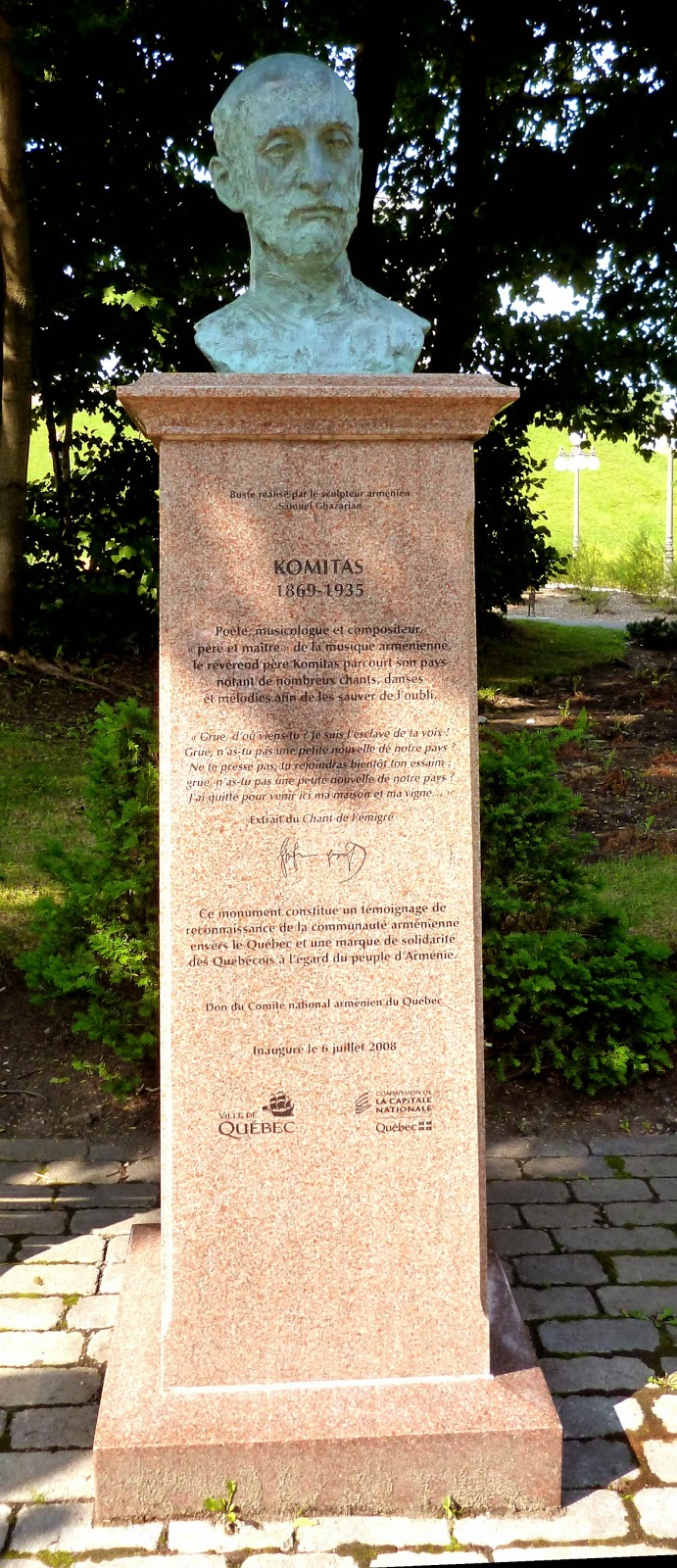
On the rue d'Auteuil in Québec city are a series of monuments to writers, installed there at different periods of the present century. The busts of Pushkin and Nelligan testify to the friendship between Saint Petersburg and Québec city.


Émile Nelligan (1879–1941), about whom I made a post here.

The bust contains a sonnet in which it is (quite possibly incorrectly) dated as 1899, the same year of Nelligan's entry into a mental hospital. The poem tells of a golden ship being wrecked, although of course it is really Nelligan himself who is mentally wrecked.

'Le Vaisseau d'or

C'était un grand Vaisseau taillé dans l'or massif.

Ses mâts touchaient l'azur sur des mers inconnues;
La Cyprine d'amour, cheveux épars, chairs nues,
S'étalait à sa proue, au soleil excessif.

Mais il vint une nuit frapper le grand écueil

Dans l'Océan trompeur où chantait la Sirène,
Et le naufrage horrible inclina sa carène
Aux profondeurs du Gouffre, immuable cercueil.

Ce fut un Vaisseau d'Or, dont les flancs diaphanes

Révélaient des trésors que les marins profanes,
Dégoùt, Haine et Névrose, entre eux ont disputés.

Que reste-t-il de lui dans la tempête brève ?

Qu'est devenu mon coeur, navire déserté ?
Hélas ! Il a sombré dans l'abîme du Rêve !'


Alexandre Pouchkine (Eng: Pushkin) (1799-1837).

'Mon nom ? Mais qu’est-il donc pour toi ?
Il mourra, comme sur la grève
Meurt l’écho que le flot soulève;
Comme un bruit, la nuit, dans un bois.

C’est un signe incompréhensible

Que ton carnet aura gardé,
Tel, sur une tombe, gravé,
Un grimoire en langue illisible.

Mon nom ? Tu l’auras oublié

Dans les remous, les aventures.
Sur ton âme il n’aura laissé
Aucune trace tendre ou pure.

Mais un jour triste, dis-le bien

À voix haute, avec nostalgie;
Tu diras : quelqu’un se souvient,
Un coœur où vit encore ma vie…'


Dante Alighieri (1265–1321)

'O lumière qui tant t'élève
au-dessus des pensées mortelles, reprête un peu
à mon esprit de ce que tu semblais
et rends ma langue si puisssante
qu'une étincelle de ta gloire
puisse arriver aux génerations futures'

Translation on the plinth of the bust from The Divine Comedy.


The poet and musical composer Komitas (1869–1935) is described here as the 'father and mother' of Armenian music, and notes that he scoured his country in order to save songs, dances and melodies from oblivion. The words below, an extact from Chant de l'émigré, are addressed to the crane bird, asking if it has news of their mutual country.

'Grue, d'où viens-tu ? Je suis l'esclave de ta voix !
Grue, n'as-tu pas une petite nouvelle de notre pays ?
Ne te presse pas, tu rejoindras bientôt ton essaim ;
grue, n'as-tu pas une petite nouvelle de notre pays ?'

The Confucian scholar and poet Nguyễn Trãi (1380–1442) was recognised by UNESCO as the person most representative of Vietnamese culture.


Taras Chevtchenko (1814–61), who was also named Schevchenko in English, was an important poet, a painter and a great supporter of Urkainian culture. The bust was erected in 2014 to commemorate the 200th anniversary of Chevtchenko's birth.

'Que notre esprit, que notre chant
Ne meure, ni s'éteigne.
C'est là que réside notre gloire,
La Gloire de Ukraine !'

I also have a link to another monument of him in Paris here.

17 August 2014

Pamphile Le May in Québec city

'ICI VÉCUT
Pamphile
LE MAY
(1837–1918)
POÈTE, ROMANCIER, ET PREMIER CONSERVATEUR DE
LA BIBLIOTHÈQUE DE L'ASSEMBLÉE NATIONALE DU QUÉBEC'

Le May's most noted works are Le Pèlerin de Sainte-Anne (c. 1877), Picounoc le maudit (c. 1878), and Les Contes vrais (c. 1899) , and he also translated works by William Kiby and Henry Wadsworth Longfellow. He was the friend of writers  Louis Fréchette, Napoléon Legendre et Adolphe Poisson.

Gabrielle Roy in Québec city

'ICI VÉCUT
LES TRENTE DERNIÈRES ANNÉES DE SA VIE
Gabrielle
ROY
(1909–1983)
ROMANCIÈRE, LAURÉATE DE NOMBREUX PRIX DONT LE
PRIX FEMINA EN 1947 POUR BONHEUR D'OCCASION ET LE
PRIX DAVID EN 1969 POUR L'ENSEMBLE DE SON ŒUVRE'

Gabrielle Roy was born between two and three thousand miles from Québec, in Saint-Boniface, Winnipeg, Manitoba, although she went with her husband to Québec in 1952, where she spent her final thirty years.


Below is my link to Gabrielle Roy's most noted book:

–––––––––––––––––––––––––––––––––––
Gabrielle Roy: Bonheur d'occasion

15 August 2014

Anne Hébert in Québec city

'ICI VÉCUT
Anne
HÉBERT
(1916–2000)
'POÈTE ET ROMANCIÈRE, LAURÉATE DE NOMBREUX PRIX DONT LE FEMINA EN 1982
POUR LES FOUS DE BASSAN, LE PRIX DU GOUVERNEUR GÉNÉRAL EN 1992
POUR L'ENFANT CHARGÉ DE SONGES ET LE PRIX GILLES-CORBEIL
EN 1990 POUR L'ENSEMBLE DE SON OEUVRE'


My other Hébert posts:

–––––––––––––––––––––––––––––––––––
Anne Hébert in Paris
Anne Hébert: Les Fous de Bassan