Showing posts with label Guernsey. Show all posts

12 May 2017

Cattle watering place, St Martin, Guernsey


'SAINTS
ABREUVEUR ET FONTAINES

The fontaine has a door which was probably fitted to stop animals drinking from the people's water supply. The abreuveur has two drinking troughs and is fed from the well. The water is constantly running and therefore remains clear. Surplus water flows down to Saint's bay. An abreuveur has existed on this site since before 1800.

This is one of more than 30 abreuveurs within the Parish of St. Martin. They are looked after by volunteers and the Parish douzaine.

Fontaine = Spring/Well. Abreuveur = Cattle watering place.'

And a shot of Saints bay itself.

Victor Hugo in Candie Gardens, St Peter Port, Guernsey

The notice in Candie Gardens, St Peter Port, explaining the history of the statue of Hugo:

'Statue of Victor Hugo Unveiled on 7th July 1914. This statue was produced c.1913 by Jean Boucher for the Société Victor Hugo and was purchased by the French government for 30,000 francs (£1,291). The statue was shipped to Guernsey and was transported from the harbour to Candie Gardens on a trolley pulled by a steamroller. It was mounted on a block of Guernsey granite carved by local stonemasons.'

Around the statue:

'....... AU ROCHER D'HOSPITALITÉ ET DE LIBERTÉ
À CE COIN DE VIEILLE TERRE NORMANDE
OÙ VIT LE NOBLE PETIT PEUPLE DE LA MER
A L'ÎLE DE GUERESEY SÉVÈRE ET DOUCE.....

                                                                                 V.H.'

'DON DE LA FRANCE À L'ANGLETERRE
ET À L'ÎLE DE GUERNESEY
––––––––––––
CE MONUMENT, ŒUVRE DE JEAN BOUCHER,
À ÉTÉ ÉRIGÉ
LE 7 JUILLET 1914,
PAR LES SOiNS DE LA SOCIÉTÉ VICTOR HUGO,
EN PRÉSENCE DE
MAUGAGNEUR, MINISTRE DE L'INSTRUCTION PUBLIQUE,
REPRÉSENTANT LE GOUVERNEMENT DE LA
RÉPUBLIQUE FRANÇAISE'

A mural on Best Western Moores Central Hotel, Le Pollet, St Peter Port,  shows important figures in the history of Guernsey. Victor Hugo, of course, is one of them:

11 May 2017

Peter Le Lievre, St Peter Port, Guernsey

'Peter
Le Lievre
1812 – 1878
Artist
lived here'

Unmarried Le Lievre lived at 17 Hauteville, St Peter Port, with his two sisters. The plaque is just a few paces from Victor Hugo's Hauteville House.

30 April 2017

Victor Hugo's Hauteville House, St Peter Port, Guernsey

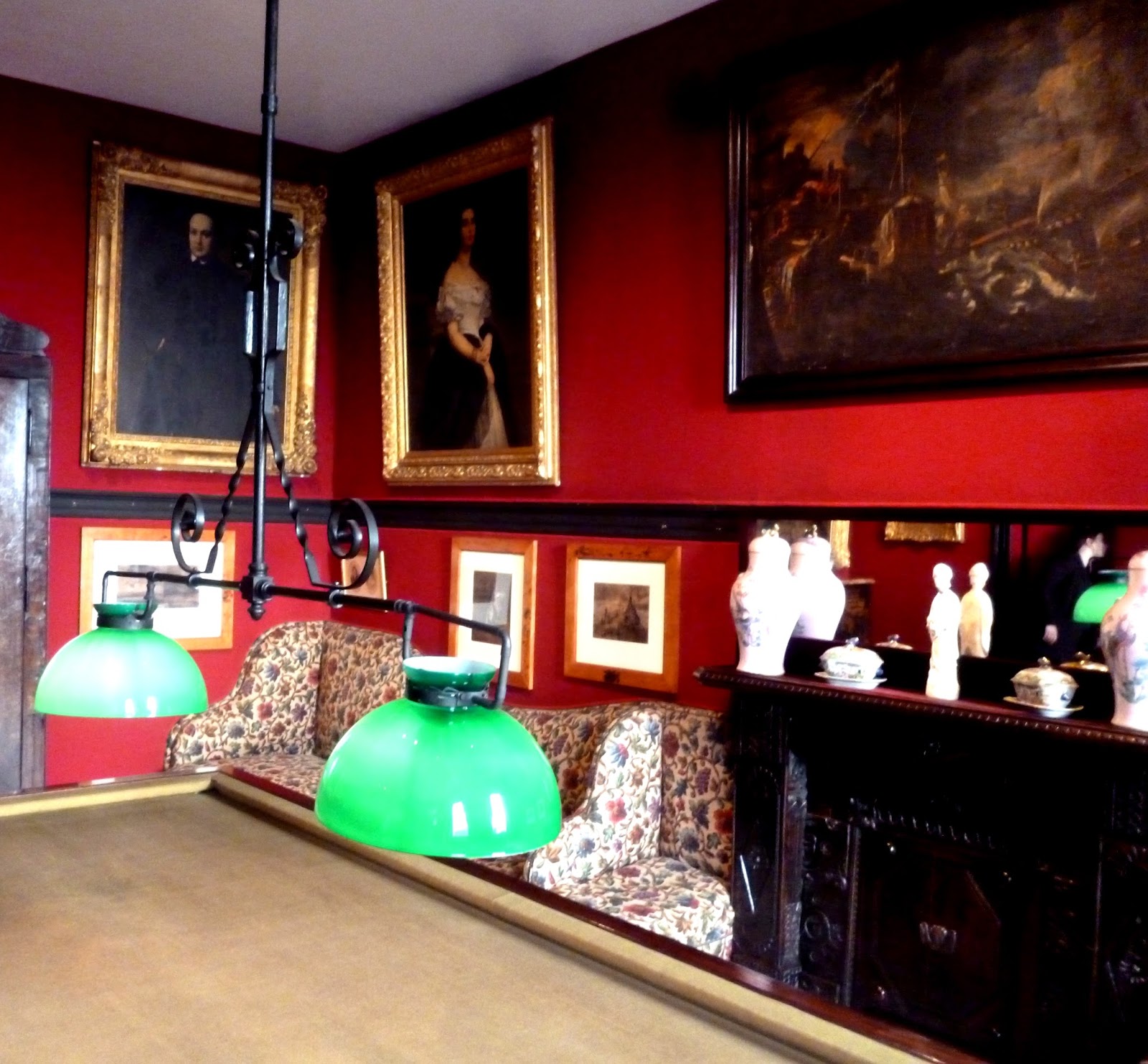
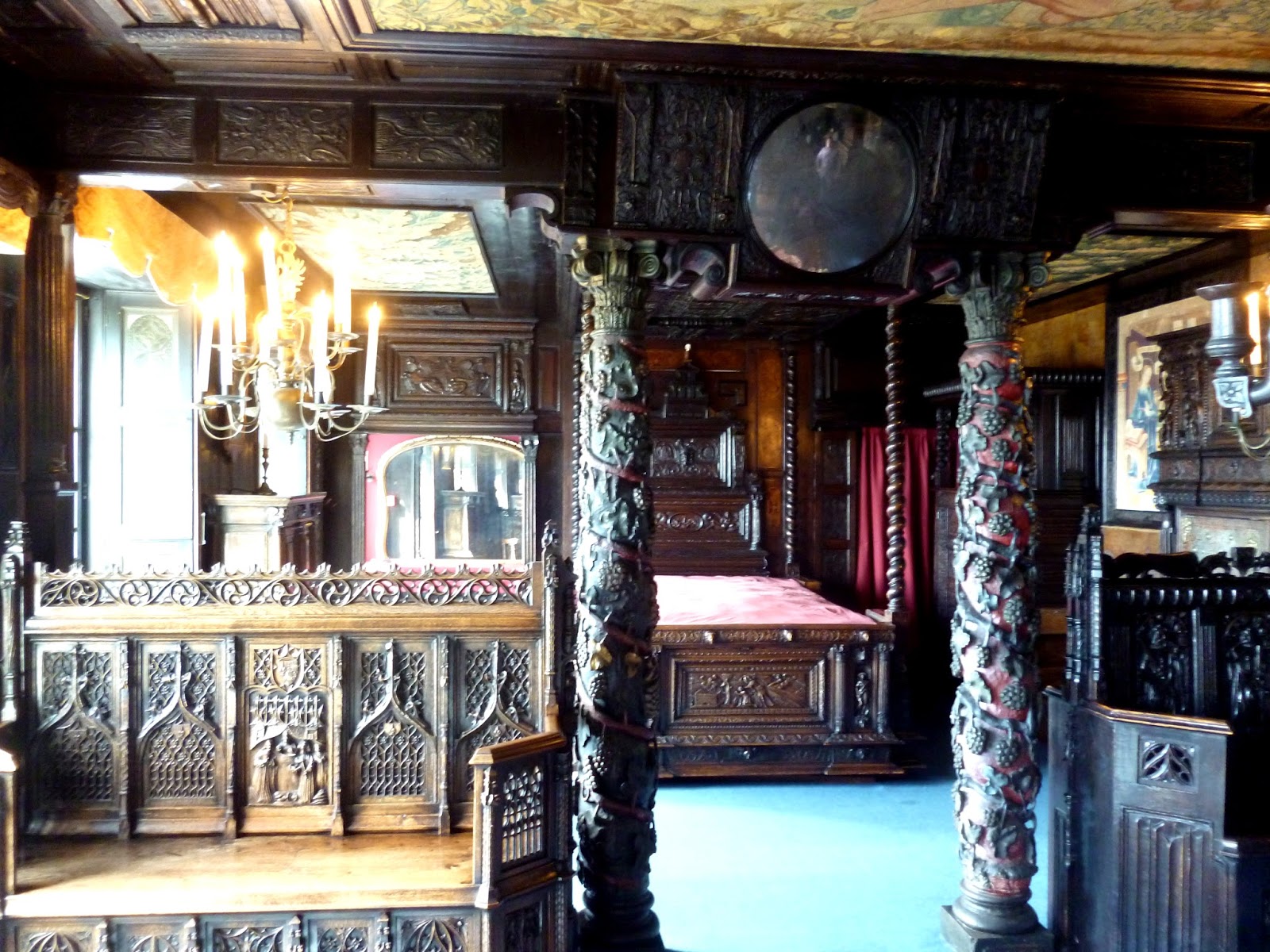
Hauteville House, St Peter Port, Guernsey, the Channel Island where Victor Hugo lived in exile between 1855 and 1870. Exile is written throughout the house, where Hugo installed a collection of his findings, making this a treasure trove, indeed a museum, where he wrote and drew, carved out the names of great authors, welcomed the poor and fed them, and above all wrote many of his great works from his 'look-out'. It has belonged to the city of Paris since 1927.

Hauteville House from the back garden.


The billards room.

Shakespeare's name is misspelt.


Hugo's dark room.


The red room.


Hugo's bedroom.


'The Look-Out'.


'"Hauteville Fairy"
Première maison
de Victor Hugo à Guernesey
de 1855 à 1856
et demeure de Juliette Drouet
à partir de 1864'

Hugo's mistress lived just a few houses down from the Hugo household.

My Victor Hugo posts:
–––––––––––––––––––––––––––––––––––
Victor Hugo's Hauteville House, Guernsey
Victor Hugo, Place des Vosges
Victor Hugo in Bièvres
Victor Hugo in Candie Gardens, St Peter Port, Guernsey
Émilie de Putron in Foulon Cemetery, Guernsey

2 April 2017

Marjorie Ozanne, Vale, Guernsey

'MARJORIE EDITH
OZANNE
1897 – 1973.'

Marjorie Ozanne was born in Vale and wrote stories and poems in Guernesiaise, particularly for La Gazette de Guernesey in the 1920s, and the Guernsey Evening Press between 1949 and 1965. She was the daughter of a verger of Vale Church, and when he was ill took on his duties there. She founded the world's first bird hospital in Les Cordeliers, Guernsey, where she lived with her companion Nell Littlefield. Ken Hill translated her works, although he had the knowledge to realise the problems of translation and included Ozanne's work simultaneously with his own. She was buried in an unmarked grave until the Société Guernesiaise discovered it in 1988 and gave it this headstone.

Émilie de Putron in Foulon Cemetery, Guernsey

la mémoire
de
ÉMILIE,
FILLE DE
MATTHIEU DE PUTRON,
ET DE MARTHE BOURGAIZE
SA FEMME.
DÉCÉDÉ LE 14 JANVIER 1803,
AGÉE DE TRENTE ANS.'

The importance of this grave is not only that Émilie de Putron was the fiancée of Victor Hugo's son François-Victor, but also that Victor Hugo wrote the inscription, which is unfortunately now virtually illegible. I found most of the inscription in a large and very informative fold-out leaflet at Hugo's Hauteville House, St Peter Port, Guernsey: 'Victor Hugo's Guernsey' by Gérard Pouchain and The Victor Hugo in Guernsey Society, and although some of that too is illegible, very kindly Dinah Bott, chairman of the society, has made a comment below, including a link to the content of Hugo's original words about Émilie. These words I include below, and interestingly they show that the inscription on the grave is a somewhat abbreviated version of what Hugo in fact wrote. Also interesting is that Hugo wrote the girl's forename in the English form 'Emily' as opposed to the French 'Émilie':

'Emily de Putron était le doux orgueil d’une respectable et patriarcale famille. Ses amis et ses proches avaient pour enchantement sa grâce, et pour fête son sourire. Elle était comme une fleur de joie épanouie dans la maison. Depuis le berceau, toutes les tendresses l’environnaient ; elle avait grandi heureuse, et, recevant du bonheur, elle en donnait ; aimée, elle aimait. Elle vient de s’en aller !

'Où s’en est-elle allée ? Dans l’ombre ? Non. C’est nous qui sommes dans l’ombre. Elle, elle est dans l’aurore.

'Elle est dans le rayonnement, dans la vérité, dans la réalité, dans la récompense. Ces jeunes mortes qui n’ont fait aucun mal dans la vie sont les bienvenues du tombeau, et leur tête monte doucement hors de la fosse vers une mystérieuse couronne. Emily de Putron est allée chercher là-haut la sérénité suprême, complément des existences innocentes. Elle s’en est allée, jeunesse, vers l’éternité ; beauté, vers l’idéal ; espérance, vers la certitude ; amour, vers l’infini ; perle, vers l’océan ; esprit, vers Dieu.

'Va, âme !'

Dinah Bott mentions that the founder of The Victor Hugo in Guernsey Society, Dr Gregory Stevens Cox, states that Victor Hugo's son François-Victor – whose project was to translate Shakespeare – arrived in Guernsey in 1855, found Emily de Putron to help him, and fell in love with her. They were engaged, although in January 1865, on near completion of the project, Emily died from tuberculosis.

Hugo's full text is here .

My Victor Hugo posts:
–––––––––––––––––––––––––––––––––––
Victor Hugo's Hauteville House, Guernsey
Victor Hugo, Place des Vosges
Victor Hugo in Bièvres
Victor Hugo in Candie Gardens, St Peter Port, Guernsey
Émilie de Putron in Foulon Cemetery, Guernsey

31 March 2017

Le Trepied Dolmen, Perelle Bay, Guernsey

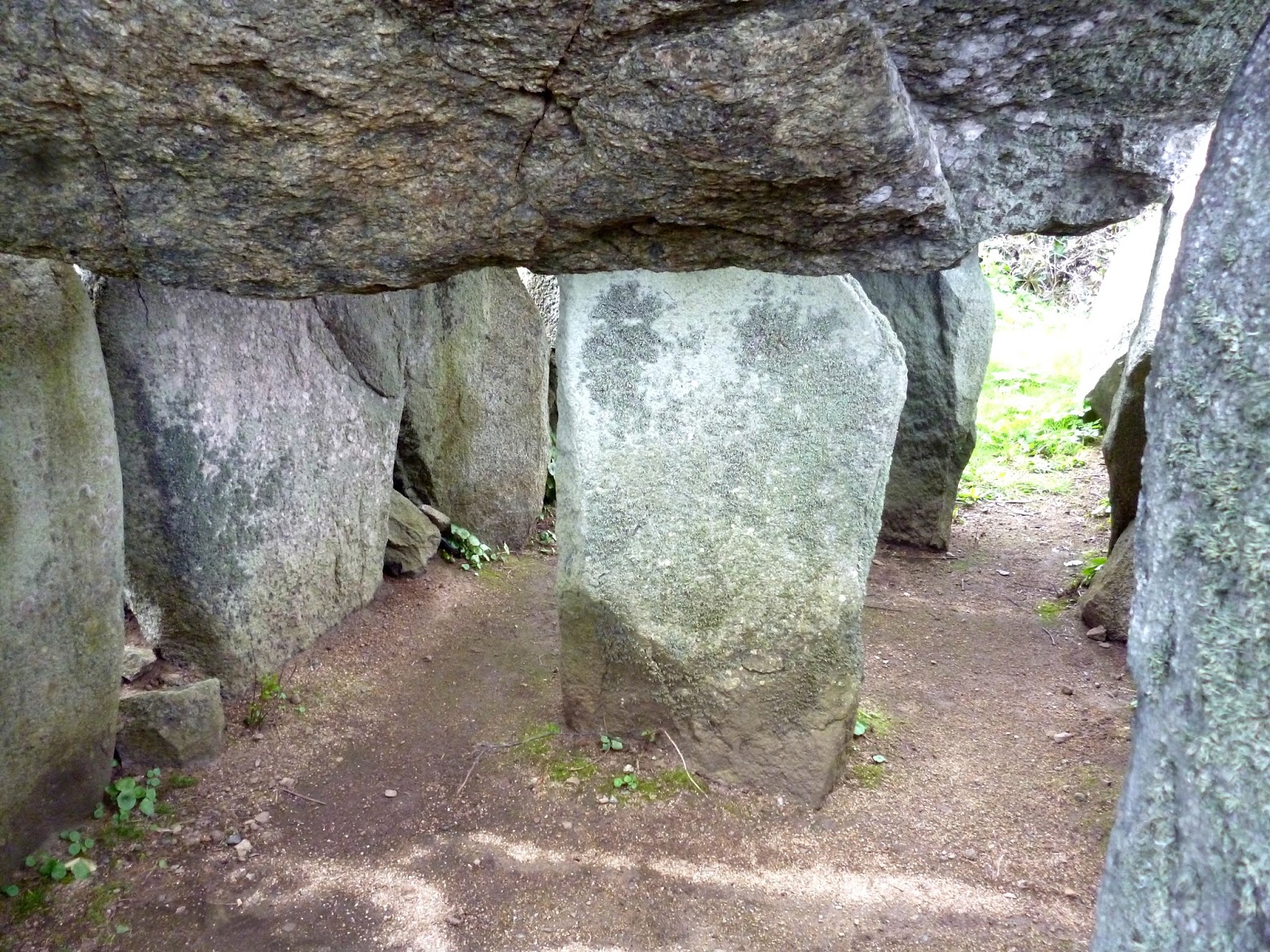
A prehistoric passage grave built between around 4000 and 2500 BC, and in use until about 1000 BC. Excavations by F. C. Lukis began in 1840. The site is frequently mentioned in seventeenth century witch trials.

Inside the dolmen.

Close to the dolmen, the Mont Chinchon Battery, one of over sixty, was built as a defence against possible invasion by France. The cannons were cast between 1760 and 1820. It was also known as the Druids Altar Battery due to its closeness to the Trepied dolmen.

Thomas de la Rue in Forest and St Peter Port, Guernsey

The pub in St Peter Port, Guernsey, named after the printer.

'THOMAS de la RUE
Founder of the House of De La Rue
1793 – 1866'

De la Rue co-founded Le Publiciste, and shortly afterwards his own publication Le Miroir politique. His was the first business to be granted the right to publish playing cards.


'Thomas
de la Rue
1793 – 1866
Printer
Born at
Le Bourg'

Lihou Island, Guernsey

Lihou Island, the most western of the Channel Islands, seen from Guernsey.

Lihou Island, which is about a half of a mile from Guernsey, can be reached on foot during low tide periods: a causeway links it to the mainland. There's a lot of nonsense about stout footwear being needed to make the crossing, although anyone making the twenty-minute effort, while not needing wellingtons, should be prepared for wet feet: the causeway isn't entirely continuous, and the (slightly) adventurous have to contend with rather slippery seaweed (once a part here of the iodine industry). Apart from Victor Hugo's Hauteville house and the Little Chapel, this must rank as the third Guernsey must: and it's free! (In The Book of Ebenezer le Page (1981), G. B. Edwards mentions the childhood days of Ebenezer and his friend Jim, who get stranded on the island and spend the night there.)

Part of the remains of the twelfth century Benedictine Priory here.

Lihou farmhouse, now a hostel.

29 March 2017

Denys Corbet in Forest, Guernsey

The grave of Denys Corbet (1826 – 1909), poet and painter. He wrote in English, French and Guernsey French and patois, and his noted works are L'Touar de Guernsey, Les Fueilles de la forêt and Les Chants du Drain rimeux (translated as The Songs of the Last Rhymster). He was the editor of Le Baillage and lived at La Roberge. 

G. B. Edwards in St Sampson, Guernsey

Hawkesbury House, Braye Road, St Sampson, Guernsey.

'G. B. Edwards
1899 – 1976
author of
The Book of
Ebenezer Le Page
lived here'