Showing posts with label Bouches-du-Rhône (13). Show all posts

21 March 2021

Dominique Cabrera's Corniche Kennedy (2016)

I don't really think there's a great deal to say about this film in terms of plot because a large amount of the film is taken up by visual shots of people jumping from increasing heights on the Corniche Kennedy slightly to the south of central Marseille: these are essentially young males and females from the cités to the north of Marseille, no hopers, educational losers who believe that not to have a 'proper' job is far better than having a bum job. Therefore, having no chance of obtaining academic qualifications, they spend their time smoking cannabis by the Mediterranean in this relatively small area.

Suzanne (Lola Créton) is a great exception, although she manages not to be: she lives in a comfortable family in a house overlooking the area of the Corniche where the gang hangs out, and is fascinated by their activities. By mistake, the gang suspect her of stealing from them, but she is only taking photos of them diving. Challenged to dive too, she is soon in with the leader Mehdi (Alain Demaria) and his friend Marco (Kamel Kadri), much to her mother's chagrin.

Marco is a drug runner surveyed by the police, and Awa (Aïssa Maïga) and Gianni (Moussa Maaskri) in particular, and as Medhi is involved to some extent she becomes involved too. It's not exactly a Jules et Jim situation, although Suzanne is deeply attached to both men.

Visually, quite a spectacular film, although this is not Robert Quédiguian.

21 July 2019

Marie Cappelle in Saint-Paul-de-Mausole, Saint-Rémy-de-Provence (13)

This is one I forgot to add last month. Madame Lafarge (born Marie Cappelle in 1816) was known as 'the poisoner of Tulle' for killing her husband with arsenic in 1840. She served part of her sentence in Montpellier, and was interned in Saint-Paul-de-Mausole psychiatric hospital in St-Rémy-de-Provence (where Van Gogh stayed later) for fifteen months (1851-2). Suffering with tuberculosis, she was released and died in Ussat-les-Bains (Ariège) in November 1852. There are very serious doubts as to whether she did in fact poison her husband.

Marie Cappelle was also a writer of talent and over some years wrote a series of memoirs, most published in her lifetime and a few posthumously.

20 June 2019

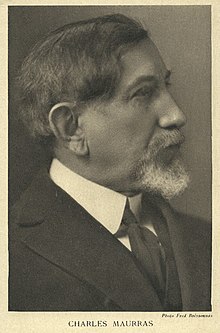
Charles Maurras, Bouches-du-Rhône (13), Roquevaire

The anti-semitic Charles Maurras (1868-1952), journalist, essayist, politician and French poet, member of L'Académie française and one of the principal movers behind the ultra-right Action française, is buried in the cemetery in Roquevaire.

Description de cette image, également commentée ci-après


Behind this grave, the wonder of the Montagne Sainte-Victoire, painted so many times by Cézanne.

19 June 2019

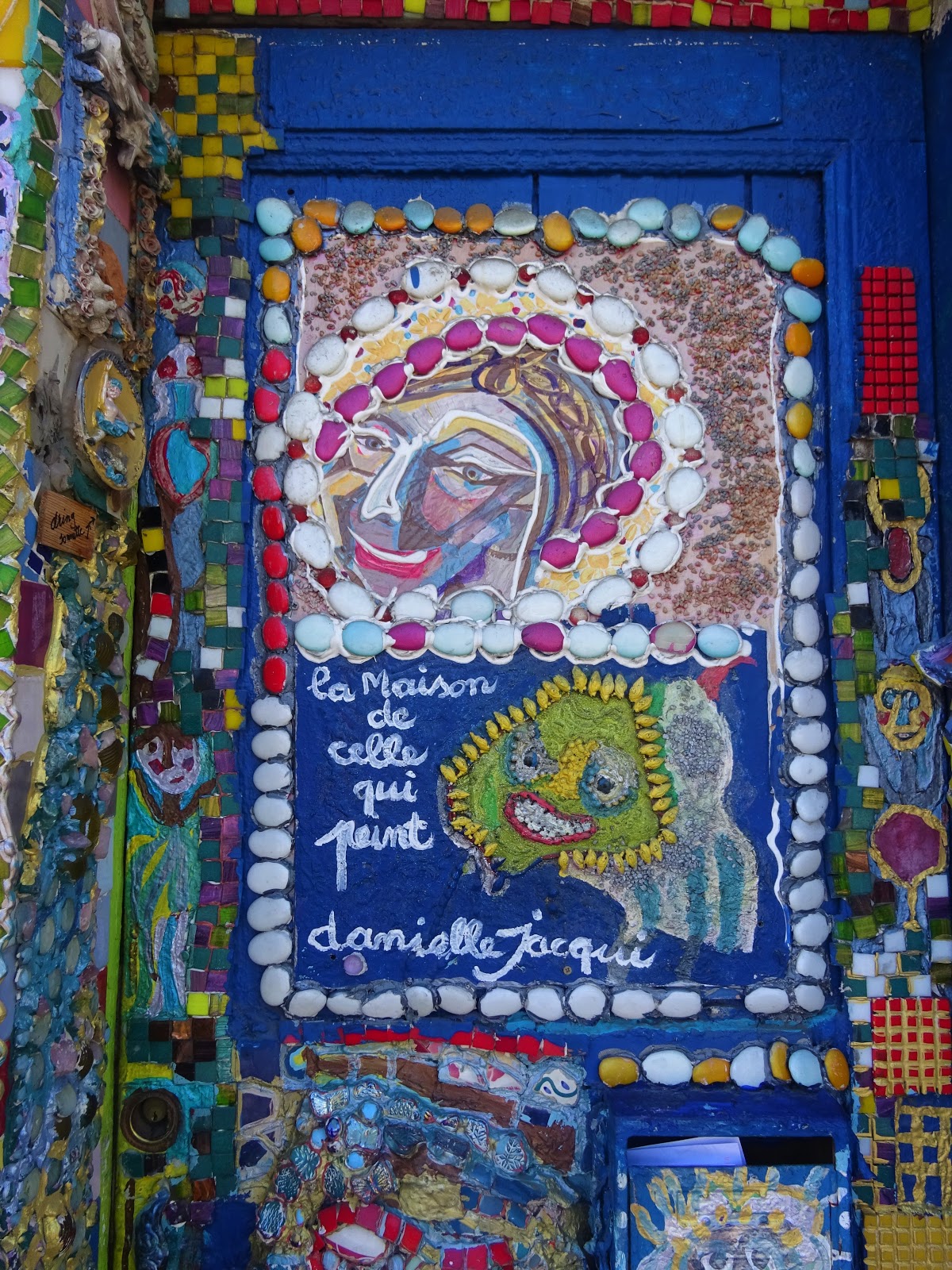
The Amazing World of Danielle Jacqui, Roquevaire (13)

 'La Maison de celle qui peint', lit. 'The House of the Woman who Paints' is the major attraction by a very long shot in Roquevaire, more specifically in Pont-de-l'Étoile, a hamlet in that commune. She received a 'progressive' education (à la A. S. Neill if a semi-equivalent needs to be found in terms of English culture), and this was important to her development as an individual. She married at the age of eighteen, and it was after her divorce in 1970 that she began to find herself as an artist. The relatively short time we spent with Danielle Jacqui was quite revealing: she is a very remarkable, gifted woman with strong intellectual qualities, a large knowledge of things artistic, and a keen sense of nuance. As a person educated in mainly literary sources, I was very interested in how literature could be placed among her interests and influences. Danielle Jacqui's early literary influences include Lewis Carroll (the Queen figures among the artistic characters here), Henry Miller and Ken Kesey's One Flew over the Cuckoo's Nest (Vol au-dessus d'un nid de coucou), and largely foreign writers such as Russian ones. When I tried to press her on her influences by contemporary French writers, she agreed to an interest in Marie NDiaye, but more particularly Marguerite Duras (both among my all-time favourite authors).

The images I include below I do so without comment, partly because many of Danielle's inspirations come from within her mind and body, they are largely figures from her unconscious mind, often inexplicable. Unfortunately it wasn't possible for me (because of the time of day) to take a good shot of the exterior of her house, but I include a few lousy ones nonetheless. Inside, I try to sum up in pictures what Danielle is about: her Arbre de vie ('Tree of life') with its hands with eyes pushing away evil; there's a shot of her office; the staircase; the atelier; the bedrooms; a poem; an unpublished novel-cum-diary; most of all, Danielle is everywhere here. It was a very rare privilege, and indeed an honour, to have Danielle Jacqui talk to us, to make very intelligent nuances and most of all to be just who she is: a great artist and a great mind.


My Art Brut and related posts:
–––––––––––––––––––––––––––––––––––
Kevin Duffy, Ashton-in-Makerfield
The Art Brut of Léopold Truc, Cabrières d'Avignon (34)
Le Musée Extraordinaire de Georges Mazoyer, Ansouis (34)
Le Facteur Cheval's Palais Idéal, Hauterives (26) 
The Little Chapel, Guernsey
Museum of Appalachia, Norris, Clinton, Tennessee
Ed Leedskalnin in Homestead, Florida
La Fabuloserie, Dicy, Yonne (89)
Street Art City, Lurcy-Lévis, Allier (03)
The Outsider Art of Jean Linard, Neuvy-deux-Clochers (18)
La Fabuloserie, Dicy, Yonne (89)
Jean Bertholle, La Fabuloserie, Yonne (89)
Jean-Pierre Schetz, La Fabuloserie, Yonne (89)
Jules Damloup, La Fabuloserie, Yonne (89)
Camille Vidal, La Fabuloserie, Yonne (89)
Pascal Verbena, La Fabuloserie, Yonne (89)
The Art of Theodore Major
Edward Gorey's Yarmouth Port, Cape Cod, MA
Marcel Vinsard in Pontcharra, Isère (38)
Vincent Capt: Écrivainer : La langue morcelée de Samuel Daiber
The Amazing World of Danielle Jacqui, Roquevaire (13)
Alphonse Gurlie, Maisonneuve (07)

10 June 2019

Marguerite Duras in Saint Rémy-de-Provence (13)

'[D]es journées entières dans les arbres', says this shop, which must be among the very few to have named itself after a modern play: by Marguerite Duras. I've no idea what Duras would have thought of that: she may have written an article about it, although I suspect she'd have no interest whatsoever.

9 June 2019

Marìo Mauron in Saint-Rémy-de-Provence (13)


'On 5 April 1896,
one fine Easter morning,
MARÌO ROUMANILLE
(Nom de plume MARÌO MAURON)
Was born in this farm'

Charles Gounod in Saint Rémy-de-Provence (13)


Charles Gounod (1818-93) was a composer who is perhaps most well known for his operatic interpretation of Frédéric Mistral's Mireille.

Vincent Van Gogh in Saint-Paul-de-Mausole, Saint-Rémy-de-Provence (13)

In the ancient monastery Saint-Paul-de-Mausole, Saint-Rémy-de-Provence, is a psychiatric hospital to which Van Gogh went after living for a short time in Arles, a town in which he disgraced himself so much that the inhabitants had drawn up a petition to either intern him or banish him. His stay at the hospital was from 8 May 1989 to 16 May 1990, when he left Saint-Rémy for Auvers-sur-Oise, where he killed himself two months later, on 28 July 1990. His time at Saint-Paul-de Mausole was artistically very fruitful for him, and he painted about 150 pictures there, some among his most famous, such as La Nuit étoilée (Starry Night). Parts of it are open to the public.

Rear view of Saint-Paul-de-Mausole and its impressive garden.

The cloister in Saint-Paul-de-Mausole.

The garden within the cloister.

A reconstruction of the kitchen.

This is one of four representations of Van Gogh's bedroom in Arles.

The reconstruction of Van Gogh's room.

The artist had a very good view from his bedroom, which may or may not be like the present view.

A sculpture of Van Gogh by Ossip Zadkine: La lettre de Théo a Vincent'.


Gabriel Sterk's Le Voleur de tournesol, clumsily translated as The Sunflower's Thief.

American sculptor Melvin Klapholz realised this bust in 1996.

All the way along Rue Van Gogh, it is studded with these markers.

22 June 2018

Brémonde de Tarascon, Tarascon, Bouches-du-Rhône (13)


Elisabeth 'Alexandrine' Brémond (1858–98) was a félibresse born in Tarascon, who died in Fontvieille and is better known as Brémonde de Tarascon. She came from an old family of paysans from Provence, published her first work in 1883 and married the poet and lawyer Joseph Gautier in 1886. The back of the monument lists her works: Li Blavet de Mount-Majour (1883), Velo Blanco (1887), Brut de canèu (1892), Lou debanaire flouri (published posthumously in 1908 by Joseph Roumanille), and the unpublished play 'Anen aganta la luno'. The monument was erected in 1965.