
Showing posts with label Amiens (80). Show all posts
Showing posts with label Amiens (80). Show all posts
3 September 2017
Saint-Leu, Amiens, Somme (80)
Libellés :
Amiens (80),
Somme (80)


Marcel Sueur in Amiens, Somme (80)
Libellés :
Amiens (80),
Somme (80),
Sueur (Marcel)


Built in 1901, this house of monumental mason Marcel Sueur is on Rue Saint Maurice, opposite the Cimetière de la Madeleine. This was also Sueur's workshop. The sculpture in the centre is by Valentin Molliens (1868–1937) from Longpré-les-Amiens, and is a representation of Sueur's wife Andrée (née Largemain).
René Goblet in Amiens, Somme (80)
Libellés :
Amiens (80),
Goblet (René),
Somme (80)


1 September 2017
Charles Dallery in Amiens, Somme (80)
Libellés :
Amiens (80),
Dallery (Charles),
Somme (80)


In 1780 he invented a steam machine with a tubular boiler. In 1803 he took out a patent as the first person to use a propellor on a steam ship.
However, his attempts to introduce a windmill with horizontally turning sails, according to his Wikipédia entry, resulted in him being nicknamed 'moulin de la folie', and the 'mad' and obviously severely wounded Dallery leaving Amiens for good. Dallery died in Jouy-en-Josas, where he is buried.
Jules Verne in Amiens (80) (continued)
Libellés :
Amiens (80),
Somme (80),
Verne (Jules)


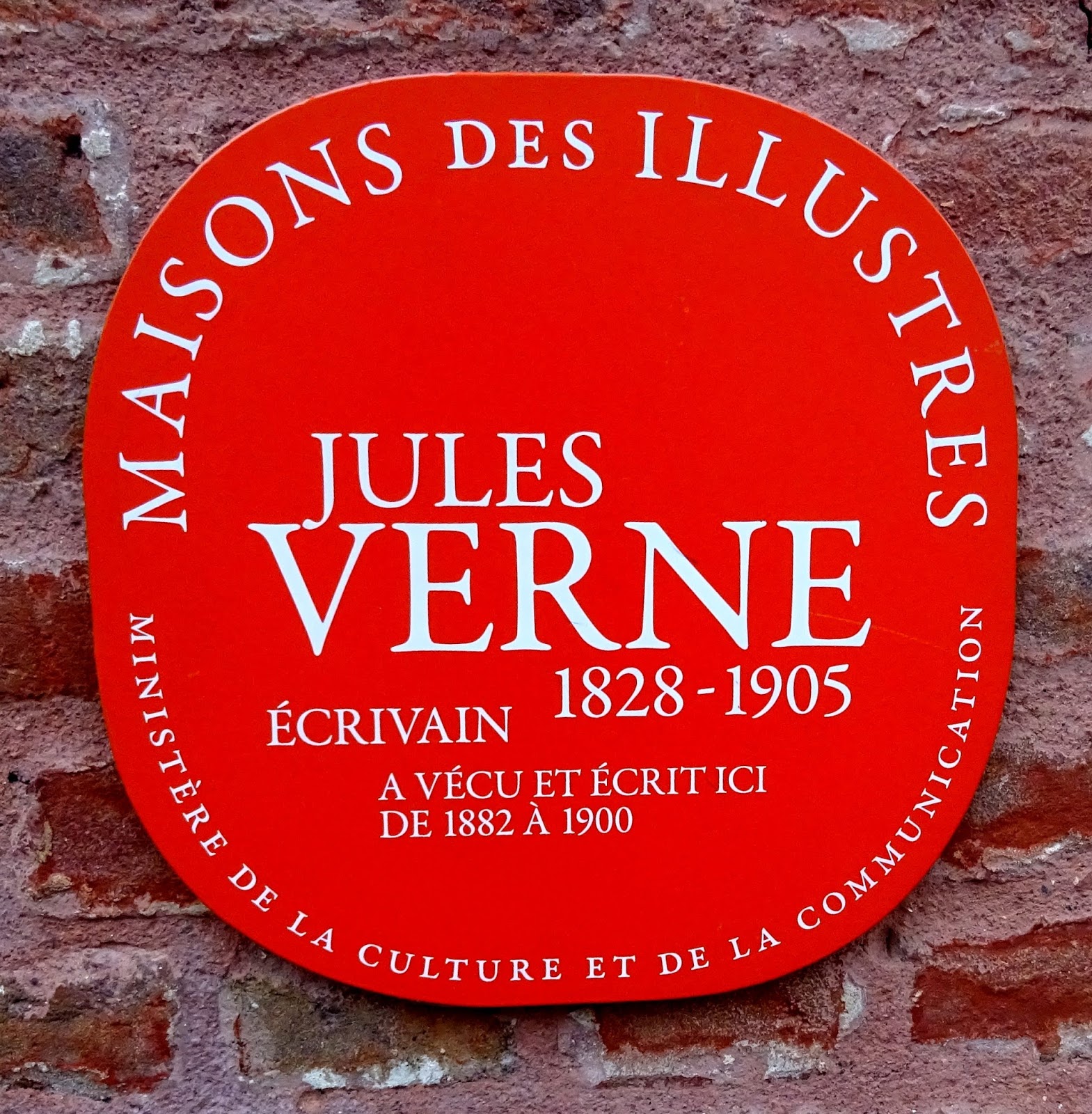
'JULES VERNE
VÉCUT 14 ANS
DANS CETTE MAISON
IL Y MOURUT
LE 24 MARS 1905'


Not far from Jules Verne's museum is this monument: a bust of Verne with children at the base reading his Voyages extraordinaires. It was sculpted in 1908 by Albert Roze a year after he enhanced Verne's tomb so extravagantly.

A number of Verne's works are engraved on the other side of the statue, plus a globe.
31 August 2017
La Maison de Jules Verne in Amiens (80), Somme (80)
Libellés :
Amiens (80),
Somme (80),
Verne (Jules)


François Schuiten added the sphère armillaire (or armillary sphere) to the tower in 2005, and the re-opening of the house was in the following year. The tromphe-l'oeil fresco is also his work:


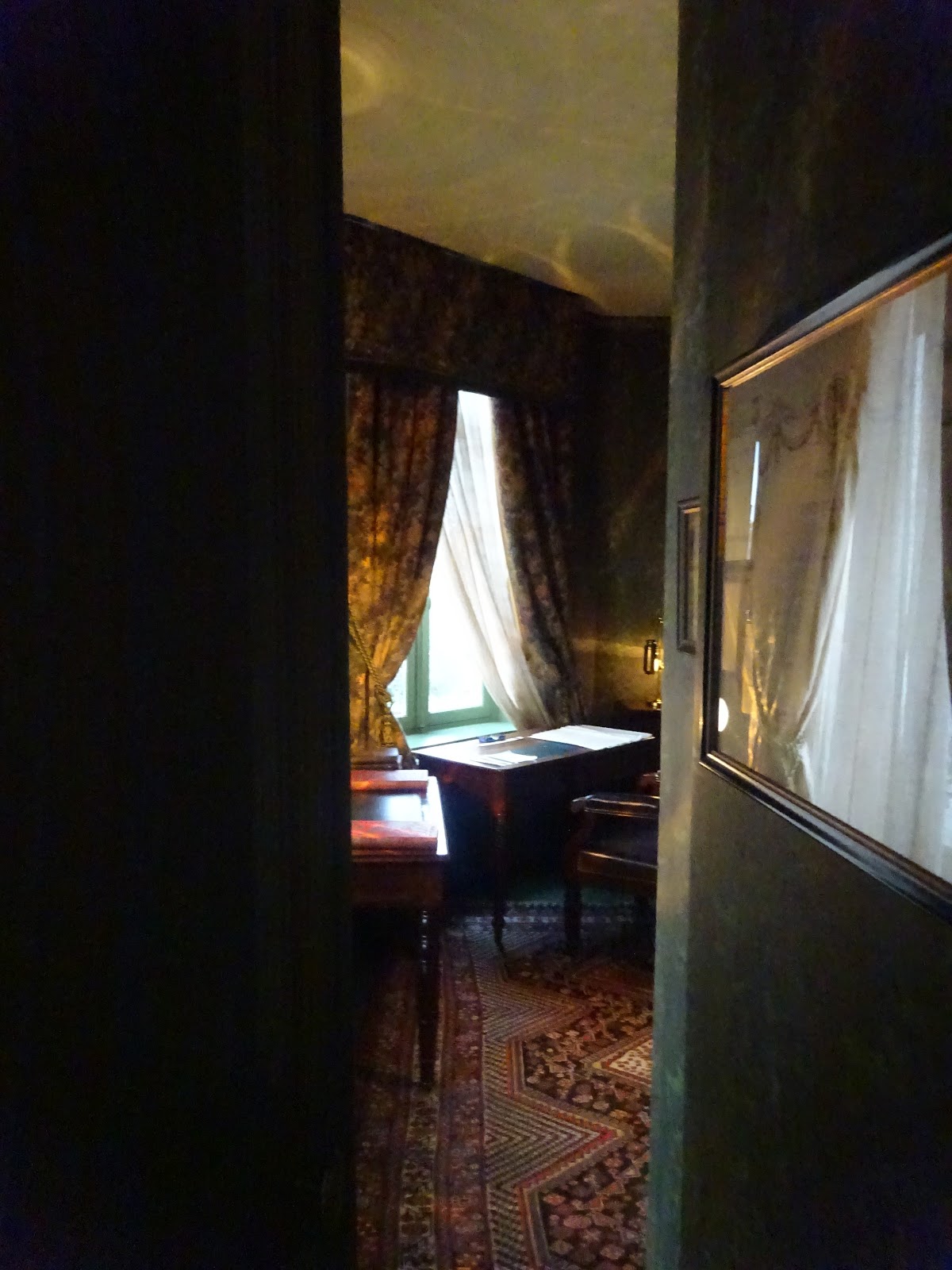


Nellie Bly (whose grave I visited in NYC) is also included in the loft here.

A representation of Jules Verne on his deathbed.

A death mask of Verne.


From the top to the bottom of the staircase. A wonderful place.
Jules Verne in Le cimetière de La Madeleine, Amiens (80), Somme (80)
Libellés :
Amiens (80),
Somme (80),
Verne (Jules)


'Jules VERNE
NÉ À NANTES
LE 8 FÉVRIER 1828
DÉCÉDÉ À AMIENS
LE 24 MARS 1905
HONORINE ANNE HÉBE DE VIANE
SON ÉPOUSE 1829–1910'
Understandably the most popular grave in the cemetery, this is one of a number of sculptures here by Albert Roze, entitled 'Vers l'immortalité et l'éternelle jeunesse' ('Towards Immortality and Eternal Youth'). Verne's biographer Jean Jules-Verne (via his translator Roger Greaves), states that Verne's wish was to have a simple grave, which was originally the case. However, his son Michel is responsible for the ostentatious (but quite brilliant) update created two years later, showing a representation of the writer breaking free from his shroud and breaking the tomb lid, his outstretched arm and his face turned toward the sky.
As I have previously said of the strikingly similar grave of symbolist poet and novelist Georges Rodenbach (1855–98) in the Cimetière du Père-Lachaise, Charlotte Besnard (1854–1931) sculpted it and Albert Roze was inspired by it to create this addition to the grave of Jules Verne.
As I have previously said of the strikingly similar grave of symbolist poet and novelist Georges Rodenbach (1855–98) in the Cimetière du Père-Lachaise, Charlotte Besnard (1854–1931) sculpted it and Albert Roze was inspired by it to create this addition to the grave of Jules Verne.
27 August 2017
Jean Jules-Verne: Jules Verne (1973; trans. and adapted by Roger Greaves 1976)
Libellés :
Amiens (80),
French Literature,
Greaves (Roger),
Jules-Verne (Jean),
Somme (80),
Verne (Jules)

But then, translation of a 'non-fictional' book (if that means much) is surely preferable, and much less dubious, than a translation of a work of fiction? Usually, yes, although I refuse to mention any more of my obsession with Howard Parshley's almost criminal interference with Simone de Beauvor's Le deuxième sexe. Mercifully, Roger Greaves's book has no resemblance to that horrific monster. This is a considered, developed, and apparently generally well-written text: if some of the time it reads a little clunkily, that may well be because that's the way people used to speak.
It isn't my purpose here to speak of the author's impressions of Jules Verne's more famous works, such as Voyage au centre de la terre (1864) (Journey to the Centre of the Earth), Vingt mille lieues sous la mer (1870) (Twenty Thousand Leagues under the Sea), or Le Tour du monde en quatre-vingt jours (1873) (Around the World in Eighty Days).
No, what I found most interesting was the obscure L'Île à hélice (1895) (trans. as both The Floating Island and Propellor Island), which appears in part to predict the internet, and I love the idea of reading a (fictional, still) work in chocolate print on rice paper which can be eaten after reading, and available in formats for readers with either diarrhoea or constipation.
Also fascinating, I found, was the reference to Verne's Le Rayon Vert (1882), which immediately got me thinking (quite correctly) of any possible relationship between this book and Éric Rohmer's film of the same name (1986).
And then there's the posthumous Les Naufragés du Jonathan (1909) (The Survivors of the Jonathan), in which an anarchist is forced (paradoxically) to take the lead.
Occasionally I don't understand how Jean Jules-Verne arrives at a conclusion – how, for instance, can he possibly interpret Jules Verne's opinion of Johann David Wyss's Swiss Family Robinson as an implication of weakness on the basis of the flimsy information we're given here? Or does the fault lie in the translation of Jules-Verne's text?
Whatever the faults, here we have a somewhat dysfunctional family, with a wayward son (Michel) and dull wife (Honorine), ruled over by a failed stockbroker with a passion for sailing, an apparent passion for an unnamed mistress in Asnières, but an obsession for a hobby (writing) which brings him in a lot of money. And surprisingly, perhaps, Jules Verne was definitely a kind of anarchist.
A venerable book on a man about whom no doubt much more research has been done in later years, but I shall discover that in time.
23 April 2015
Jules Verne and Georges Rodenbach: Graves
Libellés :
Amiens (80),
Besnard (Charlotte),
Paris,
Rodenbach (Georges),
Roze (Albert),
Somme (80),
Verne (Jules)
.jpg)


Surely there has to be a link between the two? Yes, indeed there is. I discovered an essay on the sculptor of Rodenbach's tomb: 'Charlotte Besnard (1854–1931) : être femme sculpteur et épouse d’artiste en vogue, au tournant du XXe siècle' by Hélène Moreau-Sionneau. (Charlotte was the wife of artist Albert Besnard (1849-1934)). Moreau-Sionneau writes that Besnard sculpted the Rodenbach grave, on which was an inscription of a few now completely illegible lines of his poetry addressed to the Lord and praying for an after-life in literature. This tomb inspired Albert Roze (1861–1952) – commissioned by the Verne family – to sculpt the later grave, which is titled Towards Immortality and Everlasting Youth (Vers l’immortalité et l’éternelle jeunesse). Roze, with the aid of Verne's death mask, completed his work in 1907.
Subscribe to:
Posts (Atom)


 Posts
All Comments
Posts
All Comments