Showing posts with label Tameside. Show all posts

23 May 2021

The Grave of Poet Thomas Barlow, Mottram, Cheshire


These unfortunate times can have some compensations, such as looking around your local area. Today I discovered the grave of a modest local poet in Mottram cemetery: the cross has fallen and it took a little time to free it of the weeds, but it's in a reasonable state. As far as I know, these are the only photos of his grave on the internet. I was made aware of his existence from Thomas Middleton's Poets, Poems, and Rhymes of East Cheshire (1908), which is freely available to download and is a wealth of information on local writers and can be very humorous when he speaks of their eccentricities. I can't find anything eccentric about Thomas Barlow, although I was interested in what Middleton has to say about him:

'THE BARD OF LONGDENDALE.

This poet was born at Radcliffe, in Lancashire, on the 17th of January, 1826, but at an early age removed to Hyde, Cheshire, where he became engaged as a calico printer. Afterwards he removed to Dinting, and the remainder of his life was spent in the neighbourhood of Glossop. He was a poor-law guardian for Glossop, a prominent member of the local Co-operative Societies, and was made one of the first working-men magistrates for the borough of Glossop. On several occasions I was in the company of the Bard of Longdendale, and found him an interesting, though somewhat reserved man. A collection of his works under the title of "Barlow's Poems" was published by Messrs. John Heywood and Sons, Manchester, in 1867. It is a volume of 230 pages, consisting of "A Trip to Woodhead," "Scenes Around Castleton" and other poems, and one of the features of the book is the successful way in which the poet describes local scenery. There are many choice gems in his poems on Longdendale.

THE FACTORY GIRL

Though not possessed of golden store,
Nor deck'd in jewels rare,
Sweet Lucy's virtues shine no less,
Nor is she the less fair.
Can gold bestow a kindlier heart?
Can jewels make it rare?
Ah, no! 'tis something richer far
Must hold possession there.

My song is not of titled dame,
Of nobleman nor earl:
I sing of one I love to name
The modest Factory Girl.

Though not so queenly beautiful,
She's fair, yes, passing fair:
She has a pleasing grace of form,
And dignity of air;
And there is that in Lucy's breast
Which beauty never gives
There is a true, a gentle heart,
Which feels for all that lives.

I sing not now of titled dame,
Of nobleman nor earl;
I sing of one I love to name,
The modest Factory Girl.

Too oft your pompous lady fair
Is fickle, false, and vain,
Inflicting wounds in other hearts
Without remorse or pain.
So 'tis not wealth begets respect,
As often hath been proved
And Lucy in a humble way
Is known but to be loved.

I sing not now of titled dame,
Of nobleman nor earl:
I sing of one I love to name,
The modest Factory Girl.

A low sweet voice and manners true
In Lucy are combined,
Which say, although she be but poor
She's riches in her mind;
And though her lineage doth not spring
From nobleman or earl,
She's honoured she's respected as
A modest Factory Girl.

I sing not song of titled dame,
Of nobleman nor earl:
I sing of one I love to name,
The modest Factory Girl.'

17 May 2020

John Frederick La Trobe Bateman in Mottram in Longdendale, Tameside, Greater Manchester


'JOHN FREDERICK LA TROBE BATEMAN
(1810-1889)
Pioneer - Water Engineer Extraordinaire

Brought water to the taps of Tameside and Manchester by constructing
the six mile long chain of Longdendale Reservoirs from 1848.

At the time these became the largest reservoirs constructed
in the world and Europe's first major conservation scheme.

Completed in 1877, these waters have never run dry.
This plaque is located on the deepest air shaft over
Mottram Tunnel measured at some 200ft below.'

'La Trobe' was Bateman's mother's surname.  He worked on many water supply systems in many parts of the country, and also in Buenos Aries, Naples, Constantinople and Colombo. His Wikipedia entry says 'In 1855 he wrote a paper for the British Association, On the present state of our Knowledge on the Supply of Water to Towns, enunciating the nature of the problem, outlining previous measures, enumerating sources from which towns could be supplied, and discussing their merits. In 1865 he published a pamphlet On the Supply of Water to London from the Sources of the River Severn, a scheme he designed and surveyed at his own expense. A royal commission in 1868 reported in favour of the project, a gravitation scheme to convey 230 million gallons of water a day to the city.'

L. S. Lowry in Mottram in Longdendale, Tameside, Greater Manchester


The painter L. S. Lowry (1887-1976) lived at The Elms on Stalybridge Road, Mottram in Longdendale, Tameside, Greater Manchester from 1948 until his death. His statue was installed at the junction of Stalybridge Road and Hyde Road in 2005. At the time of making this post, Lowry now wears a mask.

11 May 2020

The Mottram Frog Stone, Roe Cross, Mottram in Longdendale, Tameside, Greater Manchester

'The Mottram Frog Stone
During the construction of
Mottram Deep Cutting (1814-1826), a
stonemason split a piece of stone and discovered
the outline of a frog or toad. It is believed that it
crawled into a cavity in the stone through a
small crack, then fed on insects until it was
too large to escape. Sucessive generations
have marked the stone to
keep the story alive.'

This plaque couldn't be a traditional red one (for history) because it's a part of folklore, an unfounded tale that nevertheless is part of the fabric of the area. The stone itself is said to be regularly repainted, although when I came along it wasn't too recognisable as a frog.

10 April 2015

Robert Higham in Hyde, Greater Manchester

'In
Ever-Loving
Memory of
Robert Higham, J.P.
of Windsor Bank, Hyde,
Editor and joint proprietor
of the
North Cheshire Herald,
for upwards of 40 years,
who died Febr. 17th 1905,
aged 66 years.'
 
Strange how I missed this in Hyde Cemetery the first time round. Many local writers were published in the North Cheshire Herald, which for a large number of them was a literary launching pad leading to individual publications. George Booth's side of the monument is here.

9 April 2015

Samuel Scott Sudlow, Hyde, Greater Manchester


In Poets, Poems, and Rhymes of East Cheshire (1908) Thomas Middleton devotes a few pages to the forgotten Samuel Scott Sudlow (1865–1951), who was born in Delamere Forest near Frodsham in the west of Cheshire, and moved to Hyde (probably with his parents) in 1881. His father was simply named Samuel Sudlow (1838–1914), who is the first named person on the grave here, followed by his mother Fanny (c. 1840–1920).

As the sentence states above in Hyde Cemetery, 'ALSO SAMUEL S[COTT], THEIR SON, DIED IN AUSTRALIA, SEP. 17TH. 1951, AGED 86 YEARS.' Middleton says that Sudlow hadn't published much, although he prints his 'To the Blue Bell' in full and says that it will 'take a high place in local verse'. At the time that Middleton published his book Samuel Scott Sudlow was about 43 and had yet to leave Hyde for Australia, although he appears to have published nothing at all there. But he was obviously a little more successful in another field.

Samuel Scott Sudlow was a joiner by trade, although Middleton speaks more of Sudlow's artistic education and of his local fame as a portrait and landscape artist. He says '[h]is work is highly spoken of by those competent to judge, and he is one of the few local men who have been successful as a portrait painter'.

And interestingly, a little Googling tells me that 'S Scott Sudlow' was several times one of the finalists for painting prizes in Australia, including one called Self Portrait, but – frustratingly – I can't find any of his paintings online.

8 April 2015

William Bedford (1811–61) in Hyde and the USA

William Bedford was an obscure working-class poet and political writer of English birth who killed himself eleven or twelve years after emigrating to America with his wife Sarah Nancy (née Wood) (1812–1892) and five children: two more were born in the USA. The truly bizarre thing about his death is that he left some writing – although not a suicide letter giving the reasons for deliberately taking a lethal dose of laudanum but notes – perhaps written over three hours, and describing exactly how the drug was affecting him from immediately after taking it until what must have been a few moments before his death. He makes no mention of his wife, but refers to his friends and children, specifically expressing his concern for the two youngest: James Rosser (1846–1942) and Thomas W. (1853–1921).

I'll return to the letter – which I'll quote in some detail – but for the moment I'll say what we know of Bedford, the large part of which comes from Thomas Middleton's Poets, Poems, and Rhymes of East Cheshire (Hyde: John Higham, 1908).

William Henry Bedford was the son of Matthew Bedford (1791–?), who was born in Clayton West, Yorkshire, and Sarah (née Rosser) (1789–1872), who was born in Stockport, Cheshire. Middleton says that their were thirteen other children in the family, and that Matthew had come to Hyde and worked at John Howard's mill. William attended the Wesleyan Sunday School and 'received the bulk of his education from there'. He was first a piecer and then a spinner at the same mill where his father worked.

From an early age William was interested in the poor conditions of the working classes. The above plaque at the entrance to the market in Hyde marks the site of The Norfolk Arms, where a disaster took place on 1 April 1829. Seven hundred cotton workers – among them William and Matthew Bedford – assembled here to discuss their employers' plans to reduce their wages during the depression in the cotton trade. The floor collapsed, causing people to fall into the cellar. Twenty-nine people were killed and many more injured, although William and Matthew escaped. The family first moved to Stockport and later Ashton-under-Lyne.

William Bedford wrote poems and – under the name 'Sam Shuttletip' – also wrote political papers on the government, the working class and communism. His own family originally appear to have been successful, and it is unknown why he took his life. Below are the parts that Middleton publishes of the remarkable letter that Bedford wrote as he was dying during a walk near the Hudson River:

'August 10, 1861.

I have just swallowed the laudanum in a small quantity of brandy; do not feel much effect from it yet, except a bitterness in my mouth and throat, and a little trembling in my hands. [...] 15 minutes since I took the laudanum; the effects feel exhilarating, like those of intoxicating drinks. No pain, and the scenery of the Hudson River [...] grand and glorious, my heart aches, and my eyes weep for my friends and children, especially for my boys James and Thomas, but I hope they will not grieve much at my lot, and that they will try to be good boys. [...] Quarter of an hour later, I feel a bitterness and dryness in my throat, and a tendency to lay down and go to sleep, but I shall resist it as long as I can. [...] quarter later. [...] I am trying to read a paper called the "Phunny Fellow," but my ideas begin to get confused, as they have done many a time before, when I have fallen asleep reading. [...] Two hours since I took the dose, I feel more confused in mind every minute, [...] but it don't feel unpleasant.– It must be a quarter of an hour later, and I had just fallen to sleep, and have waked again, [...] I have tried walking about, but it is no use,– cannot keep awake, and feel a trembling all over. [...] Cannot calculate the time, think it must be three hours since I took it. Feel a little inclined to vomit, but hope I shall not do so, have walked about a little, and the sickness is nearly gone away, but my limbs tremble considerably–I have lain down awhile–don't know how long–and have dreamed as usual about the dear friends at home; very sleepy indeed, and my mouth and throat dry–end.'

2 March 2015

Church of St Lawrence, Denton, Greater Manchester


'CHURCH OF ST LAWRENCE

Built early sixteenth century and originally dedicated to
St James until the discovery in the mid-nineteenth century
of a stained glass window to St Lawrence.
Affectionately known as "Th'Owd Peg" because its framework
was fastened together with wooden pegs.
Resting place of John Angier, the famous Puritan divine
and of Colonel Robert Duckenfield, Tameside's
Civil War hero.'

'JOHN ANGIER
1605–1677

A Puritan divine who was Minister of
St Lawrence for forty six years until his
death in 1677. He survived the various
religious upheavals of those troubled times
and continued to preach his
Puritan message.'

One known published work by John Angier is An Helpe to Better Hearts for Better Times: Indeavoured in severall Sermons preached in the year, 1638, etc (1637), and there is a biography written by Oliver Heywood (1968).

'1872'. The year the church was expanded. This is a Grade II* building.

12 July 2014

John Critchley Prince and Joseph Johnston in Hyde, Cheshire

In Thomas Middleton's remarkably informative Poets, Poems, and Rhymes (1908), he gives clear directions to the grave of minor poet Joseph Johnston (1810–68) in St George's churchyard, Hyde. Unfortunately, the grave now seems to have disappeared under a children's playground. Johnston (although teetotal) was a good friend of John Critchley Prince, so I'm taking advantage of that fact to post more shots of Prince's grave, but cleaned up this time:

Now, we are able to see a much clearer picture of the grave.

'ERECTED
BY A FEW ADMIRERS
TO THE MEMORY OF
JOHN CRITCHLEY PRINCE
AUTHOR OF
HOURS WITH THE MUSES
BORN 21ST JUNE 1808
DIED 5TH MAY 1866'

Inside the large circle is a laurel wreath and the initials 'J C P'.

My John Critchley Prince posts:
–––––––––––––––––––––––––––––––––––
John Critchley Prince in Harpurhey, Manchester
John Critchley Prince in Hyde
John Critchley Prince and Joseph Johnston in Hyde
The Life of John Critchley Prince (1880), by R. A. Douglas Lithgow

29 April 2014

Robert G. Hall and Stephen Roberts (eds): William Aitken: The Writings of a Nineteenth Century working Man (1996)

Hall and Roberts's William Aitken: The Writings of a Nineteenth Century Working Man is dedicated to an unfairly forgotten man of Greater Manchester. Aitken (1812– or 1814–69) was born in Dunbar, Scotland, although his family moved to Ashton-under-Lyne when he was a child. He began work in a cotton mill at the age of twelve and was largely self-taught. He opened a school in Ashton in 1833, where he and his wife Mary taught mainly working-class children. He had a strong sense of justice and spent much effort on the Chartist cause and fighting for the ten-hour working day.

After the Chartist defeat of 1842 Aitken left with two friends for America for a year, and wrote the short book A Journey up the Mississippi River from its Mouth to Nauvoo, the City of the Latter Day Saints (1845).

Depressed, he died by slitting his throat at his home.

This book briefly details Aitken's life in the Introduction, and then moves to Aitken's unfinished autobiography, which was called 'Remembrances and Struggles of a Working Man for Bread and Liberty', and the first paragraph is concerned with a kind of revisionism:

'It has not been by timidity or fear that the battles of liberty have been won, but by a moral courage equalling, if not surpassing, the hero who marches to victory over his slaughtered enemies and vindictive foes.'

History now remembers some of those fighting for freedom against an oppressive state – such as the Chartists and the suffragettes – as heroes. (Let's hope that at some time in the future it will see in the same light the often highly dangerous efforts of asylum seekers to escape from tyranny.)

Slavery is also tyranny of course, but Aitken – very wrongly, in my view – supported the American South because the blockade on Southern ports exporting cotton was causing hardship to English workers such as those in the cotton town of Ashton.

Aitken's autobiography unfortunately ends at 1840, the point he had reached before he killed himself, thus leaving out twenty-nine years of his life. Unsurprisingly, it is full of the injustices meted out by the more fortunate on the less fortunate, and of Aitken's and others' concerns to eleviate the conditions of working people. As might be expected, Aitken speaks of the roles played by such Chartist activists as Feargus O'Connor and Joseph Rayner Stephens, but two lesser known activists were Aitken's friends Dr Peter Murray McDouall, and John Bradley from Hyde. They were both imprisoned for 'seditious' activities in 1840, as was Aitken, who in a note before his utopian prison poem 'The Captive's Dream' – printed here along with several of his other poems – wryly states that the meaning of 'seditious conspiracy' means 'haters of poverty and oppression'.

I was surprised that this book is still on sale eighteen years after publication. And this is the first publication of the autobiography since the original instalments in the Ashton News. Very interesting it is as well.

I find the front cover a little surprising too: it shows a cropped, reverse image of a portrait reproduced in greater detail on the title page, where Aitken's buttons can clearly be seen in the correct position!

26 April 2014

Samuel Laycock in Stalybridge, Tameside

The above title is slightly misleading because the photos were taken in the Portland Basin Museum, Ashton-under-Lyne, and this of course is a representation of a nineteenth-century print shop. But what really interests me is the copy of the old poster hanging up in the middle of the picture:

'SAMUEL LAYCOCK
LANCASHIRE POET
TO HONOUR THE MEMORY AND RECORD
THE CONNECTION OF SAMUEL LAYCOCK
WITH THE TOWN OF STALYBRIDGE THE FOLLOWING
PROGRAMME HAS BEEN ARRANGED AS A
LAYCOCK CELEBRATION
IN WHICH THE GENERAL PUBLIC OF STALYBRIDGE
ARE INVITED TO TAKE PART'

 The specific details of the event are brought to the fore:

'Saturday next, Sep. 23

3.0   Reception at the Free Library.

3-30  Unveiling of Portrait of Samuel Laycock in the Free Library.
Unveiling Ceremony by Mrs. Bowness of Blackpool, Daughter of the Poet.

4-0   Unveiling of Bronze Tablet outside the Mechanics' Institution.
Unveiling Ceremony by Mrs. ? Schofield, Thronton-le-Flyde, ?, Daughter of the Poet.

6.0   PUBLIC ENTERTAINMENT and Laycock Celebration, at the
Mechanics' Institution.

Splendid Programme by Dialect Entertainers, including Lancashire Sketches, Recitals,
and Songs of Laycock and Waugh. Programme by Lancashire Authors' Association.

NO CHARGE FOR ADMISSION TO ENTERTAINMENT COLLECTION FOR EXPENSES

Geo. Whittaker and Sons, Printers, 50 Market Street, Stalybridge Tel. 794'

My Samuel Laycock posts:
–––––––––––––––––––––––––––––––––––
Samuel Laycock: Layton Cemetery, Blackpool
Samuel Laycock in Stalybridge

25 April 2014

Samuel Hill in Stalybridge, Tameside

'SAMUEL HILL
 
POET, LOCAL HISTORIAN,
LOVER OF THE LANCASHIRE DIALECT.
BORN IN KING STREET, STALYBRIDGE, 1864.
LIVED IN THIS HOUSE FOR MANY YEARS
AND HERE DIED, 24TH DECEMBER, 1909.
 
COMMEMORATION OF STALYBRIDGE CENTENARY
5TH MARCH 1957'

Samuel Hill's Bygone Stalybridge: Traditional, Historical, Biographical (1907) – a book which the author sold from his home at 78 Hamilton Street, Stalybridge – states that among other books he wrote were: Old Lancashire Songs and their Singers (1899), Lancashire Poets and their Poems (1900), Foirewood, or Splinters an' Shavin's fro' a Carpenter's Bench (1902), Little Spadger's Dog, and other Sketches (1906), and Local Poets of the Past [date not given].

The book includes a chapter titled 'Local Literary Men', which contains information on several writers linked to Stalybridge: John Jones, Thomas Kenworthy, George Smith, Joseph Rayner Stephens, William Chadwick, and Samuel Laycock.

24 April 2014

Donkey Stones in Ashton-under-Lyne

This building is on Lower Wharf Road close to the B6170 on the outskirts of Ashton-under-Lyne, Tameside, and has an interesting history.
 
 'ELI WHALLEY
DONKEY STONE MANUFACTURERS

The firm of Eli Whalley, the last mass producer of donkey stones
in the country, closed early in 1979 and was based here
at Donkey Stone Wharf.

Donkey stones are scouring stones, named after the trade-mark
of one of the earliest firms, Reads of Manchester,
and were cream, brown and white.

Originally used to put a non-slip surface on greasy
stone staircases in the mills of Lancashire and Yorkshire and later
by proud housewives, who made stoning the front door step
a form of decoration and competition.

Eli Whalley's trade-mark, the "lion-brand", impressed
on the stones was taken from a photograph of
a live specimen in Belle Vue Zoo.'

23 January 2014

Hyde Colliery Explosion, 18th January 1889

'THE HYDE COLLIERY EXPLOSION
18th January 1889

This plaque is located near to the site where a
horrific gas explosion in the Hyde Lane Coal Pit
killed 23 men and seriously injured 5 more victims.

The inquest recorded that the explosion took place
at some distance from a shaft, which was known
as the "Two Foot Level", shortly after 9.00 a.m.

The verdict reported that the incident was
accidental and was caused by the use of
naked lights by the miners.

Unveiled by Councillor Joe Kitchen,
Cabinet Deputy of Lifelong Learning,
on February 21st 2001'

Related post below:

–––––––––––––––––––––––––––––––––––
Joseph Sidebotham and Haughton, Denton

2 July 2013

John Wroe in Ashton-under-Lyne

This building in Park Square, off Mossley Road, was threatened with demolition in 2003 but was given a Grade II listing because of its historical interest.

'PROPHET JOHN WROE
(1782–1863)
 
Founded the Christian Israelite Church and declared that
Ashton-under-Lyne would be the new Jerusalem.
Four gatehouses were built of which this building
was one. Later banished for alleged indecent
behaviour, he went to Australia where
the Christian Israelite Church
still survives today.'

Wroe was born in Bradford the son of a woolcomber and it was during an illness that he had visions which led to him establishing the Christian Israelite Church. He conducted baptisms in the River Medlock. The Sanctuary was built in Ashton-under-Lyne in 1825, and later became the Scala cinema. The gatehouse here became Ashton's cholera hospital, and later the Odd Whim pub.

In 1830 Wroe asked members of his flock for seven virgins, two of whom were to accuse him of indecent behaviour. Although acquitted, this spelled the end of his church in Ashton. In the novel Mr Wroe's Virgins, Jane Rogers  gives a fictional account of the virgins' story.
 
Below are links to John Wroe's three-part autobiography, plus a link to my review of the novel:

–––––––––––––––––––––––––––––––––––
Private Communications, Given to John Wroe, Vol. I (1845)

Private Communications, Given to John Wroe, Vol. II (1846)
Private Communications, Given to John Wroe, Vol. III (1853)
Jane Rogers: Mr Wroe's Virgins (1991)

27 February 2013

Tameside Central Library, Ashton-under-Lyne

 
I've not yet found anything out about this semi-transparent reading man, but it's attractive and blends in well with the building.
 
One blue plaque here is just before the entrance, although it's only really visible at opening times:
 
'Raymond Ray-Jones
1886–1942
 
A highly talented artist born in Ashton-under-Lyne.
 
He was a student in this building
when it was the Heginbottom School of Art.
 
Unveiled by his son, Philip Ray-Jones
17th February 1996.'
 
And the other plaque is in the library itself:
 
James Keogh
1915–1938
 
In honour of James Keogh of Wellington Street,
Ashton-under-Lyne, who died in March 1938 at Calaceite
in the Province of Aragón in Spain, fighting for freedom
and democracy in the Spanish Civil War of 1936–39
and those other volunteers from this borough
who also fought in Spain.
 
Unveiled by Councillor Jackie Lane
25 November 2011'


Hannah Mitchell in Ashton-under-Lyne

43 Elizabeth Street, Ashton-under-Lyne.
 
'HANNAH MARIA MITCHELL
1871 – 1956
 
A working class woman who became a
local leader in the Suffrage and Labour
movement in the North of England.
She lived here from 1900–1910.'
 
Hannah Mitchell was born into a farming environment in Hope Woodlands in the High Peak area of Derbyshire and it was on her early move to Bolton as a seamstress that she became engaged with the socialist movement. An early influence was Robert Blatchford, and she became a feminist and a pacifist. She began her autobiography before the end of World War II, although it was not published until twelve years after her death: The Hard Way Up: The Autobiography of Hannah Mitchell, Suffragette and Rebel, was edited by her grandson and published in 1968.

14 January 2013

Jethro Tinker and John Bradbury in Millbrook, Stalybridge

At the entrance to Stalybridge Country Park, Millbrook, are two plaques remembering local men of note:

'Jethro Tinker
1788–1871
 
An ardent naturalist who recorded much
of Stalybridge's flora. Born at North
Britain Farm, The Brushes.
 
Unveiled by Councillor
George Hatton
16th November
1995.'
 
Tinker, the son of a weaver who later also became village schoolteacher in Mottram in Longdendale, spent all his life in the Stalybridge area. He first worked as a shepherd around Hollingworth, but later became a weaver in Stalybridge, where he progressed to manager of Cheetham Mill. He made many local journeys collecting natural history specimens and became an amateur authority on the subject. He died at 82 and a memorial (vandalized in 1997) was erected in Stamford Park. N. Dennis and Elaine R. Bullard wrote the article 'Jethro Tinker (1788-1871): Field Naturalist', which was published in the Naturalist in 1981.
 
'John Bradbury
1768–1825
 
A botanist and explorer of repute.
Born at Souracre Fold, Stalybridge.
 
Unveiled by Councillor
George Hatton
16th November
1995.'
 
Bradbury is most noted for his travels in the USA, particularly in the Midwest and the West, where he documented species of plants and sent seeds back to his son in England. He published Travels in the Interior of America, in the years 1809, 1810, and 1811; including a description of Upper Louisiana, together with the states of Ohio, Kentucky, Indiana, and Tennessee, with the Illinois and Western territories [etc.] (1817).

13 January 2013

Beatrix Potter's Relatives in Gee Cross and Stalybridge, Greater Manchester

In the churchyard of Hyde Chapel, Gee Cross, Greater Manchester, is the family grave of the Potter family – Beatrix Potter's parents and paternal grandparents.

'In loving memory of
EDMUND POTTER
DIED 26TH OCTOBER 1883
AGED 81 YEARS.'

Also of JESSY POTTER [née Crompton]
WIDOW OF EDMUND POTTER
DIED 9TH SEPTEMBER 1891
AGED 90 YEARS.

[...]

also of RUPERT POTTER
2ND SON OF THE ABOVE EDMUND POTTER
DIED 8TH MAY 1914 AGED 81 YEARS.
ALSO OF HELEN POTTER [née Leech], WIFE OF THE ABOVE
RUPERT POTTER
DIED DECEMBER 20TH 1932 AGED 93 YEARS.'

And in Stalybridge:

'BEATRIX POTTER
(1866–1943)

Renowned children's story writer author
and artist of the famous Peter Rabbit book.

Beatrix's maternal grandparents John and Jane [née Ashton] Leech
bought the Gorse Hall Estate after their marriage and
built the Gorse Hall Mansion which was demolished in 1910.

Born in London, Beatrix in later life made several visits
to her grand parents and recorded her fond memories
of the place.

Unveiled by John Heelis OBE, great nephew
of Beatrix Potter's husband, William Heelis
on 23rd November 1999.'

Beatrix  Potter's mother Helen Leech was born at Gorse Hall. In 1909 George Harry Storrs of Gorse Hall was stabbed to death there by an attacker who remains unknown. His wife Maggie had the building demolished the following year and the hilly grounds now serve as an area for walks.

12 January 2013

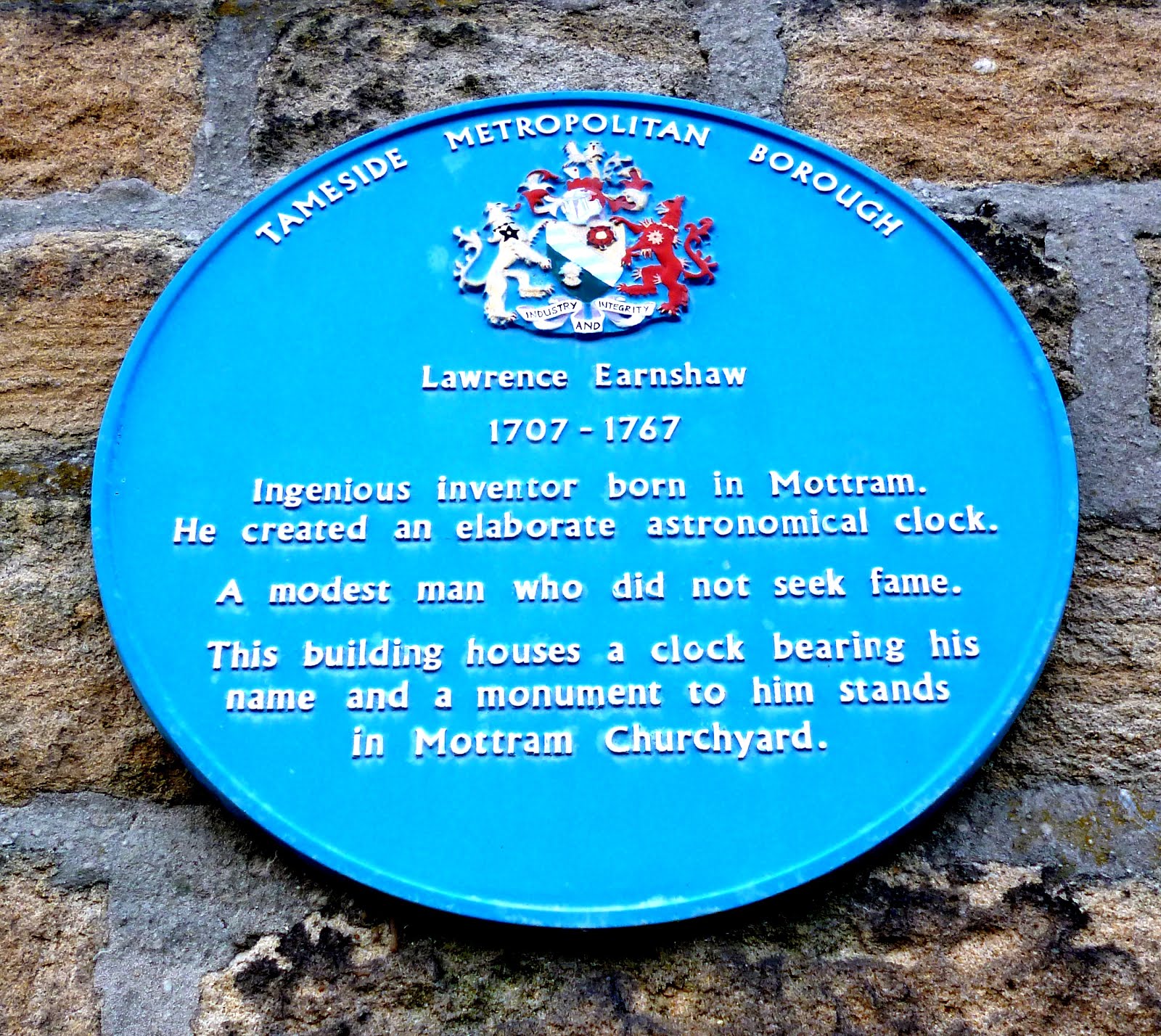
Lawrence Earnshaw in Mottram in Longdendale, Tameside

On the wall of the Court House, Market Place, Mottram in Longdendale:
 
'Lawrence Earnshaw
1707–1767
Ingenious inventor born in Mottram.
He created an elaborate astronomical clock.
A modest man who did not seek fame.
This building houses a clock bearing his
name and a monument to him stands
in Mottram Churchyard.'
 
Lawrence Earnshaw's monument at Mottram. There are four different inscriptions around the base:
 
'LAWRENCE EARNSHAW
MOTTRAM
DIED MAY 12TH 1767
AND WAS BURIED IN THE
ADJOINING CHURCHYARD.'
 
'A SELF-TAUGHT GENIUS AND
OF HUMBLE BIRTH HIS TALENTS
AS AN INVENTOR ANITCIPATED
BY MANY YEAR THE DISCOVERIES
OF OTHER EMINENT MEN.'
 
'BY HIS SKILL IN GEOMETRY
AND
ACQUIREMENTS AS A MECHANICIAN
HE DESIGNED AND CONSTRUCTED
AN ASTRONOMICAL CLOCK
REGISTERING THE REVOLUTIONS
OF THE HEAVENLY BODIES AND
THE FLOW OF THE TIDES.'
  
'A CENTURY AFTER HIS DECEASE
THE ADMIRERS OF HIS GENIUS
AND WORTH
ERECTED THIS MEMORIAL.
A. D. 1867.'
 
'JOHN EATON
ASHTON'
 
The Hyde poet James Leigh mentions Earnshaw's memorial in this verse from one his dialect poems in Glimpses of Sunlight and Other Poems:
 
'Bu' come, we'll have a look through t' yard
Th' owd ancient burial-greaund
Wheer Mottram's dead for ages
Ha'n slept so snug an' seaund;
We'll visit Earnshaw's Monument
(Neglected in his day
This cenotaph ne'er mark'd his worth
Till years had pass'd away).'
 
Below is a link to an online article on Earnshaw in the Tameside Citizen, with several more verses from Leigh's poem:
 
 –––––––––––––––––––––––––––––––––––
'A Tribute to Lawrence Earnshaw'