Showing posts with label Aymé (Marcel). Show all posts

4 February 2019

Antoine Blondin and Pierre Assouline: Le Flâneur de la rive gauche: Entretiens (1988)

This is an edited collection of interviews made in 1988 between Pierre Assoulline and Antoine Blondin, three years before the writer's death. As might be expected, it is really humorous, and at the same time appears to be very honest. But.

Associated with what Bernard Frank (of whom Blondin speaks highly) in 1952 calls Les Hussards, when taken to task on the definition of this group, Blondin says that it essentially referred to himself, Roger Nimier, Michel Déon and Jacques Laurent: the 'core' Hussards, which was never a 'school' as the writers were very different. To Blondin, the common ground was the criticism of Sartre (who was nevertheless praised in Nimier's early writing) as an 'intellectual terrorist' without humour.

Assouline tries to dig out Blondin's political affiliations, although he says he has none: he repeats (as in his chat with Serge Gainsbourg (available online via Youtube)) that he's seen as left-wing by the right, and right-wing by the left. He vaguely situates himself somewhere in the middle. Vagueness seems to be a norm with Blondin.

What isn't vague is Blondin's drinking, which is almost a religion to the man. Alcohol is to some extent an escape, certainly a way of life, but the comfort it brings, and in particular the false companionship that accompanies it, is not exactly everything to Blondin, but it's halfway there. That's all in the fun: the 'bullfighting' of cars on the Boulevard Saint-Germain, the spending of six entire days 'Chez Blanche' (a bar on the rue du Bac), the 33 arrests, Roger Nimier rescuing him financially from the cops, and on and on.

Blondin had many literary friends, Nimier being perhaps his greatest (until his death in 1962), but then there's also Marcel Aymé, Paul Morand, Jacques Chardon, etc. The idea of Blondin being elected to L’Académie française wasn't impossible: but how would he have reacted to such an invitation? Well, there were five cafés between Blondin's flat and the Académie: he would never make it there: although only 150 metres away, he would start out in his habit vert, leave his sword in the first bistrot, leave his cocked hat in the second, and shamefully end up at the Académie française in his underpants!

As for Blondin's most famous quotation, the last sentence of his novel L'Humeur vagabonde: 'Un jour nous prendrons des trains qui partent' (lit. 'One day we'll take leaving trains.'): the meaning? On 30 July 2018, the day France won the world football cup, Frédéric Beigbeder, in La Frivolité est une chose serieuse, claims that at last he's understood what Blondin meant: happiness has to be shared, otherwise it's worthless; being  proud of your country brings people closer to others. Yeah, sure, whatever you say, Beigbeder. Assouline tried hard to eke out a meaning from Blondin, and the first answer is: the quotation means that one day Blondin will write a readable book. Assouline repeats the question, and Blondin says that the meaning is that the trains will take him home. Er...

Antoine Blondin's grave in Père-Lachaise.

My Antoine Blondin posts:
––––––––––––––––––––––––––––––––––––
Antoine Blondin and Pierre Assouline: Le Flâneur de la rive gauche
Antoine Blondin: Monsieur jadis ou l'école du soir
Antoine Blondin: Les enfants du bon Dieu

11 November 2011

Gen Paul in Montmartre, 18th arrondissement, Paris, France: Literary Île-de-France #21

Gen Paul (1895—1975) has a place in literary history not for writing but for featuring in the works of two writers: very briefly in Marcel Aymé's short story 'Le Passe-Muraille' ('The Man Who Walked through Walls') (1943), and as an important character in his friend Louis-Ferdinand Céline's novel Féerie pour une autre fois (Fable for Another Time) (1952).

Gen Paul was born in rue Lepic, Montmartre, and lost a leg in World War II. While convalescing he took up again the painting that had been his hobby as a child, his expressionistic ideas being influenced by many different artistic sources. He was to make his living as a painter for the rest of his life.

 Gen Paul's home and workplace at 2 avenue Junot, Montmartre.

'Eugéne PAUL dit GEN-PAUL
artiste peintre
et graveur français
a vécu et créé
dans cette maison
de 1917 à 1975'

'Eugéne PAUL known as GEN-PAUL
artist painter
and French engraver
lived and created
in this house
from 1917 to 1975'


Unless you actually knew, it would be impossible to tell that this is Gen Paul's grave, as no matter where you look there's no indication of it, no inscription at all.

8 November 2011

Marcel Aymé in Montmartre, 18th arrondissement, Paris, France: Literary Île-de-France #14

'"Histoire de Paris

Le Passe-Muraille

Il y avait à Montmartre[, au troisième étage du 75 bis de la rue d'Orchampt,] un excellent homme nommé Dutilleul qui possédait le don singulier de passer à travers les murs sans en être incommodé." Modeste employé de troisième classe dans un ministère, il se découvre fortuitement cet étrange pouvoir, et l'utilise d'abord pour rendre fou un sous-chef de service qui l'abreuvait d'humiliations. Vient alors, après quelques fruitueuses cambriolages signés "Garou—Garou", le tour du directeur de la Santé, impuissant à garder un prisonnier qui sort déjeuner dans le quartier et l'appelle innocemment pour régler la note... L'amour perd cependant notre héros, figé à l'intérieur de la muraille au sortir d'une nuit passionée. Depuis, "certaines nuits d'hiver, dans la sollitude sonore de la rue Norvins", seuls les accords de guitare joués par le peintre Gen Paul "pénétrent au coeur de la pierre comme des gouttes de lune"... L'âpre lucidité de Marcel Aymé s'en donne à coeur joie dans ce receuil de nouvelles paru en 1943, qui dénonce d'un coup discret de baguette magique, narquoise irruption du fantastique dans un quotidien trop bien réglé, la médiocrité du monde moderne.

'The Man Who Could Walk through Walls

In Montmartre, there was [on the third floor of 75b Orchampt Street], a splendid man called Dutilleul who had the strange gift of being able to go through walls with no difficulty whatsoever. A modest clerical assistant in a government department, he discovered this odd gift quite by chance, and as his immediate boss had deeply humiliated him, he first used it to drive him mad. After several fruitful burglaries signed "Will-O'-the-Wisp", the turn came for the director of the mental hospital, who was powerless in retaining an inmate who went for lunch in the neighborhood and innocently called him to pay the bill... However, our hero was lost to love, and he's now trapped inside the exit wall after a night of passion. Since then, "on certain winter nights, in the dead quiet of Norvins Street", only the chords of a guitar played by the painter Gen Paul "penetrate the heart of the stone like moon drops"... Marcel Aymé's bitter lucidity lends joy to the heart in this collection of short stories published in 1943, which, with one wave of a magic wand, brought a subtle eruption of the fantastic into the all too regulated, mediocre daily routine of the modern world.'

'ICI VÉCUT
L'ÉCRIVAIN
MARCEL AYMÉ
1902 — 1967'

'HERE LIVED
THE WRITER
MARCEL AYMÉ
1902 —1967'

This is now named after the writer.

 But the center of attention is the sculpture in the square, representing the end of the short story, when Tutilleul's powers desert him. (The face is that of Aymé himself.)

This was sculpted by Jean Marais in 1989.

 Marcel Aymé was buried in Cimetière Saint-Vincent, or Saint-Vincent Cemetery, in Montmartre.

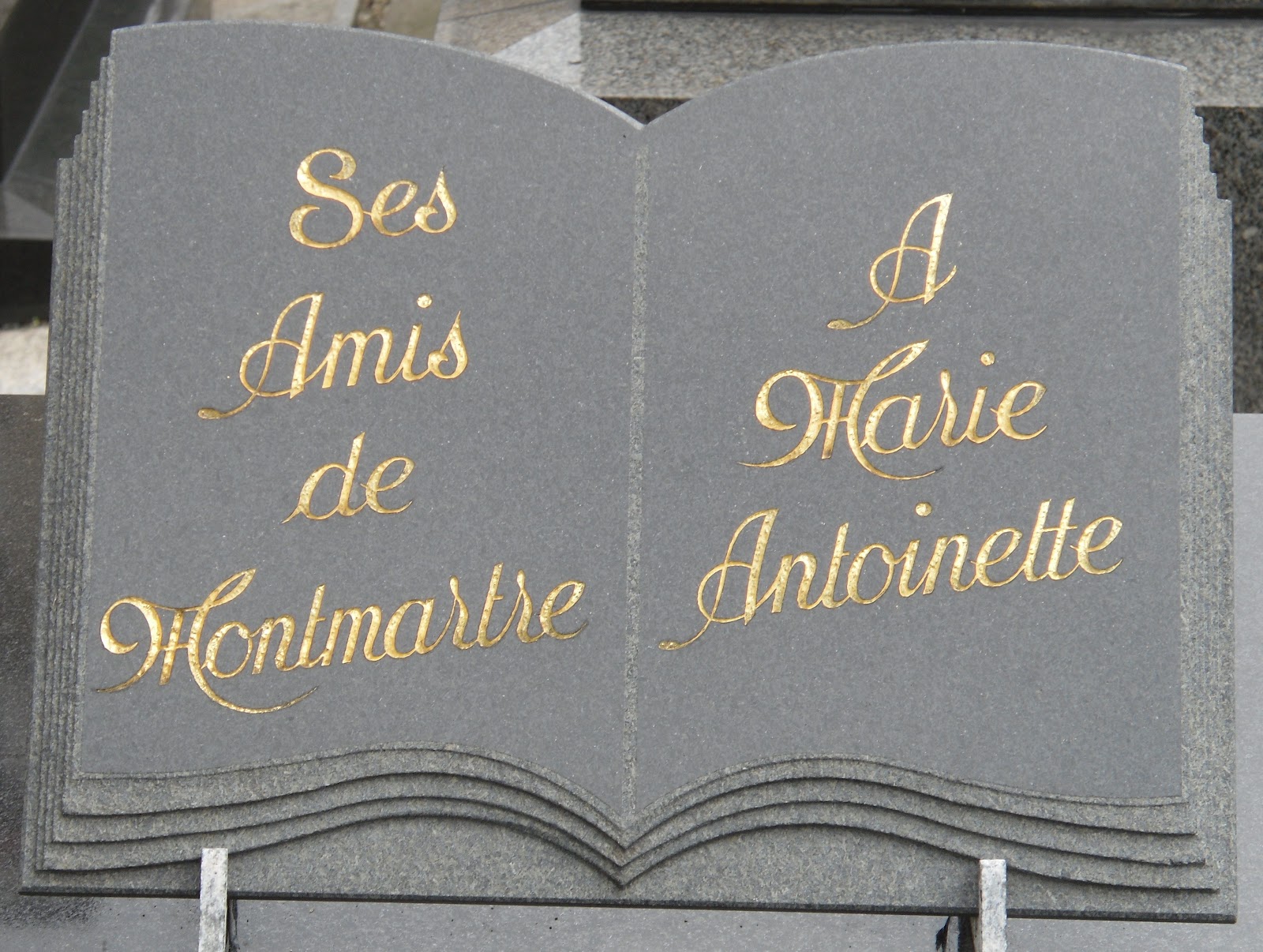
 'Ses amis de Montmartre' | 'À Marie Antoinette'.

'Nous ne Vous Oublierons Jamais'

['We shall Never Forget You']

Addendum: My thanks to Dr Jean-Pierre Belleville for drawing my attention to this website linked below, which he runs:

–––––––––––––––––––––––––––––––––––
SAMA Société des Amis de Marcel Aymé