The Bitterweed Path (1950) by Thomas Hal Phillips (1922–2007) is an interesting book in the history of homosexual literature. It features in Anthony Slide's Lost Gay Novels: A Reference Guide to Fifty Works from the First Half of the Twentieth Century (Routledge: 2003), which includes novels published from 1917 to 1950, and not necessarily written by authors who were gay.
Showing posts with label Mississippi. Show all posts
31 January 2014
Thomas Hal Phillips: The Bitterweed Path (1950; repr. 1996)
1 January 2013
Mildred D. Taylor: The Road to Memphis (1990)
Libellés :
Jim Crow,
Mississippi,
Southern Literature,
Taylor (Mildred D)
Mildred D. Taylor is sometimes mentioned as a writer of young adult fiction, but this novel certainly doesn't read that way. The Road to Memphis is set in 1941 and belongs to Taylor's Logan family saga, concerning the situation of blacks in mainly rural Mississippi, where they are very much second class citizens in a segregated society, where there are restaurants and toilets strictly for whites and blacks only, and where blacks sit or stand at the back of buses, and the seats at the front are for whites only.
Taylor was born in Jackson, Mississippi in 1943, and although her family moved to the North, as a child she frequently re-visited the South, absorbing the many stories she heard, later incorporating them into her novels, and The Road to Memphis is a fictional representation of archival and family research.
The author painfully depicts a world in which blacks must call whites 'Mr' and are daily forced to accept different kinds of intimidation that whites mete out with (usual) impunity. Jeremy Simms is a young white man who is an exception to these rules, though, as he believes that 'folks are folks', and is generally respected by the black community. Until, that is, he joins his racist cousins the Aames in chasing Harris, who badly breaks his leg as a result. However, Jeremy redeems himself when Moe snaps and beats up the Aames, and he not only hides Moe in his truck but secretly drives him to Jackson, from where he escapes in Stacey Logan's car to Memphis and by train to the safety of Chicago.
But there are no easy endings. There can't be.
Taylor was born in Jackson, Mississippi in 1943, and although her family moved to the North, as a child she frequently re-visited the South, absorbing the many stories she heard, later incorporating them into her novels, and The Road to Memphis is a fictional representation of archival and family research.
The author painfully depicts a world in which blacks must call whites 'Mr' and are daily forced to accept different kinds of intimidation that whites mete out with (usual) impunity. Jeremy Simms is a young white man who is an exception to these rules, though, as he believes that 'folks are folks', and is generally respected by the black community. Until, that is, he joins his racist cousins the Aames in chasing Harris, who badly breaks his leg as a result. However, Jeremy redeems himself when Moe snaps and beats up the Aames, and he not only hides Moe in his truck but secretly drives him to Jackson, from where he escapes in Stacey Logan's car to Memphis and by train to the safety of Chicago.
But there are no easy endings. There can't be.
4 July 2012
Hillary Jordan: Mudbound (2008)
Libellés :
Greenville (MS),
Jim Crow,
Jordan (Hillary),
Mississippi,
Southern Literature
Mudbound is the first novel by Hillary Jordan, who grew up in Dallas, Texas and Muskogee, Oklahama. The book is almost entirely set on and around a cotton farm in the late 1940s in the Mississippi Delta not far from Greenville, and takes the form of a multiple narrative in six voices – three from the white McAllan family, and three from the black Jackson family:
Henry McAllan is Laura's husband and is steady and reliable but a little too conventional, a little too accepting of old ways and of his father in particular. The land is in his blood.
Jamie is Henry's beloved brother. A handsome man who has women flocking to him, he first greatly impresses Laura when he dances with her at the famous Peabody in Memphis. He will later return from the war to live with the McAllan family, somewhat traumatised and with an addiction to whiskey.
Hap Jackson is a share tenant on Henry's property who is keen to get justice for his family but is aware of the dangers of stepping too far over the line in a Jim Crow society where the whites hold all the trump cards.
Florence Jackson is Hap's wife and the local midwife who also helps Laura out with household jobs. She is an intelligent woman who is also a good psychologist.
Ronsel Jackson is Hap and Florence's son and – transgressively – forms a close friendship with Jamie. He too comes with mental baggage from the war, part of it caused by a love affair with a white German woman. He finds it very difficult to adjust to a society which eagerly uses blacks as cannon fodder to protect itself but will not even acknowledge that they should have the same rights as anyone else.
Bit by bit, the six voices unravel into a powerful story of mindless racial violence, adulterous sex, and parricide.
2 January 2012
The Oxford American: Thirteenth Annual Southern Music Issue (2011)
Although now published in Conway, Arkansas, The Oxford American takes its name from its original place of publication: Oxford, Mississippi. This quarter is the magazine's thirteenth annual Southern music issue, which this year includes a CD compilation of music from Mississippi.
A few of the tracks are by well-known musicians such as Howlin' Wolf and Bo Diddley, but most of them are less famous.
Jimmy Donley (1929–63) from Jonestown near Gulfport sings 'Radio, Jukebox, and T.V.', and Ben Ehrenreich's article on Donley begins with the sentence 'Take a tour of loneliness.', which is as much an introduction to Donley's life than the song itself. Donley was married several times in his short – often poverty-burdened, often drink-sodden – 33 years. He had psychiatric problems, was violent, and was no stranger to the inside of a prison cell. Collectively, the mere titles many of his songs appear to scream his despair: 'I'm Alone', 'You're Why I'm So Lonely', 'I Really Got the Blues', 'Oh How It Hurts', and the very telling 'Born to Be a Loser' – which became the title of a 1992 biography by Johnnie Allan and Bernice Larson Webb – seems to sum up his sorry life. But it would be difficult to find a more appropriate title than 'Stop the Clock': Donley succeeded in asphyxiating himself to death with the exhaust fumes of his car.
Megan Mayhew Bergman gives a fascinating account of The International Sweethearts of Rhythm. Originally called The Swinging Rays of Rhythm, the Sweethearts came out of Dr Laurence C. Jones's (African American) Piney Woods School a little more than twenty miles south of Jackson. In fact, the girls escaped from it: initially serving as fund raisers for the school, they decided to go their own way and earn more money. Recruiting more musicians of different races, they became the first racially integrated all-girl band, and in a time of war when their male big band counterparts were being called up, they very adequately filled the gap. With difficulty they lasted until 1949, through the boys' return, the intolerance of Jim Crow, internal difficulties, and changing musical fashions.
Words certainly can be off-putting, as Nikil Saval noted on first hearing of Milton Babbitt because automatically the surname triggered off associations with the eponymous central character of Sinclair Lewis's novel Babbitt. He thought of 'American philistinism' in relation to the novel, although I think 'American conformity' is more apt. No matter, as neither expression can be applied to Milton Babbitt's music. Quite the reverse, and Babbitt's experimental 'Post Partitions' is an amazing piano composition. Babbitt wrote a thesis on Arnold Schoenberg's twelve-tone system (or twelve-tone composition), but it was not published until many years later in 1992, when he was also awarded a PhD for it by Princeton University.
As usual, though, I'm drawn as if by magnetic force to the obscurities here:
––– Mattie Delaney, the blues singer who appears to have only ever recorded two tracks, in 1930, at the famous Peabody Hotel in Memphis, Tennessee, and who has been covered by Rory Block and Lucinda Williams.
––– John Stirratt is well known as Wilco's bassist, but his early days in Oxford, MS with The Hilltops are far less so. I must listen to more on Oxford American's website as 'Sidewalk' is wondrous stuff.
––– And I must also take up OA's offer in the magazine to 'experience more Henry Green' by checking out that website some more. 'Storm thru Mississippi', inspired by the 1936 tornados, is scary, wrathful, Old Testament preaching. Nicholas Rombes's article doesn't seem to give any indication who the man was, although his very common name is a big setback to finding out.
––– The Riviaires were two kids smitten by The Beatles' music in their early teens, and Ralph 'Wattsy' Watts's very youthful voice emphasizes the fact. Wattsy and the drummer Bill Latham released this themselves (with a brief instrumental on the B-side), and their parents footed the bill. But there were no more records from The Rivieres, as they were just having fun.
––– Finally, from Jackson come The Germans, a punk band with lead vocalist Carla Wescott making wonderful noises, ditto the startling guitar playing of Sherry Cothren.
This is the list of the tracks on the CD:
1. Harold Dorman: 'Uncle Jonah’s Place' (1961)
2. Charles Wright & the Watts 103rd Street Rhythm Band: 'What Can You Bring Me' (1971)
3. Ernie Chaffin: 'I'm Lonesome' (1957)
4. Bo Diddley: 'Heart-O-Matic Love' (1955)
5. Mattie Delaney: 'Tallahatchie River Blues' (1930)
6. Fern Kinney: 'I'm Ready for Your Love' (1982)
7. Leon Bass & the Keystones: 'Love-A-Rama' (c. 1956)
8. Joe Henderson: 'Snap Your Fingers' (1962)
9. Hayden Thompson: 'Blues, Blues, Blues' (1956)
10. The International Sweethearts of Rhythm: 'Jump Children' (1946)
11. Howlin' Wolf: 'Howlin' for My Darling' (1959)
12. Dusty Brooks: '(My Baby Loves) Chili Dogs' (1951)
13. Ruby Andrews: 'Tit for Tat' (1969)
14. The Hilltops: 'Sidewalk' (1991)
15. Carter Brothers & Son: 'Old Joe Bone' (1928)
16. Syl Johnson: 'I've Got the Real Thing' (1968)
17. Guitar Slim: 'Guitar Slim' (195418. Jimmy Donley: 'Radio, Jukebox, and T.V.' (1958)
19. The Golden Nugget: 'Gospel Train' (1973)
20. Travis Wammack: 'Rock & Roll Blues' (1958)
21. Henry Green: 'Storm Thru Mississippi' (1951)
22. Wadada Leo Smith and Ed Blackwell: 'Uprising'' (1986)
23. Jim Jackson: 'Old Dog Blue' (1928)
24. The Riviaires: 'Bad Girl' (c. 1965)
25. The Germans: 'Love Sick' (1981)
26. Milton Babbitt' (played by Robert Miller): 'Post-Partitions' (1977)
27. Ted Hawkins: 'Biloxi' (1994)
It's just occurred to me: I suppose Bobbie Gentry's 'Ode to Billie Joe' was too obvious to include? Pity, though, as it's one of my all-time favorites. I note it's contributor Yusef Komunyakaa's favorite Mississippi song. Good man.
29 July 2011
Carl Corley: Sky Eyes (1967)
Libellés :
Corley (Carl),
Gay Literature,
Mississippi,
Southern Literature
After reading Hubert Creekmore's Cotton Country (see the post below), I got curious about other obscure Mississippi writers, and then noticed a link at the bottom of Creekmore's Wikipedia entry, which led to some pages of John Howard's Men Like That: A Southern Queer History, which told me very little about what I wanted to know, although the mention of Carl Corley proved a gem.
Corley was born in Florence, Mississippi in 1921, and was an artist in the 1950s, although in just five years – from 1966 to 1971 – he published 22 erotic gay pulp novels. The cover art (see above) was always his own.
Sky Eyes begins with a stagecoach ride in 1831 from Louisiana (where Corley moved to) to Fort Adams in south-west Mississippi, during which the young, innocent and strikingly handsome Vik Alta meets the older hunk Rafe Savage. After a night of unbridled oral and anal sex, they continue up the Natchez trace, until the stagecoach is attacked by Choctaw indians, the driver and Rafe are killed, and Vik is taken prisoner.
Cutting things short, Vik (renamed 'Sky Eyes') becomes a sex slave to the (male) leader Neshoba, although their first encounter makes Vik a very willing one. The narrator is very quick to stress how civilized the Indians are when compared with their white counterparts:
'They were tactful - Vik grew to learn – ambitious, grave, humble on occasion if it were warranted, were clean of body (though he had not considered so at first) even going swimming in the river when it was edged with ice, and adhered, with strict obedience, to the laws of their tribe. Unlike the white man, they did not steal from one another (though they stole with relish from the paleface) did not commit adultery, rape nor incest, and did not kill, except in lust for domination of the tribe; a lust strong in the heart of every brave who longed to become chief of the Hiwannee and the Kewannee.'
Also:
'[T]he males were all extremely well proportioned in bone and muscle; were golden smooth of complexion, boasted shiny manes of jet black hair, and wore hardly enough to hide their nakedness.'
It seems that Vik has accidentally stumbled on some kind of paradise.
Soon, Neshoba and Vik develop a strong love for each another, and they get married. One day shortly after, though, when Neshoba and friends are out attacking a wagon train, Nik can't resist having sex with the virgin squaw Winona, although a member of his tribe sees the girl entering the honeymoon tepee and tells Neshoba, who blows a fuse. Winona's punishment: being strung up, her breasts hacked off, and a poisonous snake shoved right up between her legs. This is the first prong of Vik's punishment – the second is that Neshoba is no longer going to lay a finger on him.
Out on his own one day, Vik is amazed to meet Rafe, who in fact survived, and has come to take Vik back to white man's land. After some hesitation - well, he certainly deeply loves Neshoba, but what does that mean if he can't express it to him - he decides to go back with Rafe. But Neshoba has sent out a scout to watch Vik, definitively sinks a tomahawk into his rival Rafe's head, and gives Vik the choice: either return freely to Fort Adams and white civilization, or stay with him with the Indians. The problem is, Vik wants to return to the loving sexual relationship he had with Neshoba before his heterosexual dalliance with Winona. That's not a problem, says Neshoba: everything will be as before. So Vik agrees.
There are more than a few creaky elements in this novel - what do you expect with someone who seems to write faster than Amélie Nothomb? But the interesting thing is the subversion of sexual norms, especially bearing in mind the date this was written: utopia, the (admittedly very violent, especially when jealous) noble savage, and the eternal triangle are all seen within a homosexual context.
Most of Corley's books aren't readily available, and I suspect that the printrun was very small. Not one of his novels is listed in the Library of Congress or British Library catalogs. It is probably impossible to find any of his books online at a reasonable price, but Sky Eyes is online here. It's in four sections - to move to the next, simply change the number at the end of the URL from '1' to '2', etc.
27 July 2011
Hubert Creekmore: The Fingers of the Night (1946), aka Cotton Country (1950)
Libellés :
Creekmore (Hubert),
Mississippi,
Southern Literature
Hubert Creekmore (1907-66) was born in Water Valley, Mississippi, and the son of a lawyer from a renowned planter family. Before the publication of his first novel, The Fingers of the Night (later retitled Cotton Country), he had published three books of poetry. He published more poetry, also translating works from Latin and other European languages, but only produced two more novels: The Welcome (1948) and The Chain in the Heart (1953). In general, Creekmore's novels were considered to negatively reflect the then poorest state in the union. A book I haven't read more or less sums up the reason for his early death: To Hubert Creekmore: Who Died in a Taxi on His Way to the Airport on His Way to Spain, by William Jay Smith (1967).
My attention was first drawn to Creekmore's existence by a very recent article by J. B. Slogan: 'Roughhousing, Again, in the Southern Libraries: Pulp in the Afternoon' in the current (summer) issue of Oxford American (number 73). Slogan and I didn't read the same book, of course – no one ever does, even if we're the same person reading at different times – and my verdict on Cotton Country is really much more positive. Obviously I didn't expect this to be anything like as good as Faulkner (who lived just twenty miles north of Water Valley) or Welty (Creekmore's sister-in-law), but after reading such a negative article I'm so impressed by how good it actually is. No, J. B. Slogan, you can't judge this book by its cover, and Cotton Country deserves a far better one (the American one being actually better than the UK one because the characters are better drawn, although they're perhaps a little too moviestar glamorous).
Cotton Country is a strong indictment of Mississippian religious fundamentalism in the 1940s, essentially concerning – throughout – the relationship between the young Cleance and Tessie (née Ellard) Andrews and Tessie's (generally unrecognized as) psychotic father Maben (usually called Pa). Pa belongs to a church that segregates man from woman (aisle-wise) in its services, and we later learn that Cleance's father has left the flock, calling the congregation 'too holy to be human', and stating that he 'wouldn't go to no church that didn't believe in life.'
Why is Pa certifiably insane? Well, his wife was 'sinning', and it's about the time of her death (probably caused by Pa beating her senseless in tandem with giving her (or her giving herself, it's unclear) a very dangerous abortion) that the church went crazy. And Pa almost killed his daughter Bett for 'sinning' (the exact crime is unclear), and sent her boyfriend Tuck Manning running by giving him a gunshot wound. Not only does he believe that sex is a sin, but that marriage is a sin as it leads to the sin of sex, as opposed to the ideal virgin birth. Whatever would this guy do to his younger daughter Tessie, who's been enjoying Cleance's attributes in the cotton barn, as well as other unmentionable places?
Slogan cites a paragraph at the beginning of the book – when Cleance and Tessie, er, come together in the cotton barn – and seems to find it laughable and/or badly written, skipping several paragraphs and so missing the one that should have been quoted: the two together:
'Her eyes looked past his shoulders and saw the vaporous walls quake as if a wind had crossed them. She arched her back. The smell of cotton seed swept into her nose.
'Drops of saliva ran between Cleance's teeth and open lips, overflowed at the center and fell on her neck. He closed his mouth too late and licked his gums as if they were dry.'
This is way before the Chatterley trial, and it paid to be careful, so this is what authors had to do: euphemize. And I think it worked.
So Tessie gets pregnant, has to marry Cleance, and flee with him. Life in cotton country ain't easy, though, because they are scratching for a living. No, they can't afford a midwife, but quite by chance an African American one is there to greatly help at the time. At the time, of course, they weren't called African Americans, and the Jim Crow laws were still strong, but the presentation of this black family by the narrator makes them shine brightly against the inhuman prejudices of the whites. Any (extremely minor, let's be honest) racist thoughts in this novel, I'm sure, belong to the characters in the book, and not to the author of it.
Oh, and Creekmore was gay. Surely some transfer could be applied here?
6 June 2011
Judith Sargent Murray in Gloucester, Cape Ann, Massachusetts
Libellés :
Cape Ann,
Gloucester (MA),
Mississippi,
Murray (Judith Sargent)
Judith Sargent Murray spent almost all of her life in Gloucester and was a powerful supporter of women's rights. Her education came from reading in her parents' large library. She was an essayist, poet, playwright and editor who wrote 'On the Equality of the Sexes' (which predates Mary Wollstonecraft's Vindication of the Rights of Woman (1792)) as 'Constantia'.

And opposite the house, a long mural in which Murray is the main focus:
'THIS MURAL WAS PAINTED IN 1996 BY BE SARGENT ALLEN TO HONOR
JUDITH SARGENT MURRAY OF GLOUCESTER (1751 - 1820)
FEMINIST, VISIONARY & COMMUNITY ACTIVIST'
1 April 2011
Oxford American #72
The latest issue of Oxford American has just arrived, and shows the writer Barry Hannah (1942-2010), who died last March, on the cover. It contains several pages of tributes, and an article on him by John Oliver Hodges. He was born in Meridian, Mississippi, and died in Oxford MS, where he had taught Creative Writing at Ole Miss for 28 years. Hodges took a drive around Tuscaloosa AL with Hannah a few years ago, and I'd already seen the 10-minute video of it, which is here. An example of Hannah's writing is this short story 'The Spy of Loog Root', published in Oxford American in 1992. This is his obituary in The Guardian, although far more interesting is this article in The New York Observer.
Also in this season's issue is an article about someone unfamiliar to me: Judy Bonds, a coal miner's daughter from Whitesville, West Virginia who died in the New Year, and was a staunch campaigner against mountaintop removal.
Another thing that initially catches my eye (apart from a few pages of correspondence between Eudora Welty and William Maxwell) is the editor Mark Smirnoff saying 'the book and first movie handled the material with more wisdom and art' of the Coens' True Grit re-make. Maybe I was right not to go and see it then, although I'll no doubt catch it when it comes to DVD. And while on the subject, this February Will Self wrote a revisionist take on the Coens.
Also in this season's issue is an article about someone unfamiliar to me: Judy Bonds, a coal miner's daughter from Whitesville, West Virginia who died in the New Year, and was a staunch campaigner against mountaintop removal.
Another thing that initially catches my eye (apart from a few pages of correspondence between Eudora Welty and William Maxwell) is the editor Mark Smirnoff saying 'the book and first movie handled the material with more wisdom and art' of the Coens' True Grit re-make. Maybe I was right not to go and see it then, although I'll no doubt catch it when it comes to DVD. And while on the subject, this February Will Self wrote a revisionist take on the Coens.
20 October 2010
Kathryn Stockett: The Help (2009)
Libellés :
Jackson (MS),
Mississippi,
Southern Literature,
Stockett (Kathryn)
Kathryn Stockett's The Help (2009) is a very popular novel, and I'm wary of such animals. However, this book - written by a woman born and raised in Jackson, Mississippi by a black 'help' and with an obviously partly autobiographical subject matter - is a powerfully written reconstruction of Southern life (largely from the point of view of black domestics) in the early 1960s.
The novel is structured in a series of narratives by the 'helps' Aibileen and the younger Minny (both written in a kind of black vernacular), and the young white Miss Skeeter (written in standard English). Having the tail end of the Jim Crow law era as its central backcloth, The Help is firmly centered on black and white issues in the domestic field, concentrating on the abuse of black women in that area. With some justification, the front cover of the English Penguin paperback calls it 'The other side of Gone wih the Wind'.
At the heart of the novel is the relationship between Miss Skeeter and Aibileen and the former's strong interest in publishing a series of interviews about the treatment of black domestics by their white employers. Gradually, Aibileen persuades over ten other black workers to be interviewed, and eventually the anonymously authored book is published, and meets with some success, as well as considerable criticism in the Jackson community.
What shines through all this is not just the courage of the black women, not just the courage of one white woman to record it all, but the strength of human resistance against racial bigotry and general ignorance. A heartwarming book with no facile conclusions.
The novel is structured in a series of narratives by the 'helps' Aibileen and the younger Minny (both written in a kind of black vernacular), and the young white Miss Skeeter (written in standard English). Having the tail end of the Jim Crow law era as its central backcloth, The Help is firmly centered on black and white issues in the domestic field, concentrating on the abuse of black women in that area. With some justification, the front cover of the English Penguin paperback calls it 'The other side of Gone wih the Wind'.
At the heart of the novel is the relationship between Miss Skeeter and Aibileen and the former's strong interest in publishing a series of interviews about the treatment of black domestics by their white employers. Gradually, Aibileen persuades over ten other black workers to be interviewed, and eventually the anonymously authored book is published, and meets with some success, as well as considerable criticism in the Jackson community.
What shines through all this is not just the courage of the black women, not just the courage of one white woman to record it all, but the strength of human resistance against racial bigotry and general ignorance. A heartwarming book with no facile conclusions.
2 January 2010
Selah Saterstrom's The Pink Institution (2004)
Libellés :
Mississippi,
Saterstrom (Selah),
Southern Literature
In the world of Southern literature, Southern Gothic is by no means rare, and indeed continues to be strong, but although Southern Gothic is stange and disorienting, it isn't 'experimental', by which I mean that the form and the style don't challenge existing literary norms. But unfortunately many people simply don't see Southern literature in the same serious way that they see other literatures in the U.S., and I've banged on about north-eastern literary hegemony for some years. And the general misconception of Southern literature as 'realist' is as wrong-headed as the conception of working-class literature as 'realist' is, and in the case of Southern literature this label neglects, for example, such writers as William Faulkner, Frances Newman, Barry Hannah, and Padgett Powell.
The novel is divided into five main parts. The first is extremely fragmented in that it contains four sections introduced by what appear to be (partly obliterated) thoughts on 'The Confederate Ball Program Guide 1938': these sections all contain large white spaces between the words, and there is frequent incoherence. The second part is as long as the first and divided into three sections: 'Childhood Objects', 'Maidenhood Objects', and 'Motherhood Objects', which are in regular prose but each contain information about the family. The third part is very brief, but the only titled one - PSALTER: (Birth Interim). Part four takes us up to the present day. The final part five is a kind of coda.
The novel, in effect, is a very short four-generation saga - from post-bellum decay and the attendant social problems of (self)-abuse, through to trailer park hell. Via any route you can think of. This is a very powerful, and very disturbing, novel.
I'll comment on Selah Saterstrom's second novel, The Meat and Spirit Plan, in due course, but I hope it's as accomplished as this is.
24 November 2009
Ripley, Mississippi: Colonel William Falkner: Literary Landmarks of the Southern United States, #14
Ripley, Mississippi, at midday Saturday is so dead that you can probably drive round the center in your sleep and come to no harm nor cause any. Venture onto the highway a few hundred yards away, though, and somewhere at least is open: yes, McDonald's is where everyone seems to hang out here. Back in the 19th century, though, Colonel William Clark Falkner – William Faulkner's great-grandfather – was involved in the re-creation of the railroad here. He was also involved in a number of other things, and probably none too popular: an attempt to shot him misfired, although he killed his would-be murderer and got off with self-defense. He became a writer, and wrote a best-selling novel – The White Rose of Memphis (1881). But his days were numbered, and ex-business partner R. J. Thurmond shot him in the street in the center of Ripley: he died the next day.
His great-grandson wanted to be a writer too, and he took his relative (as Colonel Sartoris) as a model in Sartoris (1929; repr. as Flags in the Dust, 1973), and The Unvanquished [1938].
The Colonel's grave is not difficult to find in Ripley Cemetery: with the statue on top of it it stands at 23 feet, and is a very impressive sight. On to Tennessee.
23 November 2009
New Albany, Mississippi: William Faulkner: Literary Landmarks of the Southern United States, #13
Libellés :
Faulkner (William),
Mississippi,
Oxford (MS),
Southern Literature
'William Faulkner. Here, September 25, 1897, was born the distinguished author, member of the American Academy of Arts and Letters, winner of the Pulitzer Prize and recipient of the 1949 Nobel Prize in Literature.'
Although Faulkner's birthplace no longer exists, a model of it is in the Union County Museum a few houses down from the street marker.
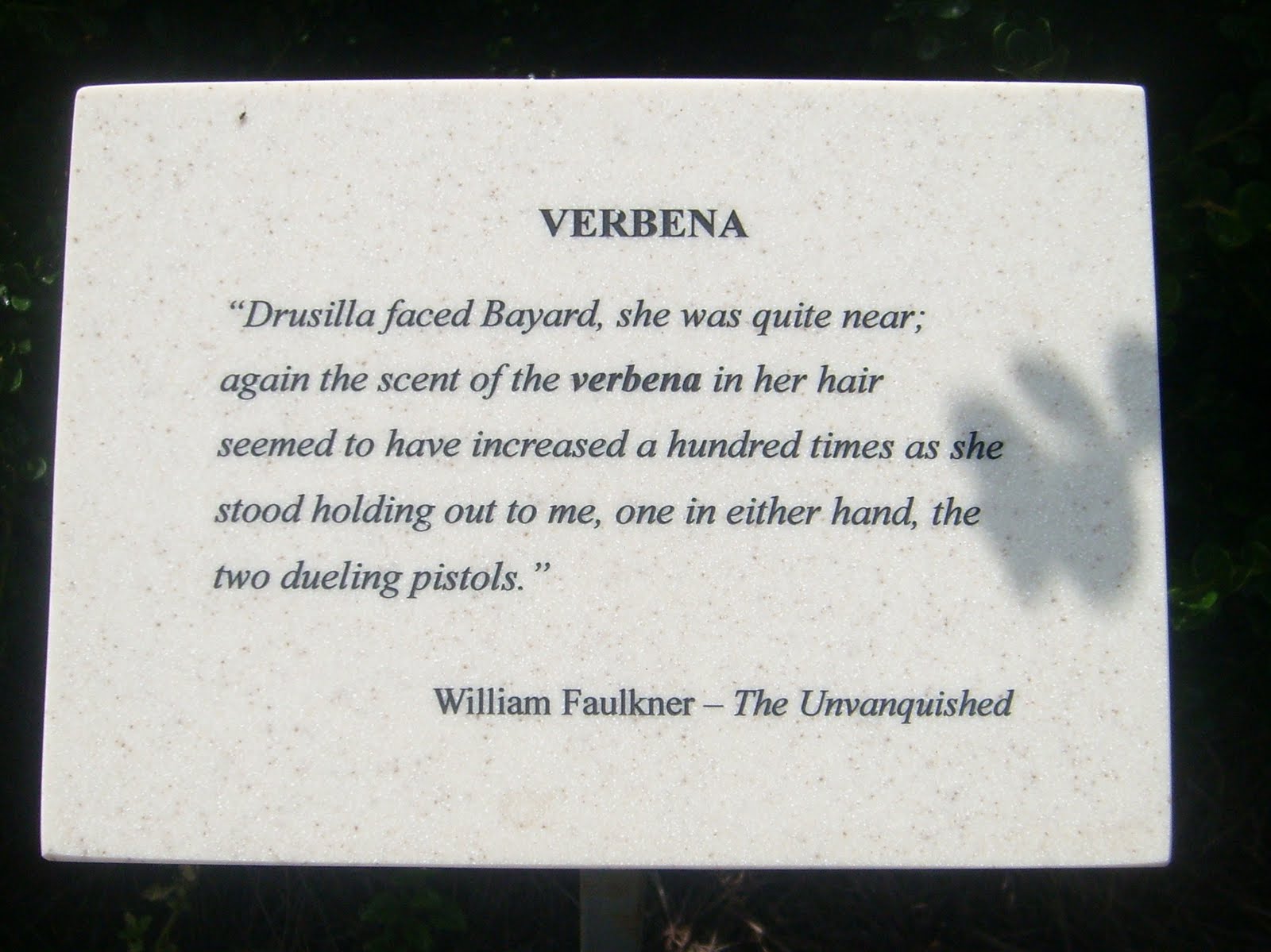
At the back of the museum, as a tribute to Mississippi's most distinguished literary son, is a literary garden, with a large number of plants mentioned in Faulkner's work, and markers showing the appropriate quotations.
Jimson Weed. 'Here. Here's you a jimson weed. He gave me the flower.' '...Ben squatting before a small mound of earth...at either end of it an empty bottle of blue glass that once contained poison was fixed in the ground. In one was a withered stalk of jimson weed...' William Faulkner, The Sound and the fury.
Bridal Wreath/Spirea. 'About this half-moon of lawn...were bridal wreath and crepe myrtle bushes as old as time and huge as age could make them'. William Faulkner, Sartoris.
'Drusilla faced Bayard, she was quite near; again the scent of verbena in her hair seemed to have increased a hundred times as she stood holding out to me, one in each hand, two dueling pistols.' William Faulkner, The Unvanquished.
Oxford, Mississippi: William Faulkner: Literary Landmarks of the Southern United States, #12
Libellés :
Faulkner (William),
Mississippi,
Oxford (MS),
Rowan Oak,
Southern Literature

'The Falkner House. Built in 1931 as the home of Murry and Maud Falkner, the parents of Nobel Prize winning author William Faulkner. [William had added the "u" some years previously.] The house stands on land purchased in 1898 by J. W. T. Falkner, William Faulkner's grandfather.'
William Faulkner bought Rowan Oak, which had been empty for several years, in 1930, when it was then known as 'The Bailey Place'. It was built in the 1840s by Colonel Robert Sheegog, a planter from Tennessee. Faulkner moved in with his wife Estelle and his two step-children, Malcolm and Victoria. Their daughter Jill was born a few years later. Here, the Faulkners lived until Faulkner's death in 1962.

Three views of Rowan Oak.
Faulkner's bedroom. On the mantelpiece on the other side of the room is a prominent '64', an identifying number that Faulkner wore at a horse show.
Faulkner's office has the plot of his novel A Fable written on the wall. He sometimes took the typewriter and one of the Adirondack chairs outside to work.
The library. The painting of Faulkner is by his mother Maud Butler, and the sculpture in the foreground is by the Brazilian Marnarz, a student of Jean Arp's.
Estelle's bedroom, where she painted and bird watched. Faulkner thought air conditioning unnatural, and wouldn't allow any in the house, although Estelle had some installed immediately after his funeral.
Jill's bedroom. The painting of her is also by Maud Butler.
The servants' quarters, and once home of their much loved caretaker 'Mammy Callie'.
Original detached kitchen from the 1840s, adapted by Faulkner into a smokehouse for his hams.
The 1840s barn, which Faulkner used for storage, was later rebuilt from the original wood.
The paddock and stable, built by Faulkner for his horses in the late 1950s.
Memory House on 406 University Avenue, Oxford. This was the home of John Faulkner, William Faulkner's brother, who was also a novelist, and who wrote My Brother Bill: An Affectionate Reminiscence very shortly after his brother's death.20 October 2009
Greenville, Mississippi: Highway 61 Revisited: Literary Landmarks of the Southern United States, #11
Libellés :
Greenville (MS),
Mississippi,
Southern Literature
I take Highway 61 again (which I had previously taken to visit Port Gibson and Natchez), and am once more reminded not only of Bob Dylan's album Highway 61 Revisited, but – as I'm driving through the Mississippi Delta – also of David Cohn's famous words in his book God Shakes Creation (1935): 'The Mississippi Delta begins in the lobby of the Peabody Hotel in Memphis and ends on Catfish Row in Vicksburg.' We've just spent three nights in Vicksburg and are headed north, but Memphis and The Peabody Duck March are just not on the itinerary: this is supposed to be a literary trail, not a record of the tourist traps of the South. No, we're on the way to Washington. County, Mississippi, that is, and more specifically Greenville, which is about eight miles west of Highway 61, and where about 30% of the population live below the poverty line: this is a world away from the $200 a night Peabody Hotel in Memphis, Tennessee. But Greenville, from a literary point of view, is remarkable. Greenville Library is on 341 Main Street, and the street marker by the sidewalk opposite the entrance to the building proudly proclaims the literary talent that has come from Greenville, Mississippi:'Greenville's Writers. An extraordinary literary atmosphere in Greenville produced winners of the Pulitzer Prize, National Book Award and O'Henry [sic] Award. Writers influenced by the creative ambience here include William A. Percy, Shelby Foote, Walker Percy, Hodding Parker, Jr., Charles Bell, Ellen Douglas, Bern Keating and David L. Cohn.' This is an extremely impressive list for a population of under 36,000.
Greenville takes an evident pride in its literary heritage. The William Alexander Percy Memorial Library is named after the writer who was Walker Percy's uncle. Walker's grandfather, and then his father, committed suicide, and following the death of his mother in a car crash, William Alexander brought up Walker and his two brothers in Greenville. Walker Percy (1916–90) wrote novels of alienation and existentialism, and his first novel, The Moviegoer (1962), was recently voted 6th best Southern novel of all time by Southern American, the literary journal of the University of Southern Arkansas. The writer Ada Liana Bidiuc said 'If a better book than The Moviegoer has been written, I'll cut off my little toe'. They talk like that in the South.
Jackson, Mississippi: Eudora Welty: Literary Landmarks of the Southern United States, #10
Libellés :
Jackson (MS),
Mississippi,
Southern Literature,
Welty (Eudora)

Jackson celebrates Eudora Welty's centenary, and this was a very eventful day for us. We were, as we had been for the past three days, staying in a hotel in Vicksburg, and the Welty house was within easy reach, particularly as an interstate exit was very close to the house in the centre of Jackson.
I was given a leaflet entitled 'Eudora Welty Driving Tour' at the house, so took the occasion to explore places in the area associated with Welty. This is the birthplace of Eudora Welty on North Congress Street.'David Norris and Joe purchased the property in 1979 for offices. Their restoration efforts reversed the tragic decline of the condition of the house and preserved it for its later acquisition by the Mississippi Writers Association to serve as the focal point of the Eudora Welty Writers' Center. The foresight of the Mississippi Legislature in funding this project and the leadership efforts of Jo Barksdale, Writers Association Executive Director, combined to make possible this living tribute to one of Mississippi's greatest writers.'
This building on Griffith Street is now the Mississippi Department of Education in this state capital, but it was formerly the Central High School where Welty was educated after the elementary school.
Welty's gravestone bears a quotation from The Optimist's Daughter: 'For her life, any life, she had to believe, was nothing but the continuity of its love.
On the other side is a quotation from One Writer's Beginning: 'The memory is a living thing—it too is in transit. But during its moment, all that is remembered joins, and lives—the old and the young, the past and the present, the living and the dead.As you have seen, I am a writer who came of a sheltered life. A sheltered life can be a daring life as well. For all serious daring starts from within.'
Subscribe to:
Posts (Atom)