Showing posts with label Charente-Maritime (17). Show all posts

6 March 2018

Dominique de Roux in Chaniers (17), Charente-Maritime (17)

In the 1950s, on returning from various courses and jobs in Germany, Spain and England, Dominique de Roux, along with several friends and young relatives, founded the first (roneotyped) editions of L'Herne. In 1961, this organ became Cahiers de l'Herne, a collection of monographs dedicated to various literary figures, of whom Wikipédia gives a large number of examples: René-Guy Cadou, Georges Bernanos, Borges, Louis-Ferdinand Céline, Ezra Pound, Witold Gombrowicz, Pierre Jean Jouve, Burroughs-Pélieu-Kaufman, Henri Michaux, Ungaretti, Louis Massignon, Lewis Carroll, H. P. Lovecraft, Alexandre Soljenitsyne, Julien Gracq, Dostoïevski, Karl Kraus, Gustav Meyrink, Thomas Mann, Edgar Allan Poe, Jules Verne, Arthur Koestler, Charles Péguy and Raymond Abellio.

He also wrote several works of non-fiction and several novels, a few of which were published posthumously: Mademoiselle Anicet (1960); L'Harmonika-Zug (1963); Maison jaune; Le Cinquième empire (1977); La Jeune Fille au ballon rouge (1978); and Le Livre nègre (1997). He died of a heart attack at the age of forty-one. The publishing house still exists.

'DOMINIQUE DE ROUX
17 SEPTEMBRE 1935
29 MARS 1977
ÉCRIVAIN, FONDATEUR
DES ÉDITIONS DE L'HERNE'

5 March 2018

The Cairns at Saint-Denis-d'Oléron (17), Île d'Oléron (17), Charente-Maritime (17)

Until less than a few years ago – perhaps originally due to a number of schoolchildren on a bus trip – many sculptural cairns created from stones and pebbles emerged not far from the Phare de Chassiron (lighthouse) at the tip of L'Île d'Oléron. They became a great attraction, being mentioned in various 'unknown Charente-Maritime' publications, shown on YouTube clips, etc. Sadly, the local council decreed that they were causing erosion, were a danger, blablabla, and these ephemeral sculptures no longer exist: the shoreline at Saint-Denis-d'Oléron is lovely to see, but its heart has been removed. Bullshit, not the people's art, endures.


Georges Bordonove in Le Château-d'Oléron (17), Île d'Oléron (17), Charente-Maritime (17)

Georges Bordonove (1920–2007) was a writer of historical novels and biographies. He received several literay prizes, among them L’Académie française for his novel Les Quatre Cavaliers (1962) and his historical study Les Marins de l'An II (1974).


3 March 2018

Henri Béraud in Saint-Clément-des-Baleines (17), Île de Ré (17), Charente-Maritime (17)

Henri Béraud (1885–1958) scooped the Goncourt in 1922 for Le Vitriol de lune and Le Martyre de l'obèse. His politics veered from extreme left to extreme right, he was condemned to death for collaboration in 1944, although several writers (notably François Mauriac) argued in his favour, and Charles De Gaulle pardoned him. He was freed in 1950 and died in his home on Île de Ré.


26 February 2018

Pierre-Henri Simon, Saint-Fort-sur-Gironde (17), Charente-Maritime (17)

Pierre-Henri Simon (1903–72) was a literary historian, a novelist, poet and literary critic born in Saint-Fort-sur-Gironde, Charente-Maritime. He was elected to the Académie française in 1966. As a seven-year-old his teacher's anti-clerical views shocked him so much that his mother withdrew him from school and taught him for four years. André Malraux admired his work, he narrowly missed gaining the Femina for Les hommes ne veulent pas mourir (1953), and his Contre la torture (1957) (concerning his views on the Algerian war, towards which the government of the day was hostile) was defended by François Mitterrand (then Garde des Sceaux). Several streets and squares in different towns in Charente-Maritime are named after him, including Place Pierre-Henri Simon in Saint-Fort-sur-Gironde. He is buried in the cemetery of the town of his birth.


25 February 2018

Émile Combes, Pons (17), Charente-Maritime (17)

Émile Combes (1835–1921) was a politician who was mayor of Pons for forty-three years. Elected radical-socialiste sénateur of Charente-Inférieure in 1885, he became President of 'La Gauche Démocratique'. His anti-clericalism played a large part in the divorce of the state from the church. His writings are many, and include La Psychologie de saint Thomas d'Aquin, thèse présentée à la Faculté de Rennes (1860); De la Littérature des Pères et de son rôle dans l'éducation de la jeunesse (1864); and Considérations contre l'hérédité des maladies (1868). Below is the monument to him in the centre of Pons in the shadow of the donjon; the house in Pons where he lived for sixty years and where he died; and his grave in the Cimetière Saint-Martin in Pons.


24 February 2018

Former tannery, Pons (17), Charente-Maritime (17)

In the post immediately below on Barthélemy Gautier, I mentioned that his parents were tanners. This old tannery is perhaps very picturesque to look at, but tanning is of course a by-product of the mindless cruelty to which animals are incessantly subjected.

Barthélemy Gautier, Pons (17), Charente-Maritime (17)


Barthélemy Gautier (who dropped the Pierre- in front of his name) was born into a family of tanners, although he managed to escape from the same fate due to his artistic abilities: he was a talented creator of humorous sketches of Saintongeais and Parisians, which he drew for a number of mazagines. He was born and died in Pons, and his bust, on its huge pedestal, holds pride of place among the sculpted hedges in le jardin public by the donjon in Pons. Jean Becker's film La tête en friche has many scenes taken in Pons, including ones in the jardin public with Gérard Depardieu and Gisèle Casadesus: the book of the same name was written by Marie-Sabine Roger.

Shell sculpture, Pons (17), Charente-Maritime (17)

We came across this scalloped sculpture by chance, and I'm not too sure what the place was, as there was no sign and the place was padlocked, although there did appear to be a be a number of shiny objects inside.

ADDENDUM: I've only just realised (1 January 2020) that this is one of the stages in the Saint-Jacques-de-Compostelle (Paris-Tours, etc) pilgrimage, and that the coquille Saint-Jacques is the symbol!

23 February 2018

Boîte à lire, or books in a barrel, Jonzac (17), Charente-Maritime (17)

Émile Gaboriau in Jonzac (17), Charente-Maritime (17)


Émile Gaboriau had a number of jobs before becoming Paul Féval's secretary, from whom he learned the art of journalism. His best known work as a novelelist is L'Affaire Lerouge (1865), where the police inspector Lecoq appears, and Gaboriau is generally considered to be the father of the detective story. He was influenced by Edgar Allan Poe, and in turn influenced Arthur Conan Doyle. His health was fragile and he died of a lung infection at the age of forty. His father Charles Gabriel Émile Gaboriau retired to Jonzac, where Émile is buried with him and his mother Stéphanie (née Magistel). Jonzac appears under the name 'Sauveterre' in Émile Gaboriau's work.

24 November 2010

Jean Becker's La tête en friche (2010)

Back in June, on my way back from Champagne-Vigny to the Arvert peninsula in south-west France, I accidentally took a wrong turning and found myself entering the town of Pons in Charente-Maritime. As I'd never heard of Pons, I stupidly imagined it to be of no interest, and turned round toward Royan. What I'd missed seeing was what seems to be a lovely place, and it also happens to be the main settting for Jean Becker's La tête en friche, which goes under the ugly and inapproprate English title of My Afternoons with Margueritte (sic) , which Philip French in The Observer accurately notes sounds like an Eric Rohmer movie title. A literal translation would be something like 'The Unplowed Brain', which is clearly unsuitable, but surely a little thought along those lines would have produced a better name.

To the film itself. It's an adaptation of Marie-Sabine Roger's novel of the same name, and centers around the relationship between the sixtysomething Germain Chazes (Gérard Depardieu) and the 95-year-old Margueritte (Gisèle Casadesus).  Germain is an amiable, fat, scarcely literate small-time vegetable gardener and handyman who works in the Chez Francine bistrot,  and Margueritte (whose father was semi-literate, hence the unconventional spelling) a charming, lonely, bookish ex-school teacher. This odd couple begin a friendship. As a child, Germain  was bullied at school by his English teacher, and at home by his slightly aggressive and self-destructive mother (played by Claire Maurier); he is even the present butt of jokes about his lack of learning by his drinking partners: he's never really stood a chance in the intellectual stakes. But as Germain and Margueritte's friendship develops, she teaches him some literature, and Germain is extremely eager to make up for lost time.

The film has been called sugar-coated, and The Daily Telegraph - very oddly - called its ending 'unforgivable'. The translated title isn't forgivable, a few of the sub-titles strike an odd chord ('Holy shit!' for 'Putain!', etc), but surely the weirdest thing is to cast the very bright, confidently literate Annette (the striking 33-year-old Sophie Guillemin) as the adoring girlfriend of Germain (the 63-year-old man mountain Depardieu). Anyway, isn't the Telegraph itself guilty of many more unforgivable things than this harmless, delightful - and gloriously French - film?

18 June 2010

Émile Gaboriau and Saujon, Charente-Maritime (17), France

Émile Gaboriau (1832-73) was born in Saujon, and is regarded as the first detective story writer. A great fan of Edgar Allan Poe, Gaboriau - who was a journalist with trials and morgues - transformed ideas behind Poe's stories into popular detective fiction. His first novel in this genre was L'Affaire Lerouge (1866), which first introduced his famous character Monsieur Lecoq, who was modeled on Eugène François Vidocq (1775-1857), a former thief who became a police officer, and who wrote the semi-fictional Les Vrais Mémoires de Vidocq.

The young Arthur Conan Doyle was one of the writers initially influenced by Gaboriau, although he took Poe's Dupin more as a model when he became a writer.

Although there is (surprisingly?) no monument to Gaboriau in Saujon, a street is named after him, but even then, it sounds slightly snooty to refer to him as a 'popular novelist'. As opposed to a serious one?

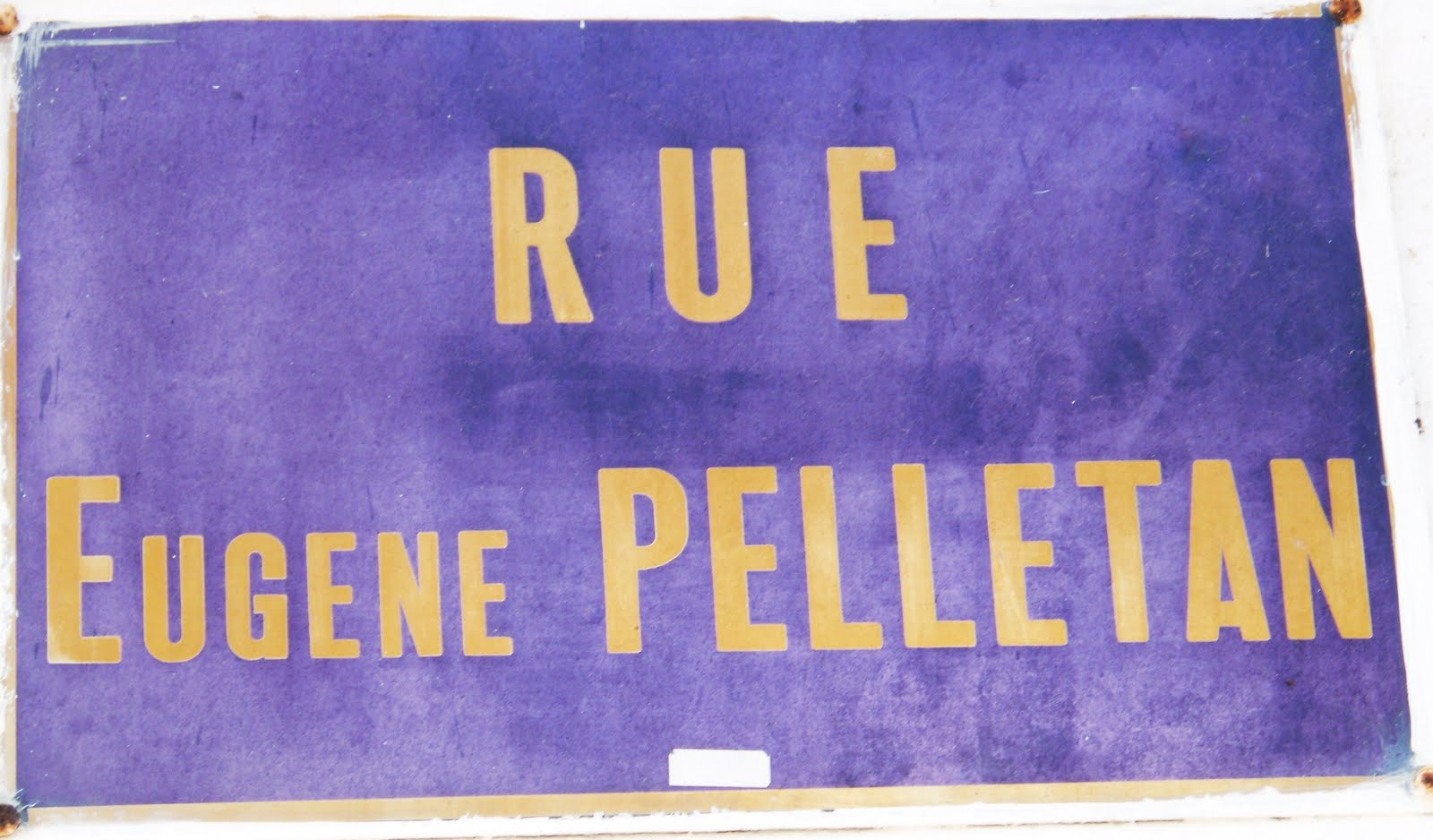
Eugène Pelletan and Royan, Charente-Maritime (17), France

Eugène Pelletan (1813–84) was a writer, journalist and politician born in Royan, and much noted for his oratory. He was a Saint-Simonian during the republic.

In 1892 a statue in Royan was erected in his memory, although this was melted down during World War II. In the town of his birth, only a street name remembers him.

However, in the neighboring seaside town of Saint-Georges-de-Didonne, a bust of Pelletan was recently erected.

And although Saint-Georges-de-Didonne is a very small town, there are in fact three streets there named after Pelletan.

And there is a street in Saintes too which bears his name.

12 June 2010

Victor Billaud and Royan, Charente-Maritime (17), France

Victor Billaud (1852-1936) was born in Saint-Julien-de l'Escap, near Saint-Jean-d'Angély, Charente-Maritime, and started his own weekly newspaper, La Chronique charentaise, in the town at the age of 22 in 1874. It contained articles on literature, poetry, and science. He abandoned the venture two years later, though, encouraged by Frédéric Garnier, the mayor of Royan, to settle in the town and run his own printing press.

There, he started printing Le Phare Littéraire, which had little success, but he soon established La nouvelle Gazette des Bains de Mer de Royan sur l'océan, which was very successful, particularly after the artist Barthélemy Gautier was recruited to draw for it. René, Billaud's elder son, took over the illustrations after Gautier's death in 1893. The paper became a mine of information on life in Royan.

He also founded several other papers, such as Le Royan, which his son Pierre later directed. But Billaud was also known for his postcards, his Guide du touriste (to Royan, of course), his photography, and also for his poetry. He remains one of the best known figures in Royan.

Billaud wrote a poem on each occasion of the unveiling of three public monuments in Royan: for the author and journalist Eugène Pelletan's statue in 1892, for Frédéric Garner's in 1907, and the above World War I memorial in 1921. Only the last has survived.

A street in Royan remembers both Victor Billaud and his son Pierre.
 
And Monique Chartier's Victor Billaud: Le Chantre de Royan (Vaux-sur-Mer: Bonne Anse, 2005) makes a very good job of remembering not only Victor Billaud, but also much of the history of Royan in general.

6 June 2010

Étienne Baudry, Rochemont (Saintes) and Royan, Charente-Maritime (17), France

Étienne Baudry (1830-1908) is not a name well known in France, the country of his birth, let alone the UK, but a new book, Étienne Baudry: Une vie chantentaise...châtelain, dandy et écrivain militant (Saintes: Le Croît vif, 2010), written by his grand-daughter Yvonne Melia-Sevrain, may begin to change things. Baudry was born in Saintes and spent much of his life in the castle at Rochemont, near Saintes. Rochemont more or less depended on the revenue from its extensive vineyards.

In 1864 Baudry married Isabelle Bardin, a younger woman incapable of dressing herself without a servant, and the disastrous marriage was later satirized in Baudry's Le Camp des bourgeois (1868), a publication that came out two years before the essay Les Bras mercenaires. In these publications, along with his La fin du monde, Baudry sketched out his ideas for a future socialistic - even to some extent anarchistic - society, partly influenced by Louis Blanc and Charles Fourier.

Baudry established a workshop at Rochemont, where the artist Louis-Augustin Auguin lived for some months, and, for a longer period and more (in)famously, Gustave Courbet, who was a considerable financial burden to Baudry.

Due to the failure of his vineyards, Baudry was forced to sell Rochemont and move to Royan, where he died. Until recently, his grave in the cemetery in Royan lay unnoticed, and it is only a few years ago that it has been restored.

Goulebenéze and Saintes, Charente-Maritime (17), France

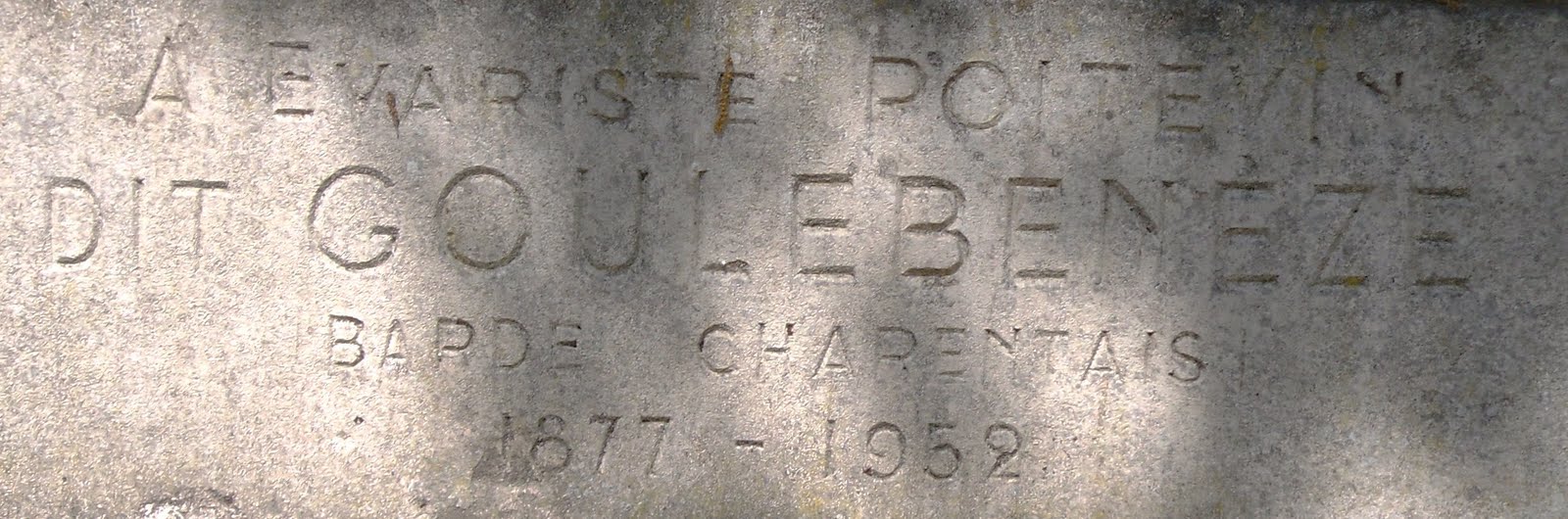
This superb monument to Goulebenéze is tucked away outside the Office du Tourisme, 62 Cours National, in Saintes, Charente-Maritime.

Goulebenéze ('goule bien aise'), and with an 'e' acute rather than 'e' grave, is the normal appellation of the 'bard', poet, and singer of Charentais songs, of those of the area within Charente, or Santonge. He is Évariste Poitevin (1877-1952), born in Montigny, near Burie, and his poems, writings, and songs were often in the santongeais dialect. Today, he is regarded with great respect in the local area, largely because of his contribution to the local heritage.

From 1902, for 50 years, he was known locally, and even to a minor extent nationally, as an entertainer. He married in 1914, very shortly before being called up, had two children, but had great difficulty preventing his family from falling into debt, slowly having to sell off the family assets.

His poem 'Bonjour Santonge' is one of his most popular, being one that he wrote for the prisoners of World War II.

Goulebenéze died in poverty in Saintes on 30 January 1952, and this is an example of his work, in santongeais:

'Magnière prr' ine jheune feuille d'entortiller un garçon'

'O faut coumincé à pas mais faire cas de li que s'o l'était in méchant cheun de reun du tout. S'il asséye de s'agrâler , o faut chaurit in p'tit et zi virer le thiu aussitout. Thiau gâs s'rat caunit, il érat s'capit dan-n-in coin. Jhuste à thieu moument, o faut avé l'ar de s'éthiuper à causé à in aut' garçon, et d'êt'en grande convarsation avec li, histouère de faire cagné l'aute. O faut n'en resté là prr' le premier cot . O faut pas asseyé de pieumer le canet coum' thieu tout d'in randon, o faut thitté thieuq' coutons à l'ozâ prr' la prochaine renconte.

Thielle lâ lâ arat yieu de peurférence dan-n-in endreit vour o l'arat jholiment de monde : dan-n-in bal prr' exemp'lle. In p'tit de poumade qui sent à bon aux ch'veux, deux ou trois brins de bâz'lit dans l'jhabot, et c' qui ne f'rait pas de tort, ine quoue de langrote dans l'coin dau mouche-nez, et en route prr' le bal !

Gardez-vous beun, sultout, de dévisajhé en rentrant thiaulâ que vous v'lez aguigné. Ne vous avisez pas de vous enguillebaudé avec li, et dansez tout fin jhû ine ou deux veurses ou mazulka, o b' in deux quadrilles. Si sârre les douets in p' tit fort, o faut qu' vout' main à vous devinjhe molle coum' de la laine. En montant vous rafraichit, sonjhez à pas vous laisser lucher les jhottes dans l'escayier: o vaut reun thieu, i se creirait tout parmit.

A la sortie dau bal, au moument de partit, mais à thieu moument seulement, pendant que les veilles peurnant zeux fichut, et que vous êtes en train de vous embobyiné dans voute capeline, vous teurcherez dans la salle l'homme en question, vout oeuil s'appouérat su li coum' in grand aubrât s'abat su in paur' chêtit échardrit, et là, les z'oeuils dans les z'oeuils, vous le fisquerez bin coum' o faut, o s'rat coum' ine éloize, le gas s'rat-t-abrâzé.

Ne vous thittez pas reconduit prr' li. Si le lendemain au matin vous entendez subié dau coûté de vout' porteau, o l' est qu' o l' arat fait effet, et que le gâs est pris coum' in chafouin dan-n-ine bouzine.
A partir de thieu moument , vous peuvez le thitté s'agrâlé sans minfiance et le laissé dénoué vout' devantâ.

Et prr' m' armercier de vous z' avé douné de si bons conseils, vous m' inviterez à la noce!'

I can't imagine anyone ever coming after me with a copyright hammer for reproducing this, as, let's face it, this piece by Goulebenéze is pretty obscure. And how could anyone even consider translating it? The flavor is untranslatable.The mark of the sculptor, P. M. Marchand.

Le Croît vif is a bookshop and publisher of Charentais literature at 2 ruelle de l'Hospice, Saintes. The interesting thing about this shop is that it used to be a grocer's where Goulebenéze regularly went.

24 May 2010

Boutique de Poésie, Saint-Pierre-d'Oléron, Île d'Oléron, Charente-Maritime (17), France

I couldn't resist taking a shot of this, the Boutique de Poésie at the top of the rue de la République opposite the covered market, Saint-Pierre-d'Oléron, L'Île d'Oléron, France, as its heart is certainly in the right place: 'la poésie n'est pas faite pour les chiens elle est faite pour vous' ('poetry isn't made for dogs it's made for you'), and 'sans nous les poètes l'humanité ne serait qu'un immense ventre' ('without us the poets humanity would just be a huge belly'). So there we have it, but the poets lose: this place seems to have been unproductive for some years, but the restaurants in the town appear to be thriving. Quelle vie de chien.