Showing posts with label Neuilly-sur-Seine (92). Show all posts
19 September 2017
Cimetière nouveau de Neuilly, Hauts-de-Seine (92) #:9 Jean Aragny
Libellés :
Aragny (Jean),
Hauts-de-Seine (92),
Neuilly-sur-Seine (92),
Paris
Jean Aragny (1898–1939) was a playwright about whom little information seems readily available, apart from his writings, seems to be known. His plays include Les Yeux du spectre (1924), Prime (1932), and Bourreaux d'enfants (1939). He also wrote the screenplay adaptation of Timothy Shea's novel Toute sa vie (1930), the screenplay of Les vacances du diable (1931), and co-wrote the screenplay for Le Poignard malais (1931).
18 September 2017
Cimetière nouveau de Neuilly, Hauts-de-Seine (92) #8: Victor Charbonnel
Libellés :
Charbonnel (Victor),
Hauts-de-Seine (92),
Neuilly-sur-Seine (92),
Paris
Victor Charbonnel (1863–1926) was a priest who left the priesthood and then gave a series of anti-clerical talks. Among a number of other publications he wrote Séparation de l'Eglise et de la famille (1900), Victor Charbonnel: Sensations de vie (1906), and La Vérité sur le Vatican: Palais et caverne [1907]. In 1901 he founded the paper La raison and was a director of L'Action with Henry Bérenger.
17 September 2017
Cimetière nouveau de Neuilly, Hauts-de-Seine (92) #7: Georges Izambard
Libellés :
Hauts-de-Seine (92),
Izambard (Georges),
Neuilly-sur-Seine (92),
Paris
Georges Izambard (1848–1931) was teacher of Rhetoric and became the friend of his student, Arthur Rimbaud, in Charleville-Mézières. His first wife Marie was the sculptor René Fauche's daughter. His writings include À Douai et à Charleville. Lettres et écrits inédits [by Arthur Rimbaud] commentés par Georges Izambard (1927) and Rimbaud tel que je l'ai connu (1947).
15 September 2017
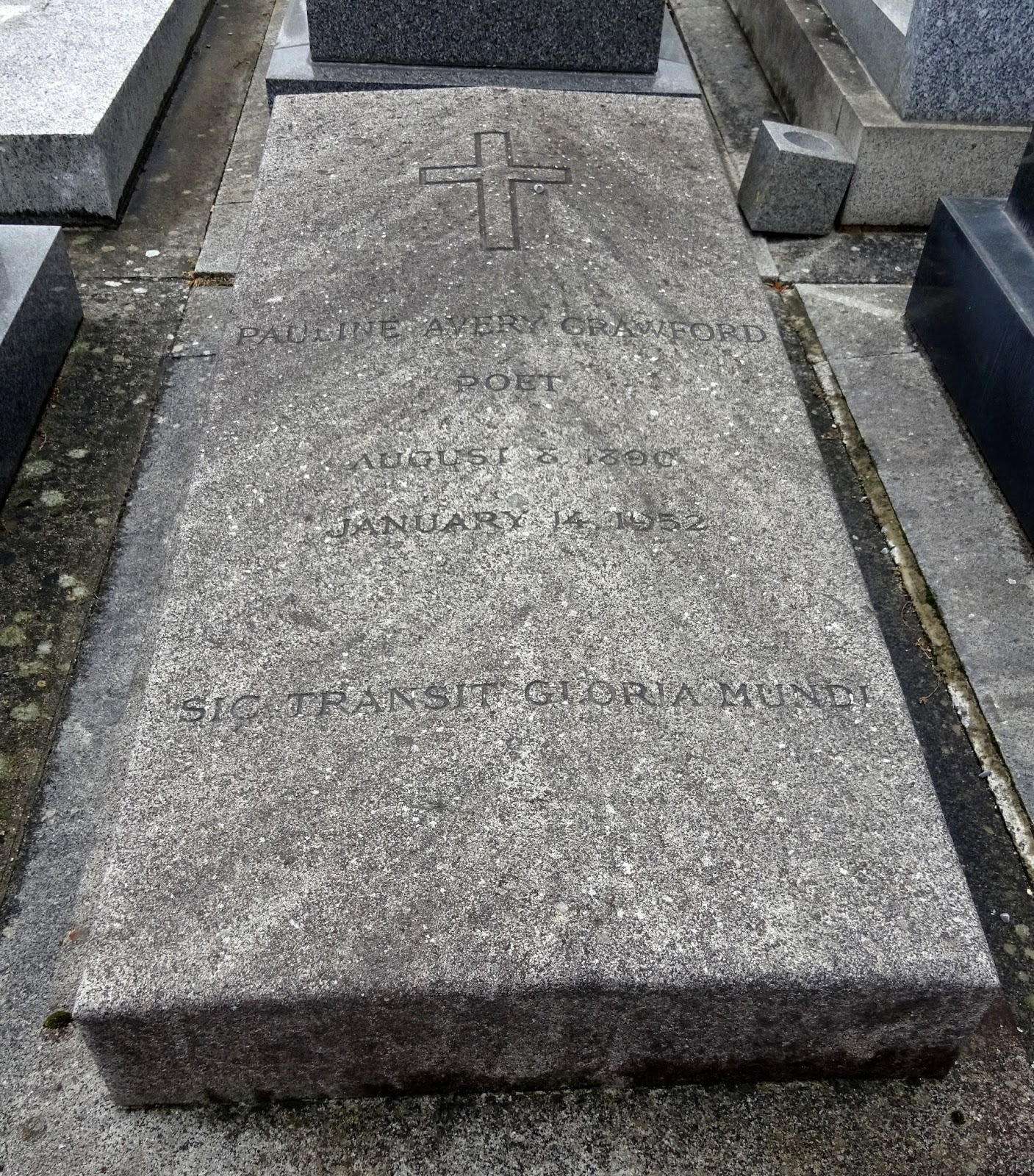
Cimetière nouveau de Neuilly, Hauts-de-Seine (92) #6: Pauline Avery Crawford
Pauline Avery Crawford (1890–1952) was, as Charles L. Robertson's 2001 biography of her states, An American Poet in Paris. His sub-title is 'Pauline Avery Crawford and the Herald Tribune': Crawford was an american expatriate who wrote for the Paris edition of the New York Herald Tribune in the 1930s and 1940s. After the war she wrote a column called 'Our Times in Rhyme' up until shortly before her death.
Cimetière nouveau de Neuilly, Hauts-de-Seine (92) #5: Alek Plunian
Libellés :
Hauts-de-Seine (92),
Neuilly-sur-Seine (92),
Paris,
Plunian (Alek)
Alek (or Alexia) Plunian (1894–1967) was born into a Breton family. Her first novel, Lina, la Jaguine (1926) was about maritime life in Brittany: in the 1920s, she spent several months teaching at a school in Saint-Jacut-de-la-Mer (Côtes-d'Armor). Her other books include Histoire de Pommette (1933), Tempête... (1937), and the play Le Coq qui se fait pigeon (1951).
Cimetière nouveau de Neuilly, Hauts-de-Seine (92) #4: Charles Chassé
Libellés :
Chassé (Charles),
Hauts-de-Seine (92),
Neuilly-sur-Seine (92),
Paris
Charles Chassé (1883–1965) was born in Quimper and died in Neuilly-sur-Seine. He wrote enormously, and was particularly interested in the unusual, the mysterious, the esoteric: the loves of Napoléon, for example, or religion, witchcraft, the Seznec affair, the Ankou, etc. Three of his works stand out above all: Napoléon par les écrivains (1921), Sous le masque d'Alfred Jarry, les sources d'Ubu-Roi (1922), and Gauguin et son temps (1963).
Cimetière nouveau de Neuilly, Hauts-de-Seine (92) #3: Paul Géraldy
Libellés :
Géraldy (Paul),
Hauts-de-Seine (92),
Neuilly-sur-Seine (92),
Paris
Paul Géraldy (1885–1983) was a poet and playwright who was born in and died in Neuilly-sur-Seine. He has now virtually slipped into oblivion, although his collections of simple poetry, particularly Les Petites Âmes (1908) and Toi et moi (1912) were great popular successes. His plays revolved around the psychology of bourgeois families between the wars.
22 November 2016
Félicien Marceau, Neuilly-sur-Seine, Hauts-de-Seine (92)
Libellés :
Hauts-de-Seine (92),
Marceau (Félicien),
Neuilly-sur-Seine (92)
'Louis CARETTE dit Félicien MARCEAU
de l'Académie française 1913 – 2012'
Félicien Marceau was a French playwright and novelist born in Belgium. His most noted play is L'Œuf (1956), which is developed from his novel Chair et cuir (1951). His novel Creezy (1969) won the Goncourt on its year of publication: it concerns a cover girl and a député who are deeply in love but whose relationship backfires, and Marceau described it as a very modern story. The grave is in the Cimetière ancien de Neuilly.
22 September 2015
Paris 2015: Théophile Gautier in Neuilly-sur-Seine (92)
Libellés :
Gautier (Théophile),
Hauts-de-Seine (92),
Neuilly-sur-Seine (92)
'LE POÈTE
THÉOPHILE GAUTIER
NÉ À TARBES LE 31 AOÛT 1811
EST MORT DANS CETTE MAISON
LE 23 OCTOBRE 1872'
THÉOPHILE GAUTIER
NÉ À TARBES LE 31 AOÛT 1811
EST MORT DANS CETTE MAISON
LE 23 OCTOBRE 1872'
'Maison de Théophile Gautier
En 1857, quittant la rue de la Grange-Batelière à Paris, l'écrivain Théophile Gautier (Tarbes, 1811 – Neuilly-sur-Seine, 1872) s'installe au 32, rue de Longchamp, sur les conseils des directeurs du Moniteur universel, journal dont il est l'un des principaux collaborateurs.
Avec sa compagne, Ernesta Grisi, cantatrice d'origine italienne, ses deux filles, Judith et Éstelle, ses deux sœurs, ses chats, ses livres et ses objets d'art, il emménage dans cette petite maison de campagne à deux étages, pourvue d'un jardin en contrebas.
C'est ici qu'il a fait paraître notamment Le Roman de la Momie (1858), Le Captaine Fracasse (1863), des récits de voyages tel que Voyages en Russie (1866), sans oublier ses innombrables critiques dramatiques et artistiques. Sa maison accueille entre ses murs écrivains et artistes : on y côtoie Charles Baudelaire, Alexandre Dumas père et fils, Ernest Feydeau, Gustave Doré, Edmond et Jules de Goncourt, Gustave Flaubert ou Pierre Puvis de Chavannes.
Durant la Commune de Paris, en 1871, la Maison subit de lourds dégâts. Réfugié à Versailles, Théophile Gautier regagne Neuilly au printemps 1871 et enterprend de remettre l'édifice en état. Malade, il y décède le 23 octobre 1872 entouré des siens.
Entre 1873 et 1876, un décor commémoratif dédié à Gautier, est mis en place sur la façade : un buste de l'écrivain et une plaque de marbre signalent au passant l'identité de l'ancien locataire.'
My Translation:
'Théophile Gautier's house'
In 1857, on leaving rue de la Grange-Batelière in Paris, the writer Théophile Gautier (Tarbes, 1811 – Neuilly-sur-Seine, 1872) moved into 32 rue de Longchamp following the advice of the directors of Moniteur universel, a paper to which he was one of the main contributors.
With his companion Ernesta Grisi, a prima donna of Italian origin, his two daughters Judith and Éstelle, his two sisters, his cats, his books and his objets d'art, he moved into this two-storey house with a garden at the back.
Notably, it is here that he published Le Roman de la Momie (1858), Le Captaine Fracasse (1863), accounts of voyages such as Voyages en Russie (1866), not to mention his innumerable dramatic and artistic criticisms. Within these walls he welcomed writers and artists: one could rub shoulders with Charles Baudelaire, Alexandre Dumas père and fils, Ernest Feydeau, Gustave Doré, Edmond and Jules de Goncourt, Gustave Flaubert or Pierre Puvis de Chavannes.
During the Paris Commune of 1871 the house was seriously damaged. Exiled to Versailles, Théophile Gautier returned to Neuilly in the sping of 1871 and undertook the restoration of the house. In poor health, he died here on 23 October 1872 surrounded by his family.
Between 1873 and 1876 a commemorative decoration dedicated to Gautier was placed on the facade: a bust of the writer and a marble plaque informing the passerby of the identity of the former resident.'
Another old plaque is affixed to the house:
'IL EST DÉFENDU
DE LAISSER PASSER
LES CHEVAUX ET BESTIAUX
SUR LE TROTTOIR'
'IT IS FORBIDDEN
FOR HORSES AND CATTLE
TO BE ALLOWED TO WALK
ON THE PAVEMENT'
31 October 2013
Pierre Drieu la Rochelle: Le Cimetière ancien de Neuilly-sur-Seine #3
Inevitably, the 'Pléiadisation' of Pierre Drieu la Rochelle (1893–1945) last year (2012) brought shocked objections. How could it not? A fascist's writings allowed into the esteemed Pléiade? Fascist Drieu certainly was (specifically from 1934), although he saved his friend Jean Paulhan from the Gestapo, and also saved such writers as Sartre. Drieu's life in any case can't be reduced to simplistic condemnations: he was riddled with contradictions. What would have become of him if he'd gone into hiding after the liberation of Paris (as for instance André Malraux suggested) and not killed himself?
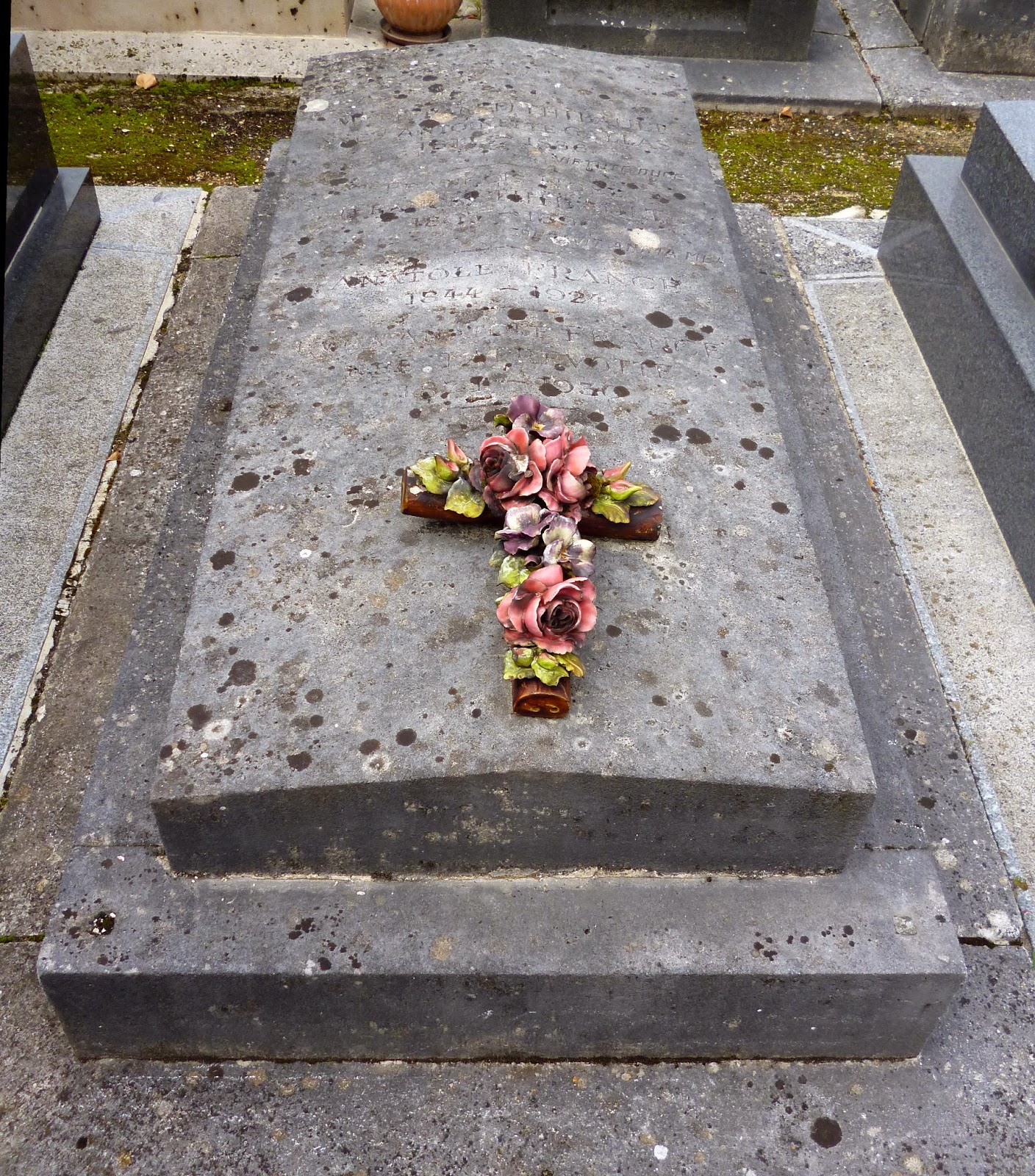
Anatole France: Le Cimetière ancien de Neuilly-sur-Seine #2
Libellés :
France (Anatole),
Hauts-de-Seine (92),
Neuilly-sur-Seine (92)
This time I had no trouble finding the grave of Anatole France (1844–1924), François Anatole Thibault's pseudonym. He was one of the greatest writers and literary critics of the late 19th and early 20th centuries, and in 1921 he was awarded the Noble Prize for Literature. He was also involved in many of the social and political concerns of his time – he was a Dreyfusard, for instance.
A great number of Anatole France's books are freely available online, in French and in English, via Project Gutenberg. I provide a link to them below, as well as to my original post of other graves in this cemetery:
Charles de Bernard: Le Cimetière ancien de Neuilly-sur-Seine #1
'ICI
REPOSE
CHARLES DE BERNARD
du Grail.
NÉ À BESANÇON (DOUBS)
LE 24 FÉVRIER, 1804.
DÉDÉDÉ À SABLONVILLE, CN DE NEUILLY*,
LE 6 MARS 1850.
LE 24 FÉVRIER, 1804.
DÉDÉDÉ À SABLONVILLE, CN DE NEUILLY*,
LE 6 MARS 1850.
ÉCRIVAIN DISTINGUÉ.
MODESTE DANS LE SUCCÈS.
SIMPLE DANS SES HABITUDES.
COEUR NOBLE ET DÉVOUÉ.
IL A VÉCUT POUR SA FEMME
ET SES ENFANS
DONT IL FIT LE BONHEUR.
PRIEZ POUR LUI.'
MODESTE DANS LE SUCCÈS.
SIMPLE DANS SES HABITUDES.
COEUR NOBLE ET DÉVOUÉ.
IL A VÉCUT POUR SA FEMME
ET SES ENFANS
DONT IL FIT LE BONHEUR.
PRIEZ POUR LUI.'
'DISTINGUISHED WRITER.
MODEST IN HIS SUCCESS.
SIMPLE IN HIS WAYS.
A NOBLE AND DEVOTED HEART.
HE LOVED HIS WIFE
AND CHILDREN
WHOM HE FILLED WITH HAPPINESS.
PRAY FOR HIM.'
Charles de Bernard was a novelist and short story writer who was very popular in the 1840s. He was a friend of Balzac and was translated into English and appreciated both in Great Britain and the USA.
Time has not been kind to his memory. Writing in the late 1870s, Henry James considered him a second-rate French author largely of only historical interest. He is almost forgotten today.
*Sablonville (literally 'Sandtown') was a village in the commune of Neuilly-sur-Seine. Today the nearby métro station Les Sablons (Jardin d'Acclimatation) remembers the Plaine des Sablons, where sand was extracted for building purposes.
Below is a link to a novel by Bernard, plus a link to an earlier post I made on other graves in this cemetery:
–––––––––––––––––––––––––––––––––––
Charles de Bernard: Le Noeud gordien (1938)
Cimetière ancien de Neuilly-sur-Seine
Charles de Bernard: Le Noeud gordien (1938)
Cimetière ancien de Neuilly-sur-Seine
30 October 2013
Eça de Queiroz in Neuilly-sur-Seine, Hauts-de-Seine (92)
Libellés :
Eça de Queiroz,
France,
Hauts-de-Seine (92),
Île-de-France,
Neuilly-sur-Seine (92)
I'll try to keep these posts (photos shot in a month in the Paris area mid-September to mid-October) in date order, although I may fail because of tricky ones I have to research too much. This was the first day and the clouds appearing to predict rain held off most of the time – in fact almost all of the time it was superb summer weather until the last few days.
OK, here goes, and the first writer mentioned isn't even French.
Eça de Queiroz – also (particularly in modern Portuguese) written Eça de Queirós – is noted for his naturalist novels and for introducing naturalism into Portuguese literature. He is sometimes called the Portuguese Zola, although Flaubert was probably a bigger influence on him, and Zola himself even rated him above Flaubert.
SCULPTURE DE ANTÓNIO TEIXEIRA LOPES
SELON UNE ÉTUDE DE 1903
OFFERTE PAR LA MAIRIE DE LISBONNE
EN PARTENARIAT AVEC
L'AMBASSADE DU PORTUGAL À PARIS
2004'
OK, here goes, and the first writer mentioned isn't even French.
'EÇA DE QUEIROZ
ÉCRIVAIN ET DIPLOMATE
1845–1900'
ÉCRIVAIN ET DIPLOMATE
1845–1900'
I chose not to crop the photo as I love the memory of the Grande Arche de La Défense relatively close behind me as I capture this in the central reservation on avenue Charles de Gaulle in Neuilly-sur-Seine, the bust obscuring a distant Arc de triomphe.
'EÇA DE QUEIROZ, CONSUL DU PORTUGAL
À PARIS, EST MORT À NEUILLY-SUR-SEINE
LE 16 AOÛT 1900
À PARIS, EST MORT À NEUILLY-SUR-SEINE
LE 16 AOÛT 1900
SCULPTURE DE ANTÓNIO TEIXEIRA LOPES
SELON UNE ÉTUDE DE 1903
OFFERTE PAR LA MAIRIE DE LISBONNE
EN PARTENARIAT AVEC
L'AMBASSADE DU PORTUGAL À PARIS
2004'
Eça de Queiroz first worked as the Portuguese consul in Paris in 1888. Although he died in Neuilly, he was buried in Portugal.
19 November 2011
Cimetière ancien de Neuilly-sur-Seine, Hauts-de-Seine (92), France: Literary Île-de-France #31
Josef Hoëné-Wronski (1776—1853) was born Josef Hoëné in Poland, but after adopting French nationality and settling in Paris, he changed his name to Wronski. He was a philosopher and mathematician whose ideas were seen as useless and utopian, although more recent research has suggested that he in fact had great mathematical perception and even some genius.
André Maurois (1885—1967) was born Emile Salomon Wilhelm Herzog, the son of émigrés from the Franco—Prussian War. His first success as a writer was with the partly autobiographical Le Silence de Colonel Bramble, and he wrote a number of biographies of both French and English authors, such as Sand, Balzac, Hugo, Proust, Disraeli, Shelley, and Byron.
His second wife was Simone de Caillevet, who was the granddaughter of Léontine Arman de Caillavet, the mistress of Anatole France. And Anatole France is buried here, although I couldn't find him. At the cemetery reception his location was found (with some difficulty), and the clerk mentioned that he had seen his grave, although the details I was given didn't seem to meet with anything that even vaguely resembled the reality. I gave up — it had already been a long day.
Subscribe to:
Posts (Atom)