 One of the works of the romantic poet Rużar Briffa (1906-63) is called 'Fil-Barrakka ta' Fuq' ('At Upper Barrakka') and it is appropriate that there should be a plaque commemorating him in the Upper Barrakka Gardens in Valletta.
As a medical student - later a specialist in dermatology and venereology - he was friends with fellow student and future novelist Ġużè Bonnici, and they used to discuss literature together. Briffa admired Keats, Dante and D'Annuncio.
His wife Louisette said that he dreamed of 'beautifying' patients, and this idea is reflected in some of his work: he was known as 'The Poet of Beauty'. Louisette donated her husband's manuscripts to the University of Malta, which has copied some examples to a CD-ROM, and here are several images of the manuscripts. Also, there's a 5 minute 29 seconds documentary in Maltese on Briffa.
Coleridge went to Malta both because of the better climate and to try to cure himself of his addiction to opium.
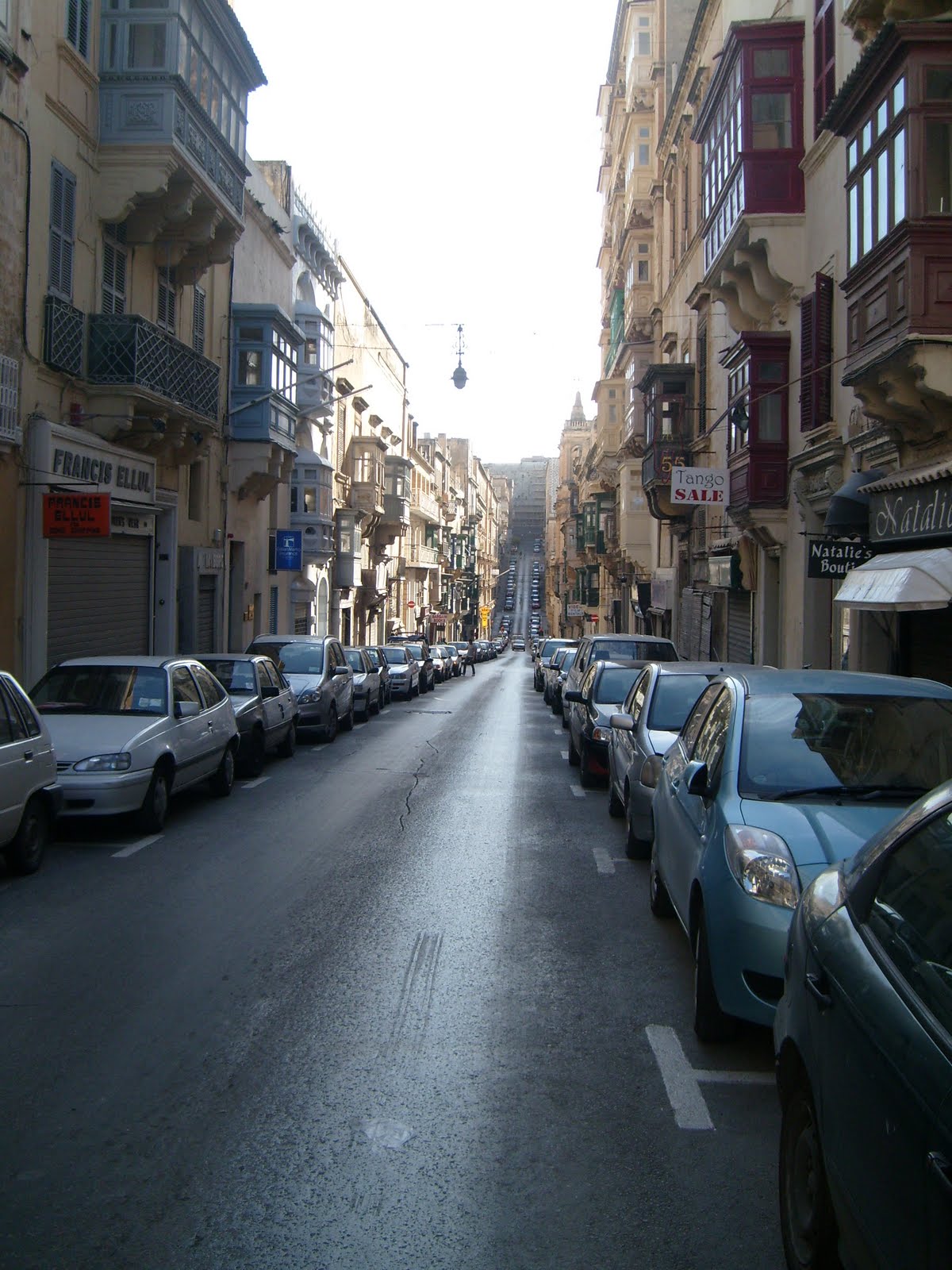
 He arrived 18 May 1804 on the merchant ship Speedwell - carrying 84 cannons to be delivered to Trieste - and walked up the long, steep, narrow Old Bakery Street in Valletta. Photos here give a vague idea of what this walk would have been like. Coleridge's friend Dr John Stoddart was the King's Advocate there, and he had encouraged him to go to Malta. At the top of Old Bakery Street was Casa de St Foix, where Stoddart lived.


 Coleridge first stayed at the Casa de St Foix, which looked out onto Marsamxett harbor.
He met the governor of Malta, Sir Alexander Ball, 20 May. Ball's aim was for Britain to permanently occupy Malta and Sicily in order to control sea routes, and sometime in June he had enrolled Coleridge to help him in his secret endeavors. His job was to write papers such as 'The French in the Mediterranean', which was sent to Nelson, and others - 'Algeria', 'Malta', 'Egypt' and 'Sicily' - were sent to Downing Street. Some weeks before this, Ball had become convinced about Coleridge's ability, and installed him in his palace on a salary 6 July. He began to eat well exercise well, and in general help to alleviate his addiction.
 Ball's summer residence - now the President of Malta's official residence - was at St Anton(io), some miles inland from Valletta.
 The chapel near the entrance to the palace.
 The statue outside the palace.
 And some photos of the extensive palace gardens, where Coleridge delighted in the plants and the wildlife, such as the lizards.
.jpg)


 The Public Secretary of Malta died 18 January 1805, and Coleridge accepted the job of acting Public Secretary while Ball awaited the official new one, receiving a salary of £600 a year.
Initially Coleridge was very happy, but as rumors came of problems in the home he had left in England, he dosed himself at night with opium and spirits, began having sexual fantasies and became preoccupied with unconventional erogenous zones. But the many pages of his Notebooks on many other subjects continued, as did his public duties.
However, he learned at the end of March of the death of his friend John Wordsworth, William's brother, and was ill for two weeks.
It is probably while in San Antonio that Coleridge wrote this poem to 'Asra' (Sara Hutchinson), which he lost and re-wrote later:
THE BLOSSOMING OF THE SOLITARY DATE-TREE
I
Beneath the blaze of a tropical sun the mountain peaks are the Thrones of Frost, through the absence of objects to reflect the rays. `What no one with us shares, seems scarce our own.` The presence of a ONE,
The best belov`d, who loveth me the best,is for the heart, what the supporting air from within is for the hollow globe with its suspended car. Deprive it of this, and all without, that would have buoyed it aloft even to the seat of the gods, becomes a burthen and crushes it into flatness.
II
The finer the sense for the beautiful and the lovely, and the fairer and lovelier the object presented to the sense ; the more exquisite the individual`s capacity of joy, and the more ample his means and opportunities of enjoyment, the more heavily will he feel the ache of solitariness, the more unsubstantial becomes the feast spread around him. What matters it, whether in fact the viands and the ministering graces are shadowy or real, to him who has not hand to grasp nor arms to embrace them ?
III
Hope, Imagination, honourable Aims,
Free Commune with the choir that cannot die,
Science and Song, delight in little things,
The buoyant child surviving in the man;
Fields, forests, ancient mountains, ocean, sky,
With all their voices--O dare I accuse
My earthly lot as guilty of my spleen,
Or call my destiny niggard ! O no ! no!
It is her largeness, and her overflow,
Which being incomplete, disquieteth me so!
IV
For never touch of gladness stirs my heart,
But tim`rously beginning to rejoice
Like a blind Arab, that from sleep doth start
In lonesome tent, I listen for thy voice.
Belovéd ! `tis not thine ; thou art not there!
Then melts the bubble into idle air,
And wishing without hope I restlessly despair.
V
The mother with anticipated glee
Smiles o`er the child, that, standing by her chair
And flatt`ning its round cheek upon her knee,
Looks up, and doth its rosy lips prepare
To mock the coming sounds. At that sweet sight
She hears her own voice with a new delight ;
And if the babe perchance should lisp the notes aright,
VI
Then is she tenfold gladder than before!
But should disease or chance the darling take,
What then avail those songs, which sweet of yore
Were only sweet for their sweet echo`s sake?
Dear maid ! no prattler at a mother`s knee
Was e`er so dearly prized as I prize thee:
Why was I made for Love and Love denied to me?
Coleridge left Malta 4 September 1805.
 This backstreet is tucked out of the way in Gżira, although I'm not aware of any of the man's connections with the town. In general, though, Coleridge is not publicly remembered in Malta - perhaps because he was in fact a spin doctor working for the British, dispensing propaganda in order to win support from the Maltese?
 Manwel Dimech (1860-1921) is something of a hero in Malta, which by first appearances might seem a little strange for a person who, at a young age, was imprisoned for theft on eight occasions, and then, at the age of 17, sentenced to 20 years imprisonment for murder. But then, most things about Dimech's life are exceptional.
Dimech was born on 25 December 1860 in a slum dwelling in Triq San Ġwann, Valletta, where his family lived in one room, and the small building housed 60 people. The family moved house a few times before his father died at 37, leaving his mother to cope with a family of 10 children. Just two weeks after his father's death, in 1874 and at the age of 13, Dimech was imprisoned for his first theft. This established a pattern - petty theft and brief imprisonment - that would continue until his murder trial in 1878. Dimech left prison in 1890, only to return a few months later for counterfeiting money. Eventually, in July 1897, he was released at the age of 36, after spending 20 years in imprisonment.
Dimech had been illiterate before going to prison, but while there he educated himself and read promiscuously, teaching himself Maltese, English, French and Italian. At the beginning of 1898 he started his own language school, and published a weekly newspaper - Il-Bandiera tal-Maltin (The Flag of the Maltese) - as a voice for the oppressed, in which he criticized, among many other things, the abuse of prisoners, the strength of the Catholic Church, the oppression of the working classes, and campaigned for free education for all. He also wrote two books on language learning.
In 1904 he wrote a revolutionary novel, Ivan u Prascovia, about two Russian lovers under the Tzarist regime, although part of it was lost and it was published unfinished.
In 1911 he founded the philanthropic association Xirca tal-Imdawwlin (The Society of the Enlightened) - renamed Xirka Maltija - whose aim was to encourage support for his ideas on social reform. For a number of reasons - advocating the emancipation of women and criticizing the clergy among them - Dimech was excommunicated in the same year, and in 1914 the (British colonial) Maltese government arrested and exiled him for life for 'agitating the Dockyard workers against the government because he had anticlerical and socialist principles'. He left behind his wife and three children in Malta, and died a prisoner in Alexandria, Egypt, in 1921.
As a writer, he is probably remembered more for his journalism, although he also wrote two novels and some poetry. Unfortunately, nothing has been translated into English.
A statue of Manwel Dimech now stands prominently in Valletta in front of the Kastilja. Several streets and a bridge have also been named after him.


 Dimech's statue stands prominently among trees in front of the Kastilja in Valletta.
 Dimech's birthplace, 128 Triq San Gwann, Valletta.
 And a broader view of the house and general environment, with Grand harbour in the background.
 Dr. Mark Montebello, a Dominican friar, is Dimech's biographer, and also wrote a much more comprehensive book called, simply, Dimech. He has done a large amount of work regarding the interests of prisoners on Malta.

 One of the works of the romantic poet Rużar Briffa (1906-63) is called 'Fil-Barrakka ta' Fuq' ('At Upper Barrakka') and it is appropriate that there should be a plaque commemorating him in the Upper Barrakka Gardens in Valletta.




.jpg)


 Posts
Posts

