Born in La Beauce region, writer and poet Charles Péguy (1873-1914) saw Chartres cathedral as his own. He went on a pilgrimage on two occasions, in 1912 and 1913, to Chartres from his home in Palaiseau, Essonne, a distance of some 140 kilometres return. The organisation L'Amitié Charles Péguy commermorated the century of his pilgrimage by creating Le Chemin Charles Péguy. Blue and white markers plot out the route.
Great hero of the French Resistance, Jean Moulin (1899-1943) has a very impressive mural here. He was briefly préfet of the département Eure-et-Loir before being forced into hiding from the Nazis. Several places locally honour Moulin, including one where a quotation from is paper, Premier Combat, is given.
The sitting statues sculpture in the Place Châtelet in Chartres is by the famous German artist Hanneke Beaumont and was installed in 2009 for Chartres's 'Art en Ville' event. Chartres Tourisme describes this as two men reaching out for contact, but who will never make contact, seem to be waiting for the viewer to make contact, for us to join them.
A monument in the centre of Chartres celebrating two medieval poets born in Chartres: Philippe Desportes (1546-1606) and Mathurin Régnier (1573-1613).
L'abbé Franz Stock (1904-48) was a German Catholic priest. He was chaplain in prisons during World War II, ministering to condemned men. He was the spiritual director of the 'séminaire des barbelés' in Chartres. On his death he was buried in the cemetery in Thais, although his remains were moved in 1963 to the very impressive L'Église de Saint-Jean-Baptiste in Rechèvres, Chartres, constructed in 1961, where his tomb lies. Unfortunately, a heavily sunned notice on the church door informed us that the church was, er, temporarily closed apart from at the time of Mass.
Right in the centre of Chartres, a double-sided Boîte à lire with a great number of books. No comment!
Boîtes à lire:
––––––––––––––––––––––––––––––––––––
Boîte à Lire, Dicy, Nièvre
Boîte à lire, Maisons-Laffitte, Yvelines
Boîte à lire, Sorigny, Indre-et-Loire
Boîte à Lire, Jonzac, Charente-Maritime
Boîte à lire, La Roque-d'Anthéron, Bouches-du-Rhône
Boîte à Lire, Épineuil-le-Fleuriel, Cher
Boîte à lire, Marseille, Bouches-du-Rhône
Boîte à lire, East Markham, UK
Boîte à lire, La Folie Couvrechef, Caen, Calvados
Boîte à lire, Bergues, Nord
Boîte à lire, Le Havre, Seine-Maritime
Boîte à lire, Villerville, Calvados
Boîte à lire, Saint-Servan, Saint-Malo, Ille-et-Vilaine
Boîte à lire in Caen, Calvados
Boîte à Lire, Noyant d'Allier, Allier
Boîte à lire, Dampierre-en-Burly, Loiret
Boîte à lire, Illiers-Combray, Eure-et-Loir
Boîte à lire, Chartres, Eure-et-Loir
Boîte à lire, Saint-Romain-au-Mont-d'Or, Rhône
In 1919 the decision was made to construct L'Hôtel des Postes in the centre of Chartres. The architect was Raoul Brandon (1878-1941), who incorporated a number of mosaics relating to the postal service, which Patrick Macquaire, in his book Un essai de transformation sociale : Le Quartier Picassiette à Chartres (2018), suggests may have been an inspiration to Raymond Isidore, or 'Picassiette'. The building became Médiathèque l'Apostrophe in 2007.
The renovation of the Hauts-de-Chartres area of Chartres, essentially led by Patrick Macquaire, importantly included the work of Raymond Isidore (Picassiette) in the process, and mosaics were all-important. Many people joined in the work, some of which included mosaics on boulders. Here are some examples:
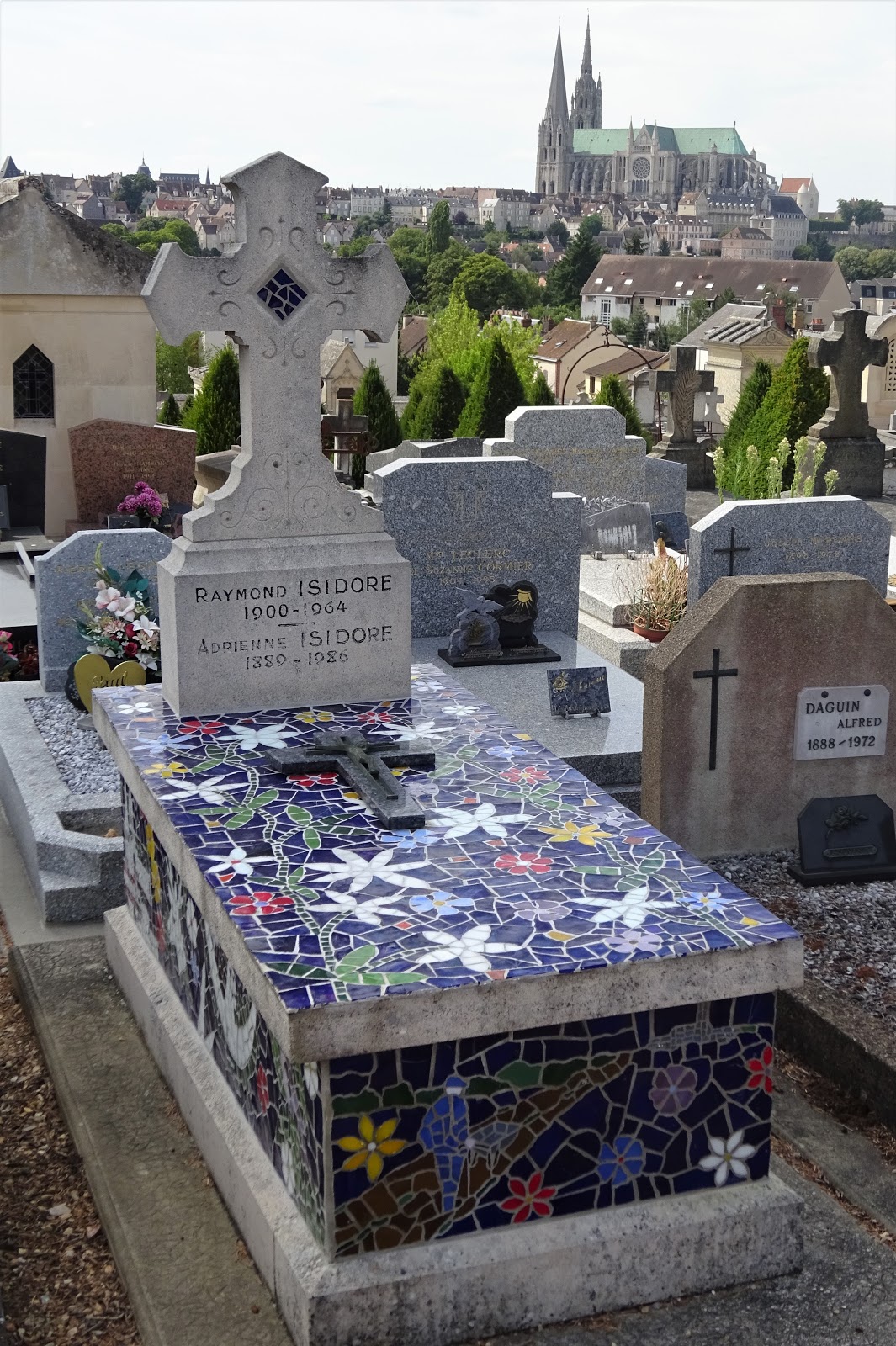
As an article in the local paper L'Echo Républicain says, many people know where Raymond Isidore's (or Picassiette's) house is, but not where he's buried, which is in the Cimetière Saint-Chéron (where he worked as a sweeper), just a few hundred metres from the Maison Picassiette, and the grave (which of course is also that of his wife Adrienne) has relatively recently been renovated. An interesting fact is that his grave is within sight of the cathedral in Chartres, the place he represented so many times in his art.
Raymond Isidore (1900-64) was born in Chartres (where he died) into a family of modest means, received only a rudimentary education and initially had a number of jobs. In 1924 he married Adrienne Rolland, a widow with three children, and on buying a small plot of land built a house on it for his family.
In 1935 he was a road builder, but in his spare time he'd been collecting pieces of broken porcelain and earthenware, with which he created mosaics with cement, 'cladding' his house. He found his crockery in local rubbish dumps, and later, when he was a cemetery sweeper, also from broken ornaments on graves. He said that his creations (often based on Christian religion) came to him in his dreams. He earned the name 'Picassiette', the French for 'scrounger', although there's also an obvious reference to Picasso there.
And although his genius is now recognised, at the time the jokes about him can't have done a great deal of good to his mental health: during the war for instance, he spent several months in a psychiatric hospital. It was on leaving hospital, in 1949, that he became a sweeper at the local cemetery in Hauts-de-Chartres, just a minute's walk from his house.
In 1956 he began new constructions at the back of his house: a chapel and a summer house. On retirement he devoted himself entirely to his work, and in 1962 he began his final creation: 'Le tombeau de l'esprit' (lit. 'The grave of the spirit').
His work took him 35 years in total, using five tonnes of broken crockery. He was re-admitted to a psychiatric hospital in 1964. On 6 September he was found worn out at the side of a road and died the next day. The town of Chartres bought the house in 1981 and La Maison Picassiette was declared a Monument Historique in 1983. The area Hauts-de-Chartres underwent a process of renovation from the late 1980s to 2015, using Raymond Isidore as its inspiration: mosaics are laid into the pavement and a number of large rocks with mosaics on them characterise the Hauts-de-Chartres.
The images I show below follow the self-guided tour of La Maison Picassiette, showing:
A few photos of Raymond Isidore.
The main house. Raymond Isidore started decorating it in 1938, beginning with the interior. There are just three rooms - kitchen, living room and bedroom, with murals (such as the Mont-Saint-Michel one), mosaic sewing machine cover, etc.
The chapel. This was built between 1953 and 1956, and although most of the themes here are religious, there are also a few agricultural images.
La Cour noire. Black was chosen to represent earthly life for this open air display. Chartres cathedral is represented in stone, above a black grave with a black throne facing it.
The summer house. This was built at the same time as the chapel, and the interior is painted (the house leaflet calls it 'étonnamment maladroites' ('astonishingly clumsy')).
The garden. This is in two parts, one having a number of statues, the other a French garden with a tiny pond and a representation of the town of Jerusalem.
Le Tombeau de l'esprit. Blue, symbolising celestial space.




 Posts
Posts

