Showing posts with label Great Barrington (MA). Show all posts

6 July 2014

Books and Arguments in Great Barrington, MA

I visited the W. E. B. Du Bois National Historic Site after visiting the Bookloft in the Barrington Plaza, which in a way was a good thing because (in spite of the mosquitoes) it allowed me to cool off and concentrate on peace. I've never come across arguments in Barnes & Noble, or Waterstones in England for that matter, but isn't that what independent bookshops are for? A place where you can have a good conversation, argument or whatever?

This is a preliminary to me saying that I really couldn't stand waiting in a line to pay for my books without saying something to the customer in front of me who was yelling at the (rather disinterested, or maybe just plain uninterested, I thought) sales assistant that voting should be compulsory for everyone. Well, when I hear crap like that I just have to react. Politely, I interrupted and said that no one should be forced to vote for the party they least hate, and that as a pacifist I refuse to vote as all political leaders are warmongers. She pretended to partly agree with me, although added that anyone who didn't vote denied their rights to citizenship. Wanting just to pay for my books and get the hell out with my partner Penny,  I then pretended that I didn't know what a citizen is, although this fanatic was obviously more or less trying to tell me that if I didn't support war then I didn't exist, or something like that. (I won't venture to argue much about the opinions on war of the authors of the books I bought.)

The Masachusetts Review (Fall 2013) on 'W. E. B. Dubois in His Time and Ours'.

Edna St. Vincent Millay: Collected Poems. (Yeah, I know all about her support for WWII.)

Catharine Maria Sedgwick: The Linwoods. (An abolitionist, but...)

Finally, I re-post my shot of the mockingbird originally actually taken in Barrington Plaza three years ago. We ended the trip back here (avoiding the bookstore) with me drinking a blueberry smoothie and regretting the absence of any birds this time, but reflecting on the words of Harper Lee (via Atticus Finch).

W. E. B. Du Bois relatives buried in Great Barrington, MA

'"IN 1950 THE MONTH OF FEBRUARY HAD FOR ME SPECIAL
MEANING. I WAS A WIDOWER. THE WIFE OF 53 YEARS LAY
BURIED IN THE NEW ENGLAND HILLS BESIDE HER FIRST-BORN
BOY"

W. E. B. DUBOIS (1868-1963)
PREMIER ARCHITECT OF THE AMERICAN CIVIL RIGHTS MOVEMENT

ERECTED BY THE GREAT BARRINGTON HISTORICAL SOCIETY
1994'

'NINA GOMER DU BOIS
1870  –––  1950'

Burghardt was Du Bois's infant son. His daughter Yolande was also buried here in Mahaiwe Cemetery, Great Barrington, although I didn't find any grave with her name.

W. E. B. Du Bois in Great Barrington, MA (revisited)

'W. E. B. Du Bois
Boyhood Homesite
University of Massachusetts Amherst'

This leaflet is published by the W. E. B. Du Bois National Historic Homesite and its title states 'It is time to honor this influential African American'. On the reverse it says that this is the 'only public place in the United States' dedicated to the life and ideals of Du Bois (1868–1963). I hadn't been aware of the place when I first visited Great Barrington in 2011, so took the opportunity to do so this time.

A trail with seven information posts like the one above weave through the (this mid-June, mosquito-infested) woods, each giving fresh details about what the leaflet describes as 'a scholar, a champion of civil rights, and an international activist for peace' who 'fought for democracy and freedom in a world of racial and economic injustice'. I can think of no one of his stature who exists today, although the world is still very much in great need of such a person.

This boulder was placed here in 1969 by the W. E. B. Du Bois Memorial Committee to commemorate the man's life and work. By the boulder is a plaque which contains a number of quotations apparently written by Julian Bond, the most chilling of which I thought was this so very true sentence:

'Violence is an economy that believes in socialism for the rich and capitalism for the poor.'

This site is a mile or so from Great Barrington itself, where Du Bois was born on Church Street. The small photo on the marker above shows Mary Silvina Burghardt with her son William in 1868. He moved here, with his mother and half-brother Idelbert, to the home of his grandparents Othello and Sally Burghardt when he was two. By the time he was five he had moved back to Great Barrington, although in 'The House of the Black Burghardts' (1928) he says that this is 'the first home that I remember'.

Du Bois always maintained a sentimental attachment for the house, and in 1928, on his 60th birthday, a group of his friends throughout the country gave the house to him. By 1954 the house was in a very bad state of repair and Du Bois, at the age of 84, sold the house to a neighbor who demolished it.

To the left of the platform above this photo, the remains of the chimney.

On another information panel is a beautiful quotation by W. E. B. Du Bois, from his book I Take My Stand for Peace (1951):

'I want progress; I want education; I want social medicine; I want a living wage and old-age security; I want employment for all and relief for the unemployed and the sick; I want public works, public services, and public improvements. I want freedom for my people. And because I know and you know that we cannot have these things, and at the same time fight, destroy and kill all around the world in order to make huge profit for big business – for that reason, I take my stand behind the millions in every nation and continent and cry Peace – No More War!'

19 October 2011

William Edward Burghardt (or W. E. B.) Du Bois in Great Barrington, Massachusetts: Literary New England #10

'I WAS BORN BY A GOLDEN RIVER IN THE SHADOW OF TWO GREAT HILLS. FIVE YEARS AFTER THE EMANCIPATION PROCLAMATION.'
BIRTHSITE OF W.E.B. DUBOIS (1868-1963)
PREMIER ARCHITECT OF THE AMERICAN CIVIL RIGHTS MOVEMENT

ERECTED BY THE GREAT BARRINGTON HISTORICAL SOCIETY
1994'

Du Bois's mother, Mary Sylvina Burghardt, had married Alfred Du Bois in 1867 and they rented a small property near this site on Church Street. After some trouble from Mary's family, though, Alfred left to make his own way. In Darkwater, W.E.B. Du Bois remembered its clapboards, its five rooms, and the delicious strawberries at the back. It was demolished in 1897.

William went to meetings at the Town Hall on the corner of Main and Castle streets to gather news for the Freeman (which was later called the Globe), a newspaper from New York with a predominant African American circulation.

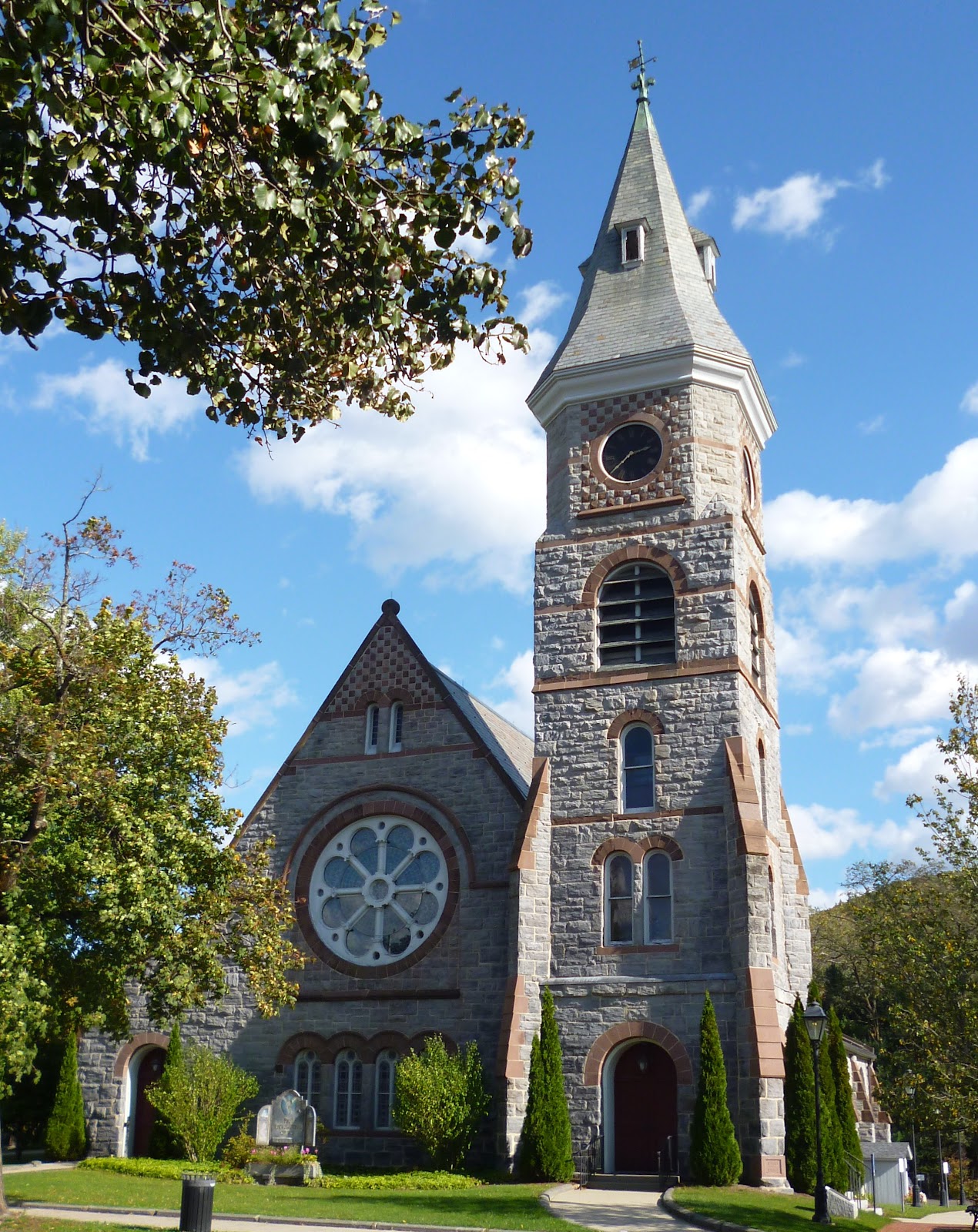
The ailing Mary moved to other rented accommodation in Church Street, at the rear of the Congregational Church on Main Street, which she joined. When she died in 1885, William moved in with his aunt on Main Street for a short time before going to Fisk University. This is one of three congregations that helped him financially.

Clinton African Methodist Episcopal Zion Church in Elm Court is the oldest black church building in Berkshire County. William returned to give a talk there in 1894. The following year, he became the first African American to earn a PhD from Harvard University. 

'W.E.B. DU BOIS
RIVER GARDEN

"The Housatonic River flows gently
as the first life stream of our town".
                               W.E.B. Du Bois, 1961'.