Showing posts with label Bloomsbury. Show all posts

31 August 2012

Virginia Woolf in Richmond and Bloomsbury: London #18

 
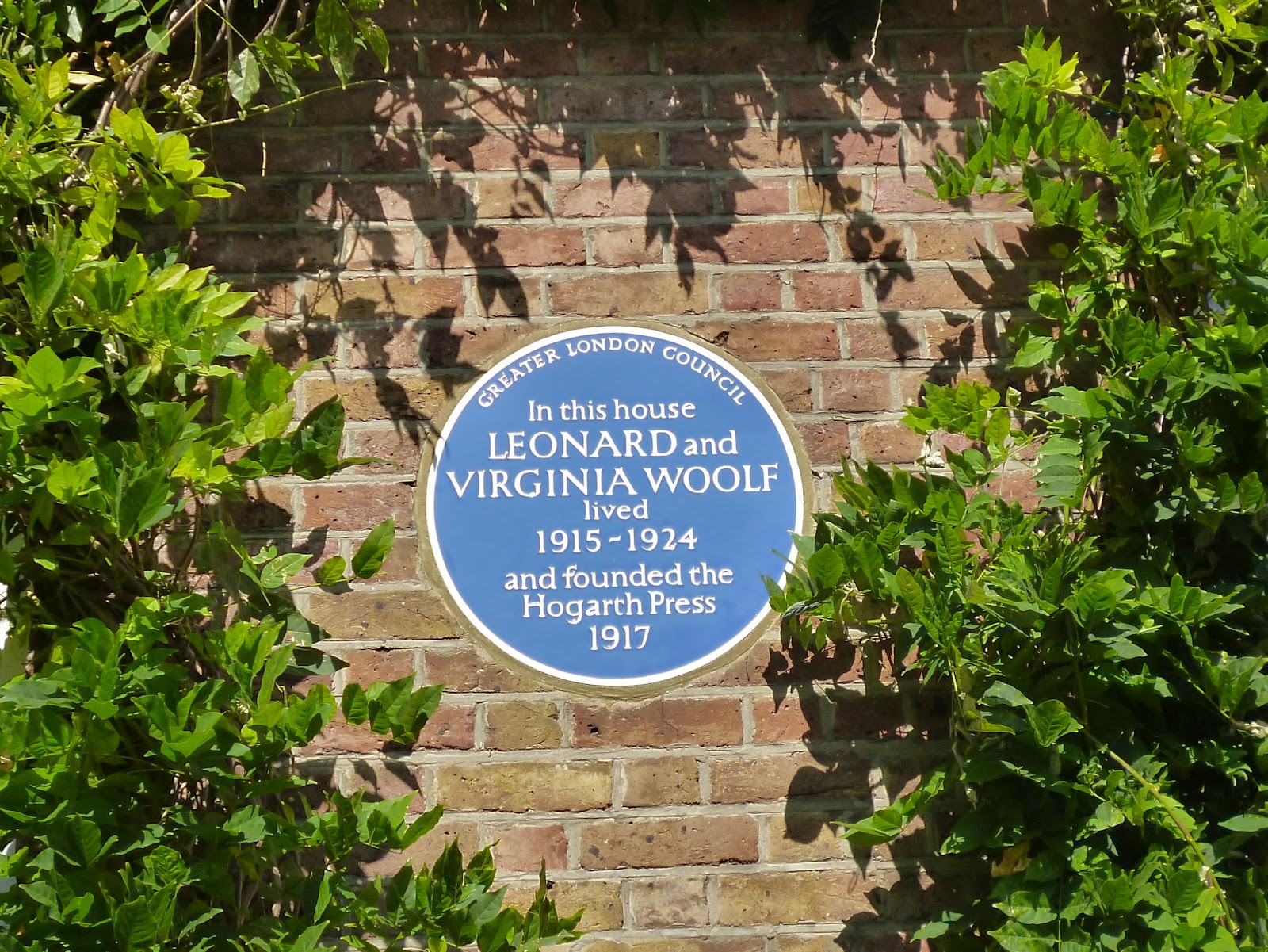
Hogarth House, Richmond: T. S. Eliot's The Waste Land was published here in 1922, in the same year Sylvia Beach published Joyce's Ulysses.
 
'In this house
LEONARD and
VIRGINIA WOOLF
lived
1915–1924
and founded the
Hogarth Press
1917'

 
'VIRGINIA WOOLF
1882–1941'
 
'Virginia Woolf
lived in a house formerly on the south side of
Tavistock Square from 1924 to 1939 where most of her
greatest novels were written and published.
 
"Then one day walking around Tavistock Square I made up,
as I sometimes make up my books, To the Lighthouse; in
a great, apparently involuntary, rush."
 
This memorial was erected by the
Virginia Woolf Society of Great Britain
26th June 2004'.

17 August 2012

Rabindranath Tagore in Gordon Square: London #2


'RABINDRANATH TAGORE
(1861–1941)
Indian Poet, Philosopher and
First Nobel Laureate from Asia
Unveiled by
HRN The Prince of Wales
7th July 2011'

'Sculpted by Shenda Amery
Installed by the Tagore Centre UK'

'Thou hast made me endless, such is thy pleasure. The frail vessel thou emptiest again and again, and fillest it even with fresher life. This little flute of a reed thou hast carried over hills and dales and hast breathed through it melodies eternally new. At the immortal touch of thy hands my little heart loses its limits in a great joy and gives birth to utterance ineffable. Thy infinite gifts come to me only on these very small hands of mine. Ages pass and still thou pourest and still there is room to fill.

Rabindranath Tagore'


27 December 2011

Roland Camberton: Scamp (1950; repr. 2010)

A short time ago I wrote a few words about the recent (re-)publication of Roland Camberton's Scamp, which I've just read, and which I think deserves a comment of more than a few words.

Scamp was a novel with a contemporary story when it was first published in 1950, but today, with its rat-infested Bloomsbury hovels, its journalists with whisky flasks at the hip, its greasy spoon cafés, its politically incorrect talk, its war rationing hangover, its national service, its unwanted pregnancies, and its omnipresent fags and newspapers, it seems to belong to a very distant England indeed. It is a world where Bernard Shaw, James Agate and Cyril Connolly are figures of great importance.

If there'd ever been an English dream, this would be the flipside of it, a society of virtually unemployable losers, many of whom only half-heartedly try to make it as writers, have sex without emotional commitment, and whose idea of social networking is meeting for hours in the pub or the café to philosophize and talk of unrealizable dreams, often scrounging or conning at the same time. Although far less menacing — in fact decidedly cartoonish —the characters aren't so far removed from those of Patrick Hamilton , and the title Scamp indicates an essentially childlike as opposed to sinister nature, although this is in fact a kind of maguffin, being the title of a magazine that's never published.

John Minton's cover is revealing, and Iain Sinclair (in his Introduction 'Man in a Macintosh: Roland Camberton, The Great Invisible in English Fiction') certainly believes that the man depicted is a representation of Camberton (born Henry Cohen). This man is the only clearly drawn human, but focussed to the right of the drawing, behind an unnamed pub. It is perhaps early evening, and in the background are sketchy figures walking together. The man, though (maybe late twenties or early thirties, balding with stubbly chin), is alone and either deep in thought or unhappy. He has a sheaf of papers or a wad of magazines under his arm, and surely the main point here is the weight given to the background: the eye is drawn to the main detail of the man under the pub, who is disappearing bottom right, his head full of what he's leaving: the pub, the people, the streets, the noise, the conversation, the whole fantasy world. Leaving mentally or physically, or perhaps both?

Ivan Ginsberg, the 30-year-old main character in Scamp, is an under-published ex-short story writer who wants to be a literary magazine editor, his only problems being that he has to find the money, contributors and printer to do so. Like many of the other characters, he hasn't grown up, although he begins to do so at the end.

4 May 2010

H. D. (Hilda Doolittle) at Mecklenburgh Square, Bloomsbury: Literary London #23

44 Mecklenburgh Square. 'H. D. (HILDA DOOLITTLE) POET AND WRITER LIVED HERE 1917-1918'.

D. H. Lawrence and his wife Frieda stayed here in November 1917 after being forced away from Cornwell.

Lionel Britton and the Foundling Hospital, Coram's Fields, Guilford Street, Bloomsbury: Literary London #22

Ed Glinert, in A Literary Guide to London (2000), mentions that Dickens publicized the work of the Foundling Hospital that once stood on Guilford Street in Household Words, and goes on to say that Harriet Beadle in Little Dorrit (1857) is known as 'Tattycoram' partly after an old nickname she had, partly after the place in which she was brought up.

When Lionel Britton - or rather, his protagonist Arthur Phelps - passed this way, it was still a hospital:

'Half-way down Guilford Street is the Foundling Hospital. That is for the love children. Thrown away because they were too expensive to keep, or because they were not proper, or because they came through lack of knowledge and were inconvenient. The bourgeoisie, whose social organisation has made it possible for the child and the mother to be together, built the stone walls and took it in. Do for cannon-fodder...'

Hunger and Love (1931), p. 412.


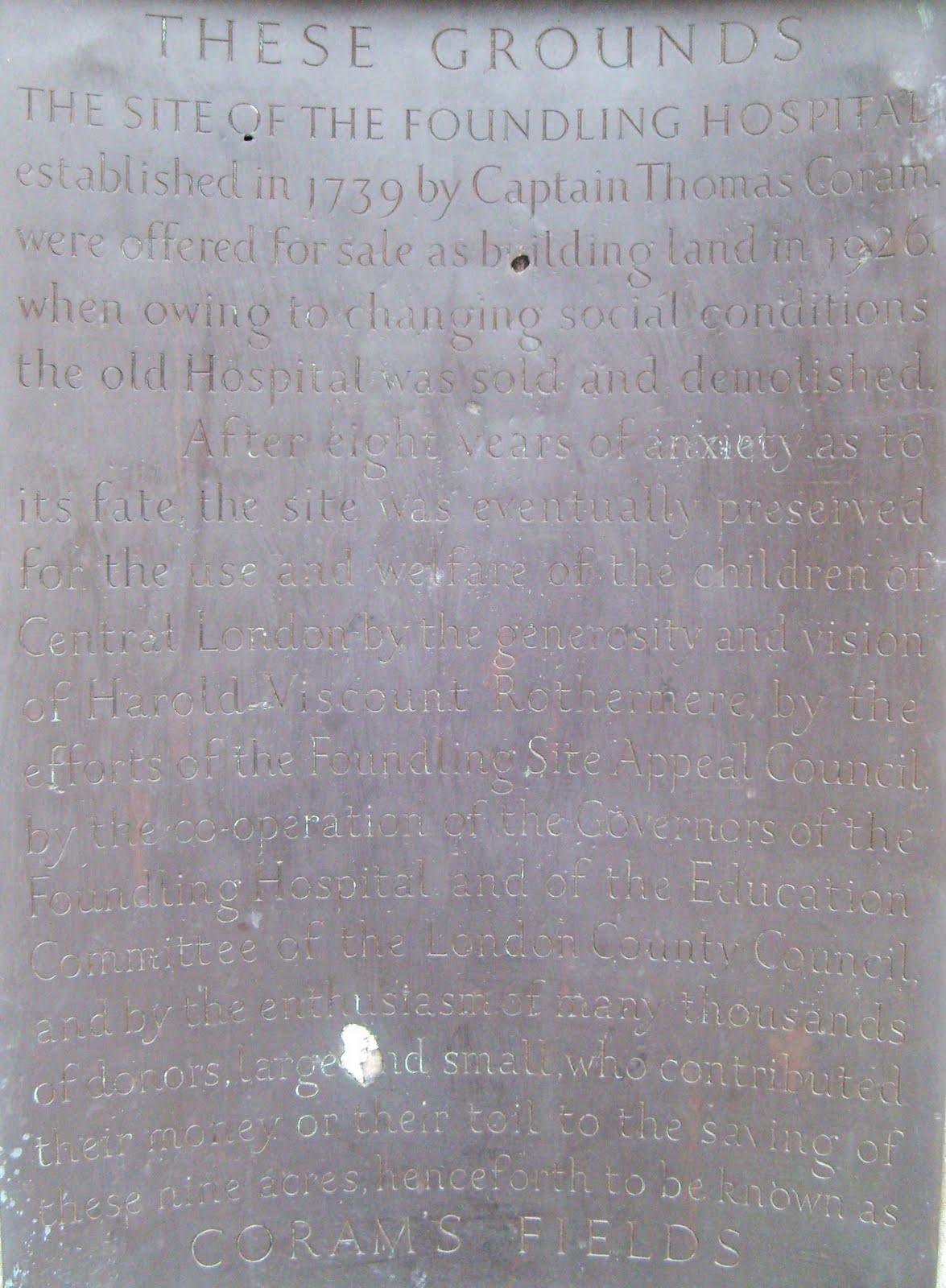
'THESE GROUNDS

THE SITE OF THE FOUNDLING HOSPITAL

established in 1739 by Captain Thomas Corem were offered for sale as building land in 1926, when owing to changing social conditions, the old Hospital was sold and demolished.

After eight years of anxiety as to its fate, the site was eventually preserved for the use and welfare of the children of Central London by the generosity and vision of Harold, Viscount Rothermere, by the efforts of the Foundling Site Appeal Council, by the co-operation of the Governors of the Foundling Hospital and of the Education Committee of the London County Council, and by the enthusiasm of many thousands of donors, large and small, who contributed their money or their toil to the saving of these nine acres, henceforth to be known as CORAM'S FIELDS'.

So the land has now been turned into a park. Coram's Fields looked interesting to me, but I wasn't allowed to enter as I wasn't accompanied by a child. The mad side of political correctness?

Sydney Smith, Charles Dickens, Vera Brittain, and Winifred Holtby at Doughty Street, Bloomsbury: Literary London #21

The impressive Doughty Street had security gates at each end in Charles Dickens's day: it was a very short distance from the slums of Saffron Hill, where Dickens had set Fagin's hovel in Oliver Twist.

14 Doughty Street. 'Sydney Smith 1771-1845 Author and Wit Lived Here'.

48 Doughty Street. 'Charles Dickens 1812-1870 Novelist Lived Here'. Dickens lived here from 1837 to 1839, when he was completing Pickwick Papers (1837), Oliver Twist (1839), most of Nicholas Nickleby (1839), and the start of Barnaby Rudge. He had married Catherine a short time before living here.

52 Doughty Street. Unfortunately, the whole house has scaffolding over it, and does not take a pretty photo, although the blue plaque is readable:

'Vera
Brittain
1893-1970
Winifred
Holtby
1898-1935
Writers and Reformers
lived here'.

 ADDENDUM: In August 2013 I returned to the street and took pictures of a house clear of scaffolding:

Benjamin Disraeli at Theobald's Road: Literary London #20

22 Theobald's Road. 'BENJAMIN DISRAELI Earl of Beaconsfield born here 1904'.

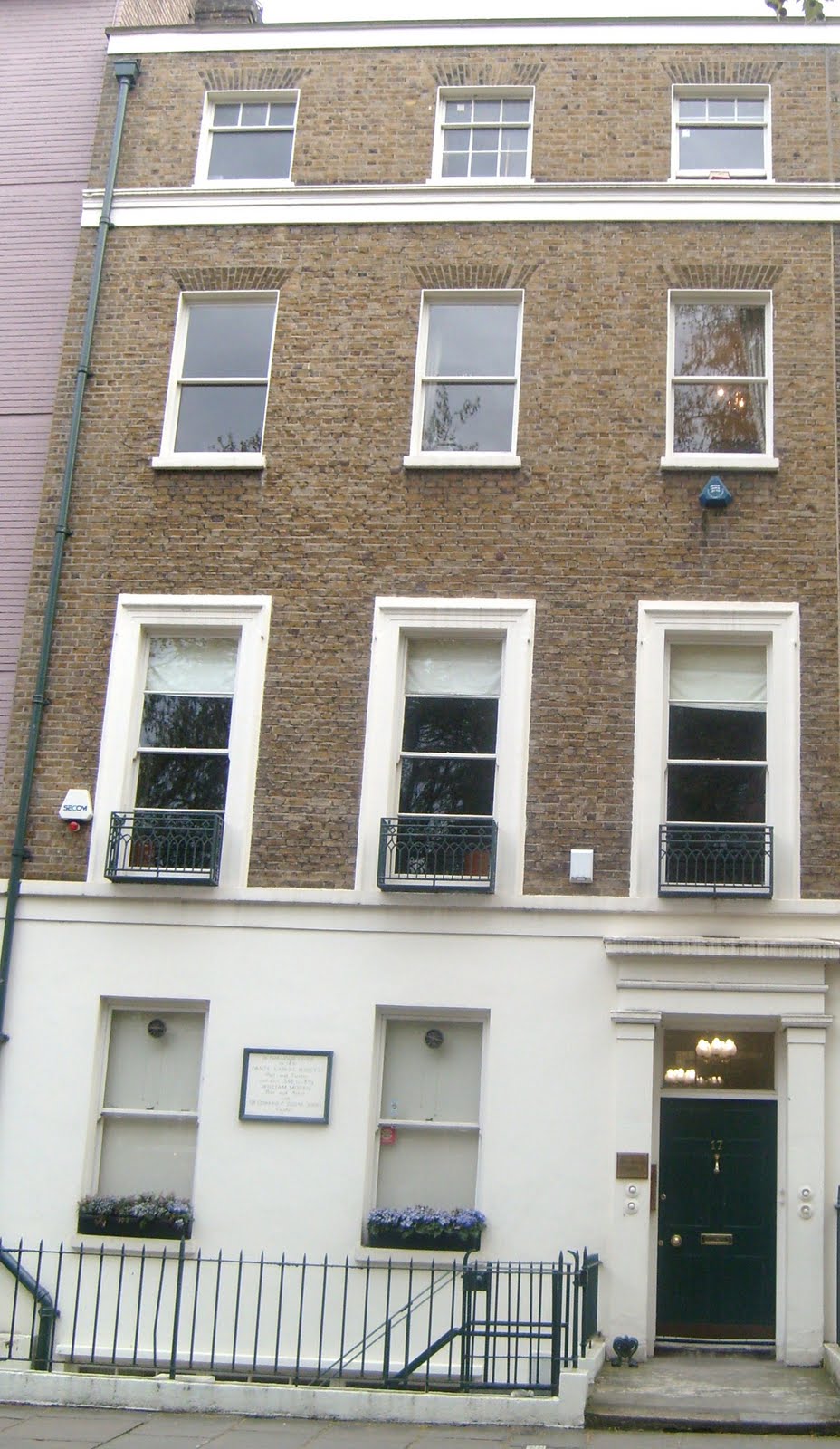
Dante Gabriel Rossetti, William Morris, and Edward Burne-Jones at Red Lion Square, Bloomsbury: Literary London: #19

17 Red Lion Square. 'In this house in 1951 lived Dante Gabriel Rossetti Poet and Painter and from 1856 to 1859 William Morris Poet and Artist and Sir Edward C. Burne-Jones Painter'.

When Morris moved in there was no furniture, so he and Burne-Jones made furniture after the medieval fashion that was later to become his hallmark style.

Isaac D'Israeli and Benjamin Disraeli at Bloomsbury Square, Bloomsbury: Literary London #18

6 Bloomsbury Square. The young future prime minister and novelist Benjamin Disraeli (1804-81) lived here from 1817-24, although it is his father Isaac D'Israeli who is commemorated in the stone plaque here:

'ISAAC D'ISRAELI. AUTHOR LIVED HERE. BORN 1766 | DIED 1848' Isaac wrote The Curiosities of Literature here.

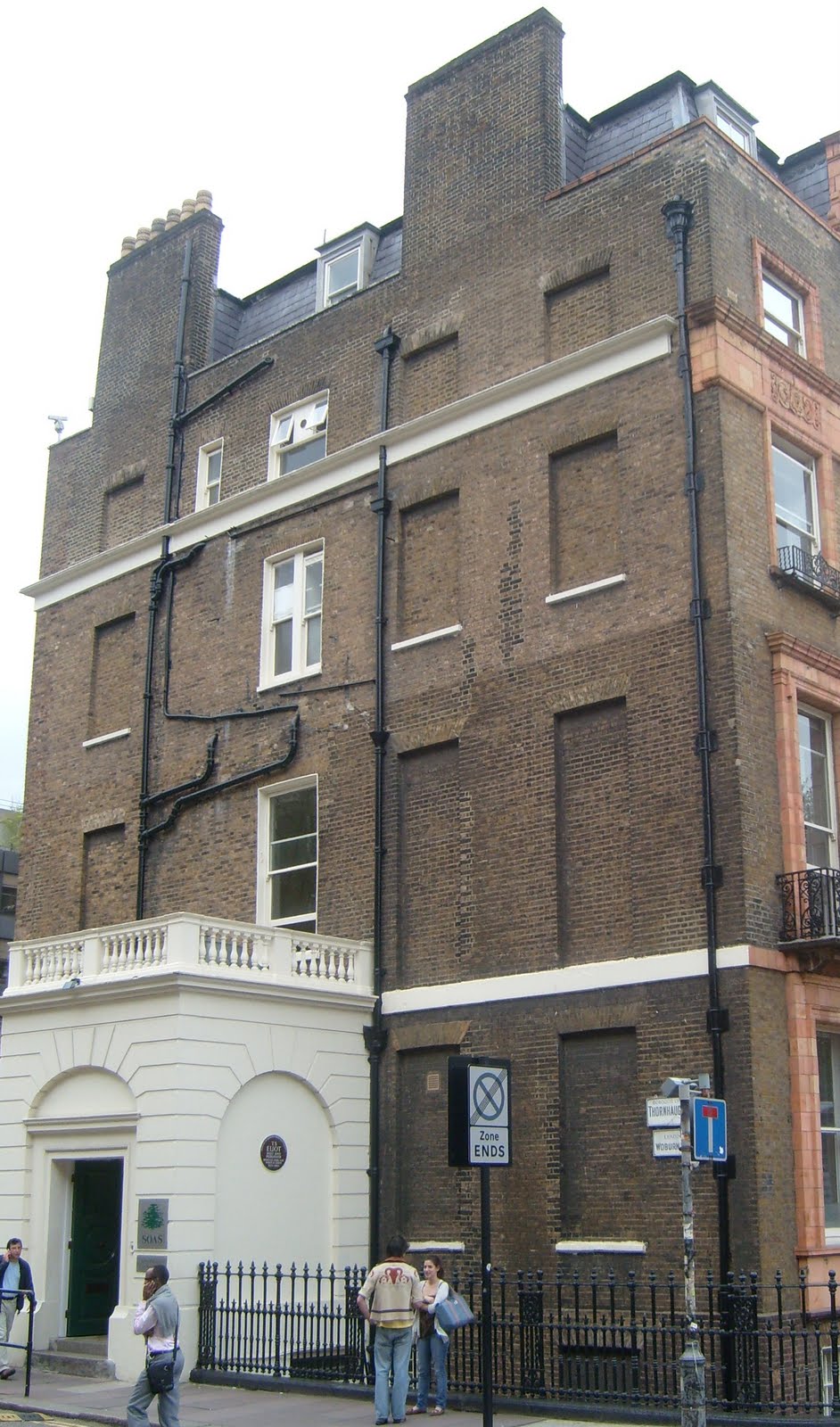
T.S.Eliot, Faber & Faber, and Russell Square, Bloomsbury: Literary London #17

25 Russell Square. 'T.S. ELIOT POET AND PUBLISHER WORKED HERE FOR FABER & FABER 1925-1965'

T. S. Eliot published a great deal of poetry during his long time with Faber & Faber, some of the most noted poets being W. H. Auden, Stephen Spender, Louis MacNeice, Ezra Pound, and Marianne Moore.

Eliot also, along with other publishers, rejected George Orwell's Animal farm.

Mahatma Gandhi, Fredda Brilliant, and Tavistock Square, Bloomsbury: Literary London #16

On several occasions, this blog has mentioned the sculptor Fredda Brilliant - the wife of Lionel Britton's friend Herbert Marshall - and sometimes in relation to her being the sculptor of Britton's bust, which recently appeared on an online auction site. But this is the work that Brilliant (known as 'Freddie' by Britton) is most remembered for: the statue of Mahatma Gandhi in Tavistock Square.

3 May 2010

Weedon Grossmith, Anthony Hope, Elizabeth Jesser Reid, and Ram Mohun Roy at Bedford Square, Bloomsbury: Literary London #15

1 Bedford Square. Weedon Grossmith lived at this address from 1902 to 1919, some years after the publication of The Diary of a Nobody (1892).

41 Bedford Square. This was the address of Anthony Hope Hawkins (Anthony Hope) from 1903 to 1917. His best known work is The Prisoner of Zenda (1894).

48 Bedford Square. 'BEDFORD COLLEGE FOR WOMEN UNIVERSITY OF LONDON FOUNDED HERE 1849 BY ELIZABETH JESSER REID'.

49 Bedford Square. 'Ram Mohun Roy 1772-1833 Indian Scholar and Reformer lived here'.

52 Bedford Square. Between 1877 and 1881 Robert Bridges lived here with his mother as a physician. He would later become poet laureate, and perhaps is best known now for publishing Gerard Manley Hopkins's work.

The Bloomsbury Group at Gordon Square, Bloomsbury: Literary London #14

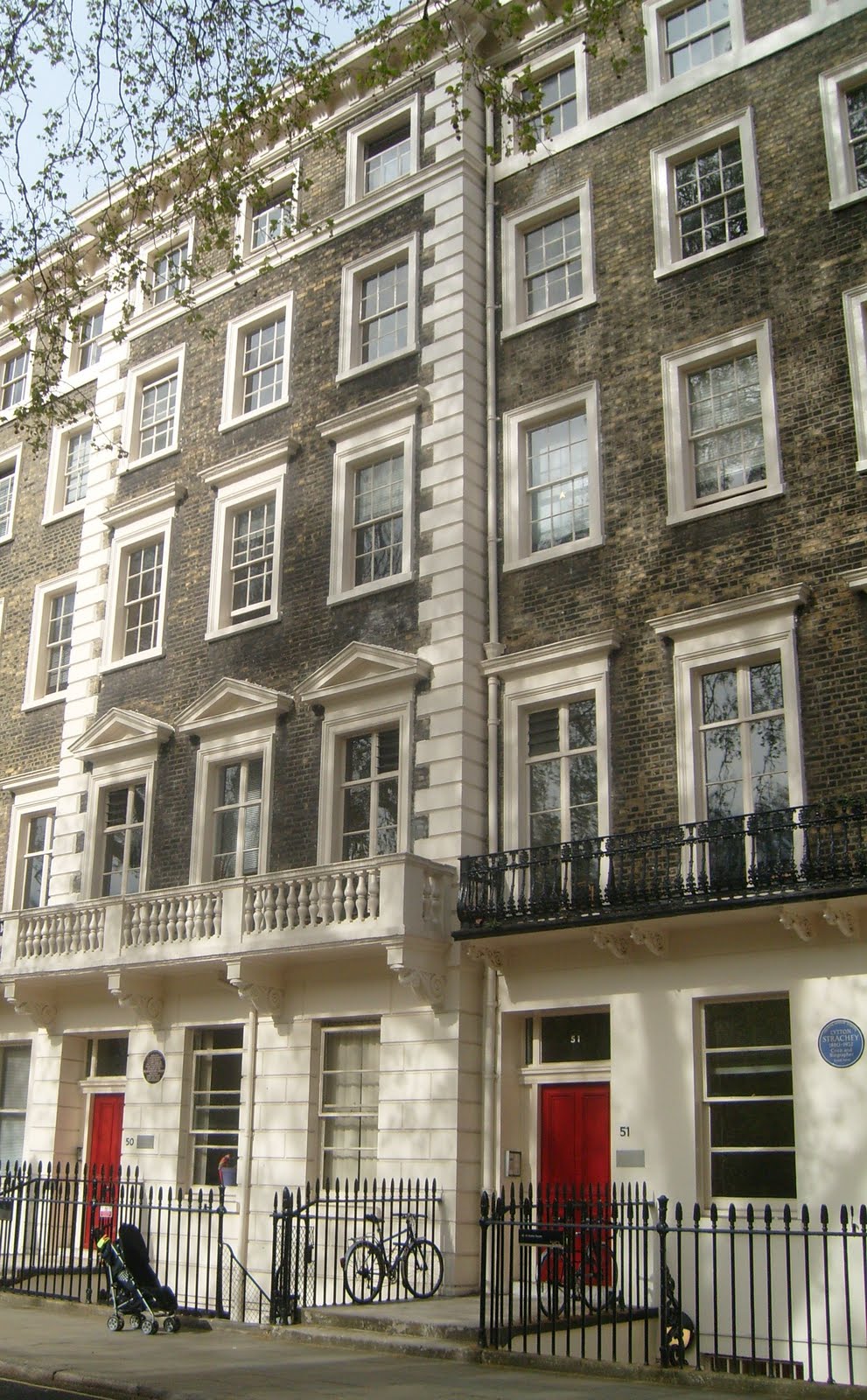
The plaque at 50 Gordon Square states 'HERE AND IN NEIGBOURING HOUSES DURING THE FIRST HALF OF THE 20TH CENTURY THERE LIVED SEVERAL MEMBERS OF THE BLOOMSBURY GROUP INCLUDING VIRGINIA WOOLF CLIVE BELL AND THE STRACHEYS'.

Included in the top photo is 51 Gordon Square: 'Lytton Strachey 1880-1932 Critic and Biographer lived here'. Here, Strachey wrote Queen Victoria (1921), his follow-up to the ground-breaking Eminent Victorians (1918).

46 Gordon Square. 'John Maynard Keynes 1883-1946 Economist lived here 1916-1946'. Oddly, there is no plaque commemorating the fact that Virginia Woolf (then still Stephens) lived here from 1904-06, nor, perhaps even more surprising, that this is in effect the birthplace of the Bloomsbury Group. Virginia moved here with her sister Vanessa and her brothers Adrian and Thoby, who was to die in Greece in 1906.

2 May 2010

Christina Rossetti and Torrington Square, Bloomsbury: Literary London #13

An old stone plaque at 30 Torrington Square, where Christina Rossetti lived from 1877 to 1894, reads: 'HERE LIVED AND DIED CHRISTINA GEORGINA ROSSETTI POETESS BORN 1830: DIED 1894'. She never married, and declined her later suitor Charles Cayley's proposal apparently on religious grounds, although a batch of poems found at Torrington Place after her death were written for him, and her brother William Rossetti was convinced that he was the love of her life.

As an example of the intense sensual power trapped within her, there can surely be no better example than Goblin Market (1862). I publish this in full, as indeed the whole of this beautiful poem should be read in full:

GOBLIN MARKET

Morning and evening
Maids heard the goblins cry:
'Come buy our orchard fruits,
Come buy, come buy:
Apples and quinces,
Lemons and oranges,
Plump unpecked cherries,
Melons and raspberries,
Bloom-down-cheeked peaches,
Swart-headed mulberries,
Wild free-born cranberries,
Crab-apples, dewberries,
Pine-apples, blackberries,
Apricots, strawberries;-
All ripe together
In summer weather,-
Morns that pass by,
Fair eves that fly;
Come buy, come buy:
Our grapes fresh from the vine,
Pomegranates full and fine,
Dates and sharp bullaces,
Rare pears and greengages,
Damsons and bilberries,
Taste them and try:
Currants and gooseberries,
Bright-fire-like barberries,
Figs to fill your mouth,
Citrons from the South,
Sweet to tongue and sound to eye;
Come buy, come buy.'

Evening by evening
Among the brookside rushes,
Laura bowed her head to hear,
Lizzie veiled her blushes:
Crouching close together
In the cooling weather,
With clasping arms and cautioning lips,
With tingling cheeks and finger tips.
'Lie close,' Laura said,
Pricking up her golden head:
'We must not look at goblin men,
We must not buy their fruits:
Who knows upon what soil they fed
Their hungry thirsty roots?'
'Come buy,' call the goblins
Hobbling down the glen.
'Oh,' cried Lizzie, 'Laura, Laura,
You should not peep at goblin men.'
Lizzie covered up her eyes,
Covered close lest they should look;
Laura reared her glossy head,
And whispered like the restless brook:
'Look, Lizzie, look, Lizzie,
Down the glen tramp little men.
One hauls a basket,
One bears a plate,
One lugs a golden dish
Of many pounds weight.
How fair the vine must grow
Whose grapes are so luscious;
How warm the wind must blow
Through those fruit bushes.'
'No,' said Lizzie, 'No, no, no;
Their offers should not charm us,
Their evil gifts would harm us.'
She thrust a dimpled finger
In each ear, shut eyes and ran:
Curious Laura chose to linger
Wondering at each merchant man.
One had a cat's face,
One whisked a tail,
One tramped at a rat's pace,
One crawled like a snail,
One like a wombat prowled obtuse and furry,
One like a ratel tumbled hurry skurry.
She heard a voice like voice of doves
Cooing all together:
They sounded kind and full of loves
In the pleasant weather.

Laura stretched her gleaming neck
Like a rush-imbedded swan,
Like a lily from the beck,
Like a moonlit poplar branch,
Like a vessel at the launch
When its last restraint is gone.

Backwards up the mossy glen
Turned and trooped the goblin men,
With their shrill repeated cry,
'Come buy, come buy.'
When they reached where Laura was
They stood stock still upon the moss,
Leering at each other,
Brother with queer brother;
Signalling each other,
Brother with sly brother.
One set his basket down,
One reared his plate;
One began to weave a crown
Of tendrils, leaves, and rough nuts brown
(Men sell not such in any town);
One heaved the golden weight
Of dish and fruit to offer her:
'Come buy, come buy,' was still their cry.
Laura stared but did not stir,
Longed but had no money:
The whisk-tailed merchant bade her taste
In tones as smooth as honey,
The cat-faced purr'd,
The rat-faced spoke a word
Of welcome, and the snail-paced even was heard;
One parrot-voiced and jolly
Cried 'Pretty Goblin' still for 'Pretty Polly;'-
One whistled like a bird.

But sweet-tooth Laura spoke in haste:
'Good folk, I have no coin;
To take were to purloin:
I have no copper in my purse,
I have no silver either,
And all my gold is on the furze
That shakes in windy weather
Above the rusty heather.'
'You have much gold upon your head,'
They answered all together:
'Buy from us with a golden curl.'
She clipped a precious golden lock,
She dropped a tear more rare than pearl,
Then sucked their fruit globes fair or red:
Sweeter than honey from the rock,
Stronger than man-rejoicing wine,
Clearer than water flowed that juice;
She never tasted such before,
How should it cloy with length of use?
She sucked and sucked and sucked the more
Fruits which that unknown orchard bore;
She sucked until her lips were sore;
Then flung the emptied rinds away
But gathered up one kernel stone,
And knew not was it night or day
As she turned home alone.

Lizzie met her at the gate
Full of wise upbraidings:
'Dear, you should not stay so late,
Twilight is not good for maidens;
Should not loiter in the glen
In the haunts of goblin men.
Do you not remember Jeanie,
How she met them in the moonlight,
Took their gifts both choice and many,
Ate their fruits and wore their flowers
Plucked from bowers
Where summer ripens at all hours?
But ever in the noonlight
She pined and pined away;
Sought them by night and day,
Found them no more, but dwindled and grew grey;
Then fell with the first snow,
While to this day no grass will grow
Where she lies low:
I planted daisies there a year ago
That never blow.
You should not loiter so.'
'Nay, hush,' said Laura:
'Nay, hush, my sister:
I ate and ate my fill,
Yet my mouth waters still;
To-morrow night I will
Buy more:' and kissed her:
'Have done with sorrow;
I'll bring you plums to-morrow
Fresh on their mother twigs,
Cherries worth getting;
You cannot think what figs
My teeth have met in,
What melons icy-cold
Piled on a dish of gold
Too huge for me to hold,
What peaches with a velvet nap,
Pellucid grapes without one seed:
Odorous indeed must be the mead
Whereon they grow, and pure the wave they drink
With lilies at the brink,
And sugar-sweet their sap.'

Golden head by golden head,
Like two pigeons in one nest
Folded in each other's wings,
They lay down in their curtained bed:
Like two blossoms on one stem,
Like two flakes of new-fall'n snow,
Like two wands of ivory
Tipped with gold for awful kings.
Moon and stars gazed in at them,
Wind sang to them lullaby,
Lumbering owls forbore to fly,
Not a bat flapped to and fro
Round their rest:
Cheek to cheek and breast to breast
Locked together in one nest.

Early in the morning
When the first cock crowed his warning,
Neat like bees, as sweet and busy,
Laura rose with Lizzie:
Fetched in honey, milked the cows,
Aired and set to rights the house,
Kneaded cakes of whitest wheat,
Cakes for dainty mouths to eat,
Next churned butter, whipped up cream,
Fed their poultry, sat and sewed;
Talked as modest maidens should:
Lizzie with an open heart,
Laura in an absent dream,
One content, one sick in part;
One warbling for the mere bright day's delight,
One longing for the night.

At length slow evening came:
They went with pitchers to the reedy brook;
Lizzie most placid in her look,
Laura most like a leaping flame.
They drew the gurgling water from its deep;
Lizzie plucked purple and rich golden flags,
Then turning homeward said: 'The sunset flushes
Those furthest loftiest crags;
Come, Laura, not another maiden lags,
No wilful squirrel wags,
The beasts and birds are fast asleep.'
But Laura loitered still among the rushes
And said the bank was steep.

And said the hour was early still
The dew not fall'n, the wind not chill:
Listening ever, but not catching
The customary cry,
'Come buy, come buy,'
With its iterated jingle
Of sugar-baited words:
Not for all her watching
Once discerning even one goblin
Racing, whisking, tumbling, hobbling;
Let alone the herds
That used to tramp along the glen,
In groups or single,
Of brisk fruit-merchant men.

Till Lizzie urged, 'O Laura, come;
I hear the fruit-call but I dare not look:
You should not loiter longer at this brook:
Come with me home.
The stars rise, the moon bends her arc,
Each glowworm winks her spark,
Let us get home before the night grows dark:
For clouds may gather
Though this is summer weather,
Put out the lights and drench us through;
Then if we lost our way what should we do?'

Laura turned cold as stone
To find her sister heard that cry alone,
That goblin cry,
'Come buy our fruits, come buy.'
Must she then buy no more such dainty fruit?
Must she no more such succous pasture find,
Gone deaf and blind?
Her tree of life drooped from the root:
She said not one word in her heart's sore ache;
But peering thro' the dimness, nought discerning,
Trudged home, her pitcher dripping all the way;
So crept to bed, and lay
Silent till Lizzie slept;
Then sat up in a passionate yearning,
And gnashed her teeth for baulked desire, and wept
As if her heart would break.

Day after day, night after night,
Laura kept watch in vain
In sullen silence of exceeding pain.
She never caught again the goblin cry:
'Come buy, come buy;'-
She never spied the goblin men
Hawking their fruits along the glen:
But when the noon waxed bright
Her hair grew thin and grey;
She dwindled, as the fair full moon doth turn
To swift decay and burn
Her fire away.

One day remembering her kernel-stone
She set it by a wall that faced the south;
Dewed it with tears, hoped for a root,
Watched for a waxing shoot,
But there came none;
It never saw the sun,
It never felt the trickling moisture run:
While with sunk eyes and faded mouth
She dreamed of melons, as a traveller sees
False waves in desert drouth
With shade of leaf-crowned trees,
And burns the thirstier in the sandful breeze.

She no more swept the house,
Tended the fowls or cows,
Fetched honey, kneaded cakes of wheat,
Brought water from the brook:
But sat down listless in the chimney-nook
And would not eat.

Tender Lizzie could not bear
To watch her sister's cankerous care
Yet not to share.
She night and morning
Caught the goblins' cry:
'Come buy our orchard fruits,
Come buy, come buy:'-
Beside the brook, along the glen,
She heard the tramp of goblin men,
The voice and stir
Poor Laura could not hear;
Longed to buy fruit to comfort her,
But feared to pay too dear.
She thought of Jeanie in her grave,
Who should have been a bride;
But who for joys brides hope to have
Fell sick and died
In her gay prime,
In earliest Winter time
With the first glazing rime,
With the first snow-fall of crisp Winter time.

Till Laura dwindling
Seemed knocking at Death's door:
Then Lizzie weighed no more
Better and worse;
But put a silver penny in her purse,
Kissed Laura, crossed the heath with clumps of furze
At twilight, halted by the brook:
And for the first time in her life
Began to listen and look.

Laughed every goblin
When they spied her peeping:
Came towards her hobbling,
Flying, running, leaping,
Puffing and blowing,
Chuckling, clapping, crowing,
Clucking and gobbling,
Mopping and mowing,
Full of airs and graces,
Pulling wry faces,
Demure grimaces,
Cat-like and rat-like,
Ratel- and wombat-like,
Snail-paced in a hurry,
Parrot-voiced and whistler,
Helter skelter, hurry skurry,
Chattering like magpies,
Fluttering like pigeons,
Gliding like fishes,-
Hugged her and kissed her:
Squeezed and caressed her:
Stretched up their dishes,
Panniers, and plates:
'Look at our apples
Russet and dun,
Bob at our cherries,
Bite at our peaches,
Citrons and dates,
Grapes for the asking,
Pears red with basking
Out in the sun,
Plums on their twigs;
Pluck them and suck them,
Pomegranates, figs.'-

'Good folk,' said Lizzie,
Mindful of Jeanie:
'Give me much and many:'-
Held out her apron,
Tossed them her penny.
'Nay, take a seat with us,
Honour and eat with us,'
They answered grinning:
'Our feast is but beginning.
Night yet is early,
Warm and dew-pearly,
Wakeful and starry:
Such fruits as these
No man can carry;
Half their bloom would fly,
Half their dew would dry,
Half their flavour would pass by.
Sit down and feast with us,
Be welcome guest with us,
Cheer you and rest with us.'-
'Thank you,' said Lizzie: 'But one waits
At home alone for me:
So without further parleying,
If you will not sell me any
Of your fruits though much and many,
Give me back my silver penny
I tossed you for a fee.'-
They began to scratch their pates,
No longer wagging, purring,
But visibly demurring,
Grunting and snarling.
One called her proud,
Cross-grained, uncivil;
Their tones waxed loud,
Their looks were evil.
Lashing their tails
They trod and hustled her,
Elbowed and jostled her,
Clawed with their nails,
Barking, mewing, hissing, mocking,
Tore her gown and soiled her stocking,
Twitched her hair out by the roots,
Stamped upon her tender feet,
Held her hands and squeezed their fruits
Against her mouth to make her eat.

White and golden Lizzie stood,
Like a lily in a flood,-
Like a rock of blue-veined stone
Lashed by tides obstreperously,-
Like a beacon left alone
In a hoary roaring sea,
Sending up a golden fire,-
Like a fruit-crowned orange-tree
White with blossoms honey-sweet
Sore beset by wasp and bee,-
Like a royal virgin town
Topped with gilded dome and spire
Close beleaguered by a fleet
Mad to tug her standard down.

One may lead a horse to water,
Twenty cannot make him drink.
Though the goblins cuffed and caught her,
Coaxed and fought her,
Bullied and besought her,
Scratched her, pinched her black as ink,
Kicked and knocked her,
Mauled and mocked her,
Lizzie uttered not a word;
Would not open lip from lip
Lest they should cram a mouthful in:
But laughed in heart to feel the drip
Of juice that syrupped all her face,
And lodged in dimples of her chin,
And streaked her neck which quaked like curd.
At last the evil people,
Worn out by her resistance,
Flung back her penny, kicked their fruit
Along whichever road they took,
Not leaving root or stone or shoot;
Some writhed into the ground,
Some dived into the brook
With ring and ripple,
Some scudded on the gale without a sound,
Some vanished in the distance.

In a smart, ache, tingle,
Lizzie went her way;
Knew not was it night or day;
Sprang up the bank, tore thro' the furze,
Threaded copse and dingle,
And heard her penny jingle
Bouncing in her purse,-
Its bounce was music to her ear.
She ran and ran
As if she feared some goblin man
Dogged her with gibe or curse
Or something worse:
But not one goblin skurried after,
Nor was she pricked by fear;
The kind heart made her windy-paced
That urged her home quite out of breath with haste
And inward laughter.

She cried 'Laura,' up the garden,
'Did you miss me?
Come and kiss me.
Never mind my bruises,
Hug me, kiss me, suck my juices
Squeezed from goblin fruits for you,
Goblin pulp and goblin dew.
Eat me, drink me, love me;
Laura, make much of me:
For your sake I have braved the glen
And had to do with goblin merchant men.'

Laura started from her chair,
Flung her arms up in the air,
Clutched her hair:
'Lizzie, Lizzie, have you tasted
For my sake the fruit forbidden?
Must your light like mine be hidden,
Your young life like mine be wasted,
Undone in mine undoing,
And ruined in my ruin,
Thirsty, cankered, goblin-ridden?'-
She clung about her sister,
Kissed and kissed and kissed her:
Tears once again
Refreshed her shrunken eyes,
Dropping like rain
After long sultry drouth;
Shaking with aguish fear, and pain,
She kissed and kissed her with a hungry mouth.

Her lips began to scorch,
That juice was wormwood to her tongue,
She loathed the feast:
Writhing as one possessed she leaped and sung,
Rent all her robe, and wrung
Her hands in lamentable haste,
And beat her breast.
Her locks streamed like the torch
Borne by a racer at full speed,
Or like the mane of horses in their flight,
Or like an eagle when she stems the light
Straight toward the sun,
Or like a caged thing freed,
Or like a flying flag when armies run.

Swift fire spread through her veins, knocked at her heart,
Met the fire smouldering there
And overbore its lesser flame;
She gorged on bitterness without a name:
Ah! fool, to choose such part
Of soul-consuming care!
Sense failed in the mortal strife:
Like the watch-tower of a town
Which an earthquake shatters down,
Like a lightning-stricken mast,
Like a wind-uprooted tree
Spun about,
Like a foam-topped waterspout
Cast down headlong in the sea,
She fell at last;
Pleasure past and anguish past,
Is it death or is it life?

Life out of death.
That night long Lizzie watched by her,
Counted her pulse's flagging stir,
Felt for her breath,
Held water to her lips, and cooled her face
With tears and fanning leaves:
But when the first birds chirped about their eaves,
And early reapers plodded to the place
Of golden sheaves,
And dew-wet grass
Bowed in the morning winds so brisk to pass,
And new buds with new day
Opened of cup-like lilies on the stream,
Laura awoke as from a dream,
Laughed in the innocent old way,
Hugged Lizzie but not twice or thrice;
Her gleaming locks showed not one thread of grey,
Her breath was sweet as May
And light danced in her eyes.

Days, weeks, months, years
Afterwards, when both were wives
With children of their own;
Their mother-hearts beset with fears,
Their lives bound up in tender lives;
Laura would call the little ones
And tell them of her early prime,
Those pleasant days long gone
Of not-returning time:
Would talk about the haunted glen,
The wicked, quaint fruit-merchant men,
Their fruits like honey to the throat
But poison in the blood;
(Men sell not such in any town:)
Would tell them how her sister stood
In deadly peril to do her good,
And win the fiery antidote:
Then joining hands to little hands
Would bid them cling together,
'For there is no friend like a sister
In calm or stormy weather;
To cheer one on the tedious way,
To fetch one if one goes astray,
To lift one if one totters down,
To strengthen whilst one stands.'

Dame Millicent Garrett Fawcett, PRB, Lady Ottoline Morrell, and Charles Darwin, Gower Street, Bloomsbury: Literary London #12

Bloomsbury is a roughly rectangular area confined within the boundaries of Euston Road to the north, new Oxford Street/High Holborn to the south, Tottenham Court Road to the west, and Gray's Inn Road to the east. Its many grassy squares and its lavish houses set it some distance apart from its very close geographical neighbor, Fitzrovia.

The blue plaque at 2 Gower Street reads:

'Dame Millicent Garrett Fawcett 1847-1929 pioneer of women's suffrage lived and died here'.

Millicent Fawcett wrote a number of works on the women's movement and political economy, and just one novel: Janet Doncaster (1875).

And at 7 Gower Street:

'In this house the Pre-Raphaelite Brotherhood was founded in 1848'.

This lower part of Gower Street is rich in cultural history. At number 10:

'Lady Ottoline Morrell (1873-1938) Literary Hostess and Patron of the Arts lived here'.

In Graham Greene's It's a Battlefield, Lady Caroline Bury lives in a house modeled on this.

Much further north of Gower Streeet, a blue plaque reads:

'Charles Darwin 1809-82 Naturalist lived in a house on this sight 1838-42.'

Charles and his wife Emma Darwin's first home was 12 Upper Gower Street, a spot now occupied by university premises. In 1839, Darwin's son recalled the house as 'a small common-place London house, with a drawing-room in the front, and a small room behind, in which they lived for the sake of quietness, [...]. The only redeeming feature was a better garden than most London houses have, a strip wide as the house, and thirty yards long. Even this small space of dingy grass made their London house more tolerable to its two country-bred inhabitants.'