
 Étienne Baudry (1830-1908) is not a name well known in France, the country of his birth, let alone the UK, but a new book, Étienne Baudry: Une vie chantentaise...châtelain, dandy et écrivain militant (Saintes: Le Croît vif, 2010), written by his grand-daughter Yvonne Melia-Sevrain, may begin to change things. Baudry was born in Saintes and spent much of his life in the castle at Rochemont, near Saintes. Rochemont more or less depended on the revenue from its extensive vineyards.
In 1864 Baudry married Isabelle Bardin, a younger woman incapable of dressing herself without a servant, and the disastrous marriage was later satirized in Baudry's Le Camp des bourgeois (1868), a publication that came out two years before the essay Les Bras mercenaires. In these publications, along with his La fin du monde, Baudry sketched out his ideas for a future socialistic - even to some extent anarchistic - society, partly influenced by Louis Blanc and Charles Fourier.
Baudry established a workshop at Rochemont, where the artist Louis-Augustin Auguin lived for some months, and, for a longer period and more (in)famously, Gustave Courbet, who was a considerable financial burden to Baudry.
Due to the failure of his vineyards, Baudry was forced to sell Rochemont and move to Royan, where he died. Until recently, his grave in the cemetery in Royan lay unnoticed, and it is only a few years ago that it has been restored.


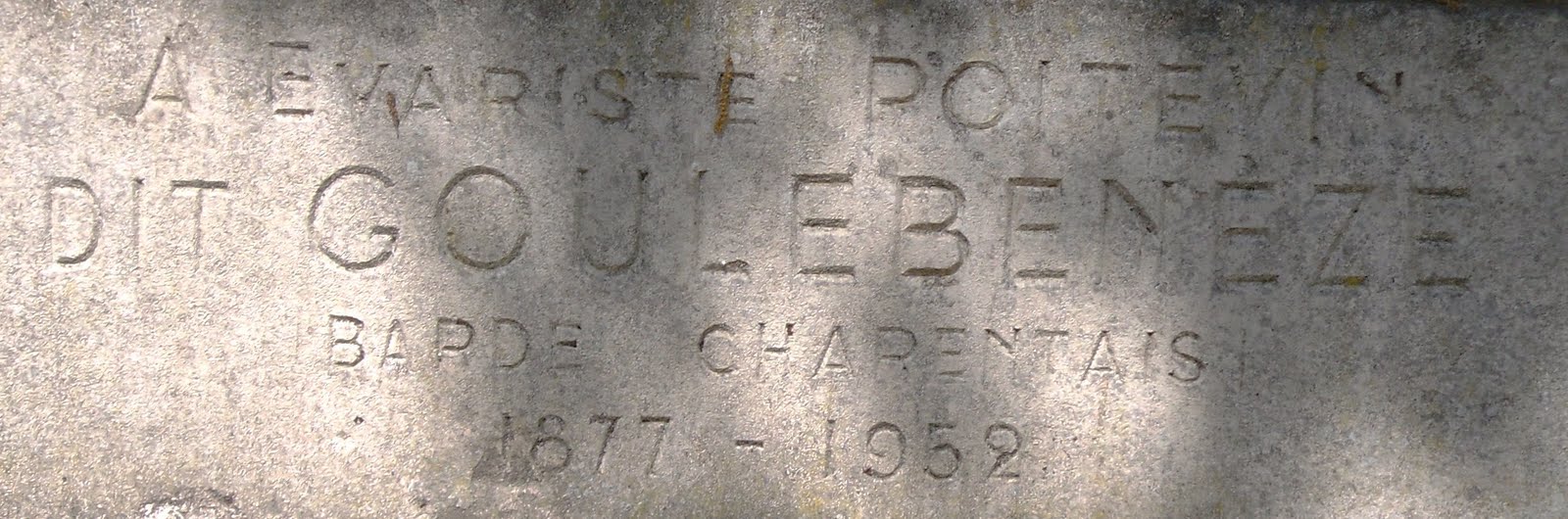
This superb monument to Goulebenéze is tucked away outside the Office du Tourisme, 62 Cours National, in Saintes, Charente-Maritime.

 Goulebenéze ('goule bien aise'), and with an 'e' acute rather than 'e' grave, is the normal appellation of the 'bard', poet, and singer of Charentais songs, of those of the area within Charente, or Santonge. He is Évariste Poitevin (1877-1952), born in Montigny, near Burie, and his poems, writings, and songs were often in the santongeais dialect. Today, he is regarded with great respect in the local area, largely because of his contribution to the local heritage.
From 1902, for 50 years, he was known locally, and even to a minor extent nationally, as an entertainer. He married in 1914, very shortly before being called up, had two children, but had great difficulty preventing his family from falling into debt, slowly having to sell off the family assets.
His poem 'Bonjour Santonge' is one of his most popular, being one that he wrote for the prisoners of World War II.
Goulebenéze died in poverty in Saintes on 30 January 1952, and this is an example of his work, in santongeais:
'Magnière prr' ine jheune feuille d'entortiller un garçon'
'O faut coumincé à pas mais faire cas de li que s'o l'était in méchant cheun de reun du tout. S'il asséye de s'agrâler , o faut chaurit in p'tit et zi virer le thiu aussitout. Thiau gâs s'rat caunit, il érat s'capit dan-n-in coin. Jhuste à thieu moument, o faut avé l'ar de s'éthiuper à causé à in aut' garçon, et d'êt'en grande convarsation avec li, histouère de faire cagné l'aute. O faut n'en resté là prr' le premier cot . O faut pas asseyé de pieumer le canet coum' thieu tout d'in randon, o faut thitté thieuq' coutons à l'ozâ prr' la prochaine renconte.
Thielle lâ lâ arat yieu de peurférence dan-n-in endreit vour o l'arat jholiment de monde : dan-n-in bal prr' exemp'lle. In p'tit de poumade qui sent à bon aux ch'veux, deux ou trois brins de bâz'lit dans l'jhabot, et c' qui ne f'rait pas de tort, ine quoue de langrote dans l'coin dau mouche-nez, et en route prr' le bal !
Gardez-vous beun, sultout, de dévisajhé en rentrant thiaulâ que vous v'lez aguigné. Ne vous avisez pas de vous enguillebaudé avec li, et dansez tout fin jhû ine ou deux veurses ou mazulka, o b' in deux quadrilles. Si sârre les douets in p' tit fort, o faut qu' vout' main à vous devinjhe molle coum' de la laine. En montant vous rafraichit, sonjhez à pas vous laisser lucher les jhottes dans l'escayier: o vaut reun thieu, i se creirait tout parmit.
A la sortie dau bal, au moument de partit, mais à thieu moument seulement, pendant que les veilles peurnant zeux fichut, et que vous êtes en train de vous embobyiné dans voute capeline, vous teurcherez dans la salle l'homme en question, vout oeuil s'appouérat su li coum' in grand aubrât s'abat su in paur' chêtit échardrit, et là, les z'oeuils dans les z'oeuils, vous le fisquerez bin coum' o faut, o s'rat coum' ine éloize, le gas s'rat-t-abrâzé.
Ne vous thittez pas reconduit prr' li. Si le lendemain au matin vous entendez subié dau coûté de vout' porteau, o l' est qu' o l' arat fait effet, et que le gâs est pris coum' in chafouin dan-n-ine bouzine.
A partir de thieu moument , vous peuvez le thitté s'agrâlé sans minfiance et le laissé dénoué vout' devantâ.
Et prr' m' armercier de vous z' avé douné de si bons conseils, vous m' inviterez à la noce!'
I can't imagine anyone ever coming after me with a copyright hammer for reproducing this, as, let's face it, this piece by Goulebenéze is pretty obscure. And how could anyone even consider translating it? The flavor is untranslatable.
 The mark of the sculptor, P. M. Marchand.
 Le Croît vif is a bookshop and publisher of Charentais literature at 2 ruelle de l'Hospice, Saintes. The interesting thing about this shop is that it used to be a grocer's where Goulebenéze regularly went.

 Eugène Pelletan (1813–84) was a writer, journalist and politician born in Royan, and much noted for his oratory. He was a Saint-Simonian during the republic.
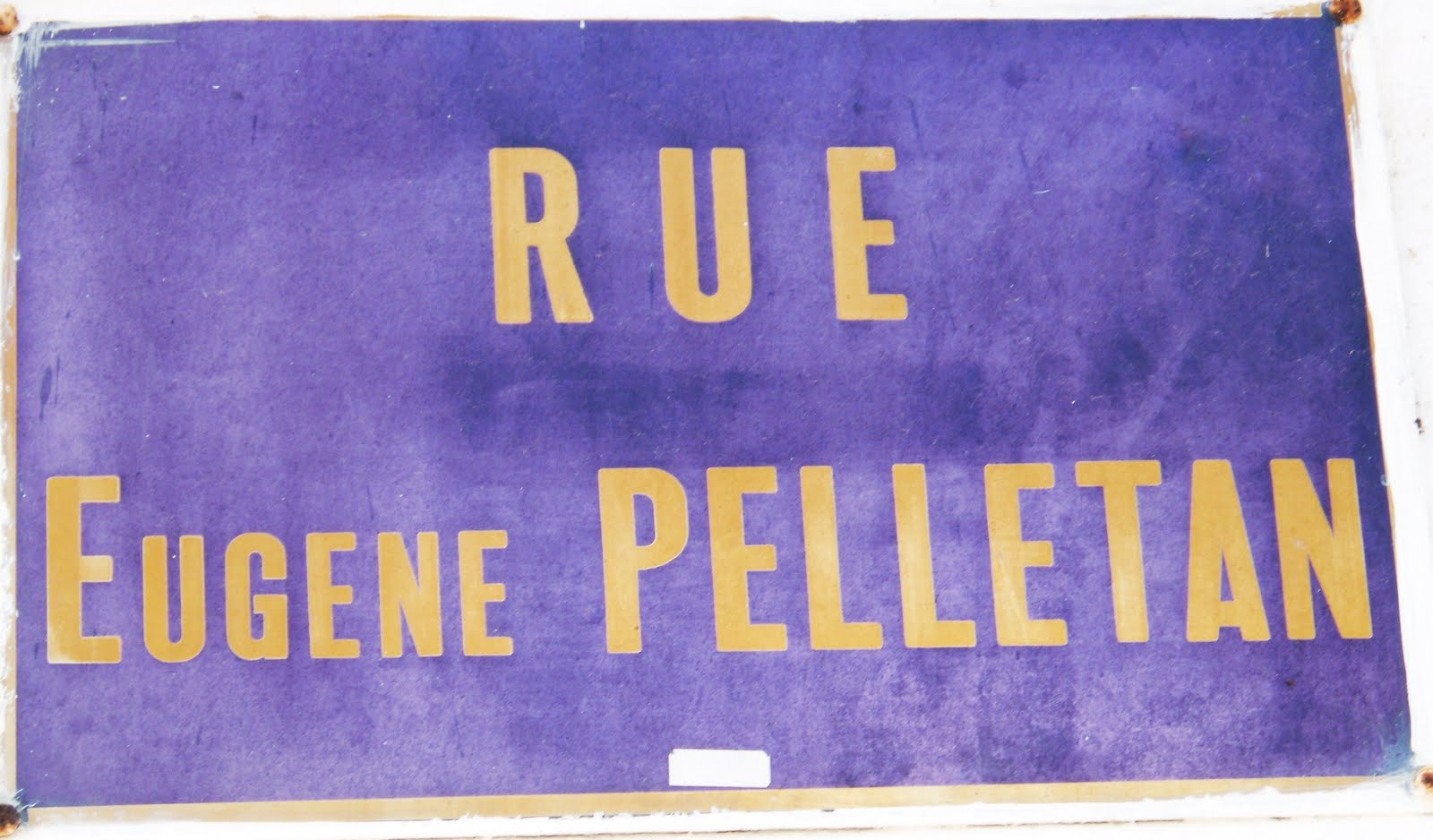 In 1892 a statue in Royan was erected in his memory, although this was melted down during World War II. In the town of his birth, only a street name remembers him.
 However, in the neighboring seaside town of Saint-Georges-de-Didonne, a bust of Pelletan was recently erected.
 And although Saint-Georges-de-Didonne is a very small town, there are in fact three streets there named after Pelletan.
 And there is a street in Saintes too which bears his name.




 Posts
Posts

