Showing posts with label Seine-et-Marne (77). Show all posts

18 August 2020

André Dhôtel in Provins, Seine-et-Marne (77)

The author André Dhôtel (1900-91), born in Attigny (Ardennes), most famed for his novel Le Pays où l'on n'arrive jamais (1955), which was awarded the Prix Femina, is buried with his wife Suzanne (née Laurent), whom he married in 1932, in Le Cimetière Ville Basse in Provins.


16 March 2019

Pierre Mac Orlan in Saint-Cyr-sur-Morin, Seine-et-Marne (77)

Le Musée de la Seine-et-Marne is where George Simon originally had a saw mill. In 1905 he had built L'Hôtel Moderne to sell wood for heating, coal, wholesale wine and groceries. The hotel lodged agents selling wood to craftsmen.

The Guiberts, Parisian café keepers, acquired the hotel in 1926, which they considered an ideal place to raise their two sons. Their younger son Pierre began to work in the auberge at fourteen. He was fascinated by the clog maker's workshop, and collected his first tool: a doloire (a kind of axe) to shape out a clog. In 1946 he took over the management of the auberge and in about 1956 gave his collection of tools to it.

The Guiberts were friends of Pierre Mac Orlan and were with him during the last ten years of his life. Mac Orlan used to eat at La Moderne, inviting his friends there, a number of whom – such as Georges Brassens and Monique Morelli – were famous personalities.

In 1987 the building and the Guibert collection were acquired by the general council of Seine-et-Marne, and the former Hôtel Moderne became a museum. Part of this museum is dedicated to Pierre Mac Orlan, whose house can only be visited by individuals at strictly very limited times, although their present publicity is ambiguous. Needless to say, we arrived – almost inevitably – when the museum/house wasn't open. There was, though, an exhibition on Pierre Mac Orlan and his relation to music.

Mac Orlan was fascinated by music in general and different musical genres, and was interested in both the authors and the interpreters. He also made a collection of records from around Europe.

Women were Pierre Mac Orlan's favourite interpreters of his songs, and the current exhibition at the Musée de la Seine-et-Marne (which closes 23 December 2019) concentrates on women singers such as Francesca Solleville, Juliette Greco, Monique Morelli, Catherine Sauvage and Germaine Montero:


Clémont Poma's bust of Pierre Mac Orlan (2010):

Finally, a homage to Mac Orlan's Les Poissons morts, by Tio (2009):

15 March 2019

Armand Auguste in Saint-Cyr-sur-Morin, Seine-et-Marne (77)


The impressive grave of the sculptor Armand Auguste (1839-1947) in the cemetery at Saint-Cyr-sur-Morin. Auguste was a student of Jean-Baptiste Carpeaux (1827-75) and is noted in Saint-Cyr for his 'Maison des Têtes' work.

Frédéric Gérard in Saint-Cyr-sur-Morin, Seine-et-Marne (77)

Frédéric Gérard (or just Frédé) (1860-1938) and his partner Berthe Serboure acquired the famous bar 'Le Lapin Agile' in Montmartre in 1912 – frequented, among many other now famous people, by Pierre Mac Orlan. Frédé's donkey Lolo is of course famous for painting, voir the tricks of Roland Dorgelès elsewhere on this blog.

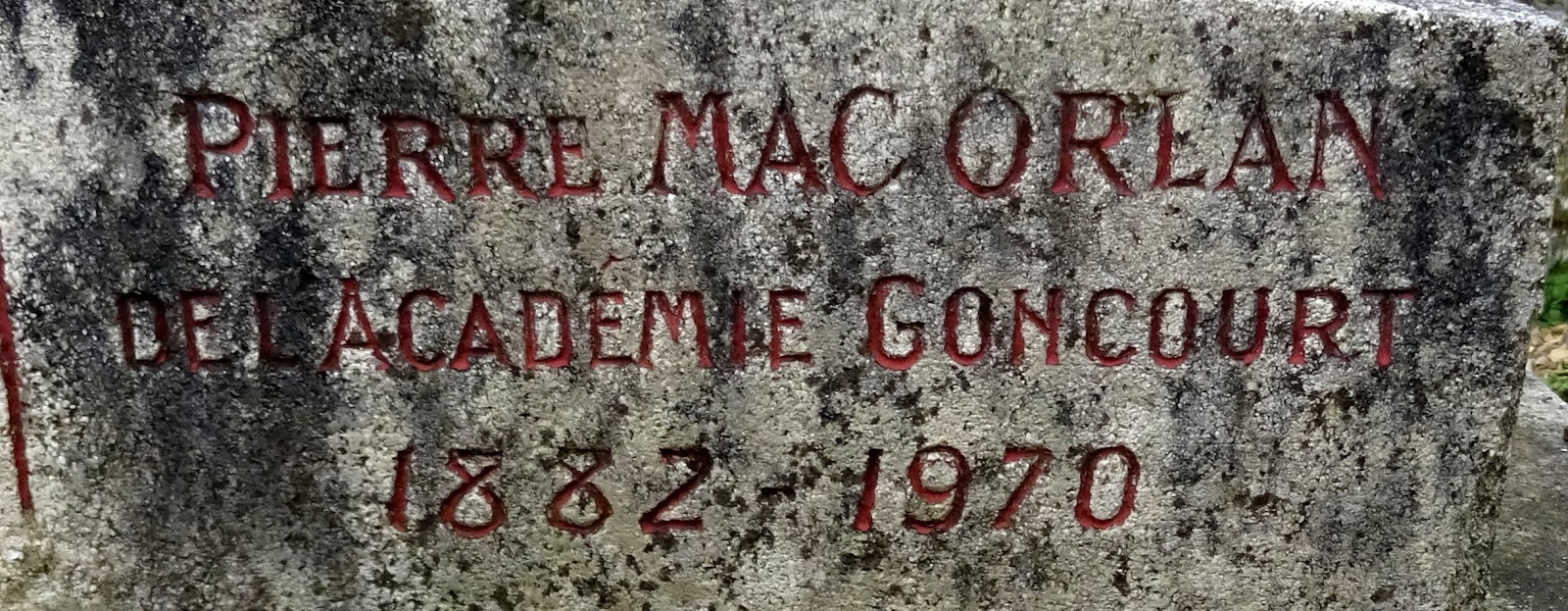
Pierre Mac Orlan in Saint-Cyr-sur-Morin, Seine-et-Marne (77)


'PIERRE MAC ORLAN
DE L'ACADÉMIE GONCOURT
1882-1970'

Pierre Mac Orlan's grave is easily spotted in a corner of the Saint-Cyr-sur-Morin cemetery, nearer to Saint-Ouen-sur-Morin than Saint-Cyr.

22 November 2013

Oscar Milosz in Fontainebleau, Seine-et-Marne (77), France


'OSCAR VLADISLAS DE L. MILOSZ
(1877–1939)

Ecrivain Français, poète, diplomate, Lituanien.
amis des oiseaux, fit de longs séjours à
l'Hôtel de l'Aigle Noir de 1930 à 1939.

–––––––––––––––––––––

OSCAR VLADISLAS DE L. MILOSZ
(1877–1939)

French writer, poet, Lithuanian diplomat
and bird lover, enjoyed long stays at the
Hotel de l'Aigle Noir from 1930 to 1939.'


'DANS CETTE MAISON MOURUT
LE 2 MARS 1939
LE POÈTE FRANÇAIS
     D'ORIGINE LITHUANIENNE
O. V .DE L. MILOSZ    NÉ EN 1877'

Milosz moved into his new home on 1 February 1939, and died just
four weeks later. He is buried in the cemetery at Fontainebleau.


'O.V.de L. MILOSZ
Poète et Métaphysicien
Premier Représentant
  de la Lithuanie
   en France


...nous entrons dans
la seconde innocence,
dans la joie méritée,
reconquise, consciente.'

Katherine Mansfield and Gurdjieff in Avon, Seine-et-Marne (77), France

'VILLE d'AVON
Rue
Katherine Mansfield
Ecrivain née le 14 octobre 1888
A Karori (Nouvelle-Zélande)
Décédée le 9 janvier 1923
Au prieuré des Basses-Loges, Avon'


It's not much but at least it recognises the importance of its former resident.


Obviously, no one would expect a conventional grave for Gurdjieff. Below I transcribe a poster at the side of the grave, and then translate it into English, changing the tense into the past as is conventional in English.


'Georges Ivanovitch GURDJIEFF
né au Caucase en 1877
mort à Paris en 1949
 
–––––––––––– 

Dès son enfance, il s'intéresse aux questions
inexpliquées philosophiques et religieuses et, avec
un groupe de Chercheurs de Vérité, poursuit à
travers l'Asie sa quête de sources
de connaissances traditionnelles.
Pour mettre en pratique son enseignement
il crée en 1920 à Tiflis l'Institut pour
le Développement Harmonique de l'Homme.
En 1922 il s'installe à Avon, au Prieuré des
Basses Loges (actuellement propriété privée).
Le lieu devient un centre qui attire quelques
intellectuelles parmi les plus éminents de l'époque,
en particulier des Anglais et des Américains.
Quelques années plus tard il ferme l'Insitut et
poursuit son travail à Paris et aux Etats-Unis.
L'œuvre de Gurdjieff suscite toujours recherches
et interrogations passionnées, scepticisme
ou admiration sans bornes.'
 
'George Ivanovitch GURDJIEFF 
born in the Caucasus in 1877
died in Paris in 1949'
 
–––––––––––––––––
 
'From childhood, he was interested in unexplained
religious and philosphical matters and, with
a group of Seekers after Truth, pursued his
quest for the sources of traditional
knowledge across Asia.
To put his teaching into practice,
in 1920 in Tiflis he created the
Institute for the Hamonious Development of Man.
In 1922 he moved into the
Prieuré des Basses Loges (now private property).
The place became a centre of attention for
some of the most eminent intellectuals of the day,
English and Americans in particular.
A few years later he closed the Institute
and continued his work in Paris and the United States.
Gurdjieff's work still arouses endless enthusiastic
research and investigation, scepticism and admiration.'
 

'KATHERINE MANSFIELD
WIFE OF
JOHN MIDDLETON MURRY
1888 – 1923
BORN AT WELLINGTON
NEW ZEALAND
DIED AT AVON'
 
'Katherine MANSFIELD

(de son vrai nom: Kathleen BEAUCHAMP)
(1888 – 1923)
Ecrivain
 
–––––––––––––––
 
Très tôt, elle révèle des dispositions
pour la littérature et la musique.
En 1917, elle contracte une pneumonie
qui se complique en tuberculose pulmonaire.
Le 18 octobre 1922, elle arrive à Avon pour
effectuer une retraite auprès de GURDJIEFF.
dans son "Institut pour le Développement
harmonique de l'Homme"
installé au Prieuré des Basses-Loges
(actuellement propriété privé).
Elle y mourut le 9 janvier 1923
d'une hémophtysie.
Parmi ses nouvelles les plus célèbres,
on peut citer
"Pension allemande" (1911)*
et "Sur la baie" (1922)*.'

*The dates given are the first editions in English, but I doubt very much that they were translated into French in the same year.

'Katherine MANSFIELD
(birth name: Kathleen BEAUCHAMP)
Writer
 
–––––––––––––
 
At a young age she showed a predilection
for literature and musique.
In 1917 she contracted pneumonia
which developed into pulmonary tuberculosis.
On 18 October 1922, she arrived in Avon
to stay at Gurdjieff's retreat,
in the "Institute for the Harmonious
Development of Man" at the
Prieuré des Basses-Loges
(now private property).
She died on 9 January 1923
of a pulmonary haemorrhage.
Among her famous short stories,
of note are
"In a German Pension" (1911)
and "At the Bay" (1922).'
 
My other Mansfield posts are below:

–––––––––––––––––––––––––––––––––––
Claire Tomalin: Katherine Mansfield: A Secret Life
Katherine Mansfield in Wellington, New Zealand

Arnold Bennett in Avon, Seine-et-Marne (77), France

I'd been completely unaware of this plaque in Avon near Fontainebleau and only came upon it by chance. This was unveiled by the Arnold Bennett Society in 2008.
 
'L'auteur anglais
Arnold
Bennett
(1867-1931)
vécut dans la villa "les Néfliers"
(1908-1911) où il écrivit
son chef d'oeuvre
"The Old Wives' Tale"'.
 
Néflier means 'medlar'.

Olivier Larronde in Samoreau, Seine-et-Marne (77)


'OLIVIER
LARRONDE
1927 – 1965
&
JEAN-PIERRE
LACLOCHE
1925–2006'
 
Olivier Larronde was born in La Ciotat, noted for his beauty, and left for Paris in 1943, where he soon met Jean Cocteau and Jean Genet, the latter of whom persuaded the publisher Marc Barbezat to bring out his first collection of poems, Les Barricades mystérieuses, in 1946. This book interested Raymond Queneau and Michel Leiris among a number of other people. The year before, Larronde and his equally beautiful constant companion, protégé and muse Jean-Pierre Lacloche had charmed the likes of Cyril Connolly in London. Larronde was seen as an obviously gifted young man destined for a great future, although he had an attack of epilepsy and started self-medicating with opium for it.
 
 His second collection of poetry wasn't published until thirteen years later, in 1959: Rien voilà l’ordre, which is an anagram of his name, and the book was liberally illustrated by Giacometti. But epilepsy, opium and alcohol took their toll and Larronde died at 38. His third book of poetry, L'Arbre à lettres, was published the year after his death. He is seen by some as belonging to the poète maudit tradition, particularly like Rimbaud.

He was buried in Samoreau cemetery next to Mallarmé, his favourite poet. Many years later (in fact just seven years ago) he was joined by
Jean-Pierre Lacloche.

21 November 2013

Stéphane Mallarmé in Valvins, Vulaines-sur-Seine, Seine-et-Marne (77)

Stephane Mallarmé à Valvins: Livret de visiteur by Marie-Anne Sarda (Vulaines-sur-Seine: Musée départemental Stéphane Mallarmé, 1995)* is a very useful and beautifully illustrated guide to Mallarmé's holiday home, more than half of it consisting of biographical detail of Mallarmé in Valvins, and the rest is a more detailed description of the house itself.

The front, Seine-facing elevation, where Mallarmé loved sitting on the stone bench, and very much as it looked over a hundred years ago.

'STÉPHANE MALLARMÉ
HABITA DE 1874 À 1898
CETTE MAISON
QU'IL AIMA ET OÙ IL MOURUT'

Mallarmé, then, lived here for twenty-four years, although by no means all of the time because he had been teaching English in Paris since 1871. Shortly after arriving in Paris Mallarmé met Édouard Manet, who became a good friend and who executed the famous Portrait de Stéphane Mallarmé in 1876. It was partly under the influence of Manet – noted for his plein air paintings – and partly due to the example of his contemporaries – that he sought a holiday home. He rented only two rooms in the house at Valvins initially in 1874, renting more in 1895 after his retirement. It was then that the Mallarmés did work on the house, transforming the two rooms on the upper floor into bedrooms.

Mallarmé had married Maria Gerhard, with whom he had two children – Geneviève and Anatole, the latter dying at the age of eight. In 1874 they stayed at Valvins in the school summer holidays in August and September, although this was often extended in later years to include Easter and la Toussaint, and occasionally other days.

The poet spent his days at Valvins writing correspondence, but probably did little creative writing after his retirement in 1893. The river also took up a lot of his time. He had had a little wooden boat with a triangular mast and which he called a 'canot' and (idiosyncratically) Paul Valéry described as a 'yole' in his poem 'Valvins'; it was built at Honfleur and Mallarmé loved sailing 'S.M.', as he called her. In addition, Mallarmé enjoyed walking in Fontainebleau forest.

He also delighted in receiving a number of guests to his 'petite maison', some of the writers including Paul Valéry, Édouard Dujardin, Octave Mirbeau, Georges Rodenbach and Henri de Régnier.

The back of the house.

A new fruit press in the garden.
 
The outside lavatory.
 
Which has a quarry tile floor.

And a verse by Mallarmé:

'Toi qui soulages ta tripe
Tu peux dans ce gîte obscur
Chanter ou fumer la pipe
Sans mettre tes doigts au mur'


Outside the house is an extract from a letter Mallarmé wrote to Paul Verlaine on 16 November 1885, in which, with a little fantasy, he writes of his great love of the river and of sailing, of its ability to heal:

'[...] J’oubliais mes fugues, aussitôt que pris de trop de fatigue d’esprit, sur le bord de la Seine et de la forêt de Fontainebleau, en un lieu le même depuis des années : là je m’apparais tout différent, épris de la seule navigation fluviale. J'honore la rivière, qui laisse s'engouffrer dans son eau des journées entières sans qu'on ait l'impression de les avoir perdues, ni une ombre de remords. Simple promeneur en yoles d'acajou, mais voilier avec furie, très fier de sa flotille'

After Mallarme's death Geneviève, now married to Dr Edmond Bonniot, bought the house and left the rooms intact, and collected what her father had kept in his home in rue du Rome, Paris: in so doing she preserved much of the memory of her father's life.

The family grave is in Samoreau cemetery about a mile away.

'ANATOLE
MALLARMÉ
mort à huit ans
1871–1879
––––––––––––––
STÉPHANE
MALLARMÉ
1842–1898
––––––––––––––
MARIE
MALLARMÉ
18351910
––––––––––––––
GENEVIÉVE
BONNIOT-MALLARMÉ
18641919'
––––––––––––––
 
*The photo on the front cover is by Nadar