Showing posts with label Vaucluse (84). Show all posts
5 July 2019
24 June 2019
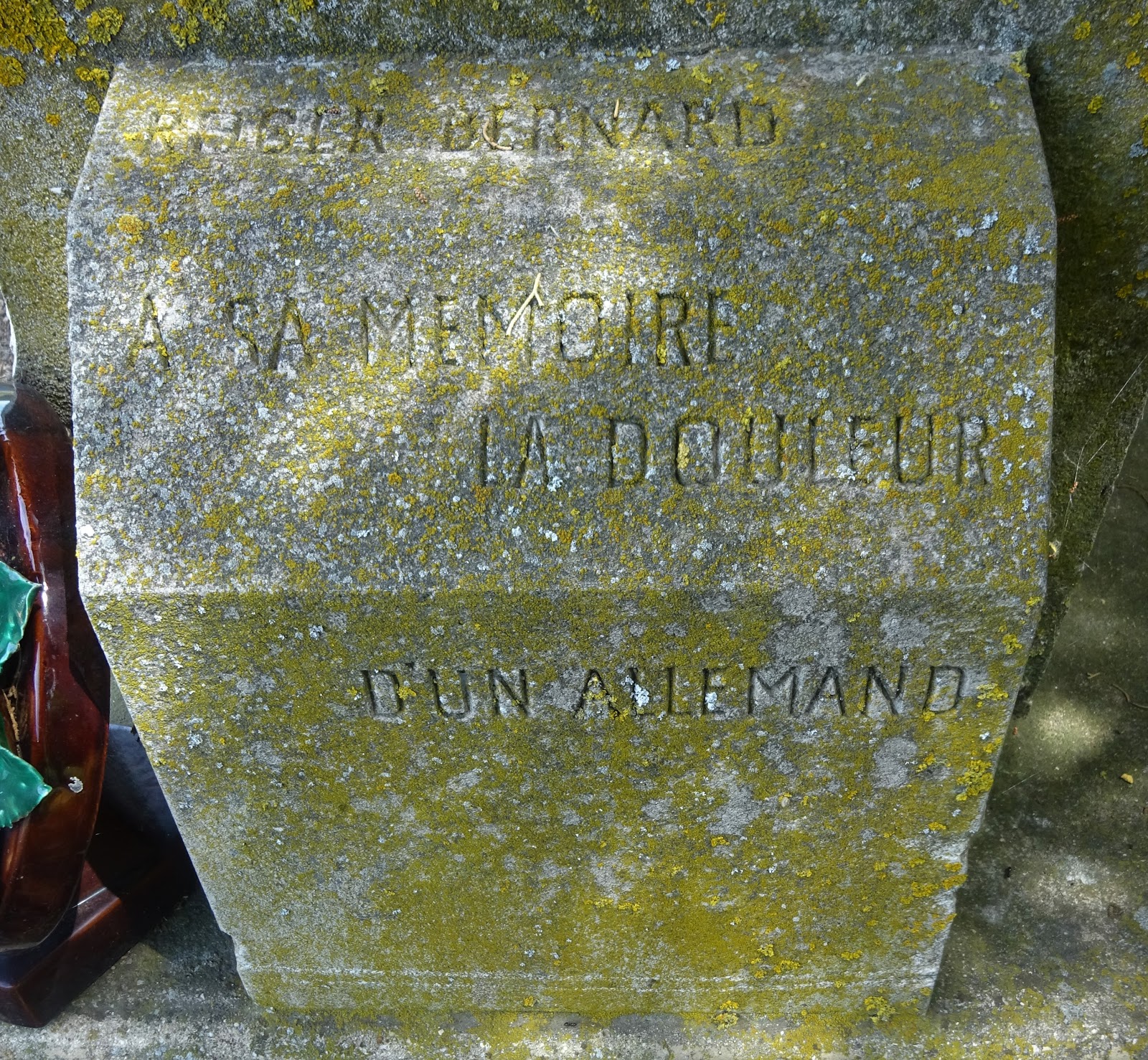
Roger Bernard in Saint-Martin-de-Castillon, Vaucluse (84)
On the D33 heading north towards Viens, about one hundred metres after its junction with the D900, several hundreds metres from Céreste in Alpes-de-Haute-Provence but in fact only a few yards inside Vaucluse, is a monument to the poet Roger Bernard, who was killed here by the Gestapo on 22 June 1944 at the age of twenty-three. Included in the memorial are a few words from Anna Marly's 'Le Chant des partisants'.
Frédéric Mistral in Grambois, Vaucluse (84)
Libellés :
Grambois (84),
Mistral (Frédéric),
Provence,
Vaucluse (84)
At the side of the church in Grambois is a quotation from Frédéric Mistral's Lis Óulivado (1912) – meaning 'Les Olivades', or olive gatherings – into French as "Le paysan, en tout pays, est le support de la nation ; on aura beau faire des inventions, il faut que se remue la terre": Mistral is of course emphasising the vital importance of the peasant, the person who works the soil, in all countries.
My Frédéric Mistral posts:
––––––––––––––––––––––––––––––––––––
Frédéric Mistral at Le Mas du JugeMy Frédéric Mistral posts:
––––––––––––––––––––––––––––––––––––
Frédéric Mistral: Mireille
Frédéric Mistral in Maillane
Le Pavillon de la Reine Jeanne, Les Baux-de-Provence
Frédéric Mistral in Saintes-Maries-de-la-Mer
Frédéric Mistral in Saint-Giniez, Marseille
Frédéric Mistral, Marseille
Frédéric Mistral in Avignon
Frédéric Mistral in Saint-Rémy-de-Provence
Frédéric Mistral in Grambois
Frédéric Mistral in Saint-Michel-l'Obsevatoire
Frédéric Mistral in Pertuis
23 June 2019
Marius André in Sainte-Cécile-les-Vignes (84)
Libellés :
André (Marius),
Sainte-Cecile-les-Vignes (84),
Vaucluse (84)
Marius André (1868-1927) was a writer, poet, journalist, critic and translator from French to Occitan, born in Sainte-Cécile-les-Vignes, where there is a plaque on his house. Initially he was close to Mistral's Félibrige and published by Joseph Roumanille. However, he later became one of the collaborators of Charles Maurras's L'Action française. He also contributed to Revue universelle, La Revue du siècle and other organs. In the garden of the chapel at Sainte-Cécile-les-Vignes a reproduction of his funeral monument, made by David Vallée, was made to replace the original in the Cimetière de Vaugirard in Paris, which was accidentally destroyed.
22 June 2019
The Water Mill, Les Taillades, Vaucluse (84)
Libellés :
Les Taillades (84),
Provence,
Vaucluse (84)
The paddle wheel water mill in Les Taillades. Le Moulin de Saint Pierre began in 1859, on the opening of Le canal de l’Isle, when its activities were concerned with the madder plant, noted for its dyeing qualities. Competition meant the mill was auctioned in 1867, passed thorough several hands inactive, until it was bought by two millers in 1874, when it became a flour mill until 1881. Eventually the municipalité of Les Taillades bought the mill in 1981, where it serves a number of cultural purposes.
21 June 2019
Tino Rossi in Lauris, Vaucluse (84)
Libellés :
Lauris (84),
Provence,
Rossi (Tino),
Vaucluse (84)
Tino Rossi (1907-83) was born in Ajaccio and was known by the yucky epithet 'Le Roi des chanteurs de charme' ('The king of the charm singers') His 'Petit Papa Noël' (1946) remains the song which has sold the most number of copies in the history of the French recording industry. As the sign here notes in a shop in Lauris which is now a florist's, this is where he made his first public performances, on 14 and 15 September 1930. The representation of the harp on the façade strongly indicates that this building was originally designed for musical activities.
16 June 2019
Vélocio (Paul de Vivie), Pernes-les-Fontaines (84)
Paul de Vivie (1853-1930) isn't a household name, even in his native France, and nor even is he well known by his more popular name 'Vélocio' (which the French Wikipédia page translates as 'the fast cyclist'). However, he's big in Pernes-les-Fontaines, a small town in Vaucluse. Vélocio was born in Pernes, moved to Saint-Étienne and started cycling in 1881. He became secretary of the Club des cyclistes stéphanois the following year, when he also established the Stéphanoise cycle company La Gauloise, and in 1886 L'Agence Générale Vélocipédique. In 1887 he founded Le Cycliste forézien magazaine, which became Le Cycliste in 1888. He visited England and established firm connections with Raleigh cycles in Nottingham. Vélocio is the founder of French cycling tourism, and a firm supporter of vegetarianism, which he believed led to a long life. Unfortunately he died in 1930 after being hit by a tram, which fractured his skull and from which he never regained consciousness. He is buried in the Cimetière de Loyasse, in Lyon.
As a centenary commemoration of his birth, this plaque was affixed to Vélocio's birthplace.
This monument was inaugurated in 2003, the 150th anniversary of Vélocio's birth.
15 June 2019
Le Massif ocrier du Luberon, Roussillon (84)
Libellés :
Roussillon (84),
Vaucluse (84)
The village of Roussillon is most popularly known as the village where Samuel Beckett stayed with his partner Suzanne Dechevaux-Dumesnil from 1942 to 1945 during World War II. But the ochre hills around Roussillon have long been exploited commercially, one site has been listed and is open as an attraction. Here natural geographical shapes mix with shapes that have been formed by exploitation, and some structures have exotic names such as Cheminées des fées, Cirque des aiguilles and Chaussée des géants. Two trails exist, of different lengths and merging into each other. It is quite a spectacular sight.
14 June 2019
Jean Raffegeau's Cadran solaire (sundial) in Roussillon (84)
Libellés :
Raffegeau (Jean),
Roussillon (84),
Vaucluse (84)
'Jean Raffegeau
1923-1993'
I daren't say anything about Jean Raffegeau's sundial because I don't understand anything about it: explanations are given in French and English but they may just as well be written in the most obscure language in the world for all I know: this is science, and I just have to admire from an ignorant distance.
Garlic in Piolenc (84)
Libellés :
Piolenc (84),
Vaucluse (84)
A head of garlic is the emblem of Piolenc, Vaucluse, which also has a garlic festival. This representation of a head was made and given to Piolenc by Leonardo Leone, and blessed by Father Khanh Nguyen, curé of Piolenc. It was inaugurated by the town mayor in August 2016 at the time of the thirty-seventh garlic festival.
6 June 2019
Raoul Dautry in Lourmarin (84)
Libellés :
Dautry (Raoul),
Lourmarin (84),
Provence,
Vaucluse (84)
The Dautry grave in Lourmarin includes Raoul Dautry (1880-1951), who began his career with La Compagnie du Chemins de fer du Nord. During the Occupation he retreated to his property to Lourmarin, where he became mayor between 1945 and 1951. Dautry masterminded the cite-jardin in Tergnier in the Nord, although from the little I've read about him his interests seem to tend towards a kind of Taylorism: maximum efficiency for the maximum profit. He wrote Métier d'Homme (1937), which is prefaced by Paul Valéry.
Frédéric Mistral in Pertuis (84)
Libellés :
Félibrige,
Mistral (Frédéric),
Pertuis (84),
Provence,
Vaucluse (84)
La Santo-Estello is the Félibrige festival-cum-congress which takes place in a town in one of the thirty-two départements in the south of France: this year is the turn of Pertuis in Vaucluse. The festival promotes regional culture, and it is of course fitting that Frédéric Mistral should boldly feature on the poster advertising the event which is between 7 to the 11 June 2019.
My Frédéric Mistral posts:
––––––––––––––––––––––––––––––––––––
Frédéric Mistral at Le Mas du JugeMy Frédéric Mistral posts:
––––––––––––––––––––––––––––––––––––
Frédéric Mistral: Mireille
Frédéric Mistral in Maillane
Le Pavillon de la Reine Jeanne, Les Baux-de-Provence
Frédéric Mistral in Saintes-Maries-de-la-Mer
Frédéric Mistral in Saint-Giniez, Marseille
Frédéric Mistral, Marseille
Frédéric Mistral in Avignon
Frédéric Mistral in Saint-Rémy-de-Provence
Frédéric Mistral in Grambois
Frédéric Mistral in Saint-Michel-l'Obsevatoire
Frédéric Mistral in Pertuis
6 July 2018
Mirabeau in Pertuis, Vaucluse (84)
Libellés :
Mirabeau,
Pertuis (84),
Provence,
Vaucluse (84)
This is one I forgot when in Provence. Gabriel Riqueti de Mirabeau, often simply known as Mirabeau (1749–91), was a writer (including erotic wrting), diplomat, journalist and politician who played his part in the French Revolution. Although born in Bignon, Loiret, he came from an aristocratic family in Provence, and studied Law in Aix-en-Provence university. His family lived in the square here in Pertuis, which took Mirabeau's name on his death. His Lettres à Sophie, correspondance with his mistress Sophie de Monner written while imprisoned on Vincennes, are amongst his best known writings. Lamartine was greatly impressed by them, and Albert Thibaudet considered them some of his best work. A similar statue of Mirabeau In Aix has been moved several times, and once the arm pointed to the town hall toilets in Aix. There is also a bust of him in the nearby town of Mirabeau.
23 June 2018
Robert Laurent-Vibert, Lourmarin, Vaucluse (84)
Libellés :
Laurent-Vibert (Robert),
Lourmarin (84),
Provence,
Vaucluse (84)
Rich heir, former industrialist and historian Robert Laurent-Vibert (1884–1925) settled in Lourmarin in 1920, where he acquired its delapidated castle and set about having it restored. Years before, after his studies at the ENS, he visited Rome and, impressed by the Villa Médicis, was inspired enough to think of the existence of a 'Petite Villa Médicis de Provence' which would welcome creative boarders in the summer. In 1923 he willed the Château de Lourmarin and his collections to the Académie des Sciences, Agriculture, Art et Belles Lettres d’Aix-en-Provence. He died in a car crash in 1925, and the Fondation de Lourmarin Robert Laurent-Vibert was created. Laurent-Vibert's publications include Les Affaires et la pensée (1921); Le sophisme de la compétence (1922); Voyages, routiers, pèlerins et corsaires aux Échelles du Levant (1923); L'Orient en mai 1923 (1923); Ce que j'ai vu en Orient : Mésopotamie, Palestine, Syrie, Égypte, Turquie, notes de voyage, 1923-1924 (1924).
15 June 2018
André de Richaud in Althen-des-Paluds, Vaucluse (84)
Libellés :
Althen-des-Paluds (84),
Provence,
Richaud (André de),
Vaucluse (84)
André de Richaud was a writer, poet and playwright who was born in Perpignan in 1907 and died in Montpellier in 1968. By the time he was seventeen or eighteen both of his parents were dead. At college in Carpentras he befriended Pierre Seghers, who was to be his editor. Later he met the poet André Gaillard, founder of Cahiers du Sud, and Joseph d'Arbaud, an écrivain-félibre who directed Le Feu.
Richaud published his first novel, La Douleur, in 1930. Jean Grenier gave it to Albert Camus to read, who read it in one night (as usual with him), but Camus awoke to an unknown land: books weren't just for entertainment, distraction, La Douleur had given Camus a glimpse of the creative world.
André de Richaud's maternal grand-father lived in Althen, where Richaud set many of his books. He is perhaps best known for his fourteen-year life with the artist Fernand Léger and more particularly Léger's wife Jeanne. Adultery, alcoholism, and being a begging tramp are also sometimes mentioned in biographical details.
And not only is a street named after André de Richaud, but a school too.
My André de Richaud posts:
––––––––––––––––––––––––––––––––––––
André de Richaud: La DouleurRichaud published his first novel, La Douleur, in 1930. Jean Grenier gave it to Albert Camus to read, who read it in one night (as usual with him), but Camus awoke to an unknown land: books weren't just for entertainment, distraction, La Douleur had given Camus a glimpse of the creative world.
André de Richaud's maternal grand-father lived in Althen, where Richaud set many of his books. He is perhaps best known for his fourteen-year life with the artist Fernand Léger and more particularly Léger's wife Jeanne. Adultery, alcoholism, and being a begging tramp are also sometimes mentioned in biographical details.
And not only is a street named after André de Richaud, but a school too.
My André de Richaud posts:
––––––––––––––––––––––––––––––––––––
André de Richaud in Althen-des-Paluds
14 June 2018
Jean Althen in Althen-des-Paluds, Vaucluse (84)
Libellés :
Althen (Jean),
Althen-des-Paluds (84),
Provence,
Vaucluse (84)
The commune of Althen-des-Paluds is one of the youngest in Vaucluse, officially recognised as one is 1845. The 'Paluds' comes from swamps, but the 'Althen' is a tribute to the Armenian Jean d'Althen or Halovhannès Althounian (1710-1774), who specialised in the madder plant, cherished for its red dye and certain healthy properties of its root. Before, he was a slave in Turkey but was saved and came to Avignon, where he carried out experiments into the cultivation of madder. Althen-des-Paluds prospered in the 1830s due to the madder plant, and it is thanks to Jean Althen that it was able to gain autonomy from Monteux.
An older statue of Jean Althen existed in Althen-des-Paluds but was removed by the Nazis for melting down for weapons. In 2005 a new statue of Jean Althen, by Marcella Kratz, was erected in front of the Mairie in the presence of the French Armenian ambassador.
Camille Claudel, Montfavet, Vaucluse (84)
Libellés :
Claudel (Camille),
Montfavet (84),
Provence,
Rodin (Auguste),
Vaucluse (84)
Camille Claudel (1864–1943), the sister of the dramatist and poet Paul Claudel, was a French sculptor perhaps best known for her relationship with Auguste Rodin (1840–1917). She was born in Fère-en-Tardenois (Aisne) and died in the psychiatric hospital in Montedvergues, Montfavet. There, in July 2018, they will erect a memorial to Camille Claudel: unfortunately, we'll be elsewhere.
She met Rodin in the Académie Colarossi in Paris, becoming his student, assistant and lover. After their separation she became reclusive, attempting to free herself from the artistic style of Rodin. After the marriage of her formerly supportive brother she became a recluse in her workshop. The victim of an obsessive neurosis, she destroyed most of her works. Following the death of her father in 1913 her mother interned her in a psychiatric hosptial in Seine-Saint-Denis. She was transferred to Montfavet two years later, where she remained until her death almost thirty years later, essentially caused by malnutrition, which was normal in such hospitals during the war.
She was initially buried in a plot in Montfavet cemetery, but her remains were moved to the cemetery's then anonymous communal ossuary about 1951. Her great-niece Reine-Marie Paris had a cenotaph erected, which includes two quotations from her great-aunt.
'There is always something missing which torments me'
'My great wish, my ideal, is to fashion my shapings of the paste into an idea! The idea isn't enough for me: I want to clothe it in purple and crown it in gold'.
She met Rodin in the Académie Colarossi in Paris, becoming his student, assistant and lover. After their separation she became reclusive, attempting to free herself from the artistic style of Rodin. After the marriage of her formerly supportive brother she became a recluse in her workshop. The victim of an obsessive neurosis, she destroyed most of her works. Following the death of her father in 1913 her mother interned her in a psychiatric hosptial in Seine-Saint-Denis. She was transferred to Montfavet two years later, where she remained until her death almost thirty years later, essentially caused by malnutrition, which was normal in such hospitals during the war.
She was initially buried in a plot in Montfavet cemetery, but her remains were moved to the cemetery's then anonymous communal ossuary about 1951. Her great-niece Reine-Marie Paris had a cenotaph erected, which includes two quotations from her great-aunt.
'My great wish, my ideal, is to fashion my shapings of the paste into an idea! The idea isn't enough for me: I want to clothe it in purple and crown it in gold'.
Subscribe to:
Posts (Atom)