Showing posts with label Vaux-en-Beaujolais (69). Show all posts

9 August 2021

Musée Gabriel Chevallier in Vaux-en-Beaujolais (69), Rhône (69)

Opposite the fresco and the pissotière is the Musée Gabriel Chevallier, a small room with a wealth of (mainly pictorial) information on the writer, including some of his drawings.

A representation of Chevallier made at an unknown date.

Chevallier in his Amilcar (1923-25).

Again, the date of this photo is unknown.

Madeleine, Chevallier's wife, at the time of the marriage in 1936.

The 1945 edition of Clochemerle, with illustrations by Albert Dubout.

Chevallier was in World War I, and drew representations of soldiers, of which this is one.

An undated self-portrait.

And another (obviously much later) undated self-portrait.

La Peur (1930) is Chevallier's first novel, about World War I. It formed the basis for Jean-Pierre Jeunet's film Un long dimanche de fiançailles (2004).

Chevallier is all over Vaux, and within a few seconds of the square we encounter representations of his characters. Bernard Pivot, the ex-chair of the Goncourt panel, was born here and has a school named after him, but Chevallier reigns supreme.

Gabriel Chevallier in Vaux-en-Beaujolais (69), Rhône (69)

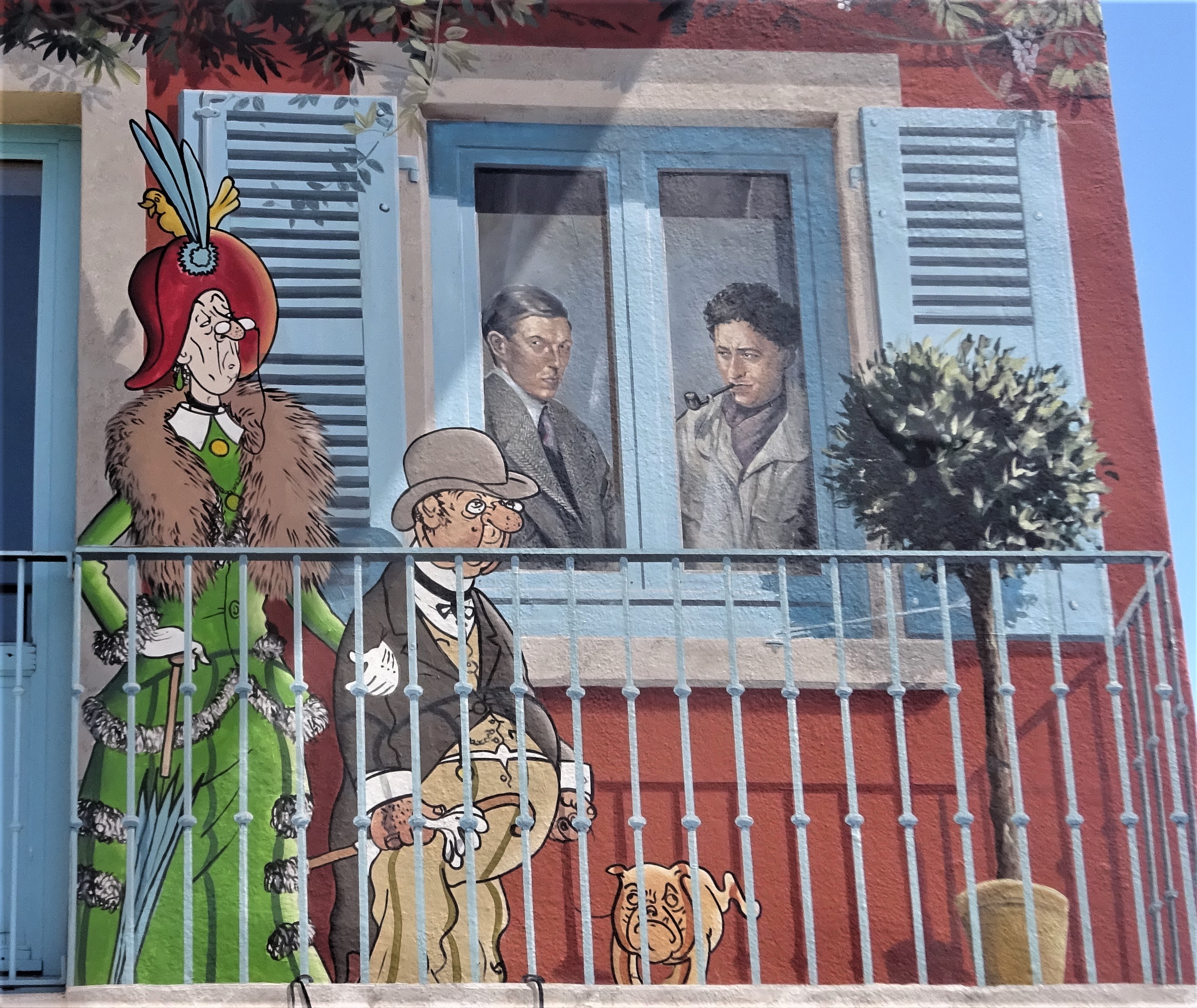
The writer and artist Gabriel Chevallier (1885-1969) was born in Lyon, although it was the much smaller Vaux-en-Beaujolais which inspired his greatest success, Clochemerle, which was originally published in 1934. It in turn inspired a film and a television series, and as you enter Vaux you find that it also has another name: Clochemerle, of course. Prominent in the village is a house with murals of some of a number of characters in the book: it was designed by the A. Fresco company after illustrations by Albert Dubout, which appeared in the 1945 edition of the novel. Included are a couple of lovers near the cuckolded butcher (wearing stag horns); the curé and his maid; the chemist; Chevalier and Dubout at a window; the baron and a local solicitor; the Café Torbayan drunkards celebrating the beaujolais nouveau; the village band; the punished; etc.  Also prominent in the square is a representation of the village pissotièreThe mock heraldic device on the building is a rebus: it shows a bell (cloche) and two blackbirds (merles) perched on a pissotière.