Showing posts with label Hauts-de-Seine (92). Show all posts

20 October 2019

Bernard Eschasseriaux: Les Dimanches de Ville-d'Avray (1958)

Bernard Eschasseriaux's Les Dimanches de Ville-d'Avray has many differences from the highly successful cult film directed by Serge Bourguignon and starring Hardy Krüger as Pierre and Patricia Gozzi as Françoise. It wasn't seen as controversial in the far more innocent days of the film and book, although today it would smack of paedophilia, highly suspect as it concerns a relationship between a thirty-year-old-man and an eleven-year-old girl. Sort of, although the man is really a child himself.

Pierre meets the girl with her father at the train station at Ville-d'Avray when the father asks him the way to the 'Les Dames de Sainte-Maguerite' institution, where he is taking her: the child has been born 'out of wedlock', the couple live separately, and the Françoise hardly knows her father. Pierre secretly follows the couple until the father leaves her with the nuns but is then killed in a hit-and-run-accident, whereupon Pierre takes him to a wood and buries him.

This of course is mighty odd behaviour, but then Pierre has been (and in fact still is, although he doesn't know it) involved with a group of criminals, had a bad fall in one of their exploits and has lost all memory of his past. Involved in this is Mado, a prostitute who has taken Pierre in, terrified that he will behave inappropriately, that he will (accidentally) reveal more than he should.

Pierre is fascinated by Françoise, seeing in her to a certain extent the child that he is: Mado is absent from their home on Sundays, so Pierre spends them with Françoise, who swiftly comes to identify with him as the father she has never had, and (uncomfortably for Pierre and the reader too), sees him as her future husband.

Things become increasingly complicated as the body in the wood is discovered, a safer home for Mado and Pierre is sought out in faraway Provence, although two deaths intervene and Françoise is finally left more alone than ever.

12 September 2018

Pierre Albert-Birot in Issy-les-Moulineaux, Hauts-de-Seine (92)


Above is La Veuve ('The Widow'), a sculpture by Pierre Albert-Birot (1876–1967) in Issy-les-Moulineaux cemetery. Albert-Birot was a sculptor, painter, publisher, printer, poet, man of the theatre and screenplay writer, to give a non-exhaustive list of his abilities. He was wary of movements, but was praised and befriended by Max Jacob and Guillaume Apollinaire. He also influenced poets such as Jean Follain, Pascal Pia and Valérie Prouzeau. He married Arlette (née Lafont) (1930–2010) in 1962, and she never ceased to promote his work.

22 September 2017

Paris 2017: Cimetière de Montrouge, Hauts-de-Seine (92) #3: Cécile Aubry


Cécile Aubry (1928–2010) was a novelist, screen writer, and an actor most remembered for her TV series success 'Belle et Sébastien' based on her novels, from which the English indie group Belle and Sebastian took its name.

Paris 2017: Cimetière de Montrouge, Hauts-de-Seine (92) #2: Michel Audiard


Michel Audiard (1920–85) was a screen writer, a film director, and a novelist. Sometimes called a right-wing anarchist, one of his greatest regrets was not to have adapted Céline's Voyage au bout de la nuit to film. He is the father of the film director Jacques Audiard. His novels include Priez pour elle (1950), Massacre en dentelles (1952), Ne nous fâchons pas (1966), Le Terminus des prétentieux (1968), and Le Petit cheval de retour (1975).

Paris 2017: Cimetière de Montrouge, Hauts-de-Seine (92) #1: Albert Kazimirski de Biberstein


Albert (or Albin) Kazimirski de Biberstein (1808–87), of French nationality but born in Poland, was an Arabic-speaking orientalist who was the author of an Arabic-French dictionary, and the translator of several Arabic-French works, principally the Koran.

21 September 2017

Paris 2017: Cimetière parisien de Bagneux, Hauts-de-Seine (92) #1: J.-H. Rosny aîné


J.-H. Rosny aîné was the pseudonym of Joseph Henri Honoré Boex (1856–1940), a French author of Belgian origin who is considered one of the founding figures of modern science fiction. Born in Brussels, Rosny spent most of his years in France. Rosny was an influence on Arthur Conan Doyle, the plot of his Force mystérieuse (1913) being adopted by Doyle for his The Poisoned Belt. Les Navigateurs de l'infini (1925) is generally considered as Rosny's best work, and his use of the word 'astronautique' is a first. However, I suspect that, in spite of a prize existing in his name, Rosny will be most remembered for his disagreements with Lucien Descaves, particularly for the, er, scandalous winning of the Goncourt in 1932 by Guy Mazeline's Les Loups, rather than Céline's Voyage au bout de la nuit, which received the 'compensatory' Renaudot.

19 September 2017

Cimetière nouveau de Neuilly, Hauts-de-Seine (92) #10 Ferdinand Brunot

Ferdinand Brunot, maire du XIVe arrondissement.jpg


Ferdinand Brunot (1860–1938) was a noted linguist. A teacher at the Sorbonne, his famous work was Histoire de la langue française des origines à 1900, nine volumes of which were published between 1905 and 1937.

Cimetière nouveau de Neuilly, Hauts-de-Seine (92) #:9 Jean Aragny


Jean Aragny (1898–1939) was a playwright about whom little information seems readily available, apart from his writings, seems to be known. His plays include Les Yeux du spectre (1924), Prime (1932), and Bourreaux d'enfants (1939). He also wrote the screenplay adaptation of Timothy Shea's novel Toute sa vie (1930), the screenplay of Les vacances du diable (1931), and co-wrote the screenplay for Le Poignard malais (1931).

18 September 2017

Cimetière nouveau de Neuilly, Hauts-de-Seine (92) #8: Victor Charbonnel


Victor Charbonnel (1863–1926) was a priest who left the priesthood and then gave a series of anti-clerical talks. Among a number of other publications he wrote  Séparation de l'Eglise et de la famille (1900), Victor Charbonnel: Sensations de vie (1906), and La Vérité sur le Vatican: Palais et caverne [1907]. In 1901 he founded the paper La raison and was a director of L'Action with Henry Bérenger.

17 September 2017

Cimetière nouveau de Neuilly, Hauts-de-Seine (92) #7: Georges Izambard

Georges Izambard photo anonyme.jpg


Georges Izambard (1848–1931) was teacher of Rhetoric and became the friend of his student, Arthur Rimbaud, in Charleville-Mézières. His first wife Marie was the sculptor René Fauche's daughter. His writings include À Douai et à Charleville. Lettres et écrits inédits [by Arthur Rimbaud] commentés par Georges Izambard (1927) and Rimbaud tel que je l'ai connu (1947).

15 September 2017

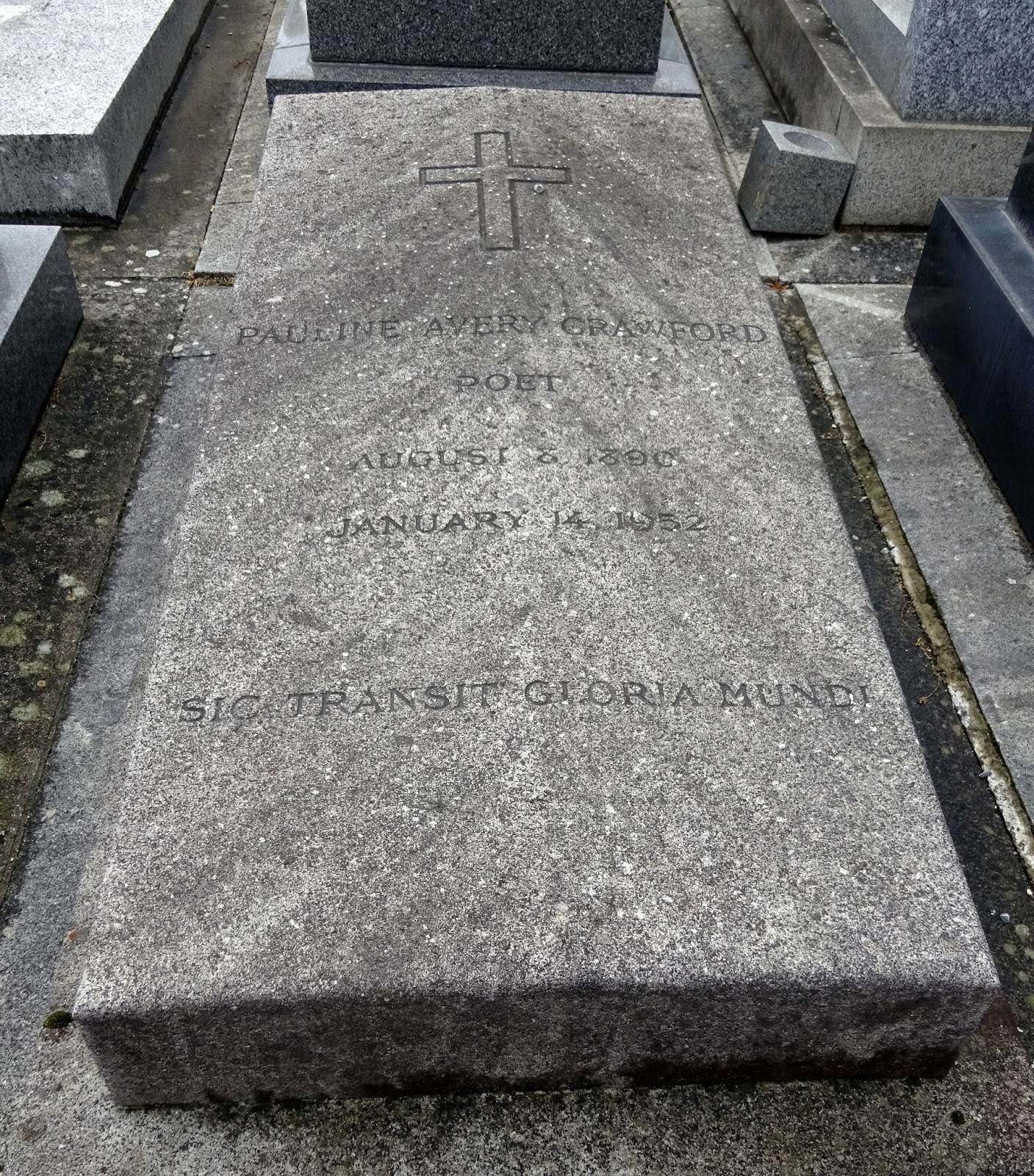
Cimetière nouveau de Neuilly, Hauts-de-Seine (92) #6: Pauline Avery Crawford


Pauline Avery Crawford (1890–1952) was, as Charles L. Robertson's 2001 biography of her states, An American Poet in Paris. His sub-title is 'Pauline Avery Crawford and the Herald Tribune': Crawford was an american expatriate who wrote for the Paris edition of the New York Herald Tribune in the 1930s and 1940s. After the war she wrote a column called 'Our Times in Rhyme' up until shortly before her death.

Cimetière nouveau de Neuilly, Hauts-de-Seine (92) #5: Alek Plunian


Alek (or Alexia) Plunian (1894–1967) was born into a Breton family. Her first novel, Lina, la Jaguine (1926) was about maritime life in Brittany: in the 1920s, she spent several months teaching at a school in Saint-Jacut-de-la-Mer (Côtes-d'Armor). Her other books include Histoire de Pommette (1933), Tempête... (1937), and the play Le Coq qui se fait pigeon (1951).

Cimetière nouveau de Neuilly, Hauts-de-Seine (92) #4: Charles Chassé


Charles Chassé (1883–1965) was born in Quimper and died in Neuilly-sur-Seine. He wrote enormously, and was particularly interested in the unusual, the mysterious, the esoteric: the loves of Napoléon, for example, or religion, witchcraft, the Seznec affair, the Ankou, etc. Three of his works stand out above all: Napoléon par les écrivains (1921), Sous le masque d'Alfred Jarry, les sources d'Ubu-Roi (1922), and Gauguin et son temps (1963).

Cimetière nouveau de Neuilly, Hauts-de-Seine (92) #3: Paul Géraldy


Paul Géraldy (1885–1983) was a poet and playwright who was born in and died in Neuilly-sur-Seine. He has now virtually slipped into oblivion, although his collections of simple poetry, particularly Les Petites Âmes (1908) and Toi et moi (1912) were great popular successes. His plays revolved around the psychology of bourgeois families between the wars.

Cimetière nouveau de Neuilly-sur-Seine, Hauts-de-Seine (92) #2: Marcel Beaufils


Marcel Beaufils (1899–1985) was a highly influential professor of the Aesthetics of Music at the Conservatoire national supérieur de musique et de danse in Paris, his most noted work being Le Lied romantique allemand (1956). He died in Saint-Germain-en-Laye (Yvelines).

Cimetière nouveau de Neuilly, Hauts-de-Seine (92) #1: Wassily Kandinsky


Born in Moscow and one of the twentieth century's most important painters of modern art, Wassily (or Vassily) Kandinsky (1866–1944) was also an engraver, art theoretician, poet and playwright. He gained French nationality in 1939 and died in Neuilly-sur-Seine.

César's thumb, La Défense, Hauts-de-Seine (92)

There are several reproductions of César's thumb, one of which I included here on our visit to Marseille. This is the largest, being twelve metres high and weighing eighteen tonnes.

22 November 2016

Félicien Marceau, Neuilly-sur-Seine, Hauts-de-Seine (92)


'Louis CARETTE dit Félicien MARCEAU
de l'Académie française 1913 – 2012'

Félicien Marceau was a French playwright and novelist born in Belgium. His most noted play is L'Œuf (1956), which is developed from his novel Chair et cuir (1951). His novel Creezy (1969) won the Goncourt on its year of publication: it concerns a cover girl and a député who are deeply in love but whose relationship backfires, and Marceau described it as a very modern story. The grave is in the Cimetière ancien de Neuilly.

27 October 2015

Paris 2015: Cimetière parisien de Bagneux #12: François-Charles Barlet

'ALBERT FAUCHEUX
DIT F.-CH. BARLET
1838 – 1921'

François-Charles Barlet was an occulist and had similar interests to those of Papus and Max Théon. He was one of the first members of the French Theosophical Society, although he left them and joined the Groupe indépendant des études ésotériques (GIDEE). His publications include Essai sur l'évolution des idées (1891), Principe de sociologie synthétique (1894), L'évolution de la sociologie (1894), L'instruction intégrale (1895), Synthèse de l'esthétique : la peinture (1895), and L'art de demain : la peinture autrefois et aujourd'hui (1897).

Paris 2015: Cimetière parisien de Bagneux #11: Semyon Yushkevich

'SEMEON
JONCHKEVITCH
NÉ LE 6
DÉCEMBRE
1869
MORT
LE 12
FÉVRIER
1927'
I've not been able to discover much about this Russian playwright and novelist, quite probably because his first name is also transcribed Simeon, Simon, Semyon, etc, and his surname Youchkievitch, Jushkevich, and so on. However there's an English Wikipedia page on him (but not a French one as far as I can see and my Russian's non-existent) which has a few paragraphs. He was a member of the Sreda literary group in Moscow and 'was a representative of the Jewish-Russian school of literature'. I also learn that he wrote a play called 'King' (1906) and a novel called 'Leon Drei'. (I use the inverted commas rather than the conventional italics because I doubt that these works have ever been translated into English, although in Russian his oeuvre apparently stretches to a fifteen-volume collection.