Showing posts with label Leconte (Patrice). Show all posts

19 January 2022

Patrice Leconte's Dogora : Ouvrons les yeux (2004)

During a French interview, Patrice Leconte said that the film he regrets making is Circulez, y'a rien à voir as it was one comedy too many. He likes Dogora more than any of his other films because hardly anyone has seen it. I'd not even heard of it, so set about rectifying that situation: it's available on YouTube and has been for five years, although so far the link has received less than six thousand views, and I can guess that many of those people don't hang around to watch the whole film. The reason for this is that there's no dialogue, but a large number of generally non-sequential scenes set in Cambodia only with the music of Étienne Perruchon on the soundtrack. Occasionally there are 'words' spoken as a chorus to this music, although this is in 'Dogorien', an imaginary language 'invented' by Perruchon.

Leconte's film, which is unlike anything he's ever done before, is a homage to the country and its people. It shows both urban scenes, mainly of the roads and the people and transport passing, and many scenes of the rural area, harvesting the fields, collecting the sap from trees to make rubber, etc. It is intensely poetic, and although the music blends in harmoniously with the scenes – loud and fast for busy street scenes, softer and slower for the calmer areas – I found it a little too intrusive, and I can sympathise with anyone thinking that these 'European' sounds are out of synch with what we see onscreen.

16 December 2021

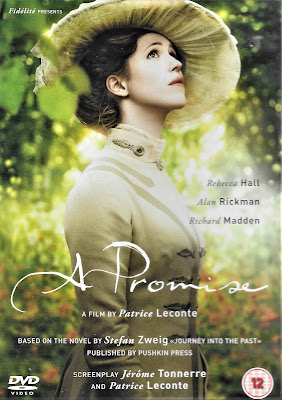
Patrice Leconte's A Promise (2014)

A Promise is Patrice Leconte's first (and almost definitely only) English film, and also has the theme of voyeurism (vide Monsieur Hire, Le Mari de la coiffeuse, Le Parfum d'Yvonne, for example) of the coveted object.

Almost universally, the critics panned this adaptation of Stefan Zweig's story and negatively compared it to other cinematic Zweig adaptations: Max Ophul's Lettre d'une inconnue (1948) and Wes Anderson's The Grand Budapest Hotel (2014). I find this somewhat baffling because I really enjoyed A Promise

The main criticisms were the slowness of the film, its inability to contact with the viewer, the perceived wooden acting of Richard Madden (playing Friederich Zeitz), but this is a film about a very bright but initially poor graduate who quickly gains the attention of Karl Hoffmeister (Alan Rickman), the ailing director of a prominent steel company in Germany. Soon, Friederich is gaining a great deal of confidence from his boss, who becomes reduced to working from home, which Friederich frequently visits to inform his boss of the business activities. There he meets Karl's much younger wife Lotte (Rebecca Hall) and her son, to whom he is giving lessons. In fact he is soon moving from his garret to join them in Karl's very comfortable home.

This is where the problems multiply because Friederich has fallen in love with his boss's wife, and any apparently constipated acting is inevitably a result of Friederich concealing his emotions, which Lotte also has to do too because her feelings are mutual.

Then a major emotional crisis occurs, where Friederich has to spend two years in Mexico: the two (platonic) lovers can hardly stand it. And then the two years become seven as World War I intervenes and the (virtual) couple are even unable to correspond. When Friederich eventually returns Karl has died and the two find communication difficult. But their feelings for each have not changed and they tentatively begin the relationship. This was the part I found the least difficult to take: most people like a happy ending but me? No thanks, I prefer real.

12 December 2019

Patrice Leconte's Le Mari de la coiffeuse | The Hairdresser's Husband (2002)

Patrice Leconte's films are of course intended to 'entertain' in the sense that they aren't made to bore people, but they are emphatically not designed for entertainment value only: quite the reverse, as Leconte's movies are multi-layered and difficult to clearly define.

A number of Leconte's movies have similar themes: suicide (or the thought of it) is quite common, occurring in Le Parfum d'Yvonne, La Fille sur le pont (twice, and although unsuccessful we could argue that the same theme is in itself suicidal); and twice, for instance, in Le Mari de la coiffeuse; ageing is seen as negative, as with the 'old queen' in Le Parfum d'Yvonne, who can't stand the Aznavour song 'Sa jeunesse' reminding him of his age, and Mathilde (Anna Galiena) is concerned about (among other things) an elderly passerby growing older each time she sees him. In Le Mari de la coiffeuse death is ever-present, Antoine being asked by a customer his opinion, to which he replies: 'Death is yellow and smells of vanilla.' 'Are you sure about that asks the customer?' 'I'm taking bets' Antoine confidently replies. All very weird, almost surreal.

Perhaps above all Le Mari de la coiffeuse involves dreams we had in childhood and of how some (particularly Antoine (Jean Rochefort here)) wish to carry them well into late adulthood. Antoine as a child is highly attracted to hairdressers, particularly the buxom one who cuts his hair and he luxuriates in her smells and glimpses of her breast. When his father asks him what he wants to be when he grows, Antoine says the husband of a hairdresser: for that he gets a slapped face from his father, who nonetheless is mystified by his own violence. And then, well into his fifties, Antoine finds a considerably younger hairdresser who too falls in love with him at first sight, they get married, and live very happily, Antoine indulging in his voyeuristic penchant.

But how much of this is reality, and how much fantasy, the imaginings of an ageing Antoine who's never grown up, is wide open to question.

23 November 2019

Patrice Leconte's Tango (1993)

At the end of Tango,  L'Élégant, aka François (Phillippe Noiret), says of the 'rebirth' of Marie (Miou-Miou): 'Même mortes, elles continuent à nous faire chier' ('Even when they're dead [women] continue to fuck us up.)' Oddly, it reminded me of Osgood (Joe E. Brown's) famous 'Well... nobody's perfect!' invraisembleable closing shot at the end of Billy Wilder's Some Like It Hot (1959). Not that Wilder's film is mysogynistic, but Tango is. François prefers masturbation to a relationship with the other, although the hotel scene of him watching a porn film on TV while drinking several mini-bottles of cognac from the mini-bar is (I hope intended to be) pathetic. This is a kind of buddy movie with a difference, in part a road movie too, and also an (unromantic, mostly) comedy. Buñuel's influence is in there, but more particularly that of Bertrand Blier.

Furious because of Marie's infidelity, Vincent (Richard Bohringer) kills both his wife and her lover with his low-flying plane and the judge very surprisingly declares Vincent not guilty. But this act will come back to haunt Vincent when François seeks his help for his nephew Paul (Thierry Lhermitte) by killing his unfaithful wife Marie: Paul has been serially unfaithful but, hey, let's uphold the double standard. Vincent isn't happy about the debt he's inherited, but has no real choice but to go by it, so it's all down to finding Marie. Which isn't easy, and this is the road movie part, where Paul starts hallucinating, their car is trashed, but they eventually find Marie in Africa.

Bang! She's dead, although Vincent didn't aim her way and Marie pretended. And then Vincent meets her in a supermarket, Marie then visits the trio and we're back to the beginning of this post.

Before the quotation in the first paragraph, François, sending Vincent out on an errand, tells him not to forget 'la boule de vanille', and he repeats this, as if it were of the utmost importance. Why is vanilla so important? We're reminded of Antoine (Jean Rochefort) in Leconte's Le Mari de la coiffeuse saying 'La mort est jaune citron et sent la vanille' ('Death is lemon yellow and smells of vanilla.') What?

Not one of Leconte's best films, but... I don't know.

27 October 2019

Patrice Leconte's La Fille sur le pont | The Girl on the Bridge (1999)

Starring Vanessa Paradis (as Adèle) and Daniel Auteuil (as Gabor), La Fille sur le pont is partly a thriller, partly a weird, very off-centre love story. Adèle is a troubled girl with a troubled history who is about to jump off a bridge. Gabor comes along and tries is save her, but she jumps anyway, he follows her and saves her anyway.

Gabor is a knife thrower, the man who throws knives at girls and whose skill means he misses: well, almost always. What has Adèle to lose but have knives thrown at her as they both make lots of money, visit different countries and live a life on the edge: the edge of a knife blade.

This is a very odd film, revealing a strange attraction in which Gabor's phallic blades must always miss, in which Adèle's fear seems to be mixed with the thrill – almost – of orgasm. Not that there's any sex between them though, although they seems jealous of each other when seen in an amorous act with another person.

This is a film of chance, winners and losers, a magic-filled fantasy in which the viewer too is on the edge. Eventually Adèle leaves a liner where they're performing, takes a lifeboat on a whim with a man she steals from his wife. And the wife continues the act on the boat as the woman Gabor throws knives at, until a knife pierces her leg.

And Gabor is washed up on the shore of his own existence, living in poverty until he is the one waiting to jump from the bridge. Until Adèle comes along that is. The wheel has come full circle.

22 October 2019

Patrice Leconte's Monsieur Hire (1989)

Patrice Leconte's Monsieur Hire is the second filmed version of George Simenon's Les Fiançailles de Monsieur Hire (1933), the first being Julien Duvivier's Panique (1946), although that film wasn't as faithful to the book as this is. To some, this movie – perhaps like most Leconte movies in general – might seem a little slow, a little encumbered by long shots, but that is how Leconte does it, lingering lovingly over the sensations of the characters, allowing the audience not only to favour the moments gently, but also to speculate on the psychology of the characters.

From the opening scenes we know that a girl in her early twenties has been murdered, although not the motive. We also know the Inspector (André Wilms) dealing with the case, and that he strongly suspects Monsieur Hire (not his real name, but a changed one) and wonders why Hire (Michel Blanc) is so detested. For detested he is: children bang on his door out of mischief, his neighbours stare at his behind his back, his gets flour bombs thrown at him, etc.

Monsieur Hire is also very odd: he not only dresses impeccably to go to his tailoring business, but he keeps rats in a cage and when one dies he wraps it up in scrap tailoring material and throws it in the river. To counteract his negative aspects, he has numerous tenpin bowling trophies, a sport at which he's recognised as a star, someone who can make a strike blindfolded.

But then again there's definitely something very creepy, very unsavoury about him because he spends hour after hour watching Alice (Sandrine Bonnaire), the girl in the opposite flat, watching her every movement, the way she irons, the way she undresses, the way she makes love to her boyfriend Émile (Éric Thuillier). She wants to marry Émile, and then notices Hire watching her, becomes obsessed by it.

But she appears not to dislike Hire's voyeurism, even seems to be enjoying it, she visits Hire, invites him out for a meal. She comes to learn of his voyeuristic habits, even learns that he is sick of paying for sex, that Hire loves her. Can she possibly be in love with Hire, this much older weird man, a man she discovers has seen Émile kill the young girl? Hire comes to believe it, and the signs she shows would suggest that too, the ecstatic (?) expressions (unseen by Hire) she makes when he touches her lovingly during public events. But surely this is just a mask, a make-believe, surely she is merely entrapping Hire?

As the net moves in closer on Hire he plans to go away with her, frees his rats, packs his bag at waits at the station. But she doesn't come and he returns home to find the Inspector with Alice: the murdered girl's bag has been found in his wardrobe – all the time Alice was playing a double game and her planting of the bag seals the frame-up and the bizarre Hire must be guilty. Hire escapes via the rooftops but falls to his death. Only afterwards does the Inspector discover that all along Hire had been innocent – he has left the proof in a locker.

Monsieur Hire is not only a thriller, not only a crime story, but a festival of the senses and proof of what an amazing film maker Patrice Leconte is.

Patrice Leconte's L'Homme du train | The Man on the Train (2002)

Patrice Leconte's L'Homme du train has only two characters of note: Manesquier (Jean Rochefort) and Milan (Johnny Hallyday). On the surface they couldn't be more different from each other – Manesquier is a taciturn, scarcely educated bank robber with brusque manners, whereas Milan is a retired French school teacher interested in poetry and playing the piano.

But from these highly improbable details stems a brief but hugely powerful bromance. Manesquier enters town (in reality Annonay, although it isn't mentioned) in the evening when everywhere's shutting down and he buys some aspirins for his headache. Milan is just leaving the shop and knows that no hotels are open that time of year, so puts Manesquier up for the night, and has lunch with him the next day and so on for a few days.

Milan knows that Manesquier has come to raid the bank, but far from being annoyed is exited. When Manesquier isn't there he tries on his leather, fringed jacket, trying out Western expressions, and is well aware that his guest has guns with him. His wish is to try using a gun himself, try to knock tin cans down, and in the budding relationship Manesquier is only too willing to allow him to do so. In effect he is trying on the role of the man he would like to have been.

Meanwhile a similar transformation is taking place in Manesquier too: on hearing Milan give a young boy a private lesson, which is on Paul-Jean Toulet's poem 'En Arles', when the boy has left, he asks why the poet says 'Prends garde à douceur des choses', which he finds an odd expression. And later he asks about a line of poetry he knows: 'Sur le Pont Neuf j'ai rencontré', which is in fact the first line of a poem by Aragon, and Milan continues it for him. Even more tellingly, Milan isn't in when his private lesson pupil calls so Manesquier holds the book in question, which is Balzac's Eugénie Grandet – even though he knows nothing about it – and asks the boy questions on the story, what it is about: remarkably, it is evident from the nature of the questions that Manesquier would have made an extremely good teacher if his life hadn't gone the other way.

In an awesome kind of ballet of death – on the Saturday of the bank robbery the two men part company, Milan going to an important hospital operation – the robbery and the operation are constantly juxtaposed, as if each takes place at the exact time. And both men die at the same time, although they both come alive again for a few moments. They, or their souls, cross the street barely noticing one another, Milan takes his place on the train for Manesquier's return journey, and Manesquier goes to Milan's house to try out the piano. Spellbinding.

21 October 2019

Patrice Leconte's Le Parfum d'Yvonne | The Perfume of Yvonne (1994)

There are three main characters in Patrice Leconte's Le Parfum d'Yvonne, which is based on Patrick Modiano's novel Villa Triste: Count Victor Chmara (Hyppolyte Girardot), Yvonne Jacquet (Sandra Majani) and Doctor René Meinthe (Jean-Pierre Marielle). The story is told historically from Victor's point of view, with many long flashbacks to 1958, when he was some years younger and dodging conscription to the Algerian war by moving to an area around Lake Leman, living in hotels and boarding houses. He looks back to the time when his life was turned upside down by the lovely young budding actor Yvonne, when both of them were driven locally to various places by René, the ageing and openly homosexual man who is slightly mad, given to fits of rage in which he calls himself 'La Reine des Belges'.

Le Parfum d'Yvonne is a sensual, dreamy fantasy-cum-reality in which all is not as it seems: 'Victor', to start with, is not a count but a man living under an assumed identity; and as his love affair with Yvonne becomes more intense, his intention being to make his lover a star in the USA, she abruptly ends the relationship without a word. And the flamboyant René is not as happy as it may at first appear: Aznavour's 'Sa jeunesse' reminds him far too much of the little time he has to live, and angers him when he hears it sung.

Early in the film Yvonne (who has a Dalmatian dog) tells Victor that these dogs are prone to suicide. If this is true or not I'm unsure, although it's certainly true that about a quarter of Dalmatians suffer from an excess of uric acid, an active chemical in human depression. Patrice Leconte seems to be obsessed with suicide: not only did he direct the animated film Le Magasin des suicides, but suicide appears in several of his other films, such as Le Mari de la coiffeuse, Monsieur Hire and La Femme sur le pont. Le Parfum d'Yvonne ends dramatically in René deliberately driving through a fence, the car toppling down a cliff and bursting into flames.