Showing posts with label Baudelaire (Charles). Show all posts

20 December 2021

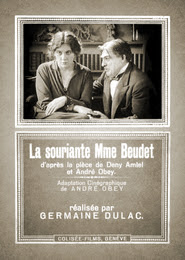
Germaine Dulac's La Souriante Madame Beudet | The Smiling Madame Beudet (1923)

Germaine Dulac's silent avant-garde movie La Souriante Madame Beudet is seen by many critics as the first explicit feminist film, and the title is distinctly ironic.

Madeleine Beudet (Germaine Dermoz) lives in a provincial town with her husband (played by Alexandre Arquillière), who is a grotesque merchant draper in the Beudet et Labas firm. Beudet lives for money, his wife for culture. In spite of her physically comfortable bourgeois existence she is bitterly miserable and a number of images, such as a tennis player whisking her husband away or the vision of a handsome man: a fantasy or a memory – appear as images or superimpostions in the film to reveal her state of mind.

Three particular lines from Baudelaire's 'La Mort des amants' strike her. They are from Les Fleurs du mal, and from the first stanza of the poem, which was incidentally one of Les Cinq poèmes de Charles Baudelaire which Debussy used as song and piano melodies:

'Nous aurons des lits pleins d'odeurs légères,

Des divans profonds comme des tombeaux,

Et d'étranges fleurs sur des étagères 

[...].'

The Beudets have been invited to the theatre to see Faust, although Madeleine (imagining her husband as Mephistopheles) refuses and while she is alone she loads Baudet's gun which he frequently plays with, pretending to kill himself. But she is stricken with remorse and sees images of the court. But before she can retrieve the gun and unload it Baudet has hold of it, and, thinking of course that it is empty, points it at Madeleine and fires. Fortunately he hits the wall, but his stupidity (and his egotism) lead him to believe that it was his wife who sought to kill herself. Return to normality.

4 October 2019

Le Jardin des Personnalités, Honfleur #5: Charles Baudelaire

Charles Baudelaire (1821-67) stayed here in 1859, with his mother and step-father, and wrote that to stay in Honfleur was the dearest of his dreams (which sounds a little like a tourist guide advert!) I'm not fond of the sculpture as it doesn't fit with any photo I've seen of Baudelaire. Under the bust is a photo of Baudelaire's mother's house in Honfleur.


21 November 2016

Charles Baudelaire, 4e arrondissement

22 quai de Béthune. Hôtel Lefebvre de la Malmaison, where Charles Baudelaire lived in 1842 and 1843.

13 November 2013

Charles Baudelaire: Cimetière du Montparnasse #12

 
This time I found Charles Baudelaire's grave and don't know why I missed it the first time round. And more lipstick stains, I think, as with Sartre and Beauvoir's grave, and (in the past at least, as it's now fenced off) Oscar Wilde's grave at Père Lachaise. I now have a sense of completion as I'd already seen the monument.

My first – and very long – post on the Cimetière du Montparnasse:

–––––––––––––––––––––––––––––––––––
Montparnasse Cemetery / Cimetière du Montparnasse

18 November 2011

6th and 7th arrondissements, by the Seine, Paris, France: Literary Île-de-France #29

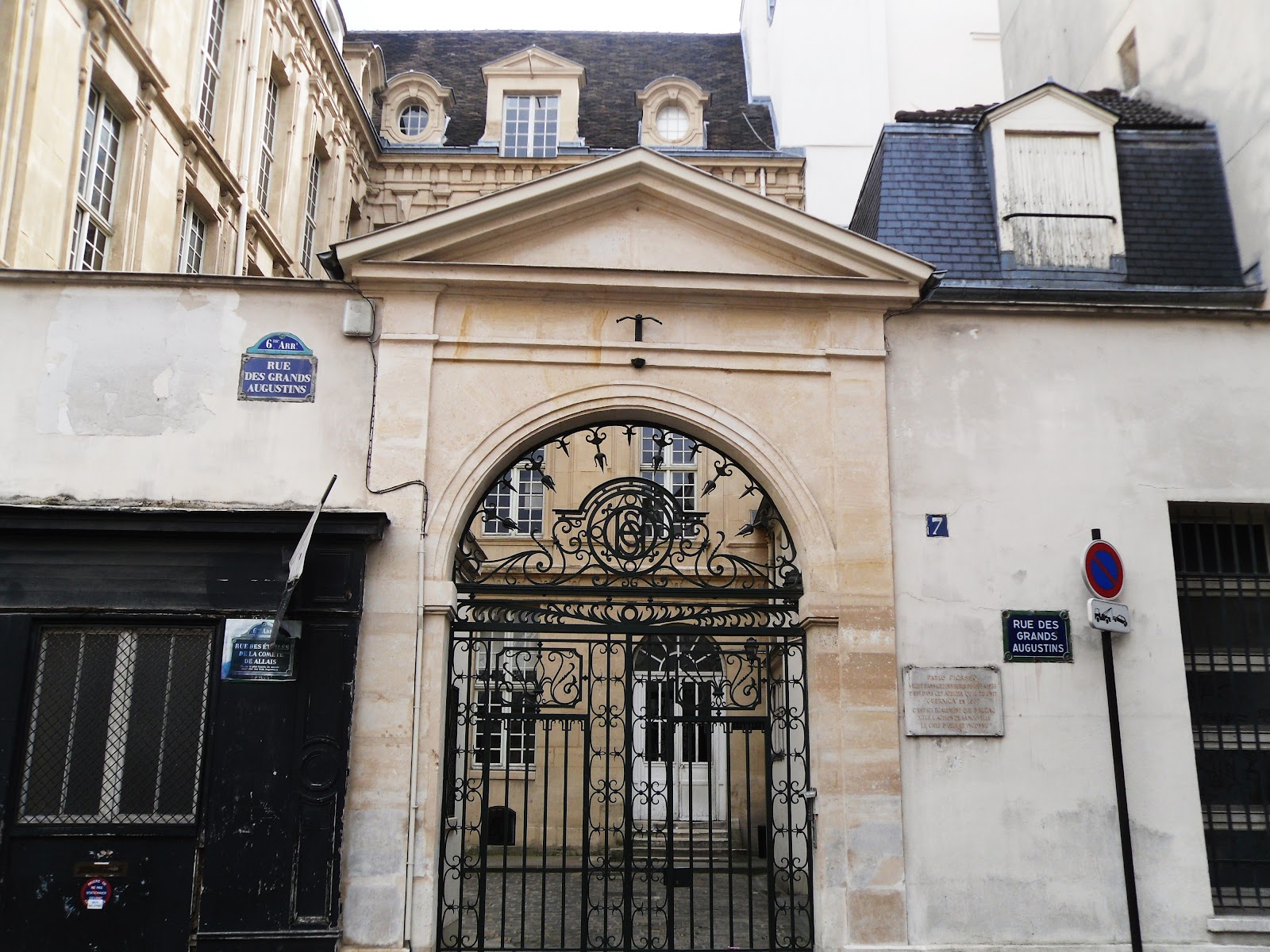
7 rue des grands Augustins.

'PABLO PICASSO

VÉCUT DANS CET IMMEUBLE DE 1936 À 1955
C'EST DANS CET ATELIER QU'IL PEIGNAIT
"GUERNICA" EN 1937'

'PABLO PICASSO
LIVED IN THIS BUILDING FROM 1936 TO 1955
IT IS IN THIS WORKSHOP THAT HE PAINTED
"GUERNICA" IN 1937'.

'C'EST ICI ÉGALEMENT QUE BALZAC
SITUE L'ACTION DE SA NOUVELLE
"LE CHEF D'OUEUVRE INCONNU"'.

'IT IS HERE TOO THAT BALZAC
SITUATED THE ACTION OF HIS SHORT STORY
"THE UNKNOWN MASTERPIECE"'.

In rue de Seine, at the back of the Institut de France, is a small enclosed grassy area with a bust and a statue of two noted French writers:

The more evident is Voltaire.


Although Montesquieu is hiding there.
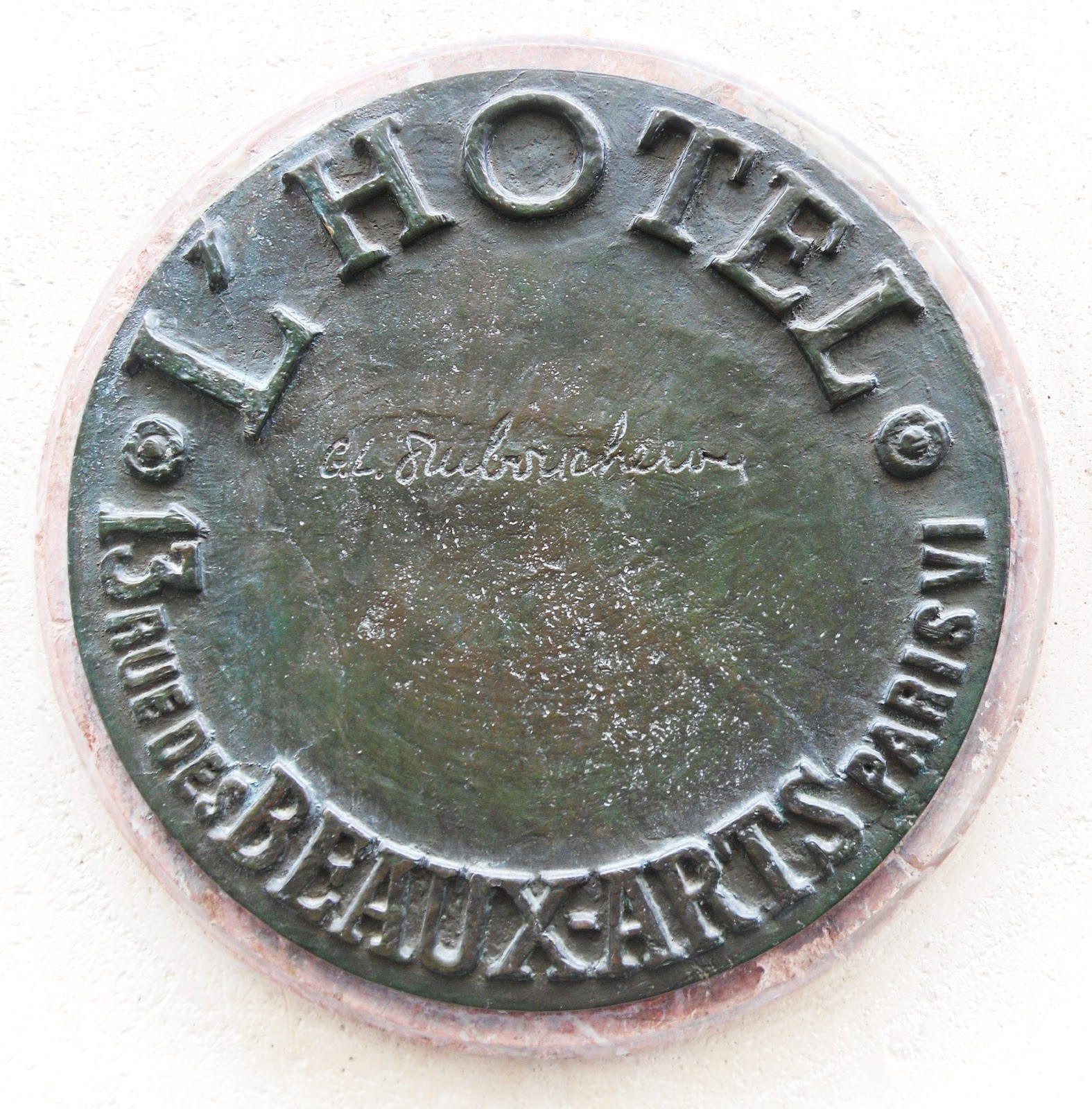
L'Hôtel, rue des Beaux-Arts, 6th arrondissement.

Oscar Wilde (1854—1900).

'OSCAR WILDE
Poète et Dramaturge
NÉ À DUBLIN
LE 15 OCTOBRE 1856
EST MORT DANS CETTER MAISON
LE 30 NOVEMBRE 1900'

'OSCAR WILDE
Poet and Playwright
BORN IN DUBLIN
15 OCTOBER 1856
DIED IN THIS HOUSE
30 NOVEMBER 1900'
 
'ICI VÉCUT

JORGE LUIS BORGES
1899 — 1986
Écrivain Argentin
LORS DE SES FRÉQUENTS SÉJOURS
À PARIS DE 1977 À 1984'

'HERE LIVED
JORGE LUIS BORGES
1899 — 1986
Argentinian Writer
DURING HIS FREQUENT STAYS
IN PARIS FROM 1977 TO 1984'

At 19 quai Malaquais, a barely visible sign around the scaffolding:

'ANATOLE FRANCE
NÉ LE 16 AVRIL 1844
QUAI MALAQUAIS NO. 19
HABITA DANS CET HÔTEL
DE 1844 À 1853'

And at 19 Quai Voltaire:

'ICI 
CHARLES BAUDELAIRE
JEAN SIBELIUS
RICHARD WAGNER
OSCAR WILDE
ONT HONORÉ PARIS
DE LEVR SÉJOVR'

'L'AURORE GRELOTTANTE EN ROBE ROSE ET VERTE
S'AVANÇAIT LENTEMENT SUR LA SEINE DÉSERTE
ET LE SOMBRE PARIS, EN SE FROTTANT LES YEUX,
EMPOINGNAIT SES OUTILS, VIEILLARD LABORIEUX'.

CHARLES BAUDELAIRE
"Le CRÉPUSCULE du MATIN"
LES FLEURS du MAL'

Le Voltaire, the house where Voltaire died.

'VOLTAIRE
NÉ À PARIS
LE 21 NOVEMBRE 1694
EST MORT
DANS CETTE MAISON
LE 30 MAI 1778'

8 November 2011

Montparnasse Cemetery / Cimetière du Montparnasse, 14th arrondissement, Paris, France: Literary Île-de-France #16

Joris Karl Huysmans (1848—97), still very much remembered for his novel À rebours (1884), which the decadent Pete Doherty named a song after on Babyshambles's Down in Albion album.

Honoré Champion (1846—1913) owned a bookstore and published books under his own name. His publications had a scientific bias, although the history of literature was his specialization. Albert Bartholomé was the sculptor of his grave.

Tristan Tzara (1896—1963).

Rather messy, but maybe this is appropriate for the founder of Dadaism.

The grave of Jean-Paul Sartre (1905—80) and Simone de Beauvoir. I was slightly surprised to see them receiving the red lipstick treatment à la Serge Gainsbourg here, or Oscar Wilde in Père-Lachaise.

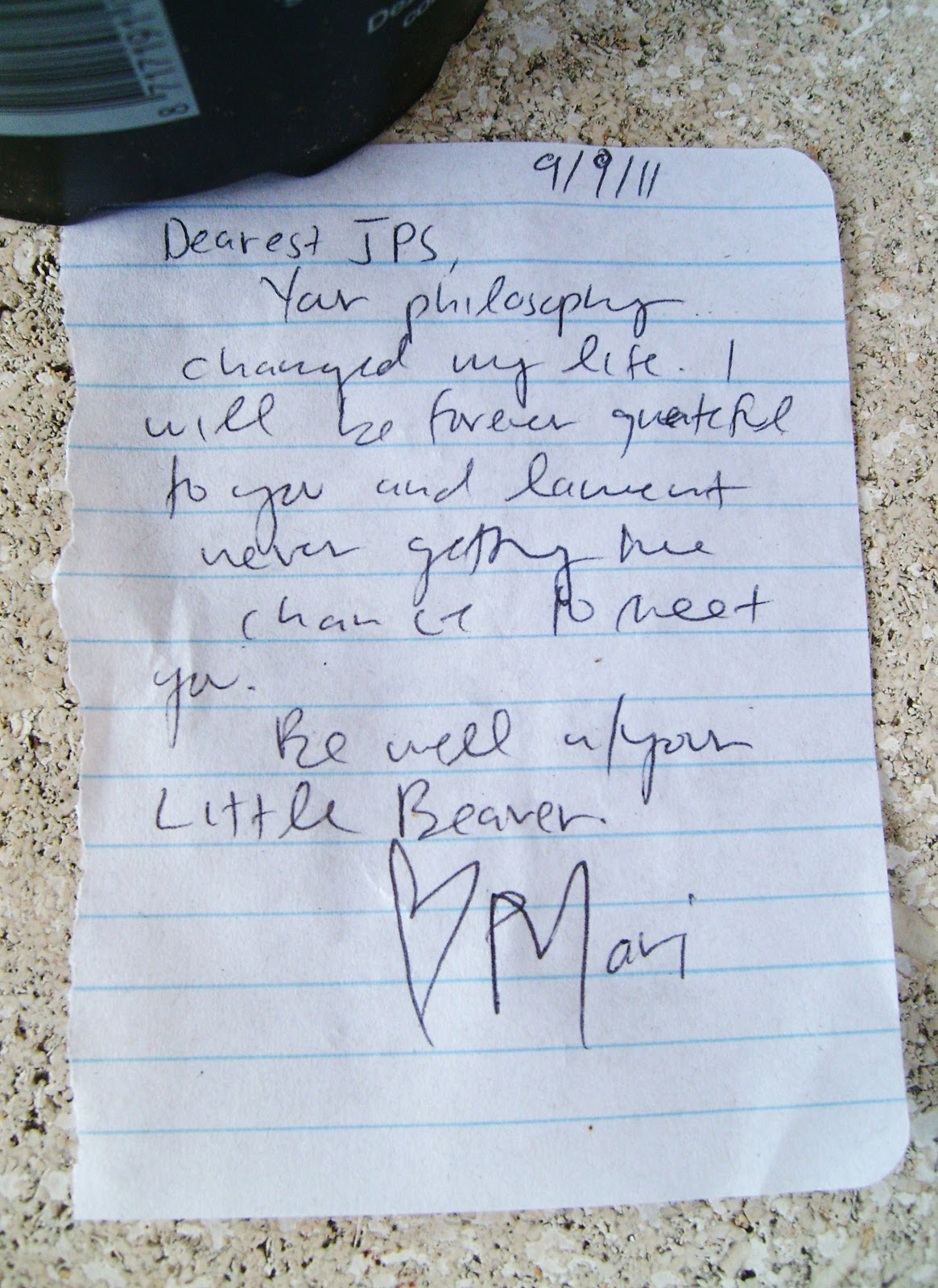
'9/9/11

Dearest JPS,

Your philosophy changed my life. I will be forever grateful to you and lament not having the chance to meet you.

Be well w/your Little Beaver.

[heart symbol] Mari'.

'Las personas mueren, las ideas no'.
['People die, ideas don't']

Eugène Ionesco (1909—94). My comments on this blog on four Ionesco plays are here

Of note is what is written at the bottom edge of the grave:

'Prier le Je Ne Sais Pas Qui
J'espère: Jésus Christ.'

['Praying for the I Don't Know Who
Jesus Christ, I hope']


Samuel Beckett (1906—89). It would have been a shock if it hadn't been a minimalist grave.


An honest rather than a flattering facial representation, by José de Charmoy, of the essayist and literary critic Sainte-Beuve (1804—69), but an extremely impressive monument.


'Poète et Romancier

"tu t'enfonces dans la rose
ébloui par l'or de la nuit'.
                                 R.B.'


Rabah Belamri (1945—95) was born in Algeria and lost his sight in 1962, on the day Algeria was declared independent. After leaving the University of Algiers, he continued his education in Paris, where he earned a doctorate on the work of Louis Bertrand Miroir, which was published several years later. He published several collections of poems and short stories and novels inspired by his Algerian childhood. He is buried with 'L'homme des voyages' Yves Rachid Lefort, although the internet doesn't seem able to tell me why that is.


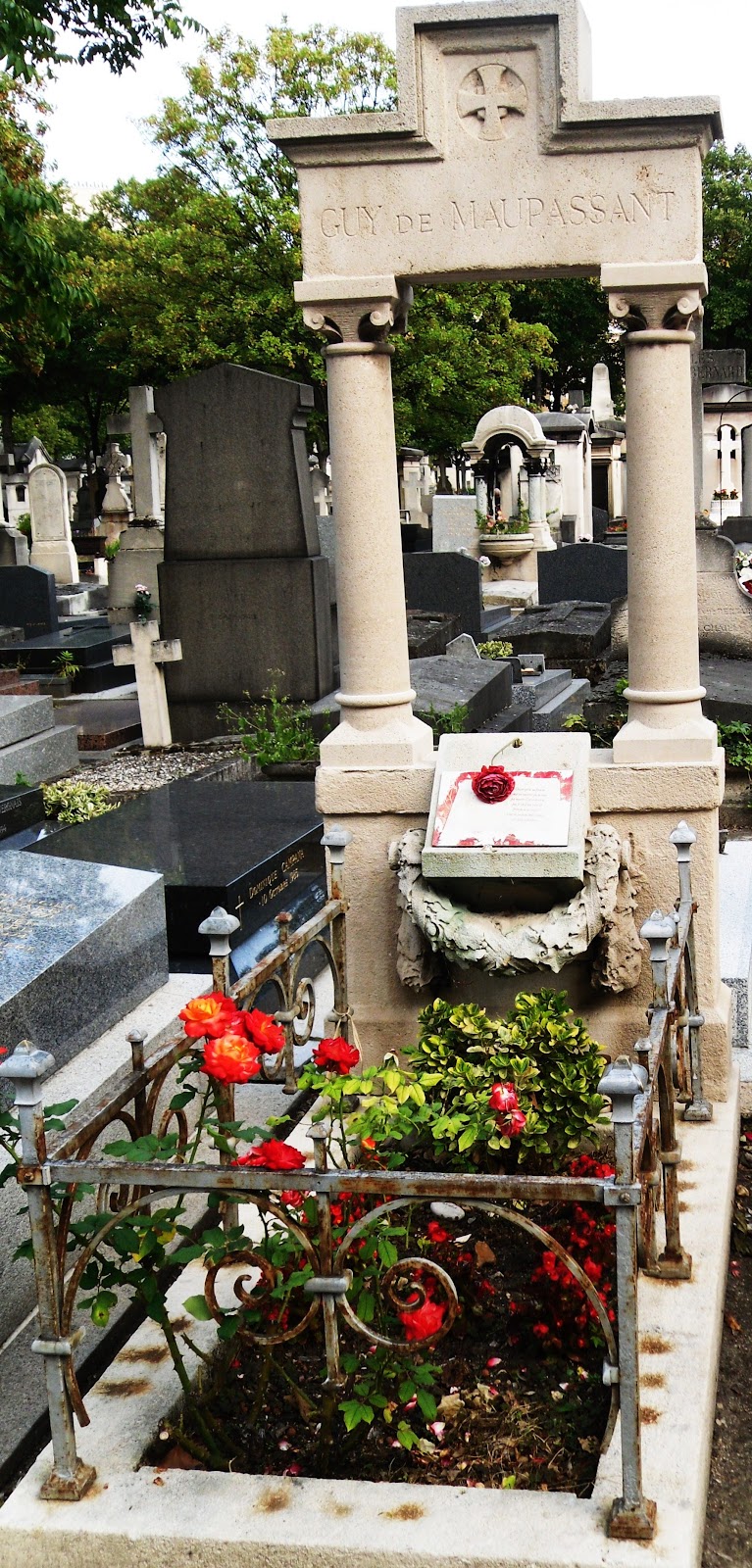
Guy de Maupassant (1950—93), a writer much influenced by the very popular Schopenhauer, although the French translation leaned heavily on the philosopher's more sensational theories about egoism, pessimism and misogyny. Flaubert thought Boule de suif a great work, and Maupassant saw him as a father figure. A very enthusiastic frequenter of brothels who wrote a number of stories about prostitutes, he died insane, riddled with syphilis at the age of 43.


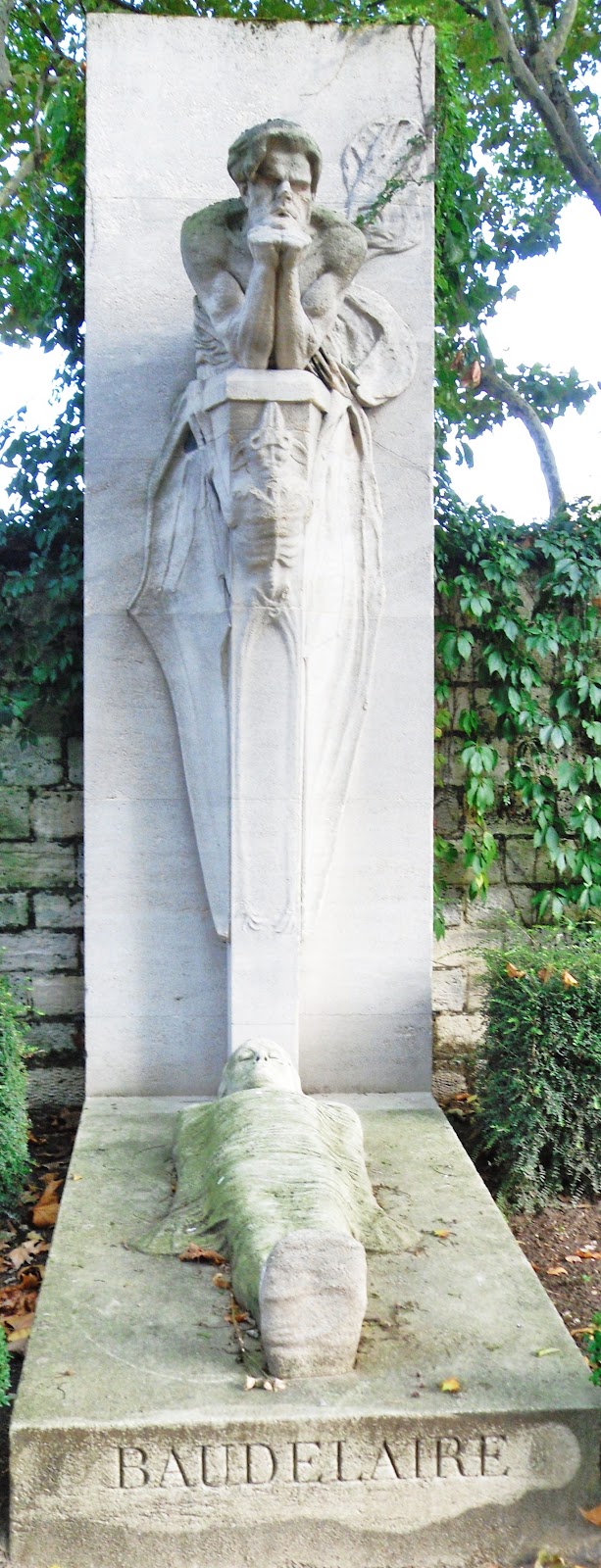
Charles Baudelaire (1821—67), whose grave (which I couldn't find) is sometimes confused with this cenotaph, which was sculpted in 1902 by the same person who made Sainte—Beuve's column — Jose de Charmoy. It features a scowling Baudelaire at the head of a column.


A (slightly vandalized) bat sprawls below him. (Baudelaire is in fact buried with Jacques Aupick, the father-in-law he hated.)

And there is a mummified figure lying on the ground in front of him.