Showing posts with label Montréal. Show all posts

10 June 2015

Alice Parizeau: Côte-des-Neiges (1983)

Alice Parizeau (1930–90) was a novelist, journalist and criminologist. The title of this book – Côte-des-Neiges  refers to an area in Montréal, the town in which much of the action in this book takes place. Parizeau's husband was the economist and politician Dr Jacques Parizeau, who died on 1 June this year.
 
Côte-des-Neiges begins with one of the two central characters – Madeleine, who is called Mado by almost everyone – as a twelve-year-old at the cinema with her friend Catherine, one of the sourdes-muettes (the deaf and dumb girls) Mado assists in a nearby convent. Coincidentally, I visited Notre-Dame-des-Neiges cemetery in Côte-des-Neiges last year, and took the photos below of a plot of deaf and dumb girls' graves. The expression 'SOURDES-MUETTES' is at the base of the cross in the centre, and I include an example of one of the gravestones, of Anna Sauvageau. Each stone bears the letters 'S.M.' for sourde-muette. Anna died in 1939, which is also coincidentally one of the years in which this novel is set. Alice Parizeau – who was buried in the adjacent cemetery of Mont-Royal – must have been aware of the existence of the plot.


Côte-des-Neiges is something of a sprawling epic covering about twenty years in the lives of two people: Mado and Thomas. Mado is a foundling whose unknown mother left her with one of the sisters. She was breaking rules by taking Catherine to the cinema, but the girls' actions are particularly visible because the place has to be evacuated due to a fire, and Mado is expelled from the convent and has to work for a pittance as a maid to the Pouliot family, in which the husband is a financially very careful (OK, mean) banker.

Thomas is the young boy who shepherds Mado and Catherine out of the cinema to safety, falling for her charms immediately and planning to make her his girl. But this will take some time, and Thomas's job as a telegram delivery boy obviously doesn't have great prospects. And then the Depression comes and his father Adam, a baker, is running into money problems because his customers are asking for credit all the time and he's a soft touch. Thomas travels across Canada, first working as a wood cutter and then making real money by selling bootleg hootch in the USA, then returns home to Montréal with enough money to keep his father's business afloat.

Thomas goes on to run a successful biscuit factory, but Côte-des-Neiges details much more: it is a study of jealousy and independence set against not only the Depression but the Spanish Civil War and the Second World War. The jealousy largely comes from Thomas's brother Joseph, who has been in love with Mado for years but who comes back from the Spanish Civil War with one arm less and a feeling of defeat.

Independence is written throughout the novel, although it's Mado's independence that is most noticeable, and in some respects Côte-des-Neiges is a strong feminist tale with Mado taking over the running of the factory during Thomas's unforeseen detention in Europe, which ruffles a few feathers and angers the frustrated Joseph, who sees her as turning into a man.

This is in many ways a riveting novel although a little old-fashioned in its ambitions, which tend to lean back to the realism of the nineteenth century novel. But that's not the main criticism I have of it: throughout, Mado and Thomas show a lack of interest in 'politics', viewing any ideology as harmful: they just want to make money and get rich, as if capitalism weren't a political ideology! The narrator seems to confuse Stalinism with communism, and the final chapter seems to me to lack any semblance of credibility: Thomas can clearly see that Canada – laughably, as he sees it – is now embracing a kind of McCarthy witch hunt mentality, although he has denied that he's a capitalist, and has plans to give his workers more money, provide them with decent and cheap housing, etc. I wasn't convinced: what would Mado say?

6 September 2014

Monique Proulx: Les Aurores montréales (1996)

As this is my first taste of Monique Proulx's work, and as there are twenty-seven short stories here – many of them very different from others – I'm undecided about what to make of her.

The title Les Aurores Montréales – translated as Aurora Montrealis in the English version – is an obvious pun on Aurora Borealis, or Northern Lights, and Montréal is almost a character in many of them. It's also the title of one of the stories about a sixteen-year-old writing a book of the same name.

Six other stories seem to be important ones, being italicised, and all ('Gris et Blanc, 'Jaune et Blanc', 'Rose et Blanc', 'Noir et Blanc', 'Rouge et Blanc', and 'Blanc') can relate to the colour of a person's skin.

A number of Proulx's stories concern multicultural Montréal, immigrants to Montréal, and the differences found in Montréal compared to elsewhere. The feeling of dépaysement (or disorientation, literally being out of one's country and the title of one of the stories) isn't only restricted to immigrants from different countries: in 'Le Futile et l'Essentiel', a daughter welcomes – which isn't the right word but it will have to do for now – her mother to the 'big city' for a short stay, although the day the mother spends on her own there ends with the terrified woman being escorted back to her daughter's place by police officers after being  – hiding and terrified – following a brief subway blackout.

And there's the thorny issue of class or status, as evidenced by the title of one of the stories: 'Fucking Bourgeois'. Then in the penultimate story 'Sans Domicile Fixe', ('No Fixed Abode') where a middle-class guy without any encouragement just gives his wallet to a homeless alcoholic guy and joins him on the carré Saint-Louis (which in twenty years doesn't seem to have changed that much).

I can't yet put my finger on what exactly Monique Proulx is up too, but it seems to be something very interesting, and maybe reading her novel Le Sexe des Étoiles (1987) – which concerns a transsexual – will give me a little more to think about.

Meanwhile, Paris calls to us again.

14 August 2014

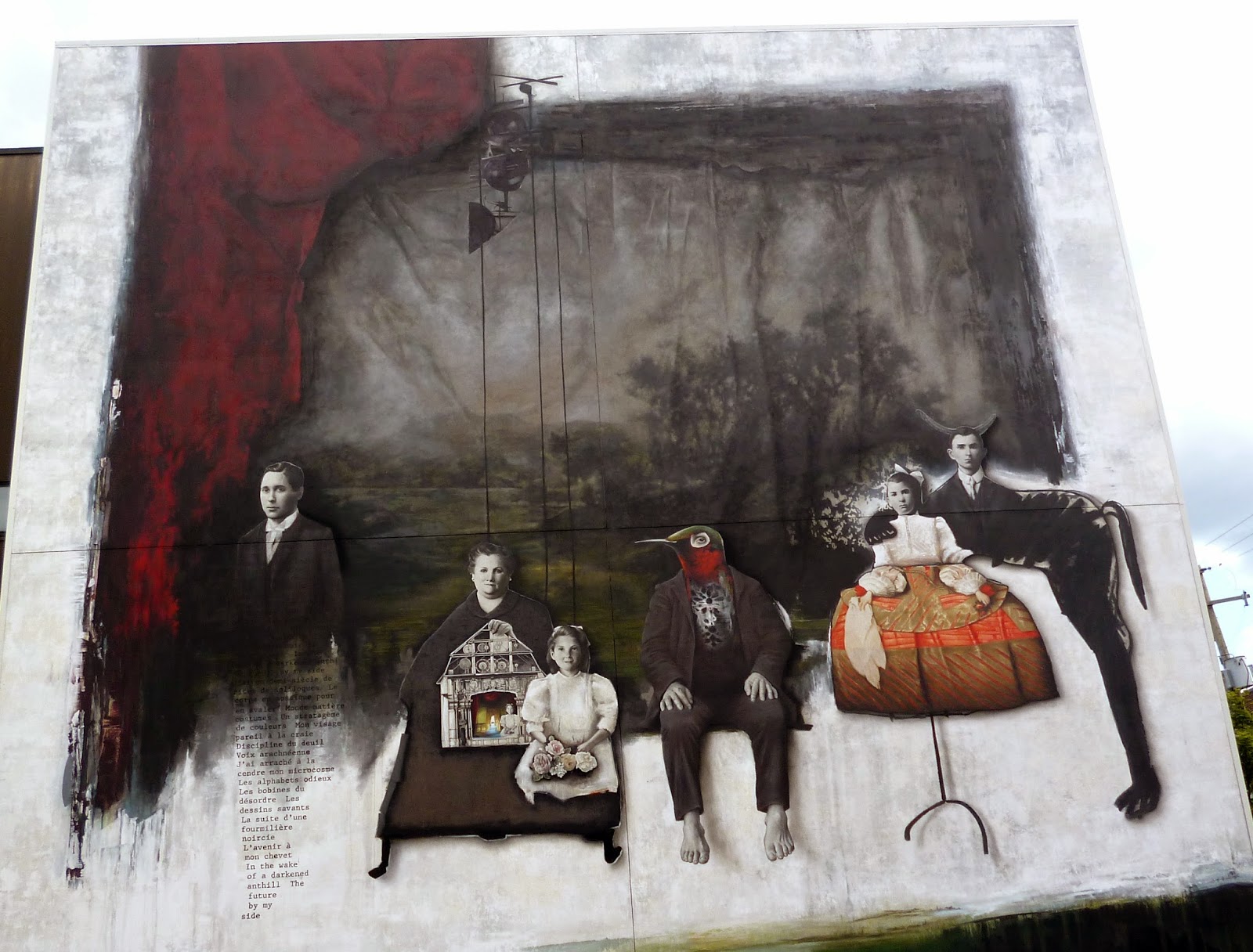
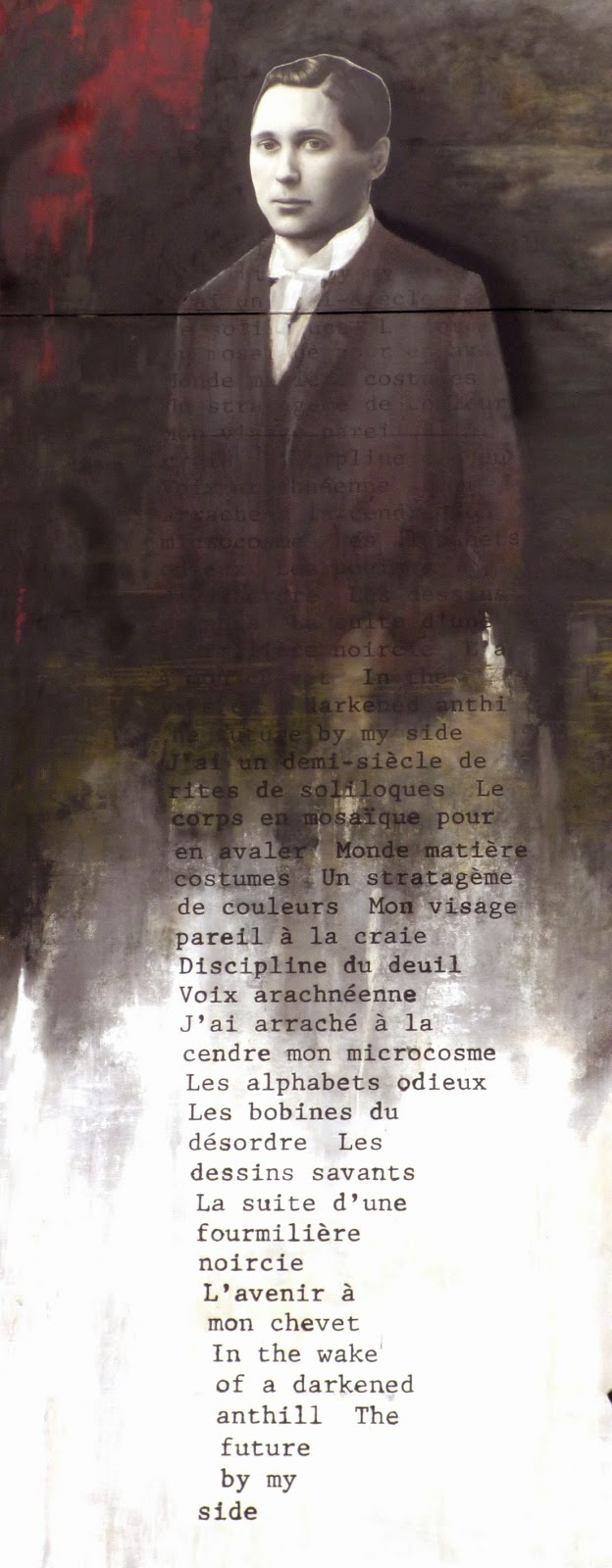
Les Conteurs, Plateau-Mont-Royal, Montréal, Québec

Les Conteurs, a mural by Richard Morin, was completed in 2011 and is another example of the MU project. It was part of the celebrations of the fiftieth anniversary of L'École nationale de théâtre of Canada. It was MU's most ambitious undertaking.


Robert Burns in downtown Montréal, Québec


The statue of Robert Burns in square Dorchester, downtown Montréal, is by G. A. Lawson and one of several replicas: the original is in Ayr, with other replicas in Melbourne, Winnipeg, Vancouver and Detroit. This statue was unveiled in 1930 and commemorates the influence of the Scottish on the growth of Montréal.

'ROBERT BURNS
1759 – 1796

"IT'S COMIN' YET FOR A' THAT
THAT MAN TO MAN THE WORLD O'ER
SHALL BRITHERS BE FOR A' THAT"

A representation from 'Tam O'Shanter'.

A representation from 'The Cotter's Saturday Night'.

A representation from 'To a Mountain Daisy'.

13 August 2014

Portuguese writers in the Plateau-Mont-Royal, Montréal, Québec

In 2009 twelve public benches were installed in the quartier portugais on the boulevard Saint-Laurent to acknowledge the fifty years of the presence of the Portuguese community in Montréal.

Each bench is inscribed with a quotation by a Portuguese writer and is decorated with ceramic tiles (or azulejos) by four Montréal artists of Portuguese origin.

Unfortunately, several of the benches have suffered from graffiti attacks. Below I show all of the benches, although I only mention the writers to whom the benches are dedicated and don't give the quotations.

Logically, the starting point for the benches is parc du Portugal, a small park where there are many tiles, such as in the example of this fountain. From here southwards the benches feature on both sides of the boulevard Saint-Laurent, although the sequence below is in no particular order.

Miguel Torga.

Natália Correia.

José Saramago.

Eça de Queirós.

Luis de Camões.

Père António Vieira.

Dom Dinan.

Fernando Pessoa.

Gil Vicente.

Manuel Maria Barbosa du Bocage.

Antero de Quental.

António Lobo Antunes.

Michel Tremblay in Plateau-Mont-Royal, Montréal, Québec


A notice under the mural states:

'2013 and 2014 marked the 45th anniversary of the first showing of Les Belles-soeurs (1968) and the 30th of Albertine, en cinq temps (1984); the 40th anniversary of C'ta ton tour Laura Cadieux, Hosanna and La duchesse de Langeais ([all in] 1973); and above all, the 35th anniversary of the beginning of Les Chroniques du Plateau-Mont-Royal with the publication of La Grosse Dame d'à côté est enceinte in 1978. So it's impossible to let this occasion go by without paying homage to Michel Tremblay in one of the series of murals produced by MU* which pay homage to the cultural builders of Montréal.

Directly inspired by the author's body of work, Rafael Sottolichio's mural at once celebrates Michel Tremblay's invaluable contribution to the literature of Québec and the typical world of Montréal on which he sheds light: the inescapable Plateau.'  (My translation.)

*A non–profit-making organisation whose aim is to promote and support public art within the metropolitan area of Montréal.

12 August 2014

Félix Leclerc in Plateau-Mont-Royal, Montréal, Québec


Debout is a monument to Félix Leclerc (1914–88) which was installed in Parc La Fontaine in 1990 after a huge campaign by the Mouvement national des Québécois in association with the sculptor Roger Langevin. In front of the statue is a flower bed with a metal ring around the edge bearing a few of Leclerc's words:

'NOUS SOMMES DES QUÉBÉCOIS ISSUS DE LA VIEILLE FRANCE MAÎTRES CHEZ NOUS ET LOIN DES ROIS APRÈS TROIS SIÈCLES DE PATIENCE NOUS SOMMES QUÉBÉCOIS DEPUIS ET POUR DES SIÈCLES...'


An interpretation panel states that Leclerc is considered to be the father of the chanson québécoise, and mentions his 'Moi mes souliers', 'Le p'tit bonheur' and 'L'Hymne au printemps' as celebrating the imagination of childhood, nature, the countryside, love and the world of humble people remaining close to their pioneering origins. It quotes a few words of his which display his love for his country:

'In certain countries there are vines, in others silk; here we have words. We make songs as others make guns, we could make a country with words.'

Octave Crémazie, Émile Nelligan and Hector de Saint-Denys Garneau, Montréal, Québec

The métro station Crémazie is named after the poet Octave Crémazie (1827–1879), who was born in Québec. A mural on the station wall by Georges Lauda and Paul Pannier and titled Le poète dans l'univers is dedicated to Crémazie and two other poets from Québec: Émile Nelligan (1879–1941) and Hector de Saint-Denys Garneau (1912–43).

A plaque explains the mural. The principal colors here are blue, black and white, evocative of the night sky, and the curves are representative of the trajectories of the heavenly bodies.

Planet and zodiac signs are evocative, by their unusual presence, of the liberty of poetic inspiration and lyricism.


Anti-clockwise, representations of the heads of Garneau, Nelligan and Crémazie.

'TOUS CEUX DONT LE COEUR PUR N'ÉCOUTE SUR LA TERRE
QUE LES ÉCHOS DU CIEL, QUI RENDENT MOINS AMÈRE
LA DOULOUREUSE VOIE OÙ L'HOMME DOIT MARCHER'

Octave Crémazie


'A-T-ON LE DROIT DE FAIRE LA NUIT
NUIT, SUR UN MONDE ET SUR NOTRE COEUR
POUR UNE ÉTINCELLE'

Hector de Saint-Denys Garneau

'MA PENSÉE EST COULEUR DE LUMIÈRES LOINTAINES,
DU FOND DE QUELQUE CRYPTE
                AUX VAGUES PROFONDEURS'

Émile Nelligan

11 August 2014

Louis Fréchette, Montréal, Québec


The poet and dramatist Louis Fréchette (1839–1908) was born in St-Joseph-de-la-Pointe-Lévy (the present-day Lévis) and died in Montréal. He claimed to have been a witness to the exhumation of the infamous 'La Corriveau' (Marie-Josephte Corriveau), who was hanged for the murder of her second husband in 1763 and posthumously exhibited in a cage, although Fréchette's presence there is dubious.

He was buried in Notre-Dame-des-Neiges cemetery in Montréal, and the sonnet inscribed on his grave (the last one he wrote) expresses his lack of fear of death, the ephemeral nature of life, and his acceptance of the 'will of God'.

'LA MORT

MON DERNIER SONNET

POURQUOI CRAINDRE LA MORT, LA GRANDE INÉVITABLE?
QU'ELLE SOIT LE REPOS, QU'ELLE SOIT LE RÉVEIL,
POURQUOI DE CETTE AURORE OU DE CE DOUX SOMMEIL,
SE FAIRE SANS RAISON UN SPECTRE REDOUTABLE?

AUCUN FANTÔME N'EST EFFRAYANT AU SOLEIL ;
DE MÊME QU'ON ACCUEILLE UN AMI VÉRITABLE,
SI L'HÔTE AU FRONT PÂLI, PREND PLACE À NOTRE TABLE,
LEVONS EN SON HONNEUR LA COUPE AU JUS VERMEIL !

POUR MOI, JE ME CONFIE À LA JUSTICE IMMENSE ;
OR, TA JUSTICE À TOI, SEIGNEUR, C'EST LA CLÉMENCE !
AUSSI, PAR TA BONTÉ CÉLESTE RASSURE,

QUAND LA TERME VIENDRA DE MA COURSE ÉPHÉMÈRE,
JE PENCHERAI MA TÊTE, ET JE M'ENDORMIRAI
SANS PEUR, COMME UN ENFANT SUR LE SEIN DE SA MÈRE !'

10 August 2014

Mordecai Richler in Montréal, Québec

Mordecai Richler (1931–2001) wrote ten novels and is most noted for The Apprenticeship of Duddy Kravitz (1959), which was turned into a movie in 1974. Scenes in the book took place in Wilensky's café, and some movie scenes took place in the café itself.

The original Wilensky café began life in 1932 on the corner of avenue Fairmount and rue St-Urbain, although it moved to its present position on the corner of Fairmount and rue Clark in 1952.

Leonard Cohen in Montréal, Québec

599 Belmont Avenue, in the comfortable Westmount area of Montréal where Leonard Cohen grew up. His father was a successful businessman who died when Cohen was only nine years old.


'And the sun pours down like honey
On our lady of the harbour'

The above words from Cohen's most famous song, 'Suzanne', have been interpreted as a reference to the Chapelle Notre-Dame-de-Bon-Secours's statue, which overlooks Montréal's Vieux Port.

9 August 2014

Émile Nelligan in Plateau-Mont-Royal and Côte-des-Neiges, Montréal, Québec

Émile Nelligan (1879–1941) has understandably been compared to Rimbaud – a poet of clear brilliance in his teens and then... And then, for Nelligan at least, it was internment for life as a mentally ill person.


A number of writers, including Nelligan, were associated with Plateau Mont-Royal, especially with the area around Square Mont-Louis. Here there is a monument to Louis Crémazie (incidentally an influence on Nelligan) and a bust of Nelligan himself.


Émile Nelligan was buried in the Cimetière Notre-Dame-des-Neiges in the Côte-des-Neiges area of Montréal.