15 December 2018

Christian Gailly: Les Oubliés (2007)

Christian Gailly’s Les Oubliés (lit. ‘The Forgotten’), as expected, is written in his recognisable, compelling style: truncated, telegraphic, pointilliste, repetitive, parenthetical. Not that Gailly would use long words, though: he prefers short simple words in short simple sentences, as in this short paragraph that Albert Brighton addresses to his dead work partner:

‘Here we are, he said. These words were addressed to Paul Schooner. And Brighton asked himself how Paul. If he were there. Present at the side of him. In contact with this woman. On approaching the house. Would have reacted. What would we have seen in his gaze?’ (My translation.)

Albert and Paul are reporters for a weekly cultural paper and this (like Gailly’s book) is their thirteenth mission. They are reporting for a series called ‘Que sont-ils devenus’ (‘What has become of them?’), cultural figures once famous but now forgotten. Gailly deals with big themes such as life, death, love, memory, forgetfulness, age, etc.

And on the way to see the forgotten cellist Suzanne Moss in Britanny their car is involved in an accident. They continue by train, but Paul dies in the toilet so it’s left to Albert to let his wife know, and he decides to take the journey to make the interview with Suzanne by himself. As it happens, he’s obviously done the right thing.

Suzanne is more than welcoming, perhaps too welcoming in a sense: when Albert gets a good old-fashioned fire going, she tells him he’s gifted, and that such people are supposed to make the best lovers. Albert senses danger.

The interview starts, and then Suzanne decides that they should go for a walk along the sea shore, which they do, Albert struggling hard to keep pace with her. And then it rains, they get drenched and take refuge in a café, and on the way back to Suzanne’s house he says something. Funny, but many important things happen in or after visiting the toilets in Quentin Tarantino’s films, and since the death of Paul, Albert has often thought of his work colleague when going there. He tells Suzanne that he made a decision when in the café toilet: Paul died in a toilet, but he wants to continue to live, which means continue to love. He concludes by saying that he’s decided to love her, that he already loves her, is she going to slap him?

They return to the coastal house with the three stray cats of varying ages that Suzanne didn’t have the heart to reject. She’s pre-cooked a lovely meal for them both which only needs re-heating, so they get a little drunk on whisky, it’s understood that Albert is staying the night, and Suzanne says that they’re sleeping together, OK? Albert says he’s very old, Suzanne shoots back ‘Me too […]. We’ll do what we can’.

In fact they do much better than that, in spite of Suzanne’s reluctance to get naked because of her wrinkles, and after all she’d had ten years of celibacy since the death of her pianist husband. But the reader gets the impression – as Albert wakes up to Suzanne next to him and not just three cats on the bed, but to the cat Franklin licking his hair and saying ‘Mia-mia’ (which Suzanne translates as ‘I love you’) – that Albert will be waking up like this for a long time to come. Yup, this is no one-night-stand.

By far the best Christian Gailly book I’ve read, and I’ve been through six others.

My Christian Gailly posts:
––––––––––––––––––––––––––––––––––––
Christian Gailly: Un soir au club
Christian Gailly: Lily et Braine
Christian Gailly: La Roue et autres nouvelles
Christian Gailly: Dernier amour
Christian Gailly: Nuage Rouge | Red Haze
Christian Gailly: L'Incident
Christian Gailly: Les Oubliés

14 December 2018

Marguerite Duras: Les Yeux bleus cheveux noirs | Blue Eyes Black Hair (1986)

Les Yeux bleus cheveux noirs (trans. as Blue Eyes Black Hair) is a novel containing limited dramatic directions: a similar Marguerite Duras play, Maladie de la mort (trans. as Malady of Death) was published four years before, in 1982. Duras also gives a brief explanation about the two protagonists in La Pute de la côte normande (also published in 1986). As yet I’ve only read the novel.

Les Yeux bleus cheveux noirs is paradoxical throughout, and strongly reminded me of Samuel Beckett, particularly Endgame, its interdependence, its madness, despair, asphyxiation, etc. It also called to mind the plays of Bernard-Marie Koltès not just for the homosexual element, but for the transaction, as if life is a (terrifying but necessary) business deal of some kind. There is certainly no escape.

There are no names here, just a man and a woman. The woman joins the man in a café, they move to another when that closes, and from then they go to the man’s place: he says he’ll pay her for being there, but not for sex. Although it’s never specifically mentioned, the man is evidently homosexual, and therefore incapable of pleasing her sexually. But she continues living there.

This is a huis clos situation, but although the woman goes out to have (violent) sex with a man in this seaside town –  modelled on Trouville where Duras lived with the homosexual Yann  Andréa, to whom she dedicates the book – she will always return. They are living out their own insanity.

She will always return and lie naked on the bed next to the naked man in the naked room, also stripped bare of any other furniture, any other means of communication with the outside world. She is naked apart from a black veil. At the man’s place she spends most of the time sleeping, and also cries a great deal, although probably far less than the man. They detest each other, but love each other, and remain inseparable, like twins who can’t break free because if one of them went they would both die. This is a chilling book, but this is the one that taught me how great a writer Marguerite Duras is.

My Marguerite Duras posts:
––––––––––––––––––––––––––––––––––––

Marguerite Duras: La Pute de la côte normande
Marguerite Duras: L'Homme assis dans le couloir
Marguerite Duras: Agatha
Marguerite Duras: Emily L.
Marguerite Duras: Les Yeux bleus cheveux noirs
Marguerite Duras: L'Amant | The Lover
Marguerite Duras: Le Ravissement de Lol V. Stein
Marguerite Duras: L'Amante anglaise
Laure Adler: Marguerite Duras
Marguerite Duras: Cimetière du Montparnasse
Marguerite Duras: Un barrage contre le Pacifique
Marguerite Duras: L'Après-midi de Monsieur Andesmas
Marguerite Duras: Les Petits Chevaux de Tarquinia
Marguerite Duras: Le Marin de Gibraltar | The Sailor from Gibraltar
Marguerite Duras: La Douleur | The War: A Memoir
Yann Andréa: Cet amour-là
Marguerite Duras and Xavière Gauthier: Les Parleuses
Marguerite Duras: Savannah Bay

Marguerite Duras: Détruire, dit-elle | Destroy, She Said
Marguerite Duras: L'Amour
Marguerite Duras: Dix heures et demie du soir en été
Marguerite Duras: Le Square | The Square
Marguerite Duras: Les Impudents
Marguerite Duras: Le Shaga
Marguerite Duras: Oui, peut-être
Marguerite Duras: Des journées entières dans les arbres
Marguerite Duras: Suzanna Andler
Marguerite Duras: Le Vice-Consul | The Vice Consul
Marguerite Duras: Moderato cantabile
Marguerite Duras: La Vie matérielle
Marguerite Duras: La Vie tranquille
Marguerite Duras: La Pluie d'été

10 December 2018

Jean-Marie Gourio: Les Nouvelles Brèves de comptoir: Tome I (2008)

Until the Charlie Hebdo massacre, Jean-Marie Gourio (who was associated with Charlie) was noted most perhaps for his collections of jokes or odd comments that customers in bars came out with. I'm not too sure that he stood or sat there pen in hand in order to collect his gems, but then (in another country, another world) I'm not too sure that Patrick Hamilton did so either.

What we have here is a book of four hundred pages with about five comments each page considered worthy of publication. Some are pretty odd, some bizarre, some obviously influenced by drink (!). There are a number of philosophical comments, some about the insanity of modern living, some plain crazy in themselves, some about sex, life in general, drink, getting pissed, politics, in fact everything: there are even comments by women! Here's a sample:

'If my husband killed another woman, I'd be jealous.'

'Kangaroos are good meat, and there's a pouch to put the chips in.'

'Things go so fast that next year is already out of date.'

'People want to live longer and longer, and then they complain that they're old.'

'With cocaine, there's no need to keep it in the cellar for ten years.'

'They put Durex machines in schools but ban chocolate bars.'

'In a million years there'll be a night train to the moon, and a day train to the sun.'

'Paedophiles must have their cocks cut off, and if they re-offend, cut them off again.'

'The most difficult tongue to learn is how to shut up.'

'A baker covered in flour is a snowman that doesn't melt.'

'The internet is like going directly to a mushroom without putting a foot in the woods.'

Sometimes you can't translate. Anyone can understand 'A scalded cat fears the bastard who threw it in the water', but not that this is from the expression 'Chat échaudé craint l'eau froide', which literally means 'A scalded cat is frightened of cold water', in other words 'Once bitten, twice shy'.

This book is highly amusing in parts, although I wouldn't like to make a collection of them.

8 December 2018

Marguerite Duras: L'Amant | The Lover (1984)

What Marguerite Duras said about things could definitely vary with her mood, or I think according to the industrial proportions of the wine she's been drinking with Yann Andréa, but at one stage she described L'Amant as 'shit', a beach read ('roman de gare'), and that she wrote it when she was drunk. After decades of novels, though, she scooped the Prix Goncourt in 1984 with this novel, at the age of seventy.

In a way this is a type of replay of Un barrage contre le Pacifique (1950), although much shorter, and with less linearity, different ages of the protagonist being shown, different perspectives of the same person ('I' and 'she'), for instance. In Barrage the mother is a kind of pimp, but not here: she's given a much softer treatment.

But it's not the family itself that's the important thing in L'Amant: it's the relationship between the adolescent girl and her Chinese lover. Her rich Chinese lover, who has a very rich father who owns a great deal of property. Initially, though, the Chinese lover (who's not given a name) sees this white young creature as the only white person on the ferry across the Mekong, but that's her last time, and from then on in she's chauffeured to her lycée.

She also willingly loses her virginity to her Chinese lover, willingly accepting that she is just one of his many conquests, although he loves her. It's a mésalliance of sorts, though, as in spite of his money he's considered inferior because of his race. The girl's elder brother, invited to an expensive meal with the girl's family and on to a kind of night club, doesn't once speak to him, although everything is of course paid for by the Chinese lover, who will also pay for the girl's mother's journey back to Paris.

The relationship between men and women, money, power in its broadest sense, time and age, psychology, sex and what it can pay for, all play their part in a novel that's interesting enough, but surely far inferior to Lol V. Stein. But then, Marie NDiaye's Goncourt-winning Trois femmes puissantes was very much inferior to her Rosie Carpe (which won the 'consolation' Renaudot).

My Marguerite Duras posts:
––––––––––––––––––––––––––––––––––––

Marguerite Duras: La Pute de la côte normande
Marguerite Duras: L'Homme assis dans le couloir
Marguerite Duras: Agatha
Marguerite Duras: Emily L.
Marguerite Duras: Les Yeux bleus cheveux noirs
Marguerite Duras: L'Amant | The Lover
Marguerite Duras: Le Ravissement de Lol V. Stein
Marguerite Duras: L'Amante anglaise
Laure Adler: Marguerite Duras
Marguerite Duras: Cimetière du Montparnasse
Marguerite Duras: Un barrage contre le Pacifique
Marguerite Duras: L'Après-midi de Monsieur Andesmas
Marguerite Duras: Les Petits Chevaux de Tarquinia
Marguerite Duras: Le Marin de Gibraltar | The Sailor from Gibraltar
Marguerite Duras: La Douleur | The War: A Memoir
Yann Andréa: Cet amour-là

Marguerite Duras and Xavière Gauthier: Les Parleuses
Marguerite Duras: Savannah Bay

Marguerite Duras: Détruire, dit-elle | Destroy, She Said
Marguerite Duras: L'Amour
Marguerite Duras: Dix heures et demie du soir en été
Marguerite Duras: Le Square | The Square
Marguerite Duras: Les Impudents
Marguerite Duras: Le Shaga
Marguerite Duras: Oui, peut-être
Marguerite Duras: Des journées entières dans les arbres
Marguerite Duras: Suzanna Andler
Marguerite Duras: Le Vice-Consul | The Vice Consul
Marguerite Duras: Moderato cantabile
Marguerite Duras: La Vie matérielle
Marguerite Duras: La Vie tranquille
Marguerite Duras: La Pluie d'été

6 December 2018

Marguerite Duras: Le Ravissement de Lol V. Stein | The Ravishing of Lol V. Stein (1964)

'Manon' is a patient Marguerite Duras once met in a psychiatric hospital, and to some extent the Lola Valérie Stein of the title of this novel is very loosely based on her. Not, though, that this novel is entirely (or even partly) about a mad woman. Indeed, as the very uncertain plot progresses, the truth becomes increasingly blurred, to such an extent that most of my statements here could be suffixed by a one-word sentence: 'Perhaps.'

The truth is elsewhere, although there at least seem to be some definites in this story, which  appears to be set in a vague U.S.A, although later incarnations of the morphing story (in the cinema) usually point strongly to Normandy. Lol V. Stein lives in S. Tahla and is engaged to be married to Michael Richardson; she goes to a ball at T. Beach casino, where her fiancé dances with an older woman, Anne-Marie Stretter, and he leaves with her and Lol is left with her best friend Tatania Karl. Lol V. Stein is devastated, but tries not to show it.

Traumatised, Lol V. Stein takes some months to 'recover' and then marries Jean Bedford, they move to U. Bridge for ten years, have three daughters, and then return to S. Tahla, to the home where Lol V. Stein's parents lived. The children are no problem as the couple have money to employ servants. But barely a quarter of the novel has passed: most of the other three quarters concerns the reconstruction of the past.

Reconstruction (by memory), obsession, paranoia, insanity (?), a possibly unreliable narrator, etc, all follow. Lol V. Stein goes for walks, thinks about the events at the ballroom leading up to her ten-year-old trauma, follows Tatiana with her lover to l'Hôtel des Bois, later meets Tatiana and her husband Pierre Breuger, who's with his friend Jacques Hold, Tatiana's lover, who also turns out to be the narrator.

And the narrator  is not omniscient, imagines things, conjures things up, so how much of this is the reader to believe? Tatiana and Lol seem to merge at times: the same person, or is Jacques Hold, or Lol, or indeed Tatiana, deforming reality to serve unknown ends? Not that reality can in any way be defined here, partly because Lol's reality is part of her madness (if she is mad), partly because she doesn't fit into any framework, because she's part of a jigsaw that will never make a full picture, only (at best) a distorted vision of what this book is about.

Le Ravissement de Lol V. Stein is certainly Marguerite Duras's most complicated novel, and it is also most probably her best. Paradoxically, she thought it unpublishable, but then there are many paradoxes surrounding Duras, who is undoubtedly one of the greatest writers of the twentieth century.

My Marguerite Duras posts:
––––––––––––––––––––––––––––––––––––

Marguerite Duras: La Pute de la côte normande
Marguerite Duras: L'Homme assis dans le couloir
Marguerite Duras: Agatha
Marguerite Duras: Emily L.
Marguerite Duras: Les Yeux bleus cheveux noirs
Marguerite Duras: L'Amant | The Lover
Marguerite Duras: Le Ravissement de Lol V. Stein
Marguerite Duras: L'Amante anglaise
Laure Adler: Marguerite Duras
Marguerite Duras: Cimetière du Montparnasse
Marguerite Duras: Un barrage contre le Pacifique
Marguerite Duras: L'Après-midi de Monsieur Andesmas
Marguerite Duras: Les Petits Chevaux de Tarquinia
Marguerite Duras: Le Marin de Gibraltar | The Sailor from Gibraltar
Marguerite Duras: La Douleur | The War: A Memoir
Yann Andréa: Cet amour-là

Marguerite Duras and Xavière Gauthier: Les Parleuses
Marguerite Duras: Savannah Bay

Marguerite Duras: Détruire, dit-elle | Destroy, She Said
Marguerite Duras: L'Amour
Marguerite Duras: Dix heures et demie du soir en été
Marguerite Duras: Le Square | The Square
Marguerite Duras: Les Impudents
Marguerite Duras: Le Shaga
Marguerite Duras: Oui, peut-être
Marguerite Duras: Des journées entières dans les arbres
Marguerite Duras: Suzanna Andler
Marguerite Duras: Le Vice-Consul | The Vice Consul
Marguerite Duras: Moderato cantabile
Marguerite Duras: La Vie matérielle
Marguerite Duras: La Vie tranquille
Marguerite Duras: La Pluie d'été

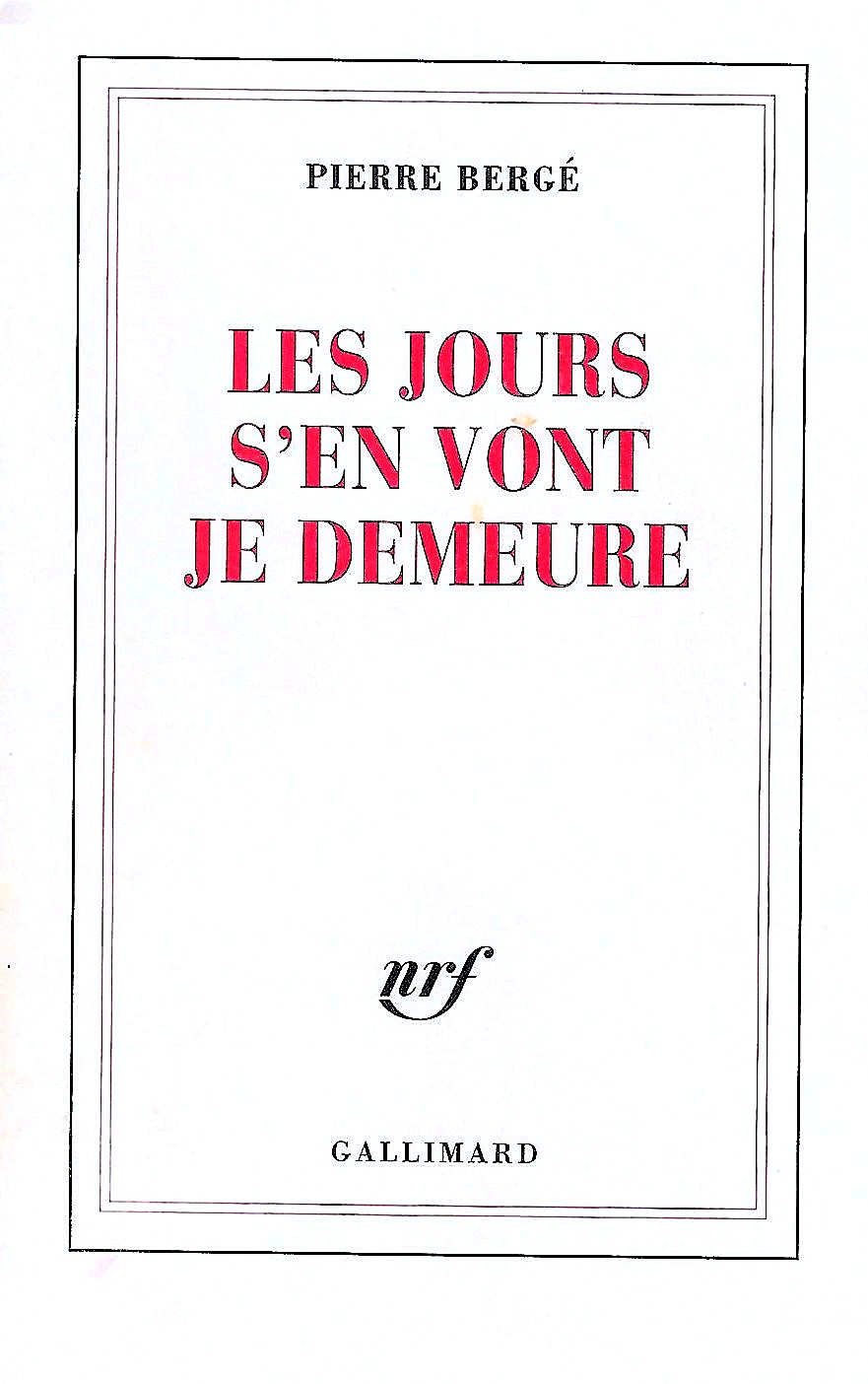
Pierre Bergé: Les Jours s'en vont je demeure (2003)

Pierre Bergé (1930–2017), who was born in Saint Pierre d'Oléron and died in Saint-Rémy-de-Provence, is perhaps best known as the partner of Yves Saint Laurent, whom he doesn't include in this book, although he does include many other people he knew.

He begins with an aphorism by Jean Cocteau, that whether we paint a landscape or a still life, what we are in effect painting is a portrait of ourselves. This in a sense is Bergé's excuse, if any were needed, to display to the reader his relationships with the many people included in this book.

At the age of fifteen, Bergé read Céline's Voyage au bout de la nuit and discovered the nature of literature, how words spurt, and how to spit in the face of the world. He notes that Céline called Henry Miller one of his 'plagiarists', although to Bergé Miller was a kind of pupil. At eighteen, Bergé began to live with the slightly older Bernard Buffet for eight years.

Bergé splits this book into two sections: the main people he knew, and those of whom he has less to say. Of the main people not mentioned above are: Jean Giono, François Mitterrand, Marie-Laure de Noialles, Louise de Vilmorin, Louis Aragon (who during a restaurant meal wonders if the waiter 'sucks well'), Chanel and Schiaparelli, Lili Brik and Tatiana Yakovleva. The smaller accounts of known people are: Garry Davis, Pierre Mac Orlan and Francis Carco, Marguerite Duras, the Rostands (Maurice and Rosemonde), Diana Vreeland, Rudophe Nureev, Danielle Cattand, Andy Warhol, Robert Mapplethorpe, Jean-Louis Barrault and Madelaine Renaud.

This is a gem.

1 December 2018

Gilles Costaz: Edith Piaf (1974)

Although much shorter than Duclos and Martin's biography, which I could in no way conclude, this book – which is both biography and the words of her most noted songs – I could relate to it far more as it is straightforward and doesn't lose itself at all.

It's interesting to note that both Piaf and Maurice Chevalier – who I can't stand at all – were both born in the Belleville area of Paris (20th arrondissement), but received a very different upbringing. Piaf had a much rougher time, and was literally born in the street. Her mother was an 'artiste lyrique' and her father a street acrobat. After staying some years (during three of which she was blind) with her brothel-keeping paternal grandmother in Bernay, l'Eure, her father took her back to Belleville when she was seven. There, she passed around the hat for her father's audience, and he got her to sing a few lines of songs in the process. Realising the success of her singing, he taught her some more songs.

She was on her own at the age of fifteen, became pregnant at seventeen but lost her baby at a young age. She moved to Pigalle and was 'discovered' at twenty by Louis Leplée, who changed her songs from the sugary Tino Rossi type to a more 'realistic' kind.

However, a bigger break came when Raymond Asso, who came to write songs for her, changed her name from 'la môme Piaf' to Edith Piaf. The rest, I suppose, is well-known history, and Costaz goes on to mention her first film La Garçonne (an adaptation of Victor Margueritte's novel); the beginning of her song-writing during the war ('La Vie en rose'); her acting L'Étoile sans lumière with Yves Montand; and her success with 'Les Trois Cloches', which I've mentioned before in this blog in relation to Jean-François Nicot and the wrongly identified grave in Baumes-les-Messieurs, Jura.

Piaf's short life, her addiction to morphine and refuge in alcohol, etc, make for sad reading. Both of her marriages were short-lived: the first, to the famous boxer Marcel Cerdan, only lasted a few years because he died in an air crash in 1949. She re-married in 1962, to the much younger Theophanis Lamboukas (later Sarapo), although she died a year later, at 47.

Costaz finishes the story on a positive note: Piaf's grave in Père-Lachaise has become one of the most sought-after sights in the cemetery; Serge Lama and Léo Ferré, for instance, wrote songs of praise to her; but most of all her singing lives on.

30 November 2018

Gilbert Cesbron: Il est minuit, docteur Schweitzer (1952)

Gilbert Cesbron's play takes place in twenty-four hours, and begins and ends with the words of the title, 'Il est minuit, docteur Schweitzer', first spoken by Albert Schweitzer's faithful assistant Marie, secondly by the administrator Leblanc. War has broken out in 1914, and the then German Schweitzer, born in Alsace, must leave Gabon.

Schweitzer has left his wife and child in Alsace to work in Lambaréné in the African bush, consoling himself on his piano, treating patients stricken by malaria. His African name is N'Chinda ('The one who cuts well'). As the twenty-hours progress, the more the net tightens in on his and his workmate Marie and Father Charles de Ferrier (really Charles de Foucauld). A powerful story of love, war, power and death.

29 November 2018

Charles-Louis Philippe: La Mère et l'enfant (1900; repr. in full 1911) | Le Pére Perdrix (1902)

This is a collection of two books in one, the first – La Mère et l'enfant – being a partly autobiographical account of a working-class child at different stages, essentially aged two, five, twelve, fifteen and twenty. There are great hopes for him and – a very promising scholar – he earns a bursary to a lycée, gets his bac and then goes to Paris with even greater hopes. However, he disappoints his parents by ending up with a menial office job, earning a paltry 3 francs 75 per day, with (horrors!) dreams of becoming a writer.

Charles-Louis Philippe's work is noted for its sympathy with the plight of the poor and its hatred of the complacency and callousness of the rich, of which Le Pére Perdrix is a good example. In Bruno Vercier's Preface, he notes that the main character the farrier (with his wife), often called le Vieux and  la Vieille, are based on the Cérilly blacksmith Jean-Baptiste Galand and his wife.

In Le Pére Perdrix we see the farrier being advised by his doctor to cease work because of his failing eyesight. He does so and receives money from the bureau de bienfaisance, although this public assistance is cut off due the collusion of the same doctor and the mayor. The story also involves le vieux's nephew Jean, a well-paid chemical engineer, walking out of his job in sympathy with the striking workers. Soon after his return, Jean walks out on his parents who are disgusted with him and ashamed of his 'idleness'. Jean goes to live with the farrier and his wife, who dies, and Jean takes a reluctant Vieux to Paris and to more poverty.

My Charles-Louis Philippe posts:
––––––––––––––––––––––––––––––––––––
Charles-Louis Philippe Birthplace museum and grave
Charles-Louis Philippe: Contes du matin
Charles-Louis Philippe: Dans la petite ville
Charles-Louis Philippe: La Mère et l'enfant | Le Pére Perdrix
Charles-Louis Philippe: Bubu de Montparnasse

25 November 2018

Nicolas Mathieu: Leurs enfants après eux |The Children Who Came After Them (2018)

Literary hyperrealism isn't an expression that's frequently employed in English, and yet it's relatively common in French. It's one that's been used of Nicolas Mathieu's work, and his first novel – Aux animaux la guerre (2014) – earned him the title 'The Harry Crews of the Vosges' from one reviewer. And François Busnel on La Grande Librairie, just after Mathieu's Goncourt victory, pointed to the influence of Southern writers less well-known than Faulkner and company: David Joyce, Larry Brown, and Barry Hannah. Mathieu readily agreed.

One of the reasons why the Goncourt jury chose Leurs enfants aprés eux is because although this big book (426 tightly-printed pages) is set in 1992, 1994, 1996 and 1998 it still concerns modern aspects of life, life in the wreckage of a post-industrial society. Here, the blast furnaces of the Vosges have shut down, former workers are on some kind of income support and/or are surviving on small, far lesser paid jobs, mainly in the service sector, or making additional income on the black economy: heavy drinking and smoking are a matter of course. The scapegoats, as in many other post-industrial societies, are the non-whites, blamed for taking white people's jobs, resulting in a change of voting behaviour: instead of the working classes voting for the traditional working-class supporting parties, they are tending to vote for the far-right FN (Front National). For the young people life is something of a disaster as there's little to do but smoke (and sell) cannabis, added to cheap beer from Aldi, all night parties, casual sex and occasionally poppers or (rarely) coke. Heroin isn't mentioned. It's a deadend life that the kids have inherited, most accept it and think they can't change things, and only a few find their most important means of escape from a dying society is not getting out of their heads, but just getting out of the area by education. Nicolas Mathieu left the Vosges at the age of twenty, survived on small jobs, and didn't publish his first novel until he was thirty-six.

Another reason for the Goncourt 2018 triumph is the language used – the book uses a deluge of slang, youth talk, often in verlan – giving a powerfully authentic feel to the novel, not just in the speech, but in the narrative itself, which joins in the slang talk in sympathy with the victims the book deals with. It amuses me to think what the translator of this book will do to the language, as verlan obviously can't be translated, and there are many thousands of French slang words which can sound flat in English, being without the original playfulness. (The title Leurs enfants aprés eux is taken from the Bible, and the English translation – due out next year – is to be called 'The Children Who Came After Them'.)

In 2005 Thierry Ardisson interviewed Michel Houellebecq after the publication of La Possibilité d'une île and asked him if young people have also lost love (as well as God), and quite naturally Houellebecq replied that he didn't know as he's no longer young. It's an interesting question though, and love virtually has no place in this novel, where people fuck (baisent, niquent, etc) live with and marry, but never seem to really relate to each other: there's always a gap. Anthony, perhaps, is an exception; we follow the exploits of this main character throughout – from the precocious 14-year-old (whose parents divorce) to the hardened 20-year-old, and although the word 'love' is never expressed, he almost seems to have such feelings for Steph, who is seen at the end about to carve out a new life for herself in Canada with her guy.

Violence is always close to the surface, as in the graphic scene in which Anthony fights with the Moroccan Hacine in the toilets of the ironically-named bar L'Usine (The Factory), and the even more graphic entrance of Anthony's father Patrick, who literary smashes Hacine's teeth in for stealing his motor-bike. This leads to Patrick hitting the skids, and indirectly to him drowning himself some time later.

Goncourt jury member Paule Constant said Macron should read this book. It wouldn't make any difference: Macron could never understand that it's politicians such as him, and the superrich and the EU he idolises, who have created such wastelands of desperation as are described here. Probably the best Goncourt winner I've read.

19 November 2018

David Foenkinos: Le Potentiel érotique de ma femme (2004)

I suppose many of us, at least at some time or other of our lives, have collected something: stamps are a classic example, but then there is the almost pathological collection of train numbers, postcards, whatever. In my time I've collected beer mats, beer labels, matchbox labels, yoghurt containers, crisps packets, but I was defeated when it came to hat pins.

However, having in parts enjoyed David Foenkinos's La Délicatesse, I thought I'd give him a second chance with this: the back cover enticed me with its lists (Foenkinos, as I've mentioned before, is fond of lists) of things that protagonist Hector has collected: election campaign badges, cocktail sticks, rabbits' feet, melon labels, birds' eggs, and so on. The one-line paragraph that he then started to collect his wife didn't deter me, but maybe it should have.

We have Hector at the beginning failing to kill himself after failing a collection competition, then trying to reabilitate himself by going cold turkey on collecting. It seems to work as he meets a young woman who seems similar to him in that they're both learning about the USA in an attempt to convince others that they've really been there. This even provides Hector with the opportunity to start a new career teaching people how to be mythomanics, and this all seems promising in spite ot the weird false starts to the book, the odd sentences that somehow don't seem to fit anywhere, just don't gel. Trouble is, the lack of gelling continues.

More than halfway through, the narrator says 'We should always die in groups, like on a package tour'. Yeah? Two pages later he says that Hector's wonderful soup-making mother Mireille, who has difficulty recovering from the death of her husband, is given a sachet of soup: 'All these years she had bought, washed and peeled dozens of millions of vegetables to, on the moment of her husband's death, discover that our modern society provides delicious ready-made soups.' (OK, we'll allow for satire, but....) 

But this book continues to describe how Hector moves on to be spellbound by his wife cleaning windows, his obsession with her cleaning windows by collecting on film the moments that she cleans windows, and then everyone likes her cleaning windows, his friend Marcel's partner Laurence likes to feel his balls when they're alone in the kitchen (although that's another issue, as is his stripping naked after dinner and asking the others if they think his cock's small), and oh, is this book dead on its feet, as boring as hell. I never want to read another David Foenkinos book. I feel better for saying that.

My David Foenkinos posts:
––––––––––––––––––––––––––––––––––––
David Foenkinos: La Délicatesse
David Foenkinos: Le Potentiel érotique de ma femme

17 November 2018

Eric-Emmanuel Schmitt: La Nuit de feu (2015)

Eric-Emmanuel Schmitt's La Nuit de fer is a part-autobiographical novel set in the south of Algeria. The title of the book comes from a phrase Blaise Pascal used about his conversion to Christianity in 1654, and Eric-Emmanuel Schmitt made a similar visit to Algeria in 1989.

The philosopher narrator, with director Gerard who wants to make a film about Charles de Foucauld and Eric-Emmanel to write the scenario, join eight others on a walking expedition from Temanrasset, through the Hoggar (a mountainous area in the middle of the Sahara Desert) to Assekrem, the place of Foucauld's hermitage.

The expedition is led by the Tuareg Abaygher (a man of the old wisdom of pre-industrialised societies) and the American guide Donald. They camp rough over ten to eleven days, in fear of snakes and scorpions and perhaps other humans. Ségolène is a Catholic who questions Eric-Emmanuel on his atheism and he tells her about the three philosphical 'proofs' of the existence of God: the universal consensus proof, the cosmological proof, and the ontological proof, all of which can be blown away in a few words.

However, Eric-Emmanuel rather stupidly loses himself from the group in a particularly anonymous, mountainous area. He has no food and virtually no water, and with night coming on he has to dig himself a bed to shield himself from the bitter cold. It is during this time that he had an epiphanic moment, and comes to believe in God: in the morning he finds his way to the camp and the worried team by following the path the stars showed him the night before.

In the Epilogue, the present-day Eric-Emmanuel Schmitt talks about his profound experience in the desert, when he was born a second time, and explains that he remains a philosopher, and if asked if he believes in God he would say 'I don't know', followed by 'I think I do'. He has a sentence to 'explain' things: 'What I know isn't what I believe.' He believes that certainty, a person knowing that he or she does or doesn't believe, is the problem, as this position goes beyond the rational, and certainties create dead bodies. He seems sure of this, but all I can think is 'Er, just a second...'.

My Eric-Emmanuel Schmitt posts:
––––––––––––––––––––––––––––––––––––
Eric-Emmanuel Schmitt: La Nuit de feu
Eric-Emmanuel Schmitt: Milarepa
Eric-Emmanuel Schmitt: La Tectonique des sentiments
Eric-Emmanuel Schmitt: La Femme au miroir

16 November 2018

Anna Langfus: Les Bagages de sable | The Lost Shore (1962)

Anna Langfus's Les Bagages de sable (trans. as The Lost Shore) won the Prix Goncourt in 1962, which made her only the fourth female winner since the first Goncourt in 1903. A female writer – Elsa Triolet – became the first female Goncourt winner in 1944: yes, all the winners from 1903 to 1943 were men. There have been 116 Prix Goncourt since its creation – but only 12 of them have been women. Furthermore, of the ten members of the Goncourt jury, only three are women, and the (at present male) jury leader is allowed to have two votes in case of a five-five final choice. Women, the perception seems to be, just can't write as well as men.

Anna Langfus's Les Bagages de sable is a tale of the post-traumatic stress disorder – with obvious autobiographical elements – of the young Polish woman Maria, whose family was killed during the war. (Anna Langfus is of Polish origin and writes French as a second language, her family was killed during World War II, she was tortured but was freed at the end of the war.)

The book is written as a kind of dreamscape, with Maria imagining or perhaps hallucinating her family, incapable of telling her story to those who haven't lived through what she has lived, only on one occasion speaking of a small part of her ordeal to a Polish survivor. In Paris at the beginning, passing people she meets on park benches have no idea of her internal suffering, which of course remains internal.

Eventually she meets an old man (Michel Caron) with a dog and grows to like him because he seems genuine and he doesn't ask questions. Unknown to her at the time, the old man, who has fallen in love with her, is married, and, leaving his wife, he takes Maria to the south of France where a friend has left him his basic home for an apparently indefinite time. Maria 'earn's' her keep by doing most of the housekeeping and sleeping with the man.

Maria knows that she is mature far beyond her years, and tries to break free from the stranglehold that her terrifying past has on her, but although she has many ways of finding defence mechanisms to stave off pain, she keeps falling back into the abyss.

This is an immensely powerful novel which deserves to be far better known than it is. My secondhand copy, apart from the first few pages, was uncut since 1962: it almost seems a crime to have it and not to read this devastating novel.  Also, clumsily, the back cover mis-spells the old man's name as 'Carron'.

My Anna Langfus posts:
––––––––––––––––––––––––––––––––––––
Jean-Yves Potel: Les Disparitions d’Anna Langfus
Anna Langfus: Les Bagages de sable | The Lost Shore
Anna Langfus: Cimetière parisien de Bagneux, Hauts-de-Seine

Thomas B. Reverdy: Les Évaporés (2013)

Les Évaporés is Thomas B. Reverdy's Japan book, which he wrote at the Villa Kujoyama in Kyoto in 2012, and which is influenced by the American writer Richard Brautigan: two of Brautigan's quotations are given at the front of the book, a number of his quotations are included in the novel itself in italics, and Brautigan too spent some time in Japan and (briefly) married a Japanese woman.

Brautigan killed himself, disappeared, but not in the same way as the johatsu, the essential subjects of this book. They disappear, or 'evaporate', and very often never return: disappearance not in itself being a crime, the police have no interest in it. Disappearance is, for instance in times of debt, seen as the honourable way to go in order to avoid one's family paying the money owed.

 And so begins the story here, with down-at-heel private eye, er. Richard B. – who needs him these days with the internet doing the work for you? – in San Francisco, and who's probably too fond of whiskey for his own good, being contacted by his former girlfriend Yukiko, a San Francisco barmaid: her mother in Japan has contacted her to tell her that her huband (Yukiko's father) has become one of the disappeared. Obviously, Yukiko wants her ex-boyfriend to help her out, and prints out online tickets for them both.

So begins a 300-page story – which is really two stories because we also discover what happens to the father Kazehiro. And all this is set against Japan's triple whammy – the tsunami, the earthquake, and the nuclear power disaster Fukushima. Reverdy also includes a fair bit about Japanese society in this interesting story.

My Thomas B. Reverdy posts:
––––––––––––––––––––––––––––––––––––
Thomas B. Reverdy: Les Évaporés
Thomas B. Reverdy: Il était une ville

Maurice Genevoix: Trente mille jours (1980)

Maurice Genevoix (1890–1980) was born in Decize (Nièvre), spent his early years in Châteauneuf-sur-Loire (Indre), and from 1929 largely lived in Saint-Denis-de-l'Hôtel (Indre). This book is one of his autobiographies, published in the year of his death.

Trente mille jours doesn't begin where you would expect, but in the small town – Saint-Denis-de -l'Hôtel – where he spent most of his later life. In fact, the book isn't generally chronological and jumps about a great deal, apparently following Genevoix's thoughts. This was for me the main fault of the autobiography, which tends to ramble, although it rambles in a very well written and poetic fashion.

It's interesting to learn how Genevoix acquired his dream home in Vernelles near Saint-Denis de l'Hôtel at the side of the Loire, because he didn't buy it as such but 'swapped' a prominent property in Jargeau, the small town opposite on the left bank of the Loire for it: the pride of the former owner of the house in Vernelles couldn't resist it.

Genevoix bought the house on the proceeds of his sales of Raboliot (1925), the novel that won him the Prix Goncourt. He calls this win 'manne providentielle', which is no doubt the reaction of many Goncourt winners (but certainly not all): securing this prize (which only with great difficulty can be compared to the Booker) means worldwide recognition and a virtual guarantee of numerous translations.

Although the in some respects unconventional, Genevoix went on to produce many more books and became a member of the prestigious Académie française, his work is often rooted in the Sologne/Berry area, and some of his books are also influenced by World War I, in which he was injured in Les Éparges, very close to where Alain-Fournier met his death in the commune of Saint-Rémy-la-Calonne (Meuse).

My Maurice Genevoix posts:
––––––––––––––––––––––––––––––––––––
Maurice Genevoix: Trente mille jours
Maurice Genevoix: Raboliot

More from Le Cimetière Père-Lachaise Columbarium, Paris (75): #26: István Keszei

István Keszei (1935–84) was a Hungarian poet who died in Paris. He gained French nationality in 1973, and his early death at the age of forty-eight was caused by pneumonia.

15 November 2018

More from Le Cimetière Père-Lachaise Columbarium, Paris (75): #25: Wolfe Kaufman


Wolfe Kaufman (1905–70) was born in Poland, moved to the USA, and made his home in France in 1954. He wrote for many American magazines.

14 November 2018

More from Le Cimetière Père-Lachaise Columbarium, Paris (75): #24: Isidore Isou Goldstein

Poet, painter, film-maker, playwright, philosopher and novelist, Isidore Isou Goldstein (1925–2007), who wrote as Isidor Isou, was born in Romania and died in Paris. A gifted child, he read Dostoevski at thirteen, Marx at fourteen, and Proust at sixteen. He is the creator of lettrisme and received the support of Queneau and Jean Paulhan, who published his lettriste manifesto Introduction à une nouvelle poésie et à une nouvelle musique in 1947.  Included here is a quotation from his La Créatique ou la Novatique - 1941-1976.

More from Le Cimetière Père-Lachaise Columbarium, Paris (75): #23 Pierre Castex


Pierre Castex (1924–91) was a journalist and writer of screenplays, cinema critic and journalist who worked for  Action, Libération, Les Lettres Françaises and VSD. He also wrote short stories, novels, screenplays and cartoons. 

More from Le Cimetière Père-Lachaise Columbarium, Paris (75): #22: Caroline Babert

Caroline Babert (1947–2010) was a journalist with Gala and a novelist who wrote Souviens-toi, Éléonore ! (1977), Les Méandres de la Moselle (1980), Un amour précaire (1982), Des amis et des amants (1992) and (with Isabelle Rivère) Lady D (2007). I can't find much more information about her though.

13 November 2018

The Forest Folk memorial window, Blidworth, Nottinghamshire

Now that we live in the north-west of England, in the Manchester area, we only go back to Nottingham a few times a year. After learning that there are remains of the lamented Forest Folk pub windows dedicated to James Prior, the regional novelist who wrote Forest Folk (1901), I had to see them. They're in the chapel of St Andrew's Mission Hall, The Crescent, Blidworth, and even if you have a supply of phone numbers you still might have to work on the task some time, especially if you don't live in the area. But we made it! Not all of the windows, of course, were salvaged, but these are all the remaining ones, showing animals in a rural setting. There are a number of posts relating to Prior on this blog, including my full (75, 000 word) MA on the book as a de-historicised, working-class take on the New Woman. (The Forest Folk pub, by the way, was opened in 1926 and demolished in 2005.)


8 November 2018

Sophie Divry: Quand le diable sortit de la salle de bain (2005)

Knut Hamsun's Hunger and George Orwell's Down and out in Paris and London, the experimental Franco-American writer Raymond Federman, Guillaume Apollinaire, Rabelais, and many others, are all influences on Sophie Divry's Quand le diable sortit de la salle de bain (lit. 'When the devil came out of the bathroom', but at the moment untranslated). The book is both a serious reflection on twenty-first-century life – particularly the poverty, the bureaucratic idiocies and the casual (and largely accepted) sexism in it – although it is also highly amusing.

Quand le diable sortit de la salle de bain is hard to explain. It's about Sophie, a young divorced and childless woman from Lyon, France, who is without money due to being honest and declaring that she has earned a small amount of money working as a freelance journalist: it's only 150 euros, although the social security system won't allow her any benefits until they've seen on paper the amount of money earned. The problem is that she can't prove her earnings as she's still waiting, but no proof means no more money, and she's literally starving.

The devil tempts her into stealing, but fortunately the christening of a nephew sends her down to Montpellier to her widowed mother's, where she can stoke up on some food for a few days. Returning to Paris she finds a temporary job as a waitress: it's poorly paid but she finds a little satisfaction waiting on fat, rich pigs, until she's reduced to washing the dishes and loses her cool when she wildly attacks one of the kitchen staff for his constant sexual harrassment.

That's essentially the story, although it doesn't mention the book that she's writing, the book within the book, when her friend Hector – also a character in the book – in a moment that reminds me of Gilbert Sorrentino's Mulligan Stew, comes out of the book and demands that Sophie stop making him wait to have sex with the woman he's long been lusting after. And – in a moment that reminds me of Apollinaire – when Hector invokes the devil, there's a double page spread of a prick (Sophie hates polite words) 'drawn' in words, and spurting 'AH! AH! AH!' etc. Divry also plays with different fonts and font sizes throughout the novel, and the love of long, breathless lists is frequently evident, such as the pages of lists of the things Sophie doesn't like about men: as she remarks, the list is so comprehensive that there's not a great deal positive left to play with.

Quand le diable sortit de la salle de bain is in love with words, so much so that Sophie finds the French lexicon insufficient: why, for instance, is there an adjective for Sunday (dominical) but not Saturday, why no separate words for being wet with rain and wet with snow, why no verb for 'I bought it on the internet', why no word for the false notes a violin makes when someone's learning to play it? She even tries to make up her own words, of which 'Sansconvictionnement' ('unconvincingly') is probably more than enough, although the reader can see her point.

This is a very playful book (or two) which leaps(s) out at you.

My Sophie Divry posts:
––––––––––––––––––––––––––––––––––––
Sophie Divry: Quand le diable sortit de la salle de bain
Sophie Divry: La Condition pavillonnaire

7 November 2018

Joséphine Dard: Frédéric Dard, mon père: San-Antonio (2010)

Joséphine Dard is Frédéric Dard's only biological child by his second wife Françoise, and this book is a huge love letter to her father on the tenth anniversary of his death. In 'coffee table' style this publication may be, but it is very revealing of the enigmatic, crazy, but so sane antidote that Frédéric Dard was to the world of literature, to the world in general.

Here, we have letters written to Frédéric Dard – the man known to most people as San-Antonio after his eponymous larger-than-life private detective – and many tributes and many letters by (mainly, but not exclusively) figures involved in the world of literature and the arts such as Bernard Pivot, Georges Simenon, Frédéric Beigbeder, Albert Cohen, Georges Trenet, Patrick Sebastien, Jean Dutourd, the list is huge.

Frédéric Dard was a highly gifted, highly original and very funny writer whose work will continue to inspire many other writers. He was also a very loving father, husband and very warm to his many friends, very giving. But this book seems to tease out more than Jean Durieux's book on him did. Here, and by more than one person, we learn of his hypersensitivity, shyness even, and Joséphine Dard reveals that on her first marriage he walked her to the church but no further as on that day his arms were covered in psoriasis. For me, the most revealing part in this book is in three pages he wrote about himself, which I find quite devastating.

The paper is called 'Si j'étais...Frédéric Dard' ('If I were...Frédéric Dard') and is astonishingly frank, even though he didn't (I'm sure) intend to publish it. Here we have the existential Dard, reflecting on what he, er, isn't. He writes that he always expected to be himself, that his self (Frédéric Dard) would somehow magic itself into being when he grew up, like at a particular age when he was allowed to vote. But it didn't happen, he still feels deprived of himself, is still waiting for something to happen, as if he's missed an appointment. There's a kind of parallax (my expression), a lack of correspondence between how others see him and how he sees himself. Everything he says, does and thinks doesn't conform to his 'true [or real] essence'. This seems even bleaker than Samuel Beckett.

An extremely interesting book.

One small correction: the author says that her father invited Renaud on Le Grand Échequier, in 1982, when his career was just starting: wrong, Renaud already had five successful albums to his credit by then. He went on to much greater success, but that's hardly the same thing.

My Frédéric Dard posts:
––––––––––––––––––––––––––––––––––––
Joséphine Dard: Frédéric Dard, mon père: San-Antonio
Jean Durieux: Frédéric Dard dit San-Antonio
San-Antonio: Certaines l'aiment chauve
San-Antonio: Messieurs les hommes
San-Antonio: Des dragées sans baptême

6 November 2018

René Fallet: L'Angevine (1982)

At one point in René Fallet’s L’Angevine the main character, the playwright Régis Ferrier (same initials) says that his friend’s wine tastes of raspberries, and this can’t be coincidental because the singer Boby Lapointe’s name is mentioned at least twice in this novel (once as the only footnote in the book), although his forename is misspelt as ‘Bobby’. ‘Framboise’ (meaning ‘raspberry’) is the name of Boby Lapointe’s most famous song, the one he sang in Truffaut’s Tirez sur le pianiste, and the song is appropriate to the novel in several ways.

The title of the novel, L’Angevine, refers to the main female character in the book, Christine Labé, who lives in Angers, which is in the département Maine-et-Loire, and both Angers and the Maine-et-Loire are mentioned in the song. Framboise’s name is really Françoise, although customers in the bar she serves in call her Framboise, and Boby Lapointe harps on her big breasts: Christine’s breasts are mentioned a number of times, and Régis Ferrier likes to fondle them, although unlike Framboise’s they are very small. Régis Ferrier will ponder on all these things, including the fact that Framboise refuses to have sex, when he drowns his lost love in several whiskies towards the end of the novel, just after Christine has told him she’ll never again have sex with him.

Boby Lapointe’s song is one of many references to singers and novels in the book, but the most quoted. One novel that’s obliquely referred to more than once is Zola’s La Faute de l’abbé Mouret, and although it’s not Jean-Luc Labé's ‘sin’ but his wife’s, these are opportunities for Fallet to indulge in a Lapointe-style pun in wishing Labé dead: ‘Labé mourait’.

Régis doesn't first think of Christine with love, though: he is married, although it’s a dead marriage, and he has several much younger female sex objects at the same time: Christine, no matter what her confessions of love for him, and the fact that he’s sexually opened her blinkered eyes, initially has little effect on Régis from a romantic angle, although Christine (who has three children) gets to see him in his Paris appartment as often as she can.

The novel is in three sections: ‘Avant’, ‘Pendant’ and ‘Après’ to describe the three parts of the relationship. In the first, then, Christine doesn’t much impact on Régis, although in the second he rather quickly comes to love her and they can’t see each other too much, escaping to Belgium and London (where the restaurant food is unspeakable), etc. It even comes to a point where Règis begins to live with Christine in a ZAC (Zone d’aménagement concerté), or urban development area: although he gets on with the children very well, and although it’s obvious that he’s like a fish out of water, it’s Christine who very soon abruptly sends him packing because she has realised that there’s a difference between having a lover and having that lover live with you.

So, end of story and time to return to his young girlfriends, although of course he’s getting older now (53) and reflects on his losses. Strangely, though, after the ‘FIN’ there’s a PS saying they met again, will continue to meet, and will always see each other. It’s in italics, though, like so many of Christine’s wishes have been: presumably this is as real as Régis’s imaginary Muriel?

Very 1980s of course, but a fascinating read nevertheless.

4 November 2018

Pierre Magnan: La Folie Forcalquier (1995)

This takes place at the end of the era of Napoleon III, and is set in and around Forcalquier in Alpes-de-Haute-Provence, with the narrator and protagonist Félicien Brédennes, a herbalist  and something of a quack doctor, something of a petty thief, and a great deal of a lover of numerous women.

And the vocabulary is quite a mountain to climb, with not only archaic expressions but – this being an epic full of the atmosphere and smells of Provence – also the names of many herbs, flowers, etc.

It is also the story of devastating letters, fear, murder, and general mayhem. There are many characters described here, perhaps the most colourful, apart from Brédennes, being the rich highwayman Zinzolin and the sex-loving Aigremoine, with who Brédennes and Zinzolin (her unwitting father) separately share sex romps.

There's a fair amount of blood shed, a great deal of chasing (especially by Brédennes on his horse behind the stolen coffin-shaped buggy), and changing affinities: a long, convoluted story with almost as many twists and turns as the horses themsleves have to undergo.

That, perhaps, is the main problem: at 487 pages, the novel goes on far too long for its own worth: which is a pity, as Pierre Magnan can write a hell of a tale with tremendous jest and confidence.