13 June 2016

René Char in L'Isle-sur-la-Sorgue (84)

The family grave in L'Isle-sur-la-Sorgue.

'RENÉ CHAR
1907 – 1988'

Like his father, the poet René Char was born in L'Isle-sur-la-Sorgue. Apart from his poetry, he is probably most remembered for his friendship with Albert Camus and his work for the Résistance. His many publications include Arsenal (1929), Le Marteau sans maître (1934), Feuillets d'Hypnos (1946), Fureur et mystère (1948), and La Parole en archipel (1962).

'SI NOUS HABITONS UN ÉCLAIR
IL EST LE CŒUR DE L'ÉTERNEL'

The couplet comes from Char's poem 'À la santé du serpent', from the book Le Poème pulvérisé.

My René Char posts:
––––––––––––––––––––––––––––––––––––
René Char in Céreste
René Char in L'Isle-sur-la-Sorgue

12 June 2016

Frédéric Mistral in Saint-Rémy-de-Provence (13)


HÔTEL DE TOURREL
D'ALMERAN – MAILLANE
LE 26 MAI 1863
EN CET HÔTEL
POUR LA PREMIÈRE FOIS ET
EN PRÉSENCE DE FRÉDÉRIC MISTRAL
CHARLES GOUNOD
FIT ENTENDRE
LA PARTITION SAINT-REMOISE
DE MIREILLE

An important occasion then, the reading of the first section of Mistral's most famous work: Mireille, or rather Mirèio in provençal.

Nostradamus in Saint-Rémy-de-Provence (13)


'ICI NAQUIT 14 DÉCEMBRE 1503
MICHEL DE NOSTREDAME
DIT NOSTRADAMUS
ASTROLOGUE'

It's no easy thing to photograph Nostradamus's birthplace in such a cramped street.

The plaque outside Nostradamus's birthplace states that he was the elder son of the solicitor Jaume de Nostradame and Raynières de Saint-Rémy, both of Jewish origin. His great-grandfather, Jean de Saint-Rémy, was a doctor and the town treasurer. Nostradamus grew up in a financially comfortable home and was educated to far above the average standard, learning mathematics and astromomy. He loved walking round the surrounding countryside and all his life was impressed by the countryside of the Alpilles and fascinated by the Roman history of Saint-Rémy which he regularly mentioned in his writings.

After studying at Avignon and Montpellier universities, he became a doctor of repute, experimenting with some success plant-based cures for the plague. He chose to call himself Nostradamus because of its meaning 'we give what is ours', in other words 'we pass on our knowledge'.

Above all Nostradamus was a humanist, a scientist, poet, and a friend of intellectuals. From 1566 he wrote his prophecies from Salon-de-Provence, where he established himself after his second marriage, and he received a great reputation for them. He became the protégé of Catherine de Médicis who in 1564 named him the king's doctor and advisor to the queen.

Nostradamus died in 1566, leaving a very rich work from a scientific, medicinal and literary point of view. He remains one of the most read authors in the world.


Nostradamus's well in the centre of town.

'FONTAINE ANCIENNE
LA FONT VIÈIO
ERIGÉ EN 1814
-----------------
BUSTE DE NOSTRADAMUS
PAR LIOTARD, DE LAMBESC
1859'


Detail of Nostradamus's bust on the fountain.


Nostradamus as street art.

Joseph Roumanille's Statue in Saint-Rémy-de-Provence (13)

The statue of the writer Joseph Romanille (1818–91), born in Saint-Rémy-de-Provence. Frédéric Mistral was one of his students when he taught in the Dupoy college in Avignon, and he was a co-founder of the Félibrige.

Around the base of the statue are words of Joseph Romanille in Provençal.

Yvan Audouard's Grave, Fontvieille (13)

Yvan Audouard (1914–2004) is buried in the family vault in the cemetery in Fontvieille. I'd not heard of him until I read René Frégni speaking of attending his funeral in Tu tomberas avec la nuit. He lived in Fontvieille and wrote many books, a number about his beloved Provence. His obvious pun on Alphonse Daudet's famous book, Lettres de mon pigeonnier (1991) (lit. 'Letters from My Dovecote') sounds interesting, although I prefer another title: La Connerie n'est plus ce qu'elle était (1993) (lit. 'Bullshit Isn't what It used to Be').


'Ce fut un belle journée.' Audouard own expression, but it would sum up the fleetingness and the pleasure of many people's lives: 'It was a fine day.'

Alphonse Daudet and Tartarin de Tarascon in Tarascon (13)

The hilarious bumbling braggart who professes to be a bold hunter of lions, but who hasn't so much as walked over the town bridge to neighboring Beaucaire until forced into an uncomfortable spot and show how, er, great he is. A brilliant sculpture of him standing on a dead lion.

And under the statue, a representation of Alphonse Daudet smiling as he writes:

'Cet homme, c'était Tartarin de Tarascon, l'intrépide, le grand, l'incomparable Tartarin de Tarascon.
En France, tout le monde est un peu de Tarason.'

'This man was Tartarin de Tarascon, the bold, the great, the incomparable Tartarin de Tarascon.

In France, everyone has a little of Tarascon in them.'

My other Alphonse Daudet posts:

–––––––––––––––––––––––––––––––––––
Alphonse Daudet in Fontvieille (13)
Alphonse Daudet: Tartarin de Tarascon (1872)
Alphonse Daudet in Fontvieille (13) again

11 June 2016

Alphonse Daudet in Fontvieille (13)

Alphonse Daudet (1840 –97) is undoubtedly noted in the popular imagination for his book Lettres de mon moulin, a collection of short stories still taught in French schools and translated into many languages: the English edition is simply Letters from My Windmill. D. H. Lawrence read it, I believe in the original French.

In his book, Daudet claims (inventively) that he bought one of the four windmills in Fontvieille. Well, he didn't, and in fact Daudet was more associated with one of the other mills. Needless to say, Daudet never (as is popularly believed) lived in any of them. But the myth that this windmill belonged to Daudet persists, so there it is. That Daudet is associated with a windmill in Fontvieille is apt because he used to visit the millers while staying at the Château de Montauban, which wasn't really a castle but a farmhouse with a highly elaborate façade.

The windmill that is now called Daudet's ceased to function in 1915 and became 'Le Moulin de Daudet' in 1935 on the initiative of Les Amis de Daudet, amongst whom was the local artist Léo Lelée, who made a number of drawings of the place, including the workings of the mill.

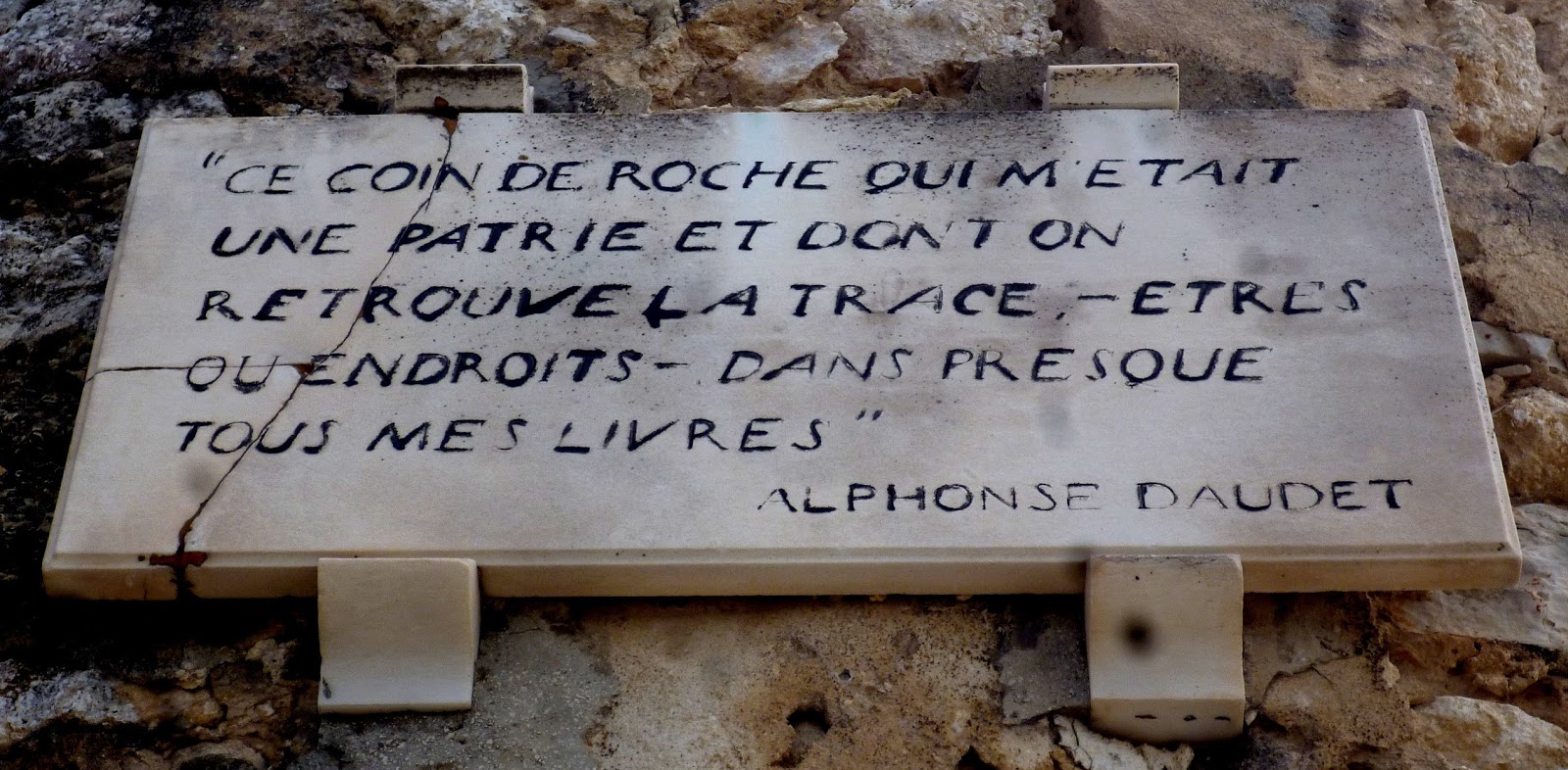
On the side of the mill:

'CE COIN DE ROCHE QUI M'ÉTAIT
UN PATRIE ET DONT ON
RETROUVE LA TRÂCE – ÊTRES
OU ENDROITS – DANS PRESQUE
TOUS MES LIVRES
               
ALPHONSE DAUDET'

'This rocky corner which was my a fatherland for me and of which can be found traces – people or places – in virtually all my books'.

The windmill has just one upper floor.

The millstones: originals or from elsewhere? I forgot to ask.

The winds are listed around the mill.

But I rather like this drawing of the 32 winds of Provence.

The stuffed owl is a good touch: in Lettres de mon moulin, Daudet mentions his feathered 'tenant'.

Moulin Tissot now has new cap and sails. This is the closest of the mills to Montauban, and Daudet spent far more time here than at any of the others, even having an idea of buying it. Tropime Avon, well known to Daudet, was the last miller here, and the mill closed in 1905.


Daudet's Ambroy cousins, particularly Timoléon, used to welcome Daudet when he'd had enough of Paris and wanted fresh inspiration.

'MONTAUBAN
---------
MAISON BÉNIE ! QUE DE FOIS
JE SUIS VENU LÀ, ME REPRENDRE
À LA NATURE, ME GUÉRIR
DE PARIS, ET DE SES FIÈVRES
                                   A. DAUDET'

'Montauban. Blessed house! So many times I have come there, to get back to nature, to cure myself of Paris and its fevers.'

A bust of Daudet occupies a central position in the village.

And this bust of Daudet is currently on display at the Fontvieille Office de Tourisme.

10 June 2016

Anne-Marie Chapouton in Lourmarin

A writer of short stories, poems and novels (notably L'Année du Mistouflon), Ann-Marie Chapouton (1934–2000) created a library in Lourmarin as well as numerous cultural activities for children.

Didier Brousse in Lourmarin

The watercolourist Didier Brousse's galerie. Outside is a printed comment by Monique Pujo Monfran, stating that Didier Brousse has written several biographies of artists, including three on Blanche Odin. Montfran concludes by revealing that she is writing a biography of Didier Brousse, whom she calls a 'watercolourist of genius'.

Albert Camus in Lourmarin, including Lourmarin Cemetery #3

A view of Lourmarin from near the cemetery where Albert Camus is buried.

The Rue Albert Camus is in the centre of  the village.


Camus's house, bought on the proceeds of his Nobel prize, although he died a mere one year and two months afterwards in a car crash in Villeblevin in Michel Gallimard's flash (and as it happened, dangerous) Facel-Vega: the creation of Jean Daninos, the writer Pierre's brother. Camus's daughter Catherine lives here and has apparently been plagued by enthusiasts.

The Café de l'Ormeau, where Camus used to drink.

Next door is the Ollier hôtel-restaurant, where Camus used to eat, and in fact where he ate with his wife Francine and Michel Gallimard on 2 January 1960, the day before Gallimard and Albert Camus died.

The plaque translates as 'The author of "The Plague" settled in Lourmarin in 1958. He has lain here since 1960.

The graves of Albert Camus and his wife Francine in the cemetery in Lourmarin.

'ALBERT CAMUS
1913 – 1960'

'MADAME
ALBERT CAMUS
NÉE
FRANCINE FAURE
1914 – 1979'
My Albert Camus posts:
––––––––––––––––––––––––––––––––––––
Michel Onfray: L'Ordre libertaire
Albert Camus in Lourmarin

Lourmarin Cemetery #2: Henri Bosco

Appropriately, the cemetery in which the writer Henri Bosco is buried is just off Avenue Henri Bosco. And interestingly, this road sign (complete with the author's dates) seems more like a memorial.


But this of course is Henri Bosco's real memorial, the cross now covered in shell and stone tributes, which I found interesting for an author who (dare I say it) is not the person who is the main attraction in  the cemetery.

'HENRI
BOSCO
1888 – 1976'

The Greek inscriptions above Bosco's tomb.

9 June 2016

Lourmarin Cemetery #1: Christian Gabriel/le Guez Ricord

I hadn't heard of the poet Christian Gabriel/le Guez Ricord,, and would still be ignorant of his existence if it hadn't been for an inked in addition near the cemetery entrance indicating the existence of his grave here: to clarify, Ricord used 'Gabriel' in both the male and the female forms. Struck by voices and visions, he was hospitalised on several occasions, and wrote Du  Fou au Bateleur in collaboration with the psychiatrist Jean-Pierre Coudray. Guez Ricord, as the  French Wikipédia entry suggests, was something of a fin de siècle poète maudit, born in Marseille, where he died. The poet Bernar Mialet was his executor. Ricord's a kind of cross between Gérard de Nerval and Antonin Artaud. I have at present no way of verifying this, and although I treat anything from Wikipedia with great caution, the scholarly Le Matricule des anges revue does mention the strong influence of Nerval on him.

7 June 2016

Le Facteur Cheval's Palais Idéal, Hauterives, France

A view of the full east elevation of Le Facteur Cheval's superb work of art, essentially made over a period of thirty-three years by the self-taught postman Ferdinand Cheval (1836–1924) from stones and pebbles he collected in a wheelbarrow as he went about his postal round. This is only the beginning though as I have a great number of photos to sift through and crop, etc, so there is much more to come later.

ADDENDUM: My blog post is now at Le Facteur Cheval's Palais Idéal, Hauterives