18 October 2015

Paris 2015: Jean-Baptiste Niel, Cimetière du Père-Lachaise #19

'L'ÉCRIVAIN
Jean-Baptiste
NIEL
1962 – 1995'
 
Jean-Baptiste Niel wrote a thesis on Marie Noël, French teacher and later bookseller. His first novel was Vous qui passez dans l'ombre (1989) (trans. as Painted Shadows) about a transexual prostitute. Ludion d'alcool (1990) came next, followed by Ceci est mon sang (1992), a work Niel said is not so much about AIDS as it is a hymn, a requiem. La Maison Niel (1995) is an autobiography and was published posthumously. He also wrote Rachel, Cathelin (1994) on the painter Bernard Cathelin (1914–2004).
 
Jean-Baptiste Niel died of AIDS. The fullest obituary I've come across is in the Independent by the gay poet James Kirkup (1918–2009), who translated his first novel: Obituary in English.

Paris 2015: Pierre Desproges, Cimetière du Père-Lachaise #18

Pierre Desproges (1939–88) was a comedian with a black sense of humor and a sense of the absurd who ridiculed stupidity and intolerance. He also published a number of books, including the highly regarded novel Des femmes qui tombent (1985), which is the only one he wrote.

17 October 2015

Paris 2015: François-Vincent Raspail, Cimetière du Père-Lachaise #17

The tomb of François-Vincent Raspail (1794-1878), who was a chemist, doctor, politician, republican and writer. He is buried with his wife Henriette Troussot (1799-1853), who died during one of his imprisonments, and is represented as a ghost in a shroud here. The boulevard Raspail is named after him.

Paris 2015: Delphine Palatsi, aka DJ Sextoy, Cimetière du Père-Lachaise #16

'DELPHINE PALATSI
1968–2002'
 
Delphine Palatsi was a French DJ with the pseudonym Sextoy, and she stood out in an essentially male profession. She was an inspiration to many musicians, and also outside the musical field. She appeared in several films and vidéos directed by La Chocha (Anna Margarita Albelo); the writer Ann Scott, whose Superstars (2000) is a homage to Palatsi, also includes her in one of her collection of short stories Poussières d'anges (2002).
 
'SEXTOY
1968–2002'

16 October 2015

Paris 2015: Félix Guattari, Cimetière du Père-Lachaise #15

 
Félix Guattari (1930–92) was a psychoanalyst and philosopher of distinctly left-wing persuasion. Among the many books he wrote were two with Gilles Leleuze under the sub-title Capitalisme et schizophrénie: L'Anti-Œdipe (1972) and Mille Plateaux (1980).

Paris 2015: Pierre Daninos, Cimetière du Père-Lachaise #14

'PIERRE DANINOS
1913–2005'
 
Pierre Daninos was a popular writer and humorist most noted for his Les Carnets du major Thompson (1954), which has the distinction of being the 472th of the 480 memories quoted by Georges Perec in Je me souviens (1978). The book also had the distinction of being adapted into a Preston Sturges film in 1955 under the title The French, They Are a Funny Race. Daninos wrote (among a huge number of other titles) four more Major Thompson books.

Daninos was also noted for Les Carnets du Bon Dieu (1947), for which he was awarded the Prix Interallié.

Paris 2015: Georges Goyau, Cimetière du Père-Lachaise #13

Georges Goyau (1869–1939) was an essayist and historian, specialising in the history of religion. His first wife was Lucie, President Félix Faure's daughter, and was also a writer and a friend of Marcel Proust in her youth. Goyau is buried with his second wife Juliette (née Heuzey), who too was a writer and wrote a biography of her husband, Dieu premier servi: Georges Goyau : sa vie et son œuvre (1947).

Paris 2015: Sully Prudhomme, Cimetière du Père-Lachaise #12


SULLY PRUDHOMME
LE PARNASSE
LES POÈTES, SES AMIS
SON ÉDITEUR'
 
The grave of the poet Sully Prudhomme (1839–1907), born René Armand François Prudhomme, Nobel Prize winner for literature in 1901. Someone has typed out and framed his poem to leave on the grave:

'Les yeux

Bleus ou noirs, tous aimés, tous beaux,
Des yeux sans nombre ont vu l'aurore ;
Ils dorment au fond des tombeaux
Et le soleil se lève encore.

Les nuits plus douces que les jours
Ont enchanté des yeux sans nombre ;
Les étoiles brillent toujours
Et les yeux se sont remplis d'ombre.

Oh ! qu'ils aient perdu le regard,
Non, non, cela n'est pas possible !
Ils se sont tournés quelque part
Vers ce qu'on nomme l'invisible ;

Et comme les astres penchants
Nous quittent, mais au ciel demeurent,
Les prunelles ont leurs couchants,
Mais il n'est pas vrai qu'elles meurent :

Bleus ou noirs, tous aimés, tous beaux,
Ouverts à quelque immense aurore,
De l'autre côté des tombeaux
Les yeux qu'on ferme voient encore.'

Paris 2015: Allan Kardec, Cimetière du Père-Lachaise #11

Allan Kardec's dolmen tomb. Any translation is my own. The top stone reads:

'NAÎTRE MOURIR RENAÎTRE ENCORE
ET PROGRESSER SANS CESSE
TELLE EST LA LOI'

'TO BE BORN TO DIE TO BE REBORN AGAIN
TO PROGRESS INCESSANTLY
SUCH IS THE LAW'
 
'ALLAN KARDEC
FONDATEUR
DE LA
PHILOSOPHIE SPIRITE
––––––––
TOUT EFFET À UNE CAUSE
TOUT EFFET INTELLIGENT
À UNE CAUSE
INTELLIGENTE
LA PUISSANCE DE LA
CAUSE EST EN RAISON
DE L'EFFET'

'ALLAN KARDEC
FOUNDER
OF THE
PHILOSOPHY SPIRITISM
––––––––
ANY EFFECT HAS A CAUSE
ANY INTELLIGENT EFFECT
HAS AN INTELLIGENT CAUSE
THE STRENGTH OF THE CAUSE
IS IN PROPORTION TO
THE MAGNITUDE OF
THE EFFECT'
 
Allan Kardec (1804–69) was born Hippolyte Léon Denizard Rivail. He was a teacher and also the founder of the philosophy Spiritism, which is still followed internationally today. He changed his name in 1855, the same time as he discovered turning tables. His principal written works are Le Livre des Esprits (1857) and Le Livre des médiums (1861).

15 October 2015

Paris 2015: Auguste de Villiers de L'Isle-Adam, Cimetière du Père-Lachaise #10

'A. de VILLIERS de L'ISLE ADAM
NÉ À ST. BRIEUC LE 7 NOVEMBRE 1838,
MORT À PARIS LE 18 AOÛT 1889.'
 
Tucked away in the barely frequented north-west of Père-Lachaise is the grave of Auguste de Villers de L'Isle-Adam, the Brittany-born writer who had such an important influence in the birth of French symbolism. In 1867 he became editor-in-chief of the weekly Revue des Lettres et des Arts, to which Mallarmé, Verlaine, Banville, Mendès and the Goncourt brothers contributed.

Villiers de l'Isle-Adam wrote novels, short stories, drama and poetry. Of particular note is the science fiction novel L'Ève future (1886), which is partly a criticism of  the scientific jargon of the day: it involves an engineer called Edison creating a beautiful and highly intelligent android to cure Lord Ewald of his doomed love of a beautiful but stupid girl. The collection of short stories Tribulat Bonhomet (1887), of which a rewrite of 'Claire Lenoir' from his weekly Revue of twenty years before is included, is a strong satire on the bourgeois mind.
 
Villiers de l'Isle-Adam died of cancer at the age of fifty.

Paris 2015: André Gill, Cimetière du Père-Lachaise #9

 
André Gill (1840–1885) – aka Lois-Alexandre Gosset de Guines – was a satirical cartoonist, painter, and singer-songwriter noted for his cartoons of (among many others) Victor Hugo, Alexandre Dumas père, Charles Dickens and Jules Verne.

He painted the bar sign for the 'Cabaret des Assassins' in Montmartre, depicting a rabbit escaping from a saucepan. The place then became known as 'Au Lapin à Gill', later to be called 'Le Lapin agile' (which was famous for its literary clientele and their pranks), and which bears that name today.

Gill was a member Le Cercle des poètes zutiques which used to meet at Hôtel des Étrangers, rue Racine, which is now Hôtel Belloy Saint-Germain. Other members of the group were Ernest Cabaner, Charles Cros, Camille Pelletan, Arthur Rimbaud, Léon Valade and Paul Verlaine.

Gill was interned in the psychiatric hospital Charenton at Saint-Maurice in 1883, where he died two years later at the age of  forty-four.

Paris 2015: Édouard Drumont, Cimetière du Père-Lachaise #8


'ÉDOUARD DRUMONT
HOMMES DE LETTRES
1844 – 1917'

This was another chance find, made when we were looking for the really difficult Jean-Dominique Bauby grave. Édouard Drumont wasn't a pleasant find though, as he was the founder of the antidreyfusard paper La Libre parole, and established the Ligue nationale antisémitique de France. Such writers as Maurras, Léon Daudet and Barrès took their inspiration from him, and he was known by some as a right-wing anarchist. Some of his writings are available online, although I wouldn't recommend them to anyone.

14 October 2015

Paris 2015: Jean Baptiste Clément, Cimetière du Père-Lachaise #7


'J. B. CLÉMENT
1836 – 1903
AUTEUR DE
"LE TEMPS DES CERISES'

As suggested on his tomb – which is very difficult to find, but impossible if you consult the new guide to the cemetery: it's in fact tucked right away in the 75th division, nowhere near the suggested (and not even indicated) 9th: a rare case of the earlier map triumphing over the new. Jean Baptiste Clément, as his tomb highlights, is best remembered for his song 'Le Temps des cerises', which was written in 1868 and has strong links to the Paris Commune of 1871. This link is to a modern version this this still popular song: Geike Arnaert: Le Temps des cerises

Paris 2015: Edmond About, Cimetière du Père-Lachaise #6

'EDMOND ABOUT
DE L'ACADÉMIE FRANÇAISE
–––––
1828 – 1885
–––––'
This sculpture is by Gustave Crauk (1827–1905). Edmond About wrote a huge large number of works: essays, novels, plays, journalism and art criticism. He spent periods in Greece and Egypt, was a noted satirist, and in his novel Le Roi des montagnes (1957) he poked fun at a mythical Greek independence leader. Other successful novels by About include Mariages de Paris (1856), Le Roi des montagnes (1857), L'Homme à l'oreille cassée (1862) and Les Mariages de province (1868). A number of streets in France are named after him.

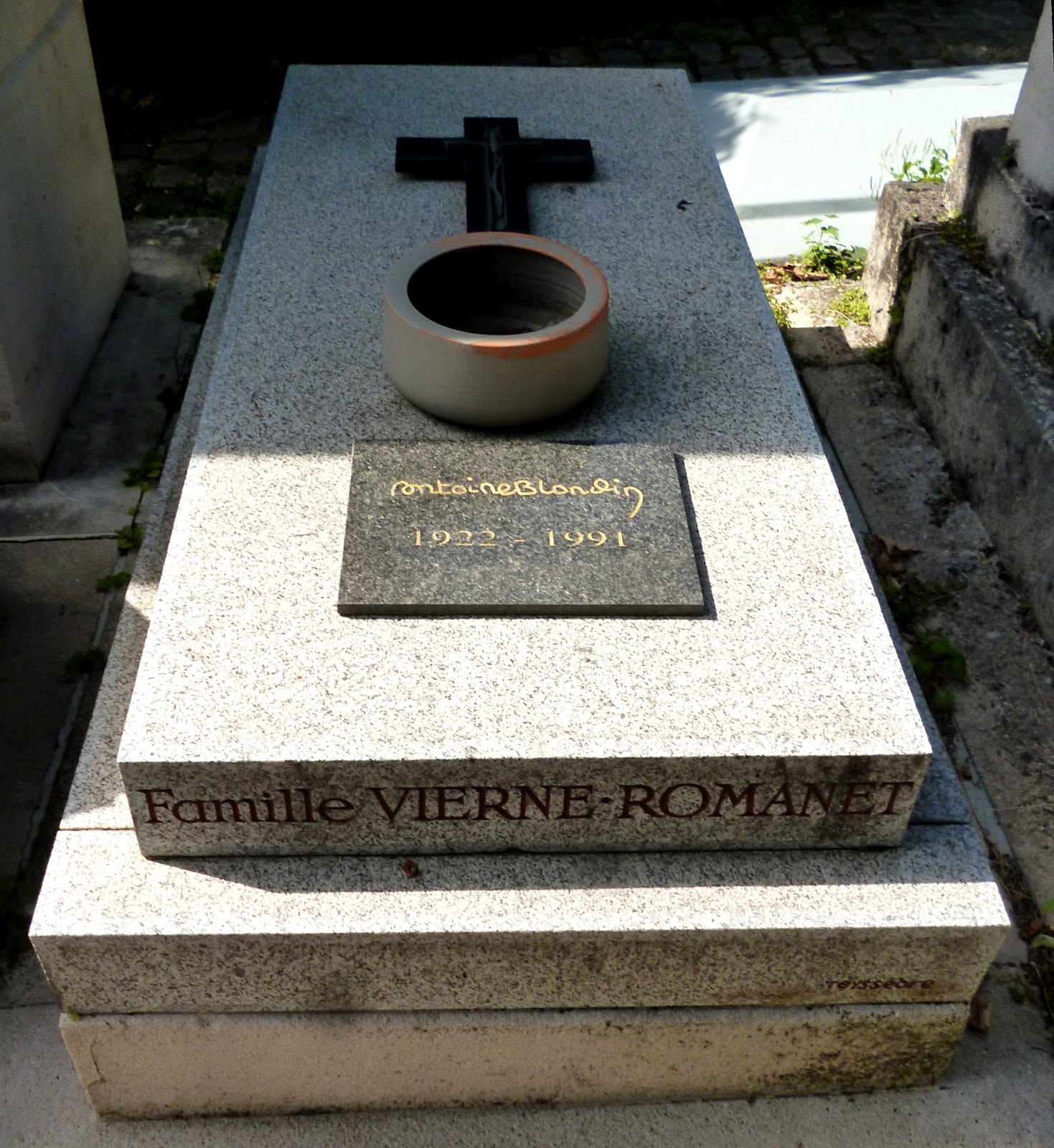
Paris 2015: Antoine Blondin, Cimetière du Père-Lachaise #5

'Antoine Blondin
1922 – 1991'

Antoine Blondin was the son of the French female poet Germaine Blondin (1887–1965) and also wrote under the pseudonym Tenorio and was associated with the Hussards. His stint under occupied France between 1943 and 1944 with the Service du travail obligatoire (STO), in an Austrian synthetic rubber factory, inspired his first novel L'Europe buissonnière (1949), which won the prix des Deux Magots and gained the attention of Marcel Aymé and Roger Nimier. Other noted novels of Blondin's include Les Enfants du bon Dieu (1952), L'Humeur vagabonde (1955) and Un singe en hiver (1959). His drunken exploits particularly around the Saint-Germain-des-Prés area were fondly remembered. The novel Monsieur Jadis ou l'École du soir (1970) is autobiographical.

13 October 2015

Jean-Pierre Enard (Text), Milo Manara (Drawings): L'Art de la fessée | The Art of Spanking (1988)

In Jean-Pierre Enard's relatively brief life (1944–87) he published a number of books, including Fragments d’amour (novel) (1976); La Ligne de cœur (novel) (1977); Le Dernier Dimanche de Sartre (novel [written a few years before Sartre's death]), Sagittaire (1978) repr. Finitude (2004); Photo de classe (novel) (1979); Avec elles (play) (1980); La Reine du technicolor (novel), Presses de la Renaissance (1980) repr. Finitude (2008); Le Voyage des comédiens (novel) (1981); Le Métro aérien (novel) (1986); Contes à faire rougir les petits chaperons (short stories), Ramsay (1987) repr. Finitude (2010). Un bon écrivain est un écrivain mort (lit. 'A Good Writer is a Dead Writer) was published posthumously by Finitude in 2005.

Enard's erotic novel L'Art de la Fessée (The Art of Spanking) – along with Milo Manara's delicious erotic line drawings to go with the text – was published posthumously too, just a year after the writer's death. The book contains the sticker 'POUR PUBLIC AVERTI', for which read 'Parental Advisory', and as with surely all 'Parental Advisory' stickers this is meaningless in the age of the internet.

Enough rambling. This is an erotic story told in the fashion of the day (the late 1980s) but it is really well written by Jean-Pierre Enard, the narrator mainly being (we learn at the end) Donatien Casanova, and in part Eva Lindt. Donatien (after Sade's first name of course) meets well-known TV personality Eva in the first-class compartment of a train from Paris to Venice, and he's well-versed in dealing with intruders: at one point he tells a woman (with a young child) that the compartment is booked and they're waiting for other members of the association 'Érotomanes Distingués de France': had she never heard of EDF? Well, I'm sure we all have now in the privatised hell in which governments have made us live, but this is enough to leave the compartment free for Donatien and Eva. Which is fine because (as of course in the porn/erotic genre of novels and movies) both are almost absolutely obsessed with sex.

Donatien has initially viewed the girls' asses in the train station in Paris while Eva has (secretly she thinks) glanced at Donatien's green notebook, which contains his writings and drawings titled 'L'Art de la fessée' ('The Art of Spanking'). Well, she's obviously very interested and they have (almost) free compartments all the way to Venice, giving Eva a great deal of time to read Donatien's notebook, which he intends to publish not as a novel but more as an instruction book. And Eva's more than willing to be instructed in a sexual art of which she's unfamiliar, although Donatien keeps her waiting right up to the, er, climax.

And the climax also involves Clara, Donatien's friend who also joins in the sex spree on the train, right into Venice station when all three are at it, much to the glee of the train staff and – much more importantly – the media. Surely Eva's been – certainly not unknowingly sexually as she's all for it, but professionally – had? She must have lost her job, destroyed her TV company, and lost so many people their jobs? Well, certainly Donatien had planned which compartment he sat in, but he's left Eva his book – the book within the book – and he's handed over the copyright, so...

A book to treasure, well constructed in any way you choose to take that expression.

My other post on spanking:
––––––––––––––––––––––––––––––––––––
Robert Coover: Spanking the Maid

12 October 2015

Christian Gailly: Un soir au club | Evening at the Club (2001)

Christian Gailly's Un soir au club is narrated by an unnamed artistic painter friend of the protagonist Simon Nardis, a heating engineer from the Paris area who really knows his profession and is married to Suzanne. Simon imagines that a job on the (presumably Breton) coast will take a short time and he'll be on the homeward bound train in a few hours. But it's more difficult than it seems and he's more likely to be back in the early hours of the following morning.

Simon's grateful one-off employer (an engineer too but whose name is not given as he really doesn't matter) treats him to a meal before he goes and then a final drink in a night club before he takes the late train. Simon really couldn't be bothered to make small talk with this man, but plays along with him because it would be rude not too. The man's hobby is philately, and he asks Simon what his 'violin d'Ingres' (hobby) is, and (when pushed) Simon lies and says that his is jazz.

But jazz is far from being Simon's hobby: it was his life, and he was a great influential jazz pianist until the realisation that his sex, alcohol, drugs and fame lifestyle would kill him soon, so he settled down to what most people see as normality: a steady professional job away from the bright lights of international cities. And he's approaching retirement almost teetotal without any more cock-straying. But his narrator friend knows he's missed his old life: 'I knew of Simon's sadness, of his semblance of life, his semblance of being, the dead soul that he trailed along behind him'. Until, that is, Simon sees that the night club has an American jazz trio and misses his last train home by playing an incredible piano solo, re-filling his veins with the jazz narcotic.

He's welcomed with open arms of course, in particular by the owner of the club Debbie, an American 'cultural refugee' who remembers thrilling to him at a stint in Copenhagen when she was a teenager, back in her globe-trotting days. Well, it's as if they've known and loved each other all their lives, although Simon knows he must return home on the early train the next day, back to Suzanne and away from ageing groupies, so he chastely refuses to go back to Debbie's place and she drives him to a hotel, so drunk she has to undress him and leave him to fall back to sleep but perhaps meet her on the beach before he goes home.

And meet her he does, and make love to (not fuck) her he does, and the time of going back just stretches out even longer until the very reasonably jealous and suspicious Debbie decides to drive to the coast and pick him up. But even about half way through we know she dies and some time later do we learn its in a car accident on the way to meet Simon, but only in the end do we learn that the pet cat Dingo is more faithful to Debbie than Simon has ever been to her.

Un soir au club is written in the similar minimalist style of several other writers in the Minuit stable, and is really riveting, hugely readable.

My Christian Gailly posts:
––––––––––––––––––––––––––––––––––––
Christian Gailly: Un soir au club
Christian Gailly: Lily et Braine
Christian Gailly: La Roue et autres nouvelles
Christian Gailly: Dernier amour
Christian Gailly: Nuage Rouge | Red Haze
Christian Gailly: L'Incident
Christian Gailly: Les Oubliés

11 October 2015

Paris 2015: Eugène Dabit, Cimetière du Père-Lachaise #4

'EUGÈNE
DABIT
1898 – 1936'
 
Working-class writer Eugène Dabit, thanks to loans from his uncles, was able to move with his parents into Hôtel du Nord at 102 quai de Jemmapes in Paris (10ème) at the edge of the canal Saint-Martin. In 1931 he received a prize of 5000 francs for the 'roman populiste' L'Hôtel du Nord. In 1936, at the invitation of André Gide, Dabit went on a literary journey to the USSR with, apart from Gide, Jef Last, Louis Guilloux, Jacques Schiffrin and Pierre Herbart. He died of scarlet fever in Sebastapol. Gide wrote Retour de l'U.R.S.S., published the same year, and dedicated it to Dabit.

My other posts on Eugène Dabit:

––––––––––––––––––––––––––––––––––––
Eugène Dabit: L'Hôtel du Nord (1929)
L'Hôtel du Nord, 10th arrondissement

Yves Ravey: La Fille de mon meilleur ami (2014)

Yves Ravey's La Fille de mon meilleur ami (lit. 'My Best Friend's Daughter') is, like I think all of his laconic fictions, short, lacking in a great deal of dialogue and psychology, packed with action (some of it described in obsessive detail), suspenseful, but most of all unpredictable right up to the end.

William Bonnet has promised, on his best friend Louis's deathbed in Montauban, to find his daughter Mathilde, who has spent a number of years in a psychiatric hospital, and who has lost custody of her son Roméo to her former husband Anthony Simonin (which is of course very close to the spelling of the crime writer Simenon, but no matter). Mathilde is easily found, and although William feels he's been thrown in at the deep end, he agrees that the least he can do for her is try and arrange a brief meeting between Mathilde and her five-year-old son, even though the judge has decreed against it.

So they end up sleeping separately in a room in a Super 8 on the outskirts of Savigny-sur-Orge, where William, using a false identity card, poses as a child welfare worker personally interested in Mathilde seeing her son for a short time. He says this to Sheila, the second mother of Roméo and the second wife of Anthony, who's the union treasurer of the Rhône-Poulenc factory which is at the moment on strike.

William arranges Mathilde's meeting with Roméo, although he has a dark side: as the financial director of Vernerey cycles in Montceau-les-Mines, he's been embezzling funds and needs a large sum of money to get out of the mess he's created. There are an awful lot of coincidences in this story, but he finds a method of blackmailing his way out of things: he's chanced upon Sheila's rather odd relationship with the Rhône-Poulenc boss Leduc, and has taken a compromising photo which will allow Mathilde to see her child and – much more importantly – can get his hands on the strike fund money and pay off his debts to Vernerey. (He arranges this in a café, and there's a great deal about milkshakes, vaguely recalling the five-dollar milkshake conversation between Vincent (John Travolta) and Mia (Uma Thurman) in Quentin Tarentino's Pulp Fiction (1994).)

But the blackmail plan is of course easier said than done, and William has to run the gauntlet of Leduc's human bulldog Bardot (certainly no Brigitte: ah, the cinematic references in these books!), plus the menacing Leduc himself, who demands the photo, the memory stick and camera memory card, and (via Bardot) sees to the destruction of William's laptop hard drive. Somehow though William still manages to steal the strike fund money, stash it in his car trunk, but just dithers over the safety of Mathilde now Bardot has trashed the hotel room and she is in the hands of the police for, or all things, taking clothes from a nearby shop when she was bored and/or drunk at the Super 8 on her own.

Never mind though, perhaps – even though William goes to the cops to find Mathilde and they suspect him (a new event) of shooting Anthony with a rifle, they find nothing in his car and even ignore the case with all the money in the trunk. He's safe, and he's won the jackpot. Or maybe he hasn't, yes he has, no he hasn't, yes he has: didn't he know all the time that Mathilde spelt trouble? Right to the final paragraph, Ravey holds his readers in suspense.

My other posts on Yves Ravey:
––––––––––––––––––––––––––––––––––––
Yves Ravey: Enlèvement avec rançon 

Yves Ravey: Un notaire peu ordinaire
Yves Ravey: Trois Jours chez ma tante

10 October 2015

Lucien Bodard: Anne Marie (1981)

Lucien Bodard's Anne Marie was the prix Goncourt of 1981. To some extent (although I've no idea how much) this is autobiographical, and the dust jacket shows a (rather badly cut: this was long before Photoshop) portrait of the author's mother freed from a family picture. It's the seventy-ninth book I've read so far this year, and almost all of those books have been French. This is one of the best of the bunch, and one of the longest.

Anne Marie describes a world which is openly violent for young people but only, er, diplomatically violent for adults. It is narrated by a ten-year-old, or rather, from a ten-year-old's perspective: no ten-year-old could relate this with such maturity and understanding. The back cover would like the reader to believe that this is a story of filial love, which it certainly is, although it is so much more.

Lucien Bonnard (sic) leaves China with his mother Anne Marie, where his father Albert is the vice-consul of Tcheng Tu: the myth is that Lucien is becoming too Chinese, that he needs a sophisticated and French education. So goodbye to his former life, where the female Chinese help for a time sent him to sleep after a (rather too) loving gesture, and welcome to the world of Edmée and her important diplomat husband André , who (we learn later) has been rejected by Poincaré, but who (we also learn later) is responsible for getting Albert his post.

We learn a great deal later, as the backstory is told in a series of flashbacks, and begins with Lucien's beloved Anne Marie arriving in a superior hotel in Paris and dumping him in one of the best schools in France, where he will be abused, bullied, insulted, at the point of despair, but eventually 'reprieve' himself by fighting back, nearly throttling his young aggressor, and score countless points for doing so: the Hobbesian world of the private French school is a kind of microcosm of the much more subtly violent (diplomatic) world from which he's come.

Anne Marie, although much loved (but rather stupidly) by Lucien, doesn't go to see him on Sundays, preferring to mail excuses saying she's too busy, although she's only too busy putting on airs in French diplomatic society, thrilling to the new world she now feels so much a part of as opposed to her humble beginnings.

As a long letter written by Albert (and rather incredibly (albeit wilfully mistakenly?) understood when Lucien clandestinely reads it) states, Anne Marie (although loved by Albert) is a parasite who has inveigled her husband into illegal activities to secure for herself and (ostensibly) for her son but not Albert a very comfortable existence in France – with a luxury apartment to come – and what can he do about it?

Well, Edmée is in correspondence with Albert, and knows all about what's going on. In another life though – long before Edmée met Albert the salesman soon turned into a diplomat by her husband – she remembers the (literally) fantastic existence she lived in the woods in Fontainebleau with Amédée Rien – who thought he was the Lord of the Renaissance – in his extravagant home, before he met and fell for the insane Dora the Scandinavian, who killed herself shortly after giving birth to their son Hector, whom the childless Edmée and André raised as their own, and of whom Edmée is insanely jealous and criticises all the time.

How wonderful to plot Anne Marie's fall, although of course there's always the danger that André will fall for Anne Marie as Dora fell for Amédée. No, it's worth betting on, as in poker or (more relevantly) the mah jong that these sinophiles play so regularly.

Lucien Bodard's Anne Marie sold an enormous number of copies, although he now seems to be almost forgotten. Which is a huge pity.

8 October 2015

Paris 2015: Armando Llamas, Cimetière du Père-Lachaise #3

'Armando LLAMAS
AUTEUR
1950 – 2003'
 
Unlike the flat Montparnasse and (outside the center of Paris) Thais, Montrouge and Bagneux cemeteries, the hilly Père-Lachaise is chaotic and it's common to stumble quite by chance across names of people unknown to you. Like Armando Llamas, for instance.
 
There are perhaps four hundred names in the new guide leaflet to Père-Lachaise, but Armando Llamas isn't one of them. Llamas was born in Spain although his parents emigrated to Argentina when he was one year old. He was a dramatist who wrote in both Spanish and French, France being the country he eventually settled in in 1973. His works include Lisbeth est complètement pétée, Gustave n'est pas moderne, Tahafôt al Tahafôt, 14 pièces piégées, Meurtres de la Princesse juive, Pièces autobiographiques, L'Amour renaît des os brûlés des Sodomites, No way Veronica. He died of AIDS.

Paris 2015: Georges Moustaki, Cimetière du Père-Lachaise #2


The grave of Georges Moustaki (1933–2013), still almost hidden by floral tributes more than two years after his death. Moustaki was born in Egypt of Greek Italian-speaking parents and was a brilliant singer-songwriter. He wrote songs for Barbara, Yves Montand, Serge Reggiani...and Édith Piaf, with whom he had a short relationship and for whom he wrote the words to one of her most famous songs: 'Milord'. He lived on Île Saint-Louis and was a friend of the also Egyptian-born Albert Cossery, who 'worked' – if that word can be applied to Cossery without insulting his name – with him on Jacques Poitrenaud's film version of Mendiants et Orgueilleux, released in 1972. Amusingly, Moustaki also used to take Cossery for a spin on his motor bike.
 
One of Moustaki's best known songs is 'Le Métèque', which is also the title of one of his albums. This clip shows a young Moustaki miming half-heartedly to it, and both his style and the words give a clear idea of his sexy appeal: Georges Moustaki: 'Le Métèque'.

7 October 2015

Paris 2015: Jean-Dominique Bauby, Cimetière du Père-Lachaise #1

I've included a great number of graves in the past in the Cimetière du Père-Lachaise on my blog, but there are always some which have escaped me, which for instance I can't find, or more often which I didn't know of. There are also, of course, newer ones dug after a previous visit. I've no idea how many times I've visited the cemetery in total, although in the last four weeks  I went on four occasions. You can't really spend all day there as it's difficult to negotiate the cobbles and tree roots and your brain starts to go fuzzy after several hours, so it's best tackled in enthusiastic spurts of say two- or three-hour sessions. Last year spotting graves was greatly improved when a new leaflet was printed, which lists many more of them and gives their (approximate) locations. It's not without its faults, but it's a huge improvement on the earlier one and has been the source of a number of my findings this year. This particular grave took a lot of finding, but in the end we got there:

'JEAN-DOMINIQUE BAUBY
AUTHEUR DU LIVRE
LE SCAPHANDRE
ET LE PAPILLON
AVRIL 1952–MARS 1997'
 
Jean-Dominique Bauby is perhaps best known not for the book Le Scaphandre et le Papillon (1997), translated literally as The Diving Bell and the Butterfly and published just a few days before his death, but for Julian Schnabel's 2007 film of the same name. The story of his stroke, his coma from which he emerged with locked-in syndrome and dictated his memoir to Claude Mendibil with his only communicative organ – his left eyelid – is very well known. Bauby died in Berck (Pas-de-Calais) and was buried here in the family grave.

My other post, on Bauby's book:

––––––––––––––––––––––––––––––––––––
Jean-Dominique Bauby: Le Scaphandre et le papillon | The Diving Bell and the Butterfly

6 October 2015

Tanguy Viel: L'Absolue perfection du crime | The Absolute Perfection of Crime (2001)

As might be expected with Tanguy Viel, there are a number of references to the cinema in this novel: I particuarly liked, for example, the expression 'vol au-dessus d'un casino', which can only be translated as 'one flew over the casino', but more of that subject later. Although L'Absolue perfection du crime (translated literally as 'The Absolute Perfection of Crime') contains very little dialogue, it reads just like a movie, in parts a B movie at that.

But there's nothing wrong with writing a novel like a B movie, and Viel is very good at it. Here we have the cliché of the foiled hold-up, and the book is divided into three parts: the preparation for it; the hold-up itself and its aftermath; and finally the reprisals.

The main reference in the novel is certainly not to a B movie but to The Godfather, complete with a mafioso-type 'uncle' who is the patriarch of the 'family', although this is a family linked not by blood ties but by criminal activities. And these activities don't take place in Sicily but on the French coast, somewhere like Viel's native Brest in Brittany.

The 'brothers' are the narrator Pierre, his friend Marin who's just spent three years in prison for an unnamed crime, Andrei, and Lucho who is pulled into the gang because of his special skills. Marin's wife Jeanne is also seen as necessary for the smooth working of this supposedly perfect crime.

Nothing is skimped on the preparation of the casino hold-up on 31 December, which appears to be in 1991: Andrei poses as a video cameraman making a tourist documentary of the town, and what could be more normal than videoing the casino, the heart of lucrative capitalist exploitation amusement? Lucho knows that the way to do it is through the roof: taking the booty away through the roof via a small tele-commanded air balloon (well, these days were long before drones) is the way to go. Marin puts the money in the balloon which he and Pierre have stolen after Pierre (who's been playing roulette with Jeanne) causes a diversion by claiming a lot of his money has been stolen and demanding to see the manager, who is of course forced at gunpoint of open his safe.

So far so unbelievable, but it works nevertheless, and the five-million franc balloon lands in the sea as planned, and Pierre retrieves its contents only to find the police waiting for the robbers: Lucho has ratted on his 'brothers', and in the ensuing shoot-out Marin escapes with the money, Andrei is killed and Pierre gets out of prison after seven years.

Seven years is a long time to mull over the ways you've been badly treated, and the, er, fun starts again when Pierre is released and ready to settle accounts. First there's Lucho, who (all things considered) is pretty stupid: he knew about Pierre's favourite game of knocking on future murder victims' doors and then withdrawing for them to find a ripped-up name, meaning they were dead men, but Lucho left it too late and gets a bullet in his head and one in his heart in his supposed escape train. And then there's Marin at the opera, who sees Pierre staring at him and escapes, which leads to an unbelievable car chase and a shoot-out. Just like in the movies. And just as gripping.

My other posts on Tanguy Viel:
–––––––––––––––––––––––––––––––––––
Tanguy Viel: Insoupçonnable
Tanguy Viel: Paris-Brest
Yves Ravey: Trois Jours chez ma tante

Philippe Besson: Un instant d'abandon (2005)

Philippe Besson, it seems, can always be relied upon to produce a very good outsider novel, and Un instant d'abandon is no exception. This is told from the point of view of Thomas, an Englishman of about thirty who has lived most of life in Falmouth, Cornwall. He paints a very gloomy picture of the town, although the description of the Chain Locker pub (and there really is one in Falmouth) made me realise Besson has never set foot in a pub in England. An English pub where you order a coffee, sit down, are served, and pay afterwards? And which also serves grenadine? I can't for a second imagine such French café style service in a pub in Falmouth.

Anyway, to cut to the quick. Thomas has been something of a weedy person physically, injured his leg as a child and suffered forever after from torment by his male school counterparts but earned great respect from Marianne, whom he married and had a child by, or rather didn't as he's infertile, although Marianne didn't know that, so her infidelity is ostensibly only known by her. But it makes for a problematic marriage made even more problematic when Thomas kills the son who isn't his biological son.

In fact he doesn't really kill him as such, he's just a little negligent taking him out to sea when warned against it, and the child just dies accidentally, although Thomas (rather harshly, I thought) gets five years for a kind of homicide after he's, well, just released a dead body (never found) to the sea. But then he didn't defend himself in court.

And after prison Thomas returns to the completely empty home his wife has left – perhaps to go with her lover: who knows or cares – to the only place he's really known, but to almost universal ostracism, to hurtful oblique comments in the Chain Locker. Almost universal, but there are two understanding souls: both are outsiders of sorts.

First there's Rajiv, the Pakistani from whose shop Thomas buys a large number of things from, and who invites Thomas into his private 'sanctuary' for cup after cup of tea, sessions during which Rajiv listens almost like – I couldn't help thinking – a psychiatrist.

And then there's Betty, an attractive girl of twenty-one who's viewed Thomas for a long time on the sly, recently watched him coming and going from the Chain Locker, identifies a fellow outsider and will have no truck with the mindless ostracism. With great pain, she listens to Thomas in the Chain Locker (and surely prison is suggested in that phrase?), hears of the initial madness he underwent inside, of the violence and egoism of survival. It's difficult for her to listen to Thomas, but she does so because she loves him, as she confesses.

How does Thomas react to this? Well, Betty has also said that she has a young child, so surely he has a ready-made family, a working partner and an end to all the outsiderdom?

Alas, Thomas can't accept the invitation to love and possible happiness and has been waiting for the return of Luke, the guy he met in prison, and who comes to join him in Falmouth. Throughout, the novel had been leaning away from the world of heterosexuality: 'Le désir des femmes, je l'ai égaré, si je l'ai jamis eu': ('Desire for women, I lost it, if I ever had it'); 'Non, la connaissance d'une autre ne m'a vraiment manqué': ('No, I never really missed the knowledge of another woman'). Besson is a world away from the explicit gay sex of some novels, but (rather differently) more tilted to the coded homosexual languages of decades ago. Just a shame he's never been to an English pub though, as he'd have been far better equipped to describe one in the novel.

My other posts on Philippe Besson:
–––––––––––––––––––––––––––––––––––
Philippe Besson: Un garçon d'Italie
Philippe Besson: En l'absence des hommes | In the Absence of Men
Philippe Besson: La Trahison de Thomas Spencer
Philippe Besson: Son frère
Philippe Besson: « Arrète avec tes mensonges »

Yves Ravey: Un notaire peu ordinaire (2013)

This is the first Yves Ravey novel I've read, so I'm just learning. His writing has been compared with that of Simenon and Jean-Patrick Manchette, which gives an idea of the territory Ravey is travelling. Un notaire peu ordinaire (literally 'An Unusual Solicitor' isn't really concerned with psychology but the events behind which psychology can (or rather can't) be read.

This is the story of a family that's gone wrong, been partly destroyed by tragedy. But the information is drip-fed (or slowly suggested) to us, and this is surely Ravey's main power (at least in this novel): the ability to hold us in suspense as he gradually unrolls the intrigue.

After fifteen years in prison for raping and it seems killing a young girl, the student narrator's forgotten (and not too intelligent) cousin Freddy is released from prison and comes to see his cousin, the widow Madame Rebernak, who has no wish to see him and fears for the safety of her daughter Clémence. But Freddy has served his sentence, been allowed to leave before time for good behavior, and unless he re-offends he's more or less free to do as he pleases. His probation officer evens hopes Mrs Rebernak will forgive him and allow his reintegration into society, even to the point of living in her house. But the idea is anathema to Mrs Rebernak, who is supicious of his hanging around outside the lycée where she works as a cleaning woman and where her daughter is a student. She goes as far as to consider Freddy's dog, who visits the outside of the house during the night, as a veiled threat.

Clémence is the girlfriend of Paul, the son of the solicitor Montussaint, who was a hunting friend of Mrs Rebernak's husband. All the time in this short novel the suspense grows and the reader knows that something awful is going to happen, although of what nature is unknown. But the sympathies start to shift and Freddy begins to decline as a force of evil in proportion as Montussaint grows as one.

Montussaint not only makes inappropriate gestures to Clémence, but tries to blackmail her into silence by threatening to cause Martha (as he refers to her mother) to lose her job if Clémence tells anyone of his sexually predatory behavior. Towards the end it's clear (by the understated way that Ravey chooses his words) that Montussaint has raped Clémence. And of course he tries to blame it on Freddy, although Martha has already figured the situation out, and finds a much better use for her dead husband's weapon than killing her cousin (and quite the opposite to the one Montussaint has suggested to her.)

This is language written in very simple words, simple and short sentences, pared down to an absolute minimum of adjectives, much suggestion and virtually no moral comment, actions revealing the psychology, etc, but this is proof positive of the power of literature to speak volumes by saying so little. That this power should be in the form of what amounts to a thriller slightly disappoints me though: surely writing of this calibre can be used to say so much more?

My other posts on Yves Ravey:
––––––––––––––––––––––––––––––––––––
Yves Ravey: La Fille de mon meilleur ami 

Yves Ravey: Enlèvement avec rançon
Yves Ravey: Trois Jours chez ma tante

Emmanuel Carrère: La Classe de neige | Class Trip (1995)

Emmanuel Carrère's Classe de neige (called Class Trip in translation) is all about the troubles of Nicolas, whose specific age isn't given, but who is under twelve. Nicolas is one of nature's outsiders: he is easily frightened and has an over-active imagination, he is small for his age and the butt of his fellow schoolkids's jokes, and as for his father – well, that comes later.

The school is off for a two-week trip into the French Alps learning how to ski, which is a great opportunity for Nicolas to try to integrate, although his father insists that it's best for him to drive the whole four hundred kilometres plus with just himself and his son: he's used to driving as he's a sales rep in the prostheses field, and may well be carrying artificial limbs or whatever: and that's what he does.

But then he deposits his son at his destination without noticing that the bag containing everything Nicolas needs for the stay, fresh clothes, pyjamas, toothbrush, drawsheet (Nicolas still wets the bed), etc, has been left in the trunk of the car: Nicolas, who has to be updated on what has happened between the arrival of the school bus and and his own arrival, is in a huge mess because he has no pyjamas to wear or even the wherewithal to brush his teeth.

Slightly ludicrously, the giant pupil Hodmann lends him a pair of pyjamas (the others not volunteering owing to Nicolas's urinary misfunctions, and of course because this is Nicolas anyway), but Hodmann seems a little menacing: not the kind of guy you'd neccessarily want as a friend, but a kind of friendship nevertheless develops between the two kids. But all along there's this atmosphere of menace, of impending doom. Will it come to Nicolas, and what will Hodmann have to do with it (if at all)?

Carrère's narrative is linear, apart from Chapter 26 (with just five chapters to go), which is very short and set twenty years on, when Nicolas is passing by Trocadéro, and his name is called by Hodmann, who's sitting on a bench drinking wine and eating meat. He shouts Nicolas's name, threatens him with a knife, and Nicolas doesn't say anything but just runs away from the danger.

Nicolas is not only still an outsider, but even more of one. Although never known alive, the presence of René, a young kid from a local village near where the ski class was situated, is felt very much in this book: René was missing, and shortly afterwards found murdered and mutilated. When the highly agreeable and tactful animateur Patrick drives Nicolas back home before the end of the trip, when he fills up with petrol at a motorway service station, he has to avoid the displayed front pages of the newspapers declaring Nicolas's father a 'monster'. He takes the boy back to his mother, although Nicolas knows that she will already have concocted excuses about his father, such as that he's in hospital but for some reason can't be seen, or that he's dead but for some reason his grave can't be visited. Nicolas knows that in his own life there will be no pardon, although of course there is nothing at all to pardon him for: he outsiders himself, but is also outsidered by others. His father has in effect destroyed him as well as René: both are now voiceless.

My other posts on Emmanuel Carrère:

––––––––––––––––––––––––––––––––––––
Emmanuel Carrère: La Moustache | The Mustache
Emmanuel Carrère: D'autres vies que la mienne | Lives Other than My Own
Emmanuel Carrère: Un roman russe

Emmanuel Carrère: La Moustache | The Mustache (1986)

This Folio edition of Emmanuel Carrère's La Moustache has a picture of Otto Dix's painting Le Roi des coiffures ('The King of Hairdressing') on the cover, and seems to indicate a quite amusing book. In fact the book is very amusing – most of the way, at least. The author moves the reader through an atmosphere of unease, and there really can only be one answer to the mysteries in this book. But there can be no way of knowing that the book turns into something very disturbing, in fact into a horror story at the very end.

But to the beginning of the novel. The narrator has access to the thoughts of Marc, an architect who's been married to Agnès, who's in publishing, for five years. When she goes to the shops on one occasion, Marc decides to shave his mustache off, and the excessively fussy narrative goes into great detail describing how he goes about this. But when Agnés returns she disappoints Marc by not saying a word about her husband's changed face. And when they go for dinner with their good friends Serge and Véronique, neither of them says anything about it either.

When they get home that night Marc introduces the subject of the silence surrounding the lack of hair between his chin and his upper lip, only to be told that he's never had a mustache. This even leads to Véronique being urged, in spite of the late hour, to phone Serge and Véronique, although they only verify the absurdity: Marc has never worn the mustache that he knows he's worn for many years. Marc knows that his wife's given to practical jokes, although he's never been the subject of one before, and her continuation of it is a little too much.

Furthermore, when he goes to work Jérôme (his  best friend) and Samira say nothing about his facial change: surely Agnès hasn't made them join in the joke too? Well, he thinks of all manner of reasons for this mystery, his marriage is suffering, maybe he should just play their game in order to bury the problem? Easier said than done.

His obsession continues, even to the point of pretending to be blind and asking a passerby if it's his photo on his identity card or he hasn't got someone else's by mistake. Yes, it's him – and he's wearing a mustache. This is a great relief, and proves that he's not the one who's going mad but his wife, so she's the one who needs the psychiatrist they've been talking about. Especially as she tries to scratch off the mustache she's convinced he's drawn on his identity card. And then she seems to have hidden the photos from their holiday in Java which prove his point, although she says they have never been to Java! And then, truly bizarrely, she claims they don't know anyone called Serge and Véronique, and Marc's parents, whom they regularly see, according to Agnès is in fact now just Marc's mother as his father died the year before. Agnès is clearly howling mad and needs urgent help.

But for some reason Jérôme too thinks the mental problem lies with Marc. How can this be? They must be having an affair and want to see Marc locked away. But why so when Agnès can so easily just ask for a divorce? Marc seems to be in a cleft stick and there's nothing for it but to run away in order to avoid the padded cell. So on an impulse Marc lands in Hong Kong, for relaxation taking the ferry backwards and forwards to Kowloon all day. But what to do with his life? How about Macao? Then he finds Agnès in the hotel room waiting for him as if nothing's happened. And so the story ends as it's begun – in a bathroom, only this time it doesn't end with shaving off a mustache, but with a final few pages of graphic self-mutilation.

The back cover tells potential readers that they're strongly advised not to peek at the last pages of the book. But there's no warning to the squeamish to avoid this truly weird, horrific book at all costs: it should be given an 18 certificate, just like movies that take things a little far. Personally I found it unputdownable, although I can understand any negative reactions.

My other posts on Emmanuel Carrère:

––––––––––––––––––––––––––––––––––––
Emmanuel Carrère: La Classe de neige
Emmanuel Carrère: D'autres vies que la mienne | Lives Other than My Own
Emmanuel Carrère: Un roman russe

Olivier Adam: Des vents contraires (2008)

I'd already read Je vais bien, t'en fais pas, À l'abris de rien and Les Lisières, so I had an idea of the kind of thing to expect here, although Olivier Adam doesn't carry things off as well as in those other novels. We have a similar heavy-drinking character who exiles himself to the coast of his native Brittany, in this case Paul, whose wife Sarah has left him. Just like that, without saying anything. And leaving him with the two young children Clément and Manon. Needless to say, he's in a mess, and young Manon gets it about right when she suggests that her father would prefer to listen to Leonard Cohen day and night rather than any other music. (Cohen, incidentally, is quoted before the beginning of Adam's Le Cœur régulier, although I've not got round to reading that book yet.)

Paul is the narrator, and a writer who has a block, so for financial reasons he's also working with his brother in Saint-Malo, who is carrying on the family driving school business. This gives Adam a great opportunity to pad the book out and introduce the reader to several more characters who are scarcely believable not so much in themselves but as a general group of students Paul happens to get – although they're none the less interesting for that.

There's the troubled young Justine who likes to take a break in the lesson in a café and on one occasion throws a funny spell, leading to Paul picking up the tab from the hotel he leaves her to sleep her troubles off in; then there's Élise, the seventysomething widow who invites Paul in for several drinks – there's a disturbing amount of drinking and driving in the novel – and asks him to dance with her; and we mustn't forget Brehel, who (not altogether legally: this is France) is permanently living on a trailer park after losing his job after knocking over a cyclist when he was drunk and has to re-take his test. The main trouble with all these separate stories is that they detract from the main story, making the novel in general too bitty.

In spite of Paul's faults – he and his wife (the latter in her diary) describe him as an egoist, and he tends to cope with situations he doesn't like by resorting to violence and/or heavy drinking – he's obviously a loving father, he readily helps out Justine and Élise (who unfortunately dies), and he goes out of his way to aid 'le grand' (probably too much but in any case in the end he, er, goes out the window). Even the cop Combe likes him, although he's just as much of a mess anyway, and is just as guilty of excessive drinking and driving.

This is very readable and very Olivier Adam, but there are too many parts here struggling to find a whole.

My other posts on Olivier Adam:

––––––––––––––––––––––––––––––––––––
Olivier Adam: Je vais bien, ne t'en fais pas
Olivier Adam: Les Lisières
Olivier Adam: Le Cœur régulier
Olivier Adam: Falaises

Olivier Adam: À l'abri de rien

2 October 2015

Paris 2015: François Villon, 5th arrondissement


François Villon (dates uncertain, but early 15th century) was a poète maudit avant la lettre: murderer, thief, vagabond and (probable) homosexual also long before that expression was ever used, Villon was also a great poet whose 'Ballade des dames du temps jadis' was sung by Georges Brassens, and whose final choral line 'Mais où sont des neiges d'antan ?' has even come through to English as 'But where are the snows of yesteryear?' This statue in the square Paul Langevin is by René Collmarini, dating from 1933.