18 March 2012

John Cullen in Bottesford, Leicestershire

I first learned of the existence of the poet John Cullen from the Bottesford Living History Project here. He was born in Newport, County Tipperary, Ireland, and left Trinity College, Dublin, before taking a degree. He had married the German Leontine Dordinger (or Derdinger) before he became curate at Bottesford, Leicestershire, from 1867 to 1869. He would have lived at The Manse on the corner or Rectory Lane and Chapel Street.

From Bottesford he became the vicar of St Mary's parish church, Radcliffe-on-Trent, Nottinghamshire in 1874, where he stayed until his death in 1914. He initiated the restoration and enlargement of St Mary's in 1877, which included rebuilding of the tower, whose unusual saddleback roof has been said to be influenced by Leontine to remind her of her native home.

Cullen supported women's suffrage and his poetry was well received in the USA. Illinois Wesleyan University, Bloomington, awarded him a doctorate in Divinity in 1893.

Cullen's son Frederick died in 1872 at the age of six months and was buried in the churchyard of St Mary the Virgin, Bottesford.

Cullen died at the vicarage in Radcliffe-on-Trent, although he was buried with his wife (who died in 1906) in Bottesford. He has an entry in the DNB written by Pamela Priestland.

'IN SACRED MEMORY OF
Leontine Eugenie Cullen
WHO DIED ON SEPT. 16 1906,
AGED 66 YEARS.

"Wir seh'n den Himmel offen
Und nicht das Grab allein."

"VERILY, VERILY, I SAY UNTO YOU, IF A MAN KEEP MY
SAYING, HE SHALL NEVER SEE DEATH." JOHN 8: 51


"I KNOW WHOM I HAVE BELIEVED." 2 TIM 1. 12.
ALSO REV. John Cullen, D. D.,
DIED MAY 6TH. 1914, AGED 77 YEARS,
40 YEARS VICAR OF RADCLIFFE-ON-TRENT.'

The full 1893 edition of Cullen's Poems and Idylls is here.

The British Library lists a number of John Cullen's publications, of which these are examples:

Horae Poeticae, New ed., rev. (London: William Macintosh, [1869]

The Life after Death, and the Things to come (London: Hatchards, 1876)

Confirmation: Its nature and obligations (London: Hatchards, 1881)

In What Way Can Romeward Tendencies Be Most Effectually Counteracted and Suppressed? (London: John Kensit, [1888])

Pen Pictures from the Life of Christ (London: R. D. Dickinson, 1889)

Poems and idylls (London: S.W. Partridge, 1893)

Songs of Consolation (London: S. W. Partridge, 1893)

The Fruit of the Spirit, 2nd ed. (London: S. W. Partridge, [1895])

Three Christian Virtues: Faith, Hope, Love, these three (London: Marshall Brothers, [1903]).

16 March 2012

Ann Taylor (1782–1866)

Ann Taylor (1782–1866) and her sister Jane (1783–24) were writers of children's poetry, and the representation above is by their father, the Rev Isaac Taylor, also a writer, and an engraver whose own father (also Isaac) had worked with the engraver Thomas Bewick. The Rev Isaac's son (also Isaac) was a writer too, as was his wife (also Ann, née Martin), and they came to be known as 'The Taylors of Ongar', a village in Essex, England.

The Rev Isaac's daughter Ann married the minister Joseph Gilbert in 1813 and they moved to Nottingham in 1825. As her Wikipedia entry (which probably provides more readily accessible biographical information about her than any other site) says: 'She died on December 20, 1866 and was buried next to her husband in Nottingham General Cemetery':


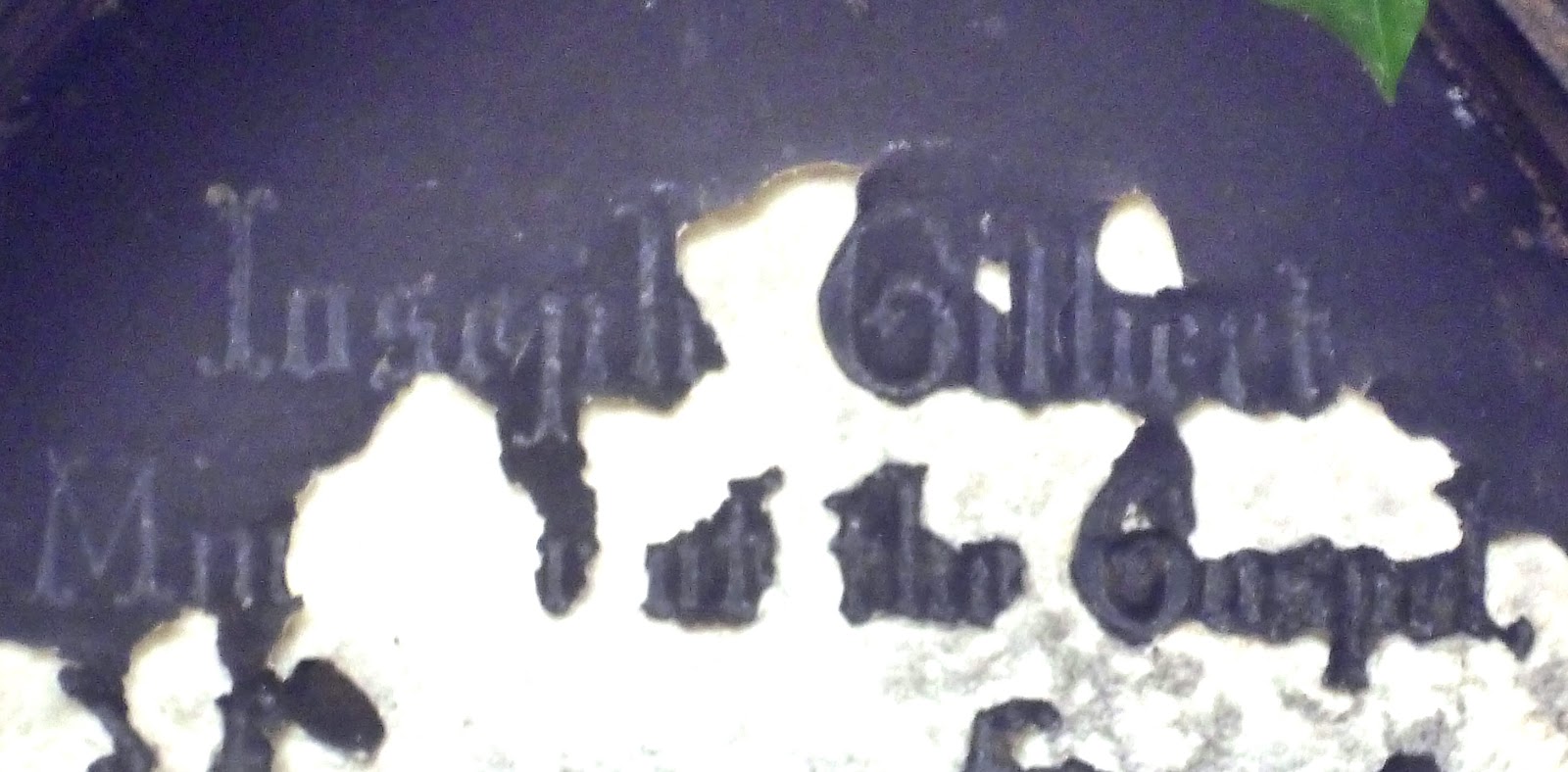
Most of the inscription is badly flaking off, although 'Joseph Gilbert' is quite clearly visible, 'Minister of the Gospel' a little less so.

The Autobiography and Other Memorials of Mrs Gilbert, (Formerly Ann Taylor) (London: Henry S. King, 1874), edited by her son Josiah Gilbert, is here. Below is a representation of Ann at 75, by her son.

Her sister Jane Taylor's famous poem of 1806:

'The Star

Twinkle, twinkle, little star,
How I wonder what you are!
Up above the world so high,
Like a diamond in the sky.

When the blazing sun is gone,
When he nothing shines upon,
Then you show your little light,
Twinkle, twinkle, all the night.

Then the trav'ller in the dark
Thanks you for your tiny spark,
He could not see which way to go,
If you did not twinkle so.

In the dark blue sky you keep,
And often thro' my curtains peep,
For you never shut your eye,
Till the sun is in the sky.

'Tis your bright and tiny spark,
Lights the trav'ller in the dark.
Though I know not what you are,
Twinkle, twinkle, little star.'


Writers and literary associations in Nottingham General Cemetery:
–––––––––––––––––––––––––––––––––––
Robert Goodacre (1777–1835)
Ruth Bryan (1805–1860)
Sarah Ann Agnes Turk (1859–1927)
Annie Matheson (1853–1924)
Josiah Gilbert (1814–1892)
Anthony Hervey (c. 1796–1850)
Charles Bell Taylor (1829–1909)
James Prior's Parents
Robert Millhouse (1788-1839)
Henry Hogg (1831-74)

14 March 2012

Rose Fyleman: The Rose Fyleman Fairy Book (1923; repr. 2010)

I've only just come across the children's poetry of Rose Fyleman (1877–1957), but this relatively recent publication (Nottingham: Bromley House Editions/Five Leaves, 2010), which is based on the Methuen first edition of 1923 and includes a number of illustrations by Hilda T. Miller, is a delight. Fyleman is perhaps almost forgotten now, but the first line of her poem 'Fairies', which opens this collection, certainly isn't forgotten: 'There are fairies at the bottom of our garden!'.

As there doesn't appear to be much information about Nottingham-born Fyleman available online, I'm forced to fall back on her Wikipedia entry here, although her book Fairies and Chimneys (1918), which also begins with the poem 'Fairies', is here. It is dedicated

'TO
THE REALEST FAIRY
OF MY CHILDHOOD
MY MOTHER'.


Humphrey Carpenter and Mari Prichard's The Oxford Companion to English Literature (1984) states that Fyleman, making the acquaintance of A. A. Milne through her contributions to Punch, first made the suggestion that he write children's verse, and that his first published children's poem, 'The Dormouse and the Doctor', appeared in Fyleman's monthly The Merry-Go-Round (which had its origins in the annual Joy Street).
12 March 2012

Anne Tyler: Ladder of Years (1995)

When Delia and Joel are talking about the absence of words to express subtleties, Joel regrets that there's only one word to describe the various hues of freckles. He is of course expressing his love, his desire, for Delia, but in a tangential, restrained, although highly eloquent manner. This is typical of the whispered art of Anne Tyler: there is never any mention of penises or clitorides, vaginas, or ever nipples.

Sometimes, however, her restraint, her deliberate avoidance of saying things seems to fall flat, becomes unrealistic, particularly with her characters' use of interjections: expressions of disgust, anger, frustration, are always covered over by words like 'Cripes!', 'Hot dog!', 'Jiminy!', 'Gosh!', 'Sheesh!', 'Compost happens!', etc, all quaint euphemisms that have a hollow ring, that in no way match the gravity of the situation. Yes, this is (most probably) the early nineties and still Dr Samuel Grinstead rebukes his son for saying (gasp!) 'for Christ's sake!'. Compared with movie language (and we've moved light years away from the shock of the word 'damn' in Gone with the Wind), Tyler's novels are stuck in a distant past as far as interjections go. (Perversely, this can be as charming as it is annoying.)

And yet she's no wilting, schoolmarmish writer, she can be (and indeed often is) caustic, and her characters can lash out at the aural anesthesia of smalltalk or the safety valves of religion that automatically annihilate any attempts to delve into troubling, complex thoughts by their soothing, readymade, robotic reflexes.

Living with Sam and the kids, Delia sometimes felt 'like a tiny gnat, whirring around her family's edges', and certainly the bizarre newspaper article that announces her disappearance and that serves as an introduction to Anne Tyler's Ladder of Years strongly indicates someone almost incidental to the lives of her family: neither her husband nor her children can decide for sure on her height, weight, the color of her eyes or what she was wearing. So who can be surprised that, without a word, she has walked out of their lives. After about a year she walks into the life of Joel and his son Noah, but then in a few months walks out again, back into Sam's. I suppose I saw the end coming, but I can't say I'm too happy with it: so like other characters of Tyler's, was Delia trying on another life, or stepping outside of time a while? Sheesh!


–––––––––––––––––––––––––––––––––––
Anne Tyler: If Morning Ever Comes (1964)
Anne Tyler: The Tin Can Tree (1965)
Anne Tyler: The Clock Winder (1972)
Anne Tyler: Celestial Navigation (1974)
Anne Tyler: Earthly Possessions (1977)
Anne Tyler: Morgan's Passing (1980)
Anne Tyler: Dinner at the Homesick Restaurant (1982)
Anne Tyler: The Accidental Tourist (1985)
Anne Tyler: Breathing Lessons (1988)
Anne Tyler: A Patchwork Planet (1998)
Anne Tyler: Back When We Were Grownups (2001)
Anne Tyler: The Amateur Marriage (2004)
Anne Tyler: Digging to America (2006)
Anne Tyler: Noah's Compass (2009)

Anne Tyler: The Beginner's Goodbye (2012)
Anne Tyler: A Spool of Blue Thread (2015)

11 March 2012

The Arkwright Building, Nottingham, and Its Statues

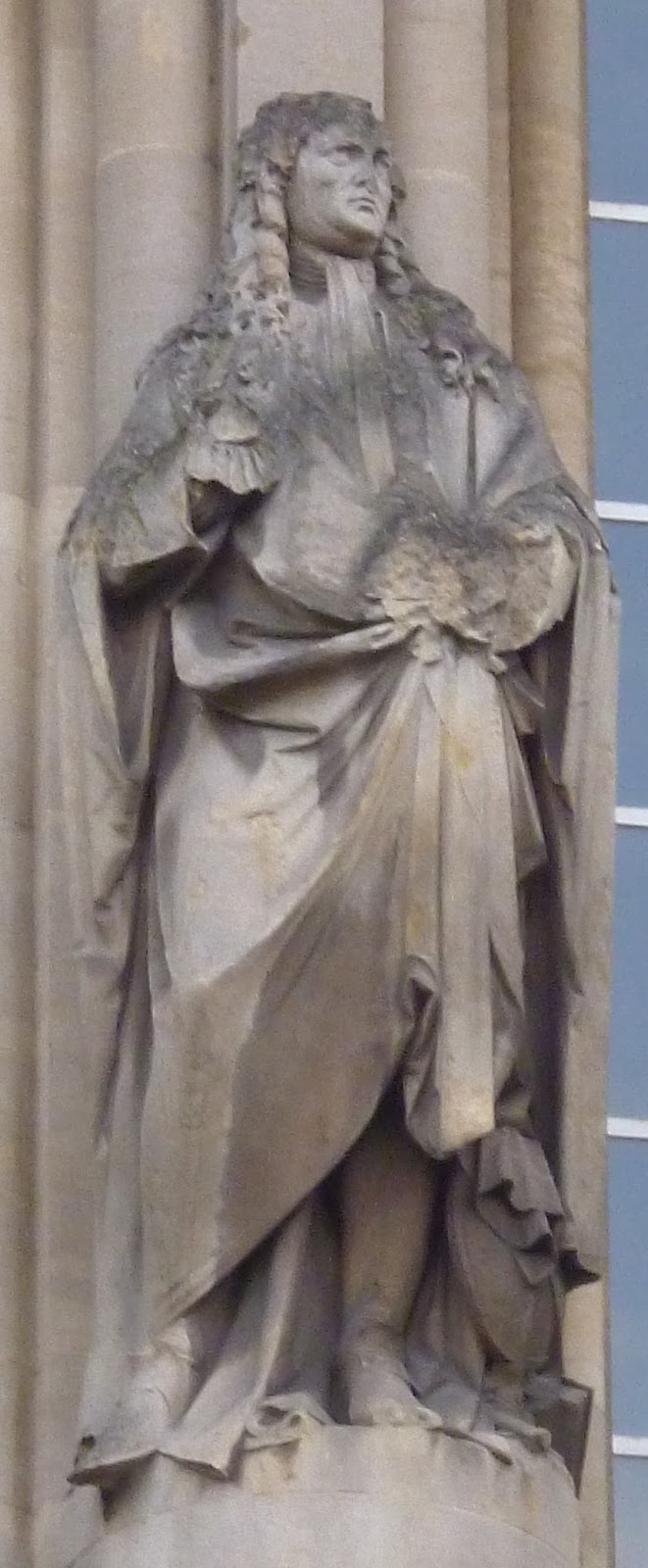
The Arkwright Building of the the former Nottingham University College (later to become the University of Nottingham) on the corner of South Sherwood Street and Shakespeare Street dates from 1881 by Lockwood and Mawson, and it is here that D. H. Lawrence studied, gaining his teaching certificate in 1908. Four other notable people are represented as statues at the Shakespeare Street side:

William Shakespeare (1564–1616) himself,

John Milton (1608–1674),

Francis Bacon (1561–1626)

and Isaac Newton (1643–1727).

The building now belongs to Nottingham Trent University.

6 March 2012

Anne Tyler: Earthly Possessions (1977)

Elements of the Southern Gothic are plentiful in Anne Tyler's Earthly Possessions. Charlotte says of her grotesquely obese mother: 'In some way, she'd grown separate from the rest of the town – had no friends whatsoever.' Added to that, her father 'Hung about as if he didn't own his own body [...] he looked like an empty suit of clothes'. And her mother said she didn't believe Charlotte was her real daughter, thought there'd been a 'mix-up' at the hospital. As a child, Charlotte's two principal fears were that she'd be rejected because she was not the real daughter, or that if she was the real daughter she wouldn't ever be able to escape.

Once again with Tyler, in this novel there's a statement that normalizes the abnormal, or abnormalizes the normal: 'Maybe all families, even the most normal-looking, were as queer as ours once you got up close to them.' What do you expect: this is Anne Tyler, who specializes in dysfunctional families and the weirdness of everyday life, who paints a world where the bizarre is an ordinary part of living. Several of Tyler's novels begin where a person walks out of a relationship, but in Earthly Possessions Charlotte Emory not only walks away from Saul to draw out money out of a bank for her escape, but at the same time walks into the clutches of bankrobber (and bad driver) Jake, whose almost consenting hostage she becomes, which begins an absurd road trip into Florida involving a mismatched couple, turning into a mismatched trio.

All this is told in two alternating first person narratives in the past tense by Charlotte, which are in fifteen sections – from the bank robbery through to the end of the road trip, and from Charlotte's early life up to the end of the road trip where the narratives converge – with a sixteenth section as a presentday coda. But Charlotte is still stuck in her past life, and things still happen to her without her being able to make anything happen for herself.


A criminal driving to Florida, a cat in a car? Isn't there just a teensie sniff of Flannery O'Connor's 'A Good Man Is Hard to Find' here? Tylerized, of course.The links below are to Anne Tyler novels I've written posts on:

–––––––––––––––––––––––––––––––––––
Anne Tyler: If Morning Ever Comes (1964)
Anne Tyler: The Tin Can Tree (1965)
Anne Tyler: The Clock Winder (1972)
Anne Tyler: Celestial Navigation (1974)
Anne Tyler: Morgan's Passing (1980)
Anne Tyler: Dinner at the Homesick Restaurant (1982)
Anne Tyler: The Accidental Tourist (1985)
Anne Tyler: Breathing Lessons (1988)
Anne Tyler: Ladder of Years (1995)
Anne Tyler: A Patchwork Planet (1998)
Anne Tyler: Back When We Were Grownups (2001)
Anne Tyler: The Amateur Marriage (2004)
Anne Tyler: Digging to America (2006)
Anne Tyler: Noah's Compass (2009)
Anne Tyler: The Beginner's Goodbye (2012)
Anne Tyler: A Spool of Blue Thread (2015)

4 March 2012

Henry Kirke White in Nottingham

'HERE ON THIS SITE STOOD THE BIRTH
-PLACE OF HENRY KIRKE WHITE
POET – – BORN MARCH 31ST 1785
DIED AT CAMBRIDGE OCT 19TH 1806'

This plaque is inside the Exchange Arcade at the Cheapside side of the Council House.

Born in Nottingham the son of a butcher, White went on to publish Clifton Grove in 1803, which made an impression on Robert Southey. However, he died in Cambridge at the age of 21 after excessive study. He is remembered in the names of several streets and in two memorials in St Wilfrids Church, Wilford, Nottingham.

A 1906 article from Transactions of the Thoroton Society on Henry Kirke White, by J. C. Warren, is here.

Graham Greene in Nottingham

The plaque on the Express Offices, Upper Parliament Street, Nottingham, tells most of the story:

'Commemorating the Centenary of Cinema 1996
–––––––––––––––––––––––––––––
GRAHAM GREENE
Screenwriter – Film Critic – Novelist
Apprentist Sub-Editor The Journal 1926
––––––––––––––––––––––––––––
"I have happy memories of this
bizarre old building...
"
––––––––––––––––––––––––––––
In association with the British Film Institute'.


And here is the 'bizarre old building', which is now closed and looks a little forlorn.

There was an informative Facebook site devoted to Graham Greene in Nottingham but it migrated, although Greene's address at All Saints Terrace, Nottingham models for his future novels, and his conversion to Roman Catholicism, among other things, are briefly mentioned via a link from Facebook.

Hans Christian Andersen in Nottingham

Not far from J. M. Barrie's old lodgings on Birkland Avenue is the pub the Gooseberry Bush on Peel Street: an acknowledgement that the street once had a maternity hospital. Anyone familiar with Wetherspoons pubs will be aware that this gives them a perfect excuse to hang things on their walls.

Such as a photo of Hans Cristian Andersen, who wrote a short story called 'The Storks'. A note underneath this states that the expression 'gooseberry bush' replaced the legend of the stork delivering a baby in a sling hanging from its bill, which it says was popularized by Andersen's story. (It notes that the stork has long been a symbol of 'happiness, fertility and prosperity'.)


Also on the wall is a representation of a scene from the story by Anne Anderson. The link here is to M. R. James's English translation of 'The Storks'.

'The
Gooseberry Bush

These licensed premises were built
in 1984, on part of the site occupied by
Nottingham Women's Hospital. The hospital had
replaced a Victorian mansion, called Sandfield House.
The first patients arrived in January 1930. The last baby
born here was in November 1981. The hospital
closed, with the site then partly cleared for
The Gooseberry Bush, named after the place
where babies are said to arrive.

These premises were refurbished
by J D Wetherspoon
in June 2011.'

J. M. Barrie in Nottingham

Shortly after earning an MA from the University of Edinburgh, J. M. Barrie (1860–37) found a brief post as a journalist with the Nottingham Journal on Pelham Street, Nottingham. He stayed at 5 Birkland Avenue.

There's a reference to Nottingham in My Lady Nicotine (1890) concerning, er, the lace trade: 'It happens that I have a connection with Nottingham, and whenever a man mentions Nottingham to me, with a certain gleam in his eye, I know that he wants to discuss the lace trade.'

'J. M. Barrie, author
of "Peter Pan",
lived here
1883–4'.

Local newspapers like to conjecture that Peter Pan was born in Nottingham, quoting George Basil Barham saying that the idea sprang from the sight of a boy while he was walking with Barrie in Clifton Grove, Nottingham.

And there's a portrait of Barrie in the Joseph Else pub in South Parade, Nottingham.

There's a link below to another post I made.


–––––––––––––––––––––––––––––––––––
Peter Pan in Kensington Gardens: London #26

George Green in Sneinton, Nottingham

The grave of the mathematical physicist George Green (1793–1841), whose influential work An Essay on the Application of Mathematical Analysis to the Theories of Electricity and Magnetism, was published in 1829.

'[...] George Green Esq. B A
Fellow of Caius College Cambridge
(Son of the above George and
Sarah Green) who departed this
life on the 31st. of May 1841
Aged 47 years.'

The grave is in St Stephen's Church, Sneinton, which is incidentally where D. H. Lawrence's parents Arthur and Lydia were married on 27 December 1875.

This is Green's Mill, a few paces from the churchyard and built on land bought in 1807 by Green's father, a wealthy Nottingham baker. This is a link to a YouTube account of Green's work by a breathless Professor Roger Bowley, who – of Green's relationship with Jane Smith, the windmill manager's daughter and Green's commonlaw wife – says 'they had a good time, having seven children'! But I don't think his geography's spot on: Sneinton 'in the middle of Nottingham'? Well, not exactly.

Below is a link to a related post.
–––––––––––––––––––––––––––––––––––
Clara Green in Sneinton, Nottingham

3 March 2012

Karl Wood and Louis Oram Trivett in Nottingham

My biography of the eccentric artist and unsuccessful writer Karl Salsbury Wood (1888–1958)* is here, and it gives a brief mention of the lace manufacturer Louis Oram Trivett (1864–1933), known as 'The Orchid King' by many because he usually wore the flower in his buttonhole. Wood lived in Nottingham from 1902 to 1914, and spent some time working as a packer for Trivett at his premises in Trivett Square in the Lace Market in Nottingham.

Trivett's tower, the pinnacle of the factory, and still a local landmark.

*Wood wrote many detailed if highly idiosyncratic articles for the Gainsborough News about his cycling trips around the UK, during which he painted many architectural features, and windmills and their remains in particular. His burning ambition was to write a book titled 'The Twilight of the Mills', although I suspect that the (sometimes laughable) zeal with which he promoted this unwritten work made the quality of it a little questionable, and it's perhaps fortunate that the book was never published because some articles of Wood's on the subject render his research rather dubious: his knowledge of the location of the mills was excellent, although his knowledge of a mill's working was distinctly
 less so.

Plus, it may well have developed into a right-wing tract as opposed to a serious study.

2 March 2012

Ann Tyler: The Accidental Tourist (1985)

This is the story of Macon Leary, whose wife Sarah leaves him not very long after their son Ethan has been shot through the head for no reason. He eventually gets together with Muriel, then goes back to Sarah, then back with Muriel again. In between we meet Macon's siblings, learning about their missing compasses, and about their absurd reluctance to use the telephone.

The absurd raises its head early in The Accidental Tourist, and page three plunges us into almost Beckettian territory when the Learys cut short a week at the beach to drive back to Baltimore, and on the way Sarah recalls saying to her husband, 'Macon, now that Ethan's dead I sometimes wonder if there's any point to life', and Macon had replied: 'Honey, to tell the truth, it never seemed to me there was all that much point to begin with'. But then, as a writer of travel guides who hates travel, absurdity for Macon more or less comes with the territory.

Macon's idea of smooth travel is being at no risk of communicating with anyone while traveling, of making the journey seem seamless. Books can serve as protection against strangers, and he has for years taken on his professionally necessary travels the novel Miss MacIntosh, My Darling by Marguerite Young, which the Dalkey Archive Press describes as a book 'of the road, a journey or voyage of the human spirit in its search for reality in a world of illusion and nightmare', adding that 'in prose of extraordinary richness [Young] tests the nature of her characters—and the nature of reality'. It also favorably compares the novel to Melville's Moby-Dick.

Macon, along with his two brothers and his sister — and also Tyler herself — all suffer from 'geographic dyslexia', and it now seems to me that probably Macon is the character the author has said she 'donated' this affliction to rather than Jeremy Pauling in Celestial Navigation (see my post here. Nevertheless, the differences and the similarities between Macon and Jeremy are very striking. Jeremy has a very advanced case of geographical dyslexia, which manifests itself in an inability to step beyond the block, or even answer the door or the phone, without experiencing some (often very profound) degree of anxiety, whereas Macon travels the world but at the same time screens himself from it by essentially ignoring it, by retreating into habit, cosiness, the familiar. As the title The Accidental Tourist suggests, the journey is peripheral to the purpose, just a necessary but loathesome burden between two points. Macon abstracts, or absents, himself from unfamiliar aspects of the outside world as a coping mechanism. It's significant, after his temporarily incapacitating fall, that he wonders if he's engineered it so that he can return to the comfort zone of his siblings.

When Macon's sister Rose thinks that she doesn't know a family more conventional than the Learys, the narrator, responding through Macon's thoughts, says: 'This was perfectly true, and yet in some odd way it wasn't. Macon couldn't explain it.' I feel much the same way about Tyler's novels, which seem normal on the surface, but lurking underneath are all kinds of strange creatures.

The links below are to Anne Tyler novels I've written posts on:

–––––––––––––––––––––––––––––––––––
Anne Tyler: If Morning Ever Comes (1964)
Anne Tyler: The Tin Can Tree (1965)
Anne Tyler: The Clock Winder (1972)
Anne Tyler: Celestial Navigation (1974)
Anne Tyler: Earthly Possessions (1977)
Anne Tyler: Morgan's Passing (1980)
Anne Tyler: Dinner at the Homesick Restaurant (1982)
Anne Tyler: Breathing Lessons (1988)
Anne Tyler: Ladder of Years (1995)
Anne Tyler: A Patchwork Planet (1998)
Anne Tyler: Back When We Were Grownups (2001)
Anne Tyler: The Amateur Marriage (2004)
Anne Tyler: Digging to America (2006)
Anne Tyler: Noah's Compass (2009)
Anne Tyler: The Beginner's Goodbye (2012)
Anne Tyler: A Spool of Blue Thread (2015)

28 February 2012

Nicholas Philibert's Être et avoir (2002)

Nicholas Philibert believes in making cinema out of everyday things, the apparently banal, and he sees the classroom as an ideal way to illustrate this. He states that he hasn't made this movie about, but with: it's a meeting place between the audience and the people on screen, not a slice of life but a construction, a story. And he feels that he's turning his back on conventional documentary film by not being didactic: we are not seeing something made by an expert, but by someone who has no answers to give.

Être et avoir (translated as To Be and to Have) was shot over ten weeks from December 2000 through June 2001 in a rural school in Saint-Étienne-sur-Usson, in Puy-de-Dôme, the Auvergne, France. There is just one class of thirteen kids up to eleven years of age, with the teacher Georges Lopez, who is reaching retirement after 35 years teaching, the last 20 of which have been at this school. He uses rather traditional teaching methods but has the respect of his pupils and of the general community outside the classroom.

For Philibert – and for the audience too – there are many dramatic elements in the movie, which shows us a whole range of emotions: anger, love, anguish, joy, boredom, sadness, etc. The director says the real subject is how difficult it is to for a child to learn, how difficult it is to develop a personality.

Fascinating.

27 February 2012

Debra Granik's Down to the Bone (2004)

Although she admits that she's simplifying, Debra Granik sees the traditional movie story as often having the shape of the letter V – the main character hits rock bottom and then climbs back up. But as she understands it, drug addiction has the shape of an ECG: it's full of ups and downs. That's not easy to depict well in a feature film, and it's doesn't make for a movie that's easily distributable.

Up to present, the theme of drug addiction based around the life of a woman with young children to look after seems to be Debra Granik's speciality. I wrote about her Winter's Bone here.

Down to the Bone is an amplification of Granik's 23-minute Snake Feed (1997), which had Corinne Stralke (who only plays a bit part and has a few behind-the-scenes roles in the feature) as Irene, an addict bringing up two kids and struggling to stay clean.

Down to the Bone stars Vera Farmiga as the (initially) married Irene, who also has two kids, and lives in upstate New York – where this was filmed – in the Catskill Mountains in Ulster County. It opens at the end of a snowy October in a dismal mall in a rundown area and moves to a supermarket checkout where the assitant Irene asks an unseen customer if she has an advantage card, and on her replying that she doesn't says 'I don't either'.

This sets the tone for the movie, which sees Irene through rehab and a relationship with supposed ex-addict nurse Bob (Hugh Dillon), but it's hard to stay clean when almost everyone around you is using. The use of the Thanksgiving turkey wishbone as talisman is a little corny, although the lingering images of the pet snake are powerful hints of sex and danger: often almost synonymous here.

This movie has a documenary feel to it, a little like some of Ken Loach's work although without the political agenda.

25 February 2012

D. H. Lawrence in Eastwood, Nottinghamshire

The D. H. Lawrence Birthplace Museum in Eastwood, Nottinghamshire.

' BIRTHPLACE OF
D. H. LAWRENCE
BORN SEPT. 11TH. 1885
DIED MARCH 2ND. 1930'

This is at 8a Victoria Street, Eastwood, Nottinghamshire, opposite The White Peacock café, of course named after Lawrence's first novel, published in 1911.

The pantry or larder is the first room on the visit.

The parlour, or front room, would be used infrequently, but especially for guests and special occasions.

On the wall is a photo of Lawrence's mother Lydia.

Lydia used to add a little to the family's income by selling from the window lace products she made.

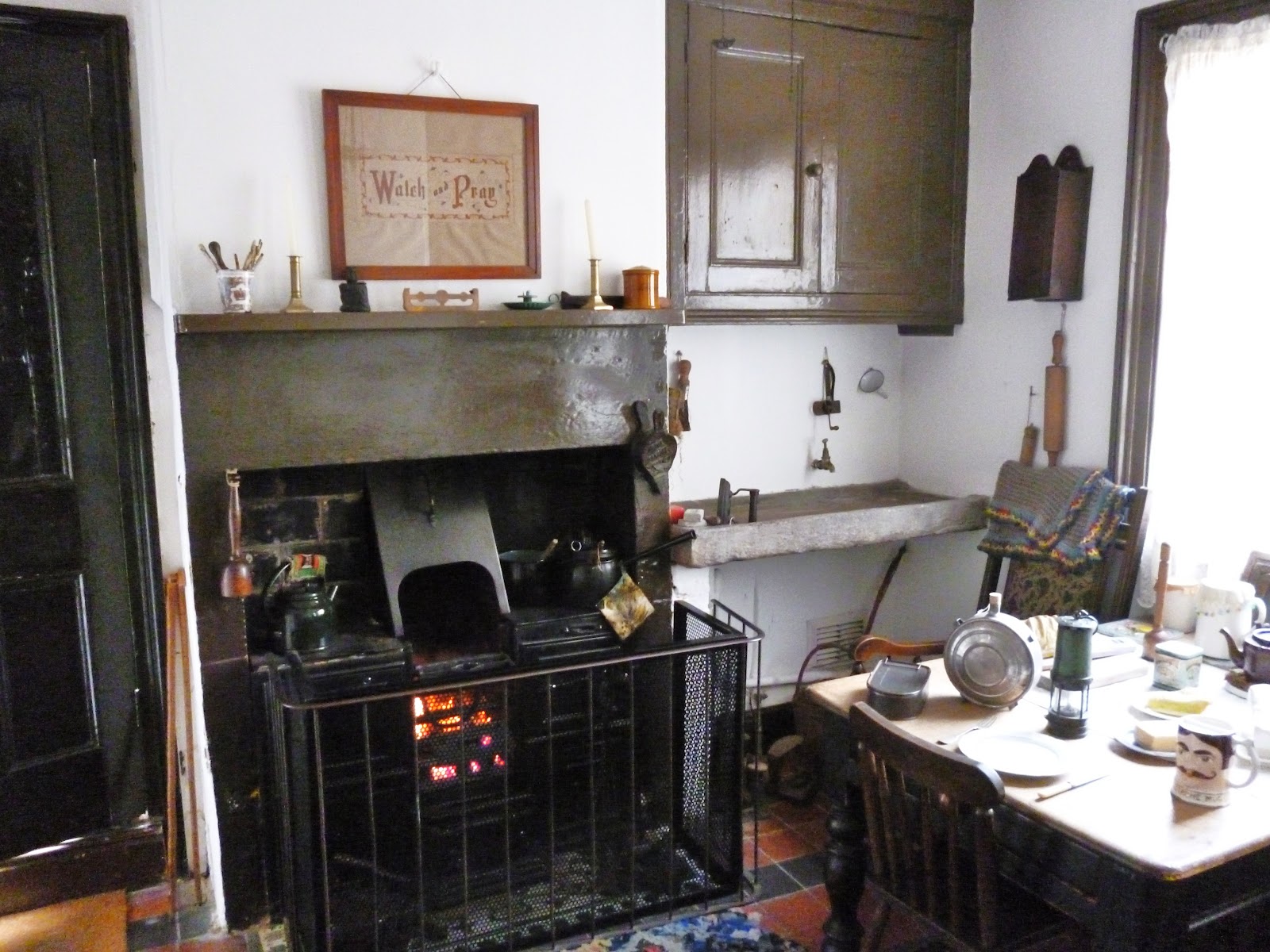
Two views of the kitchen.

At the rear, an exterior view of the washroom.

The washroom itself.

The front bedroom on the floor above.

The back bedroom.

The attic room.

A note on this exhibit states that the Victorian mahogany pedestal desk was used by D. H. Lawrence during his short employment as a clerk at J. H. Haywood, surgical appliance manufacturer on Castle Gate, Nottingham, in about 1901.
 
An advert for J. H. Haywood's products from The Chemists' and Druggists' Diary, 1904.

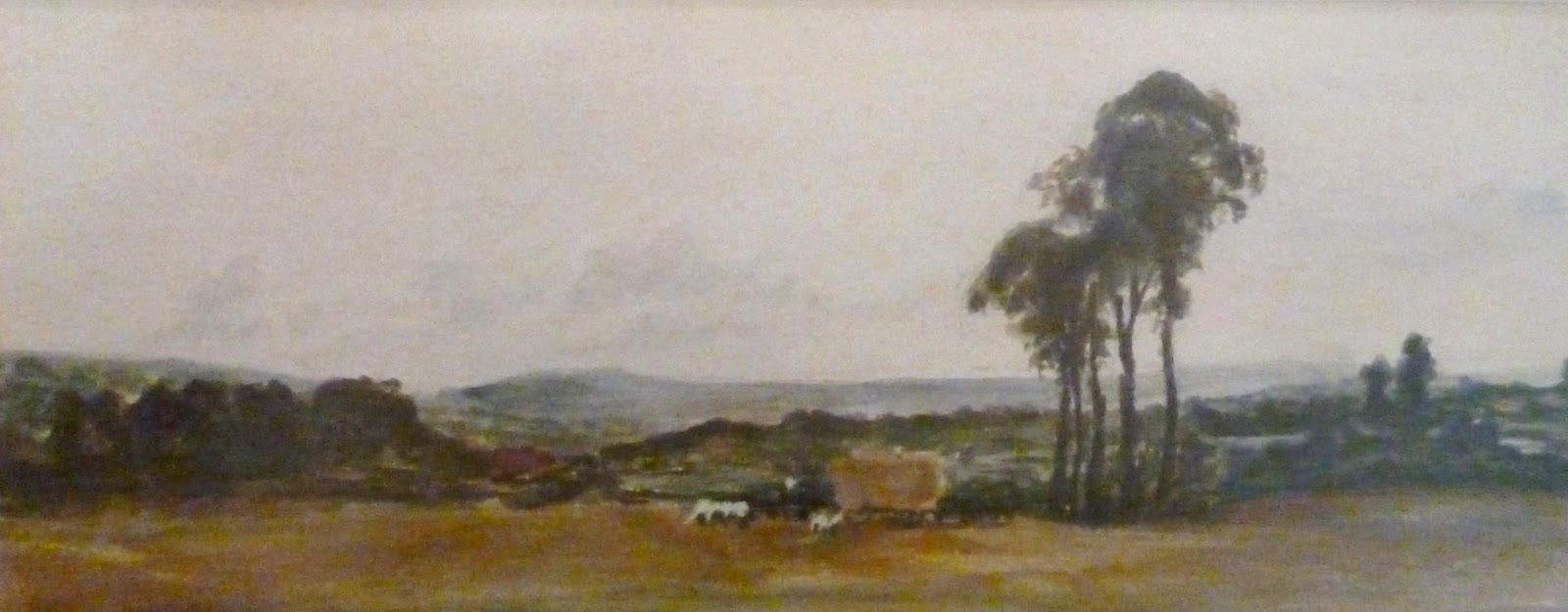
Exhibited in the Lawrence Birthplace Museum are several paintings by the writer, of which I give two examples made while he was teaching at the Davidson Road School in Croydon in 1912, staying with the Jones family: 'Landscape with Haymaking', and...

'Landscape with windmill'.

This trunk was used by Lawrence and Frieda on their numerous travels. 'D. H. L.' is inscribed on the side. Lawrence's sister Ada Clarke gave it to a local scout group in 1948, and they passed it on to the museum. The museum describes it as 'visual evidence of Lawrence's "absolute necessity to move"'.

The tombstone or headstone, a representation of Lawrence's phoenix, from his grave in Vence, France.


The head of the phoenix in more detail.


'Whoever reads me will be in the thick of the scrimmage, and if he doesn't like it – if he wants a safe seat in hte audience – let him read somebody else.' This quotation appealed to me.


Beyond the museum, the former Beauvale Board School on the corner of Mill Road and Dovecote Road.

'D. H. Lawrence was a pupil here 1893-1898'.

The Lawrence family grave is clearly marked in the cemetery off Church Street, Eastwood.

Lawrence's mother Lydia, father Arthur, and brother William are buried there.

'HERE RESTS
"UNTIL HE COME"
OUR DEAREST SON
WILLIAM ERNEST LAWRENCE
BORN JULY 22ND. 1878,
DIED OCTOBER 11TH. 1901.
HE ASKED LIFE OF THEE AND THOU GAVE IT HIM
EVEN LENGTH OF DAYS, FOR EVER AND EVER.'

'ALSO LYDIA, WIFE OF

ARTHUR LAWRENCE
BORN JULY 19TH. 1852,
DIED DEC. 9TH. 1910.
"IT IS FINISHED."
ALSO ARTHUR,
HUSBAND OF THE ABOVE
WHO DIED SEP 10TH. 1924,
AGED 77 YEARS.
REST AFTER WEARINESS.'

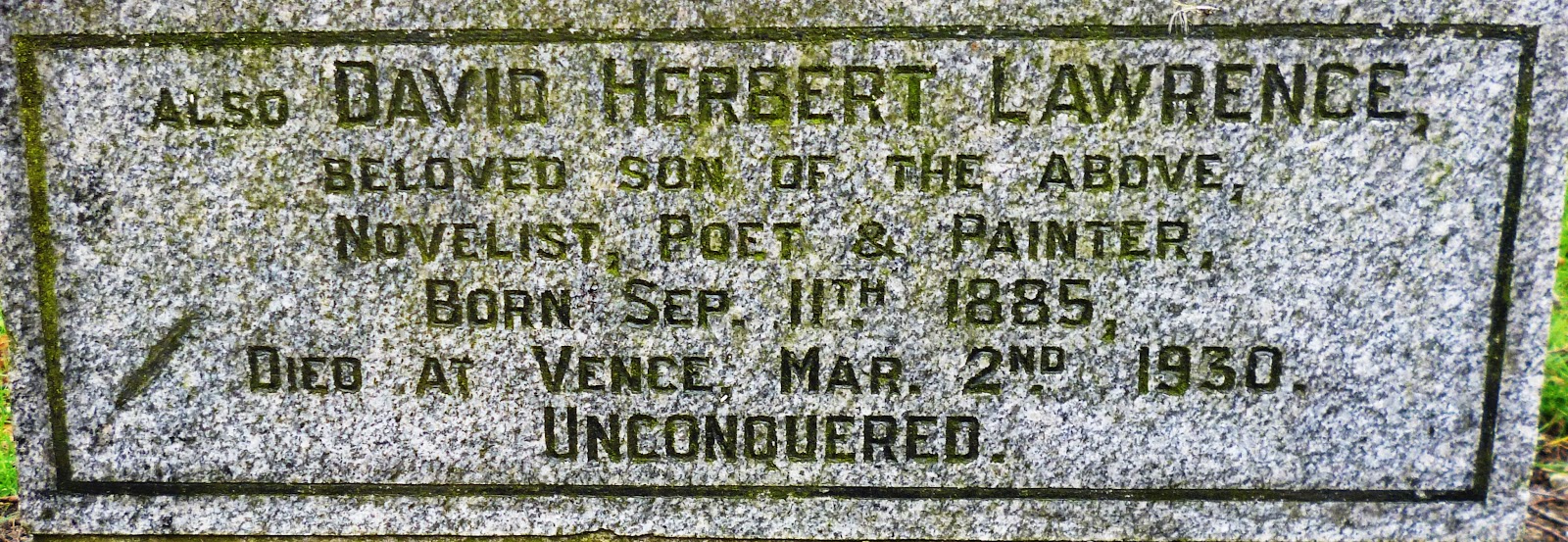
And although Lawrence of course isn't buried here:

'ALSO DAVID HERBERT LAWRENCE,
BELOVED SON OF THE ABOVE,
NOVELIST, POET & PAINTER,
BORN SEP. 11TH. 1885,
DIED AT VENCE, MAR. 2ND. 1930.
UNCONQUERED.'

ADDENDUM: I've now made a long post on the D. H. Lawrence Heritage Trail here.