10 September 2018

Cimetière du Montparnasse revisited #8: Jean-Pierre Rosnay

'Jean ROMÊAS dit
Jean-Pierre ROSNAY
Poète résistant
1926 – 2009'


Rosnay's Wikipédia entry states that it's impossible to dissociate his name from the Club des poètes and the ritual 'amis de la poésie bonsoir !' with which he began his radio and television programmes.

Cimetière du Montparnasse revisited #7: Ossip Zadkine


As I've already mentioned the great sculptor Ossip Zadine (1890–1967) before when a made a fairly extensive post on his museuam in Paris, I shall say nothing further, apart from to add that I expected something a little more, er, elaborate for his grave.

Cimetière du Montparnasse revisited #6: Claude Sautet

'Garder le calme !!! Devant la DISSOCANCE !!!

Claude SAUTET
1924 – 2000

Graziella SAUTET
1922 – 2003'

The above quotation,  'Keep your calm when faced with dissonance', might sum up the whole work. Of that work, I would rate Un coeur en hiver one of the most vital films ever made.

Cimetière du Montparnasse revisited #5: Oïser Warszawski

'A l'écrivain sans sépulture
A la mémoire
de mon mari bien-aimé
OÏSER WARSZAWSKI
homme de lettres juif
assassiné â Auschwitz en 1944
â l'age de 46 ans'

Oïser Warszawski was a writer and art critic born in Poland and who wrote in Yiddish. His first novel, Shmuglers (1920), translated in several langages, is perhaps is work he is most remembered for.

Cimetière du Montparnasse revisited #4: Adolphe Joanne

Adolphe Joanne (1813–81) gave up the legal profession for literature. He worked for a number of papers and, as an Anglophile with a great knowledge of English literature, contributed to the Revue Brittannique for twelve years. He was also a keen geographer and his 'Guides Joanne' became the 'Guides bleues'.

Cimetière du Montparnasse revisited #3: Mounir Hafez

'MOUNIR HAFEZ
1911–1993
POÊTE PHILOSOPHE'

Mounir Hafez  is of Egyptian royal origin and moved to France in 1952 with the advent of Nasser. His publications include Carosses (2004), Entre tradition et pensée contemporaine (2005), and Ce Moi sur lequel ma vie ne peut rien (2006).

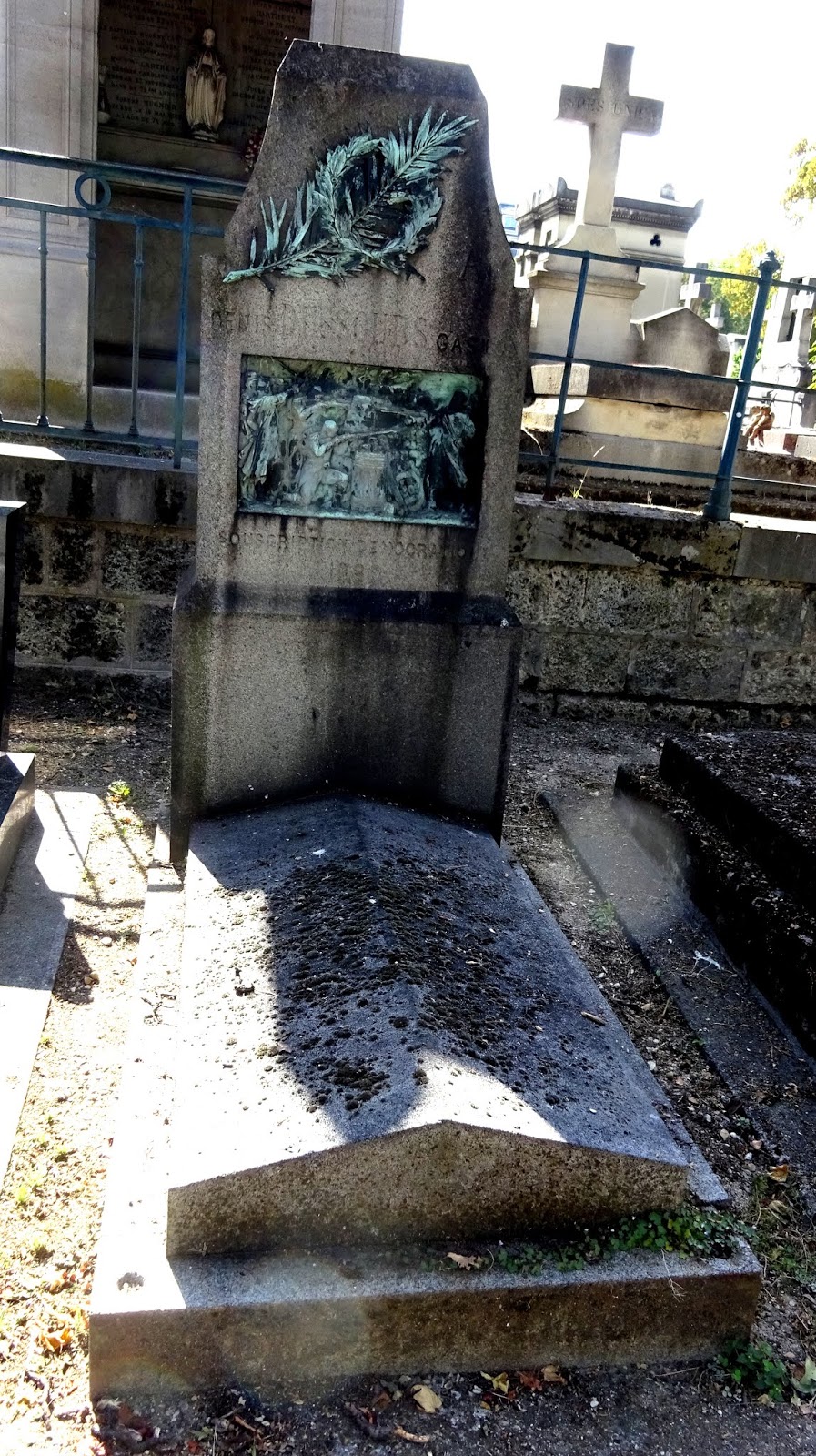
Cimetière du Montparnasse revisited: #2 Denis Dussoubs

Denis Dussoubs (1818–51), a republican martyr, was killed in cold blood by soldiers of the future Napoleon III before the barricade in rue Montorgueil in Paris. In his book L'Histoire d'un crime (1877), Hugo wrote: 'Je meurs avec la République. Ce fut sa dernière parole'. (I die with the Republic. Those were his last words.' The sculpted plaque shown here is a representation of the scene in which Dussoubs died.

Cimetière du Montparnasse revisited: #1: Jean Fougère and Paule Fougère


Jean Fougère (1914–2005) was a novelist, short story writer and non-fiction writer. His writing ias noted for its humour, its psychology and its satire, and he won several literary prizes. He is buried here with his wife Paule Fougère, who was a chemist and a writer who also won several literary prizes.

Olympe de Gouges in the 6th and 16th arrondissements

Olympe de Gouges (1748–93), who was beheaded, was one of the pioneers of feminsism in France. Her Déclaration des droits de la femme et de la citoyenne (1791) calls for the complete legal, political and social assimilation of women, on the lines of the Declaration of the rights of man. She was beheaded.

'OLYMPE DE GOUGES
1748–93
auteur de la
Déclarations des Droits
de la Femme et de la Citoyenne'


18 rue Servandoni, 6e arrondissement.

'DANS CETTE MAISON HABITA
OLYMPE DE GOUGES
ÉCRIVAIN FÉMINISTE
1748–1793'

8 rue Buis, 16e arrondissement.

9 September 2018

More from Le Cimetière Père-Lachaise, Paris (75): #14: Jean-Pons-Guillaume Viennet


Jean-Pons-Guillaume Viennet (1777–1868) was a politician, poet, dramatist and member of the Académie française. 

More from Le Cimetière Père-Lachaise, Paris (75): #13: Eugène Scribe


Eugène Scribe (1791–1861) was a highly successful and prolific dramatist, librettist and novelist elected to the Académie française en 1834 and in his late teens created plays with friends such as Casimir Delavigne, Henri Dupin and Delestre-Poirson. He is now all but forgotten.

6 September 2018

More from Le Cimetière Père-Lachaise, Paris (75): #12: Jean-Auguste-Dominique Ingres


Jean-Auguste-Dominique Ingres (1780-1867) is so obviously famous – Le Bain turc, La Grande Odalisque, etc, that I prefer not to bother concentrating on Ingres's paintings. No, for me it's his unwitting contribution to the French lexicon that pleases me: the expression 'Violin d'Ingres', which alludes not to Ingres's most reputed activity, but to his spare time interest: playing the violin. It was a hobby rather than a bread winner, hence 'violin d'Ingres' now means just that: a hobby rather than a trade.

More from Le Cimetière Père-Lachaise, Paris (75): #11: Marcel Federbusch


Marci (or Marcel) Federbusch (1911–2002). That's an extremely impressive grave, and a link to a little information about Federbusch (with photo) is here. Still no idea what the sculptures are about though.

An announcement of his death and funeral appeared in Le Monde 5 June 2002:

More from Le Cimetière Père-Lachaise, Paris (75): #10: Adolphe d'Ennery

Adolphe d'Ennery (1811–99) was a prolific novelist and dramatist who produced over two hundred plays, almost always in collaboration. He lived with his partner Clémence (whom he married after living thirty years together), and who had been collecting asiatic art since 1859. Their home became 59 avenue du Bois-de-Boulogne (now avenue Foch), which is today a museum housing the 6000 objects of the collection.

More from Le Cimetière Père-Lachaise, Paris (75): #9: Ludwig Börne

'LUDWIG BOERNE
NÉ À FRANCFORT SUR LE MEIN
LE 22 MAI 1786
MORT À PARIS
LE 12 FÉVRIER 1857'

Ludwig Boerne, who is perhaps better known as Ludwig Börne, is viewed as the leader of Jeune-Allemagne, a group of German writers who florished between 1830 and 1850. He gained his fame with Briefe aus Paris ('Letters from Paris') (1830–33), designed for publication but addressed to his friend Jeanette Wohl. Because of his radical republicanism, the letters were banned in Prussia.

More from Le Cimetière Père-Lachaise, Paris (75): #8: Gilbert Bécaud


Yes, it's usually singers' and actors' graves which are more popular than others, such as, in this cemetery, Moustaki, Piaf, and above all Jim Morrison. But the grave of Gilbert Bécaud (1927–2001) also receives a fair amount of attention. 'Mes mains', 'Nathalie', 'Le Jour où la pluie viendra' and 'Et maintenant' are among his greatest songs, 'Et maintenant' being famous in its English translation as 'What Now My Love?'. His 'Je t'appartiens' was also well known in its English version, 'Let It Be Me'.

More from Le Cimetière Père-Lachaise, Paris (75): #7: Gilles Barbedette


Gilles Barbedette (1956–92) was a novelist and translator into English, and the director of Editions Rivages's Littérature étrangère. He translated Nabokov and Edmund White and was a militant homosexual, being the founder of one of France's first homosexual liberation groups. He editeed Gai pied and his book Mémoires d’un jeune homme devenu vieux (lit. 'Memoirs of a young man grown old') was published in 1993, the year after his death from AIDS.

More from Le Cimetière Père-Lachaise, Paris (75): #6: Auguste Barbier


Auguste Barbier (1805–82) was a short story writer, poet, art critic, translator and librettist. In 1869 he was elected to the Académie française, attracting a few more votes than Théophile Gautier, which was considered scandalous. He translated Shalespeare's Julius Caesar and Coleridge's Ancient Mariner.

5 September 2018

More from Le Cimetière Père-Lachaise, Paris (75): #5: Boris Bajanov


Boris Bajanov (1900–82) became Secretary of the Politburo and assistant to Stalin in 1923. He fled from Russia in 1928 and achieved exile in France. Most of his writings are revelations about Stalin, and among them are Avec Staline dans le Kremline (1930) and J'étais le Secrétaire de Staline (1970).

4 September 2018

More from Le Cimetière Père-Lachaise, Paris (75): #4: Sarah Bernhardt

Sarah Bernhardt (1844–1923) was one of the most famous actors of the nineteenth and early twentieth centuries, and praised by many writers, of whom Victor Hugo and Jean Cocteau are just two.

More from Le Cimetière Père-Lachaise, Paris (75): #3: Louis Verneuil


Louis Verneuil (1893–1952) – real name Louis Jacques Marie Collin du Bocage was the author of thirty-eight plays and collaborated with Georges Barr on twenty-five others. His father had changed his own surname from Collin to Collin du Bocage in memory of his great-grandfather the famous geographer Jean-Denis Barbié du Bocage (1760-1825), and his grandfather the noted geographer Jean-Guillaume Barbié du Bocage (1793-1843). Louis achieved great success, and a number of his plays, such as Pour avoir Adrienne, Le Fauteuil 47, Azaïs, and Maître Bolbec et son mari were turned into films.

More from Le Cimetière Père-Lachaise, Paris (75): #2: Mounié Nadler


'MOUNIÉ NADLER
POÈTE
RÉDACTEUR EN CHEF DE LA 'PRESSE NOUVELLE' CLANDESTINE
34 ANS'

Mounié Nadler (1908–42), or from orthodox Jew to miitant communist. Nadler wrote for a number of publications, although he's best known for his editorship of the above underground weekly paper.

More from Le Cimetière Père-Lachaise, Paris (75): #1: Gerda Taro


'MEMORIAL
LIBERPRESS
2008

GERDA TARO (1910–1937)

A FIN QUE PERSONNE N'OUBLIE TA LUTTE
INCONDITIONNELLE POUR UNE MONDE MEILLEUR'

('So that no one forgets your non-conditional struggle for a better world')

Yes, although that better world seems increasingly unattainable. Gerda Taro is most noted for her photo-journalism, particularly during the Spanish Civil War. She was the photographer Robert Capa's partner. Her grave was designed by the sculptor Alberto Giacometti.

2 September 2018

Boîte à lire in Maisons-Laffitte, Yvelines (78)

This boîte à lire in Maisons-Laffitte, here called a Bibliobox, was made from a former telephone box in Remagen, Maisons-Laffitte's twined town in Germany. The project was carried out by a joint effort between the twinned towns, Les Amis de Remagen and the Lycée des Métiers Jules Verne in Sartrouville, a town across the river from Maisons-Laffitte. Pupils at the lycée conceived the exterior with images from Maisons-Laffitte and Remagen such as a horse and the plan of the park in the former, and the bridge towers and Liebeskraft ('The Srength of Love') sculpture by Lajos Barta in front of the Peace Museum in the latter. The box was opened in March 2017, although a Bücherbox had been in place several months earlier in Remagen.

Boîtes à lire:
––––––––––––––––––––––––––––––––––––
Boîte à Lire, Dicy, Nièvre
Boîte à lire, Maisons-Laffitte, Yvelines
Boîte à lire, Sorigny, Indre-et-Loire
Boîte à Lire, Jonzac, Charente-Maritime
Boîte à lire, La Roque-d'Anthéron, Bouches-du-Rhône
Boîte à Lire, Épineuil-le-Fleuriel, Cher
Boîte à lire, Marseille, Bouches-du-Rhône
Boîte à lire, East Markham, UK
Boîte à lire, La Folie Couvrechef, Caen, Calvados
Boîte à lire, Bergues, Nord
Boîte à lire, Le Havre, Seine-Maritime
Boîte à lire, Villerville, Calvados
Boîte à lire, Saint-Servan, Saint-Malo, Ille-et-Vilaine
Boîte à lire in Caen, Calvados
Boîte à Lire, Noyant d'Allier, Allier
Boîte à lire, Dampierre-en-Burly, Loiret
Boîte à lire, Illiers-Combray, Eure-et-Loir
Boîte à lire, Chartres, Eure-et-Loir
Boîte à lire, Saint-Romain-au-Mont-d'Or, Rhône