14 March 2015

The Art Brut of Edward Leedskalnin, Coral Castle, Homestead, Florida

That Ed Leedskalnin (1887–1951) was a highly unusual character is without question, as is the fact that he had – or at least that he developed – a very sophisticated and original brain. Ed was born in Latvia, where he at the age of twenty-six was due to marry the sixteen-year-old Agnes Scuffs, who jilted him on the day before the wedding was due to take place because she considered him too old.

Agnes's decision left Ed so devastated that he left Latvia and started working in Canada and California, working in highly physically demanding jobs such as the lumber industry, although he was only five foot tall and weighed just one hundred pounds. Toward 1920 he moved to the south of Florida, originally buying very cheaply a small area of land in Florida City about ten miles south of the present Coral Castle, which was initially called 'Rock Gate Park'.

In Florida City Ed began making carvings out of the coral stone, supposedly dedicating his work to his lost Agnes, whom he named 'Sweet Sixteen'. He later received help from a man with a tractor in moving his carvings to their present location, although no one is known to have seen him working on the actual carvings, which he is said to have carried out in secrecy at night, often involving moving huge and very weighty blocks around. On his own. When asked how he could have achieved this, he simply said he had an understanding of 'the laws of weight and leverage'. When asked why he did it he seems to have gone silent. This I can understand: exactly what can a football lover, or a television addict, or a stamp collector, etc, give in reply to the same unanswerable question? But at least Ed Leenskalnin's work, even if essentially gloriously useless, is a wonderful testament to self-education and of course sheer eccentricity.

Ed also wrote several publications, the longest being A Book in Every Home: Containing Three Subjects: Ed's Sweet Sixteen, Domestic and Political Views (1936), plus several pamphlets on magnetism. Billy Idol's song 'Sweet Sixteen' was inspired by Ed's preoccupation.

Ed died in his sleep from a stroke at the Jackson Memorial Hospital, Miami, at the age of sixty-four, after leaving a note on his door saying that he'd gone to hospital. He never married.

A life-size cut-out photo of Ed Leedskalnin greets visitors to Coral Castle.

Ed charged a dime for entrance to his little domain.

And this is the Three-Ton Gate entrance to Coral Castle, the actual gate to which will be revealed very shortly after a brief digression.

Basking in the Floridian heat and barely visible in the previous photo at the top of the stone and immediately above the right of the window hole is an African rainbow lizard or amaga, which is not a native to the region but probably an escapee from  a lizard-dealing neighbour. The species has now established itself in the immediate area. A splendid creature this is, and no doubt very used to humans.

'NOTICE
BE CAREFUL
ANYTHING YOU
DO ON THESE
PREMISES IS AT
YOUR OWN RISK'

Just Ed trying to cover himself.

The Three-Ton Gate seen from the inside. The triangle weighs about six thousand pounds, and is easily revolved by hand. It is still lubricated through a hole in the center.

Nine-Ton Gate, on the other hand, has no such lubricating system, and although until a number of years ago – see the Jarvis Cocker Youtube clip – it could be moved with one finger, for the preservation of both any user's health and the preservation of the structure itself, this is now out of use.

The Polaris Telescope was built in 1940.

The crossed wires of the structure can be seen through a hole in the wall opposite, and apparently Ed built his sundial (see below) by means of his observations from the telescope. As the science is beyond me, I won't even attempt to explain. 

Ed's sundial, on top of which stands the piece of furniture of which he was very proud – the first coral rocking chair he ever built.

And the sundial itself, from which it can be seen that the time was about 12:30.

The Moon Fountain, with the crescent shapes (weighing eighteen tons each) representing the first and final quarters of the moon. The circular shape in front represents the full moon, and is lined with concrete to prevent the water seeping out of the porous coral stone.

The planets, perhaps the most photographed of Coral Castle's structures.

Ed – who had no electricity – positioned his reading chairs to gain full advantage of the sun. These structures look pretty uncomfortable, although I can say from experience of sitting in the one in the foreground here that it is amazingly relaxing to sit in.

The chairs around here were rocking chairs, until concern for safety decreed that they should be grounded: the previous danger to toes is perhaps best left unthought of. They are grouped around a representation of a rock map of Florida.

A clearer view of Florida, Panhandle and all.

That 'all' including Lake Okeechobee!

The Feast of Love Table, shaped like a heart. Coral Castle usually has a wedding on Valentine's Day, and although no lover of either weddings or Valentine's Day I fully support any revenue coming into Coral Castle, a feast not only of eccentricity, but also brilliance.

Ed's obelisk. Yeah, it's so easy (but so cheap) to see the phallic in this, so let's drop it. The top is in the shape of the star of Latvia, and the obelisk is sunk six feet into the earth.

'MADE 1928
MOVED 1939 [?]
BORN 1887
LATVIA'

Ed had no running water, therefore the need for a well, in which he also stored food.

Ed's bath, which is tiny to go with its occupant.


Some refer to this as his barbecue.


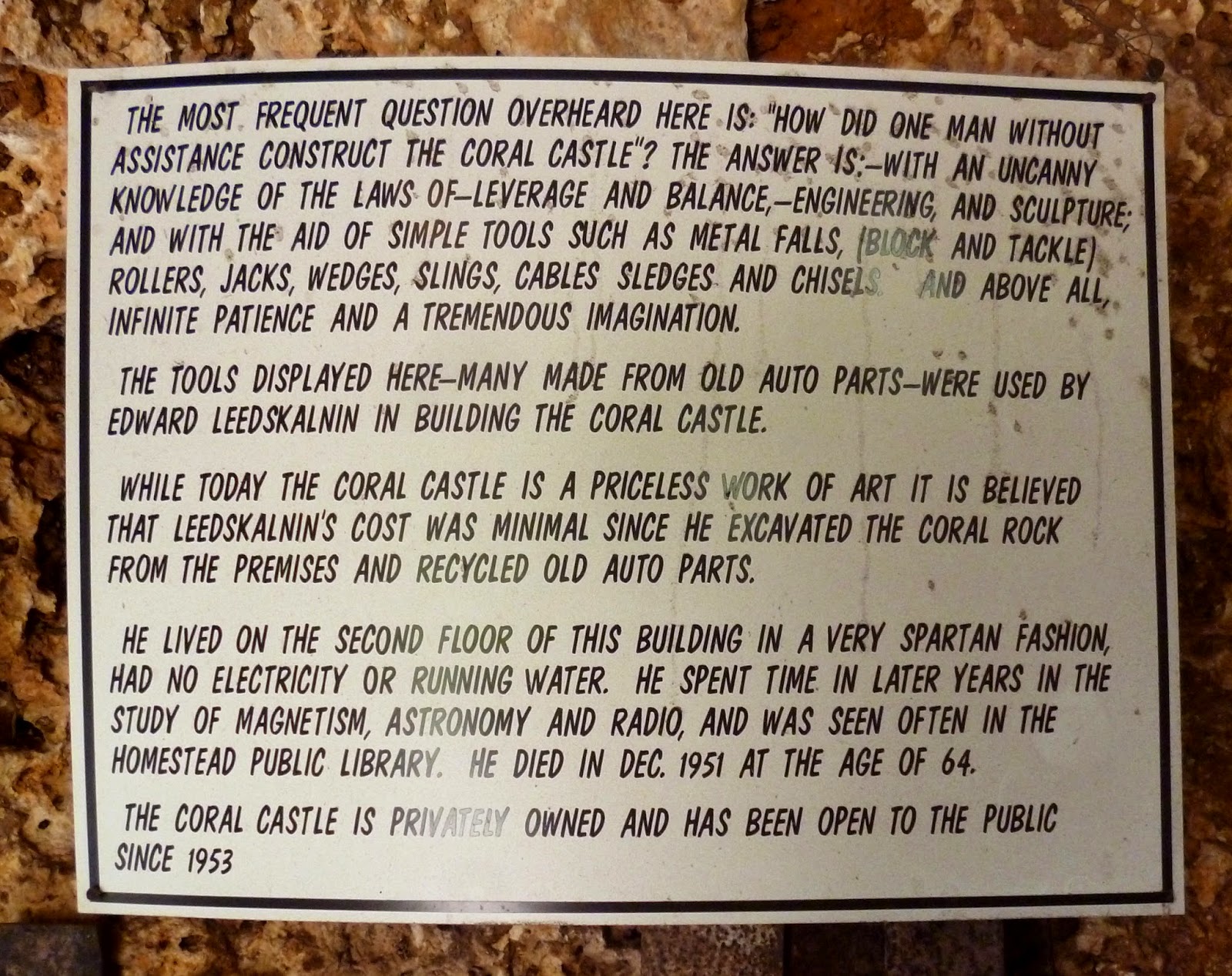
Ed's tool room beneath his living quarters.

 'THE MOST FREQUENT QUESTION OVERHEARD HERE IS "HOW DID ONE MAN WITHOUT
ASSISTANCE CONSTRUCT THE CORAL CASTLE?" THE ANSWER IS: WITH AN UNCANNY
KNOWLEDGE OF THE LAWS OF LEVERAGE AND BALANCE, ENGINEERING AND SCULPTURE
AND WITH THE AID OF SIMPLE TOOLS, METAL FALLS (BLOCK AND TACKLE),
ROLLERS, JACKS, WEDGES, SLINGS, CABLES, SLEDGES AND CHISELS – AND ABOVE ALL,
INFINITE PATIENCE AND TREMENDOUS IMAGINATION.

THE TOOLS DISPLAYED HERE – MANY MADE FROM OLD AUTO PARTS – WERE USED BY
EDWARD LEEDSKALNIN IN BUILDING THE CORAL CASTLE.

WHILE TODAY THE CORAL CASTLE IS A PRECIOUS WORK OF ART IT IS BELIEVED
THAT LEEDSKALNIN'S COST WAS MINIMAL SINCE HE EXCAVATED THE CORAL ROCK
FROM THE PREMISES AND RECYCLED OLD AUTO PARTS.

HE LIVED ON THE SECOND FLOOR OF THIS BUILDING IN A VERY SPARTAN FASHION,
HAD NO ELECTRICITY OR RUNNING WATER. HE SPENT TIME IN LATER YEARS IN THE
STUDY OF MAGNETISM, ATROMOMY AND RADIO, AND WAS SEEN OFTEN  IN THE
HOMESTEAD PUBLIC LIBRARY. HE DIED IN DEC. 1951 AT THE AGE OF 1964.

THE CORAL CASTLE IS PRIVATELY OWNED AND HAS BEEN OPEN TO THE PUBLIC
SINCE 1953.'
Sixteen steps lead up to Ed's sleeping quarters.


The bed is extremely primitive.

A child's wooden rocking chair.

The tube is where Ed kept his money, and on his death was found to contain $3600. Some of his money would have come from the sale of land.

His toilet arrangements were very basic indeed.

We were surprised and delighted to see that Coral Castle at the time  of our visit was attracting so many visitors. This is surely one of Florida's most essential places to see, much more interesting than the usual places people flock to.

My other Edward Leedskalnin post:
–––––––––––––––––––––––––––––––––––
Edward Leedskalnin: Magnetic Current

Art brut (Outsider Art) and associated:
––––––––––––––––––––––––––––––––––––
Rémy Callot, Carvin (Nord)
Carine Fol (ed.): L'Art brut en question | Outsider Art in Question
Kevin Duffy, Ashton-in-Makerfield
The Art Brut of Léopold Truc, Cabrières d'Avignon (34)
Le Musée Extraordinaire de Georges Mazoyer, Ansouis (34)
Le Facteur Cheval's Palais Idéal, Hauterives (26)
The Little Chapel, Guernsey
Museum of Appalachia, Norris, Clinton, Tennessee
Ed Leedskalnin in Homestead, Florida
La Fabuloserie, Dicy, Yonne (89)
Street Art City, Lurcy-Lévis, Allier (03)
The Outsider Art of Jean Linard, Neuvy-deux-Clochers (18)
Jean Bertholle, La Fabuloserie, Yonne (89)
Jean-Pierre Schetz, La Fabuloserie, Yonne (89)
Jules Damloup, La Fabuloserie, Yonne (89)
Camille Vidal, La Fabuloserie, Yonne (89)
Pascal Verbena, La Fabuloserie, Yonne (89)
The Art of Theodore Major
Edward Gorey's Yarmouth Port, Cape Cod, MA
Marcel Vinsard in Pontcharra, Isère (38)
Vincent Capt: Écrivainer : La langue morcelée de Samuel Daiber
The Amazing World of Danielle Jacqui, Roquevaire (13)
Alphonse Gurlie, Maisonneuve (07)
Univers du poète ferrailleur, Lizio, Morbihan
Les Rochers sculptés de L'Abbé Fouré, Rothéneuf, Saint-Malo
Robert Tatin in Cossé-le-Vivien, Mayenne
René Raoul's Jardin de pierre in Pléhédel, Côtes d'Armor
La Demeure du Chaos, Saint-Romain-au-Mont-d'Or, Rhône (69)
Emmanuel Arredondo in Varennes Vauzelles, Nièvre (58)
Musée de la Luna Rossa (revisited), Caen, Calvados (14)
La Fontaine de Château-Chinon, Nièvre (58)

13 March 2015

Railroad Mural, Okeechobee, Florida

My last time in Florida must have been about thirty years ago, although some things don't change, such as the wonderful blanket of heat: it's winter here and the temperature is constantly above 80 degrees Fahrenheit. I didn't spend much time here on my previous visit, mainly centering on Miami before traveling on to the Caribbean and Central America. Time to visit other parts of the state.

Okeechobee – which different people pronounce differently so I won't bother to transliterate – is very close to the huge Lake Okeechobee, which has a vaguely ovoid shape (little at the north or south) and I drove round the eastern edge today before hitting Florida City, the 'Entrance to the Keys' (of which much more in further posts).

I wrote earlier about Zora Neale Hurston writing of her protagonist in Their Eyes Were Watching God working the rich soil around Lake Okeechobee. I believe she said nothing of Okeechobee itself, although I post above one of the many murals in the town, this one being on the main road through the town, North Parrott Avenue. This plaque is at the side of it.

'THE RAILROAD ARRIVES – 1915
BRINGING NEW POSSIBILITIES TO OKEECHOBEE
AUGUST 2007

OKEECHOBIE MAIN STREET, INC
SECOND MURAL PROJECT

 SPONSORED BY
OKEECKOBEE HISTORICAL SOCIETY

MURAL DESIGNER AND DESIGNER
KATHY SCOTT

THE FLORIDA EAST COAST RAILROAD WAS COMPLETED
AND THE FIRST TRAIN ARRIVED IN OKEECHOBEE IN
1915. WITH THE COMPLETION OF THE ICE PLANT IN
1918, SHIPMENT OF PERISHABLE GOODS TO THE
NORTHERN MARKETS WAS NOW POSSIBLE AND
OKEECHOBEE FLOURISHED. THE MAJOR PRODUCTS
WERE CATFISH FROM LAKE OKEECHOBEE, TURPENTINE
AND TIMBER FROM THE PINE WOODS, AND FRESH
PRODUCE INCLUDING CITRUS. IN ADDITION, CATTLE
COULD NOW BE MARKETED TO DISTANT POINTS WITH
EASE AND WERE LOADED WITHIN HOLDING PENS
JUST WEST OF TOWN.'

I imagine vegetarians were looked upon as freaks in those days.

8 March 2015

Azouz Begag: Le Gone du Chaâba | Shantytown Kid (1986)

Azouz Begag's Le Gone du Chaâba is an autobiographical work – or perhaps autofictional is the correct expression, as there is a great amount of obviously artificial dialogue – concerning a few years of his life in Lyon, initially in a bidonville outside the city, later in public housing in the city itself.

Le Chaâba is the shantytown with no electricity and very primitive sanitary conditions to which families of Algerian descent have come to seek a better life. Azouz Begag was born here, and the only reason the reader can work out that this book is set in the early 1960s – outside the knowledge of Azouz's age – is the fact that Azouz (the character in the book) mentions listening to the Hit Parade and Richard Anthony's 'Et j'entends siffler le train', which came out in 1961.

This is a novel about pride, prejudice and shame. And language(s). Azouz's family speak Arabic, and the novel is peppered with the words they use, and peppered with the French words used in Lyon – such as gone (meaning 'gamin de Lyon' or young boy from Lyon) in the title. The English translation (unknown to me) must translate the book as it can, although it can't be an easy task, just as Azouz's weaving between different languages and dialects is no easy job. The novel contains brief translations of words used in his family's native Sétif in Algeria, and translations of words used in Lyon that French people outside of Lyon wouldn't understand. As a young French kid born of Algerian parents, Azouz doesn't even understand such common popular French expressions as 'Qu'est-ce que tu branles ?' (lit. 'What are you wanking about at?') or the slang verb crécher meaning to live (or 'doss' is perhaps better here). He doesn't know the French for snuff and his Arabic-speaking father tells him it's 'tababrisi', although when Azouz goes to a shop to ask for tababrisi he meets with incomprehension, but soon learns that the pronunciation 'tabac à priser' brings understanding.

Azouz's parents are understanding and supportive of their son's desire to 'improve' himself, although his earlier schoolmates see him as something of a 'creep', and there's some conflict in that. However, his desire for intellectual knowledge triumphs, and it is with great pride that he learns that one of his compositions is the best of all his other (French) competitors.

In spite of the language conflicts this is not a difficult book, although at the same time it's surprisingly complex, and a joy to read.

My other post on Azouz Begag:
––––––––––––––––––––––––––––––––––––
Azouz Begag: Béni ou le paradis privé

7 March 2015

Blackburn Cemetery #2: William Billington


William Billington's grave is obviously far more difficult to vandalise, and only his nose has been attacked here. The sculpture appears to have been taken from a photograph of the man who came to be known as 'The Blackburn Poet'.

'ERECTED BY PUBLIC SUBSCRIPTION TO THE MEMORY OF
WILLIAM BILLINGTON
(AUTHOR OF SHEEN AND SHADE [1861], LANCASHIRE
SONGS, POEMS, AND SKETCHES [1883], &c.*)
WHO WAS BORN APRIL 3RD 1827, AND
DEPARTED THIS LIFE JANUARY 3RD 1884.'
 
'DEAD AND YET LIVING – LIVING IN THAT VERSE
OUR CHILDREN SHALL REHEARSE,
CLEAVING TO WHAT IS FAIR AND GOOD AND WISE.
LET THE DROSS PASS AWAY,
LET MEANER THINGS DECAY –
THE POET NEVER DIES.'
 
 
The other side of the memorial bears a representation of Billington's Sheen and Shade.
 
Billington initially supported his family by factory work, which he hated, and eleven years after the death of his first wife (in 1857) he re-married and several years later started running a beer house because of his ill health. His (illiterate) second wife deserted him and their young child because of his intellectual interests. The beer house on the corner of Bradford Street and Nab Lane was known as 'Poet's Corner' and attracted visiting poets such as John Critchley Prince and Richard Dugdale. It was also a centre for debates.
 
Billington was a founder member of the Blackburn Mechanic's Institute, advised trade unions, and travelled around the north-west reading and selling his poetry.
 
*Billington also published the poem Pendle Hill in 1876 and Michael Ian Watson published a very brief account of the poet in about 1980: William Billington : the Blackburn poet.

Blackburn Cemetery #1: John Thomas Baron

The sorry state of the grave of John Thomas Baron (1856–1922) in Blackburn Cemetery, apparently due to vandalism rather than disrepair. Baron was a (mainly dialect) poet who was born at 42 Chapel Street, Blackburn, and often used the pseudonym 'Jack o' Ann's' after his mother. Although he never published any books of his poetry, his many works appeared in a large number of papers such as the Blackburn Times, the Blackpool Gazette, and the Preston Chronicle.  His younger brother William also wrote poetry and used the pseudonym 'Bill o' Jack's' after his father.

4 March 2015

Ray Gosling: Personal Copy: A Memoir of the Sixties (1980; rep. 2010)

How can I write coherently or in any way meaningfully about Ray Gosling (1939–2013), a man best known for his former television appearances, and whose face on the cover of this book means nothing to me? Because I'm one of the 500,000 people the supremely arrogant and fascistic BBC believes are liars when they say they don't have a television receiver. And yet I certainly don't have a television receiver, because I'm convinced that virtually all that television companies throw in people's faces is tedious, childish, right-wing, time-wasting shit. Reading Ray Gosling's book, though, I'm very willing to accept that his contributions to a generally horrendous medium were extremely rare examples of fascinating television.

There aren't many dates mentioned in this autobiography – which is in part a collection of previously published articles – to pin events down, and much seems to come from the smoke of memory, so I suppose it's fitting that this re-publication comes from Five Leaves, a small publishing company which indirectly (via Nick Drake) alludes to a small reminder, a slip of paper that was used in Rizla cigarette paper packets: only one more five-skinner to go!

However, the book tries to avoid temporal digression by being divided into a number of sections, including an early one called 'The Americans', dealing with Gosling's representation of them in the war years, and they certainly seem (in Wim Wenders's words), to 'have colonised our [i.e. Europeans's, and certainly Gosling's] subconscious': there's a quotation from Jack Kerouac's The Subterraneans in Part One ('A great preamble into nothing').

But it's not the American smoke of memory from the Beat writers that Gosling's first part concludes on, but Buckminster Fuller, which amazed me, and – like a number of things in Personal Copy – sparked off recollections. There are even two chapters here on Fuller, even including a mention of '[Fuller's] own university at Carbondale, South Illinois'. Carbondale is a tiny paradise where in summer a blanket of heat enwraps you, huge multi-coloured butterflies brush your face, chipmunks scamper around, American robins are everywhere, and people jog up to you on the sidewalk and stop just to say hello, ask you what you what you've got planned for the day, and then merrily jog off. Perhaps unsurprisingly, it was where Bucky lived with his wife for ten years in the geodesic dome he'd built. I was reminded of the two occasions I'd spent in Carbondale researching Lionel Britton, two months in all, and of how on the first occasion I couldn't find Carbondale's only (and unadvertised) 'tourist attraction': Bucky's little dome, which the (at the time) director of the Special Collections Center in the Morris Library drove me to see on learning that I couldn't locate it.

Personal Copy worked on my mind like that, forcing me to peel back the layers of the onion, memory (yeah, I couldn't resist alluding to Craig Raine, as well as Iain Sinclair above) that made up my search for Buckminster Fuller: first, many years ago, by reading I Seem to Be a Verb; searching for his modest 'Call me Trimtab' grave in Mount Auburn, Cambridge, Massachusetts; the glory of his geodesic dome in Montréal; and the disappointment on learning from the Information Center that the former Black Mountain College near Asheville, North Carolina where Bucky once taught is now occupied by a religious group which doesn't allow people to visit the grounds.

Gosling doesn't say much about Leicester, where I too went to Leicester University (French for the first degree), although he didn't stick it through, his stay there was in an era before mine, and I don't recognise any of the few places he mentions. But, odd though it may seem, he's not joking when he says that this used to be a – as the expression went at the time – 'mental hospital'  although I believe its former incarnation is now largely represented by a few office buildings.

But there's much more on Nottingham, particularly the drinking spots, and I too have spent many hundreds of hours in pubs in the heart of the city. He mentions the rather bohemian nature of the (non-licensed) Kardomah café. I only just remember this place, and that it was still then populated by oddballs but mainly student types, and everyone in those days simply called it the KD to express their (usually false, I think) great familiarity with it.

A number of pubs Gosling brings up had gone in my day, although I was very surprised that he briefly mentioned Veronica, the sturdy gruff-voiced barmaid at the Albert Hotel. She must have aged considerably by the time she (begrudgingly, I thought: maybe because she knew I was underage, or perhaps she was just that way with everyone?) used to serve me pints of Younger's in the Scotch Bar at the back of the hotel. By that time she had developed a moustache, of which she seemed very proud. Gosling says nothing of barman Bert who also worked there, and who behaved in a deliberately camp manner, but I suspect Bert came after Gosling's time.

I get a strong impression – surely backed up by the lack of dates here – that Gosling's 'sixties' are more generic than date-stampable, more in the mind than held fast to any particular period. So it seems slightly odd that such an essentially anti-establishment person should say nothing of the Scheme club, held from the sixties onwards: The Scheme were a (mainly alternative) folk group with (probably only occasionally) Paul Waplington – who later became an artist – and Stephen Morris reading poetry. I believe it began downstairs at the Fox on Parliament Street (now No. 10), moved upstairs, and ended its days at the Bowling Green (now gone).

Part Two is titled 'Battle of the Slums' and is shorter than the first part. It's concerned with Gosling's role in the struggle to save parts of the working-class St Anns area in Nottingham, which was doomed to failure. The strength of this part is the affection he shows for the people who lived there, his admiration for their spirit. Initially he has a few good words to say about Ken Coates, although Coates's co-author of the book Poverty: The Forgotten Englishmen (1970) is simply recorded as Billy or Bill, and I didn't notice either a mention of Bill's surname or the name of the book itself: the name is Silburn, and his forename on the title-page is Richard. Which reminds me that I once met Bill Silburn with a couple of other students and that at the time (by way of a reference to Marshall McLuhan) he said something to the effect that the working class would die without television, which I suppose in a sense takes us back to the beginning of this rambling post.

Ray Gosling was obviously a great character, a lovable kind of anarchist, and someone who could get away with a number of things on television that he would be unable to do in these stage-managed, fame-obsessed, trivia-pursuing days in which anything goes only as long as it's glittery, beautiful, young, famous or potentially famous: in other words anything that leaves me cold and reminds me how wonderful it is, of how I've privileged myself, to live in a world without the mindless hype of television.

Oh, and the book ends in 1979, shortly after the fateful elections, when Thatcher and later her spiritual son Blair would set about destroying the country, ploughing eccentricities into oblivion in an insane rush to kill all the social progress that had been made over many years, a rush to make greed the omnipotent ruler and the world in general a much more dangerous place to live in. There could never be another Ray Gosling, and I can't help fearing that his kind is fast becoming an extinct breed.

2 March 2015

Church of St Lawrence, Denton, Greater Manchester


'CHURCH OF ST LAWRENCE

Built early sixteenth century and originally dedicated to
St James until the discovery in the mid-nineteenth century
of a stained glass window to St Lawrence.
Affectionately known as "Th'Owd Peg" because its framework
was fastened together with wooden pegs.
Resting place of John Angier, the famous Puritan divine
and of Colonel Robert Duckenfield, Tameside's
Civil War hero.'

'JOHN ANGIER
1605–1677

A Puritan divine who was Minister of
St Lawrence for forty six years until his
death in 1677. He survived the various
religious upheavals of those troubled times
and continued to preach his
Puritan message.'

One known published work by John Angier is An Helpe to Better Hearts for Better Times: Indeavoured in severall Sermons preached in the year, 1638, etc (1637), and there is a biography written by Oliver Heywood (1968).

'1872'. The year the church was expanded. This is a Grade II* building.

Gorton Monastery, Gorton, Manchester (UK)

The superb Gorton Monastery, Gorton, Manchester, UK, is the popular name for the Saint Francis Church and Friary. Built by Franciscan friars in the early 1860s – more specifically by Edward Welby Pugin – this Gothic Revival wonder was closed in 1989, when only six ageing friars remained here. It was included in a list of the world's one hundred most endangered monuments in 1997, and restoration on it is still continuing.

The eastern part of the nave looking towards the chancel. The purple hue is from the church lighting, and not from any image manipulation on my part.

A closer view of the chancel windows.

And a closer view of the altar and part of the reredos.

The north aisle, necessarily skewed as I had to avoid light flooding in from the west window: what had begun as a snowy morning – and I post this on the same day that we visited the church – turned into a sunny, blue sky day.

This was not labelled, although I imagine it must be the original piscina mounted on bricks.

The Lady Chapel, currently under restoration.

A number of plaques adorn the pillars, and I was particularly attracted to this one dedicated to Saint Leonard (1676–1751) of Port-Maurice from Liguria, whose complete works (essentially concerning the spiritual and the ascetic) run to eight volumes.

The cloister garden, showing the apse dwelt on in the book below.

Much more about this church is in the above book: Beggars & Builders: My Story of Gorton Monastery by Tony Hurley (1953–2011), the second volume of which was published by The Monastery of St Francis and Gorton Trust in 2013, and is edited by Janet Wallwork and Ray Hanks. I can't begin to understand the odd bits about geometry and mathematics in it, but it is obviously an indispensable guide to this architectural delight.

I look forward to the completion of the restoration, which should take about two more years.