24 October 2013

The Geffrye: Museum of the Home, Shoreditch, London

The Geffrye Museum on Kingsland Road, Shoreditch, was established in 1914, originally being almshouses built in 1714.
 
Sir Robert Geffrye, the founder of the almshouses and Master of the Ironmongers' Company.
 
Up to fifty elderly poor people lived around this front garden area.
 
A partial view of the inside of the chapel.
 
The apse is a late 18th century addition.


On the other side, the reading room overlooks the back garden.

But the essential part of the museum is its display of home interiors, of which I found that the most recent ones were the easiest to photograph. They all represent middle-class homes. The room above is a reconstruction of an Edwardian (1900–14) drawing room in a semi-detached house. Electricity would have been a feature.

A 1930s living-cum-dining room in a London flat, which would have had running hot water, central heating, and wide windows.

A living-cum-dining room typical of an early 1960s house. The focal point of the room moves from the fireplace to the television.
 
Finally, from the 1990s, commercial premises converted into living space. Bare floorboards, minimal furniture.

The back garden.

An outside view of the reading room.

 
There is also a tiny cemetery which includes the founder's tomb.

23 October 2013

Sou Fujimoto and the Serpentine Gallery Pavilion 2013

The 2013 Serpentine Gallery Pavilion (open 1 June 2013 to 20 October 2013) was designed by the youngest person to accept the commission, 41-year-old Japanese architect Sou Fujimoto. The complex network of white steel poles in front of the gallery blend with the surrounding environment to create a dream-like effect that I find quite mesmerising. I'll let the images speak for themselves.


William Hogarth in Chiswick

 
'WILLIAM
HOGARTH
Painter & Engraver
1697–1764
LIVED AND WORKED
HERE FOR 15 YEARS'
 
Unfortunately I missed the opportunity to include the famous mulberry tree in the top photograph. The Hogarths lived in what is now Leicester Square and began their stay in this early 18th century house in Chiswick, just at weekends and in the summer, in 1749. William's widow Jane kept the house on and her cousin Mary Lewis (who died in 1808) inherited it.
 
This model of Hogarth was made in 1999 and is the first thing that greets the visitor inside the house: it was made by Jim Mathieson (1931–2003), who will be mentioned again later.
 
This diorama by Rhoda Dawson, dating from the 1950s, is a recreation of the present downstairs exhibition room in Hogarth's day. A brief biographical note at the side of this model states that Dawson grew up on Chiswick Mall the daughter of arts and crafts enamellers and metal-workers, and that she worked at Gunnersby Park Museum. She married puppeteer John Bickersdike and they put on shows together.
 
Upstairs, the parlour or reception room is in the oldest part of the house. The two portraits above the fireplace are reproductions of Hogarth's representations of his younger sisters Mary and Anne. One of the exhibits in the cabinet is William's father Richard's Latin primer: he unsuccessfully taught and translated as a profession and spent five years in the Fleet prison for debt (although William kept silent about this).
 
Hogarth published The Analysis of Beauty in 1753 and this, The Analysis of Beauty II, is an illustration from it.
 
It was almost certainly Hogarth who had the bay window added.
 
This room is an extension the family built in 1750.
 
The Distrest Poet (1737) shows a man starving in a garret and working on a poem called Poverty. A picture above his head is titled The Gold Mines in Peru, illustrating the gulf between wishes and reality.
 
Long after Hogarth's death the poet Henry Francis Cary (1772–1844) lived in this house with his family from 1799 to 1817. He became curate at nearby St Nicholas's Church in Chiswick and welcomed here such writers as William Hazlitt, Charles Lamb, Thomas de Quincey and D. G. Rossetti. 
 
On the wall is one of Cary's poems:

Sonnet on the Death of His Daughter

Thrice has the dart of Death my peace bereaved;
        First, gentle mother, when it laid thee low'.
        Then was my morn of life o'ercast with woe,
        And oft through youth the lonely sigh was heaved.
But in a child I thought thou wert retrieved.
        She loved me well, nor from my side would go
        Through fields by summer scorch'd or wintry snow:
        How o'er that little bier at noon I grieved!
Last when as time has touch'd my locks with white,
        Another now had learnt to shed fresh balm
        Into the wounds, and with a daughter's name,
Was as a seraph near me, to delight
        Restoring me by wisdom's holy calm.
Oh, Death ! I pray thee next a kinder aim.


A bedroom in the original part of the house.

The wardrobe shows clothes based on those Hogarth wore for his self-portrait of 1757, such as linen shirt and buckle shoes.

An excellent way to spend an hour or two, and free of charge.

In St Nicholas churchyard, the tomb containing the remains of Hogarth, his wife Jane, his sister Anne, and Mary Lewis. David Garrick's tribute, with obvious reference to Hogarth's very famous pictorial narratives, reads:
 
'Farewell great Painter of Mankind
     Who reach'd the noblest point of Art,
     Whose pictur'd Morals charm the Mind,
     And through the Eye correct the Heart.
 
If Genius fire thee, Reader, stay,
     If Nature touch thee, drop a tear:
If neither move thee, turn away
     For HOGARTH'S honour'd dust lies here.'

The tomb of Italian poet Ugo Foscolo (1778–1827), who died in great poverty in Chiswick,  is in the churchyard extension.

An interpretation board in Hogarth's House states that Foscolo was a great admirer of Henry Francis Cary's translations of Dante, and asks if Foscolo's presence in Chiswick was due to Cary.
 
Finally, the sculpture of Hogarth that should be familiar from the model shown towards the beginning of this post: this is in a prominent position on Chiswick High Road, was sculpted by Jim Mathieson and commissioned for the millennium by Chiswick Traders Association. The essential difference between this statue and the model in Hogarth's House is the addition of Hogarth's pug dog. The statue was unveiled by Ian Hislop and David Hockney in 2001.

22 October 2013

Alexander Pope in St Marys Church, Twickenham

The nave of St Marys Church, Twickenham, looking towards the chancel. Just visible is Pope's plaque on the floor slightly to the right of the furthest row of pews on the left.

'HERE ARE BURIED
THE MORTAL REMAINS
OF
ALEXANDER POPE
1688–1744
Qui nil molitur inepte
R. I. P.
 
This tablet was placed
by three members of the Faculty of English
of Yale University
1962'
 
And on one of the church walls:

'TO THE MEMORY OF
MARY BEACH
WHO DIED NOV. 5. 1725 AGED 78
ALEX. POPE, WHOM SHE NVRSED IN
HIS INFANCY AND CONSTANTLY AT-
TENDED FOR THIRTY EIGHT YEARS,
IN
GRATITVDE TO A FAITHFVL OLD SERVANT,
ERECTED THIS STONE.'
 
My other Pope posts:
 
–––––––––––––––––––––––––––––––––––
Alexander Pope's Grotto in Twickenham
Alexander Pope in Stanton Harcourt, Oxfordshire
Anthony Beckles Willson: Mr Pope & others at Cross Deep
Alexander Pope in Chiswick

Catherine Clive in Twickenham

Catherine (or Kitty) Clive (1711–1785) enjoyed a very successful acting career. In 1769 she retired to Strawberry Hill, Twickenham, where Horace Walpole provided a house for her.
 
'Sacred to the Memory of
MRS CATHERINE CLIVE,
Who died December the 7th 1785
æt 75 years.
 
Clive’s blameless life this tablet shall proclaim,
Her moral virtues and her well-earn’d fame.
In comic scenes the stage she early trod,
“Nor sought the critic’s praise nor fear’d his rod”
In real life was equal praise her due,
Open to pity and to friendship true;
In wit still pleasing, as in converse free,
From aught that could afflict humanity;
Her generous heart to all her friends was known;
And e‘en the stranger’s sorrows were her own.
Content with fame e’er affluence she wav’d,
To share with others what by toil she sav’d;
And nobly bounteous, from her slender store
She bade two dear relations not be poor.
Such deed's [sic] on life’s short scenes true glory shed
And heav’nly plaudits hail the virtuous dead.'

She was buried in St Marys Church, Twickenham. The plaque on the church wall was paid for, and the poem written by, her long-term friend Jane Pope (whose adult début was with Kitty Clive in Sir John Vanbrugh's The Confederacy).

I give a link below to a biography of Clive by Percy Fitzgerald, who is bitchy about both the (perceived) low cost of the memorial and of the quality of Jane Pope's verse.

–––––––––––––––––––––––––––––––––––
Percy Fitzgerald: The Life of Mrs Catherine Clive (1888)

21 October 2013

The Graves of David Jones and Tarrida del Mármol

When I first visited Brockley and Ladywell cemeteries two years ago I easily found Ernest Dowson's grave, but couldn't find another two I wanted to see. Luckily, the Vice-Chair of the Friends of Brockley and Ladywell Cemeteries, Mike Guilfoyle, saw my blog post (linked below) and gave me directions to the graves.
 
 
The headstone, to Alice Ann Jones and James Jones, David's parents who lived in Brockley, is by Eric Gill.
 
The circular plaque is inscribed to the daughter (David's sister) Alice Mary Hyne (1891- 1974) and David himself (1895–1974).
 
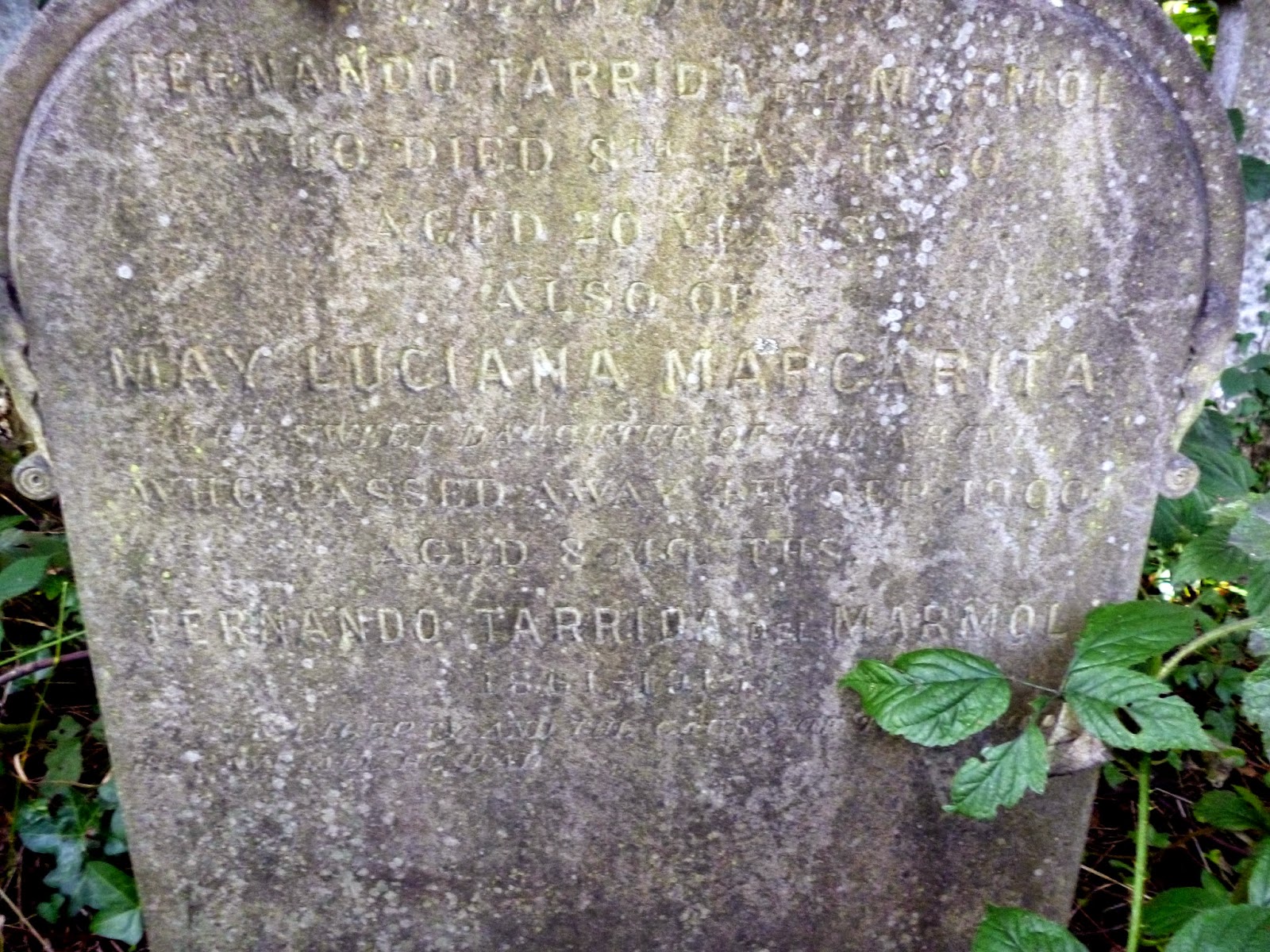
Just a few rows behind David Jones's grave is that of Fernando Tarrida del Mármol, plus his children and his wife who all died in 1900.
 
Because of the problems with Spanish surnames for non-Hispanics (such as many of them being two words derived from the surname of both the father and the mother), I looked at the website of the Biblioteca Nacional de España for references to this writer's works, and it gives the surname as Tarrida del Mármol (1861–1915).

Mike Guilfoyle gives brief biographical details of Tarrida del Mármol (linked below), and it's interesting that this relatively unknown (at least to me) anarchist stayed with Kropotkin and Louise Michel in Bromley, and 'went on Publicity tours with Kier Hardie and [erm] Ramsey MacDonald'.

I couldn't resist a link to my Louise Michel post either.

–––––––––––––––––––––––––––––––––––
Ernest Dowson, Brockley and Ladywell Cemeteries
Fernando [Tarrida] del Marmol
Louise Michel in Levallois-Perret

Philippe Djian: "Oh..." (2012)

 'Oh...' might very politely describe several reactions I had to this book during the course of reading it. There are some surprises, or shocks, in here, and I know that I'm not the only person who had to flick back a page or so to make sure that he'd read something correctly: invariably, I had. I know there's also a temptation to give up on the thing, but again I didn't because, oh...

You wouldn't expect this book to win a prize for political correctness, if there were such an animal, although Djian is a feminist, and the reader has to admit that none of the male characters comes out of this smelling of roses, whereas the female protagonist Michèle (who is also Djian's first female narrator) certainly does. She is intelligent, a free agent, a modern woman, and if she likes very rough sex....but I'm getting ahead of myself.

So here goes. The novel begins (although the reader doesn't yet know it, and the cops never will) when Michèle is nursing her rape wounds, but she just carries on with her plans to receive her son Vincent (who is by no means convinced that she fell from her bicycle) and his girlfriend Josie for a meal. Vincent is a shiftless guy who seems to go from McJob to McJob and Josie is pregnant by another guy (who is in prison) and they want Michèle to act as guarantor for an expensive flat they intend to rent in central Paris.

Michèle co-owns a screenwriting agency with Anna, who is her best friend, and she also supports her 75-year-old mother who lives elsewhere in Paris and has a strong taste for much younger boyfriends.

Her mother wants Michèle to visit her father who has been in prison for the last thirty years but he is dead as far as Michèle is concerned – we learn some time later that he massacred 70 children at a Club Mickey.

Michèle is having an affair with Anna's husband, who is as spineless as the other men in the novel, until she meets another man and begins a relationship with him. And although this man turns out to be her rapist (oh...) and is a person who can't get an erection without the rape element, Michèle still continues having sex with him (oh..., oh..., oh...) until Vincent happens in on a sex scene, quite understandably thinks his mother is being raped, and smashes the guy's skull in.

Now, I imagine almost all prospective novelists giving a book proposal such as this to most publishers would receive the 'Don't call us, we'll call you' treatment, but this novel is by Philippe Djian, the guy who wrote 37°2 le matin, which Jean-Jacques Beineix turned into a highly successful movie (Betty Blue in English), and he went on to become one of France's biggest writers.

And believe it or not, Oh... really works, and is quite a stunning book. I would have appreciated indented paragraphs though: as opposed to what Djian might think, it's not 'modern' to leave indents out – it just looks messy and is unhelpful to the reader.

ADDENDUM (1): Philippe Djian's novel 'Oh...' was adapted into a film called Elle, directed by Paul Verhoeven and starring Isabelle Huppert, in 2016.

ADDENDUM (2): Last night (24 February 2017) Elle won the César for best film, and Isabelle Huppert the César for best female actor for her performance in Elle.

18 October 2013

Vassilis Alexakis: L'enfant grec (2012)

Vassilis Alexakis's lovely novel L'Enfant grec makes many digressions, and I shall be making some of my own to illustrate the areas he covers, putting in brackets things he doesn't mention.

Alexakis's novel is also very autobiographical. It concerns an (unnamed) old man who has had a major leg operation in Aix-en-Provence and must now walk on crutches until his leg heals. Due to his mobility problems he can't immediately return to his flat in the 15th arrondissement, so he is temporarily living in L'hôtel Perreyve in rue Madame, very close to rue Fleurus and close to a western entrance to the Jardin du Luxembourg in the 6th arrondissement. The name of the hotel and the streets are real, as are the narrator's geographical details.

At one point the narrator and his companions turn from rue Guyemer (which borders the western edge of Luxembourg), cross rue de Vaugirard and take a few steps into rue Napoléon, where the narrator becomes very interested in the bronze woman with the hat and even joins her on her seat outside L'Institut hongrois.


We can see more clearly here that the girl's eyes are closed.

(On her ankle is the creator's signature: it is by Andràs Lapis and there's a copy of it in Szeged in Hungary. The original was made in 1975, although this particular sculpture dates from 1992.)

(And 'Kala palati', inscribed on the brim of the hat, is the title of the sculpture, which apparently means something like 'Under the Hat'.)
 
Much of L'Enfant grec – along with the memories of the narrator on crutches – is set in the Jardin du Luxembourg. The recuperating man now sees things at a much slower pace, a world in a grain of sand: he has time to reflect on his now slow present, and on his past.
 
The narrator often mentions L'Auberge des Marionnettes in the Jardin du Luxembourg, although there is no such establishment. But there is a place called La Buvette des Marionnettes, which is very near the marionnette theatre.
 
And the Buvette even has a menu including two puppets Alexakis frequently mentions in the novel: Guignol and Gnafron.
 
L'Enfant grec is a wonderful (if often wildly imaginative) guide to the Jardin du Luxembourg. The narrator mentions the statue of a boy ('Le Marchand des masques') to the south-east of Luxembourg near L'École des Mines, with its several masks at the boy's feet.
 
There, Balzac – who the narrator says disliked the Jardin (and implies that that is a reason why there's no statue or bust of him here) – makes an obscure appearance as a mask.
 
Alexandre Dumas is also there.
 
And so too is Barbey d'Aurevilly.
 
Significant here is that the boy holds up a mask of Victor Hugo. The title of Alexakis's book, L'Enfant grec, comes from Hugo's poem 'L'Enfant', about a child left in the ruins of Thios after its destruction by the Turks in 1822. Several times in this novel, Alexakis mentions the Sénat in the Jardin du Luxembourg, to which Hugo belonged from 1876–85. And throughout the novel we are reminded of the young Greek narrator's reading habits – Hugo's Les Misérables, or Defoe's Robinson Crusoe, or Stevenson's Treasure Island, or many more classics. (He also speaks of the financial ruins of contemporary Greece.)
 
The novel is a cross between a guide – historical and modern – to the Jardin du Luxembourg, a guide to the narrator's thoughts and memories, and to his fantasies. It may be immensely digressive, but so too are many good books. And this is undeniably a very good book.
 
 
–––––––––––––––––––––––––––––––––––