19 January 2013

Ann Hatton (1921–2013)

Earlier this week I learned the sad news of Ann Hatton's death on 11 January this year. It was Ann who had enthusiastically and very helpfully provided me with so much information about the artist Karl Salsbury Wood, particularly from family photos, postcards, and watercolours: Ann's mother Nellie (née Radford) was Wood's cousin, with whom he kept in regular contact.

Ann's father Colan Harrison had moved to Canada before World War I and worked as a logger and a cook before joining the Royal Canadian Mounted Police. He returned to England with the Canadian Regiment and guarded German prisoners of war, and while visiting his sister he met Nellie, married her in 1919, and left for a new life with his wife, sister and mother to a farm in Bowden, Alberta, where Ann was born one very cold November day in 1921. There was no school nearby, so Ann and her siblings were taught by their aunt; it was a very harsh life with poor facilities and the family decided to return to England in 1930.

Karl Wood's representation of Abbey Farm, Renhold, Bedfordshire, where Ann and her siblings were brought up

Ann qualified as an SRN during World War II, and in the course of her work met Igor, whom she married in December 1945. She was a relief matron at Uppingham School sanatorium for eighteen years, and a number of the pupils there maintained contact with her for many years. She also spent nineteen years delivering 'meals on wheels', and was active in fund raising for the church and for charities.

It was only by a series of fortunate coincidences in the mid-nineties that I met Ann: I'd been researching Karl Wood's life with a view to publishing a biography, but there were some missing links during his youth. The local paper made a few column inches out of my appeal for information, and I was quite surprised to receive a phone call from Alan Guest, who by chance had bought a few linocuts of Wood's from the Usher Art Gallery in Lincoln, and who knew Marc Oxley (the owner of a fine art business in Uppingham, Rutland), who knew Ann and was aware that she was a relative of Karl Wood's.

So shortly after learning this I found myself in Uppingham one fine summer's day sitting in front of a table with a host of Wood's postcards, photos and sketches on the patio of Ann's home, recording her wonderfully informative conversation: the missing pieces of the biographical jigsaw were slowly forming a fuller picture, and there were now images of a kilted Wood in his Seaforth Highlanders uniform, or in Nellie's garden with cap, cane and bowtie, etc. And Ann (who had a great affection for Karl) told me to take the relevant postcards and photos home to photograph at my leisure and send back to her, which I thought showed a lovely trusting spirit.

Karl Wood in Nellie's garden, date unknown

My brief book was therefore greatly enhanced by the images that Ann supplied, and it was also enhanced by the knowledge of Wood's activities in his teenage years and during World War I which I gleaned from the postcards. And I'm pleased that Ann was able to make it to Gainsborough for the exhibition of Wood's local paintings put on by the Gainsborough and District Heritage Society.

Still on the subject of art, but a different artist, it seems scarcely credible now that I'd never heard of Louis Wain until Ann showed me a few reproductions of his cats.

It is a great pleasure to have known Ann Hatton, and I shall always remember her warmth of spirit, her keen intelligence, and her (slightly mischievous) sense of humour.

(My thanks to Ann's son John for supplying the biographical information and photo.)


The link below is to my online biography of Karl Salsbury Wood:

Windmill Wood

17 January 2013

Jean-Philippe Toussaint: Fuir | Running Away (2005)

I was reminded of movie director Alan J. Pakula's films when reading Jean-Philippe Toussaint's Fuir (2005), or Running Away, but only because of the importance of the telephone: far from Pakula's realism, this novel is obviously Nouveau Roman inspired, with an (unnamed) unreliable narrator.

Chronologically, Fuir occupies the mid-position in Toussaint's three 'Marie' cycle novels, between Faire l'amour (2002), or Making Love, and the as yet untranslated La Vérité sur Marie, (2009), which will presumably be titled The Truth about Marie.

The novel's first sentence, Serait-ce jamais fini avec Marie? (lit. 'Would it ever be finished with Marie?'), is spoken by the narrator, and immediately we know there's a relationship problem, but that comes in later. Marie has sent the narrator to Shanghai to hand a $25,000 money packet to Zhang Xiangzhi, his slightly reluctant host. At an exhibition he meets Li Qi, a woman who seems to promise sex, and she invites him to take the train to Beijing with her, so he readily agrees to meet her at the train station, but is surprised to discover that Zhang Xiangzhi is going with them too. On the train, while most people are sleeping, the narrator is on the point of having sex in the toilet with Li Qi when the Pakula moment comes: it's Marie on the phone to say that her father has died at his home in Elba. This changes everything, and the narrator's sexual enthusiasm for Li Qi moves into detumescent mode. End of the first of three parts.

Now they're in Beijing, it seems that Zhang Xiangzhi could be in a relationship with Li Qi, but the narrator is no longer concerned: Marie's phone call has had a big effect: there's a difference between the world that's under his nose and the way he perceives it; the real is distorted, there's a separation, a kind of fracture, in fact he's in a state of permanent jetlag.


Zhang Xiangzhi shows him a little of Beijing in a half-hearted way, then gets a motor bike and rides them both to a bowling alley, where Li Qi later turns up with a package that the narrator guesses contains drugs that Zhang Xiangzhi has spent the twenty-five grand on. Then there's another earth-shattering phone call (although we never really find out why), this time from an unknown person to Zhang Xiangzhi, and the trio all hop on the motor bike followed by the cops, and the novel briefly turns into a kind of silent movie comedy: there's virtually no dialogue in the whole book anyway. In this way, a phone call again leads to the end of the section.

So will the common grief of Marie's father's death bring the couple together again? Well, it's not as simple as that. The narrator flies back to Paris and on to Elba to attend the funeral, but instead he just phones Marie and decides to play hide and seek for several hours. Marie finds him and they try a little sex but it doesn't work so they decide to go for a swim but he stays on the shore while Marie takes to the water.


Her father had a heart attack swimming here, but surely Marie hasn't? Has she? It seems not, so we'll rely on the narrator at the end...won't we? Nathalie Sarraute spoke of l’ère du soupçon, or 'the era of suspicion' which the Nouveau Roman heralded, and with the, er, Nouveau Nouveau Roman, it's still wise to be suspicious of the truth of what the narrator tells us.

(There's a link to a very interesting article on Jean-Philippe Toussaint in the London Review of Books by Tom McCarthy, which at the same time also tells us something about McCarthy.)

–––––––––––––––––––––––––––––––––––
'Stabbing the Olive', by Tom McCarthy

My other posts on Jean-Philippe Toussaint:
––––––––––––––––––––––––––––––––––––
Jean-Philippe Toussaint: Faire l'amour | Making Love
Jean-Philippe Toussaint: Nue

Jean-Philippe Toussaint: La Vérité sur Marie | The Truth about Marie
Jean-Philippe Toussaint: La Salle de bain | The Bathroom
Jean-Philippe Toussaint: L'Appareil Photo | Camera

Charles Portis: The Dog of the South (1979; repr. 2005)

Charles Portis is a Southern writer whose work has developed something of a cult status. He's reasonably well known for one of his five novels, True Grit (1968) – filmed by Henry Hathaway in 1969 and the Coen brothers in 2010 – but his others remain far more obscure. The Dog of the South was published some eleven years after True Grit, and also concerns a chase, this time from Little Rock, Arkansas, through Mexico to Belize. Ray Midge is the narrator, and his wife Norma has run off with her her ex-husband Guy Dupree (who is skipping bail after threatening the president), and they have taken with them Midge's credit card and his well-kept Ford Torino. Dupree has left behind his battered Buick with a hole in the driver's floor, and rather than call the cops Midge decides to follow them in it to Mexico.
 
On the way Midge picks up the con-man and struck-off doctor, Reo Symes, who has been living in a former school bus called 'The Dog of the South'. Symes wants to see his mother in Belize, as he has plans to turn a small island she owns into a hugely profitable business venture, but then Symes is full of these kinds of enthusiastic projects that the reader knows will come to nothing.
 
Ron Rosenbaum, who's been one of Portis's greatest champions, says in 'Of Gnats and Men: A New Reading of Portis' in the New York Observer that the novel  – which contains an epigraph by Sir Thomas Browne about the 'restlesse motions' of primitive life forms – is in essence about the 'tortile twists of the stream of consciousness', and I think a simple but useful illustration of this is the uncertain way the narrator sometimes describes things, doubletakes by correcting himself or hedging his bets, as when he gets a cab to pick up Dupree's car at the garage:
 
'The cabdriver let me out in front of a filthy café called Nub's or Dub's that was next door to the garage. Nub – or anyway some man in an apron – was standing behind the screen door and he looked at me.'
 
Many people find Portis a funny writer because he uses odd words, eccentric expressions. He writes about the insignificant, about everyday neuroses or fastidiousness that probably most people suffer from. Midge, for instance, anchors down his paper napkin by dipping his finger in the beer and wetting the corners because he doesn't want to look stupid carrying the napkin up to his mouth with the glass. And he drinks from the mug as a left-hander would because that side of the glass is less used. The interesting thing here, of course, is that Portis writes about things authors don't usually write about: inconsequential things. A friend of my aunt's once told her that he wouldn't lend her neighbor a book she wanted to borrow from him as she looked like the kind of person who licked her fingers before turning the pages – this is the kind of world that Portis's characters inhabit, talking about things that writers normally leave off the radar.
 
Conversations spring up as if from nowhere, and lead nowhere, although they're the kind of conversations people have in 'real life': 'real' people talk just the way Portis's characters talk. The apparent surrealism is the surrealism of everyday life. Leave a recording device in a room where a few people are, and on playback you might well hear such inconsequentialities, non sequiturs, repetitions, charades, interrogations, mindless insistencies, digressions, etc.
 
The Dog of the South is a good name, although we hear nothing more of it when Symes leaves the bus early on in the novel. And in fact for much of the novel, after Midge arrives in Belize with Symes, Symes largely disappears into the background, and we don't know what becomes of him in the end. Midge finds the sick Norma in hospital, nurses her to health and takes her back to Little Rock, but she soon leaves him to go to Memphis, and although it's not far away Midge doesn't follow her again: this is not a novel where things are tied up neatly at all. Which is fine.
 
If I agree with Rosenbaum that Portis is the States' 'least-known great writer' is another matter though. I shall have to read some more of his novels, and although I didn't like True Grit, I think I'm beginning to see what the attraction is.
 
ADDENDUM: A thought just came to me about Southern literature, and it's only a thought, but... Admittedly there is the traditional weirdness of Southern Gothic, but generally speaking Southern literature isn't seen as 'experimental', by which I essentially mean moving us well away from the constraints of 19th century literary practices. There's William Faulkner of course, Frances Newman, Barry Hannah, T. R. Pearson, and more recently there have been Padgett Powell and Selah Saterstrom but that appears to be all, although it seems to me that Charles Portis should be included in this category too.

14 January 2013

Jethro Tinker and John Bradbury in Millbrook, Stalybridge

At the entrance to Stalybridge Country Park, Millbrook, are two plaques remembering local men of note:

'Jethro Tinker
1788–1871
 
An ardent naturalist who recorded much
of Stalybridge's flora. Born at North
Britain Farm, The Brushes.
 
Unveiled by Councillor
George Hatton
16th November
1995.'
 
Tinker, the son of a weaver who later also became village schoolteacher in Mottram in Longdendale, spent all his life in the Stalybridge area. He first worked as a shepherd around Hollingworth, but later became a weaver in Stalybridge, where he progressed to manager of Cheetham Mill. He made many local journeys collecting natural history specimens and became an amateur authority on the subject. He died at 82 and a memorial (vandalized in 1997) was erected in Stamford Park. N. Dennis and Elaine R. Bullard wrote the article 'Jethro Tinker (1788-1871): Field Naturalist', which was published in the Naturalist in 1981.
 
'John Bradbury
1768–1825
 
A botanist and explorer of repute.
Born at Souracre Fold, Stalybridge.
 
Unveiled by Councillor
George Hatton
16th November
1995.'
 
Bradbury is most noted for his travels in the USA, particularly in the Midwest and the West, where he documented species of plants and sent seeds back to his son in England. He published Travels in the Interior of America, in the years 1809, 1810, and 1811; including a description of Upper Louisiana, together with the states of Ohio, Kentucky, Indiana, and Tennessee, with the Illinois and Western territories [etc.] (1817).

13 January 2013

Jack Judge in Stalybridge

 
 This statue in Stalybridge intrigues me.
 
'JACK JUDGE
accompanied by a WWI soldier
 
Inspired to compose the famous marching song
"It's a Long Way to Tipperary"
He was the first to sing it publicly in 1912
at the Grand Theatre in Stalybridge,
the town of its conception.
 
Unveiled 16th December 2005
by Councillor Frank Robinson'

'It's a long way to Tipperary' was certainly a 'marching song' in that World War I soldiers used it while marching, although I'm aware of no evidence that it was conceived as such, so the existence of the soldier apparently 'helping' Judge to compose the song is very fanciful.
 
The truth seems to be that the army simply adopted a completely non-military song to sing as they marched. Judge is said to have claimed that he made a five-shilling (25 pence) bet at the New Market Inn*, Corporation Street, Stalybridge, that he couldn't write an original song in 24 hours. On his way home he was inspired by a drunk he passed, and the result was that he wrote a song about an Irishman homesick in London. It appears that one or more of Judge's relatives came from Tipperary.
 
* The pub no longer exists.

The First General Strike of 1842, and Joseph Rayner Stephens, Stalybridge

This is the portico of Stalybridge Town Hall, all that remains of the original structure. It bears two interesting plaques:
 
'THE FIRST GENERAL STRIKE, 1842
 
Originated in this area, beginning as a movement
of resistants to the imposition of wage cuts
in the mills, also known as the "Plug Riots"
it spread to involve nearly half a million
workers throughout Britain and represented
the biggest single exercise
of working class strength
in nineteenth century
Britain.'
 
'JOSEPH RAYNER STEPHENS
1805–1879
Trained in the Ministry, Joseph Rayner Stephens
came to Ashton in 1832. He became an important
Chartist Leader who campaigned against
the Poor Law and for factory reform.
His greatness was in his instinctive reaction
to human distress and social injustice.
In later life he lived in Stalybridge
where he established a People's
School and is buried in
St John's Church,
Dukenfield.'

Stalybridge Station Buffet Bar, and no Q for another pub

This is a timewarp very far removed from St Pancras. They have a good selection of cask beers, but as I was driving I had a coffee, which was large and came on a tray with a jug of milk: a bargain at £1.50.
 
'This Victorian Buffet Bar is unique
and is authentic in detail since
being rebuilt in 1885.
 
Unveiled by Councillor Eileen Shorrock
on 16th July 1994.'
 
One of the four rooms.
 
And a few yards down the road is another pub with a blue plaque.
 
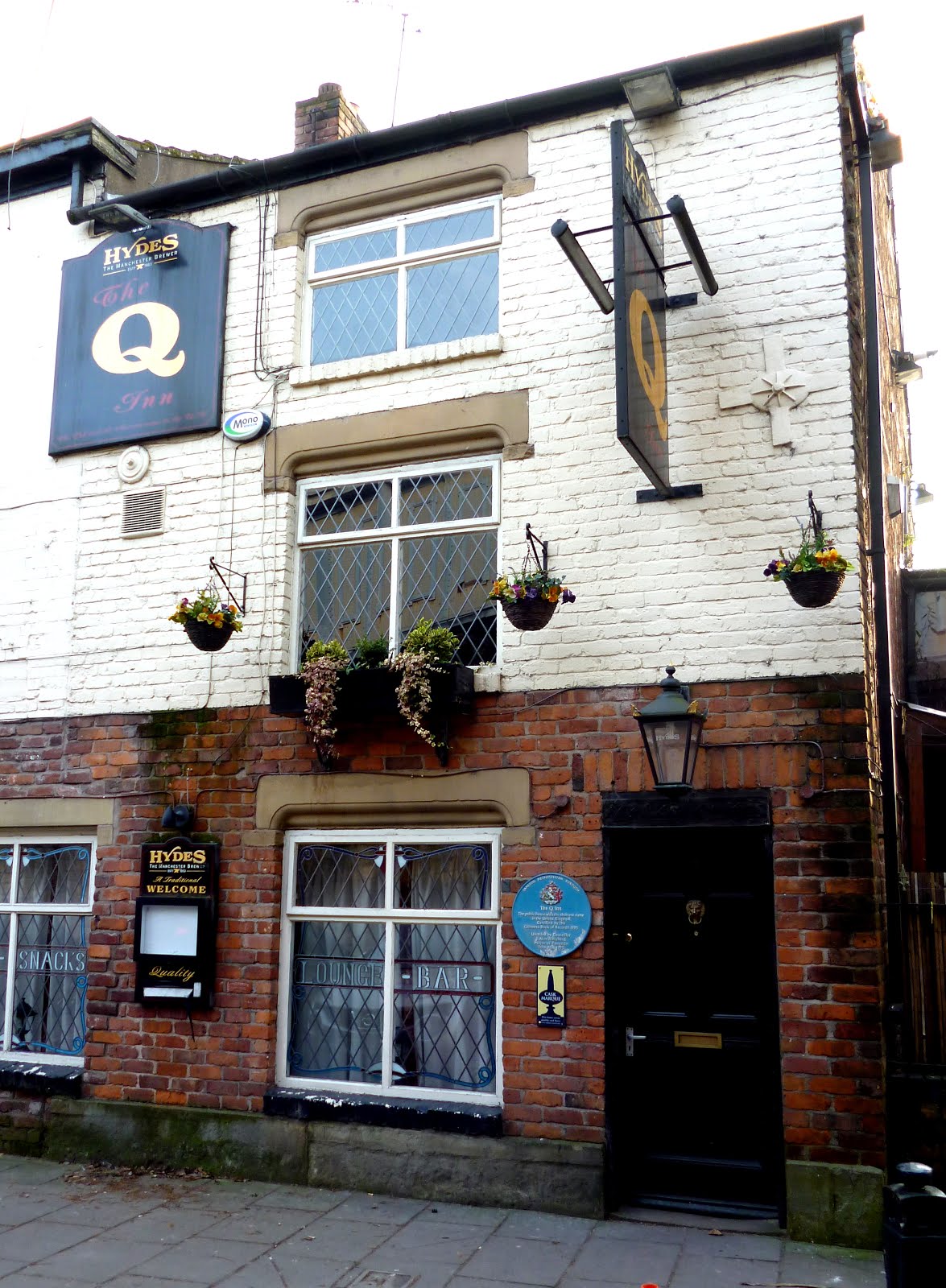
'The Q Inn
The public house with the shortest name
in the United Kingdom.
Certified by the
Guiness Book of Records 1995
 
Unveiled by Councillor
J. Alan Whitehead
Mayor of Tameside
30th May 1995'
 
Unfortunately, the pub has now closed down.

Beatrix Potter's Relatives in Gee Cross and Stalybridge, Greater Manchester

In the churchyard of Hyde Chapel, Gee Cross, Greater Manchester, is the family grave of the Potter family – Beatrix Potter's parents and paternal grandparents.

'In loving memory of
EDMUND POTTER
DIED 26TH OCTOBER 1883
AGED 81 YEARS.'

Also of JESSY POTTER [née Crompton]
WIDOW OF EDMUND POTTER
DIED 9TH SEPTEMBER 1891
AGED 90 YEARS.

[...]

also of RUPERT POTTER
2ND SON OF THE ABOVE EDMUND POTTER
DIED 8TH MAY 1914 AGED 81 YEARS.
ALSO OF HELEN POTTER [née Leech], WIFE OF THE ABOVE
RUPERT POTTER
DIED DECEMBER 20TH 1932 AGED 93 YEARS.'

And in Stalybridge:

'BEATRIX POTTER
(1866–1943)

Renowned children's story writer author
and artist of the famous Peter Rabbit book.

Beatrix's maternal grandparents John and Jane [née Ashton] Leech
bought the Gorse Hall Estate after their marriage and
built the Gorse Hall Mansion which was demolished in 1910.

Born in London, Beatrix in later life made several visits
to her grand parents and recorded her fond memories
of the place.

Unveiled by John Heelis OBE, great nephew
of Beatrix Potter's husband, William Heelis
on 23rd November 1999.'

Beatrix  Potter's mother Helen Leech was born at Gorse Hall. In 1909 George Harry Storrs of Gorse Hall was stabbed to death there by an attacker who remains unknown. His wife Maggie had the building demolished the following year and the hilly grounds now serve as an area for walks.

André Blavier #4: Ernest de Garay, aka Karl-des-Monts

Little is known of Ernest de Garay. He wrote several books, such as Les Légendes des Pyrénées (1857), in which he concentrated on the legends of the Basque country. He was also a lawyer for the imperial court of Paris, but for political reasons for imprisoned in an insane asylum in Pau, from which he wrote his most noted work under the pseudonym of Karl-des-Monts; this is Un martyre dans une maison de fous ('A Martyr in a Madhouse'), and Blavier's excerpts from it contain Garay's definition of madness and several of his prison letters, especially to Octavie, whom he addresses in loving terms.

He rails against the director for many different things: his missing or rotten teeth, his idiotic smile, his dirty beard, his corpse-like smell, attempting to draw an accurate picture of a 'manufacturer of madness'; and he rails against the madhouse itself for being a Père Lachaise des intelligences where he sleeps on a straw bed under a horse blanket. The conditions, the awful cloaical smells, are appalling, but it is surely his graphic description of a man killed by scalding water from a boiler whose tap was negligently left on that horrifies the reader the most.

Un martyre dans une maison de fous was re-published recently.

My André Blavier/Fous littéraires posts:
––––––––––––––––––––––––––––––––––––
André Blavier: Les Fous littéraires #1
André Blavier #2: Alexandre Ansaldi, G. Clair/Rupin Schkoff, Camarasa

André Blavier #3: Hyacinthe Dans
André Blavier #4: Ernest de Garay, aka Karl-des-Monts
André Blavier #5: Francisque Tapon-Fougas
André Blavier #6: Jules Allix
André Blavier #7: Alexandre-Vincent-Charles Berbiguier

12 January 2013

Lawrence Earnshaw in Mottram in Longdendale, Tameside

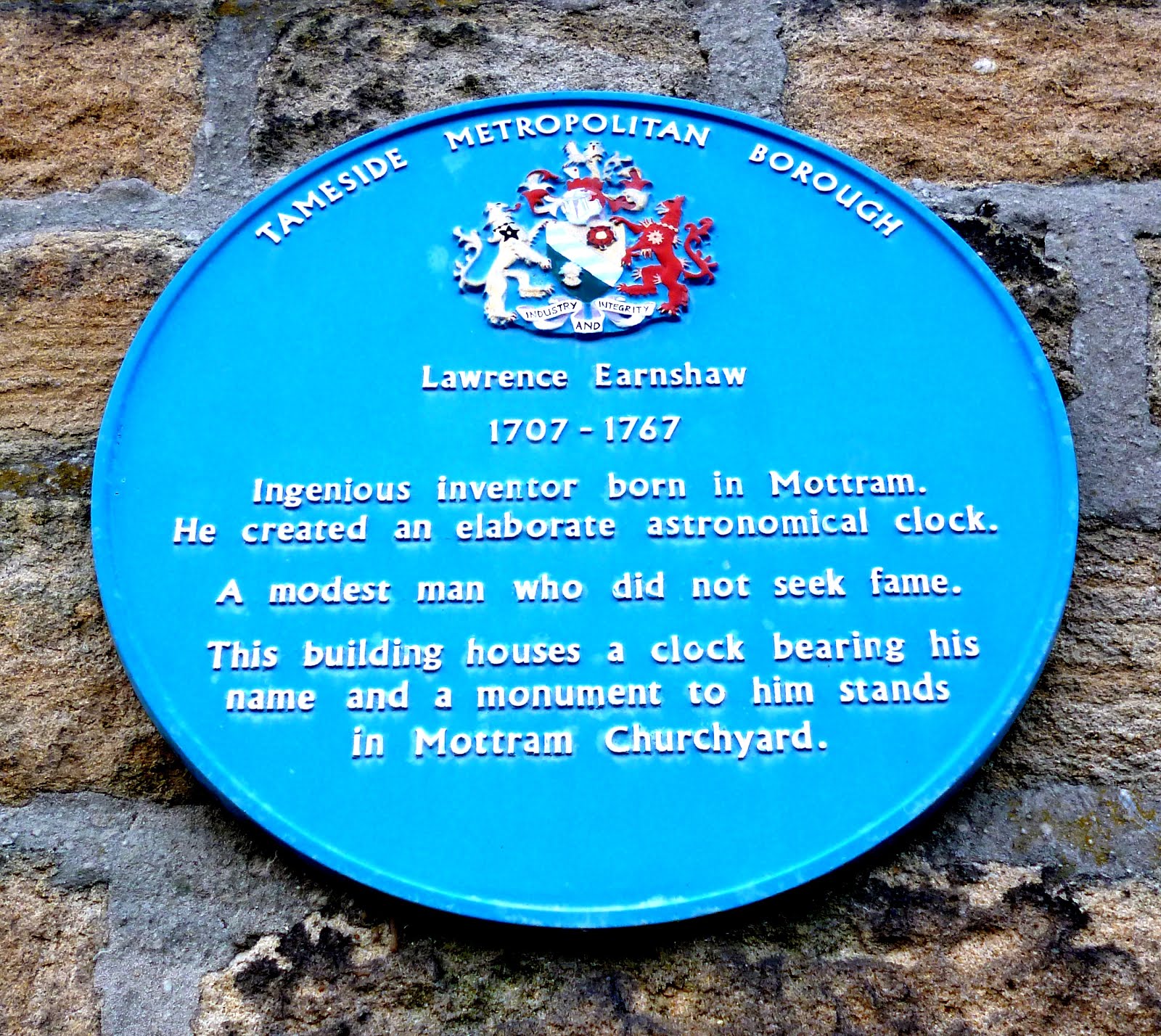
On the wall of the Court House, Market Place, Mottram in Longdendale:
 
'Lawrence Earnshaw
1707–1767
Ingenious inventor born in Mottram.
He created an elaborate astronomical clock.
A modest man who did not seek fame.
This building houses a clock bearing his
name and a monument to him stands
in Mottram Churchyard.'
 
Lawrence Earnshaw's monument at Mottram. There are four different inscriptions around the base:
 
'LAWRENCE EARNSHAW
MOTTRAM
DIED MAY 12TH 1767
AND WAS BURIED IN THE
ADJOINING CHURCHYARD.'
 
'A SELF-TAUGHT GENIUS AND
OF HUMBLE BIRTH HIS TALENTS
AS AN INVENTOR ANITCIPATED
BY MANY YEAR THE DISCOVERIES
OF OTHER EMINENT MEN.'
 
'BY HIS SKILL IN GEOMETRY
AND
ACQUIREMENTS AS A MECHANICIAN
HE DESIGNED AND CONSTRUCTED
AN ASTRONOMICAL CLOCK
REGISTERING THE REVOLUTIONS
OF THE HEAVENLY BODIES AND
THE FLOW OF THE TIDES.'
  
'A CENTURY AFTER HIS DECEASE
THE ADMIRERS OF HIS GENIUS
AND WORTH
ERECTED THIS MEMORIAL.
A. D. 1867.'
 
'JOHN EATON
ASHTON'
 
The Hyde poet James Leigh mentions Earnshaw's memorial in this verse from one his dialect poems in Glimpses of Sunlight and Other Poems:
 
'Bu' come, we'll have a look through t' yard
Th' owd ancient burial-greaund
Wheer Mottram's dead for ages
Ha'n slept so snug an' seaund;
We'll visit Earnshaw's Monument
(Neglected in his day
This cenotaph ne'er mark'd his worth
Till years had pass'd away).'
 
Below is a link to an online article on Earnshaw in the Tameside Citizen, with several more verses from Leigh's poem:
 
 –––––––––––––––––––––––––––––––––––
'A Tribute to Lawrence Earnshaw'

10 January 2013

André Blavier #3: Hyacinthe Dans

From February 1924 to November 1925 the bookseller Hyacinthe Dans in Liège was in charge of the (now, as it was his) scandalous rag Nanesse, which earned him two years' imprisonment for blackmail. Before his sentence could be carried out, though, he'd fled to Paris with his girlfriend Armande Comtat, whom he forced into prostitution to prevent himself from starving.

When she declared she was leaving him, he struck her on the head with a hammer and slit her throat, then killed his own mother (although why is unclear). Terrified of receiving the death sentence in France, he fled back to Liège, where he murdered a Jesuit priest whom he had known from Saint-Gervais college: but again, the reason is unclear, although insanity is a distinct possibility. He received life imprisonment, and became editor-in-chief of Journal des prisons belges under the pseudonym Tristan Chevreuse.

Georges Simenon had been familiar with Dans from the 1920s when they were regulars at the highly disreputable café La Cagne (which, for the record, means 'herring barrel'), and had worked on Dans's magazine. Simenon perpetuated Dans's name in his partly autobiographical first-person book Les Trois Crimes de mes amis (1928).

My André Blavier/Fous littéraires posts:
––––––––––––––––––––––––––––––––––––
André Blavier: Les Fous littéraires #1
André Blavier #2: Alexandre Ansaldi, G. Clair/Rupin Schkoff, Camarasa

André Blavier #3: Hyacinthe Dans
André Blavier #4: Ernest de Garay, aka Karl-des-Monts
André Blavier #5: Francisque Tapon-Fougas
André Blavier #6: Jules Allix
André Blavier #7: Alexandre-Vincent-Charles Berbiguier

9 January 2013

André Blavier: Les Fous littéraires (1982) #2

I mentioned André Blavier's Les Fous littéraires (1982)1 a short time ago (see link below), and have now bought a copy. This is the first edition (pub. Henri Veyrier), which contains 924 pages with details about – and examples of the writings of – many hundreds of authors who have received no or very little recognition for their (often self-published) work.2

The Introduction contains an epigraph by Latis (or Emmanuel Peillet), one of the founder members of Oulipo, stating that brevity is a positive thing, with the exception of prefaces: the Introduction is 90 pages long. After the first heading, 'Première émission ('First Programme'), there's a footnote with an explanatory note saying that the Introduction was originally conceived as a series of radio programmes that were never broadcast, and was later copiously annotated. On the second line, a second footnote explains that the expression boule de neige (lit. 'snowball') is not used here in the Oulipian sense.3 (It's used figuratively here to refer to a growing number of questions.)

As we might imagine, the influence of Queneau is very evident, so this is no conventional introduction simply explaining the rationale behind the book, but then this probably isn't a book you would read from cover to cover in any logical way. At the moment I'm getting distracted all the time, dipping into some of the characters in this colossal work. I'll give just a few examples at the moment:

– I was aware (but didn't mention it in my first post) that Paulin Gagne – who is given 26 pages here – had written a carrot culture Marseillaise (Allons enfants de la carotte, etc), but I now notice that Alexandre Ansaldi also wrote a book called La Marseillaise nouvelle in 1971: the song is on the back cover, and the text inside calls the traditional song 'imbecilic and grotesque', and 'bombastic and violent'. When Blavier was writing he knew nothing of another song titled La Marseillaise électrique (by G. Clair and Rupin Schkoff), although it's now online: it's a 'war song' for electricians, begins Allons enfants de la batt'rie ! / Le jour de voir est arrivé !, and the rest is here.4

– Antoine Madrolle wrote a theology of railways.

– Camarasa wrote a Receuil ou collection de notes, de croquis, de dessins, de schémas, pour un traité historique, théorique, pratique, philosophique, philologique, poétique, sportif, acrobatique, touristique, artistique et pittoresque de la brouette ('Book or collection of notes, sketches, designs, schemes, for a historical, theoretical, practical, philosophical, philological, poetical, athletic, acrobatic, touristic, artistic, and picturesque treatise on the wheelbarrow'.) It was printed in Madrid several times between 1915 and 1925, contained 539 pages and 993 illustrations, and was dedicated to Queen Christina.

Blavier's book is really remarkable.

––––––––––––––––––
1 Interestingly, the current English Wikipedia entry for Jean-Pierre Brisset (who is included in Blavier) has a number of similarities to the current French Wikipédia entry, and translates Fou littéraire as 'outsider writer'. In my previous post, I suggested that this is a good translation of the expression, and is one I shall continue to use about Blavier's writers: I shall be adding posts about this book when I come across interesting examples.

2 The second edition (pub. in 2000 Les Éditions des Cendres) has 1147 pages.


3 Boule de neige in the Oulipian sense refers to a poem which begins with a one-letter word for the first line, continues with a two-letter word for the second, then a three-letter for the third, etc. A boule de neige fondante (melting snowball) is a poem that begins with a word containing a certain number of letters in the first line, and then shrinks by a letter each following line.

4 Funny this undoubtedly is, although it would be a mistake to forget the gently subversive element: original words from the French national anthem –  patrie ('country') and gloire ('glory') – are changed to batt'rie ('battery') and voir ('seeing'): the song no longer glorifies the French nation, but the humble electrical workers.

My André Blavier/Fous littéraires posts:
––––––––––––––––––––––––––––––––––––
André Blavier: Les Fous littéraires #1
André Blavier #2: Alexandre Ansaldi, G. Clair/Rupin Schkoff, Camarasa

André Blavier #3: Hyacinthe Dans
André Blavier #4: Ernest de Garay, aka Karl-des-Monts
André Blavier #5: Francisque Tapon-Fougas
André Blavier #6: Jules Allix
André Blavier #7: Alexandre-Vincent-Charles Berbiguier

8 January 2013

James Prior: Three Shots from a Popgun (1880)


 Three Shots from a Popgun (1880) was Nottingham writer James Prior's first published work and contains three stories: 'Wise or Otherwise', 'Home Again' and 'Tug of War'.

Prior originally gave the copy of the book in my possession to his sister Jinnie Kirk on the year of publication. He signed it 'J. P. K.' as his real name was James Prior Kirk.

Because of the local history interest, I include the first few pages of the first story, 'Wise or Otherwise', below:

'Good-day to you, madam; and good-day to you, sir. Welcome to Nottingham. Have you any engagements, or may I hope you will accept my company for a stroll this sunny September afternoon? You will! I am greatly honoured. You have not seen much of the town, I daresay? As I thought; you have seen the Market-place pump and the Town Hall, and that is all. Well, be good enough, without more ceremony, to follow me, and I will show you a better sight.

Puff! Now we are out of the streets, and can speak and be heard. This broad avenue that you see before you is the Queen's Walk. These buildings that hedge it on every hand are the Meadows, so called because once, thirty years ago, there were meadows here green all the year, save in the springtime, when they were blue over with crocuses. Ah, if it were only thirty years ago! And why not, if we choose to have it so, and for an hour clear our memory of all the dust and rubbish that has been accumulating these thirty years? Let it be thirty years ago now, my companions. Pardon me, I am too soon familiar. Let the Queen and all of us be thirty years younger today; and let us see here nothing but what we might have seen thirty years ago.

So we are now at the end of the Walk, and by the banks of the Trent. This thing that fronts us is not an iron bridge, but a rustic ferry – Wilford Ferry, worked by one man's arm. We enter the boat, and cross in company with a milk-cart, a Nottingham stockinger, with fishing-rod and mat basket in hand, and a pair of sweethearts bound for Clifton Grove.

Safely landed with a bump! The village close at hand, almost hidden by innumerable elms, is Wilford. However, we will not enter it now, but will turn to the right by this White Horse Inn, making for the church, whose tower and spire you can see in spite of the trees.

Allow me, ladies, to assist you over this high stile. Now here we are, with nothing but a low barrier between us and the churchyard that grave-haunted Kirke White loved. But before you enter, sit down and admire the scene.

It is scarcely spoilt even now, though green fields are blotted out with red brick, and a colliery belches smoke on the opposite bank of the river. But yes, I remember we were at thirty years ago. Northward, beyond the Trent, see the broad sweep of rich meadow-land, besprinkled with trees, and bordered by pleasant hills, from which to our left rise the heights of Wollaton, clad with verdure, through which peeps the white face of a solitary mansion. To the right of these lie the houses and gentler slopes of Lenton; and next the bluff on which stands Nottingham, its two most prominent headlands crowned, the one by the Castle, the other by St. Mary's tower.

Further still, and faintly seen through the September haze, Sneinton Church sits on its own hill, like a little St. Mary's. Last of all the bold Rough Hill, covered with wood, flings round to our flank, and cuts off the view.'

Prior mentions the poet Henry Kirke White above, and there used to be a Kirke White Street in the Meadows, although with redevelopment the street was demolished. It was in the 1980s that his memory was preserved in Kirke White Court.

But Kirkwhite Walk, also in the Meadows, preserves his memory less accurately by fusing the two words and omitting the 'e'.

Anne Tyler: The Clock Winder (1972)

 
The Clock Winder is Anne Tyler's fourth novel, and the year it was published the New York Times had very little to say about it, just that it lacked substance. In a much later review in the Washington Post in 2003 – 'The Clock Winder: A Look Back to What Makes Anne Tyler Tick' – Jonathan Yardley is much more appreciative of it. And interestingly, he mentions a book I wasn't aware of – The Writer on Her Work (New York: Norton, c. 1980), edited by Janet Sternberg and containing an essay by Tyler titled 'Still Just Writing', in which she says that she's hurt when people say she chooses only to write about 'bizarre or eccentric people'. She goes on say that this is not a choice because 'even the most ordinary person [...] will turn out to have something unusual at his center.' Unusual? Well, yes, I can see that, but like most of her books The Clock Winder is (and I'm not ashamed of repeating myself ad nauseam) a world away from the milk and cookie world many believe she inhabits.

However, by coincidence, milk and cookies are literally what Mrs Emerson offers the young Elizabeth Abbott at the beginning of the book, after she does the widow a favor. But there isn't a great deal of cosiness in the rest of the novel, which depicts a very dysfunctional family with people behaving very oddly.

Mrs Emerson has had seven children, all of whom are odd, but some of whom are odder than others, such as Timothy, who kills himself earlier on in the presence of Elizabeth, and whose mentally disturbed twin brother sends her four letters in which he threatens to kill her. Most people would have been really spooked by this and called the cops, but Elizabeth doesn't tell anyone, doesn't take it seriously, and a few years later Andrew shoots her, although she's lucky to escape with a graze.

From this, it's clear that Elizabeth too is odd, and no less so for joining Dommie up the aisle only to say 'I don't'. And she doesn't just say this because she had second thoughts about that marriage proposal by Matthew, another of Mrs Emerson's sons who happens to be so persistent in chasing Elizabeth that he too seems a little spooky.

In short, and as Yardley notes, all of the characters in this novel have something odd about them, although we don't learn anything about Mrs Emerson's son Peter until the end of the book, which is in 1970, ten years after it began. For the first time in three years, Peter goes back to Baltimore to see his mother, accompanied by his wife P. J., although no one even knows he's married. Elizabeth (who's now called Gillespie and finally married to Matthew) shows P. J. their room, and they're just about set to have a meal when P. J. (alone with Peter) throws a funny and slips away quietly. Shortly afterwards, Peter slips out quietly too, finds P. J. and away they drive, back to New Jersey.

This could only be Anne Tyler. She never fails.


My other Tyler reviews are below:

–––––––––––––––––––––––––––––––––––
Anne Tyler: If Morning Ever Comes (1964)
Anne Tyler: The Tin Can Tree (1965)
Anne Tyler: Celestial Navigation (1974)
Anne Tyler: Earthly Possessions (1977)
Anne Tyler: Morgan's Passing (1980)
Anne Tyler: Dinner at the Homesick Restaurant (1982)
Anne Tyler: The Accidental Tourist (1985)
Anne Tyler: Breathing Lessons (1988)
Anne Tyler: Ladder of Years (1995)
Anne Tyler: A Patchwork Planet (1998)
Anne Tyler: Back When We Were Grownups (2001)
Anne Tyler: The Amateur Marriage (2004)
Anne Tyler: Digging to America (2006)
Anne Tyler: Noah's Compass (2009)
Anne Tyler: The Beginner's Goodbye (2012)

3 January 2013

The Collected Short Stories of Sir Temi Zammit (1995) (trans. Godwin Ellul)

Owing to a chronic allergy I hardly ever read translations – we can never be sure whose words we're reading, how faithful the translation is, and so on. Sometimes it's necessary to read in translation, though, and sometimes you just have to be generous and trust the translator.

So I had a try at this book. There are 31 short stories here, and in spite of feeling that I'd perhaps missed the point of a few of them, and noticing a few obviously off-centre expressions, I pressed on: Zammit's depiction of workers on the land in Malta in the first half of the 20th century, with its swindlers and get-rich-quick scoundrels, felt as though it was going to be interesting.

One sentence in 'Vincenza Goes to the Cinema' pulled me up sharp. It is obviously intended to say that Vincenza and her husband haven't been to the cinema before and will not do so again, but is rendered: 'This is the only time we've been to the cinema and it will not repeat itself.'

From then on I was paying as much attention to the translation as to the stories, but by 'Two Partners and Friends' (less than halfway through) I felt forced to give up: not only are there obvious errors that make comprehension difficult, but the words 'sheep' and 'goats' are used interchangeably.

That's a great pity, as it only serves to feed my translation allergy.

Linda Lê: Personne (2003)

In some ways, Linda Lê's Personne reminds me of Gilbert Sorrentino's postmodern Mulligan Stew, but then in other ways not, as Sorrentino's book is far more playful, for instance.

The usual Lê themes are here – such as death, doubles, and madness – although there's far more ambiguity. Personne, whose name means 'No one', is the main character and is a night watchman at a hotel until it burns down and he gets a job in a mail redirection business. Personne finds a computer on a tip with notes written by a woman he calls Tima, who describes her work at a museum (where she has been moved to the 'salle des gisants', containing recumbent statues), and a journey to Prague. Personne decides to retranscribe the notes, but in his own way, so it's unclear if Tima or Personne has written them.

But then, Personne is a kind of runaway train, escaping from the narrator. Other characters appear, such as Katimini the detective, Falmer (who is Personne's friend – perhaps), Ebua (whose name in reverse is 'Aube', which means 'Dawn' in French), and Abracadabra the psychiatrist is briefly mentioned. And aren't they all characters in the same book, facets of the same Personne?


My other posts on Linda Lê:

–––––––––––––––––––––––––––––––––––
Linda Lê: Les Évangiles du crime
Linda Lê: A l'enfant que je n'aurai pas
Linda Lê: Voix: une crise
Linda Lê: Lame de fond
Linda Lê: Lettre morte

1 January 2013

Mildred D. Taylor: The Road to Memphis (1990)

Mildred D. Taylor is sometimes mentioned as a writer of young adult fiction, but this novel certainly doesn't read that way. The Road to Memphis is set in 1941 and belongs to Taylor's Logan family saga, concerning the situation of blacks in mainly rural Mississippi, where they are very much second class citizens in a segregated society, where there are restaurants and toilets strictly for whites and blacks only, and where blacks sit or stand at the back of buses, and the seats at the front are for whites only.

Taylor was born in Jackson, Mississippi in 1943, and although her family moved to the North, as a child she frequently re-visited the South, absorbing the many stories she heard, later incorporating them into her novels, and The Road to Memphis is a fictional representation of archival and family research.

The author painfully depicts a world in which blacks must call whites 'Mr' and are daily forced to accept different kinds of intimidation that whites mete out with (usual) impunity. Jeremy Simms is a young white man who is an exception to these rules, though, as he believes that 'folks are folks', and is generally respected by the black community. Until, that is, he joins his racist cousins the Aames in chasing Harris, who badly breaks his leg as a result. However, Jeremy redeems himself when Moe snaps and beats up the Aames, and he not only hides Moe in his truck but secretly drives him to Jackson, from where he escapes in Stacey Logan's car to Memphis and by train to the safety of Chicago.

But there are no easy endings. There can't be.