15 August 2016

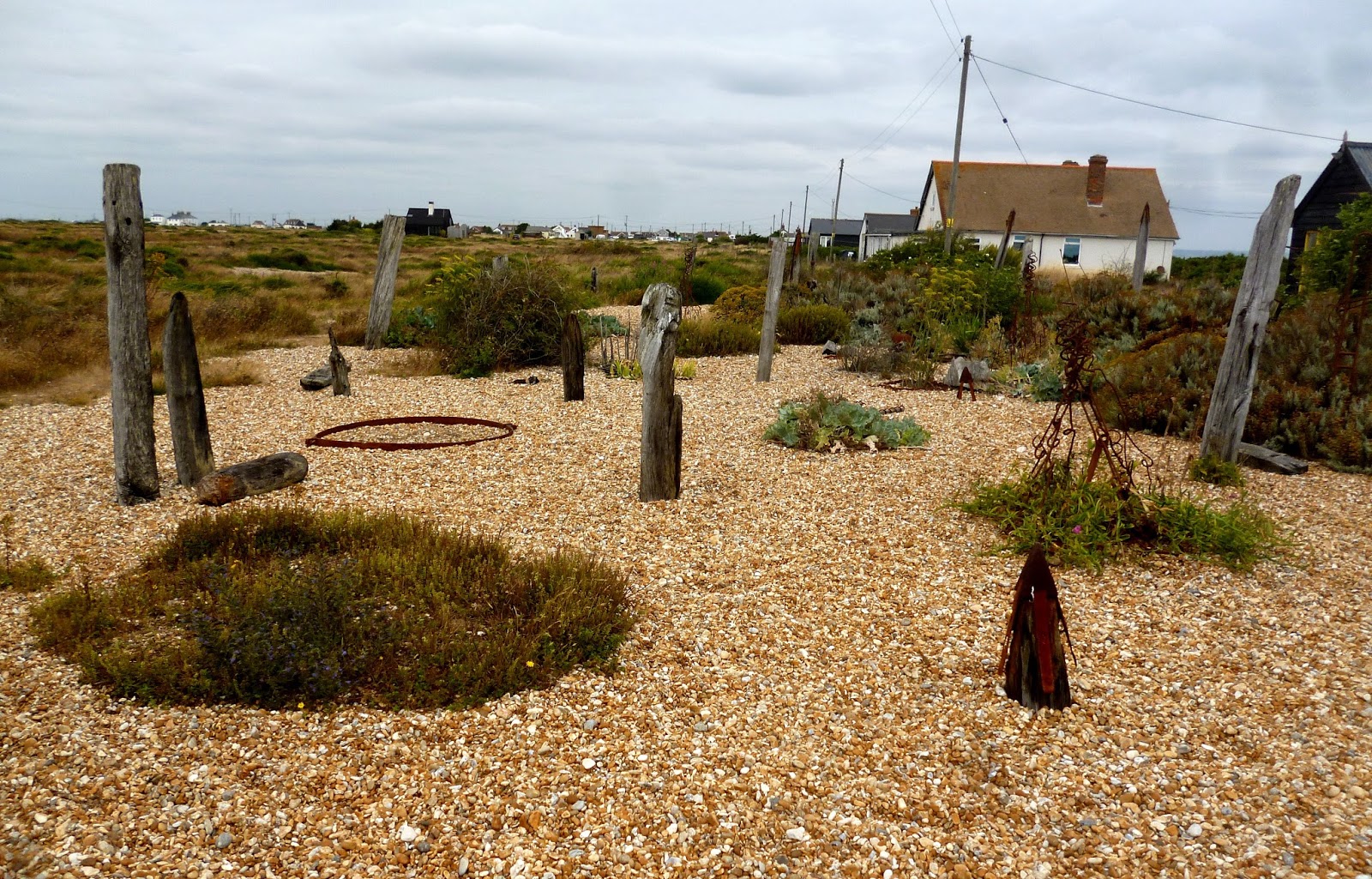
Derek Jarman's garden, Prospect Cottage, Dungeness, Kent

Prospect Cottage near Dungeness power station, which belonged to Derek Jarman (1942–94), and is noted for its bizarre garden. Shingle surrounds the flowers which grow here, although this is light years away from my former post on Vita Sackville-West's garden. Here, the yellow of the flowers blend with the yellow of the door and window frames, objets trouvés abound, bits of metal, sea- and weather-worn phallic posts stand, a part of the John Donne poem 'The Sun Rising' is in relief on a wall, the remains of a rowing boat take a prominent place, stones cluster to form a circle, much appears to be haphazard. I let the photos below speak for themselves.


My other Derek Jarman post:
–––––––––––––––––––––––––––––––––––
Derek Jarman's grave

13 August 2016

Vita Sackville-West and Harold Nicolson at Sissinghurst Castle, Sissinghurst, Kent

In 1930 Vita Sackville-West (1892–1962) and her husband Harold Nicolson (1886–1968) bought Sissinghurst Castle and its extensive surrounding property for £12,375. It was a wreck, with no electricity, tap water, heating or drains. But the couple restored the site remarkably quickly, and as early as 1932 they had achieved a great deal. This was to be their homes for the rest of their lives, and although Vita hated the idea of the castle going to 'Nat Trust or any other foreign body', it was indeed given to The National Trust in 1967, the year before Harold's death, by her younger son Nigel, who had inherited the property and had no option but to get rid of it – and preserve it at the same time – in order to avoid heavy death duties.

The sixteenth century entrance arch, seen here from the top of the Tower, was probably built by Sir Richard Baker.

The Library at the north end of the front range also served as a sitting room, and Vita called it the Big Room. It is redolent of Knole, Vita's birthplace which she didn't inherit, but appears to reflect a sense of continuity.

The painting of a very young Vita, now above the fireplace in the Library, was never there in her lifetime because she hated it. Philip de Laszlo is the painter.

Richard Baker, who was Sir John's wildly ostentatious son, urged Queen Elizabeth I to come to Sissinghurst, which she did for a few days, and knighted him a few days later. All a world away from Vita and Harold's lives, of course.

'Here lived
V. SACKVILLE-WEST
who made this garden
Born at Knole 9 March 1892
Died at Sissinghurst 2 June 1962'

Harold Nicolson of course also played no small part in the gardens. Photography (very oddly now that the NT seems to have relented on many (off-flash) photos) is not allowed within the tower, where there is the famous painting of Vita's great lover Violet Trefusis, and a reproduction of the poem 'Sissinghurst', which Harold thought was her best, and which Vita dedicated to her former lover Virginia Woolf.

One of the two tower peaks.

A partial view of the gardens as seen from the tower.

The Priest's House.

South Cottage, with the Tower in the background.

The Gazebo, used by Nigel Nicolson to write in and as a memorial.

'This
pavilion was
built in 1969 by
his sons in memory of
HAROLD NICOLSON
author, diplomatist and
Member of Parliament:
Sissinghurst was his
home from 1930
until his death
in 1968.'

The boathouse was also an idea Nigle Nicolson's, and was built in 2002.

The oast houses within the grounds, just outside the main centre of interest.

My other Nicolson-related post

–––––––––––––––––––––––––––––––––––
Nicolsons in Sissinghurst Cemetery

12 August 2016

Radclyffe Hall in Rye, East Sussex


'Radclyffe Hall
1880-1943
Novelist
Lived here'

The plaque on the High Street, Rye, is short and rather uninformative, but Radclyffe Hall lived here in the 1930s with her long-term lover Una Troubridge.

Literary connections of Romney Marsh, New Romney, Kent

'Library Mural
Literary Connections of Romney Marsh
Artists
Paula MacArthur and Alison Stump'

The mural at the side of the local library contains a number of authors, such as H. G. Wells, Henry James, E. F. Benson, Edith Nesbit, Radcliffe Hall, Joseph Conrad, Ford Maddox Ford, Monica Edwards, U. A. Fanthorpe, Russell Thorndike, etc.

11 August 2016

Derek Jarman's grave, Old Romney, Kent

Just a simple signature without his dates. Derek Jarman (1942–94) was a film director, gardener (a post on Prospect Cottage to follow soon) and author. Although an atheist, he is buried in the churchyard of St Clement:

Jarman lies to the north-west of St Clement.

A view towards the chancel from the eighteenth century minstrels' gallery seats, which doesn't show the box pews painted pink: this was done for the film version of Russell Thorndike's book Doctor Syn: A Tale of the Romney Marsh (1916), which was cinematised in 1963. I don't remember the interpretation paddle being this specific about the colour though, only that it wasn't out of keeping with the originals!

And a glimpse of pink pews.

My other Derek Jarman post:
–––––––––––––––––––––––––––––––––––
Derek Jarman's garden

10 August 2016

Nicolsons in Sissinghurst Cemetery, Kent

Sissinghurst Cemetery isn't obviously locatable: it's very near to the parish church, but not reachable from it, and there's no sign to it. Unfortunately, these photos were taken before midday and the blotches on them get increasingly worse because of the shadows from the overlooking trees.

'HAROLD
NICOLSON
1886–1968'

This image of the grave of Harold Nicolson might be thought to need no comment on the man: he was famous for being the husband of Vita Sackville-West, for their joint work on Sissinghurst Castle and gardens, and of course for his open homosexual relationships, as was his author (and gardener) wife. The fact that he was a diplomat and very prolific author himself often gets forgotten. Nevertheless, Harold wrote a large number of books, several of them on writers such as Tennyson, Byron, Swinburne, Benjamin Constant, and Sainte-Beuve. He also wrote books on English diplomacy.

'BENEDICT
NICOLSON
1914–1978'

Benedict was Harold and Vita's first son. He became an art historian, and his published works include The Painters of Ferrara (1950), Hendrick Terbrugghen (1958), Wright of Derby: Painter of Light (1968), The Treasures of the Foundling Hospital (1972), Courbet: The Studio of the Painter (1973), and Georges de La Tour (1974).

'NIGEL
NICOLSON
1917–2004'

Nigel was the younger son and went on to be an author, publisher and politician. His books are many and include works on such authors as Virginia Woolf, Fanny Burney, and Jane Austen; one on his parents' marriage; and editing Woolf's letters in six volumes, as well as (one volume of) his parents' letters. As a publisher he co-founded Weinenfeld and Nicolson, which was the cause of the failure of his (slightly wet Conservative) political career when the house published Nabokov's controversial Lolita in 1959.

My other Nicolson-related post:
–––––––––––––––––––––––––––––––––––
Nicolson (and Vita) in Sissinghurst

8 August 2016

Simone Weil in Ashford, Kent


SIMONE
WEIL
3 février 1909
24 août 1943

'IN 1942 SIMONE WEIL
JOINED THE PROVISIONAL FRENCH
GOVERNMENT IN LONDON
BUT DEVELOPED TUBERCULOSIS
AND DIED IN GROSVENOR
SANATORIUM, ASHFORD.

HER WRITINGS HAVE ESTABLISHED
HER AS ONE OF THE FOREMOST
MODERN PHILOSOPHERS.'

Simone Weils's grave is in Bybrook Cemetery near Ashford. She died of a heart attack and the 'official' report was that she effectively killed herself by starvation, although her biographers refute this claim, citing her wish to eat no more than the allowance of her fellow kinsfolk in occupied France.

Close to the cemetery, Simone Weil Avenue is named after her in 1983.

'SIMONE WEIL
This road is named in honour of Simone Weil,
the French authoress and philosopher who died
in Grosvenor Sanatorium, Ashford in 1943 at
the age of 34 years.

Bybrook Cemetery, where Simone Weil is buried,
is situated in the north side of the M20 motorway
and can be seen from here.'

Even in 1983 they still demeaned female authors by calling them 'authoresses'? Shocking. And could Bybrook Cemetery ever be seen from the corner of Simone Weil Avenue and Canterbury Road? It would surprise me.

6 August 2016

Frédéric Mistral at Le Mas du Juge, Maillane (13)

Le Mas du Juge is just a little outside Maillane on the road to St-Rémy-de-Provence. Mas is a Provençal word for a farm-cum-house, and this name comes from the fact that a judge originally lived here, then a barrister, and the name just stuck because of the legal connection.


The plaque at the side of the house is written in Provençal and tells the reader that Frédéric Mistral (1830–1914) was born here, wrote his first published work Mirèio (Mireille) (the famous narrative poem) here, and left in September 1855 after the death of his father François, who Frédéric said had made him a poet.

The mas had been in the Mistral family since 1803, and then passed to François on the death of his father Antoine in 1827. François's first wife Louise has died by this time, although the child from this relationship was Louis, Frédéric's half-brother. François then married Frédéric's future mother Adélaïde, who was the daughter of the mayor of Maillane. On his father's death, ownership of Le Mas du Juge passed to Louis.

What was the original kitchen, now a kind of museum dedicated to the life of Mistral here. There are many things of note, such as the fireplace, the photos of Mistral (including the famous outside shot of him sitting with Alphonse Daudet), and the three-person chair to the wall is a radassié, a typical Provençal piece of furniture of former times.

Several photos I took inside the kitchen turned out to be a little blurred so therefore not really publishable, although Mistral's cot is reasonably presentable.

Hen houses, and maybe a pig-pen?


Next to the kitchen were stables on the ground floor with hay fed through to the animals on the upper floor. The large lower rooms now serve as wedding receptions, etc. Walls and fixtures remain in keeping with the original layout.

And what a terrific view of the Alpilles in the background. Sophie Vulpian, the owner and distant relative of the Mistral family, gave us an obviously well-informed and very enthusiastic account of the farm where Mistral spent his early life, which evidently shaped his ideas for the rest of his literary life.


'VOUS QUI PRENEZ CE CHEMIN,
QUE CETTE CROIX VOUS APPORTE
PAIX ET SÉRÉNITÉ'

Finally, just at the entrance to the mas is a calvary, but not the original one which was lost but the one Sophie Vulvian and her parents built in 2008. The base has four sides: the north depicts a verse by Mistral hoping that the cross will bring peace and calm to those who pass; the east side welcomes visitors; the south side is a representation of the Virgin Mary as Our Lady of Grace; and the side turned towards Maillane represents Maillane's coat of arms with the fleurs de glais of which Mistral was fond as a child. Again, many thanks to Sophie for the information.

My Frédéric Mistral posts:
––––––––––––––––––––––––––––––––––––
Frédéric Mistral at Le Mas du Juge
Frédéric Mistral: Mireille
Frédéric Mistral in Maillane
Le Pavillon de la Reine Jeanne, Les Baux-de-Provence
Frédéric Mistral in Saintes-Maries-de-la-Mer
Frédéric Mistral in Saint-Giniez, Marseille
Frédéric Mistral, Marseille
Frédéric Mistral in Avignon
Frédéric Mistral in Saint-Rémy-de-Provence
Frédéric Mistral in Grambois
Frédéric Mistral in Saint-Michel-l'Obsevatoire
Frédéric Mistral in Pertuis