25 April 2012

Postman's Park, London, in Patrick Marber's Closer

Well, maybe that seems a bad title because most people – and I admit that includes me – are only familiar with Postman's Park (and therefore Alice Ayres) not directly because of Patrick Marber's play Closer (1997), but because of Mike Nichol's movie Closer (2004), starring Julia Roberts, Jude Law, Natalie Portman and Clive Owen. Still, Marber did write the screenplay based on his play, so why not use that title?

Anyway, Postman's Park is a small gem tucked away behind London Museum between Little Britain, Aldersgate Street, and King Edward Street, and its principal feature is George Frederic Watts's Memorial to Heroic Self Sacrifice (shown in the background of this photo). This is where I try to keep out of the picture and let the images speak for themselves.

'G. F. WATTS MEMORIAL
TO HEROIC SELF SACRIFICE
UNVEILED IN 1900, THE MEMORIAL TO HEROIC SELF-SACRIFICE WAS CONCEIVED AND UNDERTAKEN BY THE VICTORIAN ARTIST
GEORGE FREDERIC WATTS OM RA (1817–1904).
IT CONTAINS PLAQUES TO THOSE WHO HAVE HEROICALLY LOST THEIR LIVES TRYING TO SAVE ANOTHER.
WATTS BELIEVED THAT THESE "EVERYDAY" HEROES PROVIDED MODELS OF EXEMPLARY BEHAVIOUR AND CHARACTER.
"THE MATERIAL PROSPERITY OF A NATION IS NOT AN ABIDING POSSESSION; THE DEEDS OF ITS PEOPLE ARE" G. F. WATTS
"GREATER LOVE HATH NO MAN THAN THIS, THAT HE LAY DOWN HIS LIFE FOR HIS FRIENDS" JOHN 15:13
WATTS GALLERY, COMPTON, SURREY.'

'IN MEMORIAM
GEORGE FREDERIC WATTS
WHO DESIRING TO HONOUR
HEROIC SELF SACRIFICE
PLACED THESE RECORDS HERE'

This gives a general idea of the layout of the memorial.


And because of the movie and the play, this is the plaque in which most people are interested:
'ALICE AYRES
DAUGHTER OF A BRICKLAYER'S LABOURER
WHO BY INTREPID CONDUCT
SAVED 3 CHILDREN
FROM A BURNING HOUSE
IN UNION STREET BOROUGH
AT THE COST OF HER OWN YOUNG LIFE
APRIL 24 1885'

And for the record I add a few more examples:

'HERBERT MACONOGHU
SCHOOLBOY FROM WIMBLEDON AGED 13
HIS PARENTS ABSENT IN INDIA, LOST
HIS LIFE IN VAINLY TRYING TO RESCUE
HIS TWO SCHOOLFELLOWS WHO WERE
DROWNED AT GLOVERS POOL, CROYDE,
NORTH DEVON AUGUST 28 1882'

'FREDERICK ALFRED CROFT
INSPECTOR AGED 31
SAVED A LUNATIC WOMAN
FROM SUICIDE AT WOOLWICH
ARSENAL STATION BUT WAS
HIMSELF RUN OVER BY A TRAIN
JAN 11 1878'

'THOMAS GRIFFIN
FITTERS LABOURER
APRIL 12 1899 | IN A
BOILER EXPLOSION AT A
BATTERSEA SUGAR REFINERY
WAS FATALLY SCALDED IN
RETURNING TO SEARCH
FOR HIS MATE'

Below is a much more detailed Wikipedia link to the memorials:
–––––––––––––––––––––––––––––––––––––––––
List of tablets on the Memorial to Heroic Self Sacrifice

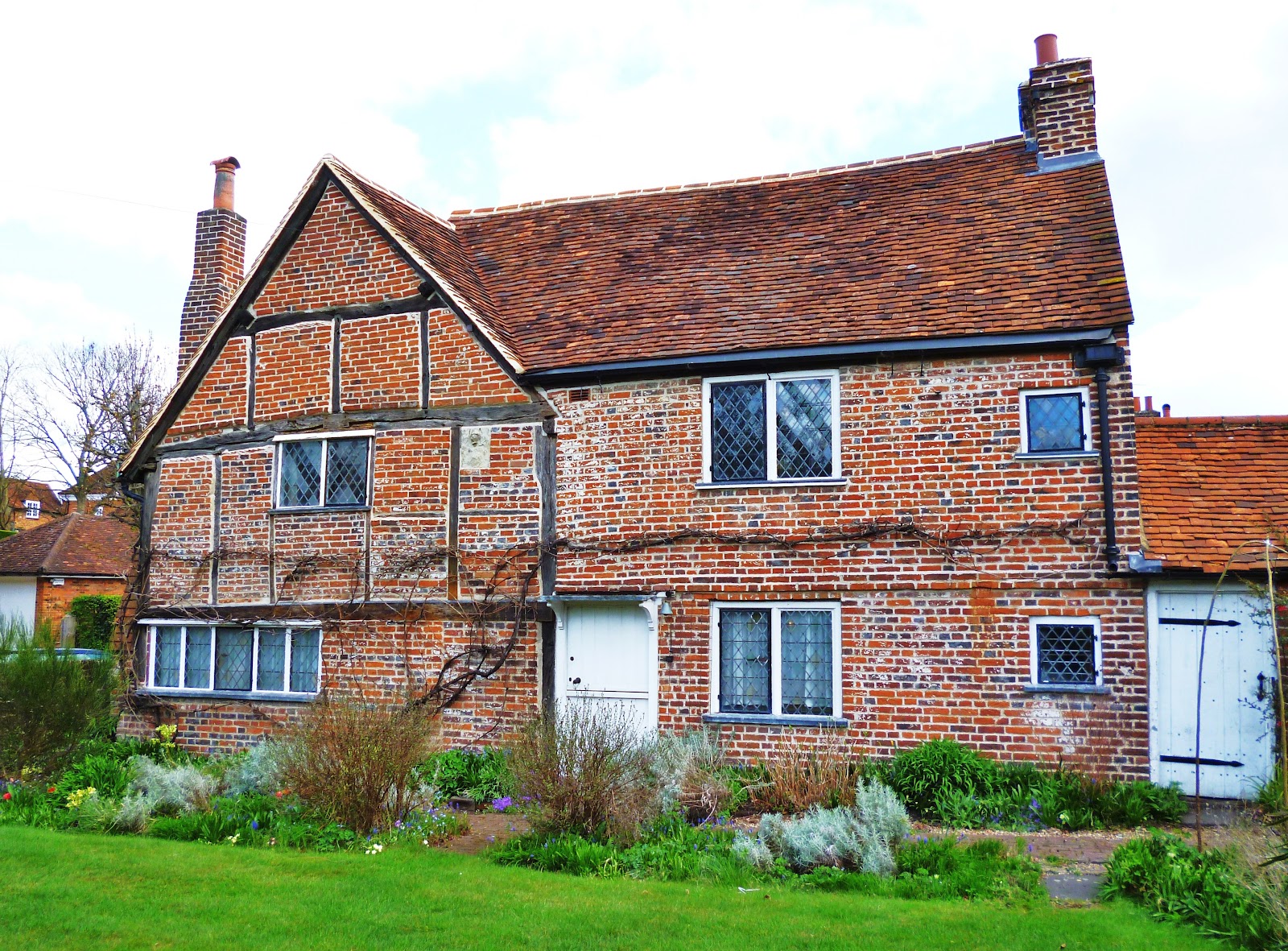
John Milton's Cottage in Chalfont St Giles, Buckinghamshire

 
John Milton (1608–74) lived here for about a year between 1665 and 1666 as an escape from the plague in London.

Thomas Ellwood, a Quaker convert living with Isaac Penington's family at Chalfont Grange (Chalfont St Peter), had been a Latin student of and a reader to the blind Milton. He rented this cottage for Milton in June 1665, describing is as a 'Pretty Box', and it is now Grade I listed.

Milton moved here with his third wife Elizabeth (née Minshull), and perhaps his daughter Deborah. The Restoration had come in 1660, Ellwood was in prison in Aylesbury for attending a Quaker funeral, Penington too was in prison: the booklet John Milton's Cottage (Milton's Cottage Trust, n.d.) declares that the new Republican resident was disappointed, disillusioned, and initially was probably isolated here. Contrary to John Aubrey's statement that Paradise Lost (1667) was finished in 1663, the booklet claims that it was completed in the cottage. Certainly Milton gave Ellwood (recently released from prison) the manuscript to read at Chalfont St Giles, and it appears that a comment by Ellwood, on returning it, suggested the idea of Paradise Regained (1671).

The entrance to Milton's Cottage, with a few plaques announcing the past presence of royalty, and a wash furnace and copper dating of course from many years after the presence of the Milton family here.

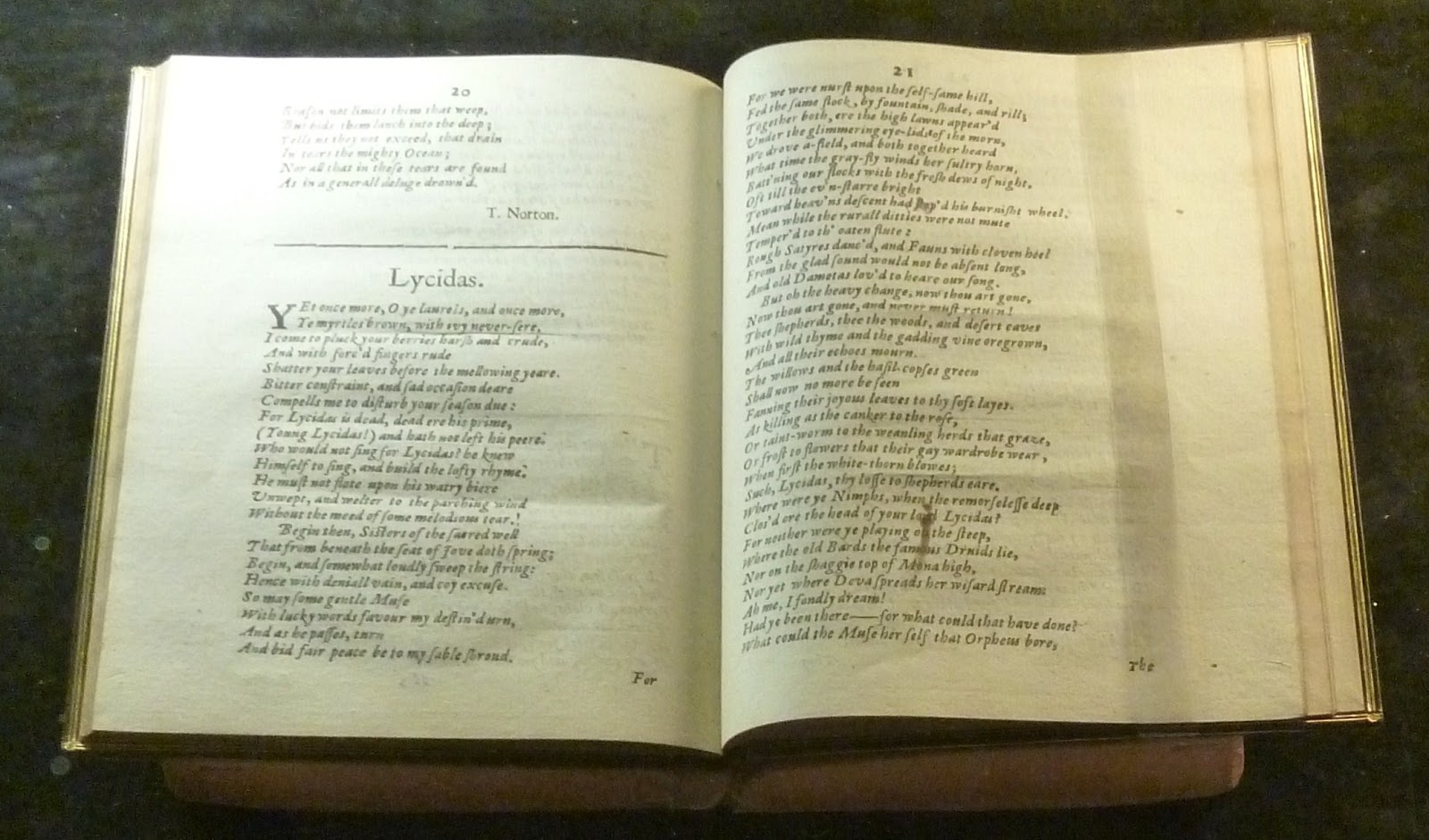
In the room where Milton would have done his writing, a first edition of Justa Edouardo King Naufrago (1638), which contains the famous 'Lycidas', which is dedicated to the memory of Edward King, a former student at Cambridge with Milton who drowned in a shipwreck off the coast of Wales in August 1637.

Bust of Milton in the same room.

A reproduction of a portrait of Milton aged ten, made in 1618 by Cornelis Janssen. A note next to the portrait, by Dr G. C. Williamson, mentions that the young Janssen painted it in the same year that he came over to live in Blackfriars, staying briefly in Bread Street, off Cheapside (and where Milton was born). He also provides information about Milton's surviving daughter, Deborah Clarke, who was old and living in poverty in Spitalfields early in the 18th century: as a result of a newspaper appeal she was suddenly rich, but died four months later.

A facsimile of the agreement for the sale of the copyright of Paradise Lost.

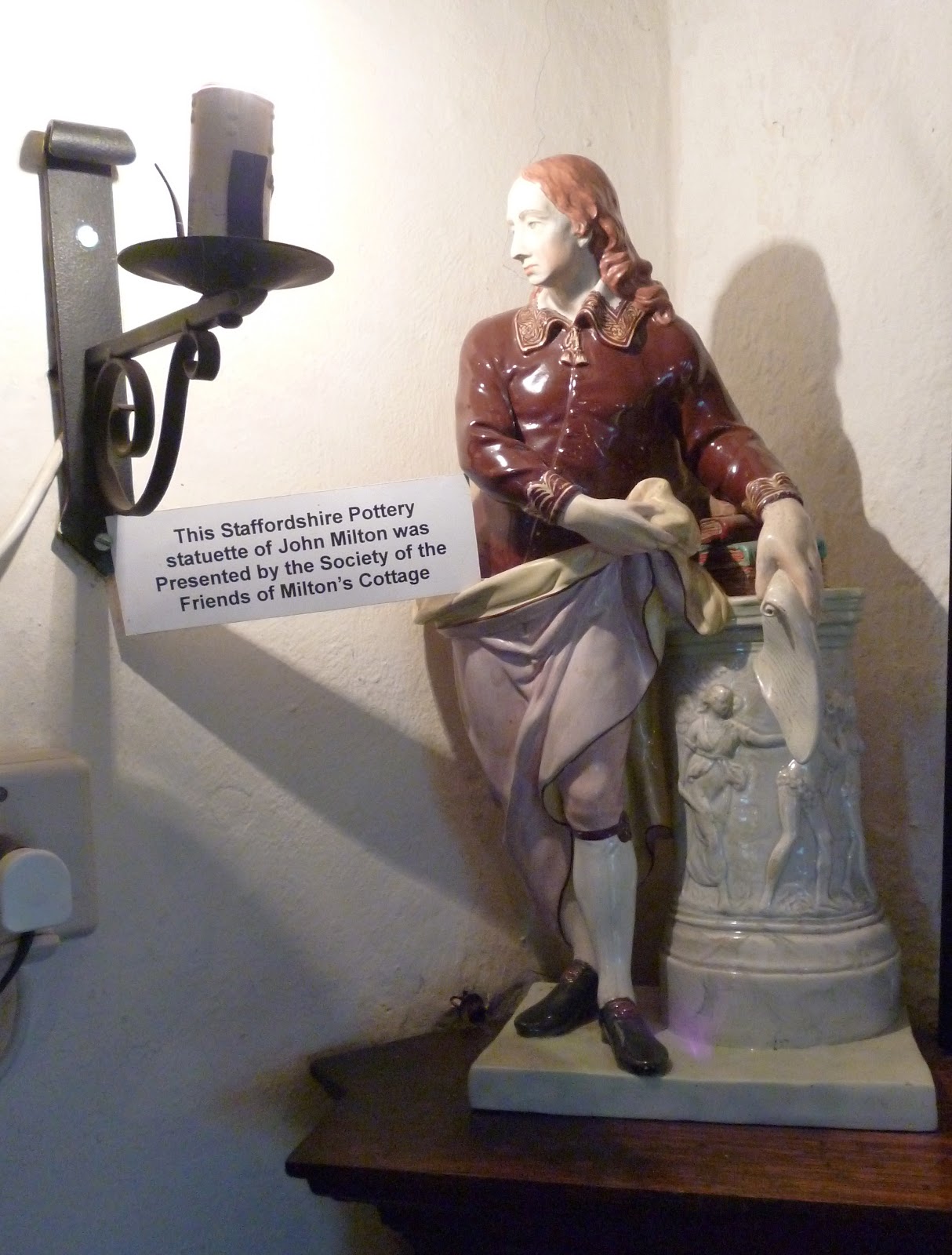
A small Staffordshire pottery statue of Milton.

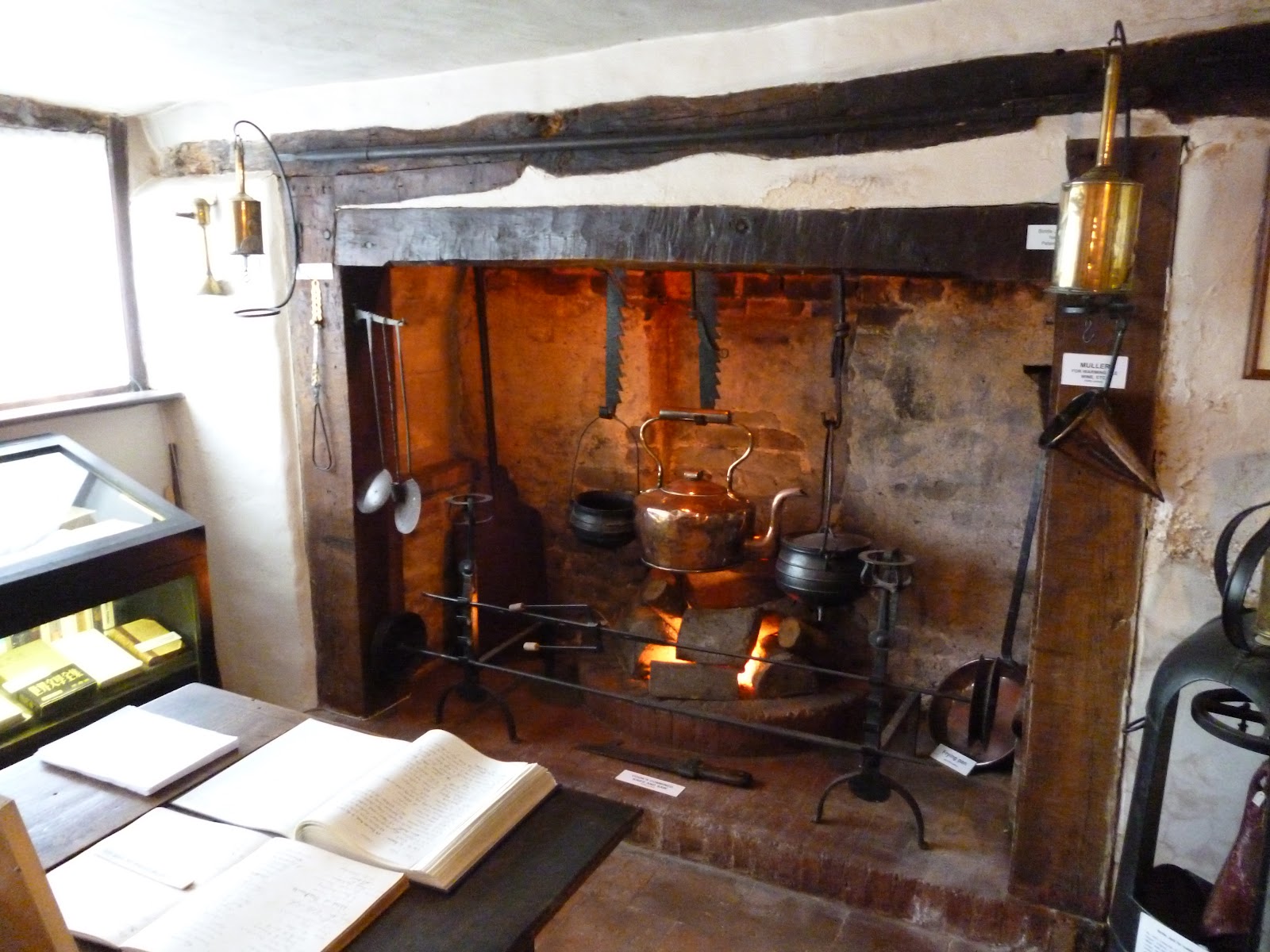
The fireplace in the kitchen.

The only copy of The Milton Shield, by Morel-Ladeuil (1820–88), described as 'steel and silver, repoussé and damascened', is also described as 'the most notable single object in the Paris Exhibition of 1897'. The original is in the Victoria and Albert Museum.

The shield depicts events in Paradise Lost:

Center: Archangel Raphael telling Adam and Eve about the war in heaven (Canto 5)

Side medallions: Rebel angels marching to assault, and becoming thunderstruck on seeing the Messiah

Below: The fight between archangel Michael and Satan (Canto 6)

Bas-reliefs above: God the father. The Creation (Canto 7)

Lower part: Death and Sin (Canto 2).

The back of the cottage looking from the entrance to the (Grade II-listed) garden.

'Weep no more, woeful shepherds, weep no more,
For Lycidas, your sorrow, is not dead,
Sunk though he be beneath the wat'ry floor.'

 'Fly envious Time, till thou run out thy race,
Call on the lazy leaden-stepping hours'.

Again, the unseeing eyes.

'So saying, her rash hand in evil hour
Forth reaching to the fruit, she plucked, she eat!'

'In those vernal seasons of the year, when the air is calm and pleasant, it were an injury and sullenness against Nature not to go out, and see her riches, and partake in her rejoicing with heaven and earth.'
 
Below is a link to my post on the church where Milton is buried.

–––––––––––––––––––––––––––––––––––
John Milton in St Giles without Cripplegate Church: London#23

24 April 2012

Flora Thompson in Alton, Hampshire, UK

The photo of Flora Thompson below (which I've slightly cropped) was taken in 1921 by Walter C. Corin of Haslemere.

I parked the car in Alton to view a few buildings associated with Jane Austen, but quite by chance we came upon The Allen Gallery in Church Street. Here was an exhibition of wood engravings by Sue Scullard inspired by Flora Thompson's partly autobiographical Lark Rise to Candleford trilogy: Lark Rise (1939), Over to Candleford (1941) and Candleford Green (1943). There were also relevant photos, and both engravings and photos usually had a quotation from one of Thompson's works added. I have sometimes slightly cropped the other photos.

'The Garden Well'

'In dry summers, when the hamlet wells failed, the water had to be fetched from a pump at some farm building half a mile distant. Those who had wells in their garden would not give away a spot, as they feared if they did, theirs, too, would run dry.'

'The Family Pig'

'The family pig was everybody's pride and everybody's business [...]. The children, on their way home from school, would fill their arms with sow thistle, dandelion, and choice long grass, or roam along the hedgerows on wet evenings collecting snails in a pail for the pig's supper [...]. When the pig was fattened [...] the date of execution had to be decided upon. It had to take place sometime during the first two quarters of the moon: for, if the pig was killed when the moon was waning the bacon would shrink in cooking, and they wanted it to "plimp up".'

As a vegetarian I find this horrific, and even the gallery note under the quotation mentions 'the apparently ambiguous connection between the country cottager and their "pet" pig'.

'Spring'

'"Ah! I thought so!" he said as he plunged his arm into the hedge at a spot from which he has seen a bird flutter out, and he came out with two bright blue eggs in his palm, and let them all feel and stroke them before putting them back in the nest. They were warm and as soft as satin.'

'Laura in the Woods'

'Cottisford School c. 1902'

'Fordlow [i.e. Cottisford] National School was a small grey one-storied building, standing at the cross roads to the entrance to the village. The one large classroom which served all purposes was well lighted with several windows'.
'Queenie Massey, bee keeper and lace-maker'

'Queenie represented another form of life which had also ended and been forgotten by most people [...] her lace-making was a constant attraction to the children [...]. Every fine day, throughout the summer, she sat there "watching the bees".'

'Bett's Cake Shop'

'Candleford was but a small town [but] to Laura it was both town and country and in that lay part of its charm. It was thrilling, after being used to walking miles to buy a reel of cotton or a packet of tea, to be able to dash out without a hat to fetch something from a shop for her aunt.'

A note under this quotation suggests that Candleford is an amalgam of four nearby towns – Buckingham, Brackley, Bicester, and Banbury – and states that Bett's Cake Shop in Banbury is where the female protagonist in Thompson's Still Glides the Stream journeyed to have tea before going shopping in the town.

'The Fringford Forge'

'On the farther, less populated side of the green a white horse stood under a tree outside the smithy waiting its turn to be shod and, from within, as the spring-cart drew up, the ring of the anvil and the roar of the bellows could be heard [...]. Their arrival has not been unobserved, however, for, as the cart drew up, a young smith darted from the forge and, seizing Laura's trunk, bore it away on his shoulder as if it weighed no more than a feather. "Ma'am! The new miss has come," they heard him call.'

This is a photo of the Fringford (or Candleford Green) forge taken in the 1890s, when, the note points out, Laura would have arrived as the 'post mistress's "learner".

Bog-myrtle and Peat (1921) was Flora Thompson's first published book, containing poems.

23 April 2012

John Goodyer and John Worlidge in Petersfield, Hampshire: Petersfield Plaques #4 & #5

Worcester House, Dragon Street. The adjoining wall (a part of which can be seen to the right) is the original garden wall.

'Birthplace and
residence of John Worlidge
(1633–1693), whose books on
progressive agriculture and
horticulture formed the basis of the
English agricultural revolution.
His Systema Agriculturae of 1669
was based on his experiments
in the adjoining garden.'

28 The Spain, whose most famous occupant introduced the Jerusalem artichoke to this country.

'JOHN GOODYER
Botanist & Royalist
1592–1664
Lived Here'

The two men, one noted in horticulture and the other botany, were also linked by blood: Goodyer was Worlidge's great-uncle. Much more recently, another link between the two men has been made.

In 1988 Major John Bowen gave his garden in the town to the Hampshire Garden Trust, which – with an eye to the town's two 17th century sons – took the 17th century as a theme and strove to recreate a town garden of that era. So 'Petersfield Physic Garden' was born.

Samuel Pepys in Petersfield, Hampshire: Petersfield Plaques #3

Winton House in the High Street. Once an inn, in the 17th century this had Petersfield's only bowling alley. It declined in importance when Dragon Street was built, creating a by-pass.

'c. 1580
This building
formed part of The White Hart,
Petersfield's leading coaching inn
until the 18th century, with stabling
for over 100 horses. Charles II,
Samuel Pepys and Peter the Great
all stayed here.'

Flora Twort in Petersfield, Hampshire: Petersfield Plaques #2

This building is at 1–2 The Square, diagonally opposite the statue of William III which occupies a central position in the town.

'1534
This former farmhouse
was occupied by Thomas Osbourne
(16th C) and Thomas Walker (17th C),
both Mayors of Petersfield. Dr. Harry
Roberts bought it in 1918 as a
bookshop and workshops run by
Flora Twort and other
local artists.'

The name Flora Twort (1893–1995) is all over Petersfield. The building above is a museum that also houses the Flora Twort Gallery, which along with some of her paintings also contains general information about the artist. Twort moved to Petersfield after World War II and kept the studio above the shop until 1948, when she moved to Church Path above.

On her death she bequeathed her studio gallery on Church Walk (where she is shown in the photo above), along with her artwork, to Hampshire County Council.

Twort's palette on display in the gallery, with reflections of some of her paintings.

Detail of a mosaic representation of Petersfield on a wall in Dragon Street, made by Kate Ford in 1994, showing (among other things) Twort's name approximately where her gallery is located.

Hampshire County Council have put many of Flora Twort's paintings and sketches online, including a large number of Petersfield and several of the old windmill at Langstone, which was owned by Twort, and is where her friend Nevil Shute (who once unsuccessfully proposed to her) briefly stayed in 1939.

The link to Twort's art is below.
––––––––––––––––––––––––––––––––––––––––––––
The Flora Twort Collection