13 September 2011

'No Bunga-Bunga please, this is my Granny!', by Robert Hughes

The guy on the right bears a distressing resemblance to Italy's Signor Berlusconi, but this is not Silvio unless he steps into a Tardis and sheds 50 years. So who is he?

Second from left is my grandmother May Duncan Britton née McCallum (1891-1978). As we noted in another article, Maisie was not above a little reverence of celebrities, despite her lifelong Socialism, and this photo was lovingly preserved in her collection.

Anyway, I can't imagine much Bunga-Bunga with scantily clad females here: take a look at the lady on the left, she is dressed as if the central heating has broken down and it's December. Interestingly enough, the girl second from the right is more image-conscious and although probably freezing is going through the motions.

Does anyone have a notion who these people are?

'Bob, Maisie and Flora Britton with a mystery couple', by Robert Hughes

Here is a photo with good definition for a change but artistically it sucks, if only because a tree is growing out of Bob Britton's head and we look over the shoulder of Flora Britton and wonder whether old Von Hindenburg has found exile in Malvern.

The date here is likely to be the very early WW2 period, or even 1938. Bob looks young and happy and not long afterwards he suffered illness brought on by anxiety about the war and the possible bombing of his home, and the use of poison gas. Even if this were 1940, he would need to be 51, and he certainly looks no older.

Seated to the right of Bob is Maisie Britton (May Duncan Britton née McCallum (1891-1878): my grandmother). Maisie, like many a good socialist, was rather taken with celebrity so why did she keep this picture? It would make sense if the other couple in the group were in some way famous later, or notable...but who were they?

On the reverse of the print is a stamp from Norman May, Malvern, so it's quite likely that this scene was somewhere in that area.

Can anyone identify the couple, or shed any more light on what this gathering was all about?

Probably the best photographers had gone off to work on air reconnaissance or morale-boosting work at the front line. The individual who took this seems to have had a good camera with a first rate lens, why could he/she not have opened it up and thrown the tree out of focus along with the hideous house and Hindenburg?

A possible answer is spontaneity! You see a good shot and you take, while if you start worrying about the technicalities it is gone. At least my granny kept this picture for forty years and my mother for another thirty; more than you can say for most holiday snaps.

12 September 2011

'Breakfast time at Trelill 1961', by Robert Hughes


We did our bit for globalisation. This is a picture probably taken by Anna, who was a bubbly Norwegian girl. She had a wonderful sense of humour, and could it be that she caught my father (who didn't really do mornings), resting his eyes at the breakfast table? I hope she prospered as a film-maker or something.

Let's have a look at who these folks are:

1. Trevor Hughes (1907-1988). Why is he wearing a fisherman's sweater around his neck? Well, he came from a long line of seafaring men, and we would usually head off to the beach after breakfast so he was ready for anything including the chilly winds likely to be encountered in Cornwall.

2. Me at 10.

3. My brother David, who was 7.

4. Melanie Lawrence. We had a slight love/hate thing with her, perhaps Freud would discuss latency and stuff, but her Mum had a small dairy herd and Melanie drank too much milk. However, she was really a very sweet person and we hope she has done well.

5. Little Dominique. He was with us two years running, and my enduring memory is of how when we held a fancy dress party he was Pharoah and very convincing with his crooked staff and the other thing across his chest.

6. Martine's dad was an abdominal surgeon of some sort. She came to us two years in a row.

7. Although you can't see her in this picture, this is actually Inga, a Nordic beauty. I don't recall if she was Anna's sister or her mate, but they arrived together.

8. Christian Bronnec, a French lad from Brittany. He had a slightly odd delivery and would say "ch" for "c". One day we were on the beach having a picnic and Christian wordlessly thrust out his paw for some piece of grub. My mother said "Now, Christian, we are trying to teach you good English here, so could you ask properly please?" "Chan I 'av eet?" he said.

Christian and his sister Sylviane were with us two years running.

9. Flora Jean Hughes, (Née Britton), has appeared on this blog before. If you look at this table, you will see that there was quite a lot to putting together breakfast for fifteen people from different nations, but she did it.

10. Olivier. A very sweet guy. I hope he did well in life.

11. Richard Rawlinson. Now this guy looks very young here, (and of course was young) but he was our tutor for awhile and taught me Latin and Maths. Unfortunately one day we were on the beach at Polzeath and some annoying boys asked him a few questions which he couldn't answer. By that time they had established what he did for a living..."I think," said one, "that you should stick to Latin!", and the other one chimed in "or Maths!"

It wasn't poor Richard's fault, and I wouldn't be surprised if he did well later.

Richard visited us when we were at boarding school, and looked at my Latin text and just read it off in English as if it was the newspaper. He grinned and said "Oh, sorry Robert!" I suspect he was really very clever.

12. Sylviane, sister of Christian, see above.

13. The lovely Carol, such a doe-eyed beauty that is it a surprise she and Richard became an item?

14. Christian Renard, a regular French macho guy.

15. Karl Sacher. His father worked in a hotel in Vienna and is credited with inventing the Sacher Cake! I hope it's true. Of all the people who stayed with us, Karl was one of the kindest and sweetest.

One phrase stays with me: I asked how the Austrians went along with Hitler, and his response was "They must!" (They had to.)

Totalitarianism is hard to fight, and we would be glib if we think we know what we would do in the face of it.

11 September 2011

Literary Île-de-France #2: Knut Hamsun in the 6th arrondissement, Paris, France

Knut Hamsun (1859—1952), the Norwegian winner of the Nobel prize for Literature in 1920, lived at 8 rue de Vaugirard in the 6th arrondissement between 1893 and 1895.

'KNUT HAMSUN
1859—1952
ÉCRIVAIN NORVÉGIEN
PRIX NOBEL DE LITTÉRATURE 1920
VÉCUT ET TRAVAILLA
DANS CET IMMEUBLE
ENTRE 1893 ET 1895'

10 September 2011

Marie–Antoinette Thomas and Atelier Verhassel, Brussels

This picture of Marie Antoinette Thomas, (née Goffin), grandmother of Lionel Britton, is not new to this blog as the old girl sent it out to all her children and grandchildren and we have seen many examples.

However, this postcard-sized print is obviously the one received by my grandfather Reginald Percy Leopold Britton, (Bob), and cherished even beyond his death in 1970.

Its importance lies in the fact that on the reverse is the imprint of the studio where the image was produced, so that we now know where Marie went to have her portrait taken.

The address might have been too obscure to be deciphered but for the fact that there is indeed to be found on the internet an Atelier Verhassel at 4 Chaussée de Gand, Bruxelles.

Marie was not necessarily born on Christmas Day 1843, and in fact that would have been unlikely if only because it would have conflicted with census evidence which suggests she was younger. She could have been entering her 80th year, or just have been about 80!

A postcard from as early as 1907 shows very infirm handwriting, but it is unclear whether this was written by Marie or by Samuel Thomas her husband. If Marie wrote all the inscriptions out by hand she was very patient and diligent, and note how the same formula is repeated on front and back of this. A slightly more plausible scenario is that an amuensis, for example a doting niece acting as carer, did all the actual penwork for her.

We would love to hear from anyone who knows stuff about the Atelier Verhassel!

4 September 2011

Lord Byron in Hucknall, Nottinghamshire (continued)

This memorial to the poet Lord Byron is at the side of the entrance to Hucknall parish church, Nottinghamshire. Unfortunately, there was a wedding in the church so I was unable to take a photo of the Byron vault.

'THE RED LION INN
WAS THE RENT HOUSE
OF LORD BYRON
IN THE 18TH CENTURY
Hucknall Heritage Society'

Of course, the poet Lord Byron only inherited his title right at the end of the 18th century – in 1798.

3 September 2011

Benjamin Mayo, aka The Old General, Radford Road, Hyson Green, Nottingham

The Old General pub on Radford Road, Hyson Green, Nottingham, is now closed down, and perhaps permanently, but it remembers one of Nottingham's well-loved eccentrics.

At the corner of Radford Road and Bobbers Mill Road, on the edge of Basford, a neon sign proclaimed 'Welcome to Hyson Green'.

And at the side, the prominent case contains a statue of the Old General, or Benjamin Mayo. It was carved by mason Joseph Holmes in his open field studio close to Radford Road and was first put on show at Nottingham Castle Museum before being moved to a showroom on Radford Road. When Joseph's brother John built the Old General pub and became the landlord in 1883, the statue was moved to its present position.

In 'An itinerary of Nottingham: Broad Marsh' in Transactions of the Thoroton Society, 30 (1926), J. Holland Walker gives perhaps the longest account of the man:

'Th[e] poor house of St. Peter's was the home of Benjamin Mayo better known as the "Old General." He was born sometime about 1779 and he died in 1843. He was a half-wit but a great character in the town. He must have been rather an attractive character for when St. Peter's poor house was dissolved Mr. Hudson the master took him into his own house and provided for him for a number of years rather than let him go to the new Union Workhouse in York Street, which speaks volumes both for Mr. Hudson's charity and for Old General's popularity. Eventually Mr. Hudson left the town and Old General went to St. Mary's workhouse. After a time he had a fall, from the effects of which he died and he was buried in Broad Marsh burial ground. There is however, an epitaph to him in the top walk of the General Cemetery close to the permanantly closed gateway which leads into Clarendon Street which reads "Benjamin Mayo commonly known by the name of "The Old General" died in Nottingham Union Workhouse 12th January 1843, aged sixty-four years. A few inhabitants of this town associating his peculiarities and eccentricities with reminiscences of their early boyhood have erected this tablet to his memory." In stature Old General was of medium height but very much bent. One of his legs was badly deformed so that his progress, which was generally a jog-trot, was very peculiar. His clothing was of the usual pauper grey but towards the end of his career he obtained a red coat which he wore with great pride. He wore no hat to cover his closely cropped head until he reached the age of about sixty when he adopted a military cap. He regarded himself as second only to the Mayor in importance within the confines of Nottingham. His great day was on Mickleton Monday. The Mickleton jury were accustomed to beat the bounds of the town on the first Thursday in September and the following Monday they proceeded through the streets of the town to take note of any obstruction or irregularities and that was when Old General was at the height of his glory. Followed by all the school children of the town whom he marshalled in some sort of military array and over whom he acted as general, he followed the jury prepared to remove any offending obstacle immediately. Did a doorstep project into the thoroughfare it was immediately turned up by Old General's followers acting under his instructions, or did a sign not meet with the approval of the Mickleton Jury Old General and his troops made short work of it. It was a great day for the school children, they demanded a holiday and most of them got it. Some few school masters however, held out against Old General and refused to liberate their pupils, when sieges were undertaken and mud and stones plentifully thrown. Old General however, was open to bribery and twopence would usually buy him off. The proceedings terminated by the army demanding admission to the Castle which was of course always refused but as compensation sweetmeats were thrown over the gateway for the children to scramble for.

'Like most half-wits Old General had a keen sense of humour which is well displayed by the following two stories. He used to be fond of drilling boys in the Market Place and upon one occasion he was so engaged when a party of officers from the barracks on the top of the Park came up and watched his proceedings. One of Old General's recruits was particularly dull and stupid and was constantly making mistakes in his drill. Laughingly an officer said to Old General "What will you do with him, he is too stupid for a soldier? "Old General said nothing to the officer but called the boy out of the ranks and standing him in an appropriate place said, "There lad you'll never make a soldier you are too stupid so I'll make an officer of you." Upon another occasion he went running through the town calling out "Speech by the Prince of Wales, full account of what his Royal Highness said yesterday." A customer purchased one of these speeches and found he was presented with a blank sheet of paper. Protesting against the imposition he received the reply "Quite correct Sir, 'is Royal 'ighness never said now't." Well, peace be to his ashes; judging from his face which appears in a picture in the Castle Museum he must have been a rather lovable old character.'

I took the above photo in the pub's more fortunate days for my book Hidden Nottinghamshire (Wilmslow: Sigma Press, 1998).

Samuel Cox and Bulwell, Nottingham

I discovered this plaque by the stream in the heart of Bulwell, Nottingham today:
'ORIGINS OF THE NAME

'The name is supposed to have been derived from a spring, which runs out of the Bunter Sandstone over a bed of clay near to the northern end of the forest which was called "Bull Well". Dr Mutschmann, in his book "The Place Names of Nottinghamshire", suggests that the first part of the name may stand for a person - Bulla, or even a bull: alternatively, it may describe the bubbling sound produced by the flowing water of the spring.

'However, the architect of the British School Building in Bulwell, a man with a sense of humour, inscribed on a stone the pretty legend beginning:

"Once upon a time a bull digging his horns into the rock, and the water gushing out"'.

Er, yes. The interesting thing, though, is that this is followed by a poem from Samuel Cox:

'How well I remember the scenes of my childhood,
Where with my companions I've rambled so free,
And slid down the sand-rock that borders on Bestwood,
And filled the pure air with our innocent glee.
Where o'er the green Forest I've rambled for hours,
And rolled down the hills, and enjoyed it so well,
From many a gorse bush have plucked off the flowers,
And drank of the cold stream that flows from Bul-Well.'

This is not the best poetry that a Nottingham son has produced, but the fact the Parks Department is promoting poetry is to be applauded. So who was Samuel Cox?

That's an interesting question. There is one Samuel Cox (1826–1893) listed in the Oxford Dictionary of National Biography who was a religious journalist and author who began working at the London docks at the age of fourteen and who went on to London University and became a baptist pastor in Southsea. In 1859 a throat complaint caused him to turn to writing for about four years, but on his cure he accepted a post as pastor at the Mansfield Road Baptist Chapel in Nottingham, where he remained for twenty-five years. Although he retired to Hastings, Sussex, where he died, he was buried in the General Cemetery in Nottingham. The ODNB notes that in spite of Cox's undoubted skills as a minister, he was a writer above all else.

I'm very grateful to the Parks Department, Nottingham, for encouraging me to Google 'Samuel Cox' and uncover such interesting information about this man, but of course the stated facts in the ODNB don't necessarily mean that the 'Bulwell' Samuel Cox is the same person as the minister.

1 September 2011

Lionel Britton with His Nephews and Niece

Lionel Britton has been referred to extensively in this blog, and much is known about his literary endeavours.

He had a long-term relationship, perhaps as long as forty years, with Sinead Acheson. However, he never married and had no children of his own. Indeed, to my knowledge there are no pictures extant which portray him with any of his own family, apart from one where his Mum is at stage left.

This little picture however, despite its indifferent quality, makes an important point. Here is the quirky, argumentative Uncle Lionel in a very normal and touching family photo.

Lionel was not easy company as he would declaim and denounce rather than discourse, but in this scene he has taken a moment to relax with his brother Reginald Percy Leopold Britton (1889–1970, known perennially as Bob), at back right; his nephew Robin Carton Leopold Britton (1921–1927), bottom right; his nephew Duncan Campbell Britton, (1915–1976); and his niece Flora Jean Britton, (1919–2008).

We have no date for the photo, but you may conclude from the ages of the children that this was taken in about 1925.

29 August 2011

Lynne Ramsay's Ratcatcher (1999) and Morvern Callar (2002), plus three Shorts

Lynne Ramsay directed three shorts before the two features of hers which have been released so far.

Small Deaths (1996) is eleven minutes long and is Ramsay's graduation movie. It is in three sections. The first – 'Ma and Da' – is perhaps set in the 1970s and shows the young girl Anne Marie, with her mother in the kitchen combing her husband's hair in preparation for his night out with the lads in working-class Scotland. This prefigures the male-dominated Glasgow in Ramsay's first feature Ratcatcher, where there are also two (rather different) hair combing scenes. The second section is in a pastoral setting showing Anne Marie as a young teenager with her younger sister. Some young kids chase cows and the girls later watch a cow dying. The third section  – 'Joke' – shows the older teenager Anne Marie with her boyfriend, who invites her into a room where a man and some youths pretend that a girl is in a coma after taking drugs.

In the eighteen-minute Kill the Day (1996), drug addict James Gallagher (played by James Ramsay) steals a handbag from a locker in a hospital, buys drugs with the proceeds and is subsequently imprisoned. Inside, he resists such temptations as drugs as he contemplates a cabbage leaf and fantasizes about the freedom that a cabbage field represents. He tries to get rid of his frustration (or the withdrawal symptoms) by working out in his cell.

He's released from prison, and there's a flashback of him running through the cornfields and nude bathing in the river with his young school (or truant) mates, until an ironic 'Greensleeves' alarm tune finds him back in his seedy room with its woodchip-covered walls.  Ignoring the pusher's car outside, he continously bangs his head on the window in frustration. Or despair.
Gasman (1998) is fifteen minutes long and involves a working-class Glasgow woman getting her son and daughter ready for them to see her estranged husband at Christmas. The children are handed over on a railway line, taken by their father to a celebration of some kind, and then delivered back on the railway line at the end. 

Ratcatcher is set on a grim working-class estate in Glasgow in 1973 at the time of the dustman's strike. Black bin bags are present everywhere, as are the rats. The main character is twelve-year-old James Gillespie (William Eadie), who lives with his parents, and whose father is an alcoholic and a womanizer. James has accidentally killed a young friend in the canal after a playful tussle, and this weighs heavily on his conscience.

In this bleak environment, James befriends a slightly older girl, Margaret Anne (Lenne Mullen), who is sexually exploited by a group of adolescents in the area. There are two innocent, tender moments in which James and Anne take a bath and sleep together. They are both deeply alienated by their surroundings.

At one point, James take a bus trip out to a new council housing estate
on Balmore Road and marvels at the (actually rather basic) facilities. There is an idyllic (and probably fantasized) scene when he finds a cornfield by the house, and this same field (definitely fantasized) is seen at the end, when the family carries furniture through it toward the house. Alas, the music of Nick Drake's 'Cello Song' (sample words 'So forget this cruel world/Where I belong') has some time before subtly suggested a different end.
Morvern Callar is based on Alan Warner's 1995 novel, and bears several of the hallmarks of Lynne Ramsay's earlier work. Again, this is set in working-class Scotland, although, like the novel, it is set not in Glasgow but in the small west coast port of Oban. And again, the eponymous protagonist (played by Samantha Morton) is young but somewhat older than either James or Margaret. She works in a supermarket with her friend Lanna (Kathleen McDermott) and earlier on the the two also show their togetherness by taking a bath together. But the central event is Morvern going back home to find her boyfriend has killed himself in the kitchen.

As in the book, we never find out the reason for the suicide, and likewise never know what is happening in Movern's head. Suffice to say that she chops up his body, loads it in installments into a rucksack and buries it, withdraws her boyfriend's money (over £3000), sends to a publisher the typescript he has thoughtfully left her to use any proceeds from (but she sends it under her name), and goes off to Spain with Lanna.

Unlike Ratcatcher, the dream here is reality, and after the two split up two publisher's representatives visit her in Spain (the movie was filmed in Almería) and offer her a £100,000 advance. Her secret reaction as she pretends to disappear to the toilet to 'consider': 'Fuckin' 'ell!' And the dream-come-true merges into a chemically induced dream as Morvern joins the rave culture.

So, Lynne Ramsay's preoccupations so far: rootlessness, working-class alienation, the fantasy life, problem parents and problem offspring, self-destruction, etc. And soon, Ramsay's eagerly awaited adaptation of Lionel Shriver's We Need to Talk about Kevin hits the cinemas. A broken home, a deeply disturbed child....oh, we'll wait and see what she's done with it. But who's betting there's a communal bath scene?

–––––––––––––––––––––––––––––––––––
Lynne Ramsay's We Need to Talk About Kevin (2011)

Samuel Butler's Langar, Nottinghamshire

George Bernard Shaw lamented the fact that Samuel Butler (1835–1902) died virtually unknown, although he is now widely recognized as the author of such works as the novels Erewhon: or, Over the Range (1872) and The Way of All Flesh (1903). Many of his works are available through Project Gutenberg, a link to which is here .

Ian Brown's booklet Samuel Butler of Langar (West Bridgford, Nottingham: Nottinghamshire County Council Leisure Services, 1990) has an excellent cover photo of the Rectory on Church Lane, Langar (pronounced with a soft 'g'), where Butler was born. In the shot I took here, foliage almost completely conceals the building.

Samuel Butler's father Thomas was the rector of St Andrew's in Langar from 1834 to 1876. On his arrival the church was very run down, and the tower had to be almost rebuilt.

The former school was established by the Rev Thomas Butler and Francis Wright. Thomas gave classes there, although Samuel was probably taught by a governess. Brown's booklet suggests that stones from the kitchen garden walls of the old Langar Hall were used in the building of the school.

A closer view of the entrance, with the school bell above the datestone,

which records 'AD 1842'. The school continued to function until very recently, and this Grade II listed building is now undergoing conversion into a home.

The original school fireplace.

The well at the rear of the school might predate the building, and possibly even have served the village itself. Many thanks to Tom and Maria Jackson for showing us round.

No Butler connections that I'm aware of here, but it seems an error not to mention the village pub – the Unicorn's Head, which dates from the 17th century according to Everards, the present owners. The distinctive chimney was once part of the pub brewhouse.

The AA sign states that Langar is four miles from Bingham and twelve from Nottingham.

25 August 2011

Robert Millhouse (1788–1839)

I've mentioned the Nottingham poet Robert Millhouse before, and my attention is drawn back to him by a comment Jim Silver made to my post about Millhouse's grave here. A reference to Millhouse's home in Mole Court, Milton Street, Nottingham, is in the Gentleman's Magazine 92 (April 1822) – and includes a poem – here.

The plaque above is outside Nottingham Castle.

Eugène Ionesco: La Cantatrice chauve (1950), La Leçon (1951), Rhinocéros (1959), and Le Roi se meurt (1963)

La cantatrice chauve was Ionesco's first play, and was inspired by his learning English through Assimil. The stage directions in the opening paragraph are only just over eight lines long, although the word 'anglais' is used to describe this 'bourgeois' setting sixteen times. The first scene introduces Mr and Mrs Smith, and the husband's first words I translate as:

'I say, it's nine o'clock. We've eaten soup, fish, potatoes in pig fat, English salad. The children have drunk English water. We've eaten well tonight. That's because we live near London and our name is Smith.'

Obviously some form of parody is intended here, probably of both the lessons and the English people. The conversation between Mr and Mrs Smith degenerates as exaggerated realistic moorings get lifted and the play moves into – well – Absurd waters, and the name 'Bobby Watson' is used for a whole family: confusion begins to become part of the norm.

When Mr and Mrs Martin knock, the Smiths retire to dress (which they don't actually do), and the Martins are left alone to play out a farce in which they 'discover' (as if they are long lost friends) that they have not only come from the same city but they live on the same road and share the same bed, etc. As they fall into each others' arms and fall asleep, the maid returns to explain that they aren't who they say they are, and that she (Mary) is Sherlock Holmes.

When the Smiths return, the conversation between the two couples becomes a trading of meaningless and rather mindless facts, with a number of mock exclamatory words of surprise for the most banal details, as if, again, Ionesco is parodying these bourgeois types. The entry of the fire chief (Capitaine des Pompiers) into the scene takes the play to a new level, when the characters exchange meaningless stories full of paradox, plays on words, non sequiturs, and it is deeply mediocre. But humorous too, of course: Ionesco has a gift for making the boring enjoyable.

He originally intended to call the play 'L'anglais sans peine' ('English without Tears'), but a change in the dialogue by the actor playing the fire chief – from 'l'institutrice 'blonde' ('the blond schoolteacher') to 'la cantatrice chauve' (translated as 'the bald soprano') – proved far preferable a title.

On the fire chief's exit to attend to a fire that probably is so insignificant as not to be worth attending to, the language degenerates even further, with the characters voicing largely meaningless invented proverbs and rhymes ('Prenez un cercle, caressez-le, il devient vicieux' (Take a circle, caress it, it becomes vicious')/'Mon oncle vit à la campagne mais ça ne regarde pas la sage-femme' ('My uncle lives in the country but that's of no interest to the midwife')). Isolated words or phrases are uttered and repeated, or changed according to a whim of assonance, etc, until 'C'est pas par là, c'est par ici' ('It's not that way, it's this way') is repeated over and over, and the curtain falls.

The use (or rather abuse) of language is evidentally all-important in Ionesco's world.
––––––––––––––––––––––––––––––––––––––––––––––

La Leçon illustrates the tyranny of language, or the tyranny of power represented by a member of the bourgeoisie – a professor. Overwhelmingly, this is a dialogue between the fiftysomething Professor and his eighteen-year-old new student, with Marie the maid making several brief appearances.

The Professor begins rather timidly, and the student confidently, although this situation is rapidly reversed, with the Professor gaining total control over the helpless student. The lesson begins with extremely basic arithmetic, and the student has no problems, even later being able to swiftly calculate the multiplication of quadrillions. But she is incapable of even the most basic substraction: it is as if she's resisting loss, or death.

In spite of Marie warning about the grave danger of the Professor moving from Mathematics to Philology, he pitches into it in a frenzied, crazy lecture in dictatorial fashion, not allowing the student to say anything, and ignoring her increasingly impassioned pleas that she has toothache: his words are causing her great pain. She is completely in his control, and he stabs her to death with one knife blow, and the directions tell us it is either a real or an imaginary knife, but the effect of the word 'couteau' (knife) - which is repeated many times by the Professor - obviously has a profoundly violent physical effect on the Student anyway. The phallic nature of the weapon is obvious to the audience, and the Student's widely spread legs also suggest a sexual attack.

Just before the next student arrives, the Professor and Marie get rid of the body, which we learn is the 40th in a week.  

Bérenger – a name that appears in several Ionesco plays – is the main character in Rhinocéros, which begins with Bérenger talking to his friend Jean in a café one morning in the small unnamed provincial town where they live. Bérenger is a little dishevelled from a drinking session the previous evening, and the responsible and respectable Jean disapproves of his friend's behavior. The conversation – and the peace of the day – are scattered by the appearance of one of two rhinoceroses: it isn't clear if it's the same one seen twice, and there is much debate over this.

The next day, when Bérenger arrives at the office, he finds the people there hotly discussing a snippet in the paper about a rhinoceros killing a cat: the boss Monsieur Papillon, who is anxious that the workers don't spend all there time gossiping about the odd occurrence; Daisy, with whom Bérenger is madly in love; Dudard, who is a rival for Daisy's heart; and Botard, a pedantic ex-schoolteacher who disbelieves in the rhinoceros's existence. However, it soon becomes evident that the rhinoceros is real, as it destroys the bottom of the office stairs, effectively imprisoning them until the fire brigade can rescue them. Madame Boeuf, who has come to excuse her husband for being unable to come to work, discovers that the attacking rhinocero is in fact Monsieur Boeuf.

Bérenger goes to see Jean, who left the café in disgust with Bérenger, although he doesn't remember anything about it, and nothing of the rhinoceros either. At the beginning, the two men find each other slightly odd, although Jean is not feeling very well, and in fact he very rapidly turns into a rhinoceros before the eyes of Bérenger, who is forced to flee for his life, although he meets a a herd of rhinoceroses outside, which are making a terrible noise.

The next day Bérenger is doing what perhaps most other people would do under the circumstances – tranquillizing (or immunizing, as he would prefer to call it) himself with alcohol – when Dudard enters, and there is much talk of the rhinoceros 'epidemic'. Slowly, Dudard breaks the news to Bérenger that Monsieur Papillon has also turned into a rhinocereros, although Bérenger thinks that he had the strength to resist it.

Later, Daisy joins the two men and informs them that Botard has become a rhinoceros, along with others she knows. When Dudard leaves, Bérenger confesses his love, and Daisy is in love with him too, although all the time, as the monstruous noises of the rhinoceroses sound more musical, and the brutes themselves appear to have a certain beauty, Daisy is seduced, and leaves Bérenger to his own devices.

In spite of the strange attraction the beasts can have, Bérenger stands firm: 'Vous ne m'aurez pas, moi. [...] Je reste comme je suis. Je ne vous suivrai pas, je ne vous comprends pas. Je suis un être humain. Je suis un être humain.' ('You won't take me. [...] I'm staying as I am. I won't follow you, I don't understand you. I'm a human being. I'm a human being.') And it is this stance which makes Bérenger – a man with an obvious propensity to alcoholism and little regard for his personal apearance – a slightly unconventional hero. Ionesco intended the play to be understood in the light of Nazism, which is perhaps only too obvious, although  by extension the rhinoceros madness can be seen as conformity in general, refusal to join the crowd, refusal to accept assimilation. Certainly, there is some similarity between Bérenger's defiant final words, 'Je ne capitule pas !' and Hugo's final words in Sartre's Les Mains sales: 'Non récuperable !'

Ionesco's Le Roi se meurt is titled Exit the King in the English translation, in which the king is Béranger I, who has two wives, the first being Marguerite and the second Marie. This has been thought by some critics to be Ionesco's most Beckettian play, as things gradually disappear from the stage, contrary the proliferation in Ionesco's usual sets.

Bérenger is dying but refuses to accept it: 'Je mourrai quand je voudrai, je suis le roi, c'est moi qui décide' ('I'll die when I want to, I'm the king, I make the decisions.')

In the end the characters leave him to die and he sits alone, while around him the doors, windows, and walls slowly disappear, as does the king himself.

16 August 2011

George Orwell, Lionel Britton, and 'The Proletarian Writer'

For a number of years now the transcript of 'The Proletarian Writer' – Desmond Hawkins's Home Service radio interview with George Orwell on 6 December 1940 – has been available in Peter Davison's A Patriot After All: 1940–1941, but I've only just noticed it online. As I've mentioned this in several posts before, I won't dwell on it again, except to repeat that it's very interesting how affected Orwell was by Lionel Britton's Hunger and Love: almost ten years after publication he's still talking about it, even calling it an 'exceptional book'. It seems hardly surprising, then, to find echoes of Britton in – for example – Keep the Aspidistra Flying and Coming Up for Air.

The transcript is here.

15 August 2011

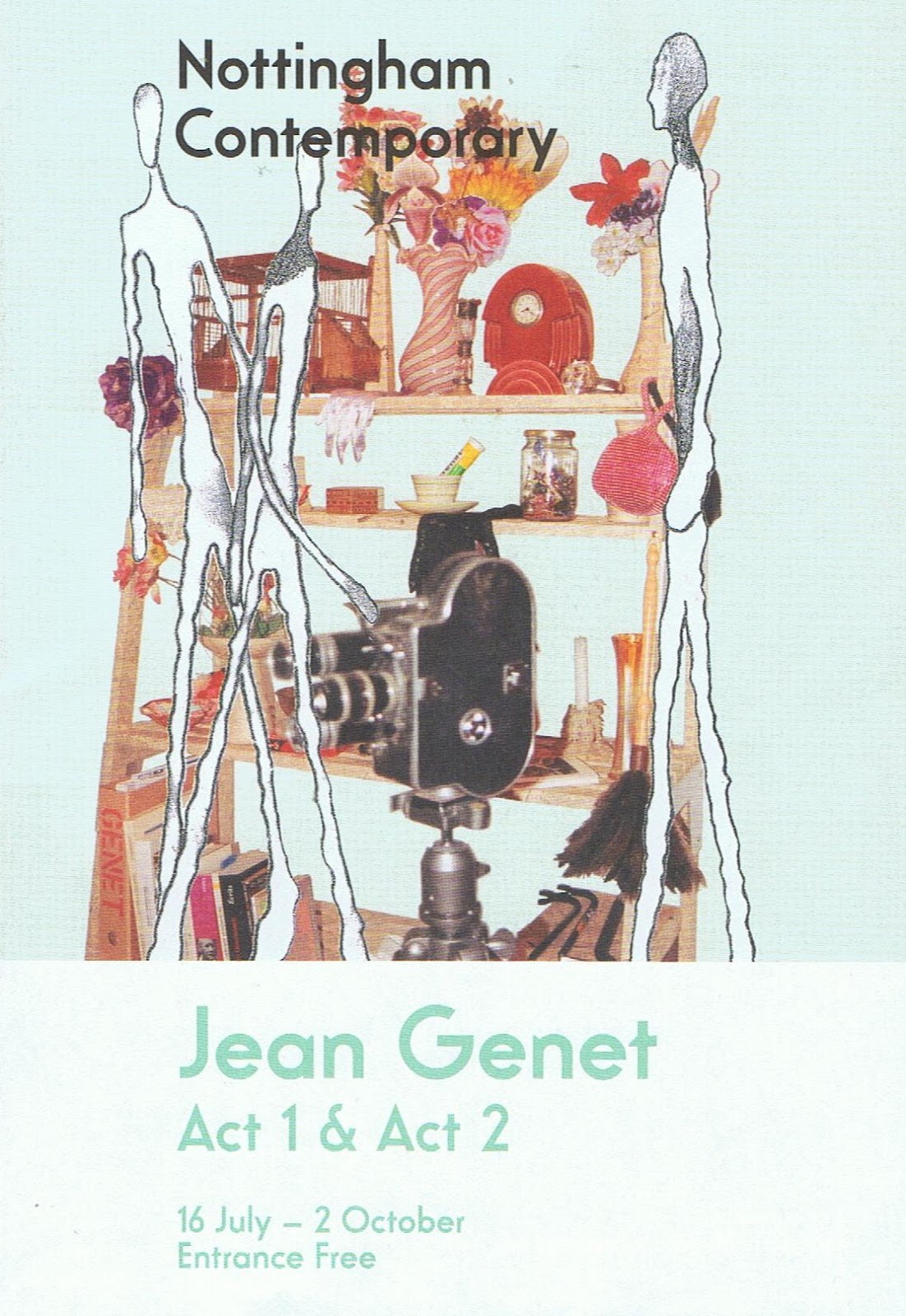
Jean Genet in Nottingham


The art gallery Nottingham Contemporary's summer (16 July 2011 – 2 October 2011) exhibition is entitled 'Jean Genet' as it is inspired by the French rebel writer, and it is in two 'Acts'.

Act 1 features work by Marc Camille Chaimowicz, and also includes sculptures (notably Man Pointing) and the portrait of Genet by Alberto Giacometti. Others works shown in Act 1 are by Tariq Alvi, Lukas Duwenhögger, Mathilde Rachet, and Wolfgang Tillmans.

Act 2 concentrates on Genet's later politically involved years, and features the film Nervus Rerum by The Otolith Group, which moves round Jenin refugee camp on the West Bank with readings from Genet's Prisoner of Love (Captif amoureux) and Fernando Pessoa's O Livro do desassossego (The Book of Disquiet). Lili Reynaud–Dewar's walls speak passages from Prisoner of Love and L'Ennemi déclaré (The Declared Enemy), with books by north African writers displayed, such as Nabile Farès's Le champ  des oliviers and Tahar Ben Jelloun's Harrouda. Act 2 also features work by André Acquart, Emory Douglas (Black Panther graphic work), Latifa Echakhch, Mona Hatoum, Glenn Ligon, Abdul Hay Mosallam, Gil J. Wolman, Akram Zaatari, and Carole Roussopoulos.

9 August 2011

Jim Loach's Oranges and Sunshine

Ken Loach is a major British director, and his movies have frequently been strong attacks on social problems often perceived as stemming from governmental policies, from the television Play for Today Cathy Come Home (homelessness) through Kes (state education in a working-class community), Family Life (conventional psychiatry), Ladybird, Ladybird (the Social Services), and The Navigators (New Labour's privatization of the public sector). Now, Ken Loach's son Jim has made his first feature film, which involves abuse by British governments in the recent past.

Oranges and Sunshine is the ironic title of this partly fictionalized story, and alludes to a 'promise' made to British children in home care that the British government deported, often to be abused sexually and by other violent physical means. Over a large number of years, perhaps as many as 150,000 of these children were deported to different Commonwealth countries as a source of labour, although the movie concentrates on Nottingham social worker Margaret Humphrey's discovery of a number of children sent to live permanently in Australia between the 1940s and 1970.

Initially an Austalian woman approached Humphreys (played remarkably well by Emily Watson) because she was seeking to find out about her parents. The movie charts the rapid increase in Humphreys's knowledge as she is given the two-year task of unearthing the facts about this abuse. A particularly poignant moment is when Len (played by David Wenham - a brilliant foil to Watson) shows Margaret the Christian Brothers' Keaney College in Bindoon, which he (along with other children) had built brick by brick, and where many were otherwise abused. Much time is spent in detective work trying to track down the parents of a number of children.

The former British Prime Minister Gordon Brown made a public apology for past governmental abuse in February 2011.

One thing I hated about the movie: the Cat Stevens song. Perhaps Humphreys would have been unaware of Stevens's (or rather Yusuf Islam's) comments on the Rushdie fatwa, but many of us are aware of them.

(Some scenes take place in Nottingham, and the streets of Sneinton to the south-east of Sneinton Boulevard, the former Sneinton Market buildings, and William Reid Dick's Welcome statue inside the Council House are clearly recognizable.)

4 August 2011

Mike Mills's Thumbsucker (2005)

This was director Mike Mills's first feature, and was filmed in Beaverton and Portland, Oregon.

Seventeen-year-old Justin Cobb (played by 17-year-old Lou Pucci) is the thumbsucker of the title, and this is an adaptation of Walter Kirn's 1999 autobiographical novel of the same name. Mills is fascinated by transgressions, and what – thinking about it – can be much more transgressive than an adult addictively sucking his thumb? Justin's father Mike (Vincent D'Onofrio) finds it repulsive; he does it at school in a toilet cubicle just as he might conceal mastubatory activity; he daren't reveal his secret shame to his would be girlfriend Rebecca (Kelli Garner); and his orthodontist Dr. Perry Lynham (Keanu Reeves) more or less hypnotizes him out of it.

One of the joys of this movie is that people don't do what is expected of them, and kids and adults have equal weight: no one is magically wise due to age, and age can actually confer lack of maturity. Adults are seen to hesitate about courses of action relating to younger people, and even young kids can have a lot more going for them mentally.

Yes, of course there are a number of Oedipal references, and in the long conversation between Kirn and Mills (a special feature on the DVD), the novelist asks why thumbsucking should be seen as so taboo when sucking on a can of beer is seen as masculine behavior. This idea (not actually mentioned in either the conversation or Mills's commentary on the movie) is underlined toward the end when Perry (who is also Justin's unofficial analyst and other self, and who has earlier identified the thumbsucking as in part a substitute for the mother's breast) very improbably but very tellingly lights up two cigarettes in rapid sucession in the dental surgery.

This is after Perry has admitted to previous hippy philosophizing, declared that thumbsucking is in fact OK behavior, and made a statement of brilliant uncertainty: 'The truth is living without an answer. I think'.

Mills wholeheartedly agrees with the above remark, and says that the aim of the film is to 'help you feel more permissive about yourself'.

Elliott Smith was set to do the whole score, consisting of covers such as John Lennon's 'Isolation' and Leonard Cohen's 'The Sisters of Mercy', but, sadly, died before finishing it. A few of Smith's songs are still in there, such as Cat Stevens's 'Trouble', which Mills sentimentally remembers from Hal Ashby's Harold and Maude. (Many people have far less fond memories of Cat Stevens, and for very good reasons, but we'll save that for the next post.)

A movie about outsiders in which everyone (yes, that's all of us) is the outsider: I'm really looking forward to watching Mike Mills's recent Beginners.

31 July 2011

Robert Owen, Manchester

This statue of the Welsh social reformer Robert Owen (1771–1858) stands outside the Co-operative building at the corner of Balloon Street and Corporation Street, Manchester. It was sculpted by Gilbert Bayes and is a copy of the one erected in Newtown, Montgomeryshire – where Owen was born - in 1956. It was commissioned by the Co-op plc.

'THIS STATUE WAS UNVEILED ON 28TH MAY 1994 BY HUGHIE TODNER
PRESIDENT OF THE 1994 CO-OP CONGRESS
IN THE PRESENCE OF
THE LORD MAYOR OF MANCHESTER CLLR. SHEILA SMITH
THE LEADER OF THE CITY COUNCIL CLLR. GRAHAM STRINGER
THE MAYOR OF NEWTOWN CLLR. DAVID PUGH
THE CHAIRMAN OF THE CO-OPERATIVE BANK TOM AGAR
THE MANAGING DIRECTOR OF THE CO-OPERATIVE BANK TERRY THOMAS'

This is a link to the Robert Owen Museum in Newtown, and the website also contains a great deal of information about Owen, including his Manchester years, and there are a number of excerpts from his writings.

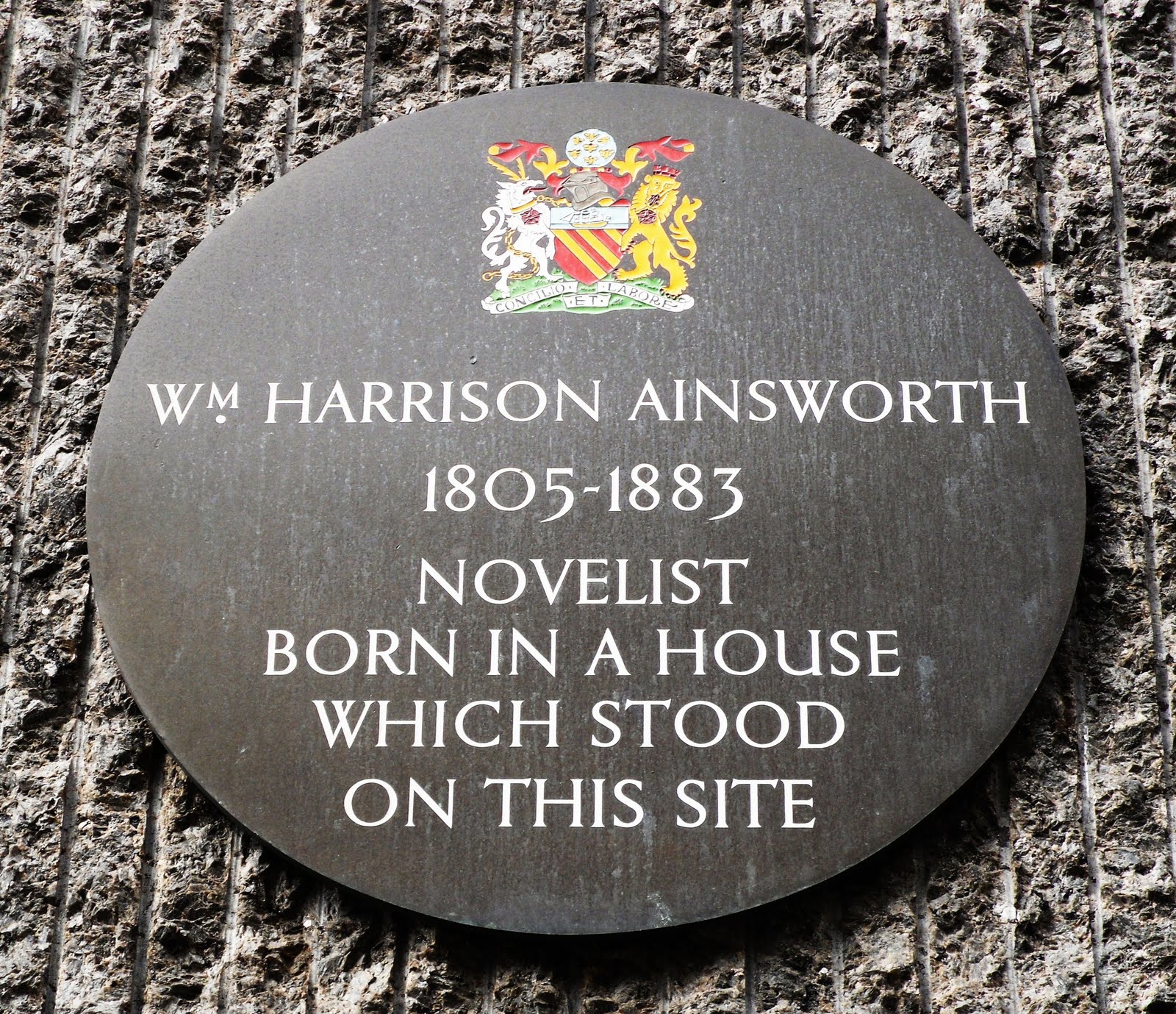
William Harrison Ainsworth, Manchester

'WM. HARRISON AINSWORTH
1805-1883
NOVELIST
BORN IN A HOUSE
WHICH STOOD
ON THIS SITE'

This plaque commemorating William Harrison Ainsworth's birth is on the National Westminster Bank building,  King Street, central Manchester.

His early 'Newdigate' novels (Rockwood (1834) and Jack Sheppard (1839)) romanticized highwaymen, and were satirized by William Thackeray in Catherine (1839–40). He wrote 39 (mainly historical) novels, among which the most noted perhaps are The Lancashire Witches (1848), Old St Paul's: A Tale of the Plague and the Fire (1841), and Windsor Castle (1843).