26 August 2021

Barthélémy Thimonnier, Amplepuis (69), Rhône (69)

Barthélemy Thimonnier (1793-1857) was born in L'Arbresle (Rhône) and died in Amplepuis (Rhône), a village to which his parents moved when he was very young. When he left his parents he first moved to Panissières as a tailor, and then to a suburb in Saint-Étienne. It was in working for his customers that he dreamed of mechanising the sewing process, and in fulfilling his dream he became the first creator of the working sewing machine. He signed the patent in partnership with Auguste Ferrand, a mining engineer, in 1830 with a view to making uniforms for the army. However, his workshop was destroyed by workers fearing that they would lose their livelihood due to mechanisation. Thimmonnier returned to Amplepuis to re-take up work as a tailor, although he came up with three more patents, each improving on his original design. But in spite of winning prizes at exhibitions and receiving praise from the press, sales were not forthcoming. His life ended in poverty and he was initially buried in a paupers' grave.

However, the name Thimonnier on sewing machines contiinued one way or another until as late as 1983. Le Musée Barthélémy Thimonnier in Amplepuis remembers the man which with a large number of sewing machines from all over the world.


The first sewing machine, by Thimonnier, 1829 (?).

The Thimonnier & Cie machine Pic-Up, undated.

Neither Étienne Thimonnier, Barthélémy's son, not any successors, produced sewing machines. Those under the tradename Thimonnier were mainly imported from Germany, or Japan, as this Janôme Thimonnier model of about 1972.

I remember very well the Bernina model my mother had, although this, at about 1944, is much earlier.

25 August 2021

Boîte à lire, Amplepuis (69), Rhône (69)

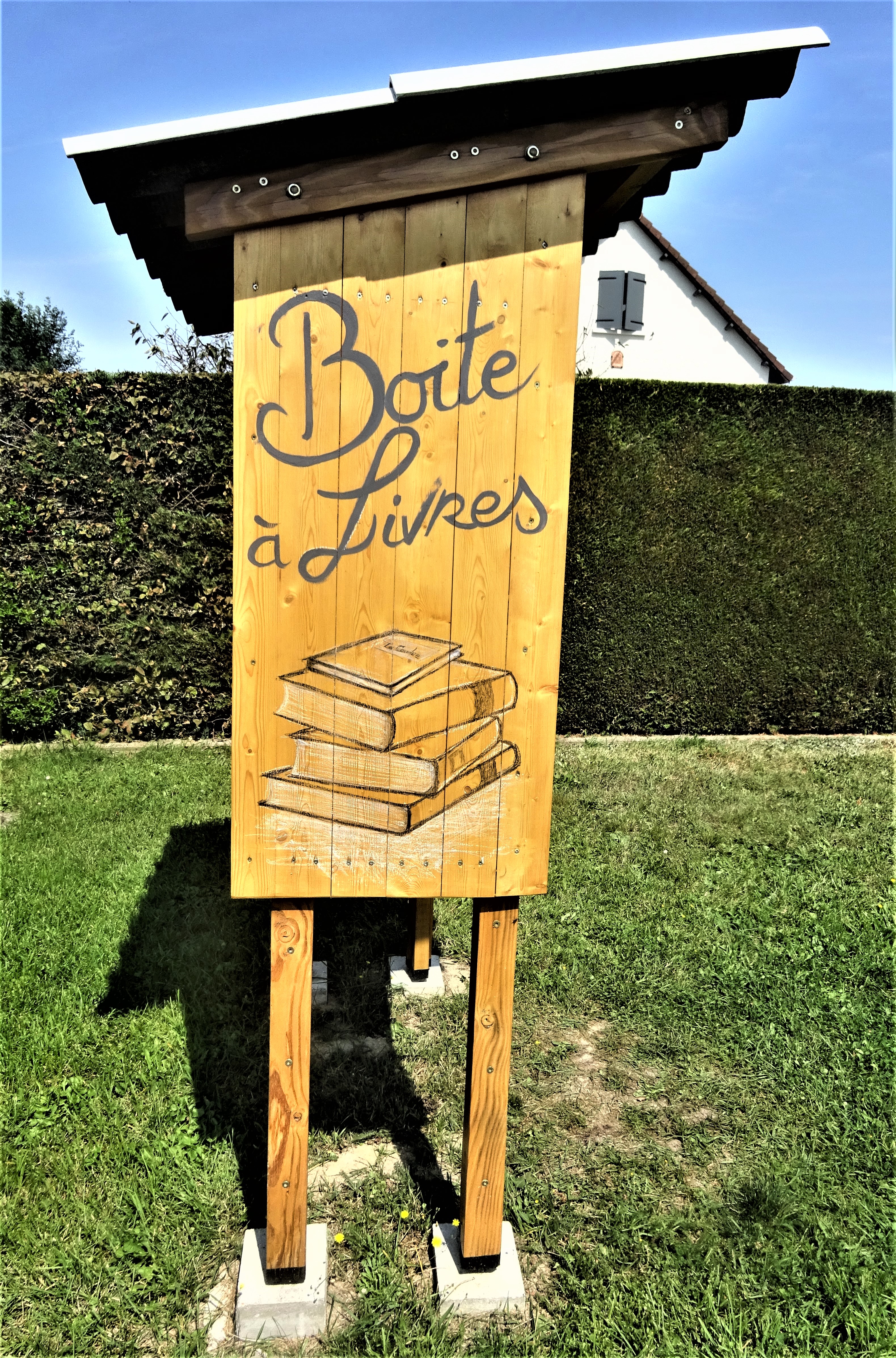
Boîte à lire, Amplepuis, with a number of books but I only relieved it of one: Octave Mirbeau's Le Jardin des supplices.

L'Église Saint-Maurice in Mervans (71), Saône-et-Loire (71)

 L'Église Saint-Maurice in Mervans was built in the fourteenth century on the site of a former Norman chapel. Despite restoration in 1893, the brick building collapsed in 1902, with only the remarkable crooked spire remaining. Any English person is inevitably reminded of the crooked spire in Chesterfield, Derbyshire, England.


Daniel Pennac in Simard (71), Saône-et-Loire (71)

I've no clear idea why a school should name itself after the writer (often of children's books) Daniel Pennac, particularly in a village in Saône-et-Loire where he has no apparent associations. Maybe I'm missing something, but it's in any case unusual for a building to be named after a living person. No matter: Pennac wrote a book, Chagrins d'école, in which he mentions his scholarly problems, specifically dysorthography, the inability to write correctly. I also note that the school pupils have re-written their own version of Paul Éluard's poem 'La Liberté.' Interesting.

22 August 2021

La Smart Flower, Buxy (71), Saône-et-Loire (71)

Attractive as well as highly ecologically sound, the sun flower in Buxy is designed to serve as a free use of electricity to bicycles and cars.

Le Marteau-Pilon (steam hammer), Le Creusot (71), Saône-et-Loire (71)

The steam hammer in Le Creusot dates from 1876 and at the time was the most powerful in the world, symbolising the industrial power of the town. The total structure weighs 545 tonnes, is twenty-one metres tall and was employed by Schneider et Cie. It was made in Essen and nicknamed 'Fritz'. Patenting rights were sold to Bethlehem Steel in Philadelphia in 1891, and it was the USA which constructed a more powerful hammer. However, the Bethlehem hammer was demolished in 1902, whereas the Le Creusot one continued until 1930. In this year it was dismantled but reconstructed in 1969 at the southern entrance to the town, where it still stands. It remains one of the last publically viewable steam hammers in the world. In 1981 it was recognised as a Historic Mechanical Engineering Landmark by the American Society of Mechanical Engineers. This is a most impressive monument to an industrial past.


21 August 2021

Boîte à lire, La Coudre (71), Saône-et-Loire (71)

 La Coudre is a tiny village which nevertheless has a boîte à lire:


Dovecote in Laives (71), Saône-et-Loire (71)

The dovecote in Laives dates back to the Middle Ages and contains 2000 boulins, or nichoirs. It was the property of the lords of Sermaisey, whose former manoir is opposite. In addition to its original purpose it sheltered soldiers in World War I and was more recently used to house cows. There was once a spiral ladder which unfortunately was destroyed when the roof collapsed in 2006, the year which it was sold to the commune of Laives for 3000 euros.


20 August 2021

Le Musée du train miniature, Châtillon-sur-Chalaronne (01), Ain (01)

Le Musée du train miniature in Châtillon-sur-Chalaronne isn't just a museum of miniature trains, and nor is it designed with children in mind: it's a mind-blowing experience of what can be achieved once an enthusiast (P. Crolle), indeed an obsessive person, decides to devote twenty years to a particular vision. The (often animated) models here, and they stretch from the shores of the Mediterranean, up the Rhône valley to Lyon to the Savoie country, are on a tiny but highly detailed scale. The model, which extends to 200 square metres, is fascinating.