11 August 2021

Nathalie Blanchet in Saint-Gengoux-le-national (71), Saône-et-Loire (71)


Nathalie Blanchet (1833-1923) was an aspiring young poet who was born, lived and died in this building. She came to the attention of Lamartine when she wrote to him, expressing her appreciation of his poetry and enclosing examples of his own. Lamartine was impressed, invited her to see him and became her friend.

9 August 2021

Claude Bernard in Saint-Julien-en-Beaujolais (69), Rhône (69)


Claude Bernard (1813-78), doctor, founder of modern physiology and epistemologist, is by far the most famous inhabitant of Saint-Julien-en-Beaujolais. His statue takes centre place in this tiny village. His museum, amazingly, is not, as far as I could see, signposted.

The impressive façade of the museum.

Bust of Claude Bernard.

Fanny Martin was married to Claude Bertrand, although it was a marriage of convenience, Bertrand receiving a large dowry from the marriage, enabling a move to Paris where he (the son of vine growers) could mix with the intelligentsia.

More interestingly, Fanny strongly disapproved of Bertrand's strong interests in vivisection. She became a founder member of the SPA (Société Protectrice des Animaux) and in time officially separated from Bernard. Her two surviving daughters, very close to Fanny, never married and devoted their lives to the interests of animals.

Later Bertrand met Marie Raffolovich, who was a great help to him, particularly in translating foreign texts. But apparently this was an unconsumated relationship, Marie being much younger than him and also being contentedly married.

No matter what my opinion of Bernard may be, this quotation of his is so true: 'C'est ce que nous pensons déjà connaître qui nous empêche souvent d'apprendre': 'It's what we think we know already which often prevents us from learning'.

Musée Gabriel Chevallier in Vaux-en-Beaujolais (69), Rhône (69)

Opposite the fresco and the pissotière is the Musée Gabriel Chevallier, a small room with a wealth of (mainly pictorial) information on the writer, including some of his drawings.

A representation of Chevallier made at an unknown date.

Chevallier in his Amilcar (1923-25).

Again, the date of this photo is unknown.

Madeleine, Chevallier's wife, at the time of the marriage in 1936.

The 1945 edition of Clochemerle, with illustrations by Albert Dubout.

Chevallier was in World War I, and drew representations of soldiers, of which this is one.

An undated self-portrait.

And another (obviously much later) undated self-portrait.

La Peur (1930) is Chevallier's first novel, about World War I. It formed the basis for Jean-Pierre Jeunet's film Un long dimanche de fiançailles (2004).

Chevallier is all over Vaux, and within a few seconds of the square we encounter representations of his characters. Bernard Pivot, the ex-chair of the Goncourt panel, was born here and has a school named after him, but Chevallier reigns supreme.

Gabriel Chevallier in Vaux-en-Beaujolais (69), Rhône (69)

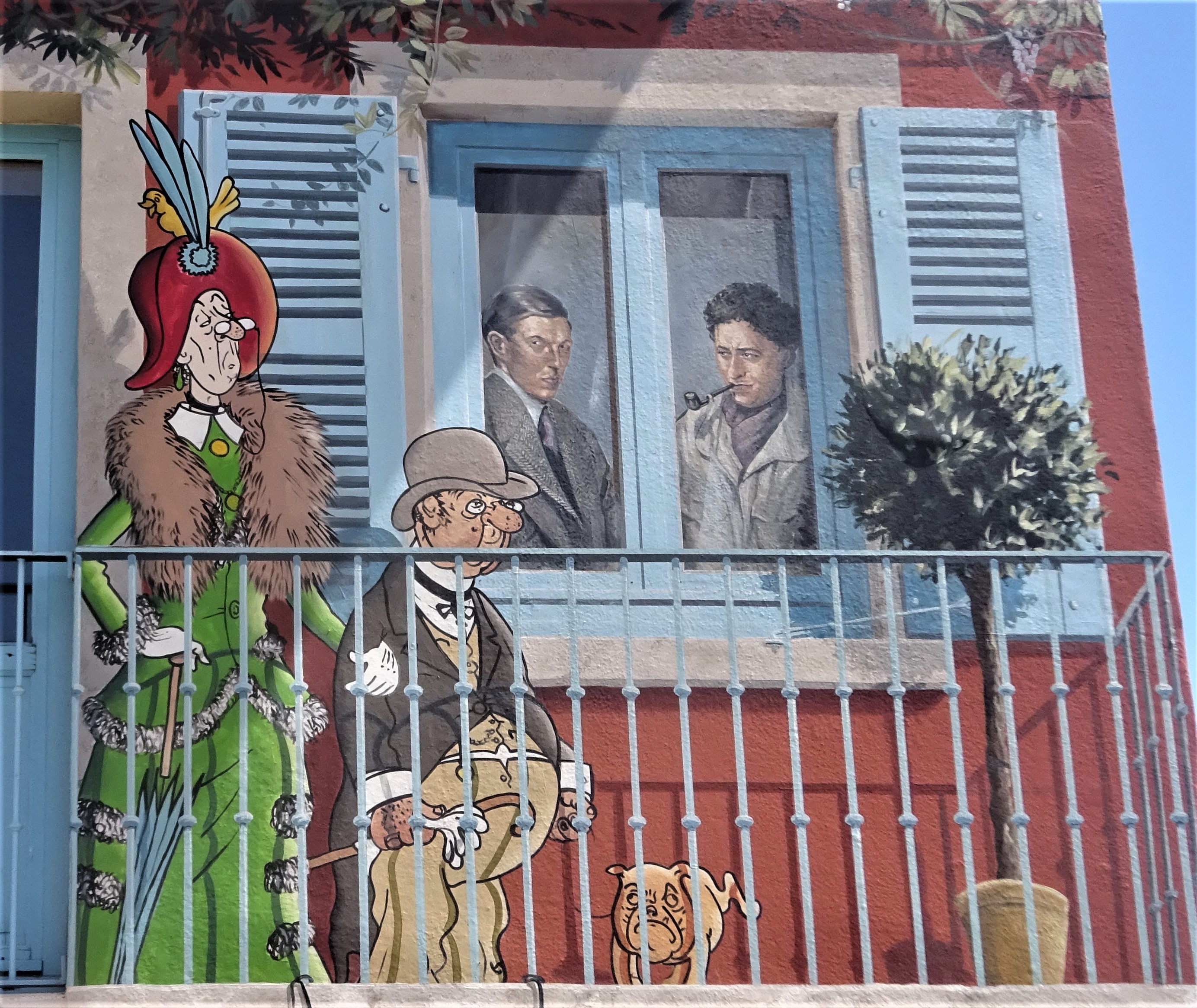
The writer and artist Gabriel Chevallier (1885-1969) was born in Lyon, although it was the much smaller Vaux-en-Beaujolais which inspired his greatest success, Clochemerle, which was originally published in 1934. It in turn inspired a film and a television series, and as you enter Vaux you find that it also has another name: Clochemerle, of course. Prominent in the village is a house with murals of some of a number of characters in the book: it was designed by the A. Fresco company after illustrations by Albert Dubout, which appeared in the 1945 edition of the novel. Included are a couple of lovers near the cuckolded butcher (wearing stag horns); the curé and his maid; the chemist; Chevalier and Dubout at a window; the baron and a local solicitor; the Café Torbayan drunkards celebrating the beaujolais nouveau; the village band; the punished; etc.  Also prominent in the square is a representation of the village pissotière. The mock heraldic device on the building is a rebus: it shows a bell (cloche) and two blackbirds (merles) perched on a pissotière.


4 August 2021

Château d’eau in Matougues (51), Marne (51)

The château d’eau (water tower) in Matougues (Marne) is ordinary enough, or at least it was until it received a decoration. The painter, engraver and sculptor Roland Irolla, born in 1935, painted this representation of the village's church and its bridge over the River Marne.

Pierre Dac in Châlons-en-Champagne (51), Marne (51)

Pierre Dac (1893-1975) was born here, 70 Rue de la Marne, and occupied rooms on the first floor (where the plaque is). In a leaflet on Châlons-en-Champagne, the office de tourisme gives this (number one on its list) as the birthplace of Dac. But they don't say anything about him, and how many people today remember (apart from seeing clips on the internet) the vital importance, vital absurdity, for instance, of the Biglotron? (Not to mention the Schmilblik.)

Étienne Œhmichen in Châlons-en-Champagne (51), Marne (51)


'ICI EST NÉ
ETIENNE ŒMICHEN
CRÉATEUR DE L'HÉLICOPTÈRE
LE 15 OCTOBRE 1884'

Œhmichen invented an early version of the helicopter. He's obviously an important international figure, although the Châlons-en-Champagne tourist office doesn't seem to make much of this. They should be exploiting the interest.

Épernay street names (4): Léon Bourgeois, Épernay (51), Marne (51)


Léon Bourgeois, sénateur of Marne, was a radical and a sculptor who won the Nobel Peace Prize in 1920. Rodin dedicated a sculpture to him.

Épernay street names (3): Marcel Paul, Épernay (51), Marne (51)

Marcel Paul was one of the five communist members of the post-war government, and as Ministre de la production industrielle is most noted for nationalising power industries, creating EDF (Électricité de France) and GDF (Gaz de France). The street named after him was originally called 'Rue de l'électricité'.

Épernay street names (2): Vincent Ballu, Épernay (51), Marne (51)

'RUE
Vincent BALLU
(2.8.1920-9.7.1980)
Fondateur de la Maison
TECNOMA'

Yes, Vincent Ballu established the agricultural machines business Tecnoma. He is also the inventor of the 'tracteur enjambeur' for vineyards, which was used in post-war France.

Épernay street names (1): La Saule Verdelette, Épernay (51), Marne (51)

On an 1831 map of Épernay there appears a small area to the south of a loop in the River Marne, named 'Le Saule Verdelette', which obviously refers to this area being named after the native willow trees. But I'm at a loss as to how this area could have slightly changed its name, making the street below it 'La Saule Verdelette'. Why the change of gender? Even the McDo restaurant, when Googled, comes up as 'McDonald's La Saule Verdelette'. Have I missed something?