19 September 2018

Jean Moulin in the 8th arrondissement, Paris (75)

'À
JEAN
MOULIN
1899–1945'


The monument to Jean Moulin (1899–1943) in Les Jardins des Champs Elysées was sculpted by the Jewish sculptor Georges Janclos (1933–97) in 1984. The five bronze statues represent tears, the whisper of the Resistance, silent imprisonment, disappearance and the Resistance, although not in the order shown.

18 September 2018

More from Le Cimetière Père-Lachaise, Paris (75): #21: Évariste Parny


Évariste de Parny (1753–1814) was a poet born in La Réunion. His name was known by his Poésies érotiques (1778), his poetry was hugely popular at the beginning of the nineteenth century, and in 1813 Chateaubriand said that he still remembered some of his works by heart.

More from Le Cimetière Père-Lachaise, Paris (75): #20: Vivant Denon


Vivant Denon (1747–1825) was an engraver and a writer as well as a French diplomat and administrator. He became the general director of museums, and as such was particularly involved with the Louvre. Study bored him, although observation entertained him. The sculpture is by Pierre Cartellier.

More from Le Cimetière Père-Lachaise, Paris (75): #19: Jacques Lelille

Jaques Delille (1768–1839) was a poet and translator (mainly from Latin and English). The most famous of his own work is Jardins (1782).

More from Le Cimetière Père-Lachaise, Paris (75): #18: Georges Cuvier


Georges Cuvier (1769–1832) was an anatomist, indeed the founder of comparative anatomy, and an ethnologist. Some of his findings led to racist conclusions, as of course could have been expected at the unenlightened time when he was writing.

More from Le Cimetière Père-Lachaise, Paris (75): #17: Philoxène Boyer


Philoxène Boyer (1824–67) was a Hellenist. During his studentship at the Sorbonne he met Charles Baudelaire, who introduced him to the Parnassian poets, including Théodore de Banville, with whom he wrote some books. He lived for literature, at the expense of his personal hygiene. A brilliant mind, he had many famous writer friends although now he is all but forgotten.

More from Le Cimetière Père-Lachaise, Paris (75): #16: Jean Bacon


'Jean BACON

Journaliste
Écrivain

9 décembre 1914
29 février 2012'

Jean Bacon was a journalist for France with the BBC for ten years and an occasional writers of plays. His most important publication, after a great deal of research work, was Les Seigneurs de la guerre in 1981, was about the commerce and the use of weapons.

More from Le Cimetière Père-Lachaise, Paris (75): #15: Marie-Céleste Bache

Rose-Céleste Bache (1774–1843) (or Céleste Vien after the painter Jjoseph-Marie Vien she married) learned Greek and Latin, of which she published several translations. During her feminist period, she published Journal des dames et des modes.

17 September 2018

Max Jacob in the 18th arrondissement

'LE POÊTE
MAX JACOB
1876 – 1944
A HABITÉ CETTE MAISON
DE 1907 – 1911'

7 Rue Ravignan.

Maurice Utrillo and Suzanne Valadon in the 18th arrondissement

Maurice Utrillo (1883–1955) was the son of Suzanne Valadon, an acrobat and model encouraged, for instance, by Degas, Toulouse-Lautrec and Renoir to develop a powerful expressionist painting talent. Unusually, Utrillo was a painter of Montmartre who was born there. La Maison Rose was immortalised by a number of painters of the time. Utrllo is buried in Le Cimetière Saint-Vincent, Montmartre, and Suzanne Valadon in the Cimetière parisien de Saint-Ouen, both graves of whom are on this blog.

Rue des saules.

Le Moulin de la Galette in the 18th arrondissement

Le Moulin de la Galette at the corner of rue Lepic and rue Girardon, Montmartre, formerly a noted guinguette. The mill is not accessible to the public, although the front is a restaurant.

15 September 2018

Audrey Tautou in the 18th arrondissement

Anyone reading my blog will be aware of how much I detest tourism, but occasionally you just have to ignore the tourists and do your thing. Jean-Pierre Jeunet's brilliant movie Le Fabuleux Destin d'Amélie Poulin (2001), boringly Anglicized to Amelie, has a number of scenes set in the Café des 2 Moulins, rue Lepic, Montmartre. As expected, there are shots of the actor Audrey Tautou on the walls, although I suspect that the vast majority of people who know this movie just prefer to take an outside shot of this place, whose interior isn't entirely recognisable from the film.

Le Lapin Agile (revisited) in the 18th arrondissement


Well, it's been seven years since I last saw Le Lapin Agile, and I'm pleased to see that there's now an 'Histoire de Paris' plaque there. It doesn't really say anymore than I wrote before (just key in the words to the left), and especially notes Roland Dorgelès's donkey hoax), so I'll say no more.


But let's not forget the origin of the place's sign: André Gill: Le Lapin Agile was originally the work of the painter Gill: Le Lapin à Gill.

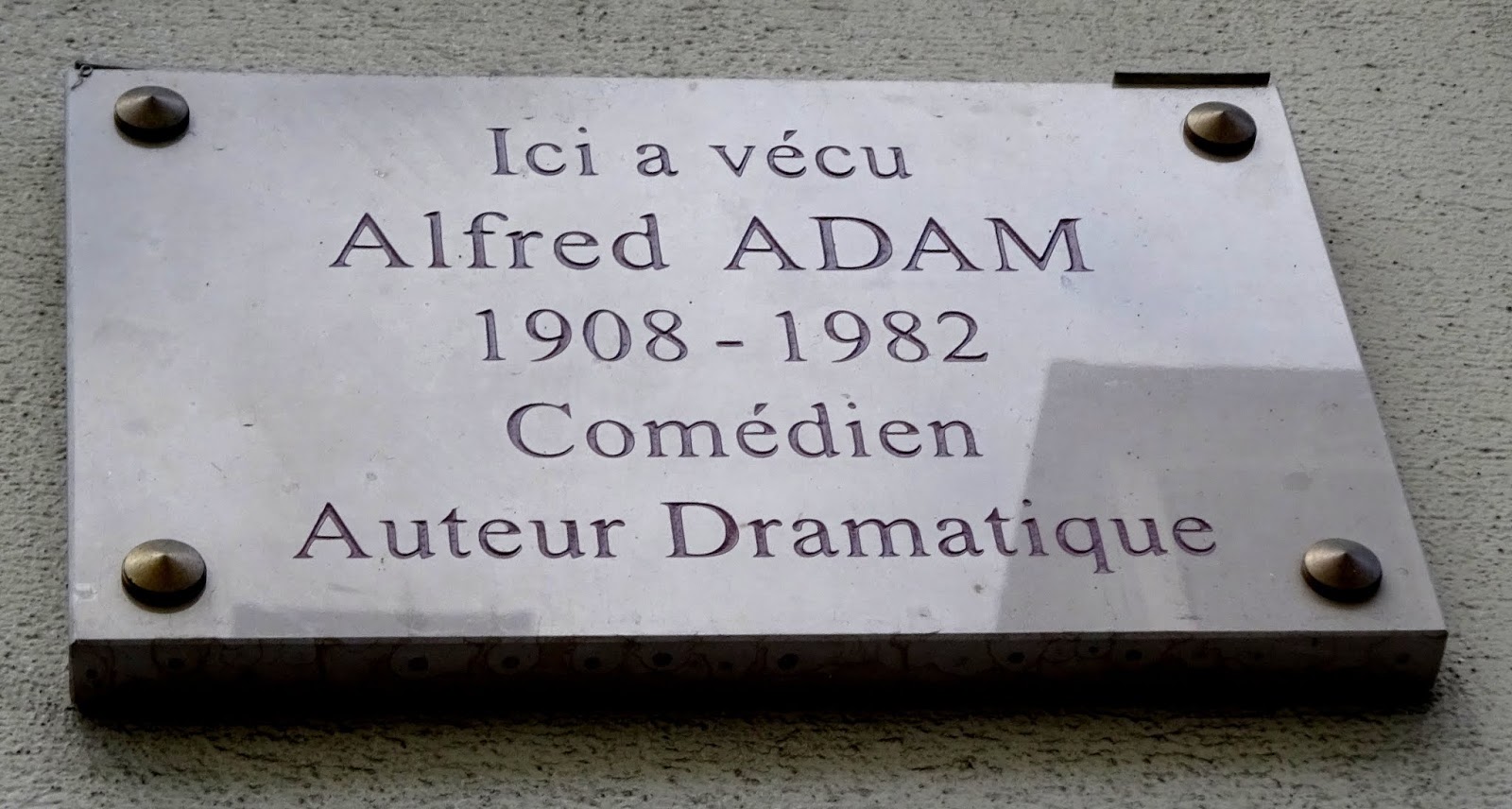
Alfred Adam in the 18th arrondissement

'Ici a vécu
Alfred ADAM
1908 – 1982
Comédien
Auteur Dramitique'

Alfred Adam appeared in many feature films and many televison films. According to Wikipédai, the wrote six plays: Sylvie et le fantôme (1942; La Fugue de Caroline (1945); La Fête du gouverneur (1949); Many (1952); Bateaux en Espagne (1952); and La terre est basse (1957).

Jacques Rigaut in the 18th arrondissement


Jacques Rigaut (1898–29) was a Dadaist writer and was a friend of Drieu la Rochelle, who made him the protagonist of three of his books: La Valise vide, Le Feu follet, and L'Adieu à Gonzague. The painter Jacques-Émile Blanche employed him as his secretary. He consumed large amounts of opium, cocaine and heroin. He married the rich American Gladys Barber in New York in 1926, who swiftly left him because of his drug addition. Back in Paris he tried various cures for his addiction, but in Châtenay-Malabry he shot himself in the heart in 1939 at the age of thirty. Renaud mentions him in 'Mon bistrot préféré' as one of the people he'd like to join him in his ideal pub. Jacques Rigaut is buried in the Cimetière de Montmartre, division 32.

Guillevic in the 5th arrondissement

'ICI VIVAIT, ICI MOURUT
LE POÈTE
GUILLEVIC
1907 – 1997
GRANDE PRIX DE LA POÉSIE
DE L'ACADÉMIE
FRANÇAISE
"nous ferons de la terre
une cathédrale sans murs"
PAROI'

Rue Claude Bernard.

Charles Vildrac in the 5th arrondissement

'ICI NAQUIT
CHARLES
VILDRAC
POÈTE ET DRAMATURGE
1882 – 1971'

22 rue Bertholet. I've mentioned Vildrac before on this blog, in relation to the literary commune in Créteil.

14 September 2018

Amorim de Carvalho in the 5th arrondissement

'DANS CET IMMEUBLE A VÉCU
DE 1969 À 1974

AMORIM DE CARVALHO

POÈTE ET PHILOSOPHE PORTUGAIS
MORT À PARIS LE 15 AVRIL 1976'

Rue Gay Lussac.

Paul Valéry in the 5th arrondissement

'DANS CETTE MAISON
VÉCUT
PAUL VALÉRY
1891 – 1899'

12 rue Gay Lussac.

13 September 2018

Pauline Delabroy-Allard: Ça raconte Sarah | All about Sarah (2018)

The pronunciation 'sarah' is sandwiched between 'conte', or story. And this is some story, one which Minuit chose alone for its rentrée novel, one which has already won a few literary prizes, and with fourteen other novels is currrently in the prix Goncourt's première selection. Does this first novel deserve all the praise that has been poured on it? In a word, yes.

Not much has been said of the autobiographical content in this novel, so we'll stay clear of that. This novel concerns a young woman who, forced by the circumstances of her partner abandoning her to herself and her child by him, chooses to teach in a lycée to spend more time with her son. But then the whirlwind happens.

The narrator meets Sarah, a successful violinist in a quartet that tours the world, and they meet and see each other a number of times. The narrator has a fixation about latency periods, and asks Sarah what she sees as the meaning. The reply: 'C'est le temps qu'il ya entre deux grands moments importants.' ('It's the time between two greatly important moments.') So there we have it.

The beginning of the women's important moment comes when Sarah tells the narrator that she thinks she's in love with her. That's like striking a match: from nothing, you get fire. Two women, homosexual virgins, begin a highly amorous, highly sexualised affair which can only end in heartbreak. They see each other as often as possible, have sex as often as possible, and when they are not together can only think about each other all the time, about when they can be together again.

This is a self-contained folie à deux, and right from the start the narrator knows that Sarah is seeing a shrink two, even three, times a week. But the madness is infectious, the narrator catches it, she can neither stand to be with Sarah nor without her, they both know they must finish a self-destructive relationship. So Sarah doesn't contact the narrator for some time, but when she does it's to tell her that she has breast cancer. End of the first of two parts, right in the middle of the book.

There are 82 often breathless and frenetic sections in Part 1, but only 30 slowly paced sections in Part 2. Is Sarah dead, has she killed her? A brief trip to Milan, then on to Trieste, to an almost adandoned house where the narrator can breath, look at the wonderful view of Adriatic, try to calm after the storm, bring back her sanity, buy pasta laced with spinach from the local store, drink and drink and drink spritz from the local bar, and. What?

Yves Ravey: Trois Jours chez ma tante (2017)

The title Trois jours chez ma tante recalls the Goncourt-winning Trois jours chez ma mère by François Weyergans, although here things are very different. Marcello was forced to leave France twenty years before over a money laundering scheme he was involved in. Since then he's been living in Liberia and not returned to see his aunt, who's been sending him substantial sums of money every month, and has not even returned to express concern over his mother's death. But now that his aunt has decided to disinherit him, he at last returns to Lyon for three days to dissuade his aunt. He is, as might be expected, an unreliable narrator.

The whole book is in the first person, so we only have access to his mind, although only part of it, as he's retaining things from his readers, making them believe things which might not be true. With Ravey, psychology takes a back seat, being of minor importance. Do we believe what he tells his aunt Vicky – who's in a medically supervised old folks' home – that he's become a new person, that he needs money to run a school in Africa, helping to educate poor, vulnerable children? Lydia, Marcello's ex-wife, is now very friendly with Vicky, which makes Marcello suspicious, and he rejects out of line the idea that he's the father of her twenty-year-old daughter: we never find out the answer to that one, as we never find out who the new heir is, or indeed several other things – that's not the way Ravey plays his game.

And yet there's a strong atmosphere of suspense right until the end, which doesn't exactly conclude the story, and leaves Marcello caught trying his best to forge his aunt's signature. And what the book very strongly suggests is that Marcello's 'school' is a sweatshop where he gets distressed young children to make money for him. Ravey makes no judgements, although his books are peopled by villains trying to fool the gullible.

And, of course, it's written in very simple language, simple sentences. But it's by no means a simple book. One reviewer describes Ravey as a writer of detective stories in a similar way that pointillistes paint. That's a very good observation.

San-Antonio: Messieurs les hommes (1955)

Bernard Tonacci is quite a man, or bloke, or chap, or guy, or mec or any other expression you care to use for a member of the human race with a dick. And Tonacci not only uses his cock, or prick, or schlong, or dick frequently but is one, meaning he's a detective, or private eye, or tec, that is. Of interest (to me at least) is not the the casual display of female breasts (with glimpses of nipples) on the cover, nor the mistaken identity in the cop-versus-gangland or the violence and murders in the story. Nor even the suspense, which is great. Nor even the fact that Bernard Tonacci, a Corsican, is in fact the detective San-Antonio, who doesn't exist in 'real life', but whose namesake has come to be the pseudonym of the real writer of this book: Frédéric Dard, who wrote 175 San-Antonio novels, and more than 300 books all told.

No, that's not my main interest: it's the language. A little of this is in verlan (or backslang), but a huge amount in slang in general. This is a world in which a door is une lourde, to open it is délourder, a cigarette is une clope or un pétard, a car is not just une bagnole but une tire, a taxi un bahut, a bottle une boutanche, an umbrella une pébroque, a hand une paluche, a shirt une limace, a hat un bitos or un bada, shoes are des lattes, and there are a number of argotic expressions either rarely used or in currency today. It's a feast for language lovers, just forget the hackneyed plot.

My Frédéric Dard posts:
––––––––––––––––––––––––––––––––––––
Joséphine Dard: Frédéric Dard, mon père: San-Antonio
Jean Durieux: Frédéric Dard dit San-Antonio
San-Antonio: Certaines l'aiment chauve
San-Antonio: Messieurs les hommes
San-Antonio: Des dragées sans baptême

Tanguy Viel: La Disparition de Jim Sullivan (2013)

Ah, France's love of America! It's evident from the number of books translated into French, the number of Americans invited onto La Grande Librairie – and almost always having to speak through interpretation: what exactly do English or American writers have against learning French? And didn't the great philosopher Sartre love American cartoons, and isn't a French writer setting a novel in the USA almost bound to be translated (meaning potentially massive sales, if not turned into a Hollywood film?) The megabucks that could flow in!

Well, La Disparition de Jim Sullivan isn't quite like that, but it's about a novel being made with an American setting, only that novel isn't quite the novel La Disparition de Jim Sullivan. It's about possibilities, shoulds and coulds, some of which don't appear in the theoretical novel, although they do in the real La Disparition de Jim Sullivan. So what is this? Not, then, we're given to believe, the novel we're reading here, which is on the one hand the author's musing about his novel, on the other hand the novel itself at the same time. So the novel we're reading, what's it about?

There are certainly (intended) clichéd main protagonists' names such as Dwayne Koster and his wife Susan, Susan's lover Alex Dennis, and then of course the waitress Milly Hartway, Dwayne's lover until he learns of her playing in porn movies and burns the video store down, but then he is of course deeply disturbed, perhaps suffering from post-traumatic war syndrome even though he's not actually left the USA, but then that's another story.

Jim Sullivan's story is yet another: he was a prominent singer who just disappeared in the desert in the 1970s, someone whose songs and story Dwayne is fascinated by, and whose example he follows, although as an ex-university lecturer he doesn't have anything like the same kudos of course. But this all makes for a hell of a tale, even if (especially because?) most of this is knitted together as the narrator thinks about what his novel should be like.

Links to my other Viel posts:
–––––––––––––––––––––––––––––––––––
Tanguy Viel: Paris-Brest
Tanguy Viel: L'Absolue perfection du crime
Tanguy Viel: Insoupçonnable

Claudie Gallay: Les Années cerises (2004)

Les Années cerises (lit. 'The Cherry Years') concerns an eleven-year-old boy and his desires, his hopes and his fears. Rather like the later Les Déferlantes, this is about a fragile individual for whom communication is really difficult. In Les Déferlantes, the unnamed protagonist is traumatised by a previous relationship and incapable of expressing her feelings; in Les Années cerises, the eleven-year-old first person narrator expresses himself very well in the book, but in his daily life can't express his feelings, his knowledge, or his desires. His parents beat him, his mother takes him to a useless psychologist, and he seems trapped. He's 'L'Anéanti', or the destroyed or the broken person, literally living on the edge of a cliff which will soon give way and threatens to send his whole family over the edge into oblivion.

Not that he doesn't have friends, such as Paulo, who comes from a richer family, but who mocks the narrator as do the other kids and his teachers, but Paulo's sister (unnamed) gets the narrator's young juices flowing, even though he knows that he's at least three years too young for her, and anyway she sees him as a bit autistic, and there's probably a fair amount of truth in that. The narrator's mother thinks that sending him to a private (Catholic) school will be better for him, and surprisingly instead of this idea alienating him, his existing schoolmates ironically see this as a major plus: he can spy on them for his former school, whose pupils are at war with the other school.

Events get in the way though, specifically the erosion of the cliff their rented house is on, to such an extent that the family will have to be rehoused. Cue for major developments. Judging by the two books I've read of Claudie Galley's, (lack of) communication appears to be a major theme with her, although I may be barking up the wrong cherry tree.

My Claudie Gallay posts:
––––––––––––––––––––––––––––––––––––
Claudie Gallay: Les Déferlantes | Breakers
Claudie Gallay: Les Années cerises
Claudie Gallay: L'Office des vivants

12 September 2018

José Bruyr in Saint-Germain-en-Laye, Yvelines (78)

José Bruyl (1889–1980) was a Francophone Belgian poet who was one of the founder members of L'Académie Charles-Cros. He was also a member of the Claude Debussy comittee in Saint-Germain-en-Laye. He was a music critic and wrote several works on Arthur Honegger, the history of music and several composers such as Schubert, Liszt, Brahms and Ravel. He wrote a large number of articles in French music papers.

Jacques Fesch in Saint-Germain-en-Laye, Yvelines (78)


Jacques Fesch (1930–57) was condemned to death for theft while carrying a firearm in 1954, followed by the death of a policeman. Whilst in prison he became a Christain mystic, and is in the current process of beatification. His complete works (close on 600 pages) were published in 2015. The only comment I have to make about this is that I am, and always have been, totally opposed to capital punishment.

Jacques Tati in Saint-Germain-en-Laye, Yvelines (78)


Jacques Tati (1907–82) was born Jacques Tatischeff of French-Russian-Dutch-Italian origin. His family grave is in Saint-Germain-en-Laye, and the bicycle tyre is most fitting for a film director well remembered for his early Jour de fête (1949), about a postman on his bicycle going about his normal work (with invitations to drink alcohol), and which obviously heavily influenced the blockbuster by Dany Boon, Bienvenue chez les ch'tis (2008), at least in one particular sequence. A great director of almost silent film comedy. The suggestion, some years ago, that his pipe be airbrushed out of stills of his films, was the suggestion of an idiot.

Pierre Albert-Birot in Issy-les-Moulineaux, Hauts-de-Seine (92)


Above is La Veuve ('The Widow'), a sculpture by Pierre Albert-Birot (1876–1967) in Issy-les-Moulineaux cemetery. Albert-Birot was a sculptor, painter, publisher, printer, poet, man of the theatre and screenplay writer, to give a non-exhaustive list of his abilities. He was wary of movements, but was praised and befriended by Max Jacob and Guillaume Apollinaire. He also influenced poets such as Jean Follain, Pascal Pia and Valérie Prouzeau. He married Arlette (née Lafont) (1930–2010) in 1962, and she never ceased to promote his work.

10 September 2018

Chateaubriand in the 6th arrondissement

'INFIRMERIE MARIE THÉRÊSE
FONDÉE EN 1819
PAR MME DE CHATEAUBRIAND
QUI REPOSE DANS LA CHAPELLE
-----------------
CHATEAUBRIAND
HABITA ICI
DE 1826 Â 1838'

Cimetière du Montparnasse revisited #9: Le Moulin

I don't know why I've not included this before. The original moulin de la charité was constructed in 1661 and made flour. There were about thirty windmills in the area in the eighteenth century, although they were demolished during the building of the Boulevard Montparnasse. With the French revolution this remaining windmill became a guinguette, and when the cemetery was built in 1894 it became the cemetery warden's house, and lost its sails in 1850, long before its classification as a historic monument in 1931. Today gravediggers keep their equipment in it. The Tour Montparnasse is in the background to the right of the windmill.