19 November 2013

Jean-Jacques Rousseau in Montmorency, Val-d'Oise (95)

'Jean-Jacques ROUSSEAU
Habitant de Montmorency 1756–1762'

The avenue Émile roundabout, Montmorency. This is the third statue of Jean-Jacques Rousseau (1712–78) here: the first was in bronze and by Louis Carrier-Belleuse in 1907, but was melted down during the war; the second was made in stone by Hélène Gustala, but was destroyed by a traffic accident in 1994; the present statue is a larger-scale reproduction of one made in 1860 by Albert Carrier-Belleuse, Louis's father.

Rousseau had set up household with Thérèse Levasseur, a linen maid who gave birth to five of their children, although they were all sent away as orphans. In April 1756 he escaped the 'ville de fumeé, de bruit et de boue' ('town of smoke, noise and mud') that he believed Paris had become, to live in Montmorency to the north of Paris. Originally they stayed in the 'Hermitage', lent to him by Mme d'Épernay, but moved to 'le petit Mont-Louis' the following year after an argument with his host.

This is now the Musée Jean-Jacques Rousseau, the area on the left of the photo (partly concealed by foliage) being the original part where Rousseau and Levasseur lived.

'Dans cette maison
J. J. ROUSSEAU
a vécu de 1757 – 1762'
 
Just before the entrance to Rousseau's former living quarters is a replica, by Jean Baptiste Stouf, of a bust by Jean-Antoine Houdon.
 
 
A reconstruction of the kitchen.
 
A reconstruction of Thérèse Levasseur's bedroom. Scarcely visible on the dressing table is a candle snuffer, which I learned is called a mouchette in French.
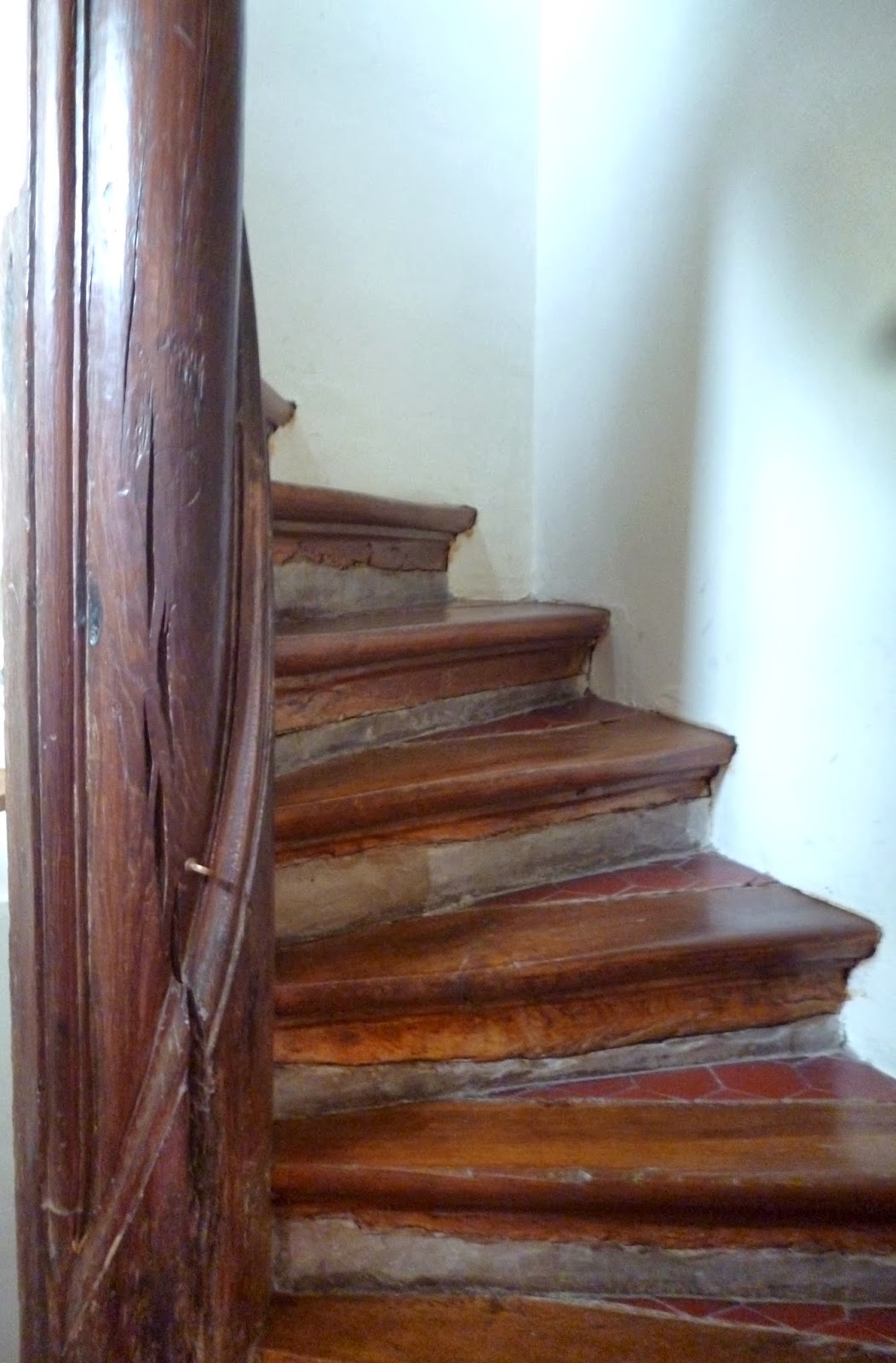
 
And the stairs to the other floor.
 
And a reconstruction of Rousseau's bedroom, although of course not his original bed.
 
The only definite original object in the tiny house is the fireplace, which came from the donjon (see further down).
 
Rousseau worked on his major publications in Montmorency: Julie ou la Nouvelle Heloise, La Lettre à d'Alembert sur les spectacles, Du contrat social, and Émile ou de l'Éducation, of which the last book – Profession de foi du vicaire savoyard – caused a storm with religious bodies, was condemned by the parlement de Paris, and forced him to flee Montmorency for Switzerland in June 1762.
 
The clock here is most appropriate because it was made in 1712 – the year of Rousseau's birth, in Geneva – the place of his birth.
 
The donjon, where Rousseau used to write.
 
In the 'cabernet de verdure' as Rousseau referred to it is this table.
 
The inscription here is by Gabriel Brizard (1744–1793), a tremendous admirer of the philosophes, and among other books he published the complete works of Rousseau. Brizard is full of praise for the great man, and the words refer to this stone as 'the altar of genius'.

'C'EST ICI QU'UN GRAND HOMME A PASSÉ SES BEAUX JOURS.
VINGT CHEF-D'ŒUVRES DIVERS EN ONT MARQUÉ LE COURS.
C'EST ICI QUE SONT NÉS ET SAINT-PRIEUX ET JULIE
ET CETTE SIMPLE PIERRE EST L'AUTEL DU GÉNIE'


27 Mars 1787

G. BRIZARD'

The garden at the back. A great day, and I'm very grateful to our enthusiastic guide, especially for her forbearance when I was translating things for Penny.

18 November 2013

Clotilde de Vaux, 11th arrondissement, Paris

Just off boulevard Beaumarchais, not very far from the Place de la Bastille, is rue Clotilde de Vaux with a bust of the poet who fired Auguste Comte with such enthusiasm.


Oddly, there appears to be no inscription here.

A representation of Clotilde de Vaux is in the Place de la Sorbonne, to the viewer's left of the statue of August Comte.

L'Abbaye de Créteil, Val-de-Marne (94)

In autumn 1906 a literary and artistic group moved into 37–39 rue du Moulin in Créteil, Val de Marne and christened it 'l'Abbaye de Créteil' after being inspired by the utopian Abbaye de Thélème in Rabelais's Gargantua. The experiment was the brainchild of the poet Charles Vildrac* and Georges Duhamel, although it only lasted until January 1908.

The housing area Mont-Mesly a little to the south-east of the village – built some decades after the end of the experiment – remembers l'Abbaye de Créteil's brief inhabitants in a number of names of streets and buildings.
 
A plaque on the wall of number 37 reads:

'René ARCOS, Georges DUHAMEL,
Albert GLEIZES, Lucien LINARD, Henri MARTIN,
Alexandre MERCEREAU, Charles VILDRAC,
RÉALISANT LE RÊVE CHANTÉ
DANS SES POÈMES PAR L'UN D'EUX
FONDÈRENT DANS CETTE MAISON
EN 1906
L'ABBAYE DE CRÉTEIL
DE GRANDES ET BELLES ŒUVRES PRIRENT LEUR ENVOL ICI
ET FIRENT PAR LE MONDE MIEUX AIMER NOS LETTRES
ET NOS ARTS.'
 
 
Just a few yards from l'abbaye de Créteil is the River Marne opposite L'île de la Gruyère, which the village cattle used as a watering place.
 
At the side of the watering place is a footbridge to the island, the delightfully named Allée des Coucous being one of the streets there, and which a comedian has tried to change to 'Couscous'.
 
Back on the mainland, rue de la prairie is lined on the waterfront side with allotments: here, a pumpkin is growing.
 
*Vildrac was born Charles Messager, but used the pseudonym as a homage to Walter Scott's character Wildrake in Woodstock, or The Cavalier: A Tale of the Year Sixteen Hundred and Fifty-one (1826).

Laurent Mauvignier: Apprendre à finir (2000)

Laurent Mauvignier's Apprendre à finir ('Learning to Finish') is painful to read, partly because it's about pain, the pain of loss, which is the writer's central preoccupation. In this respect it has a resemblance to his earlier Loin d'eux (1999), which is about the death by suicide of a son, told in a number of narratives.

But Apprendre à finir is about the loss of a husband (although not by death) and has just one narrative voice: the relentless internal monologue of a woman whose name isn't mentioned, who is looking after her husband who has just returned from hospital after a significant car accident. His recovery will take a long time, although the already broken marriage that had violently torn them apart before the accident is something that will never mend.

Another similarity between this book and Loin d'eux is the working-class background of the family: the husband here is a dustman, the wife a femme de ménage. Articulateness isn't a noted asset with Mauvignier's characters, and the reader has to forage in the half-said and the unsaid, spot the contradictions, pick out the lies, read in the interstices, in order to snatch at glimpses of the truth his characters hover around, leave clues about, or deny.

Denial is a particularly important word here. The woman's older son Philippe seems to want to tell her something, but she doesn't want to know, is frightened that he might be seeking to tell her the truth about her relationship with her husband: that it is dead, and no matter how much she works on caring for him, delighting in seeing him recover a little more each day, he probably feels nothing for her but hatred.

The woman's monologue is a repetitive, jealous rant of self-deception, weaving in and out between the future and the present in (often very long) sentences, re-living the pain of her husband's adultery, ignoring his contempt for the flowers and newspapers she frequently took to hospital for him, although she ignores his body language and lives for the day when they will be together and happy again as in the beginning, which of course will never happen, which she knows deep down, but will never allow herself to admit it. Meanwhile, her words nevertheless betray her, and neurotically she mentally photogaphs his bedside table before she goes out to work, noting the exact position of the phone so she will know if he has phoned the other woman.

She isn't insane, or even on the verge of insanity, although she is certainly very neurotic. And, in contradiction to the title, she never will learn how to get over the truth behind the lies she tells herself.

Stunningly written. My other Mauvignier posts are below:

–––––––––––––––––––––––––––––––––––
Laurent Mauvignier: Loin d'eux
Laurent Mauvignier: Ceux d'à côté
Laurent Mauvignier: Dans la foule
Laurent Mauvignier: Tout mon amour

Laurent Mauvignier: Seuls
Laurent Mauvignier: Ce que j'appelle oubli
Laurent Mauvignier: Continuer
Laurent Mauvignier: Autour du monde
Laurent Mauvignier: Une Légère blessure

15 November 2013

Philippe Le Guillou: Le Déjeuner des bords de Loire (2002)

Philippe Le Guillou's Le Déjeuner des bords de Loire begins 'Longtemps je l'ai rêvé lointain...' and we know from the Proustian allusion that this book is about epiphany.

From 1992 Le Guillou visited Julien Gracq at his last home, in Saint-Florent-le-Vieil, on a number of occasions. He had loved Gracq's writing since he read a sentence from Un beau ténébreux (1945) that moved him considerably during his troubled adolescence: 'Un pâle soleil, un soleil irréel s'est levé sur les crêtes des vagues.' He then discovered that the strength of literature opens up a kind of bottomless pit, a thirst for knowledge that can never be quenched, but the pursuit of which can be ineffably beautiful.

Gracq had moved back from Paris to his family home in Saint-Florent because of his elderly sister there, and over a the years a friendship essentially based on the love of literature developed between him and Le Guillou. The book details one occasion in February 1998 when Le Guillou journeyed by train from Rennes to Varades – within easy walking distance of Saint-Florent but involving crossing two bridges and moving from the département Loire-Atlantique to Maine-et-Loire via L’île Batailleuse – maybe something like the rural equivalent of walking due south from Châtelet to St Michel.

Le Guillou speaks of meeting Gracq, who sat beneath his portrait by Bellmer, of going to the nearby La Gabelle restaurant and discussing many things: the Loire area and its geography; such (later generation) writers as as Renaud Matignon, Jean-René Huguenin, Michel Tournier, and Jean-Erdern Hallier as a liar and a plagiarist; Le Guillou's work; the absence of literary movements since surrealism (Gracq believing the nouveau roman was just about style and not feeling); etc.

Gracq was well known for being gloriously prickly: he refused to accept the Goncourt for Le Rivage des Syrtes in 1951, refused to have his books published in poche, and so on. But there are some lovely comical bits in this, such as the anger of Mitterand – an admirer of Gracq – because the illustrator of one of Gracq's books (Un balcon en forêt, Le Guillou thinks) had dedicated it to Mitterand, but that Gracq had refused to give his signature to it; and on returning on one of his rare visits to his apartment in rue de Grenelle, Paris, Gracq is amused to find an invitation to a reception in honour of the 'Queen of England' at the Élysée Palace: Gracq comments that he was too late for it, but wouldn't have gone anyway.

Gracq, at the age of 84, was still driving and took Le Guillou back to the station. A delightful read, although I was a little surprised (well, disappointed to be honest) to learn that Gracq had a television.

14 November 2013

Véronique Ovaldé: Les Hommes en général me plaisent beaucoup (2003)

Les Hommes en général me plaisent beaucoup (literally 'In general I Really Like Men') is a strange, rather uninviting name for a novel, but this is a highly readable book.

I would almost call this first person narrated novel experimental in that it consists of many different sections that mix different times, creating a jigsaw that slowly reveals its content. And the way in which it is written – in vast, comma- and dash-strewn sentences – mirrors the troubled mind of the protagonist.

Lili has every reason to have a troubled mind. She is fourteen when her mother – who for years has protected her and her four-year-old brother from the insanity of her neo-Nazi father (who even calls his wife 'Eva B.' during sex) – dies from a mixture of exhaustion and hopelessness.

Le vieux (as Lili calls her father, although there is not the lop-sided respect in that title that exists in the English expression 'the old man') is a tyrant and leaves his kids to fend for themselves for whole weeks, changing the telephone number and leaving the front door of the flat open but filling his children with huge exaggerations of the terrors of the outside world and leaving them without a key so that they are afraid to ever leave the flat.

When Lili tries to hang herself by the light fixture it crashes down on her, but leaving a small gap in the ceiling that inevitably leads to the tenants above enquiring as to the kids' welfare, which leads to Lili meeting and forming a relationship with the tenants' friend, the enormous lemantin (sea cow) Yoïm. Yoïm not only sexually abuses the consenting Lili (in fact commits statutory rape in American law) a great number of times, but (wholly without her consent) he hires her out to a 'client', gets her commit a bungled burglary, she takes the rap and ends up in a compulsory 're-education centre'.

That's where Samuel comes in. He's a teacher but he spends his Saturdays visiting the centre. He is a good husband who has fallen in love with Lili and given her a completely different – ostensibly happy – life. But all Lili feels for him is gratitude, and when Yoïm returns on the scene she is re-attracted to him. But then, Lili is a very disturbed young 23-year-old, and much of her life is spent in dreams. Those zoo animals she keeps talking about, for instance, are surely only of symbolic significance aren't they: freedom and imprisonment, etc.

There are several similarities between this book and Ovaldé's other novel I reviewed a few years ago (and give a link to below), Ce que je sais de Véra Candida: an abused young woman who takes flight from her home, who lives with an essentially good man, and who returns (albeit with a difference) to her abuser. And the very long, comma-filled sentences. But I enjoyed this one more than Véra Candida, possibly because of those very similarities.

–––––––––––––––––––––––––––––––––––
Véronique Ovaldé: Ce que je sais de Vera Candida (2009)

Emile Durkheim: Cimetière du Montparnasse #15


'ÉMILE DURKHEIM
1858 – 1917'
 
And there is a particular note of finality to my blog posts on Montparnasse here, with the grave of one of the founders of modern sociology, probably most noted for his research on suicide. Durkheim lived at 260 rue Saint-Jacques, in the 5th arrondissement, from 1902 to 1917.

My first – and very long – post on the Cimetière du Montparnasse:

–––––––––––––––––––––––––––––––––––
Montparnasse Cemetery / Cimetière du Montparnasse

Carlos Fuentes: Cimetière du Montparnasse #14


The grave of Carlos Fuentes (1928–2012), who died in Mexico, but the date of whose death still wasn't inscribed on his tombstone two months ago. His most famous work is the novel Terra Nostra (1975), for which he was awarded the Rómulo Gallegos prize in 1977. His and Syvia Lemus's son Carlos Fuentes Lemus (1973–99) was a painter and poet who died young because of haemophilia.

My first – and very long – post on the Cimetière du Montparnasse:

–––––––––––––––––––––––––––––––––––
Montparnasse Cemetery / Cimetière du Montparnasse

13 November 2013

Julio Cortázar: Cimetière du Montparnasse #13


This may not be one of the most visited graves per se, but it must, after Serge Gainsbourg's, be the most enthusiastically visited grave in the cemetery, which I find slightly odd, although I certainly welcome such interest in an experimental, strongly left-wing writer. Wanna pull this one too, Google?
 
Julio Cortázar (1914–84) was born in Ixelles, Belgium, and was an Argentine writer whose family returned to Buenos Aires in 1918. His introduction to surrealism came from reading Jean Cocteau's Opium. He emigrated to France (where he worked as a translator for UNESCO) in 1951 to escape Perón's regime, and stayed there until his death. He supported revolutionary Cuba, and the sandinistas in Nicaragua, but refused the invitation to join Oulipo as it is an apolitical organisation.

Cortázar became a French national in 1981. His most famous work is the experimental novel Rayuela, published in Spain in 1963 and translated as Hopscotch in English in 1966 and the same year as Marelle in French.

My first – and very long – post on the Cimetière du Montparnasse:

–––––––––––––––––––––––––––––––––––
Montparnasse Cemetery / Cimetière du Montparnasse

Charles Baudelaire: Cimetière du Montparnasse #12

 
This time I found Charles Baudelaire's grave and don't know why I missed it the first time round. And more lipstick stains, I think, as with Sartre and Beauvoir's grave, and (in the past at least, as it's now fenced off) Oscar Wilde's grave at Père Lachaise. I now have a sense of completion as I'd already seen the monument.

My first – and very long – post on the Cimetière du Montparnasse:

–––––––––––––––––––––––––––––––––––
Montparnasse Cemetery / Cimetière du Montparnasse

Joseph Kessel: Cimetière du Montparnasse #11


'JOSEPH KESSEL
DE L'ACADÉMIE FRANÇAISE
31 JANVIER 1898 – 23 JUILLET 1979'
 
Joseph Kessel was a French novelist born in Argentina and was the uncle of the writer and politician Maurice Druon. Uncle and nephew illegally crossed the Pyrenees during the Occupation and reached London to join de Gaulle's Forces Aériennes Françaises Libres. It was in the White Swan pub in Coulsdon, south London, that Kessel and Druon composed Le Chant de la Libération, which became the hymn of the French Resistance.

Kessel spent twenty years working on Le Tour du Malheur (1950), a tetralogy with a strongly autobiographical element.

N.B. It seems someone at Google raised an objection to my post #10 on Alfred Dreyfus, although I've no idea what. I said nothing whatsoever that anyone could possibly have objected to, my facts were perfectly correct, I was simply highlighting a historic wrong done by the military that is common knowledge. And you only have to key in 'J'accuse...!' and click on 'Images' to see how the expression has now become common currency and is used way beyond its original meaning by Zola. I really don't have a clue why they pulled it because I have received no notification of anything: I just blinked and it disappeared! I think the only way it can make any sense is that it must have been an objection from a French person whose English isn't very good. 
 
My first – and very long – post on the Cimetière du Montparnasse:

–––––––––––––––––––––––––––––––––––
Montparnasse Cemetery / Cimetière du Montparnasse

Pierre Loüys: Cimetière du Montparnasse #9


'PIERRE LOÜYS
1870 – 1925'
As I mentioned in my Jardin des Poètes post below, Loüys was one the lovers of Marie, the husband of Henri de Régnier and the younger daughter of José Maria de Heredia. Loüys later married Heredia's elder daughter, Louise. In 1891 he founded the literary journal La Conque, which published works by well-known Parnassian and symbolist poets.

Most famously, Loüys published Les Chansons de Bilitis (1894), supposedly his translation of erotic lesbian prose poems (actually subtitled a 'Roman lyrique') by a contemporary of Sappho, but Bilitis didn't exist, and Loüys had written the poems himself. The book was a very good hoax though: Loüys had used his considerable knowledge of Greek texts to write the work, as well as incorporating several pages of falsified bibliographical notes.

My first – and very long – post on the Cimetière du Montparnasse:

–––––––––––––––––––––––––––––––––––
Montparnasse Cemetery / Cimetière du Montparnasse

Emmanuel Bove: Cimetière du Montparnasse #8


Emmanuel Bove (1898–1945) lived a childhood of poverty and deracination which deeply affected him throughout his life, and through which he sought exorcism through writing. According to a fascinating article researched by Jean-Luc Bitton, Bove (never at home anywhere really) walked out on his wife and two children, re-married (this time to Louise Ottensouser) and was left to maintain three households: his own, his ex-wife's, and that of his mother and brother. In the years 1927 and 1928, he produced eleven novels or collections of short stories.

Interestingly, Bove, who has been described as 'an interwar novelist and painter of social and psychological misery', has had several novels translated by Peter Handke.

My first – and very long – post on the Cimetière du Montparnasse, plus a link to an earlier post I wrote on one of Bove's books:

–––––––––––––––––––––––––––––––––––
Montparnasse Cemetery / Cimetière du Montparnasse

Emmanuel Bove: Le Piège (1945)
Emmanuel Bove: Mes amis

Pierre Larousse: Cimetière du Montparnasse #7

The grave of Pierre Larousse (1817–75), lexicographer and encyclopedist well known for the dictionaries bearing his name, such as Le Petit Larousse. He was born in the tiny town of Toucy, in the Yonne, Burgundy, where a statue of him stands in the town centre.

My first – and very long – post on the Cimetière du Montparnasse:

–––––––––––––––––––––––––––––––––––
Montparnasse Cemetery / Cimetière du Montparnasse

12 November 2013

Marquerite Duras: Cimetière du Montparnasse #6


'MARGUERITE DURAS
1914 – 1996'

How did I miss this the first time round?

My Marguerite Duras posts:
––––––––––––––––––––––––––––––––––––
Marguerite Duras: La Pute de la côte normande
Marguerite Duras: L'Homme assis dans le couloir
Marguerite Duras: Agatha
Marguerite Duras: Emily L.
Marguerite Duras: Les Yeux bleus cheveux noirs
Marguerite Duras: L'Amant | The Lover
Marguerite Duras: Le Ravissement de Lol V. Stein
Marguerite Duras: L'Amante anglaise
Laure Adler: Marguerite Duras
Marguerite Duras: Cimetière du Montparnasse
Marguerite Duras: Un barrage contre le Pacifique
Marguerite Duras: L'Après-midi de Monsieur Andesmas
Marguerite Duras: Les Petits Chevaux de Tarquinia
Marguerite Duras: Le Marin de Gibraltar | The Sailor from Gibraltar
Marguerite Duras: La Douleur | The War: A Memoir
Yann Andréa: Cet amour-là
Marguerite Duras and Xavière Gauthier: Les Parleuses
Marguerite Duras: Savannah Bay
Marguerite Duras: Détruire, dit-elle | Destroy, She Said
Marguerite Duras: L'Amour
Marguerite Duras: Dix heures et demie du soir en été
Marguerite Duras: Le Square | The Square
Marguerite Duras: Les Impudents
Marguerite Duras: Le Shaga
Marguerite Duras: Oui, peut-être
Marguerite Duras: Des journées entières dans les arbres
Marguerite Duras: Suzanna Andler
Marguerite Duras: Le Vice-Consul | The Vice Consul
Marguerite Duras: Moderato cantabile
Marguerite Duras: La Vie matérielle
Marguerite Duras: La Vie tranquille
Marguerite Duras: La Pluie d'été

Emil Cioran: Cimetière du Montparnasse #5

 
'EMIL CIORAN
RASINARI 1911 – PARIS 1995
–––––––––
SIMONE BOUÉ
1919 – 1997'
 
Emil Cioran published one of his key works, De l'inconvénient d'être né – literally 'On the Inconvenience of Being Born' – obviously a book about the absurdity of the human condition, in 1973. He never killed himself, and died of Alzheimer's. His partner Simone Boué died two years later.
 
My first – and very long – post on the Cimetière du Montparnasse:
 
–––––––––––––––––––––––––––––––––––
Montparnasse Cemetery / Cimetière du Montparnasse

Jean Seberg: Cimetière du Montparnasse #4


The well tended grave of American actor Jean Seberg, almost certainly best remembered for her role in Jean-Luc Godard's nouvelle vague hit À bout de souffle (1960), where she played alongside Jean-Paul Belmondo. After several suicide attempts, she killed herself with a massive overdose of barbiturates. (The suicide of her second husband Romain Gary about a year later – from whom she'd been divorced for a number of years – had no bearing on Jean Seberg, Gary stipulated in a final letter.)

My first – and very long – post on the Cimetière du Montparnasse:

–––––––––––––––––––––––––––––––––––
Montparnasse Cemetery / Cimetière du Montparnasse

Blanche Reverchon-Jouve and Pierre Jean Jouve: Cimetière du Montparnasse #3

'BLANCHE REVERCHON-JOUVE
1879 – 1974

PIERRE JEAN JOUVE
1887 – 1976'

In 1923 Blanche Reverchon, educated in Philosophy and Medicine, translated Freud's Trois Essais sur la Théorie de la sexualité from the original German. She met Freud four years later and he persuaded her to become a psychoanalyst. She had married Pierre Jean Jouve in 1925, and although the only other work she published was an article co-written with her husband – 'Moments d'une psychanalyse' in the Nouvelle Revue Française in 1933 – she had a considerable influence on Jouve's novels (eg. Hécate (1928) and Vagadu (1931)), and on his poems (eg. Sueur de Sang (1933) et Matière céleste (1937)).*

Jouve disowned any book of his published before 1925.

*Blanche also influenced the Belgian psychoanalyst Henri Bauchau, whose character 'la Sybille' in his first novel La Déchirure (1966) is inspired by her and dedicated to 'B.R.J.': between 1947 and 1950 she psychoanalysed him and encouraged him to write imaginative literature. Reverchon was also the inspiration behind Véronique, the therapist in Bauchau's L'Enfant bleu. Both Jouves had been Bauchau's friends, and just a few months after Bauchau died in 2012, his book Pierre et Blanche: souvenirs sur Pierre Jean Jouve et Blanche Reverchon was published.
 

My first – and very long – post on the Cimetière du Montparnasse:

–––––––––––––––––––––––––––––––––––
Montparnasse Cemetery / Cimetière du Montparnasse

François Coppée: Cimetière du Montparnasse #2

 
Poet, novelist and playwright, Coppée was a popular writer whose work – full of simple emotions, patriotism, and playing to the gallery – made him an obvious target for poètes maudits such as Rimbaud and Verlaine. His writings are virtually forgotten today.

My first – and very long – post on the Cimetière du Montparnasse:

–––––––––––––––––––––––––––––––––––
Montparnasse Cemetery / Cimetière du Montparnasse

Maurice Leblanc: Cimetière du Montparnasse #1

 
'MAURICE LEBLANC
HOMME DE LETTRES
OFFICIER DE LA LÉGION D'HONNEUR
1864 – 1941'
 
Maurice Leblanc was born in Rouen, died in Perpignan, and has a museum in Étretat, where he once lived. He is of course most remembered for his detective novels and in particular for his 'gentleman burglar' Arsène Lupin, who features in many of them and who may have been inspired by the non-fictional Marius Jacob. He probably inspired Gaston Leroux and Leslie Charteris.
 
Leblanc's playful Arsène Lupin contre Herlock Sholmès (1908) wasn't appreciated by Arthur Conan Doyle.

My first – and very long – post on the Cimetière du Montparnasse:

–––––––––––––––––––––––––––––––––––
Montparnasse Cemetery / Cimetière du Montparnasse

Pierre Giffard: Cimetière de Maisons-Laffitte #2


'PIERRE LOUIS GIFFARD
1853 – 1922
HOMME DE LETTRES
OFFICIER D LA LEGION D'HONNEUR
VULGARISATEUR DU TÉLÉPHONE EN 1877
                                           DU PHONOGRAPHE EN 1878
                                            DE LA BICYCLETTE EN 1890
                                            DE L'AUTOMOBILE EN 1894'

A rather unusual epitaph, 'Vulgarisateur' of course meaning 'Populariser'. Below is a link to an earlier post I made on Giffard, which also includes a little on Jean Cocteau's house in Maisons-Laffitte:
 
–––––––––––––––––––––––––––––––––––
Jean Cocteau and Pierre Giffard in Maisons-Laffitte

James Darmesteter: Cimetière de Maisons-Laffitte #1

 
'CI-GÎT
JAMES DARMESTETER
PROFESSEUR AU COLLÈGE DE FRANCE
NÉ À CHÂTEAU-SALINS
LE 28 MARS 1849
MORT À MAISONS-LAFFITTE
LE 19 OCTOBRE 1894

ET SA FEMME
MARY DARMESTETER'

James Darmesteter is noted for his work on the Avesta, the holy book of Zoroastrianism, which he translated into English with L. H. Mills (1883–87); he also wrote a three-volume translation of the book in French (1892–93).
 
His other published books include works on Persian poetry and mythology, popular Afghan songs, and Jewish history.